- Market Value (2025): USD 4.7 Bn
- Estimated Value (2026): USD 4.9 Bn
- Forecast Value (2036): USD 8.9 Bn
- CAGR (2026-2036): 6.0%
What is the Secure-Seal Easy-Peel Films Market forecast to be worth by 2036?
USD 4.9 billion in 2026 to USD 8.9 billion by 2036 at a 6.0% CAGR.
- The Secure-Seal Easy-Peel Films Market reached USD 4.7 billion in 2025.
- Demand is projected to increase from USD 4.9 billion in 2026 to USD 8.9 billion by 2036.
- The market is forecast to record 6.0% CAGR from 2026 to 2036. Dairy and prepared-food users are expected to support demand alongside protein and specialty packaging applications.
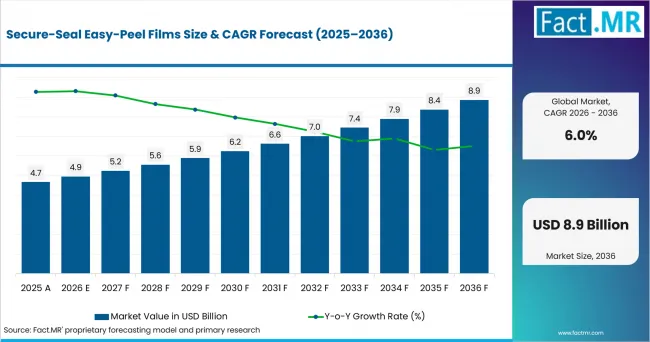
Secure Seal Easy Peel Films Value Analysis | Source: Fact.MR
What are the defining numbers behind Secure-Seal Easy-Peel Films Market growth?
An absolute opportunity of USD 3.9 billion is expected between 2026 and 2036.
- Demand Drivers in the Market
- Dairy packers need lids that seal well and open cleanly. Peel force and seal quality are especially important on fast filling lines. Weak seals can lead to rejected packs.
- Ready-meal producers need films that handle filling-line heat and chilled transport. Portioned food trays also need a reliable seal. Easy opening becomes valuable after the package has already passed filling and transport checks.
- Meat and cheese processors need films that can seal even when moisture reaches the seal area. Related permeable polyamide films show how chilled protein packs combine film strength with controlled gas behavior. Easy-peel layers must preserve that pack integrity while keeping opening force consistent.
- Medical and specialty-food converters need clear tamper evidence and controlled opening. The lid must separate cleanly with limited residue or stringing at the seal interface.
- Key Segments Analyzed
- By Seal Mechanism: Peelable sealant is expected to hold a 29.0% share in 2026. It allows a secure seal while keeping opening force under control.
- By Base Film: PET is projected to account for 36.0% share in 2026 owing to its clarity and stiffness. Adjacent CPP packaging films illustrate the wider role of sealable polyolefin structures in food packaging. PET retains value where print quality and tray presentation remain prominent.
- By Opening Performance: Clean peel is anticipated to capture 31.0% share in 2026 as converters seek predictable separation. Related anti-fogging masterbatches for packaging films serve visible chilled packs where clarity and opening quality both affect presentation. Clean edges can therefore support the same shelf-facing quality objective.
- By Application: Dairy cups are estimated to represent 37.0% share in 2026. High-throughput cup filling places seal consistency and consumer opening force in the same performance check. Dairy formats therefore give suppliers a repeatable route for qualifying peel behavior.
- Analyst Opinion at Fact.MR
- Shambhu Nath Jha, Principal Consultant at Fact.MR, states, “Commercial value depends on seal performance before and during opening. The film must survive line handling and transport, then open at a controlled force. Demand is expected to favor suppliers that tune seal initiation and contamination tolerance to the exact tray or cup substrate.”
- Strategic Implications
- Film producers should publish seal ranges and peel-force data for each substrate. Data should cover the real temperatures used on the filling line.
- Food packaging teams should qualify easy-peel structures on the actual cup or tray. The approach mirrors qualification needs in resealable films where repeated opening depends on film and package compatibility. Trial conditions should reflect the intended storage temperature and product contact environment.
- Converters should prioritize clean-peel behavior where residue or stringing can affect presentation. Dairy and ready-meal formats make opening quality visible to the final user.
- Material developers should simplify film layers where practical. The peel layer must still meet sealing and opening needs. Simpler construction should preserve the barrier level required by the packed food.
China is forecast to record 6.4% CAGR through 2036 as packaged-food retail expands. The USA is projected to post 5.9% CAGR supported by large food expenditure. Japan is anticipated to reach 5.9% CAGR owing to portioned-food demand. Germany is estimated to advance at 5.7% CAGR as recyclability rules reshape film structures. France is forecast to record 5.2% CAGR supported by concentrated food retail.
How does the Secure-Seal Easy-Peel Films Market break down by segment?
PET leads Base Film at 36.0% share in 2026; Dairy cups lead Application at 37.0% share.
Which Seal Mechanism dominates?
Peelable sealant is expected to hold 29.0% share in 2026.
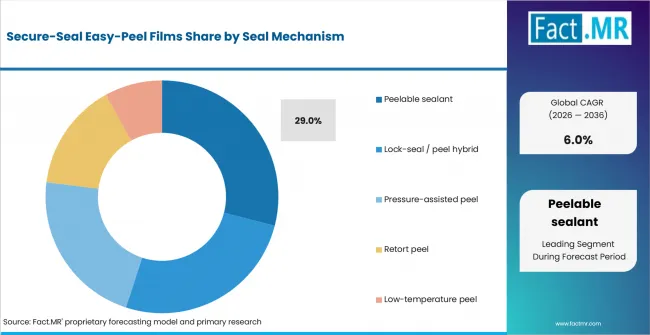
Secure Seal Easy Peel Films Analysis By Seal Mechanism | Source: Fact.MR
Peelable sealant separates package security from opening force. Converters can tune the interface to the tray or cup substrate. Lock-seal hybrids support firmer closures while retort systems serve high-temperature processing. Low-temperature peel grades suit heat-sensitive formats. Winpak lists easy-peel structures for cups and trays across dairy and protein packaging.
What leads the Base Film segment?
PET is projected to account for 36.0% share in 2026.
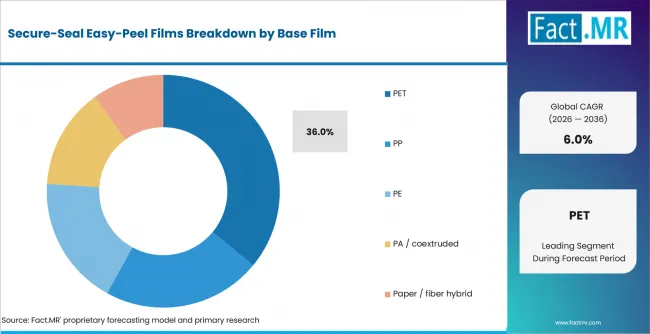
Secure Seal Easy Peel Films Analysis By Base Film | Source: Fact.MR
PET combines clarity with stiffness for printed lidding and tray formats. PP and PE suit polyolefin-based packages. PA and coextruded films serve higher barrier needs. BOPP packaging films provide another adjacent reference for printable food-packaging film structures.
How does Opening Performance shape demand?
Clean peel is anticipated to lead with 31.0% share in 2026.
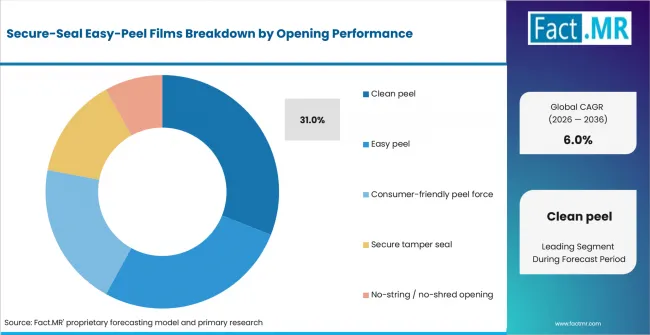
Secure Seal Easy Peel Films Analysis By Opening Performance | Source: Fact.MR
Clean peel limits residue and torn opening edges. Easy-peel force targets support consumer handling. Secure tamper seals emphasize visible first opening. The same chilled-pack environment often uses plastic lidding films with tailored seal behavior.
What supports Dairy cups within Application?
Dairy cups are estimated to represent 37.0% share in 2026.
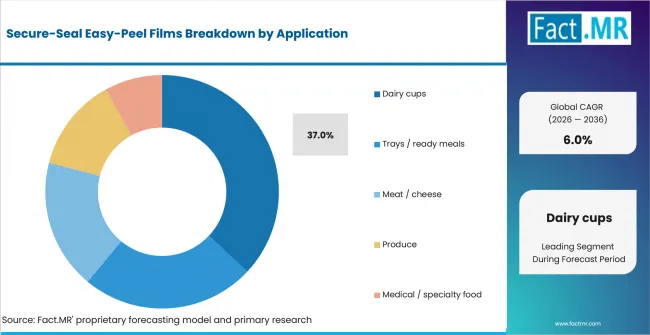
Secure Seal Easy Peel Films Analysis By Application | Source: Fact.MR
Dairy cups combine fast filling with a clear need for easy opening. Ready-meal trays also face heat and substrate needs. Meat and cheese packs often require a stronger barrier.lidding machines form the adjacent processing environment that applies film to trays.
What is accelerating Secure-Seal Easy-Peel Films Market adoption, and what is holding it back?
Controlled opening and recyclable film design support demand. Substrate fit and seal control can slow adoption.
Drivers Impact Analysis
| DRIVER | (~) % IMPACT ON CAGR | GEOGRAPHIC RELEVANCE | IMPACT TIMELINE |
|---|---|---|---|
| Controlled peel force in cup and tray formats | +1.2% | Global | Short term (<= 2 years) |
| Shift toward recyclable flexible packaging | +0.9% | Europe, North America | Medium term (2-4 years) |
| Higher use of prepared and portioned foods | +0.7% | North America, East Asia, Europe | Medium term (2-4 years) |
| Seal-through-contamination needs | +0.5% | Global | Long term (>= 4 years) |
Opportunity Impact Analysis
| OPPORTUNITY | (~) % IMPACT ON CAGR | GEOGRAPHIC RELEVANCE | IMPACT TIMELINE |
|---|---|---|---|
| Mono-material peelable lidding | +0.8% | Europe, North America | Medium term (2-4 years) |
| Low-temperature sealing windows | +0.6% | Global | Short term (<= 2 years) |
| Retort and specialty peel systems | +0.4% | East Asia, Europe, North America | Long term (>= 4 years) |
Restraints Impact Analysis
| RESTRAINT | (~) % IMPACT ON CAGR | GEOGRAPHIC RELEVANCE | IMPACT TIMELINE |
|---|---|---|---|
| Substrate-specific seal behavior | -0.5% | Global | Short term (<= 2 years) |
| Mixed-material recycling complexity | -0.4% | Europe, North America | Medium term (2-4 years) |
| Food-contact compliance and qualification | -0.3% | Global | Long term (>= 4 years) |
Which countries are scaling the Secure-Seal Easy-Peel Films Market through 2036?
- The country comparison spans 1.2 percentage points across the five profiled markets.
- China remains 0.5 percentage point above the USA as packaged-food retail activity expands.
- The USA and Japan both record 5.9% CAGR although their package formats and food-demand conditions differ.
- Germany remains 0.2 percentage point below the USA and Japan as recyclable-packaging requirements reshape film selection.
- France closes the displayed range at 5.2% CAGR supported by concentrated food retail and refrigerated formats.
Comparable CAGRs can create different commercial conditions because seal requirements vary by tray material and filling technology. Full report coverage includes North America and Latin America. It also covers Western Europe and Eastern Europe plus East Asia. South Asia & Pacific and Middle East & Africa complete the regional coverage.
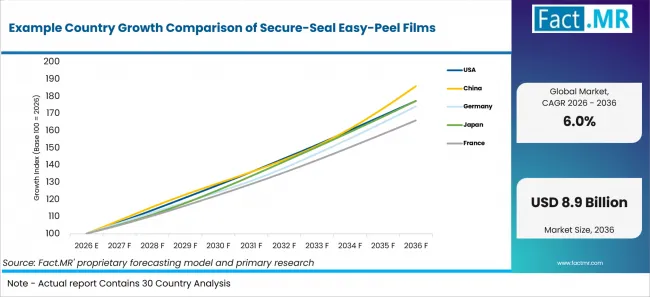
Example Country Growth Comparison Of Secure Seal Easy Peel Films | Source: Fact.MR
| Country | CAGR (2026-2036) |
|---|---|
| United States | 5.9% |
| China | 6.4% |
| Germany | 5.7% |
| Japan | 5.9% |
| France | 5.2% |
What supports USA adoption?
5.9% CAGR, supported by large packaged-food expenditure and established tray and cup use.
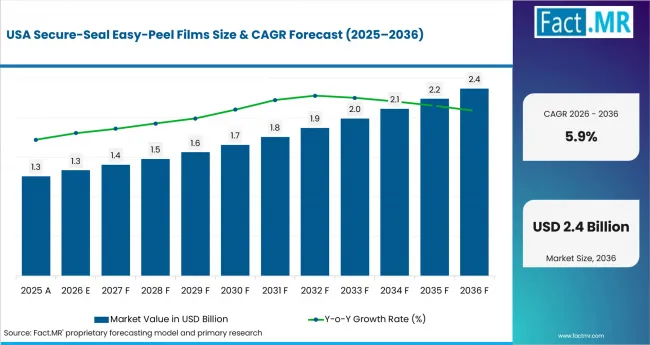
Secure Seal Easy Peel Films Country Value Analysis | Source: Fact.MR
The USDA Economic Research Service reported in June 2026 that inflation-adjusted U.S. food-at-home expenditures reached USD 1.10 trillion in 2025. Dairy cups and prepared-food trays require lidding that maintains seal integrity through distribution while allowing controlled opening. Adjacent fresh food packaging applications likewise depend on compatible tray and lidding performance. Film qualification is expected to focus on seal repeatability at production speed.
How is China scaling demand?
6.4% CAGR, led by packaged-food retail and expanding food distribution.
The National Bureau of Statistics reported in January 2026 that grain, oil and food retail sales by enterprises above designated size rose 9.3% in 2025. The increase indicates higher food retail activity among these enterprises. Easy-peel films balance closure strength with consumer opening force, while local conversion scale supports multiple resin and sealant combinations.
What is supporting Germany’s adoption?
5.7% CAGR, driven by food processing and recyclable-packaging requirements.
Destatis reported in January 2026 that Germany produced 1.7 million tonnes of ready meals worth EUR 5.9 billion in 2024, with production volume 25.6% above 2019. This production base supports recurring tray and lidding demand where dependable sealing and controlled opening matter. Peelable PET and PP structures can also support recyclability redesign.
How does Japan perform?
5.9% CAGR, backed by portioned-food demand and controlled-opening requirements.
Japan’s household food spending includes prepared foods as a distinct expenditure category. The Statistics Bureau of Japan reported that two-or-more-person households spent an average of 13,580 yen per month on prepared foods in 2025. Prepared-food consumption supports continued use of portioned packaging formats where dependable sealing and controlled opening are relevant. Clean-peel behavior remains valuable for maintaining consistent cup and tray presentation.
How is France developing demand?
5.2% CAGR, shaped by concentrated food retail and refrigerated formats.
Insee reported in June 2026 that large general food stores accounted for 58.6% of retail trade in food products excluding tobacco in 2025, measured by value excluding VAT; the data are provisional. This concentration can support standardized cup and tray specifications across large retail networks. Easy-peel films fit where packers require secure sealing followed by clean consumer opening.
Who leads the Secure-Seal Easy-Peel Films Market?
Amcor and Klöckner Pentaplast are active in peelable and lidding-film systems. Amcor completed its combination with Berry Global in April 2025, and its current lidding-film portfolio includes former Berry lidding sealants with peelable-seal options for multiple tray materials. Coveris supplies peelable and resealable lidding for refrigerated food applications. Winpak markets easy-peel films for thermoformed pockets, rigid cups, tubs and trays, while Constantia Flexibles supplies easy-peel lidding solutions for dairy packaging. Across these portfolios, seal performance, peel behavior, substrate compatibility and recyclability are important product-performance considerations.
Coveris introduced the MonoFlexBP resealable monomaterial tray solution in September 2025 and stated that its PET- and PA-free lidding film seals, peels and reseals on PP trays. Klöckner Pentaplast reported in February 2025 that its recycled-PET tray pilot used FlexiLid® containing 30% post-consumer recycled content. Constantia Flexibles highlighted EcoPeelCover in August 2025, stating that the lid reduces aluminum thickness by 25% and coating weight by 50%. These developments combine easy-opening functionality with material-efficiency and recycling-oriented packaging design.
Which companies are the key providers?
Companies profiled include Amcor, including the Berry Global legacy portfolio; Klöckner Pentaplast; Constantia Flexibles; Coveris; and Winpak.
- Amcor (including Berry Global legacy portfolio)
- Klöckner Pentaplast
- Constantia Flexibles
- Coveris
- Winpak
Bibliography
- Amcor plc. (2025, April 30). Amcor completes combination with Berry Global; positioned to significantly enhance value for customers and shareholders.
- Amcor plc. (2025, June 18). Amcor Ghent celebrates packaging innovation powered by a century of expertise.
- Constantia Flexibles. (2025, August 12). FACHPACK 2025: Constantia Flexibles invests over €100 million and expands product portfolio.
- Coveris. (2025, September 10). Coveris combines freshness and sustainability with new monomaterial pack for refrigerated goods.
- European Commission, Directorate-General for Environment. (2025, February 11). New rules enter into force for a more sustainable and competitive packaging economy.
- Statistisches Bundesamt (Destatis). (2026, January 14). Produktion von Fertiggerichten binnen fünf Jahren mengenmäßig um 25,6 % gestiegen [Production of ready meals increased by 25.6% in volume within five years].
- Insee. (2026, June 18). Parts de marché du commerce de détail selon la forme de vente : données annuelles 2025.
- Klöckner Pentaplast. (2025, February 6). kp launches 100% Tray2Tray® market-first pilot in the UK in partnership with Tesco and Hilton Foods.
- National Bureau of Statistics of China. (2026, January 20). Total retail sales of consumer goods in December 2025.
- Zeballos, E., & Sinclair, W. (2026, June 11). Total U.S. food spending reached $2.51 trillion in 2025. U.S. Department of Agriculture, Economic Research Service.
This Report Answers
- The report explains how seal mechanism, base film, opening performance, and application shape demand.
- Segment analysis identifies the leading subsegments and the operating reasons behind selection.
- Country analysis reviews the five markets and the local conditions influencing film selection.
- Competitive analysis reviews current activity in lidding, recyclable structures, food packaging, and medical peel applications.
What does the Secure-Seal Easy-Peel Films Market cover?
The market covers peelable lidding and seal films used on cups and trays plus thermoformed packs. A secure closure must separate at a controlled force. Adjacent produce packaging trays show how tray geometry and film lidding meet in fresh-food formats.
The assessment considers PET and PP plus PE. PA/coextruded and paper/fiber hybrid bases are covered where they carry the peel function. Design-for-recycling requirements are treated as structural influences on film selection.
What is included in the scope?
The scope includes peelable sealant films and lock-seal or peel hybrids. Low-temperature and retort peel systems are included when opening force is controlled. Applications cover dairy cups and ready-meal trays plus meat or cheese. Produce and medical or specialty food complete the application set.
What is excluded from the scope?
Outside the market boundary are rigid trays sold separately from peelable lidstock. General cling film and sealing equipment fall outside the film revenue base. Adhesive systems are covered only when they create the package opening interface. Lidding machines are treated as processing equipment.
Broader flexible packaging enters the scope only when the finished film has a secure-seal easy-peel function. Packaging additives remain outside the revenue base when they are sold separately from the finished peelable film.
How Was the Analysis Built?
The analysis draws on 120+ sources, 35+ company portfolios, 25+ countries, and more than 20 industry interviews.
- Primary Research: Primary research includes discussions with manufacturers, service providers, technology developers, distributors, end users, and subject-matter experts. These conversations examine purchasing priorities, product adoption, operational challenges, approval requirements, competitive positioning, and the factors that influence wider market acceptance.
- Desk Research: Desk research covers government statistics, regulatory publications, company filings, trade data, technical studies, industry associations, standards, public policy, and other authoritative sources. Every source used in the analysis is documented in the bibliography.
- Market Sizing and Forecasting: Market estimates combine historical performance, demand indicators, pricing and volume trends, segment shares, company participation, country-level growth, adoption patterns, investment activity, and barriers to market expansion.
- Data Validation and Update Cycle: Findings are validated by comparing primary interviews with public data, company activity, regulatory changes, trade patterns, and industry developments. Regular updates review new product launches, capacity changes, partnerships, approvals, and shifts in commercial adoption.
What is the report’s scope and coverage?
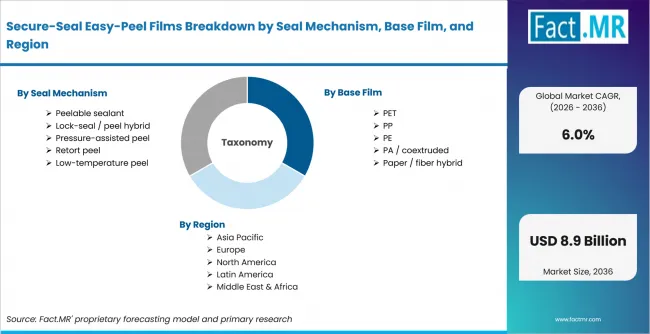
Secure Seal Easy Peel Films Breakdown By Seal Mechanism, Base Film, And Region | Source: Fact.MR
| Attribute | Details |
|---|---|
| Quantitative Units | USD Billion |
| Market Definition | Flexible lidding and seal films designed to retain package integrity before use while providing a controlled peel opening from a compatible cup, tray, pocket, or specialty package. |
| Seal Mechanism | Peelable sealant; Lock-seal / peel hybrid; Pressure-assisted peel; Retort peel; Low-temperature peel |
| Base Film | PET; PP; PE; PA / coextruded; Paper / fiber hybrid |
| Opening Performance | Clean peel; Easy peel; Consumer-friendly peel force; Secure tamper seal; No-string / no-shred opening |
| Application | Dairy cups; Trays / ready meals; Meat / cheese; Produce; Medical / specialty food |
| Regions Covered | North America; Latin America; Western Europe; Eastern Europe; East Asia; South Asia & Pacific; Middle East & Africa |
| Countries Covered | United States; China; Germany; Japan; France |
| Key Companies Profiled | Amcor (including Berry Global legacy portfolio); Klöckner Pentaplast; Constantia Flexibles; Coveris; Winpak |
| Forecast Period | 2026 to 2036 |
| Approach | Hybrid top-down and bottom-up review using packaged-food demand, seal-film applications, base-film mix, country indicators, company portfolios, and first-hand regulatory evidence. |
How is the market segmented?
-
By Seal Mechanism:
- Peelable sealant
- Lock-seal / peel hybrid
- Pressure-assisted peel
- Retort peel
- Low-temperature peel
-
By Base Film:
- PET
- PP
- PE
- PA / coextruded
- Paper / fiber hybrid
-
By Opening Performance:
- Clean peel
- Easy peel
- Consumer-friendly peel force
- Secure tamper seal
- No-string / no-shred opening
-
By Application:
- Dairy cups
- Trays / ready meals
- Meat / cheese
- Produce
- Medical / specialty food
-
By Region:
- North America
- Latin America
- Western Europe
- Eastern Europe
- East Asia
- South Asia & Pacific
- Middle East & Africa