- Market Value (2025): USD 4.0 Bn
- Estimated Value (2026): USD 4.3 Bn
- Forecast Value (2036): USD 4.3 Bn
- CAGR (2026-2036): 7.5%
What is the Antifog Films Sheets Market forecast to be worth by 2036?
USD 4.3 billion in 2026 to USD 8.9 billion by 2036, at a 7.5% CAGR.
BOPP films are frequently selected when clarity and converting fit must be balanced in antifog packaging applications.
- The antifog films sheets market reached USD 4.0 billion in 2025 as film converters and packaging distributors spent against a clear use case: clear product visibility under humidity, refrigeration and temperature-change conditions.
- Demand is projected to increase from USD 4.3 billion in 2026 to USD 8.9 billion by 2036, at a 7.5% CAGR.
- The market is forecast to record 7.5% CAGR from 2026 to 2036 as companies prove clear product visibility under humidity and temperature-change conditions.
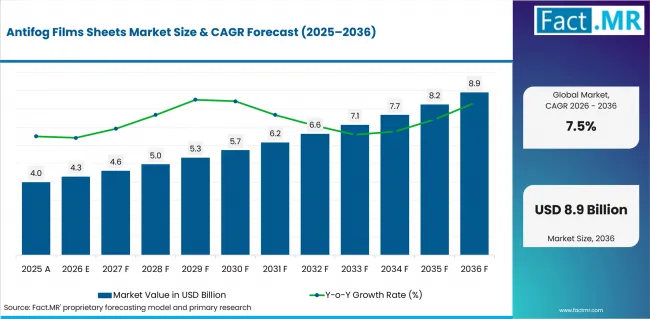
Antifog Films Sheets Market Value Analysis | Source: Fact.MR
What are the defining numbers behind Antifog Films Sheets Market growth?
USD 4.6 billion absolute opportunity is expected by 2036.
Coating choice sits close to Fact.MR's Packaging Coating Market, where durability and food-contact documentation decide supplier qualification.
- Demand Drivers in the Market
- BOPP films lead as they combine clarity, stiffness, printability and flexible-packaging economics. For fresh food and retail packs, the material has to keep the product visible.
- Food packaging is the anchor application because fogging directly affects shelf visibility and buyer confidence. In chilled produce, meat and seafood packs, antifog treatment is judged by how long the pack stays clear after cold-chain temperature changes.
- Aqueous thermosetting coating gains share where buyers want durable hydrophilic performance without moving back to heavier solvent-led systems. The practical test is migration control, coating uniformity and line compatibility.
- Direct sales lead as large packers, converters and OEM customers need grade-specific documentation. Film choice is rarely a simple catalog order.
- Key Segments Analyzed
- By Material Type: BOPP Films is projected to hold 34.7% share in 2026. BOPP films lead as they offer the balance needed in clear flexible food packs: transparency, stiffness, machinability and cost control.
- By Technology: Aqueous Thermosetting Coating is projected to hold 42.3% share in 2026. Aqueous thermosetting coating leads where converters need a more durable antifog layer and a cleaner compliance story than temporary surfactant-only approaches.
- By End Use: Food and Beverage Industry is projected to hold 28.9% share in 2026. The food and beverage industry leads because fresh and chilled formats create the most frequent fogging problem across retail display, transport and consumer handling.
- By Distribution Channel: Direct Sales is projected to hold 29.9% share in 2026. Direct sales lead as grade selection depends on film structure, food-contact documentation, sealing performance and converter-line trials.
- Analyst Opinion at Fact.MR
- Shambhu Nath Jha, Sr. Consultant at Fact.MR, opines, "Antifog films are bought when clarity protects the product's selling moment. The winning companies will prove coating durability, food-contact compliance and converter-line fit instead of relying on broad packaging-growth language."
- Strategic Implications
- Companies should document food-contact status, migration testing, seal-window behavior and shelf-life performance for each grade.
- Converters should position antifog films by application, separating fresh produce, meat and seafood, greenhouse, visor and medical-cover uses.
- Distributors can add value by helping customers match BOPP, PET, PE and coated-film options to the actual temperature and humidity cycle.
The USA is projected to record 9.73% CAGR from 2026 to 2036, followed by Japan at 9.03%, Germany at 8.27%, the UK at 7.49%, Canada at 6.77%, South Korea at 5.98%, and Australia at 5.22%.
How does the Antifog Films Sheets Market break down by segment?
BOPP Films leads Material Type at 34.7%.
Sustainability claims should be read with Fact.MR's Sustainable Packaging Market, since buyers still need clear packs that survive cold-chain use.
Why does BOPP Films lead Material Type?
BOPP Films is projected to account for 34.7% share in 2026.
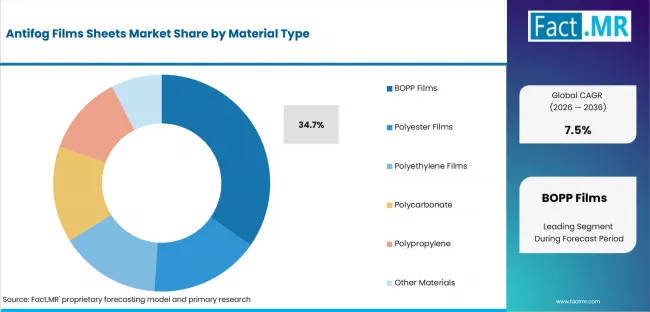
Antifog Films Sheets Market Analysis By Material Type | Source: Fact.MR
BOPP films lead as they offer the balance needed in clear flexible food packs: transparency, stiffness, machinability and cost control.
Why does Aqueous Thermosetting Coating lead Technology?
Aqueous Thermosetting Coating is projected to account for 42.3% share in 2026.
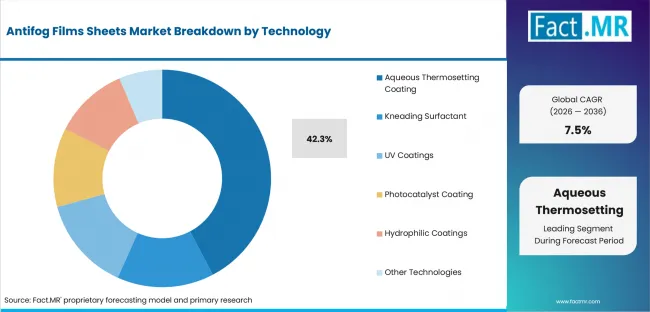
Antifog Films Sheets Market Analysis By Technology | Source: Fact.MR
Aqueous thermosetting coating leads where converters need a more durable antifog layer and a cleaner compliance story than temporary surfactant-only approaches.
Why does Food and Beverage Industry lead End Use?
Food and Beverage Industry is projected to account for 28.9% share in 2026.
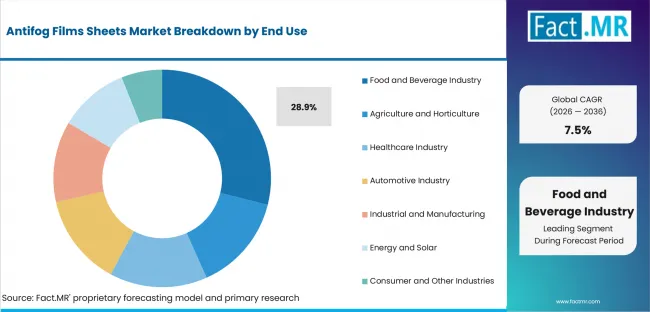
Antifog Films Sheets Market Analysis By End Use | Source: Fact.MR
The food and beverage industry leads because fresh and chilled formats create the most frequent fogging problem across retail display, transport and consumer handling.
Why does Direct Sales lead Distribution Channel?
Direct Sales is projected to account for 29.9% share in 2026.
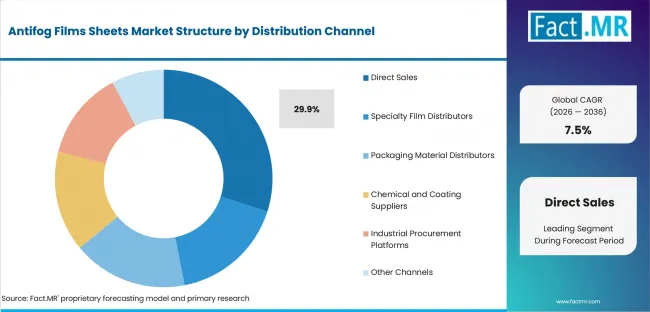
Antifog Films Sheets Market Analysis By Distribution Channel | Source: Fact.MR
Direct sales lead as grade selection depends on film structure, food-contact documentation, sealing performance and converter-line trials.
What is accelerating Antifog Films Sheets Market adoption, and what is holding it back?
Adoption is strongest where buyers can see the product's practical job and the proof needed to approve it. The main drag is buyer doubt around safety, cost, performance or documentation.
Mono-material film redesign connects with Fact.MR's High-Recyclability Mono-Material Flexible Packaging Market, especially where recyclability targets meet shelf-visibility needs.
Drivers Impact Analysis
| DRIVER | QUALITATIVE RELEVANCE | GEOGRAPHIC RELEVANCE | IMPACT TIMELINE |
|---|---|---|---|
| BOPP clarity and converting fit | High | South Korea | Short term (<=2 years) |
| Fresh-food visibility in chilled packs | High | USA | Short term (<=2 years) |
| Aqueous coating durability | Moderate | Australia | Medium term (2-4 years) |
| Food-contact documentation in direct sales | Selective | Germany | Medium term (2-4 years) |
Source: Fact.MR analysis. Updated Jul 29, 2026
- BOPP clarity and converting fit: BOPP films lead as they combine clarity, stiffness, printability and flexible-packaging economics. For fresh food and retail packs, the material has to keep the product visible.
- Fresh-food visibility in chilled packs: Food packaging is the anchor application because fogging directly affects shelf visibility and buyer confidence. In chilled produce, meat and seafood packs, antifog treatment is judged by how long the pack stays clear after cold-chain temperature changes.
- Aqueous coating durability: Aqueous thermosetting coating gains share where buyers want durable hydrophilic performance without moving back to heavier solvent-led systems. The practical test is migration control, coating uniformity and line compatibility.
- Food-contact documentation in direct sales: Direct sales lead as large packers, converters and OEM customers need grade-specific documentation. Film choice is rarely a simple catalog order.
Opportunity Impact Analysis
| OPPORTUNITY | QUALITATIVE RELEVANCE | GEOGRAPHIC RELEVANCE | IMPACT TIMELINE |
|---|---|---|---|
| Fresh produce and chilled protein packs | High | South Korea | Medium term (2-4 years) |
| Greenhouse and horticulture films | Moderate | USA | Medium term (2-4 years) |
| Technical support for converter trials | Selective | Australia | Medium term (2-4 years) |
Source: Fact.MR analysis. Updated Jul 29, 2026
- Fresh produce and chilled protein packs: Fresh-produce and chilled-protein packaging can use antifog films to protect shelf visibility and reduce rejected packs.
- Greenhouse and horticulture films: Greenhouse and horticulture films can expand demand where growers need light transmission and condensation control.
- Technical support for converter trials: Food-contact documentation and migration-test support can help companies win converter trials faster.
Restraints Impact Analysis
| RESTRAINT | QUALITATIVE RELEVANCE | GEOGRAPHIC RELEVANCE | IMPACT TIMELINE |
|---|---|---|---|
| Raw-material and coating-cost movement | High | South Korea | Short term (<=2 years) |
| Food-contact compliance and migration testing | Moderate | USA | Medium term (2-4 years) |
| Low-cost claims with weak cold-chain proof | Selective | Australia | Medium term (2-4 years) |
Source: Fact.MR analysis. Updated Jul 29, 2026
- Raw-material and coating-cost movement: Raw-material and coating-chemistry cost swings can reduce margin for converters that sell into price-sensitive food packaging.
- Food-contact compliance and migration testing: Food-contact compliance and migration testing slow substitution because customers need evidence before changing a packaging film.
- Low-cost claims with weak cold-chain proof: Performance drift after storage, sealing or cold-chain cycling can weaken confidence in low-cost antifog claims.
Which countries are scaling Antifog Films Sheets Market fastest?
Country rates show where buying conditions and supplier proof are already stronger.
Food trays and chilled display packs make Fact.MR's Thermoform Packaging Market relevant to country demand, since fog control affects the visible selling surface.
- South Korea: The market is expected to grow at a CAGR of 5.98% from 2026 to 2036. South Korea's growth is supported by advanced packaging conversion, strong chilled-food retail and export-oriented film quality requirements.
- USA: The market is expected to grow at a CAGR of 9.73% from 2026 to 2036. USA demand is shaped by large fresh-food retail, foodservice packaging and converter qualification cycles. Food-contact documentation is a major gate.
- Australia: The market is expected to grow at a CAGR of 5.22% from 2026 to 2036. Australia benefits from fresh produce and meat export handling, where clear packs need to withstand chilled logistics and retail display.
- Germany: The market is expected to grow at a CAGR of 8.27% from 2026 to 2036. Germany's outlook is shaped by strict packaging compliance, sustainability expectations and high converter discipline around documented material change.
- Canada: The market is expected to grow at a CAGR of 6.77% from 2026 to 2036. Canada follows chilled-food and greenhouse demand, with buyers placing weight on company support during seasonal temperature shifts.
- UK: The market is expected to grow at a CAGR of 7.49% from 2026 to 2036. UK demand is tied to fresh-food retail, convenience packaging and packaging-waste pressure that favors thinner but reliable film structures.
- Japan: The market is expected to grow at a CAGR of 9.03% from 2026 to 2036. Japan's adoption is supported by premium fresh-food presentation and compact retail formats where fogged packs can quickly lose shelf appeal.
The full report provides country-level CAGR analysis across North America, Latin America, Europe, East Asia, South Asia and Oceania, and the Middle East and Africa.
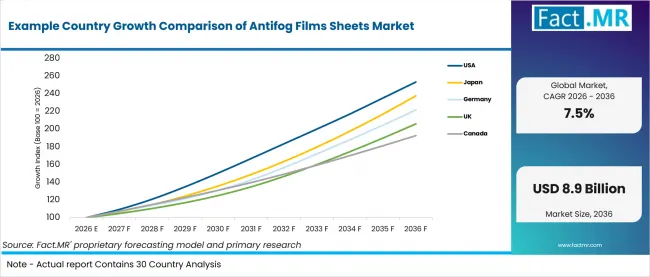
Example Country Growth Comparison Of Antifog Films Sheets Market | Source: Fact.MR
| Country | CAGR (2026-2036) |
|---|---|
| South Korea | 5.98% |
| USA | 9.73% |
| Australia | 5.22% |
| Germany | 8.27% |
| Canada | 6.77% |
| UK | 7.49% |
| Japan | 9.03% |
Source: Fact.MR analysis. Updated Jul 29, 2026
What is shaping South Korea's outlook through 2036?
5.98% CAGR from 2026 to 2036.
South Korea's growth is supported by advanced packaging conversion, strong chilled-food retail and export-oriented film quality requirements.
What is shaping USA's outlook through 2036?
9.73% CAGR from 2026 to 2036.
USA demand is shaped by large fresh-food retail, foodservice packaging and converter qualification cycles. Food-contact documentation is a major gate.
What is shaping Australia's outlook through 2036?
5.22% CAGR from 2026 to 2036.
Australia benefits from fresh produce and meat export handling, where clear packs need to withstand chilled logistics and retail display.
What is shaping Germany's outlook through 2036?
8.27% CAGR from 2026 to 2036.
Germany's outlook is shaped by strict packaging compliance, sustainability expectations and high converter discipline around documented material change.
What is shaping Canada's outlook through 2036?
6.77% CAGR from 2026 to 2036.
Canada follows chilled-food and greenhouse demand, with buyers placing weight on company support during seasonal temperature shifts.
Who leads the Antifog Films Sheets Market?
3M Company; SABIC; DuPont de Nemours, Inc.; Toray Industries, Inc. are among the visible providers in the antifog films sheets market.
3M Company and SABIC are among the most visible providers. Competition is shaped by product proof, channel access and buyer trust.
Between 2026 and 2036, market rivalry is likely to center on clearer positioning around BOPP Films, stronger documentation and better support at the point of purchase.
Which companies are the key providers?
Key companies include 3M Company; SABIC; DuPont de Nemours, Inc.; Toray Industries, Inc.; Berry Global Inc.; Amcor plc; Kafrit Industries Ltd.; FSI Coating Technologies, Inc..
- 3M Company
- SABIC
- DuPont de Nemours, Inc.
- Toray Industries, Inc.
- Berry Global Inc.
- Amcor plc
- Kafrit Industries Ltd.
- FSI Coating Technologies, Inc.
Bibliography
- U.S. FDA, Food Packaging and Other Substances that Come in Contact with Food. https://www.fda.gov/food/food-ingredients-packaging/food-packaging-other-substances-come-contact-food-information-consumers
- European Commission, Food Contact Materials. https://food.ec.europa.eu/food-safety/chemical-safety/food-contact-materials_en
- European Commission, Food Contact Materials Legislation. https://food.ec.europa.eu/food-safety/chemical-safety/food-contact-materials/legislation_en
- Fact.MR, BOPP Films Market. https://www.factmr.com/report/bopp-films-market
- Fact.MR, Packaging Coating Market. https://www.factmr.com/report/262/packaging-coating-market
- Polymers, Development of a Biopolymer-Based Anti-Fog Coating. https://www.mdpi.com/2073-4360/16/12/1745
This Report Answers
- The report provides strategic intelligence on the Antifog Films Sheets Market across segment choices that shape the 2026 market structure.
- Segment analysis covers BOPP Films and Food Packaging as the share leaders within the 2026 market.
- Country outlook evaluates the listed markets by CAGR and explains the adoption conditions in each country.
- Competitive analysis profiles the named providers and evaluates competition around product proof, channel access and buyer trust.
- Internal linking connects the report only with related Fact.MR report pages.
What does the Antifog Films Sheets Market cover?
The Antifog Films Sheets Market covers BOPP, PET, PE, polycarbonate, polypropylene and other antifog films or coated sheets used in food packaging, greenhouse films, safety gear, automotive glazing, medical equipment covers, solar panels and commercial glazing.
The Antifog Films Sheets Market covers BOPP, PET, PE, polycarbonate, polypropylene and other antifog films or coated sheets used in food packaging, greenhouse films, safety gear, automotive glazing, medical equipment covers, solar panels and commercial glazing.
Adjacent spending is included only when it is part of the same purchase decision or operating use case.
What is included in the scope?
The scope includes Material Type, Application, Technology, End Use, Distribution Channel and regional demand.
Coverage includes adjacent segment options only when they are purchased for the same defined market use.
What is excluded from the scope?
generic flexible packaging without antifog function, unrelated barrier films, uncoated plastic sheets, and finished food containers where antifog film is not a material or coating requirement.
The scope excludes generic flexible packaging without antifog function, unrelated barrier films, uncoated plastic sheets, and finished food containers where antifog film is not a material or coating requirement.
How Was the Analysis Built?
The analysis combines primary research with desk research focused on the antifog films sheets market, its segment structure and country-level demand.
- Primary Research: Interviews and validation discussions test buyer priorities, adoption barriers, pricing logic and operating requirements.
- Desk Research: The assessment reviews company disclosures, public datasets, regulatory material, technical literature and industry records relevant to the market.
- Market Sizing and Forecasting: Estimates combine top-down and bottom-up checks across demand signals, segment shares, country activity, company participation and adoption constraints.
- Data Validation and Update Cycle: Findings are validated against public evidence, company activity and country-level adoption patterns before final use.
Segmentation
What is the report's scope and coverage?
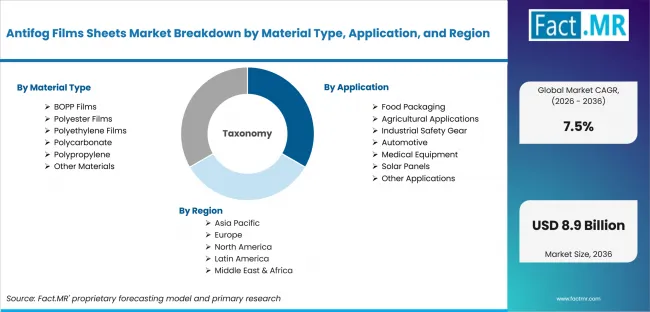
Antifog Films Sheets Market Breakdown By Material Type, Application, And Region | Source: Fact.MR
| Attribute | Details |
|---|---|
| Quantitative Units | USD 4.3 billion in 2026 to USD 8.9 billion by 2036, at a 7.5% CAGR. |
| Market Definition | Antifog Films Sheets Market covers BOPP, PET, PE, polycarbonate, polypropylene and other antifog films or coated sheets used in food packaging, greenhouse films, safety gear, automotive glazing, medical equipment covers, solar panels and commercial glazing. |
| Material Type | BOPP Films; Standard BOPP Antifog Films; Cast and Coextruded BOPP Films; Polyester Films; PET Antifog Films; Biaxially Oriented Polyester Films; Polyethylene Films; LLDPE Antifog Films; LDPE Antifog Films; Polycarbonate; Optical Grade Polycarbonate; Impact-Resistant Polycarbonate; Polypropylene; Cast Polypropylene Films; Oriented Polypropylene Films; Other Materials; Polyvinyl Chloride Films; Bio-Based and Biodegradable Polymers |
| Application | Food Packaging; Fresh Produce Packaging; Meat and Seafood Packaging; Agricultural Applications; Greenhouse Films; Horticultural Films; Industrial Safety Gear; Safety Goggles and Face Shields; Protective Visors; Automotive; Automotive Glazing; Vehicle Lighting and Optical Components; Medical Equipment; Medical Device Covers; Surgical and Diagnostic Equipment; Solar Panels; Photovoltaic Module Protection; Solar Panel Surface Films; Other Applications; Consumer Electronics; Architectural and Commercial Glazing |
| Technology | Aqueous Thermosetting Coating; Water-Based Thermosetting Systems; Crosslinked Hydrophilic Coatings; Kneading Surfactant; Internal Surfactant Additives; Migratory Antifog Additives; UV Coatings; UV-Curable Hydrophilic Coatings; UV-Resistant Antifog Coatings; Photocatalyst Coating; Titanium Dioxide-Based Coatings; Photocatalytic Hydrophilic Coatings; Hydrophilic Coatings; Permanent Hydrophilic Coatings; Semi-Permanent Hydrophilic Coatings; Other Technologies; Plasma and Surface Treatment; Nanotechnology-Based Antifog Coatings |
| End Use | Food and Beverage Industry; Fresh Food Producers; Processed Food Manufacturers; Agriculture and Horticulture; Commercial Greenhouses; Agricultural Film Producers; Healthcare Industry; Hospitals and Medical Facilities; Medical Device Manufacturers; Automotive Industry; Automotive OEMs; Automotive Component Suppliers; Industrial and Manufacturing; Industrial Equipment Manufacturers; Safety Equipment Manufacturers; Energy and Solar; Solar Module Manufacturers; Renewable Energy Equipment Producers; Consumer and Other Industries; Consumer Electronics; Architectural and Commercial Applications |
| Distribution Channel | Direct Sales; Direct Sales to OEMs; Long-Term Supply Agreements; Specialty Film Distributors; Regional Film Distributors; Industrial Film Distributors; Packaging Material Distributors; Food Packaging Suppliers; Flexible Packaging Distributors; Chemical and Coating Suppliers; Antifog Coating Suppliers; Specialty Chemical Distributors; Industrial Procurement Platforms; B2B E-Commerce Platforms; Digital Procurement Portals; Other Channels; Independent Agents; Local Sales Representatives |
| Regions Covered | North America; Latin America; Europe; East Asia; South Asia and Oceania; Middle East and Africa |
| Countries Covered | South Korea; USA; Australia; Germany; Canada; UK; Japan |
| Key Companies Profiled | 3M Company; SABIC; DuPont de Nemours, Inc.; Toray Industries, Inc.; Berry Global Inc.; Amcor plc; Kafrit Industries Ltd.; FSI Coating Technologies, Inc. |
| Forecast Period | 2026 to 2036 |
| Approach | Hybrid top-down and bottom-up assessment using demand indicators, segment mix, country growth, company participation and public evidence relevant to the category. |
Source: Fact.MR analysis. Updated Jul 29, 2026
How is the market segmented?
-
By Material Type:
- BOPP Films
- Standard BOPP Antifog Films
- Cast and Coextruded BOPP Films
- Polyester Films
- PET Antifog Films
- Biaxially Oriented Polyester Films
- Polyethylene Films
- LLDPE Antifog Films
- LDPE Antifog Films
- Polycarbonate
- Optical Grade Polycarbonate
- Impact-Resistant Polycarbonate
- Polypropylene
- Cast Polypropylene Films
- Oriented Polypropylene Films
- Other Materials
- Polyvinyl Chloride Films
- Bio-Based and Biodegradable Polymers
-
By Application:
- Food Packaging
- Fresh Produce Packaging
- Meat and Seafood Packaging
- Agricultural Applications
- Greenhouse Films
- Horticultural Films
- Industrial Safety Gear
- Safety Goggles and Face Shields
- Protective Visors
- Automotive
- Automotive Glazing
- Vehicle Lighting and Optical Components
- Medical Equipment
- Medical Device Covers
- Surgical and Diagnostic Equipment
- Solar Panels
- Photovoltaic Module Protection
- Solar Panel Surface Films
- Other Applications
- Consumer Electronics
- Architectural and Commercial Glazing
-
By Technology:
- Aqueous Thermosetting Coating
- Water-Based Thermosetting Systems
- Crosslinked Hydrophilic Coatings
- Kneading Surfactant
- Internal Surfactant Additives
- Migratory Antifog Additives
- UV Coatings
- UV-Curable Hydrophilic Coatings
- UV-Resistant Antifog Coatings
- Photocatalyst Coating
- Titanium Dioxide-Based Coatings
- Photocatalytic Hydrophilic Coatings
- Hydrophilic Coatings
- Permanent Hydrophilic Coatings
- Semi-Permanent Hydrophilic Coatings
- Other Technologies
- Plasma and Surface Treatment
- Nanotechnology-Based Antifog Coatings
-
By End Use:
- Food and Beverage Industry
- Fresh Food Producers
- Processed Food Manufacturers
- Agriculture and Horticulture
- Commercial Greenhouses
- Agricultural Film Producers
- Healthcare Industry
- Hospitals and Medical Facilities
- Medical Device Manufacturers
- Automotive Industry
- Automotive OEMs
- Automotive Component Suppliers
- Industrial and Manufacturing
- Industrial Equipment Manufacturers
- Safety Equipment Manufacturers
- Energy and Solar
- Solar Module Manufacturers
- Renewable Energy Equipment Producers
- Consumer and Other Industries
- Consumer Electronics
- Architectural and Commercial Applications
-
By Distribution Channel:
- Direct Sales
- Direct Sales to OEMs
- Long-Term Supply Agreements
- Specialty Film Distributors
- Regional Film Distributors
- Industrial Film Distributors
- Packaging Material Distributors
- Food Packaging Suppliers
- Flexible Packaging Distributors
- Chemical and Coating Suppliers
- Antifog Coating Suppliers
- Specialty Chemical Distributors
- Industrial Procurement Platforms
- B2B E-Commerce Platforms
- Digital Procurement Portals
- Other Channels
- Independent Agents
- Local Sales Representatives
-
By Region:
- North America
- Latin America
- Europe
- East Asia
- South Asia and Oceania
- Middle East and Africa
Frequently Asked Questions
Which Material Type leads the market?
Which Application leads the market?
Which Technology leads the market?
Which End Use leads the market?
Which Distribution Channel leads the market?
Which country records the highest listed CAGR?
What is the primary driver in this market?
What is the main restraint?
Who worked on this report


Preview the report firsthand - request a free sample
Free SampleGet the brochure for pricing and purchase details
Download PDF