- Market Value (2025): USD 2.82 Mn
- Estimated Value (2026): USD 3.0 Mn
- Forecast Value (2036): USD 5.57 Mn
- CAGR (2026-2036): 6.4%
What is the Self-Defense Products Market forecast to be worth by 2036?
USD 3.0 billion in 2026 to USD 5.6 billion by 2036, at a 6.4% CAGR.
- As per Fact.MR analysis, the self-defense products market reached USD 2.82 billion in 2025.
- Demand will increase from USD 3.0 billion in 2026 to USD 5.57 billion by 2036.
- The market is forecast to record a 6.4% CAGR from 2026 to 2036.
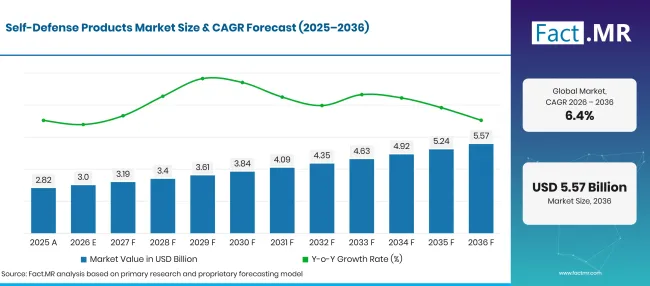
Factmr Self Defense Products Market Forecast Global | Source: Fact.MR
| Year | Basis | Market Value (USD billion) |
|---|---|---|
| 2025 | Actual | 2.82 |
| 2026 | Estimate | 3.0 |
| 2036 | Forecast | 5.57 |
| CAGR 2026 to 2036 | Forecast period | 6.4% |
Source: Fact.MR analysis. Updated Oct 19, 2026
What are the defining numbers behind Self-Defense Products Market growth?
According to Fact.MR analysis, USD 2.6 billion absolute opportunity between 2026 and 2036.
- Demand Drivers in the Market
- People choosing personal protection products need clear guidance on legal ownership and safe use.
- Online sellers must check the rules of each country before listing personal protection products, since an item allowed in one market may be restricted elsewhere.
- Specialist retailers look at ease of use and safe storage when choosing which personal protection products to sell.
- Key Segments Analyzed
- By Type: Pepper Sprays account for 34.2% share in 2026, where authorized compact products serve personal protection needs.
- By Application: Retail Outlets represent 39.2% share in 2026, reflecting shoppers who seek product comparisons before purchase.
- Analyst Opinion at Fact.MR
- Shambhu Nath Jha, Principal Consultant at Fact.MR, states, “Retail stores can help by explaining in simple language what each product can be used for and how they differ. One possible research question is whether customers care more about clear instructions and carrying comfort than extra features. However, no customer survey has measured this yet.”
- Strategic Implications
- Companies selling qualifying sprays should maintain separate instructions for each country and explain the product category clearly.
- Folding-knife manufacturers should separate ordinary utility applications from statements about defensive use. Blade rules and carrying restrictions affect how such products are presented across retail channels.
- Sporting goods stores should train staff to explain the difference between ordinary protective accessories and restricted personal weapons. accurate advice during a store visit is likely to support trust and help customers select products suited to local rules.
- Distributors should review marketplace listings before expanding cross-border sales. Different national rules create a practical need for age checks and appropriate product descriptions.
Brazil is forecast to record a 7.4% CAGR, followed by Germany at 6.9% and Japan at 6.1%. The United Kingdom carries a 5.2% outlook, while the United States records 4.6%. The differences call for separate country strategies, particularly where civilian possession rules limit the product range. the product range depends on local legal requirements.
How does the Self-Defense Products Market break down by segment?
Pepper Sprays 34.2%; Retail Outlets 39.2% in 2026.
Which Type dominates?
Pepper Sprays hold 34.2% share in 2026.
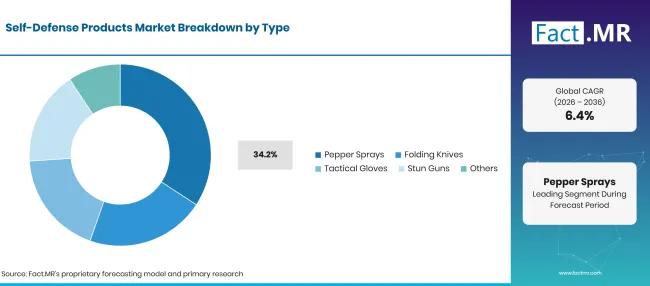
Factmr Self Defense Products Market Breakdown Type | Source: Fact.MR
| Type | Share (2026) |
|---|---|
| Pepper Sprays (Leading segment) | 34.2% |
| Other segments combined | 65.8% |
| Total | 100.0% |
Source: Fact.MR analysis. Updated Oct 19, 2026
Pepper sprays lead the type segment. Their compact size makes them a portable option in markets that permit civilian ownership. Products vary in carrying format and instructions, making clear descriptions important at the point of sale. Brazil’s July 2026 law illustrates why retailers must check the exact legal classification before offering these products.
What leads the Application segment?
Retail Outlets account for 39.2% share in 2026.
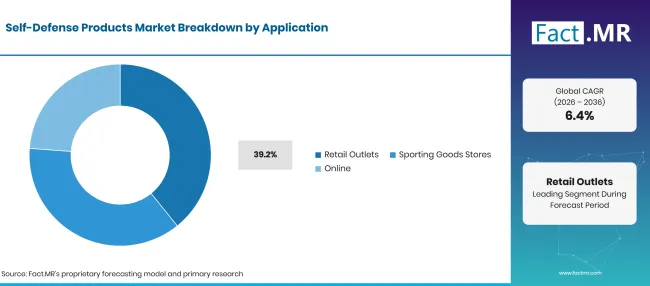
Factmr Self Defense Products Market Breakdown Application | Source: Fact.MR
| Application | Share (2026) |
|---|---|
| Retail Outlets (Leading segment) | 39.2% |
| Other segments combined | 60.8% |
| Total | 100.0% |
Source: Fact.MR analysis. Updated Oct 19, 2026
Retail outlets hold 39.2% share in 2026. Customers can compare the size and weight of permitted products in a shop, while staff can explain storage needs and distinguish utility tools from items sold for personal protection. Online channels offer another buying option, but sellers must apply location checks to restricted categories. Clear advice gives physical stores a useful role in the market.
What is accelerating Self-Defense Products Market adoption, and what is holding it back?
Personal safety purchasing and lawful product access support sales; possession restrictions limit several product categories. the product range depends on local legal requirements.
Drivers Impact Analysis
| DRIVER | (~) % IMPACT ON CAGR | GEOGRAPHIC RELEVANCE | IMPACT TIMELINE |
|---|---|---|---|
| Lawful spray access | +1.0% | Brazil | Medium term (2–4 years) |
| Portable product formats | +0.8% | United States, Germany | Medium term (2–4 years) |
| In-store product guidance | +0.7% | Global | Short term (<= 2 years) |
| Consumer safety planning | +0.5% | Global | Medium term (2–4 years) |
| Clear labeling | +0.4% | Global | Long term (>= 4 years) |
Source: Fact.MR analysis. Updated Oct 19, 2026
Opportunity Impact Analysis
| OPPORTUNITY | (~) % IMPACT ON CAGR | GEOGRAPHIC RELEVANCE | IMPACT TIMELINE |
|---|---|---|---|
| Authorized plant-extract sprays | +0.8% | Brazil | Medium term (2–4 years) |
| Store-led education | +0.6% | Global | Short term (<= 2 years) |
| Product verification | +0.5% | Global | Medium term (2–4 years) |
| Channel-specific assortments | +0.4% | Europe, Americas | Long term (>= 4 years) |
Source: Fact.MR analysis. Updated Oct 19, 2026
Restraints Impact Analysis
| RESTRAINT | (~) % IMPACT ON CAGR | GEOGRAPHIC RELEVANCE | IMPACT TIMELINE |
|---|---|---|---|
| Restrictions on sprays and electric devices | -0.8% | United Kingdom | Short term (<= 2 years) |
| Product classification differences | -0.6% | Global | Medium term (2–4 years) |
| Safety and misuse concerns | -0.5% | Global | Medium term (2–4 years) |
| Cross-border listing limits | -0.4% | Global | Long term (>= 4 years) |
Source: Fact.MR analysis. Updated Oct 19, 2026
Which countries are scaling the Self-Defense Products Market through 2036?
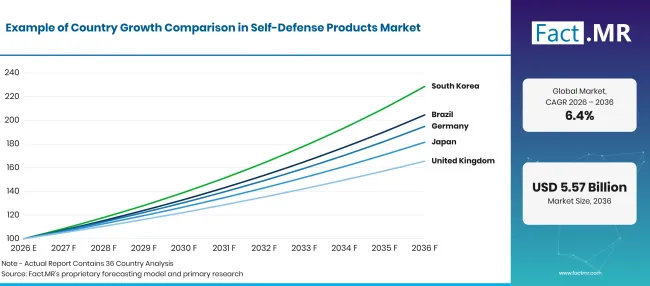
Factmr Self Defense Products Market Growth Index | Source: Fact.MR
| Country | CAGR (2026–2036) |
|---|---|
| Brazil | 7.4% |
| Germany | 6.9% |
| Japan | 6.1% |
| United Kingdom | 5.2% |
| United States | 4.6% |
Source: Fact.MR analysis. Updated Oct 19, 2026
How is Brazil expanding authorized personal protection sales?
7.4% CAGR, shaped by a new national legal route for qualifying sprays.
Brazil’s legal framework changed in July 2026 when Law No. 15,474 authorized qualifying plant-extract aerosols for women aged 18 and above [1]. Retailers serving this category must follow the applicable authorization, purchaser-identification and sales-record requirements while providing suitable consumer instructions.
Why does Germany retain a distinct product-selection pattern?
6.9% CAGR, influenced by safety perceptions and careful product classification.
German customers are expected to compare outdoor utility equipment and personal protection products by their permitted uses. The federal government reported in April 2026 that around 45% of people in its safety survey felt unsafe when using public transport at night [2].
Shops selling compact accessories can respond by giving plain-language details about carrying rules and safe storage. The same official release described a 2.3% decrease in violent crime during 2025, which is a separate measure of police-recorded incidents [2].
How is Japan approaching personal protection products?
6.1% CAGR, shaped by product classification and everyday carrying decisions.
Japan’s personal protection product market is shaped by the distinction between ordinary utility tools and items sold as weapons. The National Police Agency published its review of 2025 criminal incidents in February 2026 [6].
Retailers can use national guidance to explain the permitted purpose of each product and the circumstances surrounding its use. Folding knives sold as practical tools require clear descriptions, while protective gloves are judged by comfort and everyday use.
What shapes the United Kingdom outlook?
5.2% CAGR, with civilian weapon prohibitions limiting the sales mix.
The United Kingdom has strict rules covering civilian possession of pepper sprays and electrical stun devices, which changes the products available in ordinary retail channels [3]. In July 2026, the Office for National Statistics estimated 989,000 incidents of violence with or without injury among people aged 16 and over in England and Wales for the year ending March 2026 [7].
Shops therefore need to separate general safety concerns from the list of products legally available to consumers. Axon announced in October 2025 that TASER 10 had received approval for UK police use, a distinct professional application [5].
How are U.S. buyers comparing self-defense options?
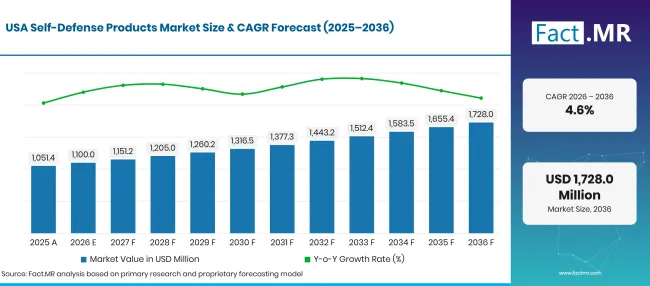
4.6% CAGR, shaped by broad retail access and jurisdiction-specific rules.
Factmr Self Defense Products Market Forecast Usa | Source: Fact.MR
Shoppers in the United States can find qualifying personal protection products through specialist shops and wider retail channels, subject to state and local rules. The FBI reported a violent-crime rate of 327.6 offenses per 100,000 residents for 2025 [4].
Retailers are likely to focus on clear labeling and useful product advice when buyers compare carrying comfort and intended use. The market also includes ordinary protective accessories with different legal treatment from restricted weapons.
Who leads the Self-Defense Products Market?
SABRE Security Equipment Corporation and Mace Security International are associated with consumer pepper spray products. Victorinox and Buck Knives operate in the knife category, where ordinary cutting-tool applications need to be distinguished from self-defense marketing.
GERBER GEAR offers tools and knives with a clear outdoor utility focus. These businesses should be compared within the product lines they actually sell rather than treated as identical personal protection specialists. the product range depends on local legal requirements.
Axon Enterprise develops TASER devices mainly for authorized professional users and public-safety institutions, placing that business in a different purchasing channel from civilian spray retail. Salt Supply Co. has marketed projectile-based personal protection equipment, which calls for jurisdiction-specific checks. Competitive positioning therefore depends on the exact product and intended customer, not a single blanket company ranking.
Which companies are the key providers?
Key companies include Victorinox; GERBER GEAR; SABRE Security Equipment Corporation; Mace Security International Inc.; Axon Enterprise Inc.; Salt Supply Co.; Buck Knives Inc.
- Victorinox
- GERBER GEAR
- SABRE Security Equipment Corporation
- Mace Security International Inc.
- Axon Enterprise Inc.
- Salt Supply Co.
- Buck Knives Inc.
Bibliography
- [1] Presidência da República. (2026, July 23). Lei nº 15.474, de 23 de julho de 2026.
- [2] Bundesregierung. (2026, April 20). Polizeiliche Kriminalstatistik 2025.
- [3] UK Parliament. (2025, November 28). Self-defence weapons: Written question 92304.
- [4] Federal Bureau of Investigation. (2026, August 24). Violent crime falls at historic rate, new FBI data show.
- [5] Axon Enterprise, Inc. (2025, October 2). Axon’s TASER 10 approved to protect officers and the public in the UK.
- [6] National Police Agency of Japan. (2026, February 12). 令和7年の犯罪情勢について [Crime situation in 2025].
- [7] Office for National Statistics. (2026, July 23). Crime in England and Wales: Year ending March 2026.
This Report Answers
- The report examines why pepper sprays lead the stated type breakdown while legal access differs across countries.
- The application comparison explains the commercial role of retail outlets and the limitations of online cross-border listings.
- Country profiles distinguish legal product access from the wider problem of public safety and reported crime.
- Competition is reviewed by actual product category rather than assuming all listed companies sell identical consumer equipment.
- Regulatory analysis separates lawful consumer sprays from restricted electrical devices and professional police equipment.
What does the Self-Defense Products Market cover?
Authorized pepper sprays and other qualifying personal protection items sold through relevant retail channels.
The market includes qualifying pepper sprays and selected protective items sold for personal safety. Folding knives and tactical gloves enter the analysis where their intended use fits the relevant market boundary. Related research into folding knife products also covers ordinary outdoor uses, which are assessed separately from personal protection purchases. Product availability remains subject to the rules in each country.
What is included in the scope?
Qualifying products and sales channels serving lawful personal protection purchases.
Market analysis covers pepper spray designs and the wider range of personal safety devices. Shops entering a new country should review the permitted product types before finalizing their assortments. According to Fact.MR analysis, local rules are likely to shape which product categories reach consumers through retail outlets.
What is excluded from the scope?
Unrelated outdoor tools and prohibited civilian products outside a lawful market boundary.
Routine utility knife purchases should not be counted as self-defense sales without a credible connection to that use. Police-only electronic weapons are assessed separately from civilian consumer products where the legal regime requires the distinction. Illegal sales and unlicensed product transfers are outside the market boundary.
How Was the Analysis Built?
The analysis draws on 120+ sources, 35+ company portfolios, 25+ countries, and more than 20 industry interviews.
- Primary Research: Primary research includes discussions with manufacturers, service providers, technology developers, distributors, end users, and subject-matter experts. These conversations examine purchasing priorities, product adoption, operational challenges, approval requirements, competitive positioning, and the factors that influence wider market acceptance.
- Desk Research: Desk research covers government statistics, regulatory publications, company filings, trade data, technical studies, industry associations, standards, public policy, and other authoritative sources. Every source used in the analysis is documented in the bibliography.
- Market Sizing and Forecasting: Market estimates combine historical performance, demand indicators, pricing and volume trends, segment shares, company participation, country-level growth, adoption patterns, investment activity, and barriers to market expansion.
- Data Validation and Update Cycle: Findings are validated by comparing primary interviews with public data, company activity, regulatory changes, trade patterns, and industry developments. Regular updates review new product launches, capacity changes, partnerships, approvals, and shifts in commercial adoption.
Segmentation
What is the report’s scope and coverage?
Factmr Self Defense Products Market Taxonomy | Source: Fact.MR
| Attribute | Details |
|---|---|
| Quantitative Units | USD billion in 2026 to USD billion by 2036 at CAGR |
| Market Definition | Products positioned for lawful personal protection, including qualifying sprays and selected protective items sold through relevant consumer and specialist channels |
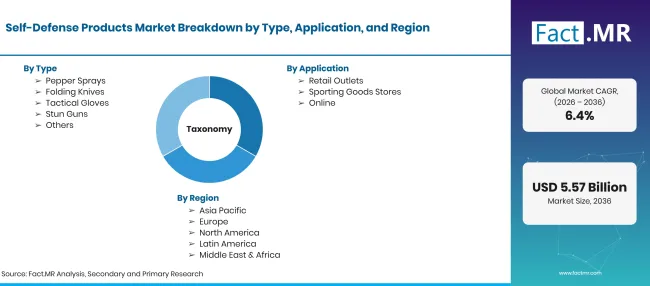
| Type | Pepper Sprays; Folding Knives; Tactical Gloves; Stun Guns; Others |
| Application | Retail Outlets; Sporting Goods Stores; Online |
| Regions Covered | North America; Latin America; Western Europe; Eastern Europe; East Asia; South Asia & Pacific; Middle East & Africa |
| Countries Covered | Brazil; Germany; Japan; United Kingdom; United States |
| Companies Profiled | Victorinox; GERBER GEAR; SABRE Security Equipment Corporation; Mace Security International Inc.; Axon Enterprise Inc.; Salt Supply Co.; Buck Knives Inc. |
| Forecast Period | 2026 to 2036 |
| Approach | Assessment of lawful product categories, retail channels, country-specific regulations, public-safety context, and supplier positioning by actual product type |
Source: Fact.MR analysis. Updated Oct 19, 2026
How is the market segmented?
-
By Type
- Pepper Sprays
- Folding Knives
- Tactical Gloves
- Stun Guns
- Others
-
By Application
- Retail Outlets
- Sporting Goods Stores
- Online
-
By Region
- North America
- Latin America
- Western Europe
- Eastern Europe
- East Asia
- South Asia & Pacific
- Middle East & Africa
Frequently Asked Questions
How big is the self-defense products market in 2026?
What CAGR is projected through 2036?
Which product type holds the largest stated share?
Which application is leading?
Who are the main companies in the self-defense products market?
Who worked on this report


Preview the report firsthand - request a free sample
Free SampleGet the brochure for pricing and purchase details
Download PDF