- Base Value(2025): 50.0 Bn
- Estimated Value(2026): 55.7 Bn
- Forecast Value (2036): 165.5 Bn
- CAGR (2026 - 2036): 11.5%
Smart Personal Safety and Security Device Market Forecast By Fact.MR
In 2025, the smart personal safety and security device market was valued at USD 50.0 billion. Based on Fact MR analysis, demand for smart personal safety and security devices is estimated to grow to USD 55.7 billion in 2026 and USD 165.5 billion by 2036. FMR projects a CAGR of 11.5% during the forecast period.
The absolute dollar growth from 2026 to 2036 is USD 109.8 billion. This expansion reflects increasing adoption of wearable safety devices, GPS-enabled tracking systems, and connected emergency alert technologies. Rising public safety concerns, growth in elderly monitoring solutions, and smartphone integration continue to support demand. Growth remains steady rather than purely disruptive because device affordability, battery limitations, and data privacy regulations influence adoption rates.
China leads with a CAGR of 12.9%, driven by rapid adoption of connected devices and expanding smart device manufacturing. India follows with 12.2%, supported by rising smartphone penetration and growing awareness of personal safety technologies. France records 11.4%, reflecting demand for connected wearable safety devices and smart emergency alert systems. The USA grows at 10.2% and Italy at 9.7%. These mature markets generate steady replacement demand, constrained by regulatory oversight on personal data protection and device certification standards.
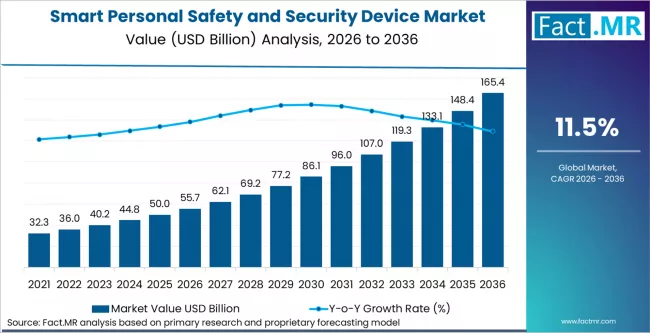
Smart Personal Safety And Security Device Market Market Value Analysis | Source: Fact.MR
Smart Personal Safety and Security Device Market
| Metric | Value |
|---|---|
| Estimated Value in (2026E) | USD 55.7 billion |
| Forecast Value in (2036F) | USD 165.5 billion |
| Forecast CAGR (2026 to 2036) | 11.5% |
Source: Fact.MR analysis. Updated Mar 13, 2026
Smart Personal Safety and Security Device Market Definition
The Smart Personal Safety and Security Device Market involves the development and sale of connected devices designed to protect individuals by enabling real time monitoring, emergency alerts, and rapid communication during unsafe situations. These devices commonly include wearables, panic buttons, GPS trackers, personal alarms, and sensor-enabled safety gadgets that integrate with smartphones or cloud platforms. Their primary function is to help users request assistance, share location data, and notify emergency contacts or authorities when a threat or emergency occurs. Such devices are widely used by consumers, lone workers, elderly individuals, and organizations to enhance personal protection and situational awareness.
Market Inclusions
This report covers global and regional market sizes for smart personal safety and security devices over a defined forecast period. It includes segmentation by device type such as wearable safety devices, panic buttons, personal alarms, GPS tracking devices, and fall detection devices. End users covered include consumers, defense personnel, healthcare workers, and industrial employees.
Market Exclusions
The scope excludes general consumer electronics that do not provide dedicated personal safety functionality. It also omits traditional security equipment such as CCTV surveillance systems, home alarm systems, and building security infrastructure not designed for individual safety monitoring.
Research Methodology
- Primary Research: Interviews were conducted with device manufacturers, safety technology developers, security service providers, and industry analysts.
- Desk Research: Data was sourced from technology market reports, safety device publications, and regulatory and industry association statistics.
- Market-Sizing and Forecasting: A hybrid model combining top-down consumer safety technology demand forecasts with bottom-up shipment and revenue estimates was used.
- Data Validation and Update Cycle: Findings were validated through expert consultations and cross-checked with recent product deployment, adoption, and industry performance data.
Summary of the Smart Personal Safety and Security Device Market
- Market Definition
- The Smart Personal Safety and Security Device Market involves the development and sale of connected devices designed to enhance individual protection through real time monitoring, location tracking, and emergency alert capabilities. These devices include wearable safety gadgets, panic buttons, GPS trackers, personal alarms, and sensor enabled safety tools that integrate with smartphones or cloud platforms. Their primary function is to allow users to share location data, send alerts, and communicate with emergency contacts or authorities during unsafe situations. Such devices are widely used by individual consumers, lone workers, elderly individuals, and organizations to strengthen personal safety and situational awareness.
- Demand Drivers
- Rising global concern regarding personal safety and individual security in public and private environments.
- Increasing adoption of wearable technology and connected devices integrated with smartphones.
- Expansion of GPS tracking, IoT connectivity, and real time emergency alert capabilities in safety devices.
- Growing demand for elderly monitoring solutions and remote health and safety monitoring tools.
- Increasing deployment of personal safety devices in workplaces, industrial environments, and public safety programs.
- Key Segments Analyzed
- Type: Smart Personal Security devices dominate with 65% share in 2026, followed by Smart Personal Safety devices.
- End User: Consumers lead with 40% share in 2026, followed by Defence, Factories, BFSI, Healthcare, Telecommunications, and Other industries.
- Device Categories: Wearable safety devices, panic buttons, personal alarms, GPS trackers, and fall detection systems.
- Geography: East Asia and South Asia drive strong growth. China leads with a CAGR of 12.9%, followed by India (12.2%), France (11.4%), USA (10.2%), and Italy (9.7%).
- Analyst Opinion at Fact MR
- Shambhu Nath Jha, Principal Consultant, Fact MR, opines, "In this updated edition of the Smart Personal Safety and Security Device Market report, industry participants will observe that value creation is shifting from standalone safety gadgets toward integrated connected safety ecosystems. Personal security devices are no longer limited to basic alarms but increasingly incorporate GPS tracking, wearable sensors, and real time mobile connectivity. Manufacturers that invest in reliable device performance, seamless smartphone integration, and advanced wearable technologies will capture stronger market adoption. The convergence of wearable electronics, IoT connectivity, and mobile safety applications defines the competitive landscape through 2036."
- Strategic Implications/Executive Takeaways
- Invest in wearable safety technologies that integrate GPS tracking, health monitoring, and emergency alert systems.
- Strengthen integration with mobile applications and cloud platforms for real time monitoring and communication.
- Expand consumer focused safety products targeting elderly monitoring, personal travel safety, and lone worker protection.
- Ensure compliance with data privacy and cybersecurity regulations governing connected safety devices.
- Develop partnerships with telecom providers, mobile platform operators, and enterprise safety service providers.
- Methodology
- Primary Research: Interviews with device manufacturers, safety technology developers, and security service providers.
- Desk Research: Data compiled from technology market reports, industry publications, and regulatory association statistics.
- Market Sizing and Forecasting: Hybrid model combining top down safety technology demand projections with bottom up shipment and revenue analysis.
- Data Validation: Findings validated through expert consultations and cross checked with recent product deployment, adoption trends, and industry performance metrics using Fact MR forecasting models.
Segmental Analysis
Smart Personal Safety and Security Device Market Analysis by Type
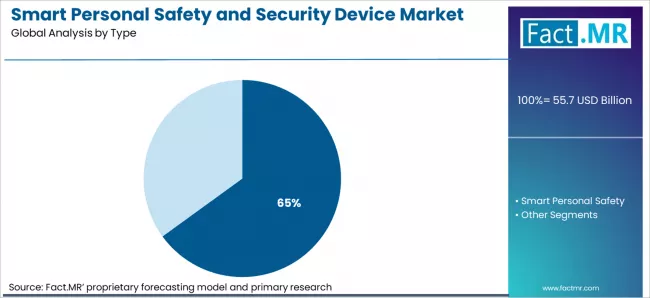
Smart Personal Safety And Security Device Market Analysis By Type | Source: Fact.MR
Market Overview: Smart personal security devices are expected to capture 65% of the market share by 2026. These devices are designed to provide immediate alerts, location tracking, and emergency communication features that enhance personal protection. They are commonly integrated with smartphones or wearable systems to notify contacts or authorities during emergencies.
Demand Drivers:
- Rising Personal Security Concerns: Increasing awareness of personal safety encourages adoption of smart security devices equipped with GPS tracking and emergency alert functions.
- Integration with Mobile Ecosystems: Many smart security devices connect with mobile applications, enabling real-time monitoring and communication during emergencies.
- Advancements in Wearable Technology: Improvements in compact electronics and wearable devices support the development of portable and user-friendly security solutions.
Smart Personal Safety and Security Device Market Analysis by End User
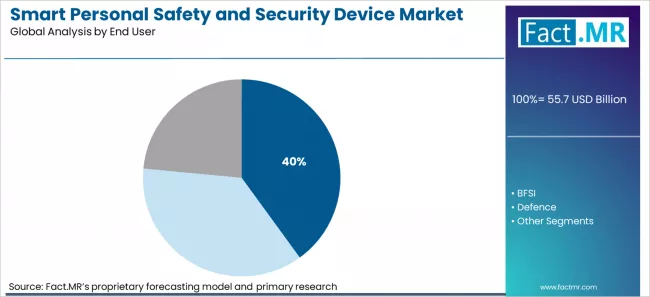
Smart Personal Safety And Security Device Market Analysis By End User | Source: Fact.MR
Market Overview: Consumers are projected to hold 40% of the market share by 2026. Individual users adopt smart personal safety devices to enhance daily security, particularly during travel, outdoor activities, or commuting. These devices provide features such as location sharing, panic alerts, and emergency notifications.
Demand Drivers:
- Growing Consumer Awareness: Increasing awareness of personal security risks encourages individuals to adopt smart safety devices for daily use.
- Ease of Access and Affordability: Many consumer-oriented safety devices are affordable and easy to operate, supporting broader adoption.
- Expansion of Smart Wearables: The popularity of connected wearables and mobile applications supports the integration of safety features, increasing demand among individual consumers.
Smart Personal Safety and Security Device Market Drivers, Restraints, and Opportunities
FMR analysts observe that the smart personal safety and security device market is a growth-aligned technology segment driven by rising personal safety concerns, increasing wearable device adoption, and integration of connectivity technologies. Historically, personal alarms and basic security tools dominated; as IoT connectivity, GPS tracking, and smartphone integration expanded, structural demand emerged for smart devices that deliver real-time monitoring, emergency alerts, and location tracking. The 2026 valuation reflects this shift, with adoption tied to connected wearables, mobile applications, and broader digital safety ecosystems.
While basic safety devices remain present in cost-sensitive applications, multifunctional smart devices combining GPS tracking, health monitoring, and emergency communication are gaining share. These advanced devices command higher prices, contributing to market value growth even as adoption expands across consumer and professional use cases. The market exists because increasing awareness of personal safety risks and advances in connected technology make smart safety solutions more accessible.
- Personal Safety Awareness: Rising concern about individual security drives demand for wearable alert systems and mobile-connected safety devices.
- Technology Integration: GPS tracking, IoT connectivity, and smartphone integration enhance device capabilities and enable real-time emergency response.
- Wearable Device Adoption: Expansion of smartwatches and connected wearables with built-in safety features accelerates market penetration across consumer groups.
Regional Analysis
The market analysis covers key global regions, including East Asia, South Asia, North America, and Western Europe. It is segmented geographically, with specific market dynamics for each region. The full report provides a detailed market attractiveness analysis.
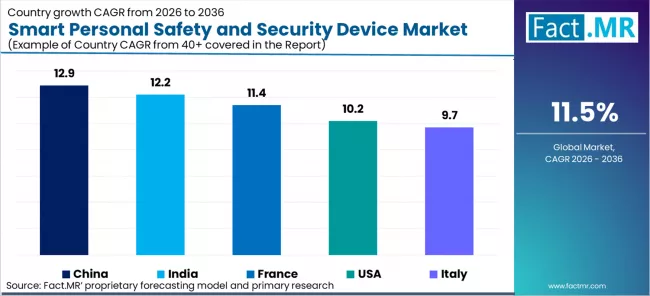
Smart Personal Safety And Security Device Market Cagr Analysis By Country | Source: Fact.MR
| Country | CAGR (2026-2036) |
|---|---|
| USA | 10.2% |
| France | 11.4% |
| Italy | 9.7% |
| India | 12.2% |
| China | 12.9% |
Source: Fact.MR analysis. Updated Mar 13, 2026
Source: Fact MR (FMR) analysis, based on proprietary forecasting model and primary research
East Asia
China represents a leading market supported by consumer electronics manufacturing, public safety initiatives, and adoption of connected safety devices. Key companies include Xiaomi Corporation, Huawei Technologies, and Dahua Technology.
- China: Demand for smart personal safety and security devices in China is projected to rise at 12.9% CAGR through 2036. Growth is supported by national public safety technology programs led by the Ministry of Public Security (03-2025) and Xiaomi Corporation’s expansion of wearable safety device production (08-2025).
South Asia
India is a major market due to increasing consumer awareness of personal safety products, smartphone connectivity, and urban safety initiatives.
- India: Demand for smart personal safety and security devices in India is projected to rise at 12.2% CAGR through 2036. Growth is supported by the Ministry of Electronics and Information Technology’s digital safety initiatives (05-2025) and expansion of connected wearable devices by boAt and Noise (09-2025).
North America
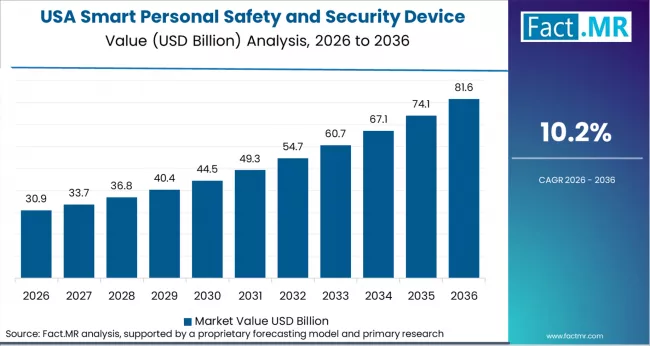
Smart Personal Safety And Security Device Market Country Value Analysis | Source: Fact.MR
The USA is a significant market driven by consumer electronics adoption, workplace safety solutions, and connected emergency alert systems.
- USA: Demand for smart personal safety and security devices in the U.S. is projected to rise at 10.2% CAGR through 2036. Growth is supported by federal personal safety technology initiatives (04-2025) and expansion of connected safety devices by ADT Inc. (08-2025).
Western Europe
France and Italy are important markets supported by urban safety programs, consumer electronics adoption, and demand for wearable emergency alert devices.
- France: Demand for smart personal safety and security devices in France is projected to rise at 11.4% CAGR through 2036. Growth is supported by national public safety technology programs (03-2025) and deployment of wearable emergency alert devices by Orange Business Services (07-2025).
- Italy: Demand for smart personal safety and security devices in Italy is projected to rise at 9.7% CAGR through 2036. Growth is influenced by urban safety monitoring initiatives by the Ministry of Interior (02-2025) and expansion of connected safety device distribution by Telecom Italia (06-2025).
Fact MR's analysis of the smart personal safety and security device market in East Asia, South Asia, North America, and Western Europe consists of country-wise assessments that include China, India, the USA, France, and Italy. Readers can find detailed trends, regulatory updates, and company-specific investments shaping market growth in these countries.
What is the Competitive Structure and Buyer Behavior in the Smart Personal Safety and Security Device Market?
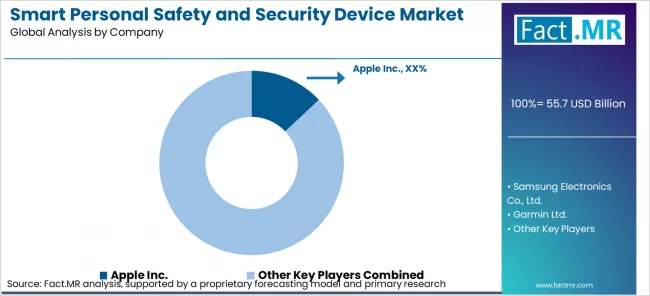
Smart Personal Safety And Security Device Market Analysis By Company | Source: Fact.MR
The smart personal safety and security device market is moderately fragmented, with technology companies and security solution providers competing across wearable devices, location tracking products, and connected safety platforms. Major consumer electronics firms such as Apple Inc., Samsung Electronics Co., Ltd., Garmin Ltd., and Fitbit LLC (Google LLC) hold a strong presence due to their established wearable ecosystems and global distribution networks. Alongside these firms, specialized providers including Axon Enterprise, Inc., Honeywell International Inc., ADT Inc., Silent Beacon, LLC, AngelSense, Inc., Trackimo LLC, SOS Alert, LLC, Kwikset (Spectrum Brands Holdings, Inc.), V.ALRT (Vsn Mobil, Inc.), and Tile, Inc. compete through niche safety solutions such as emergency alert wearables, GPS tracking devices, and personal alarm systems. Competition is driven primarily by device reliability, connectivity performance, battery life, and integration with mobile platforms and cloud-based monitoring services.
Structural advantages are held by companies with strong hardware design capabilities, established mobile ecosystems, and large user bases that enable seamless device integration and continuous software updates. Global distribution networks and brand trust also strengthen the position of large technology firms. Buyers, typically individual consumers, families, and institutional users such as schools or workplaces, exercise leverage by comparing devices across features, price, and compatibility with existing smartphones or security systems. To reduce dependency on any single provider, many users prioritize devices that support widely used mobile platforms and flexible subscription services, which limits individual suppliers pricing power and intensifies competition around product performance, reliability, and user experience.
Key Players of the Smart Personal Safety and Security Device Market
- Apple Inc.
- Samsung Electronics Co., Ltd.
- Garmin Ltd.
- Fitbit LLC (Google LLC)
- Axon Enterprise, Inc.
- Honeywell International Inc.
- ADT Inc.
- Silent Beacon, LLC
- AngelSense, Inc.
- Trackimo LLC
- SOS Alert, LLC
- Kwikset (Spectrum Brands Holdings, Inc.)
- V.ALRT (Vsn Mobil, Inc.)
- Tile, Inc.
Report Scope
| Metric | Value |
|---|---|
| Quantitative Units | USD 55.7 billion (2026) to USD 165.5 billion (2036), at a CAGR of 11.5% |
| Market Definition | The smart personal safety and security device market includes production, integration, and sale of connected devices designed to monitor, alert, and protect individuals through location tracking, emergency alerts, and wearable safety technologies. |
| Type Segmentation | Smart Personal Security, Smart Personal Safety |
| End User Segmentation | Consumers, Defence, Factories, BFSI, Healthcare, Telecommunications, Others |
| Key Companies Profiled | Apple Inc., Samsung Electronics Co., Ltd., Garmin Ltd., Fitbit LLC, Axon Enterprise, Inc., Honeywell International Inc., ADT Inc., Silent Beacon, LLC, AngelSense, Inc., Trackimo LLC, SOS Alert, LLC, Kwikset, V.ALRT, Tile, Inc. |
| Forecast Period | 2026 to 2036 |
| Approach | Hybrid top-down and bottom-up market modeling validated through interviews with device manufacturers and distributors, supported by shipment analysis, production capacity benchmarking, and adoption trends across consumer and enterprise sectors. |
Source: Fact.MR analysis. Updated Mar 13, 2026
Bibliographies
- [1] U.S. Food and Drug Administration. (2025). Wearable medical devices for fall detection and emergency alerts.
- [2] National Institute of Standards and Technology. (2023). IoT devices for personal safety and security.
- [3] Federal Communications Commission. (2024). GPS tracking and emergency alert systems regulations.
- [4] World Health Organization. (2023). Digital health technologies for personal safety.
- [5] Ministry of Public Security, China. (2025). National public safety technology programs.
- [6] Ministry of Electronics and Information Technology, India. (2025). Digital safety initiatives.
- [7] Federal Emergency Management Agency. (2025). Personal safety technology initiatives.
- [8] Ministry of Interior, France. (2025). National public safety technology programs.
- [9] Ministry of Interior, Italy. (2025). Urban safety monitoring initiatives.
This report addresses
- Market intelligence enabling evaluation of global smart personal safety and security devices by type (smart personal security, smart personal safety) and end users (consumers, defence, factories, BFSI, healthcare, telecommunications, and others).
- Market volume (revenue) estimates and 10-year forecasts from 2026 to 2036, validated using wearable device adoption trends, connected safety technology deployment, and consumer electronics demand patterns.
- Growth opportunity mapping across personal safety wearables, panic buttons, GPS tracking devices, and connected monitoring systems, with major markets including China, India, the USA, France, and Italy.
- Segment and regional revenue forecasts for wearable safety devices, emergency alert systems, and connected personal security technologies used by consumers and enterprise users.
- Competitive strategy analysis highlighting device reliability, connectivity performance, battery efficiency, integration with mobile ecosystems, and user interface design, with major players including Apple Inc., Samsung Electronics Co., Ltd., Garmin Ltd., Fitbit LLC (Google LLC), Axon Enterprise, Inc., Honeywell International Inc., ADT Inc., Silent Beacon, LLC, AngelSense, Inc., Trackimo LLC, SOS Alert, LLC, Kwikset (Spectrum Brands Holdings, Inc.), V.ALRT (Vsn Mobil, Inc.), and Tile, Inc.
- Adoption dynamics emphasizing rising consumer awareness of personal safety risks, expansion of connected wearable technologies, and increasing integration of GPS tracking and emergency alert features within mobile and cloud platforms.
- Report delivery in PDF, Excel, PowerPoint, and interactive dashboard formats suitable for executive, operational, and strategic planning.
Segmentation
Smart Personal Safety and Security Device Market Key Segments
-
Type :
- Smart Personal Security
- Wearable Devices
- Bulletproof Bags
- Personal Alarm
- Panic Button
- Fall Detection Device
- Others
- Smart Personal Safety
- Smart Helmet
- Smart Mouth Guard
- Smart Knee Guard
- Others
- Smart Personal Security
-
End User :
- Consumers
- Defence
- Factories
- BFSI
- Healthcare
- Telecommunications
- Others
-
Region :
- North America
- USA
- Canada
- Mexico
- Europe
- Germany
- UK
- France
- Italy
- Spain
- Nordic Countries
- BENELUX
- Rest of Europe
- Asia Pacific
- China
- Japan
- South Korea
- India
- Australia
- Rest of Asia Pacific
- Latin America
- Brazil
- Argentina
- Rest of Latin America
- Middle East and Africa
- Kingdom of Saudi Arabia
- United Arab Emirates
- South Africa
- Rest of Middle East and Africa
- Other Regions
- Oceania
- Central Asia
- Other Markets
- North America
Frequently Asked Questions
How large is the demand for Smart Personal Safety and Security Devices in the global market in 2026?
What will be the market size of Smart Personal Safety and Security Devices in the global market by 2036?
What is the expected demand growth for Smart Personal Safety and Security Devices in the global market between 2026 and 2036?
Which product type is expected to dominate the market?
Which region is expected to show the highest growth rate for Smart Personal Safety and Security Devices?
How significant is the growth outlook for India in this market?
What is the growth outlook for France in the Smart Personal Safety and Security Device market?
What is the growth forecast for the United States in the Smart Personal Safety and Security Device market?
What is the growth forecast for Italy in the Smart Personal Safety and Security Device market?
Which company is identified as a leading player in the Smart Personal Safety and Security Device market?
What are Smart Personal Safety and Security Devices used for?
What does the Smart Personal Safety and Security Device market include in this report?
How is the market forecast developed in this report?
What is meant by the Smart Personal Safety and Security Device market in this report?
Who worked on this report


Preview the report firsthand - request a free sample
Free SampleGet the brochure for pricing and purchase details
Download PDF