- Base Value(2025): 5.0 Bn
- Estimated Value(2026): 5.3 Bn
- Forecast Value (2036): 10.0 Bn
- CAGR (2026 - 2036): 6.6%
Knife Market Forecast and Outlook By FACT.MR
In 2025, the knife market was valued at USD 5.0 billion. Based on Fact.MR analysis, demand for knives is estimated to grow to USD 5.3 billion in 2026 and USD 10.0 billion by 2036. FACT.MR projects a CAGR of 6.6% during the forecast period.
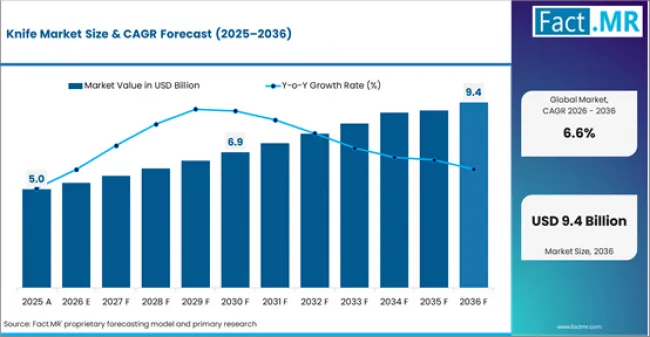
Knife Market Market Value Analysis | Source: Fact.MR
Summary of Knife Market
- Market Definition
- Market covers fixed blade and folding knives across household, commercial, and outdoor applications, sold globally across steel, ceramic, and composite blade materials.
- Demand Drivers
- Rising HoReCa expansion in India and Southeast Asia is increasing commercial knife procurement for food preparation and professional kitchen operations.
- Growing culinary culture and home cooking trends in the United States and Germany are elevating consumer spend on premium and artisanal knife brands.
- E-commerce growth and gifting culture in China and India are expanding mid-range knife penetration in markets previously dominated by unbranded local products.
- Key Segments Analyzed
- By Type: Fixed blade knives lead with 53% share in 2026, owing to broad kitchen and outdoor utility demand and established purchasing behaviour.
- By Application: Household/residential leads with 57% share, driven by kitchen knife demand across urban households and culinary culture expansion.
- By Material: Steel dominates with approximately 60% share, preferred for edge retention, durability, and ease of resharpening across professional and household segments.
- By Size: 6-9 inch blades hold approximately 50% share, representing the standard range for chef knives, utility knives, and professional kitchen tools.
- Analyst Opinion at FACT.MR
- Shambhu Nath Jha, Principal Consultant at Fact.MR, opines, ‘CXOs will observe that premium and artisanal knife segments are delivering margin expansion above overall market averages. At the same time, HoReCa growth and e-commerce penetration are unlocking scalable volume opportunities across Asia-Pacific markets that were previously difficult for branded players to access.’
- Strategic Implications
- Invest in premium steel and high-carbon blade technology targeting professional culinary and gifting segments in the U.S., Germany, and Japan.
- Expand e-commerce and direct-to-consumer channels in India and China to capture mid-range demand driven by urbanisation and HoReCa growth.
- Develop NSF-compliant and food safety-certified product lines targeting commercial food processing and institutional HoReCa buyers in regulated markets.
- Methodology
- Market sizing is based on manufacturer revenues and application volumes, validated against retail sell-through data and HoReCa procurement records.
- Incorporates trade statistics from Japan Customs, U.S. Census Bureau import data, and India DGCI&S knife trade records.
- Forecasts incorporate culinary culture indices, HoReCa expansion rates, e-commerce penetration, and expert inputs from knife industry participants.
| Metric | Value |
|---|---|
| Estimated Value in 2026 | USD 5.3 billion |
| Forecast Value in 2036 | USD 10.0 billion |
| Forecast CAGR (2026 to 2036) | 6.6% |
Between 2026 and 2036, the knife market is projected to generate an absolute opportunity of USD 4.1 billion. Growth remains broad-based and steady. Expansion is supported by rising HoReCa activity across India and Southeast Asia, alongside premiumisation trends in the United States and Germany. At the same time, gifting demand and e-commerce penetration continue to reinforce retail sales. High-volume production of commodity steel knives in China helps offset slower replacement-driven demand in Western Europe.
Procurement patterns in professional and institutional segments are evolving toward higher specifications. Buyers increasingly prioritise certified steel grades, durability standards, and ergonomically tested designs. HoReCa operators in Europe and the United States show growing preference for traceable supply chains and compliance-certified products. Established manufacturers such as Zwilling J. A. Henckels and Victorinox maintain strong positioning through specification depth and brand trust. In the mid-range segment, buyers are actively evaluating German and Japanese blade heritage, supporting sustained pricing strength.
Regionally, India leads at a CAGR of 7.5% through 2036, driven by urbanization, household formation, and food service expansion. China follows at 7.0%, supported by manufacturing scale and rising domestic consumption. The United States grows at 6.4%, reflecting strong culinary culture and outdoor usage trends. Germany records 6.0% CAGR, led by export-oriented premium production. Japan grows at 5.8%, supported by high-end artisanal demand and global exports. Mature markets such as France, Italy, and the United Kingdom continue to generate stable replacement demand with limited volume expansion.
Segmental Analysis
Knife Market Analysis by Type
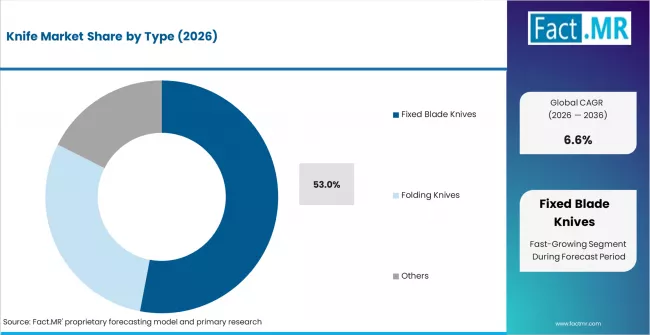
Knife Market Analysis By Type | Source: Fact.MR
Based on FACT.MR's knife market report, consumption of fixed blade knives is estimated to hold 53% share in 2026. Fixed blade configurations dominate due to superior strength and durability. They offer better structural integrity and are easier to clean. The absence of moving parts reduces failure risk. This makes them the preferred choice for professional kitchens and institutional procurement.
- Zwilling J. A. Henckels Product Expansion: Zwilling J. A. Henckels launched an expanded Pro S fixed blade chef knife line in Q3 2024. The launch targeted culinary schools and HoReCa buyers in Europe and the United States. [4]
- Spyderco Technology Development: Spyderco introduced the Smock folding knife in Q1 2025. The product uses S45VN steel for improved edge retention. It targets premium outdoor and tactical users in North America. The launch reflects rising demand for high-performance steel grades. [5]
- Fixed Blade Demand in HoReCa: Commercial kitchen knife procurement in Southeast Asia grew 11% in 2024. Fixed blade chef knives accounted for the majority of orders. Growth is driven by expansion of branded restaurant chains. Standardisation and durability remain key requirements.
Knife Market Analysis by Application
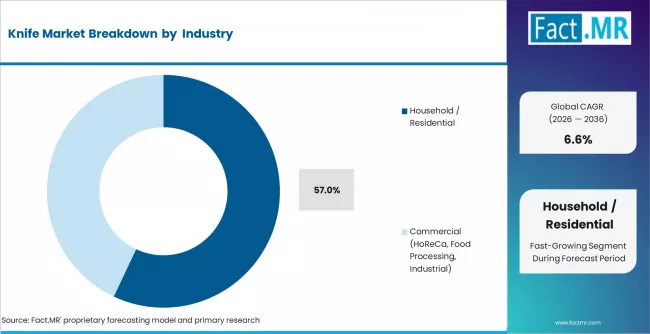
Knife Market Analysis By Application | Source: Fact.MR
Based on FACT.MR's knife market report, household and residential applications are estimated to hold 57% share in 2026. This segment leads due to consistent replacement cycles. Gifting occasions also support demand. Culinary lifestyle content drives consumer engagement. Rising home cooking trends sustain steady volume growth.
- Groupe SEB Retail Expansion: Groupe SEB expanded its T-fal and Sabatier knife ranges in H2 2024. Distribution increased across major French and German retail chains. The expansion targeted mid-range household consumers. Premium packaging supported gifting demand. The company reported 8% volume growth in this category. [6]
- Victorinox E-Commerce Growth: Victorinox reported 22% growth in direct e-commerce knife sales in 2024. Growth was driven by gifting demand and digital campaigns. The company expanded ergonomic handle variants. Focus remained on European and North American households. [7]
- HoReCa Procurement Trend: Commercial knife procurement in India increased 17% in FY2024–25. Growth was driven by new restaurant openings. Demand is strong in Tier 1 and Tier 2 cities. Buyers prefer branded and food-safety-certified knives. Institutional procurement is shifting toward trusted suppliers.
Drivers, Restraints, and Opportunities
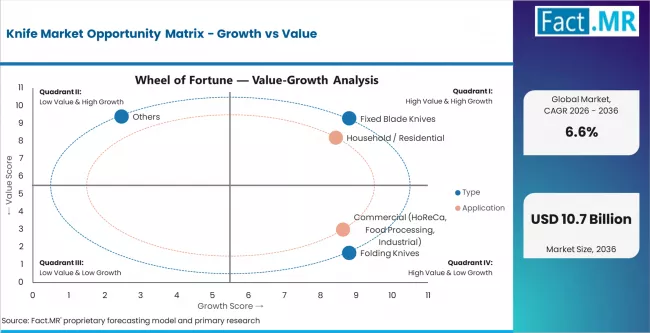
Knife Market Opportunity Matrix Growth Vs Value | Source: Fact.MR
Fact.MR analysis indicates that the knife market is stable and steadily growing. Growth is supported by replacement demand and food service expansion. The market is shifting toward brand-driven purchasing. Culinary content and digital retail are accelerating premiumisation. Demand patterns vary between developed and emerging markets.
Commodity knives from unbranded Asian producers face pricing pressure. Premium and artisanal segments are expanding margins. German, Japanese, and Swiss products command higher prices. E-commerce is improving access to premium brands. Traditional retail advantages are declining.
- HoReCa Expansion: India’s restaurant sector grew 14% in 2024–25. This directly increased commercial knife demand. Institutional buyers prefer certified and durable products. Brands like Victorinox and Zwilling J. A. Henckels are gaining traction. Procurement is shifting toward long-term contracts. [1]
- EU Compliance Shift: The European Commission updated Food Contact Material regulations in January 2025. Compliance requirements for handles and coatings increased. Manufacturers are moving toward certified product lines. Companies like Wüsthof and Zwilling are already aligned. Smaller producers face rising compliance costs. [2]
- U.S. Outdoor Demand: Outdoor participation reached record levels in 2024. This supports demand for utility knives. Brands like Buck Knives and Gerber Gear reported strong seasonal sales. E-commerce now accounts for over 35% of premium knife sales. Retail dependency is declining. [3]
Regional Analysis
The knife market is assessed across Asia Pacific, North America, Europe, Latin America, and Middle East and Africa, covering 40+ countries differentiated by HoReCa growth rates, culinary culture maturity, e-commerce penetration, and food safety regulatory environments. The full report offers market attractiveness analysis by region and country.
.webp "Top Country Growth Comparison Knife Market Cagr (2026 2036)")
Top Country Growth Comparison Knife Market Cagr (2026 2036) | Source: Fact.MR
| Country | CAGR (2026 to 2036) |
|---|---|
| USA | 6.4% |
| China | 7.0% |
| Germany | 6.0% |
| Japan | 5.8% |
| India | 7.5% |
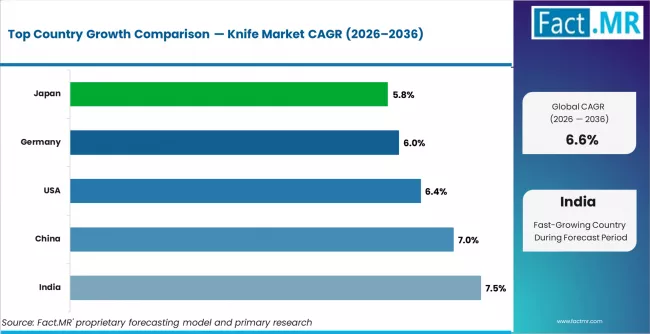
Knife Market Cagr Analysis By Country | Source: Fact.MR
Source: Fact.MR (FACT.MR) analysis, based on proprietary forecasting model and primary research
Asia Pacific Knife Market Analysis
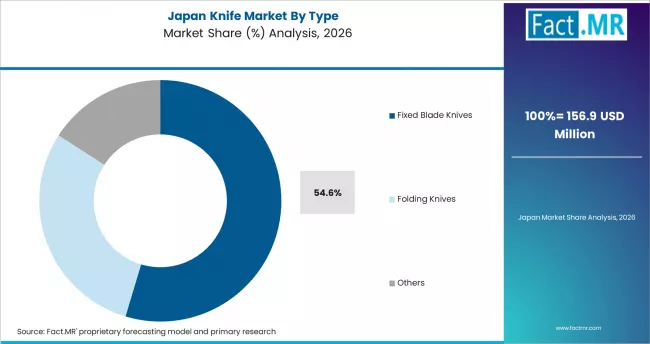
Knife Market Japan Market Share Analysis By Type | Source: Fact.MR
Asia Pacific is the fastest-growing and most volume-intensive region. Demand structures vary across China, India, and Japan. China leads in manufacturing and mid-range consumption. India drives HoReCa-led expansion. Japan sustains premium artisanal demand with export strength.
- China: Manufacturing scale and domestic consumption support 7.0% CAGR through 2036. E-commerce platforms Tmall and JD.com reported strong growth in 2024. Branded kitchen knife sales increased as consumers shifted from unbranded products. Ministry of Commerce issued catering sector standardisation guidelines in 2024. This expanded institutional procurement of stainless steel knives. Producers in Guangdong and Yangjiang increased capacity. Growth is driven by domestic branding, policy support, and export integration.
- India: HoReCa expansion and urbanisation support 7.5% CAGR through 2036. It is the fastest among major markets. National Restaurant Association of India reported 14% growth in FY2024–25. This increased institutional knife procurement. Ministry of Food Processing Industries expanded PLI scheme support in 2024. This encouraged investment in kitchen equipment. E-commerce platforms such as Flipkart and Amazon India accelerated household demand. Growth is driven by policy support, retail expansion, and rising urban consumption.
- Japan: Artisanal production and export demand support 5.8% CAGR through 2036. The market focuses on high-value precision knives. Yoshida Metal Industry expanded export-oriented product lines in Q4 2024. Ministry of Economy, Trade and Industry recognised traditional knife-making in 2024. This strengthened global brand positioning. Demand from Europe and North America remains strong. Growth is driven by craftsmanship, exports, and premium positioning.
FACT.MR covers China, India, Japan, South Korea, ASEAN, and Australia and New Zealand. Includes production data, HoReCa expansion trends, e-commerce benchmarks, and premium demand analysis.
North America Knife Market Analysis
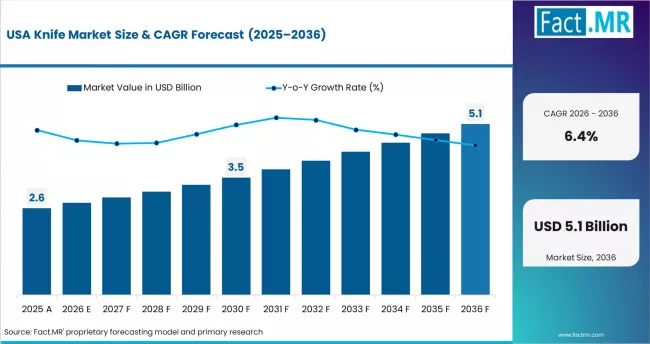
Knife Market Country Value Analysis | Source: Fact.MR
North America is the largest branded knife consumption base. Demand is shaped by culinary lifestyle culture and outdoor activity. Institutional HoReCa procurement supports steady volumes. Premium kitchen knives and artisanal tools dominate value. Zwilling J. A. Henckels and Victorinox maintain strong channel penetration across retail, e-commerce, and institutional supply networks.
- United States: Culinary culture and outdoor activity support 6.4% CAGR through 2036. The U.S. Outdoor Foundation reported record participation in 2024. This sustained demand for fixed and folding knives. Buck Knives and Gerber Gear expanded distribution across outdoor retail networks. E-commerce contributes over 35% of premium knife revenues. FDA updated food contact safety guidance in 2024.
FACT.MR covers the United States, Canada, and Mexico. Includes retail benchmarks, HoReCa procurement data, outdoor participation indicators, and e-commerce channel analysis.
Europe Knife Market Analysis
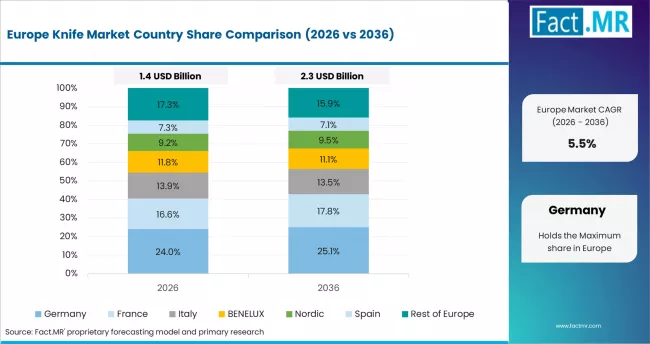
Knife Market Europe Country Market Share Analysis, 2026 & 2036 | Source: Fact.MR
Europe is a quality-driven and compliance-oriented market. Demand is shaped by heritage brands and strict regulations. Premium and artisanal knives dominate value. Replacement demand remains stable across households and institutions.
- Germany: Export strength and premium positioning support 6.0% CAGR through 2036. The country is a global hub for high-end knives. Wüsthof upgraded Solingen facilities in 2024. This improved steel precision and production quality. EU Food Contact Materials regulation update in January 2025 strengthened compliance standards. Established producers benefit from certification readiness. Retail gifting demand remains strong in Q4 cycles. Growth is driven by exports, compliance leadership, and premium demand.
FACT.MR covers Germany, France, the UK, Italy, Spain, and Rest of Europe. Includes regulatory analysis, artisanal production data, retail trends, and gifting demand insights.
Competitive Aligners for Market Players
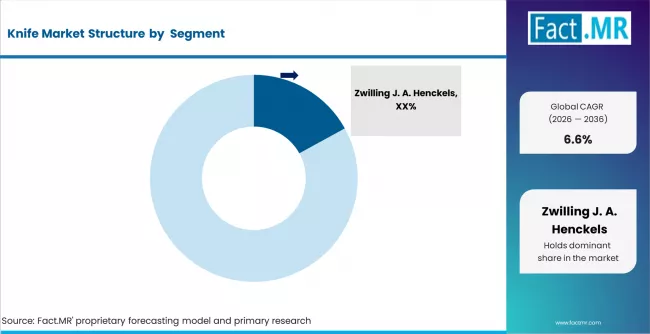
Knife Market Analysis By Company | Source: Fact.MR
The knife market is highly fragmented, with a mix of global heritage brands, regional manufacturers, and low-cost unbranded producers competing across different price tiers. Competition is not driven by a single factor. Instead, it varies by segment. In mass-market categories, price and distribution scale are the key differentiators. In premium segments, craftsmanship, material quality, and brand legacy play a much larger role.
Established players such as Zwilling J. A. Henckels, Victorinox, and Wüsthof hold strong positions in the high-end market. Their advantage comes from decades of brand trust, precision manufacturing, and the ability to meet professional-grade standards. These companies focus heavily on steel innovation, ergonomic design, and long product lifecycles, allowing them to maintain premium pricing.
At the same time, companies like Groupe SEB operate effectively in the mid-range segment by leveraging large-scale distribution and retail partnerships. Meanwhile, players such as Buck Knives, Gerber Gear, and Spyderco dominate the outdoor and tactical categories, where performance and durability are critical purchase factors. Buyer behavior is evolving. Professional users prioritise reliability and certification, while household consumers are increasingly influenced by branding, aesthetics, and online reviews. E-commerce has reduced entry barriers, allowing smaller and niche brands to reach global audiences. However, it has also intensified price competition, especially in entry-level segments. Thus, the market is shifting toward premiumisation, but remains balanced by strong volume demand in affordable categories.
Key Players
- Zwilling J. A. Henckels
- Victorinox
- Wusthof
- Groupe SEB
- Yoshida Metal Industry
- Buck Knives
- Gerber Gear
- Spyderco
Bibliography
- [1] National Restaurant Association of India. (2025). India HoReCa Sector Report FY2024-25: Restaurant Establishment Growth, Commercial Kitchen Equipment Procurement, and Food Safety Compliance Trends. nrai.org
- [2] European Commission. (January 2025). Food Contact Materials Regulation Update: Compliance Requirements for Handle Materials and Blade Coatings Used in Commercial Kitchen Knives in EU Markets. ec. europa.eu/food/safety
- [3] U.S. Census Bureau. (2024). U.S. Trade Statistics 2024: Knife and Cutting Tool Import Volumes, Steel Grade Classifications, and Country-of-Origin Data for North American Market Benchmarking. census.gov/foreign-trade
- [4] Zwilling J.A. Henckels. (Q3 2024). Product Launch Release: Pro S Fixed Blade Chef Knife Series with Ice-Hardened Steel Technology for Professional Culinary and HoReCa Supply Partnerships. zwilling.com/news
- [5] Spyderco. (Q1 2025). Product Launch: Smock Folding Knife Featuring S45VN Steel for Premium Outdoor and Tactical Applications Targeting North American Retail and E-Commerce Channels. spyderco.com/news
- [6] Groupe SEB. (H2 2024). Financial Results and Product Update: T-fal and Sabatier Knife Range Retail Expansion Across France and Germany with 8% Household Knife Volume Growth. groupeseb.com/investors
- [7] Victorinox. (2024). Annual Business Review: 22% E-Commerce Knife Sales Growth Through Culinary Gifting Campaigns and Household Portfolio Expansion in Europe and North America. victorinox.com/news
This Report Addresses
- Strategic intelligence on knife demand across household, HoReCa, food processing, outdoor, and industrial applications globally.
- Market forecast from USD 5.3 billion in 2026 to USD 10.0 billion by 2036, at a CAGR of 6.6%.
- Opportunity mapping across India HoReCa expansion, China e-commerce-driven mid-range growth, U.S. culinary and outdoor demand, Germany artisanal production, and Japan professional knife exports.
- Segment analysis by type (fixed blade, folding), application (household, commercial), material (steel, ceramic), and size (<6 inch, 6-9 inch, 9 inch+) across global and regional markets.
- Regional outlook covering Asia Pacific HoReCa and volume growth, North America culinary and gifting demand, and Europe compliance-driven premium segment dynamics.
- Competitive landscape of Zwilling J.A. Henckels, Victorinox, Wusthof, Groupe SEB, Yoshida Metal Industry, Buck Knives, Gerber Gear, and Spyderco covering brand positioning, channel depth, and product line strategy.
- Regulatory analysis covering EU Food Contact Materials framework, U.S. FDA food contact safety guidance, India PLI food processing incentives, and China Ministry of Commerce catering sector guidelines.
- Report delivered in PDF, Excel, and presentation formats supported by validated manufacturer data, HoReCa procurement benchmarks, and retail sales inputs.
Knife Market Definition
The knife market covers the manufacture and sale of cutting tools with a single-edged or double-edged blade fixed to a handle. Products serve household food preparation, professional culinary use, outdoor and utility applications, and industrial cutting tasks.
Knife Market Inclusions
Covers global and regional forecasts from 2026 to 2036 by type, application, material, and size. Includes fixed blade knives, folding knives, kitchen knives, chef knives, utility knives, and outdoor knives. Applications covered span household, HoReCa, food processing, and industrial segments across all geographic markets.
Knife Market Exclusions
Excludes surgical scalpels, industrial cutting machinery blades, and multi-tool kits where knives are non-primary components. Omits finished cutlery sets sold as tableware and disposable or single-use cutting implements. Also excludes aftermarket sharpening equipment and knife storage accessories.
Knife Market Research Methodology
- Primary Research
- Interviews with knife manufacturers, HoReCa procurement managers, specialty retail buyers, and outdoor equipment distributors across key markets.
- Desk Research
- Analysis of company filings from Zwilling J.A. Henckels, Victorinox, Wusthof, and Groupe SEB, alongside U.S. retail sales data, Japan trade statistics, and India HoReCa industry reports.
- Market-Sizing and Forecasting
- Hybrid approach using manufacturer revenues, application-level unit volumes, and average selling prices across household, professional, and outdoor segments.
- Data Validation and Update Cycle
- Validated through retail sell-through data, trade flow statistics, and expert interviews with culinary and outdoor knife buyers. Refreshed annually.
Segmentation
Scope of Report
| Attribute | Details |
|---|---|
| Quantitative Units | USD 5.3 billion (2026) to USD 10.0 billion (2036), at a CAGR of 6.6% |
| Market Definition | Market includes fixed blade and folding knives across household, commercial, and outdoor applications, sold in steel, ceramic, and composite blade materials globally. |
| Type Segmentation | Fixed Blade Knives, Folding Knives, Others |
| Application Segmentation | Household/Residential, Commercial (HoReCa, Food Processing, Industrial) |
| Material Segmentation | Steel, Ceramic, Others |
| Size Segmentation | <6 Inch, 6-9 Inch, 9 Inch+ |
| Application Coverage | Household kitchen preparation, professional culinary and HoReCa operations, food processing, outdoor and utility use, and industrial cutting applications. |
| Regions Covered | North America, Europe, Asia Pacific, Latin America, Middle East and Africa |
| Countries Covered | USA, Canada, Mexico, Germany, UK, France, Italy, Spain, Nordic, BENELUX, China, Japan, South Korea, India, ASEAN, Australia and New Zealand, Brazil, Argentina, Chile, Saudi Arabia, UAE, Turkey, South Africa, Rest of MEA |
| Key Companies Profiled | Zwilling J.A. Henckels, Victorinox, Wusthof, Groupe SEB, Yoshida Metal Industry, Buck Knives, Gerber Gear, Spyderco |
| Forecast Period | 2026 to 2036 |
| Approach | Hybrid top-down and bottom-up model using manufacturer revenues, retail sales data, application-level volume estimates, average selling prices by segment, HoReCa procurement benchmarks, and primary interviews with culinary and outdoor knife buyers. |
Knife Market by Segments
-
By Type:
- Fixed Blade Knives
- Folding Knives
- Others
-
By Application:
- Household / Residential
- Commercial (HoReCa, Food Processing, Industrial)
-
By Material:
- Steel
- Ceramic
- Others
-
By Size:
- <6 Inch
- 6-9 Inch
- 9 Inch+
-
By Region:
- North America
- United States
- Canada
- Mexico
- Latin America
- Brazil
- Argentina
- Chile
- Rest of Latin America
- Western Europe
- Germany
- United Kingdom
- France
- Italy
- Spain
- Nordic Countries
- BENELUX
- Rest of Western Europe
- Eastern Europe
- Russia
- Poland
- Hungary
- Balkan and Baltic
- Rest of Eastern Europe
- East Asia
- China
- Japan
- South Korea
- South Asia and Pacific
- India
- ASEAN
- Australia and New Zealand
- Rest of South Asia and Pacific
- Middle East and Africa
- Kingdom of Saudi Arabia
- UAE
- Other GCC Countries
- Turkey
- South Africa
- Rest of Middle East and Africa
- North America
Frequently Asked Questions
How large is the global knife market in 2025?
What will the market size be in 2026?
What is the projected market size by 2036?
What is the expected CAGR from 2026 to 2036?
Which type segment is poised to lead the market?
Which application segment holds the largest share?
Which country shows the fastest growth?
What are the primary uses of knives in this market?
Who are the key players in the knife market?
Who worked on this report


Preview the report firsthand - request a free sample
Free SampleGet the brochure for pricing and purchase details
Download PDF