- Base Value(2025): 161.4 Mn
- Estimated Value(2026): 185 Mn
- Forecast Value (2036): 720 Mn
- CAGR (2026 - 2036): 14.6%
Self-Healing Industrial Epoxy Coatings Market Forecast 2026 to 2036
In 2025, the self-healing industrial epoxy coatings market was valued at USD 161.4 million. Based on Fact MR's analysis, demand for self-healing industrial epoxy coatings is estimated to grow to USD 185 million in 2026 and USD 720 million by 2036. FMR projects a CAGR of 14.6% during the forecast period.
The absolute dollar growth from 2026 to 2036 is USD 535 million. This growth is driven by increasing demand for durable, long-lasting coatings that can automatically repair minor damages, reducing maintenance costs and extending the lifespan of industrial assets. The market is also supported by the rise in industrial automation and the increasing use of epoxy coatings in demanding environments. However, challenges such as high production costs and the need for continuous innovation in self-healing technologies could limit growth in certain regions.
The USA leads with a CAGR of 14.5%, driven by demand in industrial applications and increasing investment in advanced coatings technologies. Germany follows with a 13.8% CAGR, supported by strong industrial production and a focus on durable, high-performance coatings. Japan grows at 12.5%, fueled by the adoption of self-healing coatings in its manufacturing and automotive sectors. China grows at 11.2%, driven by the rising demand for advanced coatings in its rapidly expanding industrial sector.
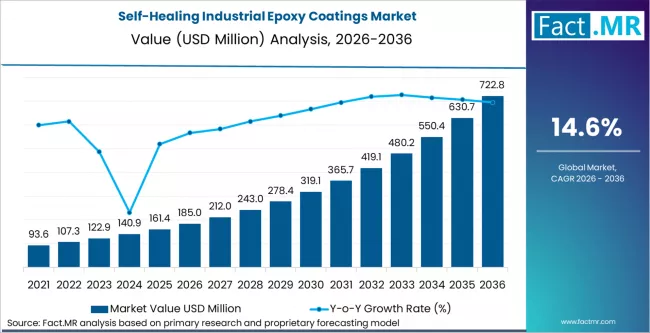
Self Healing Industrial Epoxy Coatings Market Market Value Analysis | Source: Fact.MR
Self-Healing Industrial Epoxy Coatings Market
| Metric | Value |
|---|---|
| Estimated Value in (2026E) | USD 185 million |
| Forecast Value in (2036F) | USD 720 million |
| Forecast CAGR (2026 to 2036) | 14.6% |
Source: Fact.MR analysis. Updated Feb 23, 2026
Self‑Healing Industrial Epoxy Coatings Market Definition
The Self‑Healing Industrial Epoxy Coatings Market refers to the production and sale of epoxy‑based coating systems formulated to autonomously repair micro‑cracks, scratches, or minor damage when exposed to triggers such as heat, moisture, or mechanical stress. These advanced coatings embed microcapsules, healing agents, or dynamic polymer networks that activate to restore film integrity without manual intervention. Their primary function is to extend service life, reduce maintenance costs, and protect industrial surfaces from corrosion, wear, and environmental degradation. Key end uses include infrastructure, oil and gas, marine, petrochemical plants, and heavy industrial equipment.
Market Inclusions
This report covers global and regional market sizes for self‑healing industrial epoxy coatings with a defined forecast period. It includes segment breakdowns by formulation type (microcapsule‑based, vascular systems, dynamic polymers), application (protective coatings, corrosion inhibitors, wear‑resistant layers), and end‑use industry (oil and gas, marine, infrastructure, manufacturing). Pricing trends, raw material supply dynamics, and trade flow data are included to reflect market behavior.
Market Exclusions
The scope excludes conventional industrial epoxy coatings without self‑healing capability and unrelated coating systems such as acrylics, polyurethanes, or silicone coatings. Finished products that incorporate these coatings (such as assembled equipment or OEM machinery) are not covered. Niche self‑healing polymers used solely in non‑industrial contexts (consumer electronics or medical devices) are omitted.
Research Methodology
- Primary Research: Interviews were conducted with materials scientists, coating formulators, and industry end users.
- Desk Research: Data was sourced from industry reports, materials publications, and trade association statistics.
- Market‑Sizing and Forecasting: A hybrid model was used, combining top‑down industrial coatings demand forecasts with bottom‑up shipment and revenue data.
- Data Validation and Update Cycle: Findings were validated through expert review and aligned with recent production and trade figures, with periodic updates.
Summary of the Self-Healing Industrial Epoxy Coatings Market
Market Definition
The Self-Healing Industrial Epoxy Coatings Market refers to epoxy-based coatings designed to autonomously repair minor damage, such as micro cracks or scratches, when exposed to triggers like heat, moisture, or mechanical stress. These coatings incorporate microcapsules, healing agents, or dynamic polymer networks that activate to restore the coating's integrity. Their primary function is to extend service life, reduce maintenance costs, and protect industrial surfaces from corrosion, wear, and environmental degradation. Key end uses include infrastructure, oil and gas, marine, petrochemical plants, and heavy industrial equipment.
Demand Drivers
- Increasing demand for durable, long-lasting coatings that automatically repair minor damage, reducing maintenance costs and extending the lifespan of industrial assets.
- Rising industrial automation and increased adoption of epoxy coatings in demanding environments, especially in industries like oil and gas, marine, and infrastructure.
- Growing need for protective coatings in industries facing harsh conditions, such as corrosion and mechanical wear, driving the adoption of self-healing epoxy coatings.
- Rising awareness of sustainability and the cost-effectiveness of self-healing coatings in reducing maintenance and operational downtime in industrial sectors.
Key Segments Analyzed
- Product Type: Microencapsulation-based self-healing coatings are expected to lead with 45% of the market share by 2026, offering effective self-repairing properties by releasing healing agents when damaged.
- Application: Anti-corrosion coatings are projected to dominate the application segment, capturing 42% of the market share by 2026, driven by the need for protective coatings in industries exposed to harsh environmental conditions.
- End Use Industry: Oil and gas industries are expected to be the largest end-use sector, followed by marine and industrial infrastructure, as these sectors increasingly adopt advanced coatings for enhanced surface protection.
- Region: North America leads in growth, with the USA projected to grow at a CAGR of 14.5%, followed by Germany, Japan, and China.
Analyst Opinion at FactMR
"The self-healing industrial epoxy coatings market is experiencing significant growth, driven by the increasing demand for coatings that provide long-term durability and reduce operational costs in harsh industrial environments. The adoption of self-healing technologies is particularly high in industries like oil and gas, marine, and infrastructure, where surface protection is crucial." — Shambhu Nath Jha, Principal Consultant at FactMR.
Strategic Implications/Executive Takeaways
- Focus on developing microencapsulation-based self-healing coatings that provide cost-effective solutions for industries needing long-lasting surface protection.
- Leverage the growing demand for anti-corrosion coatings to drive market penetration in industries like construction, marine, and infrastructure.
- Invest in continuous innovation to improve the effectiveness and versatility of self-healing coatings, addressing industry-specific challenges in demanding environments.
- Expand production capabilities to meet the increasing demand for advanced coatings in emerging industrial markets, particularly in North America and Europe.
Methodology
- Derived from primary research with materials scientists, coating formulators, and industry end users.
- Benchmarked against data from industrial sectors, including oil and gas, marine, and infrastructure.
- Hybrid top-down and bottom-up market modeling, validated through expert reviews and recent trade data.
Segmental Analysis
Self-Healing Industrial Epoxy Coatings Market Analysis by Product Type
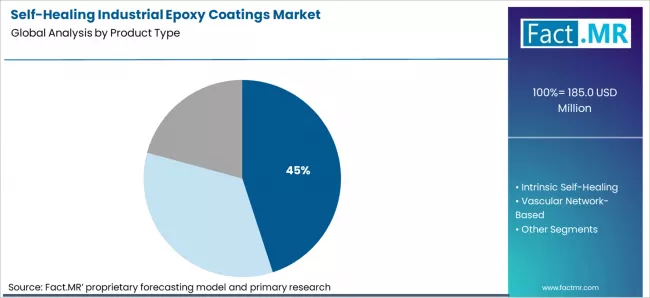
Self Healing Industrial Epoxy Coatings Market Analysis By Product Type | Source: Fact.MR
- Market Overview: Microencapsulation-based self-healing coatings are expected to hold 45% of the market share by 2026. In this technology, healing agents are encapsulated in microspheres that break open when the coating is damaged, releasing the healing agent to repair the damaged area. This type of self-healing epoxy coating is widely used in industrial applications where long-lasting protection is critical.
- Demand Drivers:
- Enhanced Durability and Performance: Microencapsulation-based self-healing coatings enhance the durability and longevity of industrial surfaces by allowing them to self-repair minor damage, thus reducing maintenance costs and downtime in industrial settings.
- Demand for Sustainable Solutions: With increasing pressure to reduce maintenance costs and extend the lifespan of industrial equipment, microencapsulation-based self-healing coatings offer a sustainable and cost-effective solution by improving the resilience of materials without requiring frequent replacements.
- Versatility Across Industries: These coatings are widely used in industries such as automotive, aerospace, and manufacturing, where equipment is subjected to harsh conditions. Their ability to enhance the protection of surfaces exposed to wear and tear drives their growth in the market.
Self-Healing Industrial Epoxy Coatings Market Analysis by Application
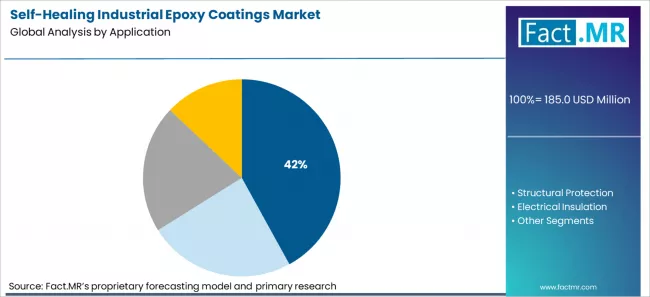
Self Healing Industrial Epoxy Coatings Market Analysis By Application | Source: Fact.MR
- Market Overview: Anti-corrosion coatings are projected to capture 42% of the market share by 2026. Self-healing epoxy coatings are increasingly used for anti-corrosion purposes, especially in industries where equipment and infrastructure are exposed to harsh environmental conditions, such as chemicals, moisture, and temperature extremes.
- Demand Drivers:
- Protection of Metal Surfaces: Anti-corrosion is a critical application for self-healing coatings, especially in the automotive, construction, and marine sectors. Self-healing coatings provide an effective solution for protecting metal surfaces from rust and corrosion, improving the durability and lifespan of structures and machinery.
- Cost-Effectiveness and Maintenance Reduction: By preventing corrosion and minimizing the need for frequent maintenance or replacement, self-healing coatings help businesses reduce long-term operational costs, which is especially important in heavy industries.
- Stricter Environmental Regulations: As environmental regulations become more stringent, there is an increasing demand for coatings that offer superior protection against corrosion while also providing eco-friendly alternatives to traditional coatings. Self-healing epoxy coatings meet these needs by offering both performance and sustainability.
Key Dynamics
Self‑Healing Industrial Epoxy Coatings Market Drivers, Restraints, and Opportunities
FMR analysts observe that the self‑healing industrial epoxy coatings market is a growth‑transition segment shaped by increasing demand for durable, low‑maintenance surface protection in harsh industrial environments. Historically, conventional epoxies provided baseline corrosion and abrasion resistance; as asset uptime and lifecycle cost pressures grew, structural demand emerged for smart coatings that autonomously repair micro‑cracks and minor substrate damage. The 2026 valuation reflects this transition, where adoption tracks with industrial maintenance budgeting, lifecycle management trends, and performance expectations in heavy industry, infrastructure, and transportation sectors.
While demand for traditional epoxy systems remains large in cost‑sensitive applications, engineered self‑healing epoxies are gaining share because they reduce direct maintenance and downtime costs over the asset lifecycle. These advanced formulations command higher per‑unit prices, contributing to net market value growth even as overall unit volumes grow moderately with industrial investment cycles. The market exists because performance criteria and regulatory pressure on asset safety and environmental containment increasingly favor coatings that maintain integrity between scheduled maintenance windows.
- Lifecycle Cost Demand: Industrial operators are specifying self‑healing coatings to extend service intervals and reduce unplanned maintenance versus standard epoxies that require frequent touch‑ups.
- Performance & Safety Standards: Regulatory frameworks such as ISO 12944 corrosion protection standards push adoption of coating systems that maintain protective performance over time, elevating advanced chemistries.
- Regional Industrial Dynamics: In North America and Europe, stringent maintenance and safety requirements drive higher uptake of self‑healing coatings compared with regions where basic protective systems remain predominant.
Regional Analysis
The market analysis covers key global regions, including North America, Europe, and East Asia. It is segmented geographically, with specific market dynamics for each region. The full report provides a detailed market attractiveness analysis.
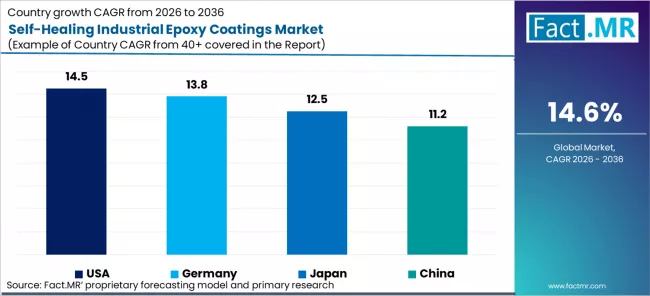
Self Healing Industrial Epoxy Coatings Market Cagr Analysis By Country | Source: Fact.MR
| Country | CAGR (2026-2036) |
|---|---|
| USA | 14.5% |
| Germany | 13.8% |
| Japan | 12.5% |
| China | 11.2% |
Source: Fact.MR analysis. Updated Feb 23, 2026
Source: Fact MR (FMR) analysis, based on proprietary forecasting model and primary research.
North America:
In North America, the USA stands out as a significant market for self-healing industrial epoxy coatings, driven by increasing demand from industries such as automotive, construction, and infrastructure for durable and long-lasting protective coatings.
- USA: Demand for self-healing industrial epoxy coatings in the U.S. is projected to rise at 14.5% CAGR through 2036. The USA’s robust industrial and construction sectors and growing focus on durable coatings continue to boost demand for self-healing epoxy coatings.
Europe:
In Europe, Germany leads the market for self-healing industrial epoxy coatings, supported by strong manufacturing sectors and growing demand for advanced coatings in the automotive, construction, and infrastructure industries.
- Germany: Demand for self-healing industrial epoxy coatings in Germany is projected to rise at 13.8% CAGR through 2036. Germany’s established industrial base and emphasis on sustainability and high-performance materials continue to drive market growth.
East Asia:
In East Asia, Japan and China are key markets for self-healing industrial epoxy coatings, supported by their large-scale manufacturing industries and increasing need for durable coatings in various sectors.
- Japan: Demand for self-healing industrial epoxy coatings in Japan is projected to rise at 12.5% CAGR through 2036. Japan’s focus on advanced materials and high demand for durable, self-healing coatings continue to contribute to steady market growth.
- China: Demand for self-healing industrial epoxy coatings in China is projected to rise at 11.2% CAGR through 2036. China’s growing manufacturing sector and demand for innovative coatings in automotive and infrastructure contribute to the market’s expansion.
Fact MR's analysis of the Self-Healing Industrial Epoxy Coatings Market in North America, Europe, and East Asia consists of country-wise assessments that include the USA, Germany, Japan, and China. Readers can find detailed trends, regulatory updates, and company-specific investments shaping the market’s growth in these countries.
Competitive Landscape
How Are Key Players Competing in the Self-Healing Industrial Epoxy Coatings Market?
In the self-healing industrial epoxy coatings market, leading companies like Akzo Nobel N.V., PPG Industries, Inc., and The Sherwin-Williams Company are leveraging advanced materials technology to create coatings that automatically repair minor damage, extending the lifespan of industrial assets. Henkel AG & Co. KGaA and Axalta Coating Systems LLC are focusing on incorporating self-healing properties into their epoxy coatings, targeting industries such as automotive, aerospace, and construction. These companies are investing heavily in R&D to enhance the durability and effectiveness of self-healing coatings, making them a viable option for reducing maintenance costs and improving the performance of critical infrastructure. Their strategies focus on improving the coatings' resistance to corrosion, abrasion, and other environmental factors while maintaining cost-effectiveness.
Recent Industry Developments
- Jotun’s "Smart Monitoring" Coating Launch (Corporate): In early 2026, Jotun introduced a new generation of "smart" protective coatings that integrate micro-sensor reactions and color-changing chemistry; these materials autonomously signal surface deterioration and corrosion initiation while utilizing upgraded hybrid epoxy systems for higher abrasion tolerance in humid environments.
- EPA PFAS Reporting & Limit Mandate (Regulatory): Effective January 2025, the U.S. EPA implemented stringent new reporting requirements and limits for PFAS ("forever chemicals") under the Safe Drinking Water Act and TSCA; this has forced industrial epoxy manufacturers to reformulate self-healing additives (which often relied on fluorinated compounds for flow and stability) to ensure compliance.
- ISO 14001:2026 Life Cycle Revision (Regulatory): Published in January 2026, the updated ISO 14001:2026 standard introduces a mandatory "life cycle perspective" for environmental management; this regulatory shift explicitly favors self-healing coatings because their ability to autonomously repair micro-damage significantly extends the maintenance-free lifespan of industrial assets, aligning with the new "climate resilience" and "circular economy" clauses.
Key Players of the Self-Healing Industrial Epoxy Coatings Market
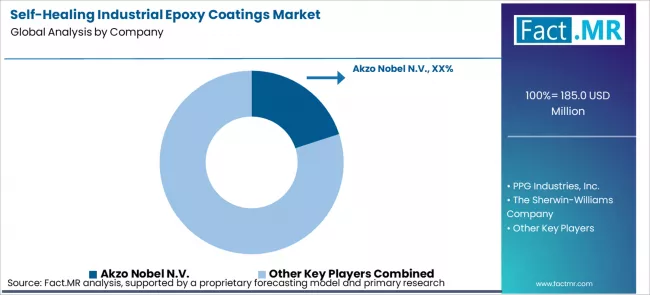
Self Healing Industrial Epoxy Coatings Market Analysis By Company | Source: Fact.MR
- Akzo Nobel N.V.
- PPG Industries, Inc.
- The Sherwin-Williams Company
- Henkel AG & Co. KGaA
- Axalta Coating Systems LLC
Report Scope
| Metric | Value |
|---|---|
| Quantitative Units | USD 185 million (2026) to USD 720 million (2036), at a CAGR of 14.6% |
| Market Definition | The self-healing industrial epoxy coatings market includes coatings designed to repair damage autonomously, increasing durability and lifespan in industries like oil & gas, marine, and industrial infrastructure. |
| By Product Type | Microencapsulation-Based, Intrinsic Self-Healing, Vascular Network-Based |
| By Application | Anti-Corrosion Coatings, Structural Protection, Electrical Insulation, Others |
| By End-Use Industry | Oil & Gas, Marine, Industrial Infrastructure, Others |
| Regions Covered | North America, Latin America, Europe, East Asia, South Asia, Oceania, Middle East and Africa |
| Countries Covered | United States, Canada, Mexico, Brazil, Argentina, Germany, France, United Kingdom, Italy, Spain, China, India, Japan, South Korea, Indonesia, Australia, and 40+ countries |
| Key Companies Profiled | Akzo Nobel N.V., PPG Industries, Inc., The Sherwin-Williams Company, Henkel AG & Co. KGaA, Axalta Coating Systems LLC |
| Forecast Period | 2026 to 2036 |
| Approach | Hybrid top-down and bottom-up market modeling validated through primary interviews with manufacturers and supported by trade data benchmarking and market research. |
Source: Fact.MR analysis. Updated Feb 23, 2026
Bibliographies
Jotun’s "Smart Monitoring" Coating Launch:
Gravity Chemicals. (2026). Jotun introduces next-generation "smart" protective coatings with micro-sensor reactions and color-changing chemistry. Gravity Chemicals.
EPA PFAS Reporting & Limit Mandate:
U.S. EPA. (2025). U.S. EPA implements new reporting requirements and limits for PFAS under the Safe Drinking Water Act and TSCA. U.S. EPA.
ISO 14001:2026 Life Cycle Revision:
SGS. (2026, January). ISO 14001:2026 introduces mandatory life cycle perspective for environmental management. SGS.
Akzo Nobel N.V. (2026). Industrial protective coatings portfolio, including advanced epoxy coating technologies for corrosion protection. Akzo Nobel N.V.
Axalta Coating Systems LLC. (2026). Industrial epoxy coating systems for structural durability and corrosion resistance (product portfolio). Axalta Coating Systems LLC.
Henkel AG & Co. KGaA. (2025). Advanced industrial coating technologies and epoxy-based protection systems (product portfolio). Henkel AG & Co. KGaA.
PPG Industries, Inc. (2026). Industrial epoxy and protective coating technologies for corrosion mitigation (product portfolio). PPG Industries, Inc.
The Sherwin-Williams Company. (2026). Industrial epoxy coatings and performance protection systems (product portfolio). The Sherwin-Williams Company.
Segmentation
Self-Healing Industrial Epoxy Coatings Market Key Segments
-
By Product Type :
- Microencapsulation-Based
- Intrinsic Self-Healing
- Vascular Network-Based
-
By Application :
- Anti-Corrosion Coatings
- Structural Protection
- Electrical Insulation
- Others
-
By End-Use Industry :
- Oil & Gas
- Marine
- Industrial Infrastructure
- Others
-
Region :
- North America
- USA
- Canada
- Mexico
- Europe
- Germany
- UK
- France
- Italy
- Spain
- Nordic Countries
- BENELUX
- Rest of Europe
- Asia Pacific
- China
- Japan
- South Korea
- India
- Australia
- Rest of Asia Pacific
- Latin America
- Brazil
- Argentina
- Rest of Latin America
- Middle East and Africa
- Kingdom of Saudi Arabia
- United Arab Emirates
- South Africa
- Rest of Middle East and Africa
- Other Regions
- Oceania
- Central Asia
- Other Markets
- North America
Frequently Asked Questions
How large is the demand for Self-Healing Industrial Epoxy Coatings in the global market in 2026?
What will be the market size of Self-Healing Industrial Epoxy Coatings in the global market by 2036?
What is the expected demand growth for Self-Healing Industrial Epoxy Coatings in the global market between 2026 and 2036?
Which product type is expected to dominate the market?
Which region is expected to show the highest growth rate for Self-Healing Industrial Epoxy Coatings?
How significant is the growth outlook for Germany in this market?
What is the growth outlook for Japan in this report?
What is the growth forecast for China in the Self-Healing Industrial Epoxy Coatings market?
Which company is identified as a leading player in the Self-Healing Industrial Epoxy Coatings market?
What are Self-Healing Industrial Epoxy Coatings used for?
What does the Self-Healing Industrial Epoxy Coatings market include in this report?
How is the market forecast developed in this report?
What is meant by the Self-Healing Industrial Epoxy Coatings market in this report?
Who worked on this report


Preview the report firsthand - request a free sample
Free SampleGet the brochure for pricing and purchase details
Download PDF