Semi-Auto Flex Filling Lines Market

Semi-Auto Flex Filling Lines Market Size and Share Forecast Outlook 2026 to 2036

Semi-auto flex filling lines market is projected to grow from USD 260.0 million in 2026 to USD 590.0 million by 2036, at a CAGR of 8.5%. SME Food & Cosmetics Producers will dominate with a 45.0% market share, while semi-auto pouch & bag filling lines will lead the system type segment with a 50.0% share.

Semi-Auto Flex Filling Lines Market Forecast and Outlook 2026 to 2036

The global semi-auto flex filling lines market is valued at USD 260.0 million in 2026 and is set to reach USD 590.0 million by 2036, recording a compound annual growth rate (CAGR) of 8.5% between 2026 and 2036. In 2026, the SME food & cosmetics producers application segment is projected to hold a 45% share, while semi-auto pouch & bag filling lines account for 50% by system type.

Key Takeaways from the Semi-Auto Flex Filling Lines Market Report

  • Market Value of the Semi-Auto Flex Filling Lines Market (2026): USD 260.0 Million
  • Market Forecast Value of the Semi-Auto Flex Filling Lines Market (2036): USD 590.0 Million
  • Forecast CAGR of the Semi-Auto Flex Filling Lines Market (2026-2036): 8.5%
  • Leading Application Segment of the Semi-Auto Flex Filling Lines Market: SME Food & Cosmetics Producers (45%)
  • Leading System Type of the Semi-Auto Flex Filling Lines Market: Semi-Auto Pouch & Bag Filling Lines (50%)
  • Key Growth Regions of the Semi-Auto Flex Filling Lines Market: North America, Europe, Asia Pacific, Latin America, MEA
  • Key Players of the Semi-Auto Flex Filling Lines Market: MULTIVAC, Bosch Packaging, Hualian, UFlex Machinery, Toppan Automation, GEA
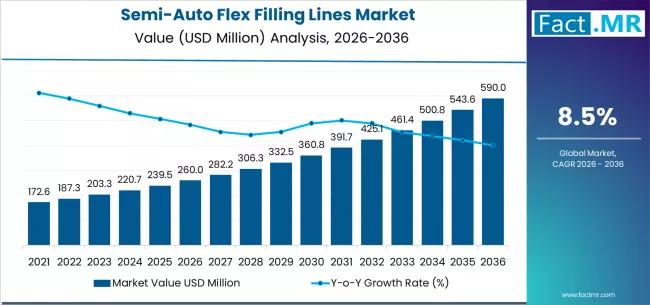
Semi Auto Flex Filling Lines Market Market Value Analysis

Market expansion is fueled by the strategic need of small and medium-sized enterprises to automate for competitiveness without the capital outlay or complexity of fully robotic systems. These lines balance essential automation in filling and sealing with manual loading or positioning, offering a significant boost in output consistency and hygiene over purely manual methods. This accessible automation enables smaller producers to meet rising quality standards from retailers and comply with stringent packaging regulations, particularly in food and pharmaceutical sectors.

Growth throughout the forecast period will be shaped by technological democratization and demand for operational resilience. Advances in servo-driven controls and user-friendly PLC interfaces are making semi-auto lines more precise, reliable, and easier to operate with limited technical staff. This evolution supports the trend toward regionalized, small-batch production by allowing manufacturers to respond agilely to local market demands with professional-grade packaging, reducing dependency on distant, large-scale co-packers.

Semi-Auto Flex Filling Lines Market

Metric Value
Estimated Value in (2026E) USD 260.0 Million
Forecast Value in (2036F) USD 590.0 Million
Forecast CAGR (2026 to 2036) 8.5%

Category

Category Segments
End-use/Application SME Food & Cosmetics Producers, Pharma & Nutraceuticals, Private Label & Retail, Small-Scale Processors, Regional Food Processors, Others
System Type Semi-Auto Pouch & Bag Filling Lines, Small-Batch Flex Lines, Semi-Auto Vertical Fillers, Entry-Level Flex Fill Lines, Others
Material Flexible Film Laminates, High-Barrier Films, Cost-Optimized Laminates, Mono-PE Films, Others
Technology Servo-Driven Fillers + FFS Interface, Cleanroom-Compatible Filling, PLC-Integrated Controls, Operator-Assist Filling Systems, Others
Region North America, Europe, Asia Pacific, Latin America, MEA

Segmental Analysis

Why are SME Food & Cosmetics Producers the Core Application Segment?
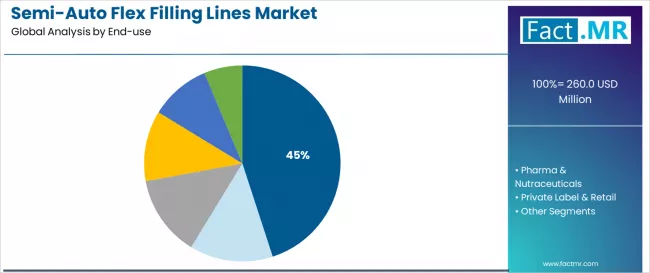
Semi Auto Flex Filling Lines Market Analysis By End Use

SME food and cosmetics producers account for a 45% market share in 2026, establishing this segment as the primary driver. These businesses face the dual challenge of scaling production while maintaining stringent quality and hygiene standards, yet often lack the capital for fully automated lines. Semi-auto systems provide the optimal compromise, automating the critical fill-and-seal process to ensure accuracy, consistency, and contamination reduction while keeping labor involved in simpler loading tasks.

This segment values flexibility above all. The ability to run shorter batches, switch between product types quickly, and handle a variety of flexible film materials is essential for SMEs producing diverse SKUs for local markets or private labels. The investment directly translates to enhanced brand professionalism, longer shelf life, and the capacity to secure contracts with larger retail distributors.

  • The proliferation of artisanal food brands and boutique cosmetics lines creates sustained demand for scalable, entry-level automation solutions.
  • Regulatory pressures for improved traceability and labeling accuracy make controlled, semi-automated processes a necessity rather than a luxury for growth-focused small producers.

What drives the Market Leadership of Semi-Auto Pouch & Bag Filling Lines?
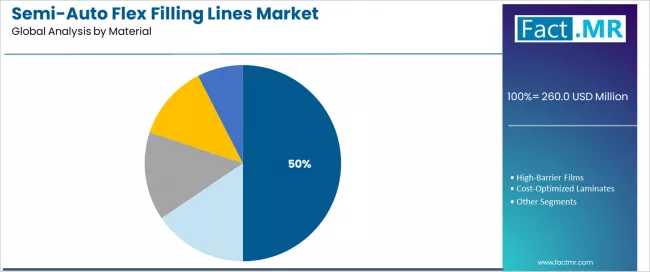
Semi Auto Flex Filling Lines Market Analysis By Material

Semi-auto pouch and bag filling lines are projected to hold a 50% share by system type in 2026. Their dominance is rooted in addressing the most prevalent packaging format across food, household, and industrial products. These systems efficiently handle pre-made pouches or form-fill-seal operations at a semi-automatic pace, offering a substantial productivity leap over manual filling without the complexity of full robotic bag handling.

The technology is highly adaptable, capable of integrating with various filling technologies for powders, liquids, and granules. The semi-auto approach allows operators to manage pouch presentation and placement, a task difficult to fully automate cost-effectively for smaller runs, while ensuring perfect, repeatable fill weights and hermetic seals. This reliability is crucial for product integrity and customer satisfaction.

  • The global shift towards unit-dose packaging and stand-up pouches in consumer goods solidifies the need for dedicated pouch-filling machinery.
  • These lines often serve as the foundational automation step for businesses, with a clear pathway to upgrade to faster, more automated systems as volume grows.

What are the Drivers, Restraints, and Trends in the Semi-Auto Flex Filling Lines Market?

The market is driven by the global growth of small-batch, high-mix production models and rising quality standards that manual operations cannot meet. Labor cost inflation and availability issues make semi-automation a financially sound intermediate solution. A key restraint is the perception of being a transitional technology, potentially causing some buyers to delay investment.

The market is trending towards more integrated operator-assist systems with enhanced ergonomics and guided human-machine interfaces (HMIs) that reduce training time and error rates, and towards designs that meet basic cleanroom standards for adjacent markets like nutraceuticals.

Analysis of the Semi-Auto Flex Filling Lines Market by Key Countries
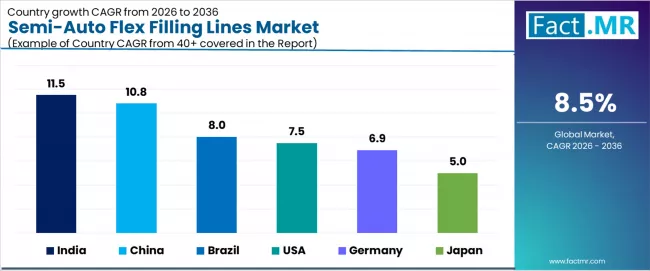
Semi Auto Flex Filling Lines Market Cagr Analysis By Country

Country CAGR (2026-2036)
India 11.5%
China 10.8%
USA 7.5%
Brazil 8.0%
Germany 6.9%
Japan 5.0%

How is Private Label Expansion and Retail Formalization Driving Demand in India?

The market for semi-auto flex filling lines in India is projected to grow at a leading CAGR of 11.5% through 2036. This is propelled by the explosive growth of modern retail and the corresponding demand for private-label goods in snacks, staples, and personal care. Thousands of small-scale processors are investing in semi-auto vertical fillers and entry-level lines to meet the packaging consistency and hygiene standards required by large retail chains. PLC-integrated controls are valued for providing repeatable accuracy with semi-skilled labor.

  • Government initiatives promoting food processing and small-scale manufacturing provide a favorable ecosystem for machinery investment.
  • The need to brand commodity products and move up the value chain is a powerful motivator for adopting professional packaging systems.

What Role Does Pharma Contract Manufacturing and Cost Optimization Play in China?

The semi-auto flex filling lines market in China is forecast to grow at a CAGR of 10.8%. Beyond food, a significant driver is the vast contract manufacturing sector for pharma and nutraceuticals, where small-batch flex lines with cleanroom-compatible features are essential. For high-volume food and consumer goods, cost-optimized laminates drive the need for reliable, efficient filling systems that maximize output while minimizing film waste and downtime.

  • Domestic machinery manufacturers are adept at providing robust, value-engineered systems that meet the specific price-performance requirements of local producers.
  • The expansion of domestic brands competing on shelf appeal necessitates better packaging quality, fueling upgrades from manual to semi-auto operations.

How do Regulatory Compliance and Small-Batch Agility Shape the Market in USA?
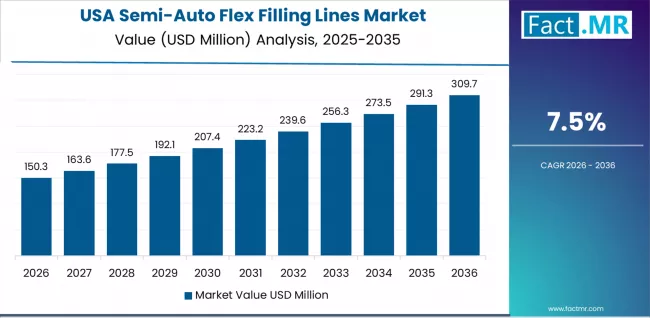
Semi Auto Flex Filling Lines Market Country Value Analysis

The market in the USA is set to grow at a CAGR of 7.5%. Growth is driven by a thriving ecosystem of craft food and beverage producers, boutique cosmetics brands, and small-scale supplement makers. These businesses require semi-auto lines that ensure compliance with FDA regulations on fill weight and contamination while offering the agility to produce limited editions and seasonal variants. Servo-driven fillers provide the precision needed for high-value products.

  • The local sourcing trend and the growth of direct-to-consumer e-commerce for specialty foods create ideal conditions for decentralized, small-batch production facilities.
  • Investments focus on systems that improve operational efficiency and reduce product giveaway in a competitive market.

Why do Precision Engineering and SME Manufacturing Define the German Market?

Demand in Germany is expected to grow at a CAGR of 6.9%. The market is characterized by the needs of Germany's renowned Mittelstand—small and medium-sized world-class manufacturers in specialty foods, chemicals, and cosmetics. These firms demand semi-automatic solutions with exceptional engineering precision, durability, and the ability to integrate seamlessly into high-quality production environments. The emphasis is on systems that offer reliability, easy maintenance, and the capability to handle high-barrier films for premium products.

  • Compliance with strict EU machinery and product safety standards is a fundamental purchase criterion.
  • There is a strong preference for systems from established European engineering firms known for long-term support and build quality.

How is the Growth of Small-Scale Food Processing Influencing the Brazilian Market?

The market in Brazil is projected to grow at a CAGR of 8.0%. Growth is fueled by the expansion of small-scale processors serving regional food chains and local markets. Entry-level flex fill lines and operator-assist systems are highly sought for their affordability and simplicity. The use of mono-PE films for certain applications supports this trend due to lower material costs. This technology allows local producers to improve hygiene, extend shelf life, and compete more effectively with national brands.

  • The focus is on robust, easy-to-maintain machinery that can perform reliably in diverse production environments with less technical support.
  • Partnerships between global machinery suppliers and local integrators are key to providing accessible solutions and service.

What drives Adoption for Regional Specialization and Quality in Japan?
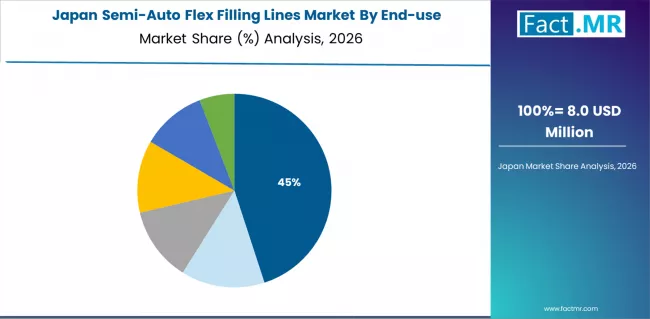
Semi Auto Flex Filling Lines Market Japan Market Share Analysis By End Use

The market in Japan is projected to grow at a CAGR of 5.0%. Adoption is focused on regional food processors specializing in high-quality local ingredients and on small-batch pharmaceutical auxiliary lines. The demand is for exceptionally reliable, precise, and space-efficient semi-auto systems. Local integrators play a crucial role in customizing solutions to fit exacting space constraints and unique packaging formats, with an emphasis on flawless operation and minimal waste.

  • The need to maintain extremely high quality and presentation standards for domestic gourmet and gift markets supports investment in precise, dependable machinery.
  • Technology adoption prioritizes ease of cleaning, quick changeover, and seamless fit within existing, often compact, production layouts.

Competitive Landscape of the Semi-Auto Flex Filling Lines Market

The competitive landscape features global packaging machinery giants serving the high-end precision segment and strong regional players offering cost-optimized, application-specific solutions. Competition centers on system reliability, ease of use, total cost of ownership, and the depth of local service and support.

Global players compete through advanced technology integration, such as sophisticated servo controls and hygienic design, while regional manufacturers win on affordability, customization for local film materials, and agile support. Key players are increasingly offering modular systems that can be upgraded, blurring the line between semi-auto and full automation to cater to growing customers. Success depends on understanding the nuanced needs of SME producers and providing tangible pathways for operational growth.

Key Players in the Semi-Auto Flex Filling Lines Market

  • MULTIVAC
  • Bosch Packaging Technology
  • Hualian
  • UFlex Machinery
  • Toppan Automation
  • GEA Group

Scope of the Report

Items Values
Quantitative Units (2026) USD 260.0 Million
End-use/Application SME Food & Cosmetics Producers, Pharma & Nutraceuticals, Private Label & Retail, Small-Scale Processors, Regional Food Processors, Others
System Type Semi-Auto Pouch & Bag Filling Lines, Small-Batch Flex Lines, Semi-Auto Vertical Fillers, Entry-Level Flex Fill Lines, Others
Material Flexible Film Laminates, High-Barrier Films, Cost-Optimized Laminates, Mono-PE Films, Others
Technology Servo-Driven Fillers + FFS Interface, Cleanroom-Compatible Filling, PLC-Integrated Controls, Operator-Assist Filling Systems, Others
Regions Covered North America, Europe, Asia Pacific, Latin America, MEA
Key Companies Profiled MULTIVAC, Bosch Packaging, Hualian, UFlex Machinery, Toppan Automation, GEA, and other leading players
Additional Attributes Market share analysis, total cost of ownership (TCO) comparisons, analysis of technology adoption barriers for SMEs, insights into ergonomic and safety features.

Semi-Auto Flex Filling Lines Market by Segments

  • By End-use/Application :

    • SME Food & Cosmetics Producers
    • Pharma & Nutraceuticals
    • Private Label & Retail
    • Small-Scale Processors
    • Regional Food Processors
    • Others
  • By System Type :

    • Semi-Auto Pouch & Bag Filling Lines
    • Small-Batch Flex Lines
    • Semi-Auto Vertical Fillers
    • Entry-Level Flex Fill Lines
    • Others
  • By Material :

    • Flexible Film Laminates
    • High-Barrier Films
    • Cost-Optimized Laminates
    • Mono-PE Films
    • Others
  • By Technology :

    • Servo-Driven Fillers + FFS Interface
    • Cleanroom-Compatible Filling
    • PLC-Integrated Controls
    • Operator-Assist Filling Systems
    • Others
  • By Region :

    • North America

      • USA
      • Canada
      • Mexico
    • Europe

      • Germany
      • UK
      • France
      • Italy
      • Spain
      • Nordic Countries
      • BENELUX
      • Rest of Europe
    • Asia Pacific

      • China
      • India
      • Japan
      • South Korea
      • Australia
      • Rest of Asia Pacific
    • Latin America

      • Brazil
      • Argentina
      • Rest of Latin America
    • MEA

      • Saudi Arabia
      • UAE
      • South Africa
      • Rest of MEA

Table of Content

  1. Executive Summary
    • Global Market Outlook
    • Demand to side Trends
    • Supply to side Trends
    • Technology Roadmap Analysis
    • Analysis and Recommendations
  2. Market Overview
    • Market Coverage / Taxonomy
    • Market Definition / Scope / Limitations
  3. Market Background
    • Market Dynamics
      • Drivers
      • Restraints
      • Opportunity
      • Trends
    • Scenario Forecast
      • Demand in Optimistic Scenario
      • Demand in Likely Scenario
      • Demand in Conservative Scenario
    • Opportunity Map Analysis
    • Product Life Cycle Analysis
    • Supply Chain Analysis
    • Investment Feasibility Matrix
    • Value Chain Analysis
    • PESTLE and Porter’s Analysis
    • Regulatory Landscape
    • Regional Parent Market Outlook
    • Production and Consumption Statistics
    • Import and Export Statistics
  4. Global Market Analysis 2021 to 2025 and Forecast, 2026 to 2036
    • Historical Market Size Value (USD Million) Analysis, 2021 to 2025
    • Current and Future Market Size Value (USD Million) Projections, 2026 to 2036
      • Y to o to Y Growth Trend Analysis
      • Absolute $ Opportunity Analysis
  5. Global Market Pricing Analysis 2021 to 2025 and Forecast 2026 to 2036
  6. Global Market Analysis 2021 to 2025 and Forecast 2026 to 2036, By End-use/Application
    • Introduction / Key Findings
    • Historical Market Size Value (USD Million) Analysis By End-use/Application, 2021 to 2025
    • Current and Future Market Size Value (USD Million) Analysis and Forecast By End-use/Application, 2026 to 2036
      • SME Food & Cosmetics Producers
      • Pharma & Nutraceuticals
      • Private Label & Retail
      • Small-Scale Processors
      • Regional Food Processors
      • Others
    • Y to o to Y Growth Trend Analysis By End-use/Application, 2021 to 2025
    • Absolute $ Opportunity Analysis By End-use/Application, 2026 to 2036
  7. Global Market Analysis 2021 to 2025 and Forecast 2026 to 2036, By System Type
    • Introduction / Key Findings
    • Historical Market Size Value (USD Million) Analysis By System Type, 2021 to 2025
    • Current and Future Market Size Value (USD Million) Analysis and Forecast By System Type, 2026 to 2036
      • Semi-Auto Pouch & Bag Filling Lines
      • Small-Batch Flex Lines
      • Semi-Auto Vertical Fillers
      • Entry-Level Flex Fill Lines
      • Others
    • Y to o to Y Growth Trend Analysis By System Type, 2021 to 2025
    • Absolute $ Opportunity Analysis By System Type, 2026 to 2036
  8. Global Market Analysis 2021 to 2025 and Forecast 2026 to 2036, By Material
    • Introduction / Key Findings
    • Historical Market Size Value (USD Million) Analysis By Material, 2021 to 2025
    • Current and Future Market Size Value (USD Million) Analysis and Forecast By Material, 2026 to 2036
      • Flexible Film Laminates
      • High-Barrier Films
      • Cost-Optimized Laminates
      • Mono-PE Films
      • Others
    • Y to o to Y Growth Trend Analysis By Material, 2021 to 2025
    • Absolute $ Opportunity Analysis By Material, 2026 to 2036
  9. Global Market Analysis 2021 to 2025 and Forecast 2026 to 2036, By Technology
    • Introduction / Key Findings
    • Historical Market Size Value (USD Million) Analysis By Technology, 2021 to 2025
    • Current and Future Market Size Value (USD Million) Analysis and Forecast By Technology, 2026 to 2036
      • Servo-Driven Fillers + FFS Interface
      • Cleanroom-Compatible Filling
      • PLC-Integrated Controls
      • Operator-Assist Filling Systems
      • Others
    • Y to o to Y Growth Trend Analysis By Technology, 2021 to 2025
    • Absolute $ Opportunity Analysis By Technology, 2026 to 2036
  10. Global Market Analysis 2021 to 2025 and Forecast 2026 to 2036, By Region
    • Introduction
    • Historical Market Size Value (USD Million) Analysis By Region, 2021 to 2025
    • Current Market Size Value (USD Million) Analysis and Forecast By Region, 2026 to 2036
      • North America
      • Latin America
      • Western Europe
      • Eastern Europe
      • East Asia
      • South Asia and Pacific
      • Middle East & Africa
    • Market Attractiveness Analysis By Region
  11. North America Market Analysis 2021 to 2025 and Forecast 2026 to 2036, By Country
    • Historical Market Size Value (USD Million) Trend Analysis By Market Taxonomy, 2021 to 2025
    • Market Size Value (USD Million) Forecast By Market Taxonomy, 2026 to 2036
      • By Country
        • USA
        • Canada
        • Mexico
      • By End-use/Application
      • By System Type
      • By Material
      • By Technology
    • Market Attractiveness Analysis
      • By Country
      • By End-use/Application
      • By System Type
      • By Material
      • By Technology
    • Key Takeaways
  12. Latin America Market Analysis 2021 to 2025 and Forecast 2026 to 2036, By Country
    • Historical Market Size Value (USD Million) Trend Analysis By Market Taxonomy, 2021 to 2025
    • Market Size Value (USD Million) Forecast By Market Taxonomy, 2026 to 2036
      • By Country
        • Brazil
        • Chile
        • Rest of Latin America
      • By End-use/Application
      • By System Type
      • By Material
      • By Technology
    • Market Attractiveness Analysis
      • By Country
      • By End-use/Application
      • By System Type
      • By Material
      • By Technology
    • Key Takeaways
  13. Western Europe Market Analysis 2021 to 2025 and Forecast 2026 to 2036, By Country
    • Historical Market Size Value (USD Million) Trend Analysis By Market Taxonomy, 2021 to 2025
    • Market Size Value (USD Million) Forecast By Market Taxonomy, 2026 to 2036
      • By Country
        • Germany
        • UK
        • Italy
        • Spain
        • France
        • Nordic
        • BENELUX
        • Rest of Western Europe
      • By End-use/Application
      • By System Type
      • By Material
      • By Technology
    • Market Attractiveness Analysis
      • By Country
      • By End-use/Application
      • By System Type
      • By Material
      • By Technology
    • Key Takeaways
  14. Eastern Europe Market Analysis 2021 to 2025 and Forecast 2026 to 2036, By Country
    • Historical Market Size Value (USD Million) Trend Analysis By Market Taxonomy, 2021 to 2025
    • Market Size Value (USD Million) Forecast By Market Taxonomy, 2026 to 2036
      • By Country
        • Russia
        • Poland
        • Hungary
        • Balkan & Baltic
        • Rest of Eastern Europe
      • By End-use/Application
      • By System Type
      • By Material
      • By Technology
    • Market Attractiveness Analysis
      • By Country
      • By End-use/Application
      • By System Type
      • By Material
      • By Technology
    • Key Takeaways
  15. East Asia Market Analysis 2021 to 2025 and Forecast 2026 to 2036, By Country
    • Historical Market Size Value (USD Million) Trend Analysis By Market Taxonomy, 2021 to 2025
    • Market Size Value (USD Million) Forecast By Market Taxonomy, 2026 to 2036
      • By Country
        • China
        • Japan
        • South Korea
      • By End-use/Application
      • By System Type
      • By Material
      • By Technology
    • Market Attractiveness Analysis
      • By Country
      • By End-use/Application
      • By System Type
      • By Material
      • By Technology
    • Key Takeaways
  16. South Asia and Pacific Market Analysis 2021 to 2025 and Forecast 2026 to 2036, By Country
    • Historical Market Size Value (USD Million) Trend Analysis By Market Taxonomy, 2021 to 2025
    • Market Size Value (USD Million) Forecast By Market Taxonomy, 2026 to 2036
      • By Country
        • India
        • ASEAN
        • Australia & New Zealand
        • Rest of South Asia and Pacific
      • By End-use/Application
      • By System Type
      • By Material
      • By Technology
    • Market Attractiveness Analysis
      • By Country
      • By End-use/Application
      • By System Type
      • By Material
      • By Technology
    • Key Takeaways
  17. Middle East & Africa Market Analysis 2021 to 2025 and Forecast 2026 to 2036, By Country
    • Historical Market Size Value (USD Million) Trend Analysis By Market Taxonomy, 2021 to 2025
    • Market Size Value (USD Million) Forecast By Market Taxonomy, 2026 to 2036
      • By Country
        • Kingdom of Saudi Arabia
        • Other GCC Countries
        • Turkiye
        • South Africa
        • Other African Union
        • Rest of Middle East & Africa
      • By End-use/Application
      • By System Type
      • By Material
      • By Technology
    • Market Attractiveness Analysis
      • By Country
      • By End-use/Application
      • By System Type
      • By Material
      • By Technology
    • Key Takeaways
  18. Key Countries Market Analysis
    • USA
      • Pricing Analysis
      • Market Share Analysis, 2025
        • By End-use/Application
        • By System Type
        • By Material
        • By Technology
    • Canada
      • Pricing Analysis
      • Market Share Analysis, 2025
        • By End-use/Application
        • By System Type
        • By Material
        • By Technology
    • Mexico
      • Pricing Analysis
      • Market Share Analysis, 2025
        • By End-use/Application
        • By System Type
        • By Material
        • By Technology
    • Brazil
      • Pricing Analysis
      • Market Share Analysis, 2025
        • By End-use/Application
        • By System Type
        • By Material
        • By Technology
    • Chile
      • Pricing Analysis
      • Market Share Analysis, 2025
        • By End-use/Application
        • By System Type
        • By Material
        • By Technology
    • Germany
      • Pricing Analysis
      • Market Share Analysis, 2025
        • By End-use/Application
        • By System Type
        • By Material
        • By Technology
    • UK
      • Pricing Analysis
      • Market Share Analysis, 2025
        • By End-use/Application
        • By System Type
        • By Material
        • By Technology
    • Italy
      • Pricing Analysis
      • Market Share Analysis, 2025
        • By End-use/Application
        • By System Type
        • By Material
        • By Technology
    • Spain
      • Pricing Analysis
      • Market Share Analysis, 2025
        • By End-use/Application
        • By System Type
        • By Material
        • By Technology
    • France
      • Pricing Analysis
      • Market Share Analysis, 2025
        • By End-use/Application
        • By System Type
        • By Material
        • By Technology
    • India
      • Pricing Analysis
      • Market Share Analysis, 2025
        • By End-use/Application
        • By System Type
        • By Material
        • By Technology
    • ASEAN
      • Pricing Analysis
      • Market Share Analysis, 2025
        • By End-use/Application
        • By System Type
        • By Material
        • By Technology
    • Australia & New Zealand
      • Pricing Analysis
      • Market Share Analysis, 2025
        • By End-use/Application
        • By System Type
        • By Material
        • By Technology
    • China
      • Pricing Analysis
      • Market Share Analysis, 2025
        • By End-use/Application
        • By System Type
        • By Material
        • By Technology
    • Japan
      • Pricing Analysis
      • Market Share Analysis, 2025
        • By End-use/Application
        • By System Type
        • By Material
        • By Technology
    • South Korea
      • Pricing Analysis
      • Market Share Analysis, 2025
        • By End-use/Application
        • By System Type
        • By Material
        • By Technology
    • Russia
      • Pricing Analysis
      • Market Share Analysis, 2025
        • By End-use/Application
        • By System Type
        • By Material
        • By Technology
    • Poland
      • Pricing Analysis
      • Market Share Analysis, 2025
        • By End-use/Application
        • By System Type
        • By Material
        • By Technology
    • Hungary
      • Pricing Analysis
      • Market Share Analysis, 2025
        • By End-use/Application
        • By System Type
        • By Material
        • By Technology
    • Kingdom of Saudi Arabia
      • Pricing Analysis
      • Market Share Analysis, 2025
        • By End-use/Application
        • By System Type
        • By Material
        • By Technology
    • Turkiye
      • Pricing Analysis
      • Market Share Analysis, 2025
        • By End-use/Application
        • By System Type
        • By Material
        • By Technology
    • South Africa
      • Pricing Analysis
      • Market Share Analysis, 2025
        • By End-use/Application
        • By System Type
        • By Material
        • By Technology
  19. Market Structure Analysis
    • Competition Dashboard
    • Competition Benchmarking
    • Market Share Analysis of Top Players
      • By Regional
      • By End-use/Application
      • By System Type
      • By Material
      • By Technology
  20. Competition Analysis
    • Competition Deep Dive
      • MULTIVAC
        • Overview
        • Product Portfolio
        • Profitability by Market Segments (Product/Age /Sales Channel/Region)
        • Sales Footprint
        • Strategy Overview
          • Marketing Strategy
          • Product Strategy
          • Channel Strategy
      • Bosch Packaging
      • Hualian
      • UFlex Machinery
      • Local Integrators
      • Toppan Automation
      • GEA
  21. Assumptions & Acronyms Used
  22. Research Methodology

List Of Table

  • Table 1: Global Market Value (USD Million) Forecast by Region, 2021 to 2036
  • Table 2: Global Market Value (USD Million) Forecast by End-use/Application, 2021 to 2036
  • Table 3: Global Market Value (USD Million) Forecast by System Type, 2021 to 2036
  • Table 4: Global Market Value (USD Million) Forecast by Material, 2021 to 2036
  • Table 5: Global Market Value (USD Million) Forecast by Technology, 2021 to 2036
  • Table 6: North America Market Value (USD Million) Forecast by Country, 2021 to 2036
  • Table 7: North America Market Value (USD Million) Forecast by End-use/Application, 2021 to 2036
  • Table 8: North America Market Value (USD Million) Forecast by System Type, 2021 to 2036
  • Table 9: North America Market Value (USD Million) Forecast by Material, 2021 to 2036
  • Table 10: North America Market Value (USD Million) Forecast by Technology, 2021 to 2036
  • Table 11: Latin America Market Value (USD Million) Forecast by Country, 2021 to 2036
  • Table 12: Latin America Market Value (USD Million) Forecast by End-use/Application, 2021 to 2036
  • Table 13: Latin America Market Value (USD Million) Forecast by System Type, 2021 to 2036
  • Table 14: Latin America Market Value (USD Million) Forecast by Material, 2021 to 2036
  • Table 15: Latin America Market Value (USD Million) Forecast by Technology, 2021 to 2036
  • Table 16: Western Europe Market Value (USD Million) Forecast by Country, 2021 to 2036
  • Table 17: Western Europe Market Value (USD Million) Forecast by End-use/Application, 2021 to 2036
  • Table 18: Western Europe Market Value (USD Million) Forecast by System Type, 2021 to 2036
  • Table 19: Western Europe Market Value (USD Million) Forecast by Material, 2021 to 2036
  • Table 20: Western Europe Market Value (USD Million) Forecast by Technology, 2021 to 2036
  • Table 21: Eastern Europe Market Value (USD Million) Forecast by Country, 2021 to 2036
  • Table 22: Eastern Europe Market Value (USD Million) Forecast by End-use/Application, 2021 to 2036
  • Table 23: Eastern Europe Market Value (USD Million) Forecast by System Type, 2021 to 2036
  • Table 24: Eastern Europe Market Value (USD Million) Forecast by Material, 2021 to 2036
  • Table 25: Eastern Europe Market Value (USD Million) Forecast by Technology, 2021 to 2036
  • Table 26: East Asia Market Value (USD Million) Forecast by Country, 2021 to 2036
  • Table 27: East Asia Market Value (USD Million) Forecast by End-use/Application, 2021 to 2036
  • Table 28: East Asia Market Value (USD Million) Forecast by System Type, 2021 to 2036
  • Table 29: East Asia Market Value (USD Million) Forecast by Material, 2021 to 2036
  • Table 30: East Asia Market Value (USD Million) Forecast by Technology, 2021 to 2036
  • Table 31: South Asia and Pacific Market Value (USD Million) Forecast by Country, 2021 to 2036
  • Table 32: South Asia and Pacific Market Value (USD Million) Forecast by End-use/Application, 2021 to 2036
  • Table 33: South Asia and Pacific Market Value (USD Million) Forecast by System Type, 2021 to 2036
  • Table 34: South Asia and Pacific Market Value (USD Million) Forecast by Material, 2021 to 2036
  • Table 35: South Asia and Pacific Market Value (USD Million) Forecast by Technology, 2021 to 2036
  • Table 36: Middle East & Africa Market Value (USD Million) Forecast by Country, 2021 to 2036
  • Table 37: Middle East & Africa Market Value (USD Million) Forecast by End-use/Application, 2021 to 2036
  • Table 38: Middle East & Africa Market Value (USD Million) Forecast by System Type, 2021 to 2036
  • Table 39: Middle East & Africa Market Value (USD Million) Forecast by Material, 2021 to 2036
  • Table 40: Middle East & Africa Market Value (USD Million) Forecast by Technology, 2021 to 2036

List Of Figures

  • Figure 1: Global Market Pricing Analysis
  • Figure 2: Global Market Value (USD Million) Forecast 2021 to 2036
  • Figure 3: Global Market Value Share and BPS Analysis by End-use/Application, 2026 and 2036
  • Figure 4: Global Market Y to o to Y Growth Comparison by End-use/Application, 2026 to 2036
  • Figure 5: Global Market Attractiveness Analysis by End-use/Application
  • Figure 6: Global Market Value Share and BPS Analysis by System Type, 2026 and 2036
  • Figure 7: Global Market Y to o to Y Growth Comparison by System Type, 2026 to 2036
  • Figure 8: Global Market Attractiveness Analysis by System Type
  • Figure 9: Global Market Value Share and BPS Analysis by Material, 2026 and 2036
  • Figure 10: Global Market Y to o to Y Growth Comparison by Material, 2026 to 2036
  • Figure 11: Global Market Attractiveness Analysis by Material
  • Figure 12: Global Market Value Share and BPS Analysis by Technology, 2026 and 2036
  • Figure 13: Global Market Y to o to Y Growth Comparison by Technology, 2026 to 2036
  • Figure 14: Global Market Attractiveness Analysis by Technology
  • Figure 15: Global Market Value (USD Million) Share and BPS Analysis by Region, 2026 and 2036
  • Figure 16: Global Market Y to o to Y Growth Comparison by Region, 2026 to 2036
  • Figure 17: Global Market Attractiveness Analysis by Region
  • Figure 18: North America Market Incremental Dollar Opportunity, 2026 to 2036
  • Figure 19: Latin America Market Incremental Dollar Opportunity, 2026 to 2036
  • Figure 20: Western Europe Market Incremental Dollar Opportunity, 2026 to 2036
  • Figure 21: Eastern Europe Market Incremental Dollar Opportunity, 2026 to 2036
  • Figure 22: East Asia Market Incremental Dollar Opportunity, 2026 to 2036
  • Figure 23: South Asia and Pacific Market Incremental Dollar Opportunity, 2026 to 2036
  • Figure 24: Middle East & Africa Market Incremental Dollar Opportunity, 2026 to 2036
  • Figure 25: North America Market Value Share and BPS Analysis by Country, 2026 and 2036
  • Figure 26: North America Market Value Share and BPS Analysis by End-use/Application, 2026 and 2036
  • Figure 27: North America Market Y to o to Y Growth Comparison by End-use/Application, 2026 to 2036
  • Figure 28: North America Market Attractiveness Analysis by End-use/Application
  • Figure 29: North America Market Value Share and BPS Analysis by System Type, 2026 and 2036
  • Figure 30: North America Market Y to o to Y Growth Comparison by System Type, 2026 to 2036
  • Figure 31: North America Market Attractiveness Analysis by System Type
  • Figure 32: North America Market Value Share and BPS Analysis by Material, 2026 and 2036
  • Figure 33: North America Market Y to o to Y Growth Comparison by Material, 2026 to 2036
  • Figure 34: North America Market Attractiveness Analysis by Material
  • Figure 35: North America Market Value Share and BPS Analysis by Technology, 2026 and 2036
  • Figure 36: North America Market Y to o to Y Growth Comparison by Technology, 2026 to 2036
  • Figure 37: North America Market Attractiveness Analysis by Technology
  • Figure 38: Latin America Market Value Share and BPS Analysis by Country, 2026 and 2036
  • Figure 39: Latin America Market Value Share and BPS Analysis by End-use/Application, 2026 and 2036
  • Figure 40: Latin America Market Y to o to Y Growth Comparison by End-use/Application, 2026 to 2036
  • Figure 41: Latin America Market Attractiveness Analysis by End-use/Application
  • Figure 42: Latin America Market Value Share and BPS Analysis by System Type, 2026 and 2036
  • Figure 43: Latin America Market Y to o to Y Growth Comparison by System Type, 2026 to 2036
  • Figure 44: Latin America Market Attractiveness Analysis by System Type
  • Figure 45: Latin America Market Value Share and BPS Analysis by Material, 2026 and 2036
  • Figure 46: Latin America Market Y to o to Y Growth Comparison by Material, 2026 to 2036
  • Figure 47: Latin America Market Attractiveness Analysis by Material
  • Figure 48: Latin America Market Value Share and BPS Analysis by Technology, 2026 and 2036
  • Figure 49: Latin America Market Y to o to Y Growth Comparison by Technology, 2026 to 2036
  • Figure 50: Latin America Market Attractiveness Analysis by Technology
  • Figure 51: Western Europe Market Value Share and BPS Analysis by Country, 2026 and 2036
  • Figure 52: Western Europe Market Value Share and BPS Analysis by End-use/Application, 2026 and 2036
  • Figure 53: Western Europe Market Y to o to Y Growth Comparison by End-use/Application, 2026 to 2036
  • Figure 54: Western Europe Market Attractiveness Analysis by End-use/Application
  • Figure 55: Western Europe Market Value Share and BPS Analysis by System Type, 2026 and 2036
  • Figure 56: Western Europe Market Y to o to Y Growth Comparison by System Type, 2026 to 2036
  • Figure 57: Western Europe Market Attractiveness Analysis by System Type
  • Figure 58: Western Europe Market Value Share and BPS Analysis by Material, 2026 and 2036
  • Figure 59: Western Europe Market Y to o to Y Growth Comparison by Material, 2026 to 2036
  • Figure 60: Western Europe Market Attractiveness Analysis by Material
  • Figure 61: Western Europe Market Value Share and BPS Analysis by Technology, 2026 and 2036
  • Figure 62: Western Europe Market Y to o to Y Growth Comparison by Technology, 2026 to 2036
  • Figure 63: Western Europe Market Attractiveness Analysis by Technology
  • Figure 64: Eastern Europe Market Value Share and BPS Analysis by Country, 2026 and 2036
  • Figure 65: Eastern Europe Market Value Share and BPS Analysis by End-use/Application, 2026 and 2036
  • Figure 66: Eastern Europe Market Y to o to Y Growth Comparison by End-use/Application, 2026 to 2036
  • Figure 67: Eastern Europe Market Attractiveness Analysis by End-use/Application
  • Figure 68: Eastern Europe Market Value Share and BPS Analysis by System Type, 2026 and 2036
  • Figure 69: Eastern Europe Market Y to o to Y Growth Comparison by System Type, 2026 to 2036
  • Figure 70: Eastern Europe Market Attractiveness Analysis by System Type
  • Figure 71: Eastern Europe Market Value Share and BPS Analysis by Material, 2026 and 2036
  • Figure 72: Eastern Europe Market Y to o to Y Growth Comparison by Material, 2026 to 2036
  • Figure 73: Eastern Europe Market Attractiveness Analysis by Material
  • Figure 74: Eastern Europe Market Value Share and BPS Analysis by Technology, 2026 and 2036
  • Figure 75: Eastern Europe Market Y to o to Y Growth Comparison by Technology, 2026 to 2036
  • Figure 76: Eastern Europe Market Attractiveness Analysis by Technology
  • Figure 77: East Asia Market Value Share and BPS Analysis by Country, 2026 and 2036
  • Figure 78: East Asia Market Value Share and BPS Analysis by End-use/Application, 2026 and 2036
  • Figure 79: East Asia Market Y to o to Y Growth Comparison by End-use/Application, 2026 to 2036
  • Figure 80: East Asia Market Attractiveness Analysis by End-use/Application
  • Figure 81: East Asia Market Value Share and BPS Analysis by System Type, 2026 and 2036
  • Figure 82: East Asia Market Y to o to Y Growth Comparison by System Type, 2026 to 2036
  • Figure 83: East Asia Market Attractiveness Analysis by System Type
  • Figure 84: East Asia Market Value Share and BPS Analysis by Material, 2026 and 2036
  • Figure 85: East Asia Market Y to o to Y Growth Comparison by Material, 2026 to 2036
  • Figure 86: East Asia Market Attractiveness Analysis by Material
  • Figure 87: East Asia Market Value Share and BPS Analysis by Technology, 2026 and 2036
  • Figure 88: East Asia Market Y to o to Y Growth Comparison by Technology, 2026 to 2036
  • Figure 89: East Asia Market Attractiveness Analysis by Technology
  • Figure 90: South Asia and Pacific Market Value Share and BPS Analysis by Country, 2026 and 2036
  • Figure 91: South Asia and Pacific Market Value Share and BPS Analysis by End-use/Application, 2026 and 2036
  • Figure 92: South Asia and Pacific Market Y to o to Y Growth Comparison by End-use/Application, 2026 to 2036
  • Figure 93: South Asia and Pacific Market Attractiveness Analysis by End-use/Application
  • Figure 94: South Asia and Pacific Market Value Share and BPS Analysis by System Type, 2026 and 2036
  • Figure 95: South Asia and Pacific Market Y to o to Y Growth Comparison by System Type, 2026 to 2036
  • Figure 96: South Asia and Pacific Market Attractiveness Analysis by System Type
  • Figure 97: South Asia and Pacific Market Value Share and BPS Analysis by Material, 2026 and 2036
  • Figure 98: South Asia and Pacific Market Y to o to Y Growth Comparison by Material, 2026 to 2036
  • Figure 99: South Asia and Pacific Market Attractiveness Analysis by Material
  • Figure 100: South Asia and Pacific Market Value Share and BPS Analysis by Technology, 2026 and 2036
  • Figure 101: South Asia and Pacific Market Y to o to Y Growth Comparison by Technology, 2026 to 2036
  • Figure 102: South Asia and Pacific Market Attractiveness Analysis by Technology
  • Figure 103: Middle East & Africa Market Value Share and BPS Analysis by Country, 2026 and 2036
  • Figure 104: Middle East & Africa Market Value Share and BPS Analysis by End-use/Application, 2026 and 2036
  • Figure 105: Middle East & Africa Market Y to o to Y Growth Comparison by End-use/Application, 2026 to 2036
  • Figure 106: Middle East & Africa Market Attractiveness Analysis by End-use/Application
  • Figure 107: Middle East & Africa Market Value Share and BPS Analysis by System Type, 2026 and 2036
  • Figure 108: Middle East & Africa Market Y to o to Y Growth Comparison by System Type, 2026 to 2036
  • Figure 109: Middle East & Africa Market Attractiveness Analysis by System Type
  • Figure 110: Middle East & Africa Market Value Share and BPS Analysis by Material, 2026 and 2036
  • Figure 111: Middle East & Africa Market Y to o to Y Growth Comparison by Material, 2026 to 2036
  • Figure 112: Middle East & Africa Market Attractiveness Analysis by Material
  • Figure 113: Middle East & Africa Market Value Share and BPS Analysis by Technology, 2026 and 2036
  • Figure 114: Middle East & Africa Market Y to o to Y Growth Comparison by Technology, 2026 to 2036
  • Figure 115: Middle East & Africa Market Attractiveness Analysis by Technology
  • Figure 116: Global Market - Tier Structure Analysis
  • Figure 117: Global Market - Company Share Analysis

- FAQs -

How big is the semi-auto flex filling lines market in 2026?

The global semi-auto flex filling lines market is estimated to be valued at USD 260.0 million in 2026.

What will be the size of semi-auto flex filling lines market in 2036?

The market size for the semi-auto flex filling lines market is projected to reach USD 590.0 million by 2036.

How much will be the semi-auto flex filling lines market growth between 2026 and 2036?

The semi-auto flex filling lines market is expected to grow at a 8.5% CAGR between 2026 and 2036.

What are the key product types in the semi-auto flex filling lines market?

The key product types in semi-auto flex filling lines market are sme food & cosmetics producers, pharma & nutraceuticals, private label & retail, small-scale processors, regional food processors and others.

Which system type segment to contribute significant share in the semi-auto flex filling lines market in 2026?

In terms of system type, semi-auto pouch & bag filling lines segment to command 50.0% share in the semi-auto flex filling lines market in 2026.

Semi-Auto Flex Filling Lines Market