- Market Value (2025): USD 315.5 Mn
- Estimated Value (2026): 335.0 Mn
- Forecast Value (2036): USD 610.0 Mn
- CAGR (2026-2036): 6.2%
What is the Silicone-Free Release Coatings Market forecast to be worth by 2036?
USD 335.0 million in 2026 to USD 610.0 million by 2036, at a 6.2% CAGR.
- The market reached USD 315.5 million in 2025, supported by the move from early product testing to regular commercial use.
- Demand is projected to increase from USD 335.0 million in 2026 to USD 610.0 million by 2036. Growth is expected to come from wider use of labels and polyolefin-based coatings across commercial applications.
- The market is forecast to record a 6.2% CAGR, driven by the need for coatings that allow clean label removal, reduce unwanted material, and improve recycling results.
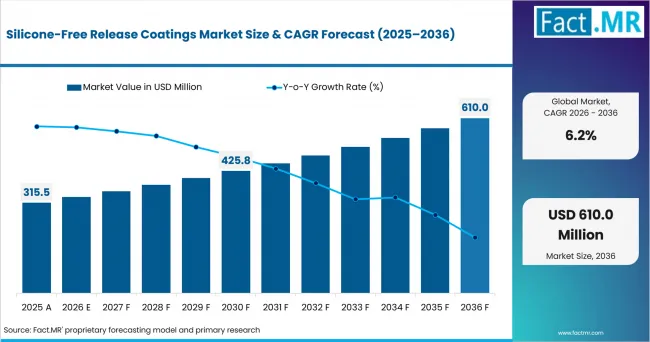
Silicone Free Release Coatings Market Market Value Analysis | Source: Fact.MR
What are the defining numbers behind Silicone-Free Release Coatings Market growth?
USD 275.0 million absolute opportunity by 2036 sits with labels and tapes.
- Demand Drivers in the Market
- Label materials must come off cleanly during washing and should not reduce the quality of recycled plastic. Silicone-free coatings may be used when standard materials create problems during washing or sorting.
- Polyolefin-based coatings are expected to see wider use in packaging made from one main material. This helps companies reduce mixed materials while keep in good product performance.
- Gravure remains common because it gives better control over coating thickness, surface quality, and production speed. A coating must perform well during full-scale production, not only in lab tests.
- Label companies need materials that remain stable during storage, printing, cutting, and use.Poor performance at any stage can lead to rejected products or customer complaints.
- Key Segments Analyzed
- By End Use: Labels are expected to hold 42% share in 2026, helped by their wide use in bottle washing, dispensing, and recycling applications.
- By Chemistry: Polyolefin is projected to account for 34% share in 2026, with strong use in plastic packaging and lower dependence on silicone-based materials.
- By Coating Method: Gravure is anticipated to capture 34% share in 2026, offering steady coating control and reliable performance in large production runs.
- By Substrate: Paper is estimated to represent 32% share in 2026, reflecting its common use in liner materials andeasy fit with existing production lines.
- By Buyer Type: Converters are forecast to account for 42% share in 2026, covering material processing, label production, and product approval.
- Analyst Opinion at Fact.MR
- Shambhu Nath Jha, Senior Analyst at Fact.MR, states, “Most companies are expected to test new release coatings before using them at a wider scale. The product must perform well during printing, cutting, storage, and use, while also avoiding problems during washing and recycling. Clear test records will make it easier for companies to approve a change. Wider use is likely to follow once the product proves reliable in regular production.”
- Strategic Implications
- New coatings should be tested during normal printing, cutting, storage, and dispensing. Clear results from these trials are more useful than broad product claims.
- Companies should compare the current coating with the new option under the same working conditions. The change should not affect package appearance, label use, recycling, or regular product supply.
- Distributors should keep test reports and product documents ready before adding a new grade. Customers often ask how the coating performs ondifferent materialsand in different uses.
Packaging rulesare encouraging companies to think about recycling from the start. This supports materials that help labels come off cleanly and keep recycled plastic in better condition. The coating must still work well during normal use. Companies now expect it to provide reliable release performance without creating problems during recycling.
Germany is expected to post a7.1% CAGR by 2036, supported by strict product checks and a well-developed packaging sector. Brazil is estimated to grow at a6.5% CAGR through 2036 with rising local production and wider use of recyclable packaging. The United States is forecast to record a 5.9% CAGR from 2026 to 2036, supported by steady packaging demand and greater focus on recycling.
How does the Silicone-Free Release Coatings Market break down by segment?
Labelsaccounts lead end use with 42% share in 2026, while polyolefin leads chemistry at 34%,
Which End Use dominates?
Labels hold 42% share in 2026.
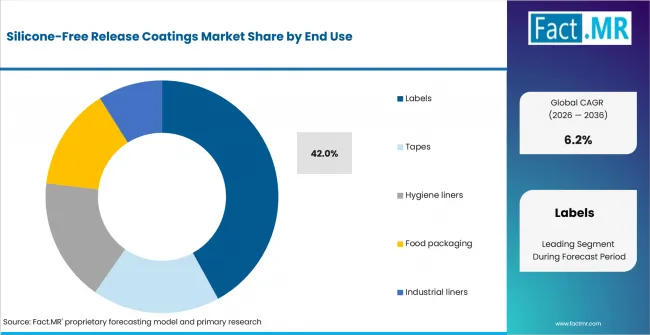
Silicone Free Release Coatings Market Analysis By End Use | Source: Fact.MR
Labels lead because their performance is easy to check during normal use. The liner must release cleanly, stay smooth, work well during printing and cutting, and run properly on packing lines. In recyclable packaging, the label should also come off during washing without lowering the quality of the recycled plastic.
Companies usually test labels under storage, heat, handling, and production conditions before approving a new coating. Tapes, hygiene liners, food packaging, and industrial liners also create demand, but they often need longer testing and stricter performance checks.
What leads the Chemistry segment?
Polyolefin accounts for 34% share in 2026.
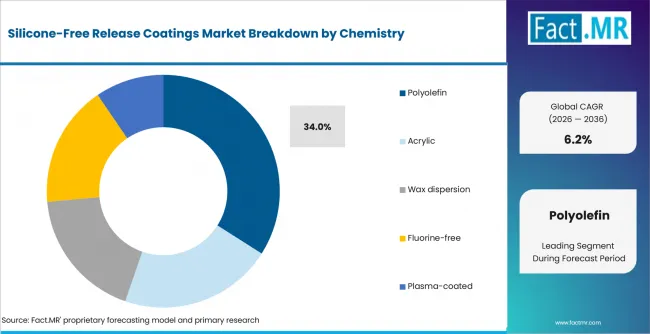
Silicone Free Release Coatings Market Analysis By Chemistry | Source: Fact.MR
Its strong position comes from its good fit with plastic packaging and its ability to reduce the use of mixed materials. Polyolefin is already common in films and liners, so companies are familiar with how it performs during production. Acrylic, wax dispersion, fluorine-free, and plasma-coated optionsremainuseful when different heat resistance, release performance, surface fit, or cost isrequired.
Before placing larger orders, companies usually check whether the material gives the same results after printing, cutting, storage, and repeated production runs.
How does Coating Method shape demand?
Gravure holds34% share in 2026.
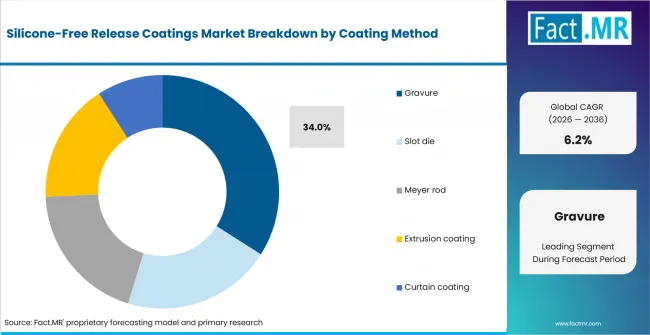
Silicone Free Release Coatings Market Analysis By Coating Method | Source: Fact.MR
Gravure is widely used because it gives steady coating thickness and even surface coverage during long production runs. Companies can also compare new coatings with current materials on the same equipment, which makes testing easier.
Slot die, Meyer rod, extrusion coating, and curtain coating remain useful for products that need a different coating thickness, drying speed, or surface finish. Gravure is more likely to be approved when several production runs show the same results under normal factory conditions.
Where isSubstrate demand strongest?
Paper leads with32% share in 2026.
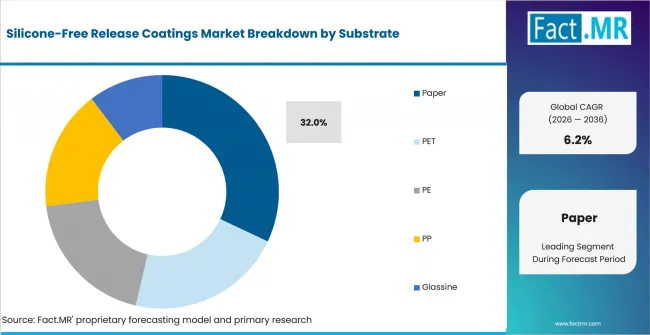
Silicone Free Release Coatings Market Analysis By Substrate | Source: Fact.MR
Paperremainswidely used inreleaseliners for labels and tapes. Companies already know how it behaves during coating, printing, cutting, and regular handling, which makes product testing easier. PET, PE, PP, and glassine are also used when greater strength, better moisture protection, or a closer fit with plastic packaging is needed.
Paper is more likely to be approved when it keeps its shape, holds the coating well, and gives steady release performance after storage, handling, and repeated production runs.
What supports Buyer Type adoption?
Converters hold42% share in 2026.
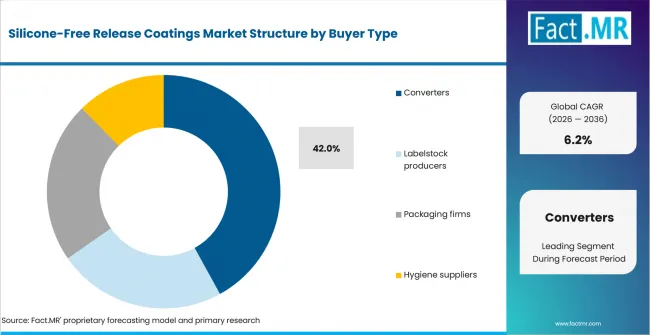
Silicone Free Release Coatings Market Analysis By Buyer Type | Source: Fact.MR
Converters play a central role because the coating, material, adhesive, production method, and customer needs must all work together during manufacturing. They look for products that run well on existing equipment, meet customer requirements, and do not create extra production problems. Release performance, waste, delivery time, technical help, and customer approval all affect the final choice.
The main concern is reliable performance. If the coating causes poor release, sticking, contamination, or dispensing problems, converters are usually the first to receive the complaint.
What is accelerating Silicone-Free Release Coatings Market adoption, and what is holding it back?
Flake quality is expected to support market growth, while testing costs and production limits may slow adoption.
Drivers Impact Analysis
| DRIVER | (~) % IMPACT ON CAGR | GEOGRAPHIC RELEVANCE | IMPACT TIMELINE |
|---|---|---|---|
| Label release testing | +0.6% | Europe and North America | Short term (<= 2 years) |
| Labels and tapes approval programs | +0.5% | Asia Pacific | Medium term (2-4 years) |
| Local support near label converters | +0.4% | Global | Long term (>= 4 years) |
Source: Fact.MR analysis. Updated Jul 15, 2026
- Label release testing: Clear test results help companies compare a new coating with the current material. Clean removal, steady release, storage performance, and smooth dispensing make the product easier to assess.
- Labels andtapesapproval programs: A clear testing process helps companies move from samples to full production. Approval is more likely when the new product lowers waste, reduces rework, and performs well in repeated trials.
- Local support near label converters: Nearby technical help makes it easier to solve problems with coating, drying, materials, and adhesives. Fast support can reduce delays and help companies keep production running smoothly.
Opportunity Impact Analysis
| OPPORTUNITY | (~) % IMPACT ON CAGR | GEOGRAPHIC RELEVANCE | IMPACT TIMELINE |
|---|---|---|---|
| Grades tuned for Labels and tapes | +0.5% | Global | Medium term (2-4 years) |
| Application labs for Polyolefin | +0.4% | Asia Pacific and Europe | Short term (<= 2 years) |
| Rule-ready documentation | +0.4% | Europe and United Kingdom | Medium term (2-4 years) |
Source: Fact.MR analysis. Updated Jul 15, 2026
- Grades for labels and tapes: Products made for specificlabeland tape uses are easier to test and approve. Companies look for steady release, good storage performance, and a close fit with the chosen material and adhesive.
- Polyolefin testing: Production-style testing helps show how the coating performs on actual equipment. Coating thickness, drying, material choice, and surface treatment can all affect the final result.
- Clear product documents: Complete and simple records help companies review a product faster. These records should cover material content, performance, recycling, and trial results.
- Local bottle-washing trials: Plant trials help confirm whether lab results hold up during normal use. India and Brazil may see more activity as local packaging and recycling systems improve.
Restraints Impact Analysis
| RESTRAINT | (~) % IMPACT ON CAGR | GEOGRAPHIC RELEVANCE | IMPACT TIMELINE |
|---|---|---|---|
| Qualification cost | -0.4% | Global processors | Medium term (2-4 years) |
| Fit limits in Polyolefin | -0.3% | Global | Short term (<= 2 years) |
| Documentation burden | -0.3% | Europe and North America | Medium term (2-4 years) |
| Scale-up risk | -0.2% | High-volume plants | Long term (>= 4 years) |
Source: Fact.MR analysis. Updated Jul 15, 2026
- Testing cost: A new coating must go through product trials, storage checks, aging tests, and customer approval before regular use. Companies may delay the change when the expected benefit is small.
- Limits of polyolefin: A material that works well in one label may not work the same way in another. Changes in the coating, base material, or adhesive can affect the final result.
- Product documents: Companies in Europe and North America often need clear records before approving a new coating. Missing or incomplete documents can slow the review process.
- Large-scale production risk: Changing a product in a high-volume plant can lead to waste, delays, and complaints if the new coating does not perform well. Companies usually move ahead only after strong test results are available.
Which countries are scaling Silicone-Free Release Coatings Market fastest?
Germany 7.1%, Brazil 6.5%, United States 5.9%.
.webp "Top Country Growth Comparison — Silicone Free Release Coatings Market CAGR (2026–2036)")
Top Country Growth Comparison — Silicone Free Release Coatings Market CAGR (2026–2036) | Source: Fact.MR
Regional analysis covers North America, Europe, Asia Pacific, Latin America, and the Middle East and Africa.
| COUNTRY | CAGR |
|---|---|
| Germany | 7.1% |
| Brazil | 6.5% |
| United States | 5.9% |
Source: Fact.MR analysis. Updated Jul 15, 2026
What supports the Germany outlook?
7.1% CAGR, linked to strict product checks and strong recycling standards.
Germany places strong focus on product safety, clear records, and recycling results before approving a new coating. Companies usually review how the material performs during normal production and whether it creates problems later in the packaging life cycle. This careful process can slow adoption, but it also gives new products a stronger place in the market once they pass testing. Coatings with clear trial results and complete documents are more likely to gain regular use.
How is Brazil developing demand?
6.5% CAGR, driven by growing use of packaged food, beverages, personal care products, and retail labels.
Brazil is seeing wider use of labels, tapes, and flexible packaging across several consumer products. Silicone-free coatings may gain interest where companies need clean release and fewer problems during recycling. Growth will also depend on price and whether local testing is easy to arrange. Products that perform well in normal production and distribution conditions are more likely to move into regular use.
What underpins United States' growth?
5.9% CAGR, supported byestablishedpackaging production and steady demand for labels and tapes.
The United States has a well-developed packaging industry, so companies usually review new coatings carefully before making a change. Silicone-free products are more likely to be accepted when they improve recycling and perform well during regular production. Ongoing work on new packaging designs also supports market growth. Most companies prefer to see clear test results before using a new coating in large production runs.
Who leads the Silicone-Free Release Coatings Market?
Michel manand Loparex are the main companies in this group, followed by Mayzo,Rayven,Evonik Industries AG, and Henkel AG & Co.KGaA.
Market position depends on how well their products perform during normal production, how steady their supply remains, and how clearly they present test results. Companies are more likely to keep using a coating when it gives the same result across several production runs and does not create delays, waste, or quality problems.
Competition also depends on the level of help available during testing and product use. Customers often need support when choosing the right coating, checking material fit, adjusting production settings, or solving problems on the line. Clear records are also important, especially when a product must pass internal review before full use.
Which companies are the key providers?
Michelman and Loparex are key providers. Mayzo and Rayven are also profiled. Evonik Industries AG and Henkel AG & Co. KGaA complete the company set.
- Michelman
- Loparex
- Mayzo
- Rayven
- Evonik Industries AG
- Henkel AG & Co. KGaA
Bibliography
- Association of Plastic Recyclers. (2025, February 21). Recyclability beyond the numbers: The impact of labels on plastic packaging.
- CELAB Europe. (2026, February 26). Recycling release liner in practice.
- European Parliament & Council of the European Union. (2025, January 22). Regulation (EU) 2025/40 of the European Parliament and of the Council of 19 December 2024 on packaging and packaging waste. EUR-Lex.
- Evonik Industries AG. (2025, April 11). Evonik launches TEGO® Wet 288 for substrate wetting of waterborne and radiation-curing formulations.
This Report Addresses
- The report provides strategic intelligence on the market across end-use and chemistry choices.
- Regional outlook evaluates China and India with Germany, Brazil, and the United States as additional growth countries.
- Competitive analysis profiles Michelman and Loparex followed by the remaining named providers.
- Use-case assessment covers labels and tapes, along with adjacent applications in release liners and specialty release coatings.
- The market outlook considers label demand, polyolefin use, coating methods, substrate preferences, converter activity, and product qualification requirements across key applications.
What does the Silicone-Free Release Coatings Market cover?
Silicone-free release coating systems used in labels, tapes, hygiene products, packaging, and other release-liner applications.
The Silicone-Free Release Coatings Market covers coating systems designed to provide controlled release without conventional silicone chemistry. Coverage includes products used on paper, films, and other liner substrates across labels, tapes, hygiene liners, packaging, and specialty industrial applications.
The market differs from the broader coatings and release-liner industries because commercial value comes from release performance, contamination control, compatibility with downstream processes, and successful product qualification. General coatings, untreated liner materials, commodity polymers, and coating equipment remain outside the boundary unless they are sold as part of a defined silicone-free release coating system.
What is included in the scope?
Silicone-free release coatings used across labels, tapes, hygiene liners, packaging, and specialty release applications.
The scope includes silicone-free coating systems based on polyolefin and other non-silicone chemistries. Coverage spans coating products used on paper and film substrates through gravure and other commercial coating methods. Labels, tapes, hygiene products, packaging, and specialty release liners are included when the coating is purchased to provide a defined release function.
Included revenue covers commercially approved coating grades, technical support linked to qualification, and repeat product deliveries. Coating companies, liner manufacturers, label producers, tape manufacturers, and other industrial users are included when the silicone-free coating forms part of the commercial product offering.
What is excluded from the scope?
Conventional silicone release systems, general coating materials, untreated substrates, and equipment-only products are outside the scope.
The scope excludes silicone-based release coatings and general resins that are not formulated or sold for a defined release function. Films, papers, adhesives, liners, and commodity polymers are also excluded without a silicone-free release coating or without a named commercial application.
Coating machinery, laboratory trial materials without commercial sales, unrelated anti-stick products, and internal-use formulations remain outside the market boundary. Technical services are excluded when they are not directly connected to product qualification or the sale of silicone-free release coating grades.
How was the analysis built? 120+ public sources, 40+ company portfolios, 25+ countries, and 20+ interviews.
- Primary Research :Primary research includes interviews with coating manufacturers, formulators, distributors, release-liner producers, and application specialists working with labels, tapes, hygiene liners, packaging, and specialty release products. The discussions examine grade qualification, trial performance, contamination concerns, documentation needs, process compatibility, and the move from sample testing to repeat orders.
- Desk Research: Desk research reviews government publications, standards bodies, packaging regulations, recycling guidelines, chemical safety criteria, technical papers, company product catalogs, and official manufacturing statistics. These sources help assess packaging design requirements, recyclability expectations, regulatory pressure, material choices, and country-level production activity.
- Market-Sizing and Forecasting: Forecasting considers release-liner output, label and tape production, coating adoption, chemistry preferences, application demand, qualification cycles, and average product pricing. The model also compares segment performance, country growth patterns, commercial adoption barriers, and changes in demand across major end-use applications.
- Data Validation and Update Cycle :Forecasts are validated through company interviews, portfolio reviews, country manufacturing indicators, segment performance, and distributor feedback. The review tests whether projected growth is commercially realistic after considering qualification costs, process fit, documentation requirements, contamination control, scale-up challenges, and repeat-order potential.
Segmentation
What is the report's scope and coverage?
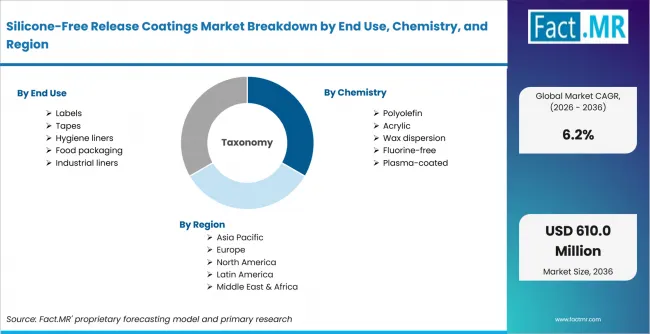
Silicone Free Release Coatings Market Breakdown By End Use, Chemistry, And Region | Source: Fact.MR
| Attribute | Details |
|---|---|
| Quantitative Units | USD Million in 2026 to USD Million by 2036 at CAGR |
| Market Definition | Release coatings for labels, tapes, hygiene liners, and packaging where silicone migration, contamination, or recyclability is restricted. |
| End Use | Labels, Tapes, Hygiene liners, Food packaging, Industrial liners |
| Chemistry | Polyolefin, Acrylic, Wax dispersion, Fluorine-free, Plasma-coated |
| Coating Method | Gravure, Slot die, Meyer rod, Extrusion coating, Curtain coating |
| Substrate | Paper, PET, PE, PP, Glassine |
| Buyer Type | Converters,Label stock producers, Packaging firms, Hygiene suppliers |
| Regions Covered | North America, Europe, Asia Pacific, Central and South America, MiddleEastand Africa |
| Countries Covered | Germany, Brazil, United States |
| Key Companies Profiled | Michelman, Loparex, Mayzo, Rayven, Evonik Industries AG, Henkel AG & Co.KGaA |
| Forecast Period | 2026 to 2036 |
| Approach | Hybrid top-down and bottom-up approach using release liners and specialty release coatings, segment shares, country growth, supplier mapping, and technical validation |
Source: Fact.MR analysis. Updated Jul 15, 2026
How is the market segmented?
-
By End Use:
- Labels
- Tapes
- Hygiene liners
- Food packaging
- Industrial liners
-
By Chemistry:
- Polyolefin
- Acrylic
- Wax dispersion
- Fluorine-free
- Plasma-coated
-
By Coating Method:
- Gravure
- Slot die
- Meyer rod
- Extrusion coating
- Curtain coating
-
By Substrate:
- Paper
- PET
- PE
- PP
- Glassine
-
By Buyer Type:
- Converters
- Label stock producers
- Packaging firms
- Hygiene suppliers
-
By Region:
- North America
- United States
- Canada
- Europe
- Germany
- United Kingdom
- France
- Italy
- Spain
- Asia Pacific
- Japan
- South Korea
- Australia
- Central & South America
- Brazil
- Argentina
- Mexico
- Chile
- Middle East & Africa
- UAE
- Saudi Arabia
- South Africa
- North America
Frequently Asked Questions
Which End Use leads the Silicone-Free Release Coatings Market?
Which Chemistry leads the Silicone-Free Release Coatings Market?
Which Coating Method leads the Silicone-Free Release Coatings Market?
Which Substrate leads the Silicone-Free Release Coatings Market?
Which Buyer Type leads the Silicone-Free Release Coatings Market?
What is the primary driver in the Silicone-Free Release Coatings Market?
What is the main restraint in the Silicone-Free Release Coatings Market?
Why is Labels important?
Why do buyers continue testing Silicone-Free Release Coatings Market?
Who worked on this report


Preview the report firsthand - request a free sample
Free SampleGet the brochure for pricing and purchase details
Download PDF