- Base Value(2025): 16.8 Bn
- Estimated Value(2026): 18.8 Bn
- Forecast Value (2036): 60.4 Bn
- CAGR (2026 - 2036): 12.4%
Smart Fitness Market Forecast By Fact.MR
In 2025, the smart fitness market was valued at USD 16.8 billion. Based on FMR analysis, demand for smart fitness solutions is estimated to grow to USD 18.8 billion in 2026 and USD 60.4 billion by 2036. Fact MR projects a CAGR of 12.4% during the forecast period.
The absolute dollar growth from 2026 to 2036 is USD 41.6 billion. This growth is driven by rising health awareness, increasing adoption of wearable fitness devices, and the integration of AI and IoT technologies in fitness equipment. The demand for personalized fitness experiences, connected gyms, and home fitness solutions is further supporting market expansion. However, high device costs and privacy concerns related to user health data may limit adoption in certain regions.
India leads with a CAGR of 15.3%, driven by growing smartphone penetration, rising health consciousness, and increasing adoption of wearable fitness devices. China follows with 13.4%, supported by expanding fitness infrastructure and rising demand for connected fitness solutions. Australia grows at 12.9%, reflecting strong adoption of smart fitness equipment and home fitness trends. The USA shows a CAGR of 11.9%, fueled by widespread use of wearable devices and connected gym systems. Germany grows at 11.0%, supported by the adoption of smart gym equipment and rising consumer awareness of health and wellness.
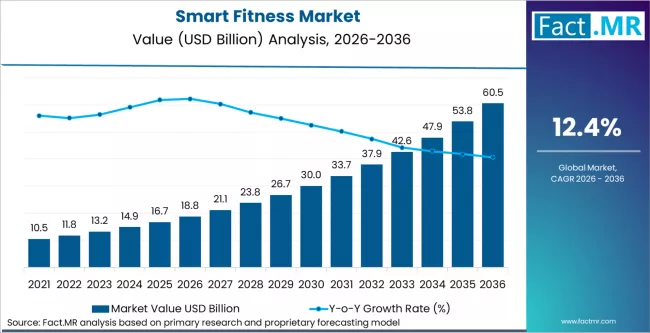
Smart Fitness Market Market Value Analysis | Source: Fact.MR
Smart Fitness Market
| Metric | Value |
|---|---|
| Estimated Value in (2026E) | USD 18.8 billion |
| Forecast Value in (2036F) | USD 60.4 billion |
| Forecast CAGR (2026 to 2036) | 12.4% |
Smart Fitness Market Definition
The smart fitness market involves the development, sale, and adoption of connected fitness products and services that use sensors, software, and data analytics to monitor performance, personalise workouts, and enhance user engagement.
Market Inclusions
This report covers global and regional market sizes for smart fitness over a defined forecast period, including product types (wearable fitness trackers, connected gym equipment, fitness apps, smart accessories), application areas (home fitness, commercial gyms, corporate wellness), and sales channels.
Market Exclusions
The scope excludes traditional, non‑connected fitness equipment and services without digital or data integration, general wearable electronics without fitness functionality, and unrelated health and wellness products.
Research Methodology
- Primary Research: Interviews were conducted with product developers, fitness service providers, and technology integrators.
- Desk Research: Data was sourced from industry reports, consumer tech publications, and trade association statistics.
- Market‑Sizing and Forecasting: A hybrid model combining top‑down fitness technology adoption forecasts with bottom‑up device and service revenue data was used.
- Data Validation and Update Cycle: Findings were validated through expert review and aligned with recent production, adoption, and revenue figures.
Summary of the Smart Fitness Market
- Market Definition
- The Smart Fitness Market involves the development, sale, and adoption of connected fitness products and services that use sensors, software, and data analytics to monitor performance, personalize workouts, and enhance user engagement. The market includes smart fitness equipment, wearables, fitness apps, and connected solutions for commercial and home use.
- Demand Drivers
- Rising health awareness and wellness-focused lifestyles among consumers.
- Growing adoption of wearable fitness devices and connected gym equipment.
- Integration of AI and IoT technologies in fitness equipment and apps.
- Increasing demand for personalized fitness experiences and data-driven workout insights.
- Expansion of corporate wellness programs, home fitness, and connected gym ecosystems.
- Key Segments Analyzed
- Product: Smart Fitness Equipment (46.1% share in 2026), Cardiovascular Training, Strength Training, Smart Fitness Wearables, Others.
- Apps: Nutrition-Tracking Apps (54.8% share in 2026), Workout Apps, Fitness Tracking Apps, Others.
- End User: Corporates, Individuals, Gyms & Health Clubs, Others.
- Geography: South Asia, East Asia, Oceania, North America, Europe; India leads at 15.3% CAGR, China 13.4%, Australia 12.9%, USA 11.9%, Germany 11.0%.
- Analyst Opinion at Fact MR
- Shambhu Nath Jha, Principal Consultant, Fact MR, opines, 'In this updated edition of the Smart Fitness Market report, industry participants will observe that value creation is shifting from basic exercise devices toward integrated, connected, and data-driven fitness ecosystems. Smart fitness equipment, wearables, and nutrition-tracking apps are no longer passive tools but active contributors to health monitoring, personalized coaching, and long-term wellness engagement. Providers that invest in AI-enabled platforms, app-device integration, and personalized fitness solutions will capture margin expansion beyond standard equipment. The convergence of data analytics, wearable technology, and connected training experiences defines the competitive landscape through 2036.'
- Strategic Implications/Executive Takeaways
- Expand smart fitness equipment offerings for interactive, data-driven workouts.
- Enhance integration of wearables with nutrition and fitness apps for holistic tracking.
- Target high-growth markets like India, China, and Australia with localized fitness solutions.
- Ensure compliance with health data privacy and interoperability standards for apps and devices.
- Offer personalized and AI-driven fitness solutions to improve engagement and retention.
- Develop connected gym systems and home fitness platforms for multi-channel adoption.
- Methodology
- Primary Research: Interviews with product developers, fitness service providers, and technology integrators.
- Desk Research: Data sourced from industry reports, consumer tech publications, and trade association statistics.
- Market Sizing & Forecasting: Hybrid model combining top-down fitness technology adoption forecasts with bottom-up device and service revenue data.
- Data Validation: Findings validated through expert review, production, adoption, and revenue figures; updated via proprietary Fact MR forecasting models.
Segmental Analysis
Smart Fitness Market Analysis by Apps
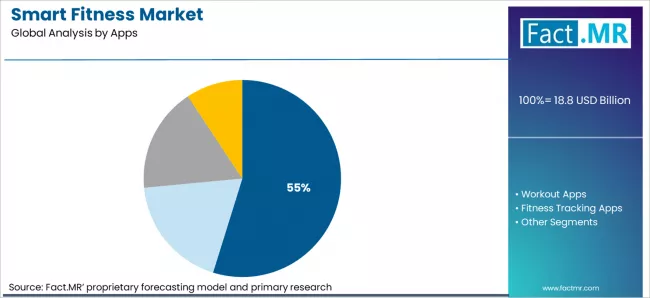
Smart Fitness Market Analysis By Apps | Source: Fact.MR
Market Overview: Nutrition-tracking apps are expected to capture 54.8% of the smart fitness market share by 2026. These apps help users monitor dietary intake, calorie consumption, and nutrient balance, supporting health, weight management, and fitness goals. They are widely used in conjunction with wearable devices and fitness programs to provide personalized recommendations and insights.
Demand Drivers:
- Growing Health and Fitness Awareness: Rising consumer focus on healthy eating and lifestyle drives demand for nutrition-tracking apps.
- Integration with Wearable Devices: These apps often integrate with smartwatches and fitness trackers, enhancing their utility and user engagement.
- Personalized Diet and Fitness Planning: Nutrition apps provide customized diet plans and tracking tools, enabling users to achieve targeted health and fitness outcomes effectively.
Smart Fitness Market Analysis by Product
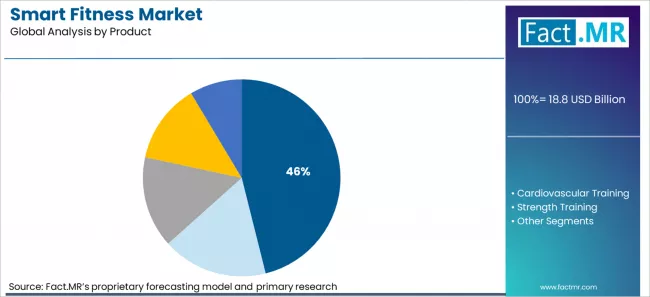
Smart Fitness Market Analysis By Product | Source: Fact.MR
Market Overview: Smart fitness equipment is projected to hold 46.1% of the market share by 2026. Smart fitness equipment, including connected treadmills, stationary bikes, and strength-training machines, provides interactive workouts, performance tracking, and integration with digital platforms for enhanced user experience.
Demand Drivers:
- Interactive and Data-Driven Workouts: Smart fitness equipment enables real-time performance monitoring, personalized training, and progress tracking, improving engagement and results.
- Home Fitness Trends: The rise of at-home workouts and remote fitness programs has increased the adoption of connected equipment for convenient and guided exercise.
- Integration with Apps and Wearables: Smart fitness equipment often pairs with apps and wearable devices, offering a comprehensive ecosystem for tracking, analyzing, and optimizing fitness routines.
Smart Fitness Market Drivers, Restraints, and Opportunities
FMR analysts observe that the smart fitness market is a growth‑aligned, technology‑anchored segment driven by rising consumer health awareness, increased adoption of connected devices, and demand for personalized workout experiences. Historically, traditional gym equipment and standalone fitness trackers dominated; as smartphones, wearables, and AI‑enabled platforms expanded, structural demand emerged for integrated smart fitness solutions that deliver real‑time feedback, remote coaching, and data‑driven performance tracking. The 2026 valuation reflects this shift, with adoption tied to broader health‑tech integration rather than basic fitness products alone.
While conventional gym and standard wearable devices remain significant in volume, advanced smart fitness systems, connected equipment, AI coaching apps, and hybrid fitness platforms, are gaining share because they elevate engagement and long‑term adherence. These higher‑value offerings often command premium pricing, contributing to net market value growth even as unit volumes grow moderately with consumer health participation. The market exists because users increasingly seek measurable progress, convenience, and personalized insights that traditional fitness solutions cannot deliver.
- Health & Personalization Demand: Consumers adopt smart fitness solutions that replace basic workouts with data‑driven, personalized training and health tracking.
- Standards & Data Integration: Health and data privacy standards push providers toward certified platforms that meet interoperability and security requirements.
- Regional Adoption Dynamics: In North America and Europe, strong wellness culture and tech adoption accelerate smart fitness uptake, while Asia‑Pacific shows rapid growth with expanding connected device penetration.
Regional Analysis
The market analysis covers key global regions, including South Asia, East Asia, Oceania, North America, and Europe. It is segmented geographically, with specific market dynamics for each region. The full report provides a detailed market attractiveness analysis.
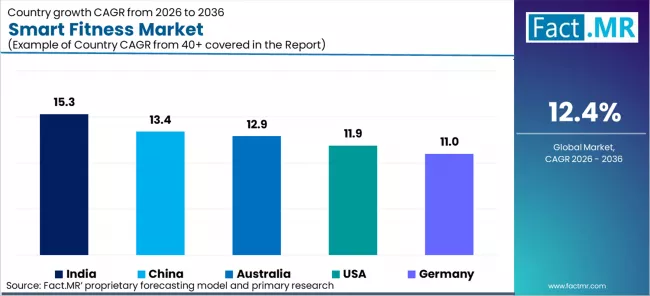
Smart Fitness Market Cagr Analysis By Country | Source: Fact.MR
| Country | CAGR (2026-2036) |
|---|---|
| India | 15.3% |
| China | 13.4% |
| Australia | 12.9% |
| USA | 11.9% |
| Germany | 11.0% |
Source: Fact MR (FMR) analysis, based on proprietary forecasting model and primary research
South Asia
India is the largest market, driven by growing consumer awareness of fitness, adoption of wearable devices, and expansion of connected gym solutions. Key players include Xiaomi, GOQii, and Fitbit.
- India: Demand for smart fitness products in India is projected to rise at 15.3% CAGR through 2036. Growth is supported by government fitness campaigns (04-2025) and GOQii’s expansion of wearable device sales (09-2025).
East Asia
China is a leading market, fueled by wearable device adoption, smart gym integrations, and consumer interest in digital fitness tracking.
- China: Demand for smart fitness products in China is projected to rise at 13.4% CAGR through 2036. Growth is influenced by expansion of connected fitness platforms (03-2025) and Xiaomi’s regional production and distribution increase (08-2025).
Oceania
Australia is a key market, supported by adoption of wearable fitness devices, connected health programs, and gym membership growth.
- Australia: Demand for smart fitness products in Australia is projected to rise at 12.9% CAGR through 2036. Growth is supported by government health promotion initiatives (05-2025) and Fitbit’s regional product expansion (09-2025).
North America
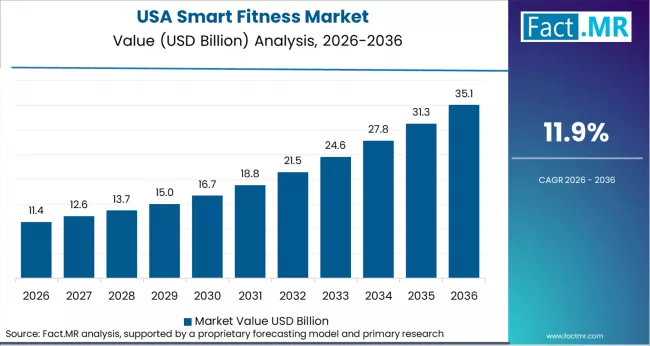
Smart Fitness Market Country Value Analysis | Source: Fact.MR
The USA represents a major market, driven by fitness-focused consumer behavior, wearable adoption, and connected gym solutions.
- USA: Demand for smart fitness products in the U.S. is projected to rise at 11.9% CAGR through 2036. Growth is supported by federal wellness programs (06-2025) and Apple’s regional expansion of smart fitness wearables (08-2025).
Europe
Germany is a leading market, supported by smart gym adoption, wearable devices, and fitness technology integration.
- Germany: Demand for smart fitness products in Germany is projected to rise at 11.0% CAGR through 2036. Growth is influenced by government fitness initiatives (03-2025) and Garmin’s expansion of connected wearable products (07-2025).
Fact MR's analysis of the smart fitness market in South Asia, East Asia, Oceania, North America, and Europe consists of country-wise assessments that include India, China, Australia, the USA, and Germany. Readers can find detailed trends, regulatory updates, and company-specific investments shaping market growth in these countries.
What is the Competitive Structure and Buyer Behavior in the Smart Fitness Market?
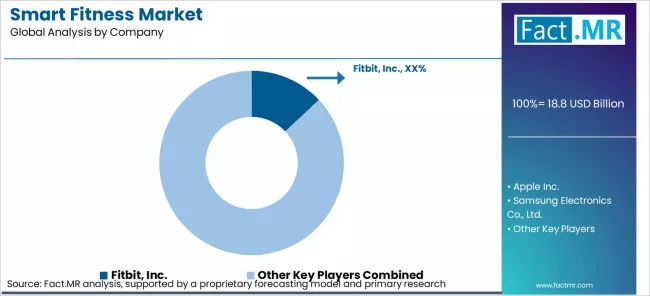
Smart Fitness Market Analysis By Company | Source: Fact.MR
The smart fitness market is moderately concentrated, with leading consumer electronics and wearable technology companies such as Fitbit, Inc., Apple Inc., Samsung Electronics Co., Ltd., Garmin Ltd., and Xiaomi Corporation collectively holding a large share of global shipments. The primary competitive variables are sensor accuracy, battery life, form factor design, platform ecosystem integration, and the richness of health and fitness analytics that influence consumer preference and retention. Companies with strong R&D capabilities, expansive software ecosystems, and global distribution networks hold structural advantages, as they can deliver seamless device‑to‑cloud experiences, maintain frequent software updates, and leverage large user communities to refine product features.
Consumers and retail buyers exhibit notable leverage by comparing devices across features, brand reputation, and price, often accessing detailed reviews and performance benchmarks before purchase. To manage dependency on any single brand, many buyers diversify across ecosystems or prioritize devices that support cross‑platform compatibility. This behavior limits individual suppliers’ pricing power, pushing competition toward delivering superior performance, user experience, data insights, and after‑purchase support rather than on price alone.
Key Players of the Smart Fitness Market
- Fitbit, Inc.
- Apple Inc.
- Samsung Electronics Co., Ltd.
- Garmin Ltd.
- Xiaomi Corporation
Report Scope
| Metric | Value |
|---|---|
| Quantitative Units | USD 18.8 billion (2026) to USD 60.4 billion (2036), at a CAGR of 12.4% |
| Market Definition | The Smart Fitness Market includes connected fitness equipment, wearable devices, and fitness applications enabling tracking, coaching, and health management across consumer and commercial users. |
| Product | Smart Fitness Equipment, Cardiovascular Training, Strength Training, Smart Fitness Wearables, Others |
| Apps | Nutrition-Tracking Apps, Workout Apps, Fitness Tracking Apps, Others |
| End User | Corporates, Individuals, Gyms & Health Clubs, Others |
| Regions Covered | North America, Latin America, Europe, East Asia, South Asia, Oceania, Middle East & Africa |
| Countries Covered | United States, Canada, Mexico, Brazil, Germany, France, United Kingdom, Italy, Spain, China, India, Japan, Australia, South Korea, and 15+ other countries |
| Key Companies Profiled | Fitbit, Inc., Apple Inc., Samsung Electronics Co., Ltd., Garmin Ltd., Xiaomi Corporation |
| Forecast Period | 2026 to 2036 |
| Approach | Hybrid top-down and bottom-up market modeling validated through interviews with fitness equipment manufacturers, app developers, and gyms, supported by deployment data and industry benchmarking. |
Bibliographies
- World Health Organization. (2023). Global status report on physical activity and health. World Health Organization.
- U.S. Department of Health and Human Services. (2023). Physical activity guidelines for Americans: Digital health and fitness monitoring technologies. U.S. Department of Health and Human Services.
- World Economic Forum. (2024). Digital health technologies and wearable fitness devices transforming healthcare. World Economic Forum.
- Organisation for Economic Co-operation and Development. (2023). Digital health and wearable technologies in modern healthcare systems. Organisation for Economic Co-operation and Development.
- Apple Inc. (2024). Apple annual report: Wearable devices, health monitoring technologies, and digital ecosystem growth. Apple Inc.
- Garmin Ltd. (2024). Garmin annual report: Wearable fitness technology and connected health solutions. Garmin Ltd.
- Samsung Electronics Co., Ltd. (2024). Samsung sustainability report: Connected health, wearables, and digital wellness technologies. Samsung Electronics Co., Ltd.
This report addresses
- Market intelligence enabling a detailed assessment of leading countries, product types, and app categories in the Smart Fitness Market globally.
- Market volume (revenue) estimates and 10-year revenue forecasts from 2026 to 2036, validated through device shipment data, app adoption figures, and fitness industry trends.
- Growth opportunity mapping across products (Smart Fitness Equipment, Cardiovascular Training, Strength Training, Smart Fitness Wearables, Others), apps (Nutrition-Tracking, Workout, Fitness Tracking, Others), end users (Corporates, Individuals, Gyms & Health Clubs, Others), and regions.
- Segment and regional revenue forecasts by product, app, end user, and geography, covering 40+ countries.
- Competition strategy analysis focusing on sensor accuracy, device integration, ecosystem support, software functionality, and wearable analytics, including major players Fitbit, Inc., Apple Inc., Samsung Electronics Co., Ltd., Garmin Ltd., and Xiaomi Corporation.
- Product, technology, and regulatory tracking aligned with digital health standards, privacy frameworks, and IoT connectivity in consumer and commercial fitness applications.
- Adoption dynamics emphasizing wearable devices, connected gym systems, AI-integrated equipment, and nutrition-tracking platforms.
- Report delivery in PDF, Excel, PowerPoint, and interactive dashboard formats for executive, operational, and strategic planning use.
Smart Fitness Market Key Segments
-
Product
- Smart Fitness Equipment
- Cardiovascular Training
- Strength Training
- Smart Fitness Wearables
- Others
-
Apps
- Nutrition-Tracking Apps
- Workout Apps
- Fitness Tracking Apps
- Others
-
End-Use Industry
- Corporates
- Individuals
- Gyms & Health Clubs
- Others
-
Region
- North America
- USA
- Canada
- Mexico
- Europe
- Germany
- UK
- France
- Italy
- Spain
- Nordic Countries
- BENELUX
- Rest of Europe
- Asia Pacific
- China
- Japan
- South Korea
- India
- Australia
- Rest of Asia Pacific
- Latin America
- Brazil
- Argentina
- Rest of Latin America
- Middle East and Africa
- Kingdom of Saudi Arabia
- United Arab Emirates
- South Africa
- Rest of Middle East and Africa
- Other Regions
- Oceania
- Central Asia
- Other Markets
- North America