- Base Value(2025): 340.5 Mn
- Forecast Value (2035): 514.2 Mn
- CAGR (2035): 5.1%
Smart Rackets Market Outlook 2025 to 2035
The global smart rackets market is expected to reach USD 514.2 million by 2035, up from USD 340.5 million in 2025. During the forecast period 2025 to 2035, the industry is projected to expand at a CAGR of 4.2%.
The smart rackets market is motivated by the growth in the number of sport participants, professional training and the development in the popularity of recreational tennis. Players performance, accuracy and injury prevention are performance factors that promote adoption. Using sensor-integrated rackets, vibration reduction systems or energy saving materials are among the advanced technologies that make the game better, more accurate, and durable. The increased interest in fitness, intelligent coaching applications and sports analytics are also driving the growth of the market in the professional, amateur, and recreational sectors.
Quick Stats for Smart Rackets Market
- Industry Value (2025): USD 340.5 million
- Projected Value (2035): USD 514.2 million
- Forecast CAGR (2025 to 2035): 4.2%
- Leading Segment (2025): Walk-behind Road Saws (38.7% Market Share)
- Fastest Growing Country (2025-2035): India (6.9% CAGR)
- Top Key Players: Babolat, Wilson, Yonex, Amer SPORTS, Dribble Up, HEAD, Tecnifibre, Gosen, SOTX and Adidas
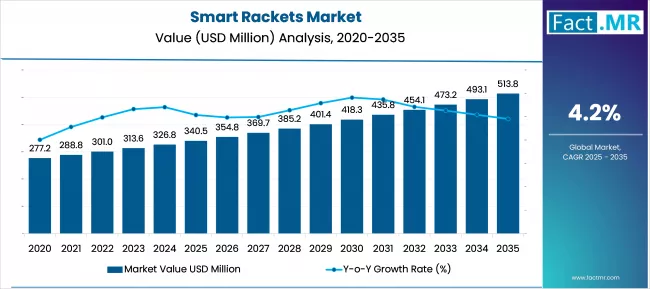
Smart Rackets Market Market Value Analysis | Source: Fact.MR
What are the drivers of the Smart Rackets Market?
The smart rackets market is growing with manufacturers aiming at improving player performance, precision, and injury prevention with energy-efficient, durable, and technologically advanced. The demand is fueled by rising urbanization, expanding sports facilities and increased professional and recreational tennis. New technologies like sensor incorporated rackets, vibration damping, Internet of Things (IoT) powered performance monitoring, enable real-time analytics, precision of strokes, and reduced maintenance.
Increased attention to fitness, intelligent training, and competitive training leads to faster adoption. Also, increasing focus on sustainable materials, ergonomic designs and regulations on player safety contribute to long-term growth in the market in professional, amateur and recreational markets on a global scale.
What are the regional trends of the Smart Rackets Market?
Sports infrastructure, urbanization and modernization in different regions have different rates of adoption of the smart rackets market. The North American market shows high demand of high performance and technologically advanced racket with sensor integration among the professional and recreational players.
The focus of Western Europe is on long-lasting, comfortable and environmentally friendly rackets which meet high safety and sustainability requirements.
Asia-Pacific including China, India and Southeast Asia are rapidly growing as a result of more sport academies, urban gyms and competitive tennis facilities.
Latin America exhibits moderate usage due to the lack of large scale professional installations and Middle East and Africa are interested in quality, durability and training orientated smart rackets in new sports programs.
What are the challenges and restraining factors of the Smart Rackets Market?
The smart rackets market has a number of threats that can limit development. Ease of entry means that small market players can provide poor quality rackets, which has an impact on the general level of adoption. The difference in the level of skills of players, training facilities and coaching styles cause unequal performance. The wear-and-tear is hastened by heavy use, mishandling and adverse playing conditions which make the replacement cost higher.
Manufacturers have to adhere to safety, environmental and quality standards all over the world. Other factors that inhibit growth include disjointed supply chains, inadequate standardization and the unavailability of qualified coaches in the developing countries. Restrictions on the uptake of the advanced rackets and maintenance costs means that uptake is limited by the amateur and semi-professional players.
Country-Wise Insights
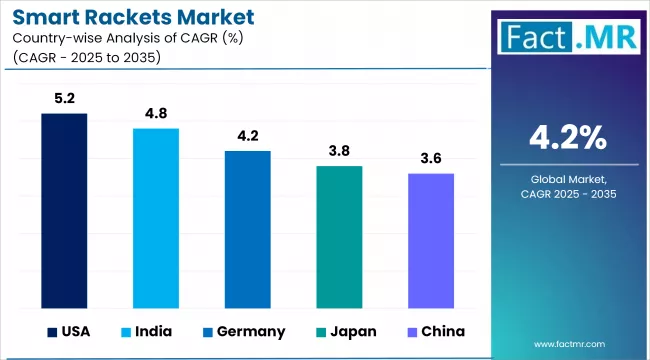
Smart Rackets Market Cagr Analysis By Country | Source: Fact.MR
United States leads with smart tennis adoption and infrastructure
The smart rackets market is led by the United States as a result of a large number of professionals and recreational players of tennis, well-developed sports infrastructure, and high awareness of performance-saving technologies by consumers. The use of smart rackets with sensors is demanded by tennis schools, training centers, and the increasing popularity of coaching based on analytics.
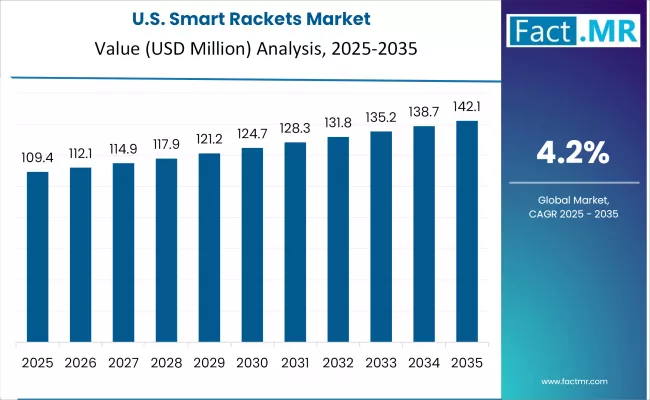
Smart Rackets Market Country Value Analysis | Source: Fact.MR
Major local and global producers are also increasing the number of distribution channels and providing new technology, like vibration-reduction models, performance monitoring based on the Internet of Things, and light materials. Growing attention to sport, prevention of injuries, and competition favors the use. The high purchasing power, infrastructure and the level of awareness of technology make the U.S. one of the major players in the global market.
China dominates Asia-Pacific driven by urbanization and sports growth
China is the Asia-Pacific smart rackets market with high growth rates of urbanization, development of sports infrastructure, and the programmes by the government supporting tennis and recreational activities. Increased investments in sports academies, professional coaches and city fitness centers are fueling the demand for smart rackets.
Manufacturers aim at long-lasting sensor-based designs, which have real-time stroke analytics, have vibration control, and lightweight material. The growth of local and global distribution networks, and technology additions enhance the market uptake of professional and recreational players. The increasing popularity of competitive tennis, fitness trends, and smart coaching solutions makes China one of the key players in the smart rackets market all over the world.
Germany emphasizes quality, advanced rackets, and tech-savvy players
Smart rackets has a major market in Germany, which is characterized by the high culture of recreational and professional tennis, high disposable income, and focus on quality sporting equipment. Academies, clubs and individual players are becoming increasingly attracted to the need to have sophisticated rackets with reduced vibration, sensorization, and use of energy saving materials.
Both domestic and foreign brands are putting money on R&D to become more precise, durable, and track mobile performance. Stern safety and sustainability rules also affect the quality of product and adoption. Together with strong sports infrastructure and tech-savvy consumers, Germany is still a major player in the European and global smart rackets market.
Category-Wise Analysis
Advanced rackets boost performance for professional and recreational players
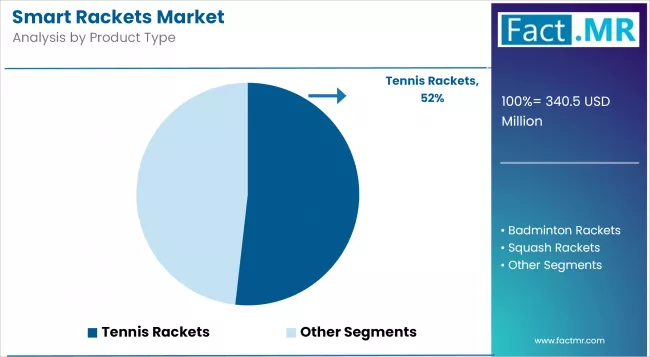
Smart Rackets Market Analysis By Product Type | Source: Fact.MR
The smart rackets market is dominated by tennis rackets, which is attributed to the increased popularity of tennis in the professional, amateur, and recreational levels. The increased involvement in clubs, schools and competitive tournaments leads to a demand of technologically developed rackets. Precision, performance, and injury prevention are provided by features like vibration-dampening, smart sensors and stroke analytics.
The manufacturers aim at lightweight, durable and ergonomically designed rackets depending on the player profiles. Connecting to mobile apps to monitor performance in real time increases user interaction. The growth of investments in sports infrastructure and coaching programs in the world is increasing the use of smart tennis rackets among professional and amateur players.
Lightweight, durable graphite rackets enhance precision and swing control
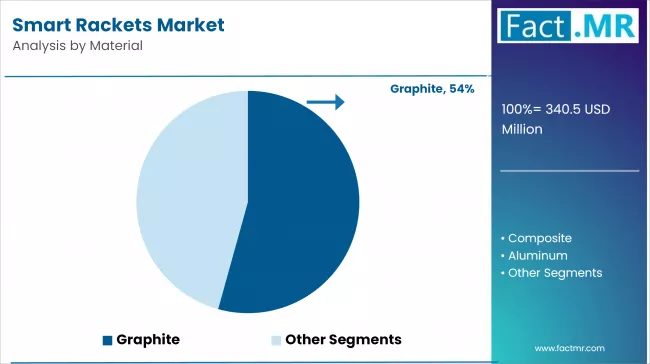
Smart Rackets Market Analysis By Material | Source: Fact.MR
The smart rackets market favors graphite rackets because of their light weight, resilience and strong responsiveness. Graphite material enhances the speed and the control of the swings, as well as precision of the strokes, which is why it is perfect in the hands of both professional and recreational players. Manufacturers are using more and more graphite in conjunction with intelligent technologies like vibration sensors, stroke counting, and IoT-powered performance monitoring.
The material is efficient in energy-saving designs as well as durability in the long-run. The demand of graphite racket is driven by increasing awareness of high-quality racket material, professionally-coached programs and the use of sports analytics. The high quality performance features of graphite has contributed to making it one of the most popular among players who are after being accurate, reliable and smart.
Smart rackets tailored for professionals improve performance and analytics
The smart rackets market is fueled by the demand of high performance, precision engineered rackets by the professional athlete segment. Players are after intelligent rackets that have sensor, vibration, control of weight and analytics of stroke, to improve competitive performance. These rackets are becoming widely used by sports academies and professional coaching programs as a way to enhance training efficiency and track player performance.
To provide high-tech materials, ergonomics, and IoT-based analytics to be used in the workplace, manufacturers invest a lot in R&D. Increasing sensitivity to player safety, injury prevention and optimization of fitness drives further adoption. The endorsement and usage by professional athletes also impact on the recreational players, which increases the market penetration worldwide.
Competitive Analysis
Key players in the Smart Rackets Market include Babolat, Wilson, Yonex, Amer SPORTS, Dribble Up, HEAD, Tecnifibre, Gosen, SOTX and Adidas.
The smart rackets market is very competitive, and the key players are distinguished by their technology, durability, performance, and innovation. The top brands like Wilson, HEAD, Babolat, Yonex and Prince have targeted sensor built rackets, vibration damping, lightweight, and energy saving built rackets to both professional players and amateur ones. Considerable investment by the R&D will improve the precision of the rackets, analytics of the stroke and safety to players.
Cooperation with sport schools, professional trainers and merchants increase market coverage. Offering of competitive prices, superior features, low maintenance, intelligent performance tracking, and good after sales support allow businesses to solidify their standing, as long as they remain innovative and high-quality in this fast-changing market.
Recent Development
- In July 2025, The TFight 305S racquet, which is sponsored by Daniil Medvedev and Iga Swiatek, is made by Tecnifibre. The players of this type need explosive speed and power and this feature is provided by a new head-light balance and new beam to help deliver punch and control.
- In January 2025, HEAD introduced the Gravity Tour 2025 tennis racquet by the new Auxetic 2.0 technology. The technology enhances stability and feel of the racquet and provides players with an increased degree of accuracy and control. Lightweight, durable materials which minimize the impact on the environment are used in addressing sustainability and performance with sensor integration which aids in tracking the performance in real time.
Fact.MR has provided detailed information about the price points of key manufacturers of Smart Rackets Market positioned across regions, sales growth, production capacity, and speculative technological expansion, in the recently published report.
Methodology and Industry Tracking Approach
The Fact.MR 2025 worldwide survey of Smart Racket was done among 7,500 respondents in 24 countries with no less than 200 respondents per country. Two-thirds were end-users, comprising of professional sports persons, coaches, sports academies and recreational players, with the rest being industry professionals, including equipment designers, sports technologists and performance analysts. Between July 2024 and June 2025, data on product adoption, desire to use smart and sensor-integrated rackets, performance, cost and market potential were gathered. The generation of correct market forecasts and segment level insights was used with more than 160 secondary sources and analytical tools such as regression analysis, scenario modeling and trend extrapolations.
With Fact.MR monitoring consumer behavior, product efficacy, industry trends, and market opportunities since 2018, this report is becoming an authoritative source of information that stakeholders can rely on.
Segmentation
Segmentation of Smart Rackets Market
-
By Product Type :
- Tennis Rackets
- Badminton Rackets
- Squash Rackets
- Pickleball Rackets
- Table Tennis Rackets
-
By Material :
- Graphite
- Composite
- Aluminum
- Wood
-
By Price :
- Budget
- Mid-Range
- Premium
-
By Distribution Channel :
- Online Stores
- Specialty Stores
- Franchise Stores
-
By End User :
- Professional Athletes
- Amateur Enthusiasts
-
By Region :
- North America
- Latin America
- Western Europe
- Eastern Europe
- East Asia
- South Asia & Pacific
- Middle East & Africa
Frequently Asked Questions
What was the global Smart Rackets Market Size Reported by Fact.MR for 2025?
Who are the major players operating in the Smart Rackets Market?
What is the estimated valuation of the Smart Rackets Market in 2035?
What value CAGR did the Smart Rackets Market Exhibit Over the Last Five Years?
Who worked on this report


Preview the report firsthand - request a free sample
Free SampleGet the brochure for pricing and purchase details
Download PDF