- Forecast Value (2035): 9.2 Bn
- CAGR (2035): 10%
Smart Gloves (Sensor-based feedback Gloves) Market Outlook 2025 to 2035
The global smart gloves (sensor-based feedback gloves) market is expected to reach USD 9.2 Billion by 2035, up from estimated value of USD 3.6 Billion in 2025. During the forecast period 2025 to 2035, the industry is projected to expand at a CAGR of 9.8%.
Smart gloves (sensor-based feedback gloves) market is motivated by the growing interest in immersive training and rehabilitation, growing popularity of wearable technology in sports and healthcare, and the development of haptic feedback, motion sensors, and cloud-based analytics. These aspects allow real-time monitoring of performance, user-specific insights, and improved user interaction, driving a broad adoption in the professional and consumer application.
Quick Stats for Smart Gloves (Sensor-based feedback Gloves) Market
- Industry Value (2025): USD 3.6 Billion
- Projected Value (2035): USD 9.2 Billion
- Forecast CAGR (2025 to 2035): 9.8%
- Leading Segment (2025): Haptic Feedback Systems (35% Market Share)
- Fastest Growing Country (2025-2035): China (10.1% CAGR)
- Top Key Players:are SensoGlove, Move It, HaptX, Inc., TESLASUIT, WEART Haptics, bHaptics, DribbleUp, MANUS, Rokoko, StretchSense, and Pressure Profile Systems
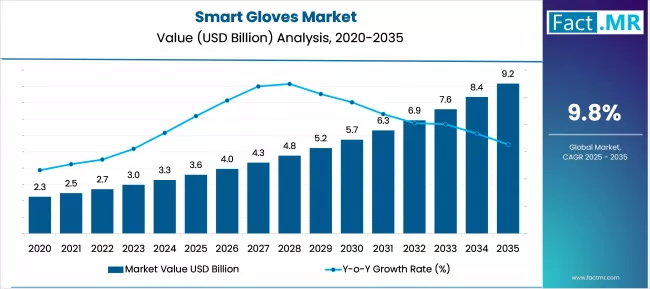
Smart Gloves Market Market Value Analysis | Source: Fact.MR
What are the key factors driving growth in the Smart Gloves (Sensor-based feedback Gloves) Market?
The main forces behind smart gloves in sports are increasing demand of real-time motion tracking, injury prevention, and performance improvement based on data. Detailed biomechanical feedback is beneficial to the athletes as it allows optimization of training programs and skill development. These insights are used by coaches and trainers to implement individualized programs and reduce risks.
The growth is also supported by the rising consumption of wearable technologies and fitness tracking among consumers, who are in search of more sophisticated solutions to their needs, as opposed to the conventional devices. Alliances between sports technology developers and wearable companies contribute to the further increase in the adoption in professional and recreational sectors.
What are the key trends driving growth in the Smart Gloves (Sensor-based feedback Gloves) market?
The main tendencies in the market of smart gloves that are sports-oriented are the incorporation of immersive VR/AR systems to provide the interactive training, AI-based analytics to provide personalized training, and the use of advanced haptic systems to simulate reality. Gloves are transforming into multi-sport devices to record grip, swing and muscle activity to assist in skill development as well as rehabilitation.
The emergence of interlinked ecosystems enables smooth exchange of data among athletes, coaches as well as sports medical personnel. Also, collaborations with gaming and e-sports applications are growing applications, integrating performance training with sport technology innovations of entertainment-based sports.
What factors hinder the growth of the Smart Gloves (Sensor-based feedback Gloves) market?
Nevertheless, the use of smart gloves in sport combats lacks impetus because of the expensive price, low awareness of the product among amateurs, and the necessity to constantly calibrate and guarantee accuracy of the measurements. Long-term use is still problematic in terms of battery life and durability in cases of intensive physical activity.
The factors that may create impediments include integration with the existing sports infrastructure and training systems. Adoption may be impeded by regulatory and certification mandates in professional sports. It is the resolutions to these concerns that will be important in the wider acceptance and making smart gloves more of a mainstream sport performance and training tool.
What are the key regional trends driving the Smart Gloves (Sensor-based feedback Gloves) Market growth?
North America
In the field of healthcare, sports, and training, North America is the most adopted region. The next-generation R&D, an enabling investment in wearable techs, and incorporation into AR/VR applications stimulate the growth, and sensor-based gloves have become an increasingly popular tool in professional sports teams and rehabilitation facilities to monitor precision and performance.
East Asia
The adoption in East Asia is swift because there is increased digitization in the healthcare and fitness sectors. In Japan, China and South Korea, local innovators are targeting low-cost, lightweight, and mobile-integrated smart gloves, which are behind adoption into sports, rehabilitation, and consumer wellness usage.
Western Europe
Western Europe also enjoys the benefits of well-developed healthcare system, high rate of adoption of sport technology and conducive regulations. Ergonomic design, biofeedback-based training, and sustainability are promoted by companies, which are used in rehabilitation, team sports, and immersive athletic training solutions in Germany, the UK, France, and other markets.
Country-wise Outlook
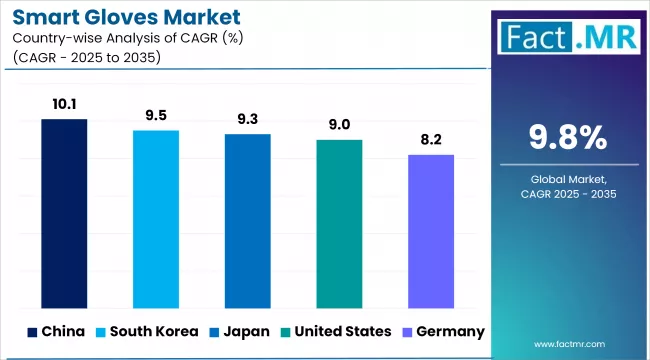
Smart Gloves Market Cagr Analysis By Country | Source: Fact.MR
Technological Innovation and Healthcare Integration Drive the United States’ Smart Gloves Market
The United States is the first to adopt the use of smart gloves as healthcare providers, rehabilitation centers, and sports institutions adopt the use of sensor-based technologies in the performance review and recovery of patients. Intensive investment in R&D, partnership with the technology innovators, and favorable regulatory corridors promote quick product development.
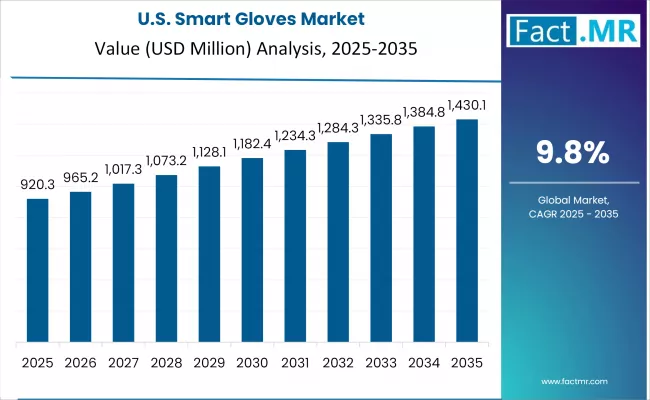
Smart Gloves Market Country Value Analysis | Source: Fact.MR
It is being used in surgical training, physiotherapy and elite sports, which creates demand. The intersection between AI, IoT, and wearable technology will make smart gloves more precise and interactive, which will place the U.S. as the global innovation and commercialization center.
Industrial Scale and Digital Ecosystem Accelerate China’s Smart Gloves Market
The market of smart gloves is rapidly growing in China, which is facilitated by mass production and the development of the digital health and sport technologies infrastructure in the country. To enhance the monitoring of the performance and interaction with patients, hospitals, fitness platforms, and rehabilitation centers are adopting sensor-driven gloves at an increasing rate.
The firm government efforts in intelligent healthcare and extensive adoption of AI and cloud platforms support local innovation. Consumer fitness trends and the spread of e-sports are also contributing to uptake, and, as a result, China is one of the main markets of affordable, scalable, and technology-based smart glove solutions.
Engineering Precision and Regulatory Rigor Propel Germany’s Smart Gloves Market
The smart glove market in Germany is driven by engineering quality, regulatory control and rehabilitation process and medical training acceptance. There is a tendency to use the gloves with highly developed haptic and motion sensors in hospitals and physiotherapy centers to improve the outcomes of therapy and surgeries. Local producers are oriented towards ergonomics, durability, and compatibility with wireless and analytics.
Academic institution and med-tech collaboration is also another way to speed up innovation. Germany is a European leader of the field of high-performance wearable solutions because of its focus on clinical safety as well as the demands of high-performance wearables in the country.
Category-Wise Market Outlook
Haptic Feedback Systems Lead Technology Growth
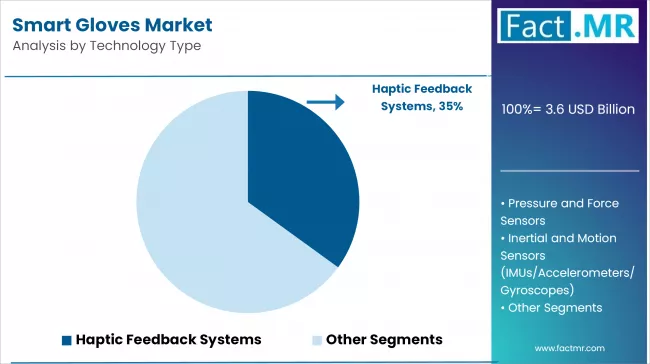
Smart Gloves Market Analysis By Technology Type | Source: Fact.MR
The most rapidly developing type of technology is haptic feedback systems where industries are in need of solutions to the glove with immersive, realistic and interactive solutions. Such systems mimic the sense of touch, whereby more effective rehabilitation, surgical training and industrial simulation are achieved. The increasing use of VR/AR systems in the field of healthcare, manufacturing, and games gives rise to the need for high-quality tactile experiences. Haptic feedback systems are taking the spotlight in smart glove development with their capability to bridge the transfer of skills, lowering the learning curve, and increasing the user involvement.
Fitness and Strength Training Dominates Sports Applications
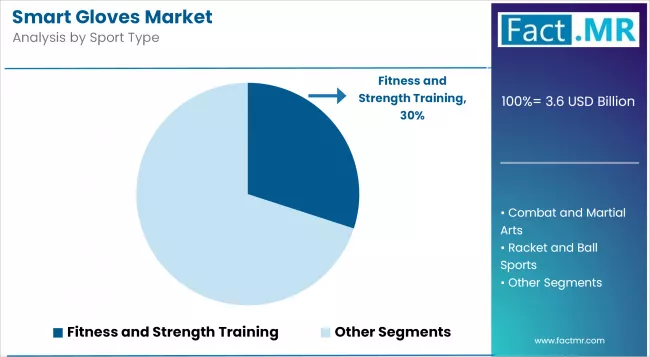
Smart Gloves Market Analysis By Sport Type | Source: Fact.MR
Fitness and strength training is growing the strong in the sport industry with the increased demand of real-time monitoring and individualized performance data. Motion sensors in smart gloves and a force gauge can give athletes and other fitness enthusiasts a step-by-step break down of grip quality, stamina, and structure. They are integrated with mobile applications and analytics platforms and advance training based on data and make it more effective. The rising trend of the connected fitness ecosystems makes this sub segment a key growth driver to the sport-oriented wearable of smart gloves.
Data Analytics and Cloud-Based Insights Drive Feedback Mechanisms
Cloud-based insights and data analytics are the most rapidly developing type of feedback that can be used to monitor performance on-the-fly, store it, and conduct superior performance evaluation. Smart gloves, capturing sensor data can easily integrate with cloud-based technologies to provide predictive data, training completion, and health data.
Enterprise training applications, remote training, and rehabilitation are some of the areas supported by this integration. With the help of analytics as a source of actionable feedback, users get more precise and long-term improvement. Scalability of cloud solutions, as well as focus on data-driven decision-making, contribute to the fast growth of this subsegment.
Competitive Analysis
Competitive Outlook: Smart Gloves (Sensor-based feedback Gloves) Market
The Smart Gloves (Sensor-based Feedback Gloves) market market is very competitive with both the specialized innovators and well established technology providers influencing the market. Firms like SenseGlove, HaptX, Inc., TESLASUIT, WEART Haptics, and bHaptics are already leading in haptic feedback and immersive simulation systems and provide high-performance force-feedback, pressure accuracy, and ergonomic designs to healthcare training, rehabilitation, and enterprise VR/AR training. StretchSense and Rokoko and MANUS specialize in motion capture, gesture recognition and biomechanical information, and are used across the industrial robotics and research sectors, up to sports and gaming. Pressure Profile Systems is another technology that builds upon this ecosystem and brings additional sensor technologies to the glove to increase real-world sensitivity and performance.
Companies such as SensoGlove, Move It, and DribbleUp are developing smart gloves by the consumer and sports market, to be used on fitness, training, and performance monitoring, and making this market grow beyond medical and industrial applications. The priorities of competitive strategies include integration of IoT, cloud collaboration, wireless connectivity, and modular hardware design.
As digital transformation has been on the move towards adoption in healthcare, manufacturing, and sports performance, these players have been putting significant financial resources into product innovation, sustainability, and scalable solutions to enhance their competitive standing in the global market.
Key players in the Smart Gloves (Sensor-based feedback Gloves) market are SensoGlove, Move It, HaptX, Inc., TESLASUIT, WEART Haptics, bHaptics, DribbleUp, MANUS, Rokoko, StretchSense, Pressure Profile Systems.
Recent Development
- In August 2025, Cybosense BV and SenseGlove announced a collaboration to develop 3D printed, self-healing bioelectronic smart gloves for human-machine interfaces, particularly targeting defense, industrial, and space applications. These gloves can sense physical, chemical, and biological signals, monitor hand gestures and pressure, and recover from damage due to the self-healing material.
- In February 2025, researchers from Tsinghua University and Shanghai AI Lab introduced DOGlove, a low-cost open-source haptic force feedback glove system. It supports 21 degrees of freedom in motion capture, plus 5-DoF multidirectional force feedback and fingertip haptic feedback. It can be built for under USD 600 and is intended for precise teleoperation and dexterous manipulation tasks.
Fact.MR has provided detailed information about the price points of key manufacturers of Smart Gloves (Sensor-based feedback Gloves) market positioned across regions, sales growth, production capacity, and speculative technological expansion, in the recently published report.
Methodology and Industry Tracking Approach
The Fact.MR study of Smart Gloves (Sensor-based Feedback Gloves) Market in 2025 enrolled more than 10,000 respondents, among which there are a minimum of 250 participants of each of the 30 countries. Almost two-thirds of the sample were end-users including hospitals, surgical centers, medical schools and rehabilitation facilities and the other third included experts in the industry including equipment designers and regulatory experts, technical consultants and technology advisors to the healthcare profession.
The study was conducted in the period between September of 2024 and August of 2025 and its purpose was to cover the adoption trends, incorporation of technology, regulatory landscape, and innovations that lead to advanced, immersive, and sustainable medical solutions. To complement the main survey, over 250 secondary sources, such as patents, product introductions, policy models, and sustainability reports, were modeled and forecasted through sophisticated modeling and prediction systems.
Fact.MR has been monitoring the development of Smart Gloves (Sensor-based Feedback Gloves) in terms of technology adoption, regulatory changes and market maturity since 2018. The 2025 report, based on this knowledge, provides actionable insights, strategic suggestions, and practical guidelines to the stakeholders who want to make informed decisions in the investment, planning, and sustainable development in this dynamic market.
Segmentation
Segmentation of Smart Gloves (Sensor-based feedback Gloves) Market Research
-
By Technology Type :
- Pressure and Force Sensors
- Inertial and Motion Sensors (IMUs/Accelerometers/Gyroscopes)
- Haptic Feedback Systems
- Hybrid Sensor Fusion (EMG/Biofeedback)
- Bluetooth/Wireless Connectivity Modules
-
By Sport Type :
- Combat and Martial Arts
- Racket and Ball Sports
- Fitness and Strength Training
- Team and Field Sports
- Endurance and Outdoor Sports
-
By Feedback Mechanism :
- Real-Time Haptic/Vibratory Feedback
- Audio and Visual App Integration
- Data Analytics and Cloud-Based Insights
- Biofeedback Loops (EMG-Driven)
- Immersive VR/AR Simulation
-
By User Level :
- Professional/Elite Athletes
- Amateur and Recreational Users
- Coaches and Trainers
- Youth and Beginner Athletes
- Rehabilitation and Adaptive Sports
-
By Distribution Channel :
- Online Retail and E-Commerce
- Sports Specialty Stores
- Gym and Fitness Centers
- Professional Sports Teams and Academies
- Direct-to-Consumer via Apps/Brands
-
By Region :
- North America
- Latin America
- Western Europe
- Eastern Europe
- East Asia
- South Asia & Pacific
- Middle East & Africa
Frequently Asked Questions
What was the Global Smart Gloves (Sensor-based feedback Gloves) Market Size Reported by Fact.MR for 2025?
Who are the Major Players Operating in the Smart Gloves (Sensor-based feedback Gloves) Market?
What is the Estimated Valuation of the Smart Gloves (Sensor-based feedback Gloves) Market in 2035?
What Value CAGR did the Smart Gloves (Sensor-based feedback Gloves) Market Exhibit Over the Last Five Years?
Who worked on this report


Preview the report firsthand - request a free sample
Free SampleGet the brochure for pricing and purchase details
Download PDF