The Smart Home Refillable IAQ Air Filters Market is analyzed across its key product, application and end-use segments, with the study covering market dynamics, regional trends and demand outlook, forecast 2026 to 2036.
By Fact.MR Consumer Goods DeskFact-checked under the Fact.MR editorial processUpdated
10 min read
Smart Home Refillable IAQ Air Filters Market Forecast and Outlook 2026 to 2036
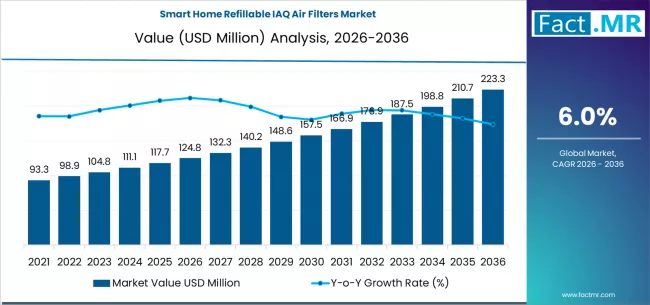
The smart home refillable IAQ air filters market will likely expand from USD 124.80 million in 2026 to USD 223.28 million by 2036 at a 6.0% CAGR. This s growth is propelled by rising health consciousness, increased urbanization, and the integration of air quality management into broader smart home ecosystems.
Smart Home Refillable Iaq Air Filters Market Market Value Analysis | Source: Fact.MR
Summary of Smart Home Refillable IAQ Air Filters Market
Market Snapshot
Global smart home refillable IAQ air filters market revenue stood at USD 124.80 million in 2026 and is forecast to reach USD 223.28 million by 2036.
At a 6.0% CAGR from 2026 to 2036, this market is set to expand ~1.8x in value, adding USD 98.48 million in absolute opportunity.
Growth is being driven by rising health consciousness, urbanization, and integration of air quality management into smart home ecosystems.
Refillable IAQ filters areemergingas sustainable alternatives, reducing waste while enabling smart monitoring and long-term cost efficiency.
Demand and Growth Drivers
Increasing awareness of indoor air pollution and health impacts is accelerating adoption.
Rising penetration of smart home systems is driving integration of air quality solutions.
Growing demand for sustainable and reusable filtration solutions is supporting market expansion.
Need for solutions that provide:
Efficient particulate removal (PM2.5 and allergens)
Reusability and reduced waste
Smart monitoring and predictive maintenance
Compatibility with connected home ecosystems
Advancements in filter media and smart sensing technologies are improving performance and usability.
Product and Segment View
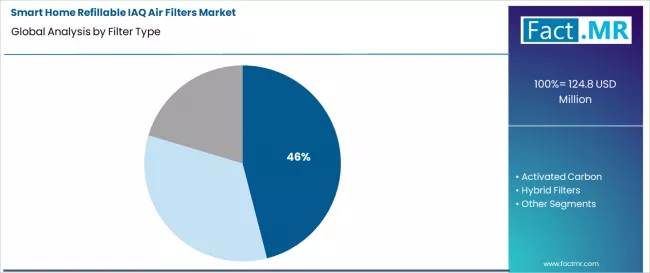
HEPA-equivalent filters hold 46% of filter type share in 2026,emergingas the leading segment due to high efficiency in particulate removal.
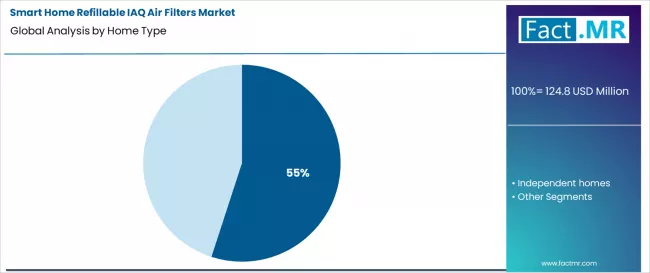
Apartments account for 55% of home type share in 2026, positioning them as the dominant segment due to urban living conditions.
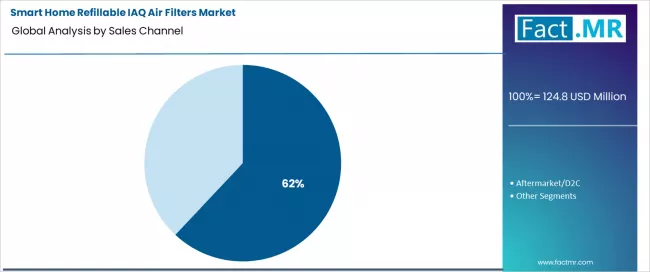
OEM Replacementrepresents62% of sales channel share in 2026, reflecting strong reliance on brand-compatible refill systems.
Key product categories include:
HEPA-equivalent filters
Activated carbon filters
Hybrid filters
Geography and Competitive Outlook
Growth is supported across major smart home adoption regions driven by urbanization and air quality concerns.
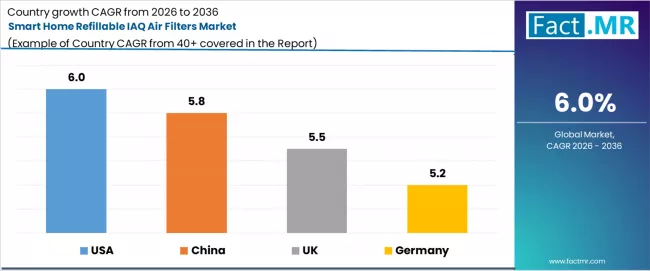
Key growth markets and CAGR: USA (6.00%), China (5.80%), UK (5.50%), Germany (5.20%).
Market expansion is closely tied to:
Smart home ecosystem integration
Rising indoor air quality awareness
Sustainability-driven product adoption
Key companies active in this marketinclude:3M, Honeywell International Inc., Panasonic, Philips, LG Electronics, Sharp.
Smart Home Refillable IAQ Air Filters Market — At a Glance
Attribute
Details
Market Value 2026
USD 124.80 million
Market Value 2036
USD 223.28 million
Absolute Dollar Opportunity 2026-2036
USD 98.48 million
Total Growth 2026-2036
78.9%
CAGR 2026-2036
6.0%
Growth Multiple
~1.8x
Key Demand Theme
Increasing adoption of smart, reusable air filtration solutions in connected homes
Leading Segment by Filter Type (2026)
HEPA-Equivalent Filters
Segment Share (2026)
46%
Leading Segment by Home Type (2026)
Apartments
Segment Share (2026)
55%
Leading Segment by Sales Channel (2026)
OEM Replacement
Segment Share (2026)
62%
Key Growth Regions
North America, East Asia, Western Europe
Country CAGRs
USA 6.00%, China 5.80%, UK 5.50%, Germany 5.20%
Top Companies
3M, Honeywell International Inc., Panasonic, Philips, LG Electronics, Sharp
Segmentation by Filter Type
HEPA-Equivalent, Activated Carbon, Hybrid
Segmentation by Home Type
Apartments, Independent Homes
Segmentation by Sales Channel
OEM Replacement, Aftermarket/D2C
Segmentation by Region
North America, Latin America, Western Europe, Eastern Europe, East Asia, South Asia & Pacific, MEA
By filter type, HEPA-equivalent media leads with a 46% share due to its proven efficacy against fine particulates. By home type, apartments constitute the dominant segment at 55%, as urban dwellers in compact spaces seek integrated solutions for pollution and allergen control. OEM replacement purchases account for 62% of all refillable air filters distribution, where consumers buy refills directly compatible with their existing smart purifier brands. Geographically, growth is led by the USA (6.00% CAGR), followed by China, the UK, and Germany, driven by regulatory standards, pollution concerns, and smart home penetration. The competitive landscape features a mix of established material science companies and consumer electronics giants, all competing on filter performance, smart features, and subscription-based refill models.
Category
Category
Segments
Filter Type
HEPA-equivalent, Activated Carbon, Hybrid Filters
Home Type
Apartments, Independent homes
Sales Channel
OEM Replacement, Aftermarket/D2C
Region
North America, Latin America, Western Europe, Eastern Europe, East Asia, South Asia & Pacific, MEA
Segmental Analysis
By Filter Type, Which Technology is the Consumer Benchmark for Performance?
Smart Home Refillable Iaq Air Filters Market Analysis By Filter Type | Source: Fact.MR
HEPA-equivalent filters lead the segment with a 46% share, solidifying their status as the consumer gold standard for particulate removal. The dominance stems from heightened, post-pandemic awareness of airborne pathogens and fine pollutants (PM2.5).
While true HEPA is often an industrial standard, HEPA-equivalent filters in consumer devices offer a compelling balance of high efficiency, affordability, and compatibility with refillable frames. Their proven ability to capture over 99% of particles down to 0.3 microns addresses a primary consumer health concern, making them the default and most trusted choice for core filtration in smart home systems, often used in conjunction with secondary layers like activated carbon for gases.
By Home Type, Which Living Environment Presents the Greatest Need?
Smart Home Refillable Iaq Air Filters Market Analysis By Home Type | Source: Fact.MR
Apartments constitute the dominant home type segment, holding a 55% share. This is driven by several urban factors: limited natural ventilation, higher density leading to shared air concerns, and prevalent proximity to outdoor pollution sources like traffic.
Apartment dwellers, often with less control over central HVAC systems, turn to standalone smart air purifiers with refillable filters as a controllable, efficient solution for their enclosed spaces. The compact, all-in-one nature of these smart devices is ideally suited for smaller living areas, and the refillable model offers a practical, space-saving alternative to storing bulky disposable filter boxes.
By Sales Channel, Where is Consumer Purchasing Behavior Most Concentrated?
Smart Home Refillable Iaq Air Filters Market Analysis By Sales Channel | Source: Fact.MR
The OEM replacement channel is the leading segment, accounting for 62% of sales. This dominance is due to the integrated and proprietary nature of smart home ecosystems. Consumers who invest in a specific brand's smart air purifier are funneled into that brand's refill ecosystem to ensure perfect sensor calibration, maintained smart app functionality, and warranty compliance.
The convenience of automated subscription refills delivered by the OEM, often triggered by the device's own usage monitoring, creates a powerful, recurring revenue model and high customer retention, locking purchases into this primary channel.
What are the Drivers, Restraints, and Key Trends Shaping this Market?
The primary market driver is the sustained global focus on health and wellness, coupled with increasing real-time air quality data from smart devices and weather apps, which educates consumers and prompts action.
A significant restraint is the higher upfront cost of smart purifier units that accept refillable filters and the persistent challenge of convincing consumers to break from the familiar, albeit wasteful, disposable filter habit.
A key opportunity lies in expanding filter media technology to efficiently target ultrafine particles, or PM0.1, and a broader spectrum of VOCs, moving beyond standard offerings to create premium, specialized refills.
The dominant trend is the deep integration of filter monitoring and auto-replenishment into holistic smart home platforms, where the air purifier communicates not only filter status but also air quality data to other systems, triggering actions like closing smart vents or adjusting HVAC settings based on a comprehensive indoor environmental dashboard.
Analysis of the Smart Home Refillable IAQ Air Filters Market by Key Countries
Smart Home Refillable Iaq Air Filters Market Cagr Analysis By Country | Source: Fact.MR
Country
CAGR (2026-2036)
USA
6.00%
China
5.80%
UK
5.50%
Germany
5.20%
How does Health Awareness and Smart Home Density Drive the US Market?
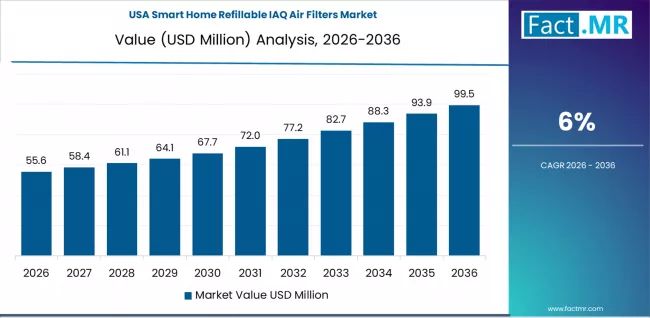
Smart Home Refillable Iaq Air Filters Market Country Value Analysis | Source: Fact.MR
The USA's leading 6.00% CAGR is driven by high consumer awareness of allergens, wildfires, and respiratory health, alongside one of the world's most penetrated smart home markets. Demand is fueled by the desire for convenience and sustainability, with consumers adopting subscription-based refill services from trusted brands.
A preference for premium, feature-rich purifiers characterize the market with multi-stage refillable filters that integrate seamlessly with voice assistants and home automation routines.
What drives China's Market Amidst Urban Pollution Challenges?
China's 5.80% growth is propelled by chronic urban air pollution concerns and the rapid adoption of smart appliances among its vast urban middle class. Domestic brands are highly influential, offering competitively priced smart purifiers with refillable filters.
The market is sensitive to value and technological features, with strong growth in online D2C sales channels. Government emphasis on environmental health and green consumption further supports the shift towards sustainable, refillable products over disposable alternatives.
Why does the UK's Focus on Renovation and Allergies Support Growth?
The UK's 5.50% CAGR is supported by a high prevalence of asthma and allergies, and a housing stock dominated by older, sometimes damp, properties. Consumers are keen on retrofit solutions to improve indoor air.
The market sees strong demand for sleek, design-conscious purifiers suitable for smaller homes and apartments, with a marked preference for refillable systems that reduce long-term waste and cost, aligning with the UK's strong cultural focus on environmental sustainability.
How does Germany's Engineering and Allergy Prevalence Shape Demand?
High engineering standards, a prevalence of pollen allergies, and a strong regulatory environment for product quality and environmental claims underpin Germany’s 5.20% growth.
German consumers prioritize filter efficacy, energy efficiency, and durable product design. The market favors robust, high-performance refillable filter systems, often sold through specialized electrical or health merchandise retailers, with a clear emphasis on verifiable performance data and sustainable product lifecycles.
Competitive Landscape of the Smart Home Refillable IAQ Air Filters Market
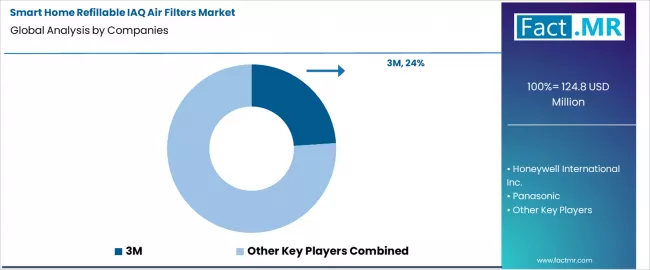
Smart Home Refillable Iaq Air Filters Market Analysis By Company | Source: Fact.MR
The competitive landscape features a strategic clash between material science corporations, traditional air quality brands, and consumer electronics giants. Companies like 3M and Honeywell compete on advanced filter media technology and B2B2C channels. In contrast, players like Philips, Panasonic, LG, and Sharp leverage their strength in consumer electronics, design, and integrated smart home ecosystems.
Competition centers on the performance and longevity of the refillable filter media, the intelligence and connectivity of the monitoring systems, the ease of the refill subscription model, and the overall aesthetic design of the purifier unit. Success depends on building a loyal installed base and securing recurring revenue through proprietary, high-margin filter refill cartridges.
Key Players in the Smart Home Refillable IAQ Air Filters Market
3M
Honeywell International Inc.
Panasonic
Philips
LG Electronics
Sharp
References
American Lung Association. (2025). State of the Air Report and Indoor Air Quality Guidelines.ASHRAE. (2025). Standard 62.2-2025: Ventilation and Acceptable Indoor Air Quality in Residential Buildings.
International WELL Building Institute (IWBI). (2025). WELL v2 Air Concept: Strategies for Residential Spaces.
Kroll, J. H., & Seinfeld, J. H. (2025). Chemistry of Indoor Environments: Sources, Reactions, and Mitigation. Annual Review of Physical Chemistry.
U.S. Environmental Protection Agency (EPA). (2025). Guide to Air Cleaners in the Home.World Health Organization (WHO). (2025). WHO Global Air Quality Guidelines: Update on Indoor Air.
Scope of Report
Items
Values
Quantitative Units
USD Million
Filter Type
HEPA-equivalent, Activated Carbon, Hybrid Filters
Home Type
Apartments, Independent homes
Sales Channel
OEM Replacement, Aftermarket/D2C
Key Countries
USA, China, UK, Germany
Key Companies
3M, Honeywell International Inc., Panasonic, Philips, LG Electronics, Sharp
Additional Analysis
Lifecycle cost analysis: Refillable vs. disposable filter systems; study of consumer willingness-to-pay for enhanced filtration technologies (e.g., antiviral coatings); analysis of sensor accuracy in smart devices and its impact on filter change cycles; assessment of supply chain and material sourcing for sustainable filter media; review of regulatory standards and labeling for consumer air filter claims.
Market by Segments
Filter Type :
HEPA-equivalent
Activated Carbon
Hybrid Filters
Home Type :
Apartments
Independent Homes
Sales Channel :
OEM Replacement
Aftermarket/D2C
Region :
North America
USA
Canada
Latin America
Brazil
Mexico
Argentina
Rest of Latin America
Western Europe
Germany
France
Italy
Spain
UK
BENELUX
Rest of Western Europe
Eastern Europe
Russia
Poland
Czech Republic
Rest of Eastern Europe
East Asia
China
Japan
South Korea
Rest of East Asia
South Asia & Pacific
India
ASEAN
Australia
Rest of South Asia & Pacific
MEA
GCC Countries
South Africa
Turkiye
Rest of MEA
Frequently Asked Questions
How big is the smart home refillable iaq air filters market in 2026?
The global smart home refillable iaq air filters market is estimated to be valued at USD 124.8 million in 2026.
What will be the size of smart home refillable iaq air filters market in 2036?
The market size for the smart home refillable iaq air filters market is projected to reach USD 223.3 million by 2036.
How much will be the smart home refillable iaq air filters market growth between 2026 and 2036?
The smart home refillable iaq air filters market is expected to grow at a 6.0% CAGR between 2026 and 2036.
What are the key product types in the smart home refillable iaq air filters market?
The key product types in smart home refillable iaq air filters market are hepa-equivalent, activated carbon and hybrid filters.
Which home type segment to contribute significant share in the smart home refillable iaq air filters market in 2026?
In terms of home type, apartments segment to command 55.0% share in the smart home refillable iaq air filters market in 2026.