Smart Thermostat Market (2026 - 2036)

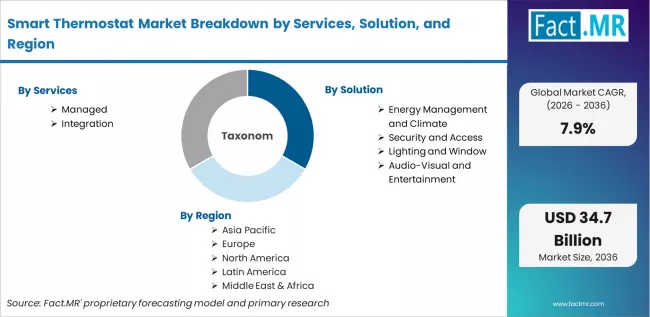
Smart Thermostat Market is segmented by Services (Managed and Integration), Solution (Security and Access, Lighting and Window, Audio-Visual and Entertainment, and Energy Management and Climate) and Region. Forecast for 2026 to 2036.

Core Findings

    Smart Thermostat Market Forecast and Outlook By Fact.MR

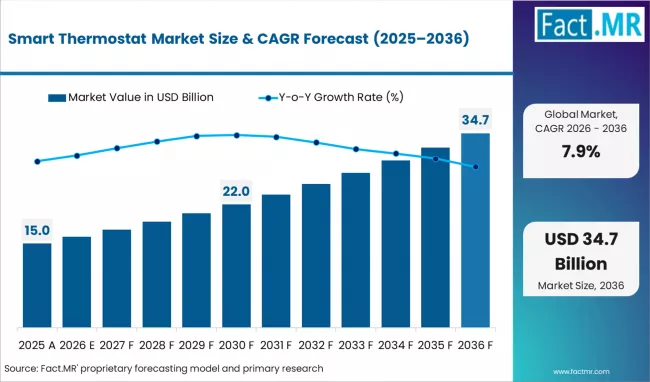
    In 2025, the smart thermostat market was valued at USD 15.1 billion. Based on Fact.MR analysis, demand for smart thermostats is estimated to grow to USD 16.2 billion in 2026 and USD 34.7 billion by 2036. FACT.MR projects a CAGR of 7.9% during the forecast period.

    During this period, the market is expected to generate USD 18.5 billion in new revenue opportunities. Growth is supported by building energy efficiency mandates, utility demand-response programme expansion, and smart home platform integration. Constraints include high device cost in price-sensitive emerging markets, fragmented smart home protocol standards limiting interoperability, and consumer inertia in replacing functional conventional thermostats without direct policy or utility incentive.

    Country growth reflects building energy codes, utility rebate programmes, and smart home adoption. South Korea leads at 9.4% CAGR driven by mandatory energy efficiency standards in new residential construction and Samsung SmartThings ecosystem integration. The United States follows at 9.1% supported by utility demand-response rebate programmes and federal Inflation Reduction Act tax credits for smart home energy devices. Japan records 8.9% through Ministry of Economy trade and industry net-zero building mandates. Germany posts 8.7% through EU Energy Efficiency Directive building retrofit targets. The United Kingdom grows at 8.5%, generating strong replacement demand from boiler upgrade schemes constrained by consumer subsidy variability and installer availability.
    Smart Thermostat Market Market Value Analysis

    Metric Value
    Estimated Value in 2026 USD 16.2 billion
    Forecast Value in 2036 USD 34.7 billion
    Forecast CAGR (2026 to 2036) 7.9%

    Smart Thermostat Market Definition

    The smart thermostat market includes connected thermostats that control residential and commercial HVAC systems through apps, voice assistants, or building management platforms.

    Market Inclusions

    Includes global and regional market forecasts from 2026 to 2036 by services and solution type across residential and commercial applications.

    Market Exclusions

    Excludes traditional non-connected thermostats, industrial HVAC controllers, smart speakers without thermostat control, and standalone energy monitoring devices.

    Research Methodology

    • Primary Research: Interviews with HVAC installers, smart home platform managers, utility demand-response directors, energy consultants, and thermostat retailers.
    • Desk Research: Analysis of IEA energy efficiency reports, EU Energy Efficiency Directive records, US ENERGY STAR data, utility rebate programmes, and company reports.
    • Market Sizing and Forecasting: Hybrid model using thermostat unit shipments, average selling prices, utility programme enrolment data, and building renovation statistics.
    • Data Validation and Update Cycle: Forecasts validated through manufacturer revenue disclosures, ENERGY STAR product data, utility enrolment statistics, and industry interviews.

    Summary of Smart Thermostat Market

    • Market Definition
      • The smart thermostat market includes connected devices used to control HVAC systems through mobile apps, voice assistants, and smart home energy platforms.
    • Demand Drivers
      • Energy efficiency regulations in major economies are increasing installation of smart HVAC control devices.
      • Utility demand-response programmes offer rebates and bill incentives encouraging thermostat adoption.
      • Smart home ecosystems from Google, Amazon, and Apple are expanding thermostat integration with connected home devices.
    • Key Segments Analysed
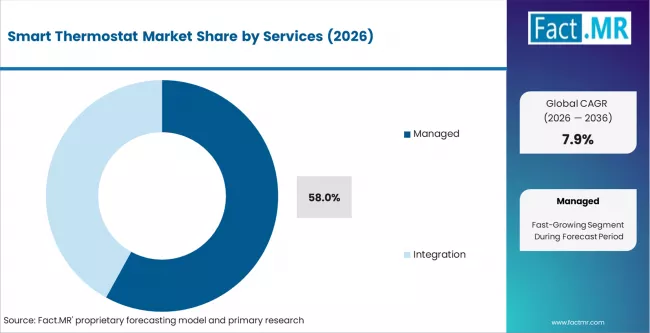
      • By Services: Managed services lead with about 58% share in 2026 due to utility demand-response programmes and installer service contracts.
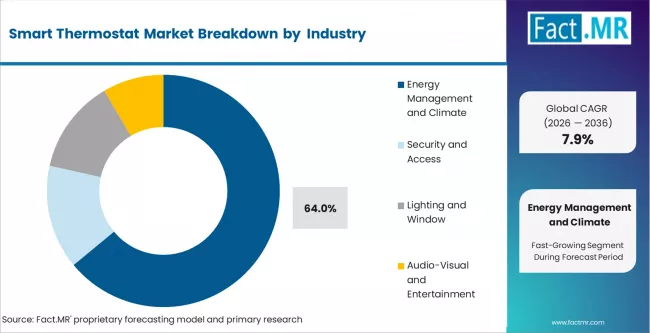
      • By Solution: Energy management and climate solutions lead with about 64% share in 2026 as thermostats primarily optimise HVAC energy use.
      • By Region: South Korea leads global revenue due to strong smart home adoption and utility incentive programmes.
    • Analyst Opinion at FACT.MR
      • Shambhu Nath Jha notes that utility demand-response partnerships, building energy efficiency regulations, and smart home ecosystem integration will drive future smart thermostat adoption.
    • Strategic Implications
      • Vendors should partner with utilities to expand managed service demand-response programmes.
      • Manufacturers should certify products under ENERGY STAR and other efficiency frameworks to access rebate programmes.
      • Companies should support Matter and Zigbee protocols to ensure compatibility with major smart home platforms.
    • Methodology
      • Market sizing used thermostat shipment volumes and pricing validated with manufacturer financial data.
      • Energy efficiency reports and utility programme data supported regional demand analysis.
      • Forecasts included building renovation trends, smart home adoption rates, and industry expert interviews.

    Segmental Analysis

    Smart Thermostat Market Analysis by Services
    Smart Thermostat Market Analysis By Services

    According to FACT.MR analysis, managed services are expected to hold about 58% share in 2026 due to demand-response participation, remote HVAC monitoring, and energy analytics subscriptions.

    • Resideo Managed Service Expansion: Resideo reported over 2.1 million homes enrolled in utility demand-response programmes using its connected thermostat platform. [5]
    • Ecobee Platform Integration Development: Ecobee launched the SmartSuite energy management platform with utility API integration and subscription energy optimisation features. [6]
    • Integration Services Adoption Trend: CEDIA reported strong demand for smart thermostat integration with home automation systems, with project value increasing in 2024. [7]

    Smart Thermostat Market Analysis by Solution
    Smart Thermostat Market Analysis By Solution

    Energy management and climate solutions are projected to account for about 64% share in 2026, reflecting the role of thermostats in controlling heating and cooling energy use.

    • Google Nest Energy Solution Investment: Google Nest expanded household participation in utility demand-response programmes with its Nest Learning Thermostat. [8]
    • Schneider Electric Climate Technology: Schneider Electric introduced the Wiser Energy 3.0 thermostat integrating solar, EV charging, and heat pump energy management. [9]
    • Security and Access Integration Trend: Many commercial buildings now integrate thermostat scheduling with security system occupancy detection to optimise energy use. [10]

    Drivers, Restraints, and Opportunities

    FACT.MR analysts observe that the smart thermostat market has expanded through building energy efficiency regulations, smart home adoption, and utility demand-response programmes. Growth has been strongest in North America and Europe where rebates and energy policies support thermostat installations.

    The market is shifting from standalone device sales to service-based revenue models. Basic Wi-Fi thermostats are becoming commoditized due to low-cost competitors. Premium demand is moving toward learning thermostats with demand-response integration, multi-zone HVAC control, and subscription-based energy analytics. These services generate recurring revenue even as hardware margins decline.

    • EU Energy Efficiency Directive Mandate: The revised EU Energy Efficiency Directive requires connected HVAC control systems in renovated buildings, increasing smart thermostat demand across Germany, France, and the Netherlands. [2]
    • US Inflation Reduction Act Incentives: The US Inflation Reduction Act offers a 30% tax credit for smart thermostats, while state utility rebates further reduce consumer purchase costs. [3]
    • South Korea Smart Home Code: Updated building standards in South Korea require automated HVAC control systems in large residential buildings, driving thermostat adoption. [4]

    Regional Analysis

    The smart thermostat market is analysed across Asia Pacific, Europe, North America, Latin America, and Middle East and Africa, covering over 40+ countries with distinct demand profiles shaped by building energy codes, utility demand-response infrastructure, smart home penetration, and government energy efficiency incentive programmes. The full report offers market attractiveness analysis based on building renovation rates, utility programme enrolment capacity, and regulatory mandate timelines.

    Top Country Growth Comparison Smart Thermostat Market Cagr (2026 2036)

    Country CAGR (2026 to 2036)
    South Korea 9.4%
    United States 9.1%
    Japan 8.9%
    Germany 8.7%
    United Kingdom 8.5%

    Source: Fact.MR (FACT.MR) analysis, based on proprietary forecasting model and primary research
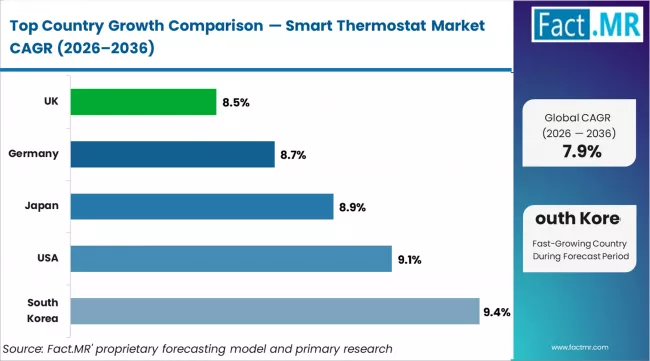
    Smart Thermostat Market Cagr Analysis By Country

    Asia Pacific Smart Thermostat Market Analysis

    Asia Pacific is the fastest-growing smart thermostat market due to stricter building energy standards and expanding smart home adoption. South Korea’s green building policies and Japan’s energy-efficient housing programmes are accelerating demand. Regional companies such as Samsung and Panasonic lead distribution, while international brands like Ecobee and Google Nest are expanding through retail and installer channels.

    • South Korea: South Korea’s smart thermostat market is projected to grow at a CAGR of 9.4% through 2036. Updated green building standards require automated HVAC control systems in new residential developments above 30 units. Energy efficiency rebates provided through the BEMS certification programme further support adoption. LG Electronics expanded its ThinQ smart thermostat range in 2025 to target both new construction and renovation projects.
    • Japan: In Japan, the smart thermostat market is expected to expand at a CAGR of 8.9% through 2036. Updated Top Runner energy standards require smart scheduling functions in residential HVAC controllers sold from 2025. Panasonic’s Econavi platform received ZEH compliance certification, enabling access to government subsidies for energy-efficient homes. Daikin also launched AI-based smart thermostats integrated with utility demand-response programmes.

    FACT.MR's analysis of the smart thermostat market in Asia Pacific includes country-level assessment for South Korea, Japan, China, India, ASEAN, and Australia and New Zealand. The study covers green building compliance, demand-response programmes, and market forecasts by services and solution type.

    North America Smart Thermostat Market Analysis
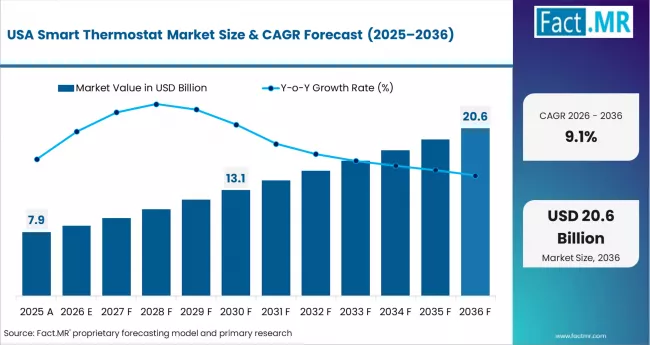
    Smart Thermostat Market Country Value Analysis

    North America remains the largest smart thermostat market due to strong smart home adoption and extensive utility demand-response infrastructure. Leading brands include Google Nest, Ecobee, Honeywell Home, and Resideo, which supply both retail and professional HVAC installer channels.

    • United States: The United States smart thermostat market is projected to grow at a CAGR of 9.1% through 2036. Federal incentives under the Inflation Reduction Act provide tax credits for smart thermostat installations, while utilities continue expanding demand-response programmes. Amazon also broadened the distribution of Ring Smart Thermostats through retail installation partnerships, increasing consumer access to connected HVAC systems.

    FACT.MR's analysis of the smart thermostat market in North America includes country-level evaluation for the United States, Canada, and Mexico. The research highlights utility programme participation, tax incentive impact, and smart home technology adoption trends.

    Europe Smart Thermostat Market Analysis
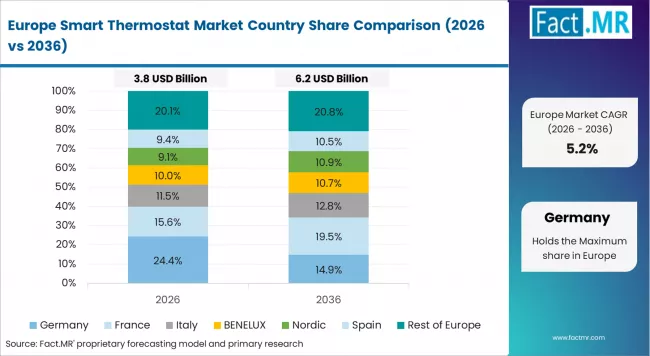
    Smart Thermostat Market Europe Country Market Share Analysis, 2026 & 2036

    Europe represents a policy-driven market where energy efficiency regulations and renovation programmes strongly support smart thermostat adoption. Companies such as Tado, Resideo, and Schneider Electric supply both consumer and professional installation markets across the region.

    • Germany: Germany’s smart thermostat market is forecast to grow at a CAGR of 8.7% through 2036. Government renovation incentives under the BEG programme provide financial support for smart energy control devices. Tado expanded its Matter-certified smart thermostat platform, while Viessmann integrated smart thermostat control with heat pump systems eligible for energy efficiency grants.
    • United Kingdom: The United Kingdom smart thermostat market is expected to grow at a CAGR of 8.5% through 2036. Government incentives under the Boiler Upgrade Scheme encourage installation of heat pumps paired with smart thermostats. Honeywell Home expanded certified thermostat offerings for installer networks, and Octopus Energy increased demand-response participation through its Intelligent Octopus tariff programme.

    FACT.MR's analysis of the smart thermostat market in Europe includes country-level assessment for Germany, France, the United Kingdom, Italy, Spain, and Rest of Western Europe. The research includes energy efficiency policy impact, utility demand-response programmes, and smart home adoption forecasts.

    Competitive Aligners for Market Players
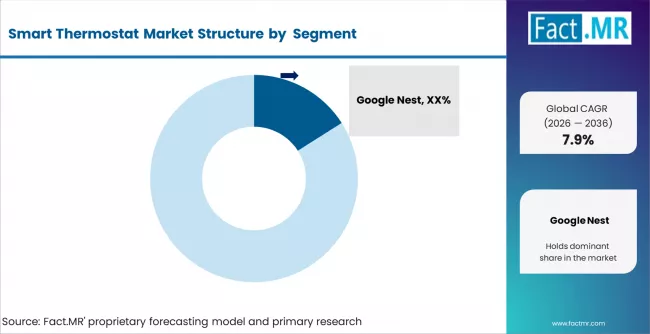
    Smart Thermostat Market Analysis By Company

    The global smart thermostat market is moderately concentrated, particularly in the premium segment where companies such as Google Nest, Ecobee, and Honeywell Home dominate sales in North America. Together, these brands account for a large share of retail revenue, largely because their products integrate easily with major smart home ecosystems. Today, competition is less about basic thermostat functionality and more about how well devices connect with voice assistants, smart home platforms, and utility energy programmes. Thermostats that work across multiple platforms and support demand-response energy programmes tend to command higher prices and stronger retail visibility, while simple Wi-Fi models increasingly face price competition from lower-cost alternatives sold online.

    Google Nest holds a strong position thanks to its integration with the Google Home and Google Assistant ecosystem, which provides broad consumer visibility. Ecobee has built an advantage through partnerships with numerous North American utilities, allowing its devices to participate in energy demand-response programmes that generate recurring service revenue. Honeywell Home and Resideo remain influential through HVAC installers, who recommend thermostat brands during millions of heating and cooling system replacements each year.

    Large buyers such as utilities and property developers typically maintain multiple approved vendors, but certification requirements from major smart home platforms create barriers for new competitors.

    Key Players

    • Google Nest
    • Ecobee
    • Honeywell Home
    • Emerson Electric
    • Johnson Controls
    • Schneider Electric
    • Amazon (Ring Thermostat)
    • Resideo Technologies
    • Lennox International
    • Tado

    Scope of Report

    Smart Thermostat Market Breakdown By Services, Solution, And Region

    Attribute Details
    Quantitative Units USD 16.2 billion (2026) to USD 34.7 billion (2036), at a CAGR of 7.9%
    Market Definition Wi-Fi and Zigbee-connected thermostats controlling residential and commercial HVAC systems, integrating with utility demand-response programmes, smart home platforms, and building energy management systems.
    Services Segmentation Managed, Integration
    Solution Segmentation Energy Management and Climate, Security and Access, Lighting and Window, Audio-Visual and Entertainment
    Application Coverage Residential HVAC energy optimisation, utility demand-response virtual power plants, commercial building HVAC scheduling, smart home ecosystem integration, and heat pump control management.
    Regions Covered Asia Pacific, Europe, North America, Latin America, Middle East and Africa
    Countries Covered South Korea, Japan, China, India, ASEAN, Australia and New Zealand, Germany, UK, France, Italy, Spain, Nordic, BENELUX, USA, Canada, Mexico, Brazil, Chile, Saudi Arabia, GCC, Turkey, South Africa, Rest of MEA
    Key Companies Profiled Google Nest, Ecobee, Honeywell Home, Emerson Electric, Johnson Controls, Schneider Electric, Amazon (Ring Thermostat), Resideo Technologies, Lennox International, Tado
    Forecast Period 2026 to 2036
    Approach Hybrid top-down and bottom-up model using smart thermostat unit shipments, average selling prices by connectivity type and service tier, utility programme enrolment data, and primary research interviews.

    Smart Thermostat Market by Segments

    • By Services:

      • Managed
      • Integration
    • By Solution:

      • Security and Access
      • Lighting and Window
      • Audio-Visual and Entertainment
      • Energy Management and Climate
    • By Region:

      • North America
        • United States
        • Canada
        • Mexico
      • Latin America
        • Brazil
        • Chile
        • Ecuador
        • Rest of Latin America
      • Western Europe
        • Germany
        • United Kingdom
        • France
        • Italy
        • Spain
        • Nordic Countries
        • BENELUX
        • Rest of Western Europe
      • Eastern Europe
        • Russia
        • Poland
        • Hungary
        • Balkan and Baltic
        • Rest of Eastern Europe
      • East Asia
        • China
        • Japan
        • South Korea
      • South Asia and Pacific
        • India
        • ASEAN
        • Australia and New Zealand
        • Rest of South Asia and Pacific
      • Middle East and Africa
        • Kingdom of Saudi Arabia
        • Other GCC Countries
        • Turkey
        • South Africa
        • Other African Union
        • Rest of Middle East and Africa

    Bibliography

    • [1] European Commission. (2023). Directive 2023/1791 of the European Parliament and of the Council on Energy Efficiency: Building HVAC Control Requirements, Smart Meter Installation Mandates, and National Transposition Deadline October 2025. October 2023. eur-lex.europa.eu
    • [2] Internal Revenue Service, US Department of Treasury. (2025). Notice 2025-15: ENERGY STAR Section 25C Residential Clean Energy Tax Credit Guidance for Smart Thermostat Qualifying Expenditures at 30 Percent Up to USD 150 for Tax Year 2025. January 2025. irs.gov/newsroom
    • [3] Ministry of Land, Infrastructure and Transport, Republic of Korea. (2024). Green Building Support Act Energy Performance Standard Update: Smart HVAC Scheduling Device Mandatory Installation Requirements for New Residential Developments Above 30 Units Effective January 2025. November 2024. molit.go.kr
    • [4] Resideo Technologies Inc. (2025). Q4 2024 Earnings Release: Pro IAQ Connected Thermostat Utility Demand-Response Programme Enrolment 2.1 Million Homes, Managed Service Contract Revenue Growth 14 Percent Year-on-Year, Virtual Power Plant Expansion. February 2025. resideo.com/investors
    • [5] Ecobee Inc. (2024). Product Launch Press Release: SmartSuite Energy Management Platform Launch with 27 Utility Demand-Response API Integrations and Occupancy-Based HVAC Optimisation Subscription Service at USD 9.99 Per Month. November 2024. ecobee.com/newsroom
    • [6] CEDIA (Custom Electronic Design and Installation Association). (2025). State of the Industry Report 2025: Smart Thermostat Integration Service Category Ranking, Average Project Value Growth 18 Percent in 2024, Multi-Zone and Voice-Assistant Configuration Trends. January 2025. cedia.org/research
    • [7] Google LLC. (2025). Nest Learning Thermostat Demand-Response Programme Update: 900,000 Additional US Household Enrolments in 2024, Average Peak Demand Reduction 2.4 kW Per Enrolled Household During Grid Stress Events, Utility Partnership Performance Data. January 2025. nest.com/press
    • [8] Schneider Electric SE. (2024). Product Launch Press Release: Wiser Energy 3.0 Smart Thermostat and Home Energy Management Platform with Solar Inverter Data Integration, EV Charger Scheduling, and Heat Pump Control for European Multi-Energy-System Homes. October 2024. se.com/newsroom
    • [9] Johnson Controls International. (2025). Smart Building Report 2025: Commercial Building Operator Survey on Smart Thermostat and Security System Integration, Thermostat Access-Scheduling Adoption Rate 43 Percent in 2024. January 2025. johnsoncontrols.com/insights

    This Report Addresses

    • Strategic insights on regulations shaping smart thermostat demand, including EU Energy Efficiency Directive mandates, US IRA tax credits, South Korea Green Building Act standards, Japan Top Runner HVAC rules, Germany BEG renovation grants, and UK Boiler Upgrade Scheme requirements.
    • Market forecast from USD 16.2 billion in 2026 to USD 34.7 billion by 2036 at 7.9% CAGR, segmented by services and solution type across major regions.
    • Growth opportunities across South Korea green building HVAC mandates, Japan ZEH subsidy programmes, US utility demand-response expansion, Germany BEG renovation incentives, and UK heat pump thermostat requirements.
    • Country CAGR outlook including South Korea 9.4%, United States 9.1%, Japan 8.9%, Germany 8.7%, and United Kingdom 8.5%, driven by energy policies and smart home adoption.
    • Competitive analysis of Google Nest, Ecobee, Honeywell Home, Resideo Technologies, Tado, Schneider Electric, Amazon Ring, Emerson, Johnson Controls, and Lennox International.
    • Technology tracking including Matter over Thread adoption, AI learning thermostat algorithms, heat pump integration, demand-response APIs, and multi-zone HVAC control platforms.
    • Regulatory analysis covering EU EED building control mandates, US ENERGY STAR and IRA incentives, South Korea HVAC standards, Japan Top Runner rules, and UK MCS certification requirements.
    • Report delivered in PDF, Excel datasets, PowerPoint summary, and dashboard formats supported by IEA energy data, utility enrolment statistics, manufacturer disclosures, and primary research interviews.

    Table of Content

    1. Executive Summary
      • Global Market Outlook
      • Demand to side Trends
      • Supply to side Trends
      • Technology Roadmap Analysis
      • Analysis and Recommendations
    2. Market Overview
      • Market Coverage / Taxonomy
      • Market Definition / Scope / Limitations
    3. Research Methodology
      • Chapter Orientation
      • Analytical Lens and Working Hypotheses
        • Market Structure, Signals, and Trend Drivers
        • Benchmarking and Cross-market Comparability
        • Market Sizing, Forecasting, and Opportunity Mapping
      • Research Design and Evidence Framework
        • Desk Research Programme (Secondary Evidence)
          • Company Annual and Sustainability Reports
          • Peer-reviewed Journals and Academic Literature
          • Corporate Websites, Product Literature, and Technical Notes
          • Earnings Decks and Investor Briefings
          • Statutory Filings and Regulatory Disclosures
          • Technical White Papers and Standards Notes
          • Trade Journals, Industry Magazines, and Analyst Briefs
          • Conference Proceedings, Webinars, and Seminar Materials
          • Government Statistics Portals and Public Data Releases
          • Press Releases and Reputable Media Coverage
          • Specialist Newsletters and Curated Briefings
          • Sector Databases and Reference Repositories
          • Fact.MR Internal Proprietary Databases and Historical Market Datasets
          • Subscription Datasets and Paid Sources
          • Social Channels, Communities, and Digital Listening Inputs
          • Additional Desk Sources
        • Expert Input and Fieldwork (Primary Evidence)
          • Primary Modes
            • Qualitative Interviews and Expert Elicitation
            • Quantitative Surveys and Structured Data Capture
            • Blended Approach
          • Why Primary Evidence is Used
          • Field Techniques
            • Interviews
            • Surveys
            • Focus Groups
            • Observational and In-context Research
            • Social and Community Interactions
          • Stakeholder Universe Engaged
            • C-suite Leaders
            • Board Members
            • Presidents and Vice Presidents
            • R&D and Innovation Heads
            • Technical Specialists
            • Domain Subject-matter Experts
            • Scientists
            • Physicians and Other Healthcare Professionals
          • Governance, Ethics, and Data Stewardship
            • Research Ethics
            • Data Integrity and Handling
        • Tooling, Models, and Reference Databases
      • Data Engineering and Model Build
        • Data Acquisition and Ingestion
        • Cleaning, Normalisation, and Verification
        • Synthesis, Triangulation, and Analysis
      • Quality Assurance and Audit Trail
    4. Market Background
      • Market Dynamics
        • Drivers
        • Restraints
        • Opportunity
        • Trends
      • Scenario Forecast
        • Demand in Optimistic Scenario
        • Demand in Likely Scenario
        • Demand in Conservative Scenario
      • Opportunity Map Analysis
      • Product Life Cycle Analysis
      • Supply Chain Analysis
      • Investment Feasibility Matrix
      • Value Chain Analysis
      • PESTLE and Porter’s Analysis
      • Regulatory Landscape
      • Regional Parent Market Outlook
      • Production and Consumption Statistics
      • Import and Export Statistics
    5. Global Market Analysis 2021 to 2025 and Forecast, 2026 to 2036
      • Historical Market Size Value (USD Million) Analysis, 2021 to 2025
      • Current and Future Market Size Value (USD Million) Projections, 2026 to 2036
        • Y to o to Y Growth Trend Analysis
        • Absolute $ Opportunity Analysis
    6. Global Market Pricing Analysis 2021 to 2025 and Forecast 2026 to 2036
    7. Global Market Analysis 2021 to 2025 and Forecast 2026 to 2036, By Services
      • Introduction / Key Findings
      • Historical Market Size Value (USD Million) Analysis By Services, 2021 to 2025
      • Current and Future Market Size Value (USD Million) Analysis and Forecast By Services, 2026 to 2036
        • Managed
        • Integration
      • Y to o to Y Growth Trend Analysis By Services, 2021 to 2025
      • Absolute $ Opportunity Analysis By Services, 2026 to 2036
    8. Global Market Analysis 2021 to 2025 and Forecast 2026 to 2036, By Solution
      • Introduction / Key Findings
      • Historical Market Size Value (USD Million) Analysis By Solution, 2021 to 2025
      • Current and Future Market Size Value (USD Million) Analysis and Forecast By Solution, 2026 to 2036
        • Energy Management and Climate
        • Security and Access
        • Lighting and Window
        • Audio-Visual and Entertainment
      • Y to o to Y Growth Trend Analysis By Solution, 2021 to 2025
      • Absolute $ Opportunity Analysis By Solution, 2026 to 2036
    9. Global Market Analysis 2021 to 2025 and Forecast 2026 to 2036, By Region
      • Introduction
      • Historical Market Size Value (USD Million) Analysis By Region, 2021 to 2025
      • Current Market Size Value (USD Million) Analysis and Forecast By Region, 2026 to 2036
        • North America
        • Latin America
        • Western Europe
        • Eastern Europe
        • East Asia
        • South Asia and Pacific
        • Middle East & Africa
      • Market Attractiveness Analysis By Region
    10. North America Market Analysis 2021 to 2025 and Forecast 2026 to 2036, By Country
      • Historical Market Size Value (USD Million) Trend Analysis By Market Taxonomy, 2021 to 2025
      • Market Size Value (USD Million) Forecast By Market Taxonomy, 2026 to 2036
        • By Country
          • USA
          • Canada
          • Mexico
        • By Services
        • By Solution
      • Market Attractiveness Analysis
        • By Country
        • By Services
        • By Solution
      • Key Takeaways
    11. Latin America Market Analysis 2021 to 2025 and Forecast 2026 to 2036, By Country
      • Historical Market Size Value (USD Million) Trend Analysis By Market Taxonomy, 2021 to 2025
      • Market Size Value (USD Million) Forecast By Market Taxonomy, 2026 to 2036
        • By Country
          • Brazil
          • Chile
          • Rest of Latin America
        • By Services
        • By Solution
      • Market Attractiveness Analysis
        • By Country
        • By Services
        • By Solution
      • Key Takeaways
    12. Western Europe Market Analysis 2021 to 2025 and Forecast 2026 to 2036, By Country
      • Historical Market Size Value (USD Million) Trend Analysis By Market Taxonomy, 2021 to 2025
      • Market Size Value (USD Million) Forecast By Market Taxonomy, 2026 to 2036
        • By Country
          • Germany
          • UK
          • Italy
          • Spain
          • France
          • Nordic
          • BENELUX
          • Rest of Western Europe
        • By Services
        • By Solution
      • Market Attractiveness Analysis
        • By Country
        • By Services
        • By Solution
      • Key Takeaways
    13. Eastern Europe Market Analysis 2021 to 2025 and Forecast 2026 to 2036, By Country
      • Historical Market Size Value (USD Million) Trend Analysis By Market Taxonomy, 2021 to 2025
      • Market Size Value (USD Million) Forecast By Market Taxonomy, 2026 to 2036
        • By Country
          • Russia
          • Poland
          • Hungary
          • Balkan & Baltic
          • Rest of Eastern Europe
        • By Services
        • By Solution
      • Market Attractiveness Analysis
        • By Country
        • By Services
        • By Solution
      • Key Takeaways
    14. East Asia Market Analysis 2021 to 2025 and Forecast 2026 to 2036, By Country
      • Historical Market Size Value (USD Million) Trend Analysis By Market Taxonomy, 2021 to 2025
      • Market Size Value (USD Million) Forecast By Market Taxonomy, 2026 to 2036
        • By Country
          • China
          • Japan
          • South Korea
        • By Services
        • By Solution
      • Market Attractiveness Analysis
        • By Country
        • By Services
        • By Solution
      • Key Takeaways
    15. South Asia and Pacific Market Analysis 2021 to 2025 and Forecast 2026 to 2036, By Country
      • Historical Market Size Value (USD Million) Trend Analysis By Market Taxonomy, 2021 to 2025
      • Market Size Value (USD Million) Forecast By Market Taxonomy, 2026 to 2036
        • By Country
          • India
          • ASEAN
          • Australia & New Zealand
          • Rest of South Asia and Pacific
        • By Services
        • By Solution
      • Market Attractiveness Analysis
        • By Country
        • By Services
        • By Solution
      • Key Takeaways
    16. Middle East & Africa Market Analysis 2021 to 2025 and Forecast 2026 to 2036, By Country
      • Historical Market Size Value (USD Million) Trend Analysis By Market Taxonomy, 2021 to 2025
      • Market Size Value (USD Million) Forecast By Market Taxonomy, 2026 to 2036
        • By Country
          • Kingdom of Saudi Arabia
          • Other GCC Countries
          • Turkiye
          • South Africa
          • Other African Union
          • Rest of Middle East & Africa
        • By Services
        • By Solution
      • Market Attractiveness Analysis
        • By Country
        • By Services
        • By Solution
      • Key Takeaways
    17. Key Countries Market Analysis
      • USA
        • Pricing Analysis
        • Market Share Analysis, 2025
          • By Services
          • By Solution
      • Canada
        • Pricing Analysis
        • Market Share Analysis, 2025
          • By Services
          • By Solution
      • Mexico
        • Pricing Analysis
        • Market Share Analysis, 2025
          • By Services
          • By Solution
      • Brazil
        • Pricing Analysis
        • Market Share Analysis, 2025
          • By Services
          • By Solution
      • Chile
        • Pricing Analysis
        • Market Share Analysis, 2025
          • By Services
          • By Solution
      • Germany
        • Pricing Analysis
        • Market Share Analysis, 2025
          • By Services
          • By Solution
      • UK
        • Pricing Analysis
        • Market Share Analysis, 2025
          • By Services
          • By Solution
      • Italy
        • Pricing Analysis
        • Market Share Analysis, 2025
          • By Services
          • By Solution
      • Spain
        • Pricing Analysis
        • Market Share Analysis, 2025
          • By Services
          • By Solution
      • France
        • Pricing Analysis
        • Market Share Analysis, 2025
          • By Services
          • By Solution
      • India
        • Pricing Analysis
        • Market Share Analysis, 2025
          • By Services
          • By Solution
      • ASEAN
        • Pricing Analysis
        • Market Share Analysis, 2025
          • By Services
          • By Solution
      • Australia & New Zealand
        • Pricing Analysis
        • Market Share Analysis, 2025
          • By Services
          • By Solution
      • China
        • Pricing Analysis
        • Market Share Analysis, 2025
          • By Services
          • By Solution
      • Japan
        • Pricing Analysis
        • Market Share Analysis, 2025
          • By Services
          • By Solution
      • South Korea
        • Pricing Analysis
        • Market Share Analysis, 2025
          • By Services
          • By Solution
      • Russia
        • Pricing Analysis
        • Market Share Analysis, 2025
          • By Services
          • By Solution
      • Poland
        • Pricing Analysis
        • Market Share Analysis, 2025
          • By Services
          • By Solution
      • Hungary
        • Pricing Analysis
        • Market Share Analysis, 2025
          • By Services
          • By Solution
      • Kingdom of Saudi Arabia
        • Pricing Analysis
        • Market Share Analysis, 2025
          • By Services
          • By Solution
      • Turkiye
        • Pricing Analysis
        • Market Share Analysis, 2025
          • By Services
          • By Solution
      • South Africa
        • Pricing Analysis
        • Market Share Analysis, 2025
          • By Services
          • By Solution
    18. Market Structure Analysis
      • Competition Dashboard
      • Competition Benchmarking
      • Market Share Analysis of Top Players
        • By Regional
        • By Services
        • By Solution
    19. Competition Analysis
      • Competition Deep Dive
        • Google Nest
          • Overview
          • Product Portfolio
          • Profitability by Market Segments (Product/Age /Sales Channel/Region)
          • Sales Footprint
          • Strategy Overview
            • Marketing Strategy
            • Product Strategy
            • Channel Strategy
        • Ecobee
        • Honeywell Home
        • Emerson Electric
        • Johnson Controls
        • Schneider Electric
        • Amazon (Ring Thermostat)
        • Resideo Technologies
        • Lennox International
        • Tado
    20. Assumptions & Acronyms Used

    List Of Table

    • Table 1: Global Market Value (USD Million) Forecast by Region, 2021 to 2036
    • Table 2: Global Market Value (USD Million) Forecast by Services, 2021 to 2036
    • Table 3: Global Market Value (USD Million) Forecast by Solution, 2021 to 2036
    • Table 4: North America Market Value (USD Million) Forecast by Country, 2021 to 2036
    • Table 5: North America Market Value (USD Million) Forecast by Services, 2021 to 2036
    • Table 6: North America Market Value (USD Million) Forecast by Solution, 2021 to 2036
    • Table 7: Latin America Market Value (USD Million) Forecast by Country, 2021 to 2036
    • Table 8: Latin America Market Value (USD Million) Forecast by Services, 2021 to 2036
    • Table 9: Latin America Market Value (USD Million) Forecast by Solution, 2021 to 2036
    • Table 10: Western Europe Market Value (USD Million) Forecast by Country, 2021 to 2036
    • Table 11: Western Europe Market Value (USD Million) Forecast by Services, 2021 to 2036
    • Table 12: Western Europe Market Value (USD Million) Forecast by Solution, 2021 to 2036
    • Table 13: Eastern Europe Market Value (USD Million) Forecast by Country, 2021 to 2036
    • Table 14: Eastern Europe Market Value (USD Million) Forecast by Services, 2021 to 2036
    • Table 15: Eastern Europe Market Value (USD Million) Forecast by Solution, 2021 to 2036
    • Table 16: East Asia Market Value (USD Million) Forecast by Country, 2021 to 2036
    • Table 17: East Asia Market Value (USD Million) Forecast by Services, 2021 to 2036
    • Table 18: East Asia Market Value (USD Million) Forecast by Solution, 2021 to 2036
    • Table 19: South Asia and Pacific Market Value (USD Million) Forecast by Country, 2021 to 2036
    • Table 20: South Asia and Pacific Market Value (USD Million) Forecast by Services, 2021 to 2036
    • Table 21: South Asia and Pacific Market Value (USD Million) Forecast by Solution, 2021 to 2036
    • Table 22: Middle East & Africa Market Value (USD Million) Forecast by Country, 2021 to 2036
    • Table 23: Middle East & Africa Market Value (USD Million) Forecast by Services, 2021 to 2036
    • Table 24: Middle East & Africa Market Value (USD Million) Forecast by Solution, 2021 to 2036

    List Of Figures

    • Figure 1: Global Market Pricing Analysis
    • Figure 2: Global Market Value (USD Million) Forecast 2021 to 2036
    • Figure 3: Global Market Value Share and BPS Analysis by Services, 2026 and 2036
    • Figure 4: Global Market Y-o-Y Growth Comparison by Services, 2026 to 2036
    • Figure 5: Global Market Attractiveness Analysis by Services
    • Figure 6: Global Market Value Share and BPS Analysis by Solution, 2026 and 2036
    • Figure 7: Global Market Y-o-Y Growth Comparison by Solution, 2026 to 2036
    • Figure 8: Global Market Attractiveness Analysis by Solution
    • Figure 9: Global Market Value (USD Million) Share and BPS Analysis by Region, 2026 and 2036
    • Figure 10: Global Market Y-o-Y Growth Comparison by Region, 2026 to 2036
    • Figure 11: Global Market Attractiveness Analysis by Region
    • Figure 12: North America Market Incremental Dollar Opportunity, 2026 to 2036
    • Figure 13: Latin America Market Incremental Dollar Opportunity, 2026 to 2036
    • Figure 14: Western Europe Market Incremental Dollar Opportunity, 2026 to 2036
    • Figure 15: Eastern Europe Market Incremental Dollar Opportunity, 2026 to 2036
    • Figure 16: East Asia Market Incremental Dollar Opportunity, 2026 to 2036
    • Figure 17: South Asia and Pacific Market Incremental Dollar Opportunity, 2026 to 2036
    • Figure 18: Middle East & Africa Market Incremental Dollar Opportunity, 2026 to 2036
    • Figure 19: North America Market Value Share and BPS Analysis by Country, 2026 and 2036
    • Figure 20: North America Market Value Share and BPS Analysis by Services, 2026 and 2036
    • Figure 21: North America Market Y-o-Y Growth Comparison by Services, 2026 to 2036
    • Figure 22: North America Market Attractiveness Analysis by Services
    • Figure 23: North America Market Value Share and BPS Analysis by Solution, 2026 and 2036
    • Figure 24: North America Market Y-o-Y Growth Comparison by Solution, 2026 to 2036
    • Figure 25: North America Market Attractiveness Analysis by Solution
    • Figure 26: Latin America Market Value Share and BPS Analysis by Country, 2026 and 2036
    • Figure 27: Latin America Market Value Share and BPS Analysis by Services, 2026 and 2036
    • Figure 28: Latin America Market Y-o-Y Growth Comparison by Services, 2026 to 2036
    • Figure 29: Latin America Market Attractiveness Analysis by Services
    • Figure 30: Latin America Market Value Share and BPS Analysis by Solution, 2026 and 2036
    • Figure 31: Latin America Market Y-o-Y Growth Comparison by Solution, 2026 to 2036
    • Figure 32: Latin America Market Attractiveness Analysis by Solution
    • Figure 33: Western Europe Market Value Share and BPS Analysis by Country, 2026 and 2036
    • Figure 34: Western Europe Market Value Share and BPS Analysis by Services, 2026 and 2036
    • Figure 35: Western Europe Market Y-o-Y Growth Comparison by Services, 2026 to 2036
    • Figure 36: Western Europe Market Attractiveness Analysis by Services
    • Figure 37: Western Europe Market Value Share and BPS Analysis by Solution, 2026 and 2036
    • Figure 38: Western Europe Market Y-o-Y Growth Comparison by Solution, 2026 to 2036
    • Figure 39: Western Europe Market Attractiveness Analysis by Solution
    • Figure 40: Eastern Europe Market Value Share and BPS Analysis by Country, 2026 and 2036
    • Figure 41: Eastern Europe Market Value Share and BPS Analysis by Services, 2026 and 2036
    • Figure 42: Eastern Europe Market Y-o-Y Growth Comparison by Services, 2026 to 2036
    • Figure 43: Eastern Europe Market Attractiveness Analysis by Services
    • Figure 44: Eastern Europe Market Value Share and BPS Analysis by Solution, 2026 and 2036
    • Figure 45: Eastern Europe Market Y-o-Y Growth Comparison by Solution, 2026 to 2036
    • Figure 46: Eastern Europe Market Attractiveness Analysis by Solution
    • Figure 47: East Asia Market Value Share and BPS Analysis by Country, 2026 and 2036
    • Figure 48: East Asia Market Value Share and BPS Analysis by Services, 2026 and 2036
    • Figure 49: East Asia Market Y-o-Y Growth Comparison by Services, 2026 to 2036
    • Figure 50: East Asia Market Attractiveness Analysis by Services
    • Figure 51: East Asia Market Value Share and BPS Analysis by Solution, 2026 and 2036
    • Figure 52: East Asia Market Y-o-Y Growth Comparison by Solution, 2026 to 2036
    • Figure 53: East Asia Market Attractiveness Analysis by Solution
    • Figure 54: South Asia and Pacific Market Value Share and BPS Analysis by Country, 2026 and 2036
    • Figure 55: South Asia and Pacific Market Value Share and BPS Analysis by Services, 2026 and 2036
    • Figure 56: South Asia and Pacific Market Y-o-Y Growth Comparison by Services, 2026 to 2036
    • Figure 57: South Asia and Pacific Market Attractiveness Analysis by Services
    • Figure 58: South Asia and Pacific Market Value Share and BPS Analysis by Solution, 2026 and 2036
    • Figure 59: South Asia and Pacific Market Y-o-Y Growth Comparison by Solution, 2026 to 2036
    • Figure 60: South Asia and Pacific Market Attractiveness Analysis by Solution
    • Figure 61: Middle East & Africa Market Value Share and BPS Analysis by Country, 2026 and 2036
    • Figure 62: Middle East & Africa Market Value Share and BPS Analysis by Services, 2026 and 2036
    • Figure 63: Middle East & Africa Market Y-o-Y Growth Comparison by Services, 2026 to 2036
    • Figure 64: Middle East & Africa Market Attractiveness Analysis by Services
    • Figure 65: Middle East & Africa Market Value Share and BPS Analysis by Solution, 2026 and 2036
    • Figure 66: Middle East & Africa Market Y-o-Y Growth Comparison by Solution, 2026 to 2036
    • Figure 67: Middle East & Africa Market Attractiveness Analysis by Solution
    • Figure 68: Global Market - Tier Structure Analysis
    • Figure 69: Global Market - Company Share Analysis

    - FAQs -

    How large is the smart thermostat market in 2025?

    The market was valued at USD 15.1 billion in 2025.

    What will the market size be in 2026?

    The market is estimated to reach USD 16.2 billion in 2026.

    What is the projected market size by 2036?

    The market is projected to reach USD 34.7 billion by 2036, creating a USD 18.5 billion absolute dollar opportunity over the forecast period.

    What is the expected CAGR?

    The forecast CAGR from 2026 to 2036 is 7.9%.

    Which services segment leads the smart thermostat market?

    Managed services lead with approximately 58% share in 2026.

    Which solution segment holds the largest share?

    Energy management and climate solutions lead at approximately 64% share in 2026.

    Which country shows the fastest growth?

    South Korea leads at 9.4% CAGR through 2036.

    What is driving growth in the smart thermostat market?

    Growth is driven by energy efficiency regulations, smart home adoption, and expanding utility demand-response programmes.

    What is the projected growth rate of the smart thermostat market?

    The smart thermostat market is projected to grow at a CAGR of about 7.9% from 2026 to 2036.

    Which regions are leading smart thermostat adoption?

    North America currently leads adoption due to strong utility incentives and widespread smart home ecosystem integration.

    Why are utilities promoting smart thermostat adoption?

    Utilities promote smart thermostats because they help manage peak electricity demand through demand-response programmes.

    What role do smart thermostats play in energy management?

    Smart thermostats optimise heating and cooling schedules to reduce energy consumption and lower household energy costs.

    Smart Thermostat Market