- Market Value (2025): USD 3.5 Bn
- Estimated Value (2026): USD 3.8 Bn
- Forecast Value (2036): USD 8.8 Bn
- CAGR (2026-2036): 8.8%
What is the Smart Room Heater Market forecast to be worth by 2036?
USD 3.8 billion in 2026 to USD 8.8 billion by 2036 at 8.8% CAGR.
- The smart room heater market reached USD 3.5 billion in 2025.
- Demand is projected to increase from USD 3.8 billion in 2026 to USD 8.8 billion by 2036.
- The market is forecast to record 8.8% CAGR from 2026 to 2036 owing to app-based control and energy-use awareness. Residential replacement demand is expected to add further support.
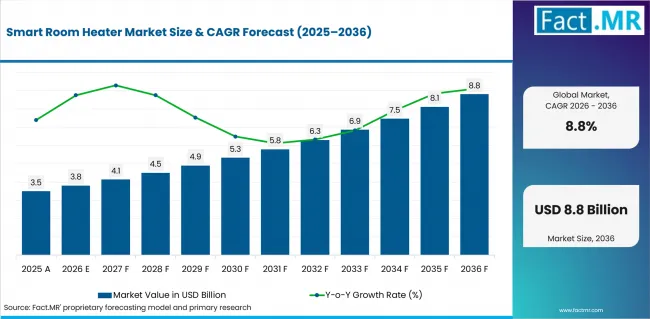
Smart Room Heater Market Value Analysis | Source: Fact.MR
What are the defining numbers behind Smart Room Heater Market growth?
USD 5.0 billion absolute opportunity by 2036.
- Demand Drivers in the Market
- Smart convection heaters are expected to gain attention where smart home devices are already part of household buying.
- Wi-Fi enabled models are likely to benefit from wider smart home use. App control helps users adjust heat remotely and check daily operating behavior more easily.
- Online retail is expected to support comparison-led buying across consumer electronics channels.
- Key Segments Analyzed
- By Product: Smart Convection Heaters are expected to hold 40.0% share in 2026 because they offer familiar room-heating performance with digital control features.
- By Connectivity: Wi-Fi Enabled models are projected to account for 50.8% share in 2026 as remote access and app schedules become easier to explain at retail.
- By Application: Residential use is anticipated to capture 41.4% share in 2026 since household buyers make the clearest case for room-level comfort.
- By Distribution Channel: Online Retail is estimated to represent 39.3% share in 2026 due to review-led product comparison and wider access to brand websites.
- By End User: Residential Consumers are forecast to hold 40.1% share in 2026 as homeowners and tenants remain the main buyers for connected room heating.
- Analyst Opinion at Fact.MR
- Shambhu Nath Jha, Sr. Consultant at Fact.MR, opines, “In the smart room heater market, the purchase test is practical. Suppliers must show that connected controls improve daily heating use without making setup or safety review harder for the buyer.”
- Strategic Implications
- Retailers can build clearer assortments by separating room-heating needs from broad smart thermostat claims.
- Suppliers can improve proposals by explaining why connected heaters fit selected electric heater use cases.
- Investors can read the Canada and UK growth spread through channel readiness over simple product availability.
USA is projected to post 11.5% CAGR from 2026 to 2036 through online comparison and replacement buying. Germany is forecast at 10.4% through appliance efficiency awareness. UK is expected to record 9.3% as connected controls influence selection. France is projected at 8.2% through channel-led product positioning. Japan is estimated at 7.3% through compact home use, while Canada is projected to record 6.2% with residential heating needs and service-coverage requirements.
How does the Smart Room Heater Market break down by segment?
Smart Convection Heaters are expected to lead Product at 40.0% share in 2026. Wi-Fi Enabled models are projected to lead Connectivity at 50.8% share in 2026.
Why does Smart Convection Heaters lead Product?
Smart Convection Heaters are projected to account for 40.0% share in 2026.
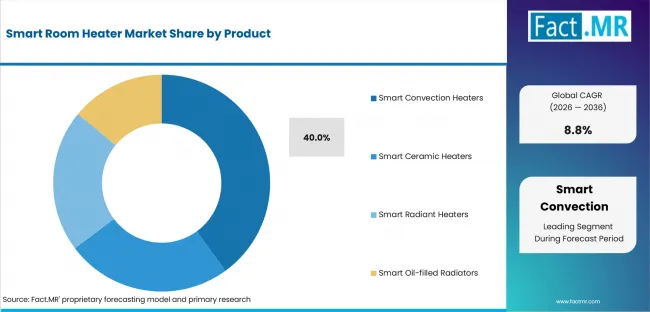
Smart Room Heater Market Analysis By Product | Source: Fact.MR
Smart convection formats give buyers a familiar heating method with added control and scheduling features. Wall-mounted and portable convection heaters remain useful when room layout shapes the purchase. Glass panel convection heaters add a design-led option for homes that value appearance.
Why does Wi-Fi Enabled lead Connectivity?
Wi-Fi Enabled is expected to hold 50.8% share in 2026.
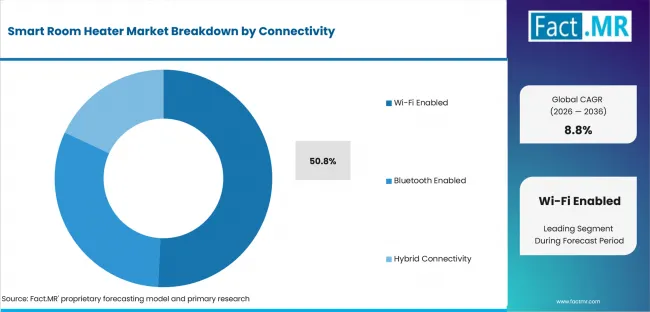
Smart Room Heater Market Analysis By Connectivity | Source: Fact.MR
Wi-Fi enabled heaters give users remote control without requiring a separate hub in many homes. Remote app control and voice assistant integration support buyers who already use connected devices. OTA firmware updates help brands maintain software performance after sale.
Why does Residential lead Application?
Residential is anticipated to capture 41.4% share in 2026.
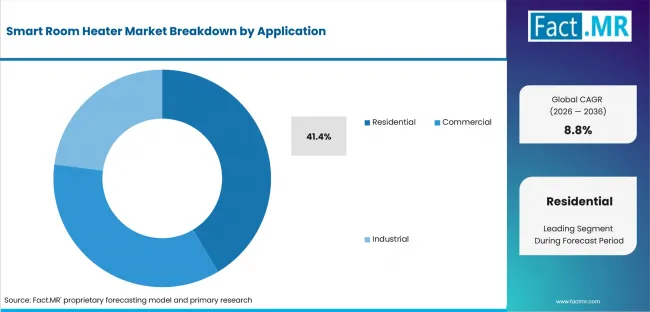
Smart Room Heater Market Analysis By Application | Source: Fact.MR
Residential demand leads where households need room-level heat for apartments and smart homes. Buyers often compare safety shutoff with electricity use before purchase. Commercial and industrial use remains more selective because duty cycles are different.
Why does Online Retail lead Distribution Channel?
Online Retail is estimated to represent 39.3% share in 2026.
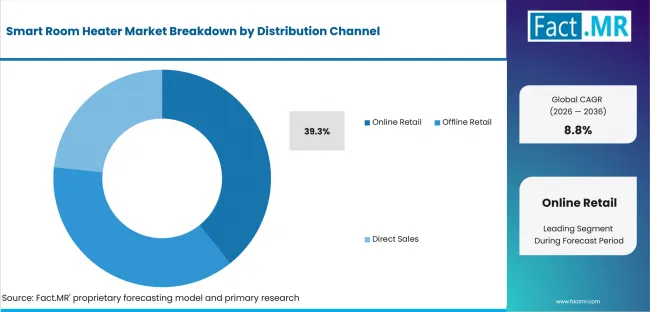
Smart Room Heater Market Analysis By Distribution Channel | Source: Fact.MR
Online retail leads where shoppers compare ratings and delivery options before choosing a heater. E-commerce marketplaces give buyers more price visibility. Brand websites and smart home platforms help suppliers explain setup steps in more detail.
Why does Residential Consumers lead End User?
Residential Consumers are forecast to hold 40.1% share in 2026.
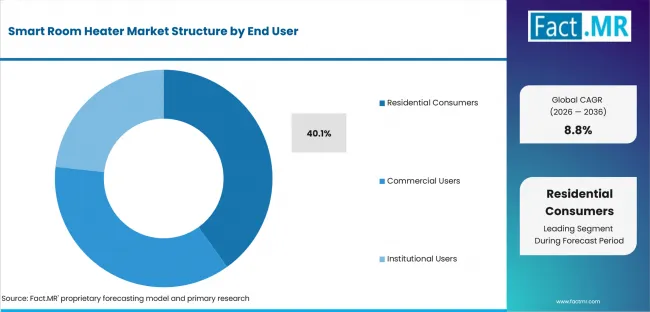
Smart Room Heater Market Analysis By End User | Source: Fact.MR
Residential consumers form the main end-user base because smart room heaters are usually purchased for daily comfort. Homeowners may prefer better control and design options. Tenants often value portability and simple app pairing.
What is accelerating Smart Room Heater Market adoption, and what is holding it back?
Demand is expected to grow through smart controls and convenient room heating. Adoption may be limited by high prices and unclear energy savings.
Drivers Impact Analysis
| DRIVER | (~) % IMPACT ON CAGR | GEOGRAPHIC RELEVANCE | IMPACT TIMELINE |
|---|---|---|---|
| Connected room-level control | +2.4% | Canada; UK; USA | Short term (<= 2 years) |
| Residential supplemental heating | +2.0% | Canada; USA; Germany | Short term (<= 2 years) |
| Online retail comparison | +1.7% | UK; USA; France | Medium term (2-4 years) |
| Smart-home compatibility | +1.5% | Japan; Germany; UK | Medium term (2-4 years) |
| Safety-feature visibility | +1.2% | Residential markets | Long term (>= 4 years) |
Source: Fact.MR analysis. Updated Jul 30, 2026
- Connected room-level control: App schedules and remote access are expected to raise the value of smart convection heaters. Buyers respond better when setup steps are simple and support is clear.
- Residential supplemental heating: Households are likely to use smart room heaters where central heating is costly or uneven. Portable units gain value when temperature control is visible to the user.
- Online retail comparison: Digital product pages are expected to make feature comparison easier before purchase. Reviews and ratings help shoppers test safety claims and daily-use performance.
Opportunity Impact Analysis
| OPPORTUNITY | (~) % IMPACT ON CAGR | GEOGRAPHIC RELEVANCE | IMPACT TIMELINE |
|---|---|---|---|
| App-led heating routines | +1.3% | Canada and UK | Medium term (2-4 years) |
| Bundled smart-home assortments | +1.1% | USA and Japan | Medium term (2-4 years) |
| Retailer private-label programs | +0.9% | Europe and North America | Long term (>= 4 years) |
| Room-size recommendation tools | +0.6% | Online retail markets | Long term (>= 4 years) |
Source: Fact.MR analysis. Updated Jul 30, 2026
- App-led heating routines: Suppliers can position smart room heaters around daily schedules and remote comfort control. The opening improves when the app explains timer setup in plain steps.
- Bundled smart-home assortments: Retailers can place heaters near IoT devices that already solve household control problems. This helps buyers understand compatibility before selecting a model.
- Retailer private-label programs: Private-label lines can widen access when they retain safety documentation and service support. Lower entry prices may help retailers reach tenants and first-time buyers.
Restraints Impact Analysis
| RESTRAINT | (~) % IMPACT ON CAGR | GEOGRAPHIC RELEVANCE | IMPACT TIMELINE |
|---|---|---|---|
| Price sensitivity around connected features | -1.2% | Global | Short term (<= 2 years) |
| Safety and certification hesitation | -1.0% | Residential markets | Short term (<= 2 years) |
| Weak evidence of energy savings | -0.8% | Canada; UK; USA | Medium term (2-4 years) |
| App setup and return risk | -0.6% | Online retail channels | Long term (>= 4 years) |
Source: Fact.MR analysis. Updated Jul 30, 2026
- Price sensitivity around connected features: Buyers may reject Wi-Fi enabled heaters when the price premium lacks a clear daily-use benefit. Brands need to explain what the added control changes.
- Safety and certification hesitation: Room heaters face close review because consumers associate the category with fire and overheating risk. Weak labeling can slow adoption even when demand exists.
- Weak evidence of energy savings: Smart controls do not automatically prove lower bills for every household. Adoption can slow when suppliers cannot explain room size fit and runtime behavior clearly.
Which countries are scaling Smart Room Heater Market fastest?
The country comparison is led by the USA at 11.5% CAGR, followed by Germany at 10.4% and the UK at 9.3%. France, Japan and Canada grow at lower listed rates.
- The USA leads through online comparison and replacement buying.
- Germany benefits from efficiency-focused product comparison.
- The UK benefits from retailer guidance and connected-appliance awareness.
- France relies on clearer channel positioning.
- Japan favors compact heaters and reliable controls.
- Canada remains tied to dependable room heating in colder regions and service-coverage needs.
Similar CAGRs create different market conditions. Service depth, retail guidance, safety and control features remain important.
The full report provides country-level CAGR analysis across North America; Latin America; Europe; East Asia; South Asia and Oceania; and the Middle East and Africa.
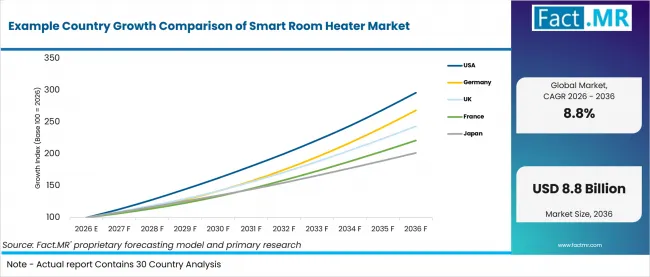
Example Country Growth Comparison Of Smart Room Heater Market | Source: Fact.MR
| Country | CAGR (2026-2036) |
|---|---|
| Canada | 6.2% |
| UK | 9.3% |
| USA | 11.5% |
| Japan | 7.3% |
| Germany | 10.4% |
| France | 8.2% |
Source: Fact.MR analysis. Updated Jul 30, 2026
What supports Canada adoption?
6.2% CAGR, supported by colder-weather use and service-coverage needs.
Canada’s growth reflects a market where buyers value reliable room-level heat across dispersed households. Smart convection heaters fit this need when brands explain setup and service access. Retail partners are expected to favor products that reduce operating uncertainty for residential consumers.
How is UK demand developing?
9.3% CAGR, driven by connected controls and retailer-led education.
Retailers in the UK are expected to shape demand by making connected appliance features easier to understand. Wi-Fi enabled models gain attention when the daily benefit is clear. Brands with simple instructions and credible after-sales support are likely to convert more buyers.
What supports USA adoption?
11.5% CAGR, backed by online comparison and replacement purchasing.
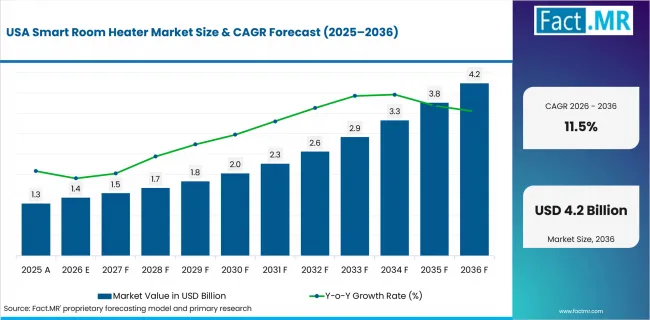
Smart Room Heater Market Country Value Analysis | Source: Fact.MR
USA growth comes from shoppers who use reviews and product pages before buying supplemental heating. Residential consumers are expected to ask for proof around safety controls and setup steps. Consistent online information can turn product interest into orders.
How does Japan perform?
7.3% CAGR, led by compact home use and quality-focused selection.
Japan’s outlook reflects demand for compact heaters that fit smaller spaces and controlled household routines. Buyers are likely to value quiet operation and dependable control. Suppliers must keep compatibility and safety information simple so connected features do not add friction.
What shapes Germany’s outlook?
10.4% CAGR, supported by efficiency awareness and product-validation needs.
Germany’s demand is expected to move through careful product comparison and clear performance claims. Residential consumers and retailers are likely to review energy-use messaging before expanding connected heater assortments. Plain warranty terms may improve channel acceptance.
How is France building demand?
8.2% CAGR, driven by channel-led positioning and connected-appliance visibility.
France’s growth depends on retailers and brand websites that make product differences easy to understand. Smart room heaters gain relevance when shoppers can compare portability with safety features quickly. Providers that avoid vague claims are expected to perform better across sales channels.
Who leads the Smart Room Heater Market?
Dyson Ltd. and De'Longhi S.p.A. are positioned among the visible providers in the smart room heater market. Honeywell International Inc. also competes through branded home-comfort recognition.
Dyson Ltd. supports premium connected heating through design-led air-treatment and heater products. De'Longhi S.p.A. contributes established room-heating and small-appliance expertise. Honeywell International Inc. adds recognition in home comfort controls and consumer safety positioning. Dreo and Xiaomi Corporation broaden the provider set through online appliance visibility. Rowenta and Lasko Products add further room-heating relevance.
From 2026 to 2036, competition is expected to depend on safety documentation and app reliability. Buyers are likely to compare warranty terms with setup instructions before repeat purchases. Providers that make control features easy to understand may gain stronger demand from residential users.
Which companies are the key providers?
Key companies include Dyson Ltd.; De'Longhi S.p.A.; Honeywell International Inc.; Dreo; Xiaomi Corporation; Rowenta; and Lasko Products.
- Dyson Ltd.
- De'Longhi S.p.A.
- Honeywell International Inc.
- Dreo
- Xiaomi Corporation
- Rowenta
- Lasko Products
Bibliography
- Office for Product Safety and Standards. (2024, March 5). Product recall: Portable electric space heater sold via Temu (2402-0315). GOV.UK.
- U.S. Census Bureau. (2026, May 18). Quarterly retail e-commerce sales: First quarter 2026.
- Office for Product Safety and Standards. (2024, December 19). Product recall: ELPINE plug-in heater (2405-0115). GOV.UK.
- DREO. (2024, March 18). DREO: Revolutionizing energy-efficient space heating with innovative wall-mounted electric heaters.
This Report Answers
- The report provides strategic intelligence on the Smart Room Heater Market across Product and Connectivity choices that shape connected room-heating purchases.
- Segment analysis covers Smart Convection Heaters and Wi-Fi Enabled models as the share leaders within the 2026 market.
- Country outlook evaluates the USA and Germany alongside the UK and France. Japan and Canada complete the growth comparison across the profiled markets.
- Competitive analysis profiles Dyson Ltd. and De'Longhi S.p.A. alongside Honeywell International Inc. Dreo and Xiaomi Corporation add online visibility. Rowenta and Lasko Products complete the provider set.
- Channel assessment covers Online Retail and e-commerce marketplaces. Brand websites and energy-efficient appliances complete the channel view alongside offline and direct sales routes.
What does the Smart Room Heater Market cover?
Smart room heaters are connected room-heating products used to manage comfort at household or commercial level. The category includes smart convection heaters and adjacent formats where app control influences selection.
The Smart Room Heater Market covers products used in apartments and smart homes. Coverage extends to offices and retail stores where connected room heating is part of the purchase decision. Hospitality facilities and light industrial sites are included when buyers compare smart controls with heating format before purchase.
What is included in the scope?
Smart room heaters are used by residential consumers and selected commercial users.
Homeowners and tenants are included when connected room-heating products are part of the purchase decision. Hotels and institutions are included only when the purchase relates directly to smart room-heater use.
What is excluded from the scope?
Unconnected heating products and central HVAC systems remain outside the scope of this market unless they directly affect smart room-heater purchase decisions.
The scope excludes unrelated infrastructure and adjacent appliance categories that do not include connected room-heating functions. Whole-building heating projects are excluded when procurement is driven by HVAC system design instead of room-level heater selection. Company revenue without a clear link to smart room heaters is also excluded.
How Was the Analysis Built?
The analysis draws on 120+ sources and 35+ company portfolios. It also reviews 25+ countries and more than 20 industry interviews.
- Primary Research: Primary research includes discussions with manufacturers and service providers. Technology developers and distributors are also reviewed. These conversations examine purchasing priorities and product adoption. They also cover approval requirements and wider market acceptance.
- Desk Research: Desk research covers government statistics and regulatory publications. Company filings and trade data are reviewed where they support the market mechanism. Technical studies and standards are used when they clarify product boundaries.
- Market Sizing and Forecasting: Market estimates combine historical performance with demand indicators. Pricing trends and segment shares are reviewed. Country-level growth and adoption patterns are checked against barriers to market expansion.
- Data Validation and Update Cycle: Findings are validated by comparing primary interviews with public data. Company activity and trade patterns are reviewed during updates. Product launches and procurement trends are checked when they affect commercial adoption.
Segmentation
What is the report’s scope and coverage?
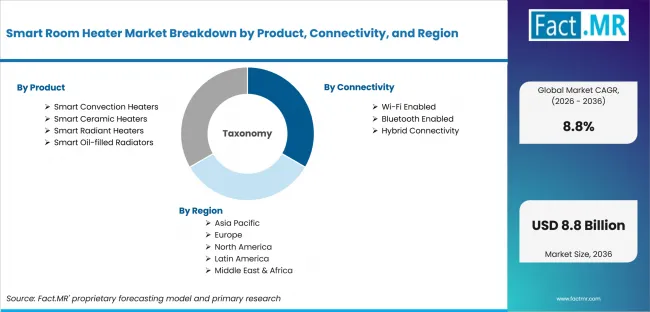
Smart Room Heater Market Breakdown By Product, Connectivity, And Region | Source: Fact.MR
| Attribute | Details |
|---|---|
| Quantitative Units | USD 3.8 billion in 2026 to USD 8.8 billion by 2036, at an 8.8% CAGR. |
| Market Definition | Connected room-heating equipment used for room-level temperature control through app and Wi-Fi features |
| Product | Smart Convection Heaters; Wall-mounted Convection Heaters; Portable Convection Heaters; Glass Panel Convection Heaters; Smart Ceramic Heaters; PTC Ceramic Heaters; Tower Ceramic Heaters; Desktop Ceramic Heaters; Smart Radiant Heaters; Infrared Heaters; Halogen Heaters; Quartz Heaters; Smart Oil-filled Radiators; Portable Oil-filled Radiators; Wi-Fi Oil-filled Heaters; Energy-efficient Radiators |
| Connectivity | Wi-Fi Enabled; Remote App Control; Voice Assistant Integration; OTA Firmware Updates; Bluetooth Enabled; Short-range Smart Control; App-based Pairing; Low-energy Connectivity; Hybrid Connectivity; Wi-Fi + Bluetooth; Matter-enabled Devices; Multi-protocol Connectivity |
| Application | Residential; Apartments; Independent Houses; Smart Homes; Commercial; Offices; Retail Stores; Hospitality Facilities; Industrial; Warehouses; Workshops; Light Manufacturing Units |
| Distribution Channel | Online Retail; E-commerce Marketplaces; Brand Websites; Smart Home Platforms; Offline Retail; Electronics Stores; Home Improvement Stores; Department Stores; Direct Sales; Builder Partnerships; B2B Sales; Commercial Projects |
| End User | Residential Consumers; Homeowners; Tenants; Smart Home Enthusiasts; Commercial Users; Hotels; Office Buildings; Retail Chains; Institutional Users; Educational Institutions; Healthcare Facilities; Government Buildings |
| Regions Covered | North America; Latin America; Europe; East Asia; South Asia and Pacific; Middle East and Africa |
| Countries Covered | Canada; UK; USA; Japan; Germany; France |
| Key Companies Profiled | Dyson Ltd.; De'Longhi S.p.A.; Honeywell International Inc.; Dreo; Xiaomi Corporation; Rowenta; Lasko Products |
| Forecast Period | 2026 to 2036 |
| Approach | Hybrid top-down and bottom-up approach using smart heater demand; connected appliance portfolios; online retail activity; residential heating needs; country adoption patterns; safety-feature requirements; app setup behavior; product-pricing review; channel execution and company portfolio review |
Source: Fact.MR analysis. Updated Jul 30, 2026
How is the market segmented?
-
By Product
- Smart Convection Heaters
- Wall-mounted Convection Heaters
- Portable Convection Heaters
- Glass Panel Convection Heaters
- Smart Ceramic Heaters
- PTC Ceramic Heaters
- Tower Ceramic Heaters
- Desktop Ceramic Heaters
- Smart Radiant Heaters
- Infrared Heaters
- Halogen Heaters
- Quartz Heaters
- Smart Oil-filled Radiators
- Portable Oil-filled Radiators
- Wi-Fi Oil-filled Heaters
- Energy-efficient Radiators
- Smart Convection Heaters
-
By Connectivity
- Wi-Fi Enabled
- Remote App Control
- Voice Assistant Integration
- OTA Firmware Updates
- Bluetooth Enabled
- Short-range Smart Control
- App-based Pairing
- Low-energy Connectivity
- Hybrid Connectivity
- Wi-Fi + Bluetooth
- Matter-enabled Devices
- Multi-protocol Connectivity
- Wi-Fi Enabled
-
By Application
- Residential
- Apartments
- Independent Houses
- Smart Homes
- Commercial
- Offices
- Retail Stores
- Hospitality Facilities
- Industrial
- Warehouses
- Workshops
- Light Manufacturing Units
- Residential
-
By Distribution Channel
- Online Retail
- E-commerce Marketplaces
- Brand Websites
- Smart Home Platforms
- Offline Retail
- Electronics Stores
- Home Improvement Stores
- Department Stores
- Direct Sales
- Builder Partnerships
- B2B Sales
- Commercial Projects
- Online Retail
-
By End User
- Residential Consumers
- Homeowners
- Tenants
- Smart Home Enthusiasts
- Commercial Users
- Hotels
- Office Buildings
- Retail Chains
- Institutional Users
- Educational Institutions
- Healthcare Facilities
- Government Buildings
- Residential Consumers
-
By Region
- North America
- Latin America
- Europe
- East Asia
- South Asia and Oceania
- Middle East and Africa
Frequently Asked Questions
Which Product leads the market?
Which Connectivity category leads the market?
Which Application leads the market?
Which Distribution Channel leads the market?
Which End User leads the market?
Which country records the highest listed CAGR?
What is the primary driver in this market?
What is the main restraint?
Why do Residential Consumers lead demand?
Who worked on this report


Preview the report firsthand - request a free sample
Free SampleGet the brochure for pricing and purchase details
Download PDF