- Base Value(2025): 2.1 Bn
- Estimated Value(2026): 2.3 Bn
- Forecast Value (2036): 5.8 Bn
- CAGR (2026 - 2036): 10.2%
Smart Hazard and Safety Indicator Control Modules Market Forecast and Outlook By Fact.MR
- In 2025, the smart hazard and safety indicator control modules market was valued at USD 2.1 billion.
- Based on Fact.MR analysis, demand for smart hazard and safety indicator control modules is estimated to grow to USD 2.3 billion in 2026 and USD 5.8 billion by 2036.
- FACT.MR projects a CAGR of 10.2% during the forecast period.
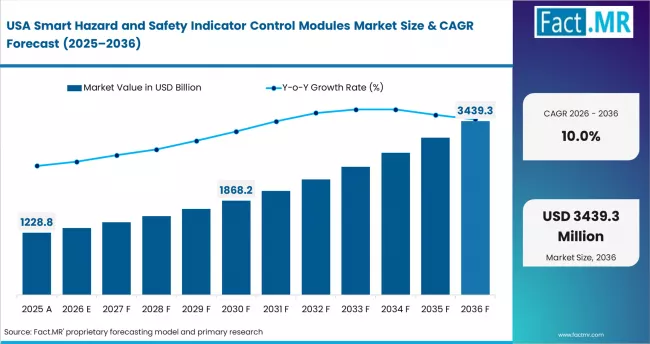
Smart Hazard And Safety Indicator Control Modules Market Country Value Analysis | Source: Fact.MR
| Metric | Value |
|---|---|
| Estimated Value in 2026 | USD 2.3 billion |
| Forecast Value in 2036 | USD 5.8 billion |
| Forecast CAGR (2026 to 2036) | 10.2% |
Source: Fact.MR analysis. Updated May 14, 2026
Summary of Smart Hazard and Safety Indicator Control Modules Market
- Market Definition
- The market includes smart electronic and electromechanical modules managing vehicle hazard warning, ADAS safety alerts, emergency telematics, and lighting control indicator functions across passenger and commercial vehicles globally.
- Demand Drivers
- ADAS proliferation across new vehicle platforms is requiring smart CAN/LIN-integrated hazard modules as standard fitment, replacing legacy electromechanical systems in OEM bill-of-materials.
- India's Bharat NCAP and AIS-140 safety mandates enforced from 2023-2024 are compelling OEMs to upgrade indicator control modules across domestically produced passenger and commercial vehicles.
- Emergency telematics mandates including eCall in Europe and equivalent standards in China are driving demand for modules with integrated hazard signaling and telematics alert coordination.
- Key Segments Analyzed
- By Component: Control Modules/ECUs lead at 40% share in 2026, driven by universal OEM fitment and rising smart module content per platform.
- By Technology: Electronic Smart Modules (CAN/LIN Integrated) dominate at 65% share in 2026; electromechanical systems retain share in cost-sensitive and aftermarket segments.
- By Application: Hazard Warning & Signaling Systems lead at 45% share in 2026, driven by mandatory fitment requirements across all vehicle categories.
- By Geography: China leads at 12.5% CAGR through 2036, driven by NEV platform smart module mandates and connected vehicle regulation scale-up.
- Analyst Opinion at FACT.MR
- Shambhu Nath Jha, Principal Analyst at Fact.MR, opines, CXOs will find that tightening ADAS regulatory timelines are significantly compressing qualification windows for smart hazard modules. OEMs are accelerating platform validation cycles to meet compliance requirements.
- Strategic Implications
- Prioritise CAN/LIN pre-certification for smart hazard modules aligned to UNECE R148 and NHTSA ADAS rulemaking timelines to accelerate OEM design-in qualification across US and European platforms.
- Build localised smart module manufacturing capacity in China and India to capture NEV and BS VI-driven OEM procurement under domestic content preference frameworks.
- Develop ADAS-integrated hazard module variants with eCall and telematics coordination capabilities to address European and South Korean mandatory emergency alert platform requirements.
- Methodology
- Market sizing uses vehicle production volumes, smart module content per platform, and OEM programme timelines validated against Tier-1 supplier disclosures.
- Analysis includes UNECE regulations, NHTSA rulemaking, Bharat NCAP, Euro NCAP, and China GB standard safety policy inputs.
- Forecasts incorporate NEV platform ramp schedules, ADAS adoption timelines, and aftermarket fleet penetration trajectories.
The market is projected to generate USD 3.5 billion in absolute opportunity between 2026 and 2036. Growth is structural and anchored to mandatory ADAS integration timelines across major automotive markets. Rising smart module content per vehicle and expanding telematics connectivity requirements sustain growth. Electromechanical replacement cycles, long OEM qualification lead times, and cost sensitivity among mid-range vehicle OEMs moderate near-term velocity.
OEM procurement teams are accelerating qualification of CAN/LIN-integrated hazard modules as ADAS mandates widen globally. Continental AG and Robert Bosch GmbH reported rising programme awards for smart indicator modules in 2024, reflecting OEM urgency to meet regulatory deadlines.
China leads at a projected CAGR of 12.5% through 2036, driven by connected vehicle mandates and ADAS scale-up across domestic NEV platforms. India follows at 11.8%, supported by AIS-140 and Bharat NCAP safety regulation adoption accelerating smart module fitment. South Korea records 10.5%, anchored by electronics integration depth at Hyundai-Kia and LG Innotek. The United States registers 10.0%, driven by NHTSA advanced safety system requirements across light and commercial vehicles. Germany posts 9.5%, reflecting premium OEM innovation cycles at BMW, Mercedes-Benz, and Volkswagen. Mature European markets generate structured replacement and upgrade demand but face pricing competition from Asian module suppliers.
Segmental Analysis
Smart Hazard and Safety Indicator Control Modules Market Analysis by Component
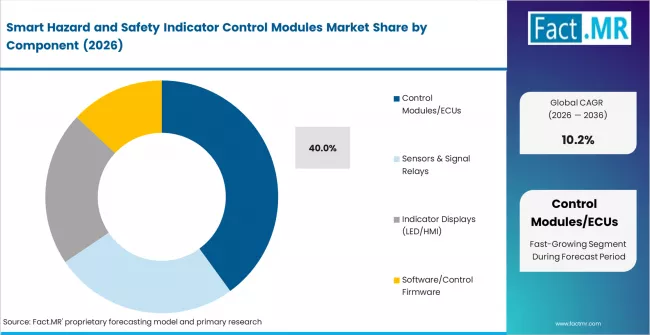
Smart Hazard And Safety Indicator Control Modules Market Analysis By Component | Source: Fact.MR
Based on FACT.MR, control modules/ECUs hold 40% share in 2026. They lead due to universal OEM fitment and rising per-platform smart content. Centralised ECU architecture in SDV platforms consolidates hazard, indicator, and alert functions. This drives higher average selling prices and displaces discrete relay-based designs.
- Continental AG Expansion: Continental AG launched an updated smart hazard control ECU series in Q1 2025 targeting Euro 7 passenger vehicle platforms in Europe and North America. The modules integrate CAN-FD and ADAS-linked indicator functions in a single unit with ISO 26262 ASIL-B certification. [1]
- HELLA GmbH Development: HELLA GmbH introduced a combined LED indicator and hazard control module for SDV platforms in Q3 2024. The module features LIN-bus integration and programmable alert sequencing for OEM ADAS supplier programmes in Germany and South Korea. [2]
- Sensor Relay Demand Trend: Texas Instruments reported a 19% increase in automotive-grade signal relay IC shipments for hazard and safety indicator applications in 2024, driven by OEM platform transitions from electromechanical to smart sensor-relay architectures across Asian and European vehicle assembly programmes. [3]
Smart Hazard and Safety Indicator Control Modules Market Analysis by Technology
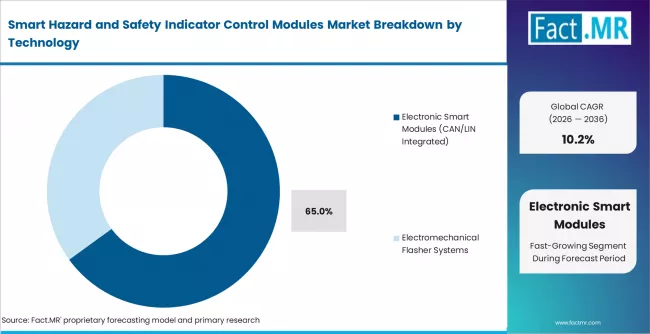
Smart Hazard And Safety Indicator Control Modules Market Analysis By Technology | Source: Fact.MR
Based on FACT.MR, electronic smart modules (CAN/LIN integrated) dominate at 65% share in 2026. They lead due to mandatory ADAS compatibility requirements and SDV architecture integration. Software-configurable alert logic and vehicle network compatibility are standard OEM procurement specifications. Electromechanical systems retain share in aftermarket and cost-sensitive segments.
- Robert Bosch GmbH Investment: Robert Bosch GmbH expanded its automotive smart indicator module production line in Feuerbach, Germany in Q2 2024, adding CAN-FD integrated hazard module capacity targeting European OEM platform supply for 2025-2027 model year vehicles. [4]
- Aptiv PLC Development: Aptiv PLC launched a next-generation smart hazard and telematics-integrated safety module in early 2025 with AUTOSAR-compliant firmware. It targets North American and Chinese OEM platforms requiring eCall-linked hazard coordination and ADAS alert sequencing. [5]
- Smart Module Growth Trend: Denso Corporation reported strong design-win momentum for CAN/LIN smart indicator modules in 2024, with programme awards across four Japanese OEM platforms and two Korean OEM programmes, reflecting accelerating OEM transition from electromechanical to fully integrated electronic hazard control systems. [6]
Drivers, Restraints, and Opportunities
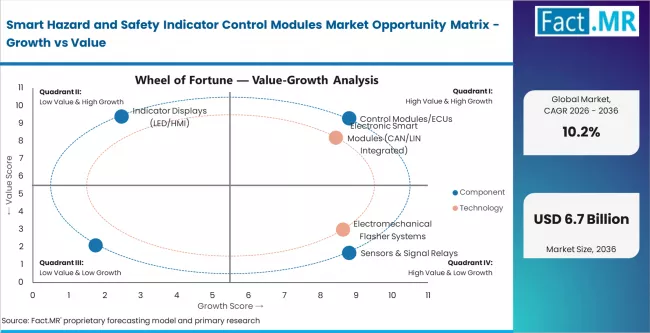
Smart Hazard And Safety Indicator Control Modules Market Opportunity Matrix Growth Vs Value | Source: Fact.MR
FACT.MR analysts observe that the smart hazard and safety indicator control modules market is in an accelerated transition phase. Growth is tied to ADAS platform proliferation and vehicle safety regulation tightening across Asia, North America, and Europe since 2022. Market scale at USD 2.1 billion in 2025 reflects steady OEM-driven adoption of smart modules as regulatory compliance replaces feature-option positioning.
Legacy electromechanical flasher systems are losing OEM share to CAN/LIN-integrated smart modules as software-defined vehicle architectures centralise indicator control.
- ADAS Regulatory Mandates: UNECE Regulation R152 on Advanced Emergency Braking Systems, enforced from 2024 for new type approvals in Europe, requires smart hazard signaling integration within ADAS controller architecture.
- China NEV Smart Module Policy: China's GB/T 40429-2021 intelligent connected vehicle standard, actively implemented through 2024-2025, mandates connected safety signaling in NEV platforms.
- India Safety Regulation Adoption: India's Bharat NCAP programme, launched in August 2023 and expanding through 2024-2025, is driving OEM adoption of advanced safety indicator control modules to achieve higher star ratings.
Regional Analysis
The smart hazard and safety indicator control modules market is assessed across Asia Pacific, North America, Europe, Latin America, and Middle East and Africa, covering 40+ countries with distinct demand profiles shaped by ADAS regulatory timelines, vehicle safety standards, OEM platform localisation, and smart module content requirements. The full report offers market attractiveness analysis by region and country.
.webp "Top Country Growth Comparison Smart Hazard And Safety Indicator Control Modules Market Cagr (2026 2036)")
Top Country Growth Comparison Smart Hazard And Safety Indicator Control Modules Market Cagr (2026 2036) | Source: Fact.MR
| Country | CAGR (2026 to 2036) |
|---|---|
| China | 12.5% |
| India | 11.8% |
| South Korea | 10.5% |
| United States | 10.0% |
| Germany | 9.5% |
Source: Fact.MR analysis. Updated May 14, 2026
Source: Fact.MR (FACT.MR) analysis, based on proprietary forecasting model and primary research
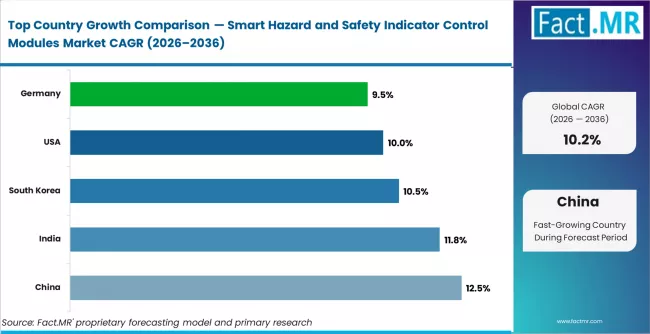
Smart Hazard And Safety Indicator Control Modules Market Cagr Analysis By Country | Source: Fact.MR
Asia Pacific Smart Hazard and Safety Indicator Control Modules Market Analysis
Asia Pacific is the fastest-growing and highest-volume production region. China drives demand through NEV platform scale and connected vehicle mandates. India and South Korea are accelerating adoption through safety regulation enforcement and electronics integration depth. Denso Corporation, Panasonic Corporation, and Omron anchor regional supply with deep OEM qualification in Japan, Korea, and China.
- China: China is set to expand at around 12.5% CAGR through 2036, led by strong regulatory enforcement. MIIT standards are mandating smart hazard signaling in connected vehicles. BYD and SAIC Motor are deploying CAN-FD modules as standard in new NEV platforms. Domestic sourcing is accelerating due to localisation preferences. High EV production volumes are creating sustained demand for smart modules.
- India: India is progressing at nearly 11.8% CAGR through 2036, supported by safety rating upgrades. Bharat NCAP is pushing OEMs toward advanced hazard systems. Tata Motors, Maruti Suzuki, and Mahindra & Mahindra are upgrading indicator modules across new models. AIS-140 compliance is expanding telematics-linked hazard integration in commercial fleets. Domestic demand remains strong across both passenger and fleet segments.
- South Korea: South Korea is advancing at about 10.5% CAGR through 2036, driven by ADAS integration. OEMs are embedding smart modules into next-generation platforms. Hyundai Motor Group and Kia Corporation are standardising CAN/LIN-based hazard systems. LG Innotek is expanding production capacity. Strong electronics capability is enabling faster supplier qualification cycles.
FACT.MR's Asia Pacific analysis covers China, India, South Korea, Japan, ASEAN, and ANZ. Readers can find NEV platform smart module adoption rates, ADAS regulation compliance timelines, and OEM localisation procurement trends.
North America Smart Hazard and Safety Indicator Control Modules Market Analysis
Smart Hazard And Safety Indicator Control Modules Market Country Value Analysis | Source: Fact.MR
North America is a regulation-anchored, OEM-led demand region. NHTSA advanced safety system rulemaking is the primary growth catalyst. Continental AG and Robert Bosch GmbH lead regional supply with established OEM design-in programmes. Domestic vehicle platform transitions from electromechanical to smart integrated modules are structuring consistent procurement volumes.
- United States: The United States is expanding at close to 10.0% CAGR through 2036, supported by regulatory enforcement. NHTSA standards are increasing ADAS-linked hazard system requirements. General Motors and Ford Motor Company are integrating smart modules in EV platforms. Aptiv PLC and Continental AG are supplying advanced modules. Fleet regulations are also expanding demand in commercial vehicles.
FACT.MR's North America analysis covers the United States, Canada, and Mexico. Readers can find NHTSA rulemaking impact data, OEM design-win programme timelines, and smart module aftermarket fleet adoption trends.
Europe Smart Hazard and Safety Indicator Control Modules Market Analysis
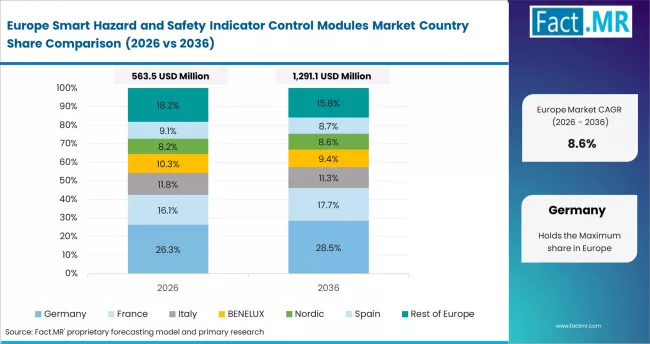
Smart Hazard And Safety Indicator Control Modules Market Europe Country Market Share Analysis, 2026 & 2036 | Source: Fact.MR
Europe is the global regulatory laboratory for smart hazard and safety indicator module standards. UNECE regulations and Euro NCAP protocols define platform specification requirements adopted globally. Robert Bosch GmbH, Valeo SA, and HELLA GmbH anchor European OEM supply with certified module programmes. Compliance-driven procurement is the defining demand mechanism.
- Germany: Germany is projected to grow at about 9.5% CAGR through 2036, supported by regulatory leadership. UNECE lighting standards are enforcing advanced hazard control functionality. BMW Group and Mercedes-Benz AG are integrating CAN-FD smart modules across new platforms. Robert Bosch GmbH and HELLA GmbH are expanding production capacity. Premium OEM demand continues to drive innovation.
FACT.MR's Europe analysis covers Germany, France, the UK, Italy, Spain, and Rest of Europe. Readers can find UNECE regulation compliance data, Euro NCAP-driven OEM module specification trends, and European Tier-1 supplier programme updates.
Competitive Aligners for Market Players
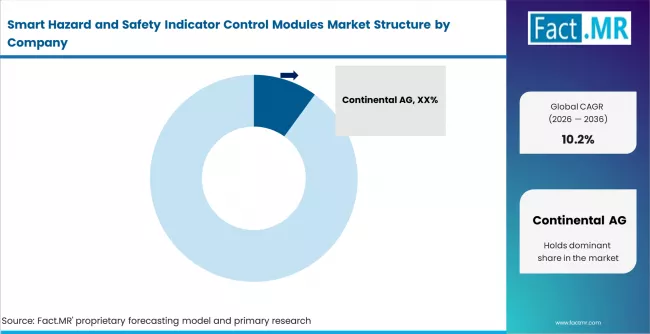
Smart Hazard And Safety Indicator Control Modules Market Analysis By Company | Source: Fact.MR
The smart hazard and safety indicator control modules market is evolving around software integration, regulatory compliance, and system-level safety performance. Competitive positioning is increasingly defined by the ability to deliver CAN/LIN-integrated modules that seamlessly connect with ADAS and broader vehicle ECU architectures.
Established tier-1 suppliers such as Robert Bosch GmbH, Continental AG, Valeo SA, HELLA GmbH, and Denso Corporation maintain strong market positions through pre-certified platforms and long-standing OEM relationships. Their ability to provide fully validated, safety-compliant modules significantly reduces OEM development timelines, making them preferred partners for new vehicle programmes. At the same time, electronics and semiconductor players such as Aptiv PLC, Texas Instruments, and NXP Semiconductors are strengthening their role in controller ICs, communication protocols, and embedded software. These capabilities are critical as hazard modules evolve into networked safety nodes within software-defined vehicle architectures.
Competitive advantage is shifting toward integration depth. Suppliers that combine hardware reliability with software configurability, cybersecurity readiness, and regulatory compliance are best positioned to secure design wins. Early-stage OEM collaboration and pre-validation under global safety standards are becoming decisive factors in capturing long-term platform contracts.
Key Players
- Continental AG
- Robert Bosch GmbH
- Denso Corporation
- Valeo SA
- Aptiv PLC
- HELLA GmbH
- Panasonic Corporation
- Omron Corporation
- Texas Instruments
Bibliography
- [1] Continental AG. (Q1 2025). Product Launch: CAN-FD Integrated Smart Hazard Control ECU Series with ISO 26262 ASIL-B Certification for Euro 7 Passenger Vehicle and North American OEM Platform Supply. January 2025. continental.com/investor-relations
- [2] HELLA GmbH. (Q3 2024). Product Development: Combined LED Indicator and Smart Hazard Control Module with LIN-Bus Integration and Programmable ADAS Alert Sequencing for SDV Platform OEM Supply in Germany and South Korea. Q3 2024. hella.com
- [3] Texas Instruments. (2024). Automotive Semiconductor Market Update 2024: 19% Growth in Automotive-Grade Signal Relay IC Shipments for Hazard and Safety Indicator Module Applications Driven by OEM Electromechanical-to-Smart Platform Transitions. 2024. ti.com/investors
- [4] Robert Bosch GmbH. (Q2 2024). Manufacturing Expansion: CAN-FD Smart Indicator Module Production Line Expansion at Feuerbach Facility Adding Hazard Control Module Capacity for European OEM Platform Supply 2025-2027 Model Year Programmes. Q2 2024. bosch.com/investor-relations
- [5] Aptiv PLC. (Early 2025). Product Launch: AUTOSAR-Compliant Smart Hazard and Telematics-Integrated Safety Module with eCall-Linked Hazard Coordination for North American and Chinese Passenger Vehicle OEM Platforms. January 2025. aptiv.com/investors
- [6] Denso Corporation. (2024). Annual Business Report 2024: CAN/LIN Smart Indicator Module Design-Win Momentum Including Programme Awards Across Japanese and Korean OEM Vehicle Platforms for Smart Hazard and Safety Alert Integration. 2024. denso.com/investors
This Report Addresses
- Strategic intelligence on smart hazard and safety indicator control module demand across OEM ADAS platform integration, NEV smart module fitment, emergency telematics coordination, and aftermarket fleet retrofit programmes globally.
- Market forecast from USD 2.3 billion in 2026 to USD 5.8 billion by 2036 at a CAGR of 10.2%.
- Growth opportunity mapping across China NEV smart module mandates, India Bharat NCAP and AIS-140 safety regulation adoption, US NHTSA ADAS rulemaking, South Korea electronics integration, and Germany UNECE R148 compliance-driven OEM procurement.
- Segment analysis by component (control modules/ECUs, sensors, indicator displays, firmware), technology (electronic smart CAN/LIN, electromechanical), and application (hazard warning, ADAS alerts, emergency telematics, lighting control).
- Regional outlook covering Asia Pacific NEV and safety regulation-driven smart module demand, North America NHTSA ADAS compliance procurement, and Europe UNECE regulation and Euro NCAP specification-anchored OEM adoption.
- Competitive analysis of Continental AG, Robert Bosch GmbH, Denso, Valeo, Aptiv, HELLA, Panasonic, Omron, and Texas Instruments covering ADAS certification depth, CAN/LIN integration capability, and OEM platform design-in positioning.
- Regulatory impact analysis covering UNECE R148 and R152, NHTSA FMVSS safety system mandates, China GB/T 40429 connected vehicle standards, India Bharat NCAP and AIS-140 telematics requirements, and South Korea vehicle safety electronics standards.
- Report delivered in PDF, Excel datasets, and presentation formats supported by primary interviews, OEM design-win data, vehicle production volumes, safety regulation implementation schedules, and Tier-1 supplier programme disclosures.
Segmentation
Scope of Report
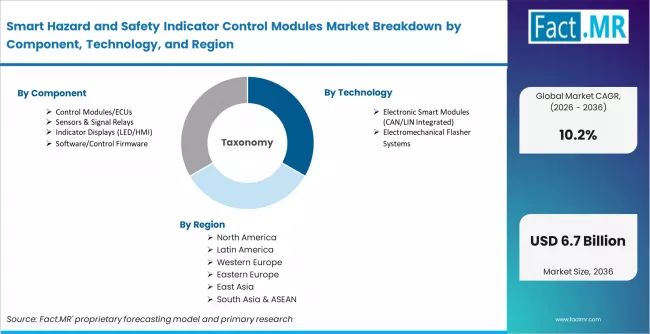
Smart Hazard And Safety Indicator Control Modules Market Breakdown By Component, Technology, And Region | Source: Fact.MR
| Attribute | Details |
|---|---|
| Quantitative Units | USD 2.3 billion (2026) to USD 5.8 billion (2036), at a CAGR of 10.2% |
| Market Definition | Electronic and electromechanical modules managing vehicle hazard warning, ADAS-linked safety alerts, emergency telematics signals, and lighting control indicator functions across passenger and commercial vehicles globally. |
| Component Segmentation | Control Modules/ECUs, Sensors & Signal Relays, Indicator Displays (LED/HMI), Software/Control Firmware |
| Technology Segmentation | Electronic Smart Modules (CAN/LIN Integrated), Electromechanical Flasher Systems |
| Application Segmentation | Hazard Warning & Signaling Systems, ADAS-Linked Safety Alerts, Emergency & Telematics Alerts, Lighting Control Integration |
| Application Coverage | OEM smart hazard ECU supply, ADAS-integrated indicator control, eCall-linked emergency signaling, NEV platform smart module fitment, and aftermarket fleet indicator module retrofit programmes. |
| Regions Covered | North America, Europe, Asia Pacific, Latin America, Middle East and Africa |
| Countries Covered | USA, Canada, Mexico, Germany, UK, France, Italy, Spain, Nordic, BENELUX, China, Japan, South Korea, India, ASEAN, Australia and New Zealand, Brazil, Argentina, Colombia, Saudi Arabia, GCC, Turkey, South Africa, Rest of MEA |
| Key Companies Profiled | Continental AG, Robert Bosch GmbH, Denso Corporation, Valeo SA, Aptiv PLC, HELLA GmbH, Panasonic Corporation, Omron Corporation, Texas Instruments |
| Forecast Period | 2026 to 2036 |
| Approach | Hybrid top-down and bottom-up model using vehicle production volumes by segment, smart module content per platform, OEM programme timelines, aftermarket fleet penetration rates, and primary interviews with automotive safety electronics procurement engineers and Tier-1 supplier programme managers. |
Source: Fact.MR analysis. Updated May 14, 2026
Smart Hazard and Safety Indicator Control Modules Market by Segments
-
By Component:
- Control Modules/ECUs
- Sensors & Signal Relays
- Indicator Displays (LED/HMI)
- Software/Control Firmware
-
By Technology:
- Electronic Smart Modules (CAN/LIN Integrated)
- Electromechanical Flasher Systems
-
By Application:
- Hazard Warning & Signaling Systems
- ADAS-Linked Safety Alerts
- Emergency & Telematics Alerts
- Lighting Control Integration
-
By Region:
- North America
- United States
- Canada
- Mexico
- Latin America
- Brazil
- Argentina
- Colombia
- Rest of Latin America
- Western Europe
- Germany
- United Kingdom
- France
- Italy
- Spain
- Nordic Countries
- BENELUX
- Rest of Western Europe
- Eastern Europe
- Russia
- Poland
- Rest of Eastern Europe
- East Asia
- China
- Japan
- South Korea
- South Asia and Pacific
- India
- ASEAN
- Australia and New Zealand
- Rest of South Asia and Pacific
- Middle East and Africa
- Kingdom of Saudi Arabia
- Other GCC Countries
- Turkey
- South Africa
- Rest of Middle East and Africa
- North America
Frequently Asked Questions
How large is the global smart hazard and safety indicator control modules market in 2025?
What will the market size be in 2026?
What is the projected market size by 2036?
What is the expected CAGR from 2026 to 2036?
Which component segment is poised to lead the market?
Which technology segment dominates?
Which application segment holds the largest share?
Which country shows the fastest growth?
What is driving demand for smart hazard and safety indicator control modules?
Who are the key players in the market?
Who worked on this report


Preview the report firsthand - request a free sample
Free SampleGet the brochure for pricing and purchase details
Download PDF