The Smart Kitchen Induction Energy Ranges Market is analyzed across its key product, application and end-use segments, with the study covering market dynamics, regional trends and demand outlook, forecast 2026 to 2036.
By Fact.MR Consumer Goods DeskFact-checked under the Fact.MR editorial processUpdated
9 min read
Smart Kitchen Induction Energy Ranges Market Forecast and Outlook 2026 to 2036
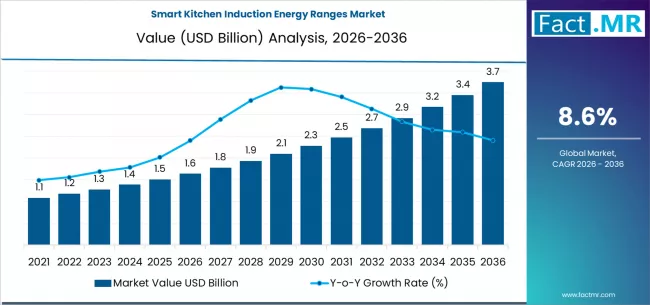
The global smart kitchen induction energy ranges market is projected to experience robust expansion, growing from USD 1.64 billion in 2026 to USD 3.74 billion by 2036, reflecting a CAGR of 8.6%.
Smart Kitchen Induction Energy Ranges Market Market Value Analysis | Source: Fact.MR
Summary of Smart Kitchen Induction Energy Ranges Market
Market Snapshot
Global smart kitchen induction energy ranges market revenue stood at USD 1.64 billion in 2026 and is forecast to reach USD 3.74 billion by 2036.
Ata8.6% CAGR from 2026 to 2036, this market is set to expand ~2.3x in value, adding USD 2.10 billion in absolute opportunity.
Growth is being driven by increasing adoption of energy-efficient appliances and integration of smart home technologies.
Smart induction energy ranges areemergingas advanced cooking solutions offering precision control, connectivity, and energy efficiency.
Demand and Growth Drivers
Rising consumer preference for energy-efficient and sustainable kitchen appliances is accelerating demand.
Increasing penetration of smart home ecosystems is driving integration of connected kitchen appliances.
Growing demand for premium and precision-driven cooking experiences is expanding adoption.
Advancements in IoT-enabled kitchen technologies are enhancing usability and automation.
Product and Segment View
Online retail accounts for 44.0% of distribution channel share in 2026,emergingas the leading segment.
Key product features and categories include:
Smart connectivity (Wi-Fi/Bluetooth)
Touch and gesture control
Energy monitoring and efficiency modes
Voice assistant integration
Safety and child lock features
Geography and Competitive Outlook
Growth is supported globally, driven by rising adoption of smart kitchen appliances and energy-efficient technologies.
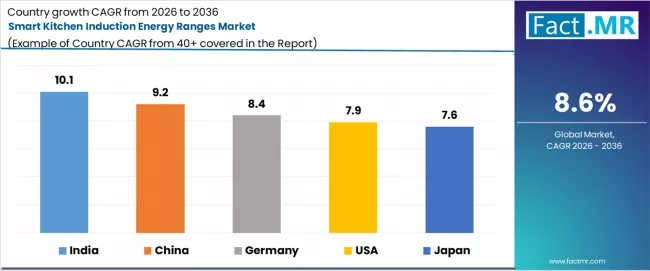
Key growth markets and CAGR:India (10.10% CAGR), China (9.20% CAGR), Germany (8.40% CAGR), USA (7.90% CAGR), Japan (7.60% CAGR)
Market expansion is closely tied to:
Smart home adoption
Energy efficiency regulations
Consumer demand for premium kitchen experiences
Key companies active in this marketinclude:Whirlpool Corporation, Samsung Electronics, LG Electronics, Electrolux AB, Bosch Home Appliances, Others
Smart Kitchen Induction Energy Ranges Market — At a Glance
Attribute
Details
Market Value 2026
USD 1.64 billion
Market Value 2036
USD 3.74 billion
Absolute Dollar Opportunity 2026–2036
USD 2.10 billion
Total Growth 2026–2036
128.0%
CAGR 2026–2036
8.6%
Growth Multiple
~2.3x
Key Demand Theme
Rising adoption of energy-efficient, smart-connected cooking appliances
Leading Segment by Distribution Channel (2026)
Online Retail
Segment Share (2026)
44.0%
Key Growth Regions
Asia-Pacific, North America, Western Europe
Country CAGRs
India (10.10% CAGR), China (9.20% CAGR), Germany (8.40% CAGR), USA (7.90% CAGR), Japan (7.60% CAGR)
Top Companies
Whirlpool Corporation, Samsung Electronics, LG Electronics, Electrolux AB, Bosch Home Appliances, Others
Segmentation by Features
Connectivity, Touch/Gesture Control, Energy Monitoring, Voice Integration, Safety Features
Segmentation by Distribution Channel
Online Retail, Offline Retail
Segmentation by End Use
Residential, Commercial
Segmentation by Region
North America, Latin America, Europe, Asia Pacific, MEA
Growth is anchored in several powerful, converging consumer and technological trends, a strong residential shift toward energy-efficient appliances, the accelerating integration of connected devices within smart home ecosystems, and rising demand for premium, precision-driven culinary experiences. These advanced appliances meet a clear market need by offering consumers superior precise cooking control, significantly reduced energy consumption compared to traditional gas or electric coils, and seamless connectivity that streamlines kitchen management through smartphone apps and voice assistants. The market is evolving rapidly beyond basic induction cooktops toward fully integrated smart ranges equipped with advanced sensors for automated pan detection, AI-driven features for adaptive heating and recipe guidance, and sophisticated interfaces that learn user preferences. This technological evolution is redefining kitchen functionality, driving both replacement cycles for existing appliances and new adoption in premium residential and high-end commercial segments, as these intelligent ranges become central hubs for efficient, connected, and sophisticated cooking.
Category
Category
Segments
Technology
Smart Connectivity (Wi-Fi/Bluetooth), Touch & Gesture Control, Energy Monitoring & Efficiency Modes, Voice Assistant Integration, Safety & Child Lock Features
Channel
Online Retail, Specialty Kitchen Stores, Electronics Superstores, Direct OEM Sales
North America, Latin America, Western Europe, Eastern Europe, East Asia, South Asia & Pacific, MEA
Segmental Analysis
By Technology, Which Feature is the Primary Purchase Driver?
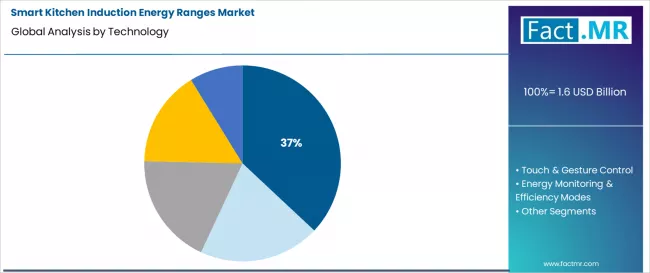
Smart Kitchen Induction Energy Ranges Market Analysis By Technology | Source: Fact.MR
Smart connectivity (Wi-Fi/Bluetooth) leads the technology segment with a 37% share. This dominance is rooted in the core value proposition of smart ranges: remote control, integration with smart home ecosystems, and access to guided cooking via companion apps.
The ability to preheat, monitor, and adjust cooking parameters from a smartphone, receive notifications, and download recipes directly to the appliance is a significant upgrade over traditional models, making connectivity the foundational smart feature.
By Channel, Where is Consumer Purchase Behavior Concentrated?
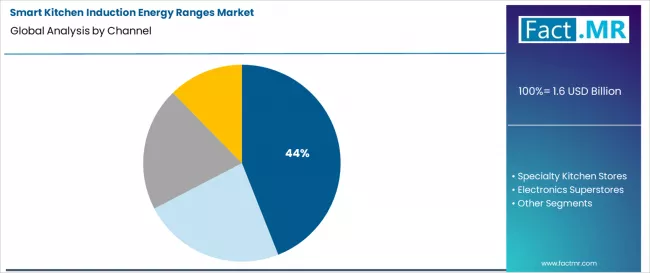
Smart Kitchen Induction Energy Ranges Market Analysis By Channel | Source: Fact.MR
Online retail is the dominant distribution channel, holding a 44% share. The high-involvement nature of this purchase benefits from extensive online research, price comparison, and access to detailed specifications and customer reviews.
E-commerce platforms offer a broader selection than most physical stores and are increasingly the preferred channel for major appliance purchases, especially among tech-savvy consumers seeking the latest smart home products.
By End User, Which Group Forms the Market Backbone?
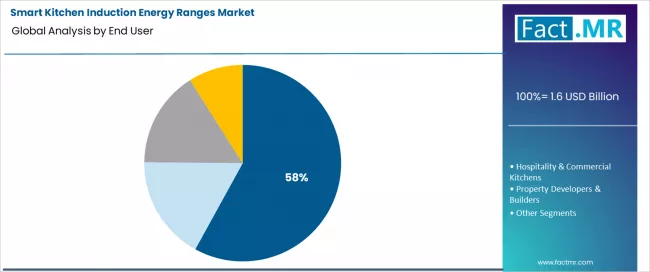
Smart Kitchen Induction Energy Ranges Market Analysis By End User | Source: Fact.MR
Residential consumers constitute the leading end-user segment at 58%. The primary demand driver is the kitchen renovation and premium appliance replacement cycle in households. Rising disposable incomes, growing interest in home cooking, and the desire for professional-grade, connected appliances in residential kitchens solidify this segment's dominant position. Adoption is accelerated by energy savings and safety features appealing to modern families.
What are the Key Drivers, Restraints, and Trends Shaping this Market?
The primary driver is the global consumer shift towards energy-efficient and connected home appliances, supported by government regulations promoting energy savings. A key restraint is the significantly higher upfront cost compared to conventional induction or gas ranges, which can limit penetration in price-sensitive markets.
A major opportunity lies in deeper integration with broader smart home and grocery management ecosystems, allowing for automated cooking programs based on scanned ingredients. The dominant trend is the advancement towards AI-powered features, such as automatic pan detection, predictive temperature control to prevent burning, and recipe-based cooking automation that adjusts power and time without user intervention.
Analysis of the Smart Kitchen Induction Energy Ranges Market by Key Countries
Smart Kitchen Induction Energy Ranges Market Cagr Analysis By Country | Source: Fact.MR
Country
CAGR (2026-2036)
India
10.10%
China
9.20%
Germany
8.40%
USA
7.90%
Japan
7.60%
How does the USA's Strong Smart Home Adoption Influence Demand?
Smart Kitchen Induction Energy Ranges Market Country Value Analysis | Source: Fact.MR
The USA's 7.90% CAGR is driven by high disposable income, a robust culture of kitchen remodeling, and the deepest penetration of smart home ecosystems. Demand is fueled by consumers seeking professional-grade appliances with seamless integration into platforms like Alexa and Google Home, with a strong preference for feature-rich, connected ranges from established premium brands.
What drives China's Market Growth in Smart Appliances?
Rapid urbanization, a burgeoning middle class, and the dominance of domestic tech giants that integrate smart appliances into their IoT platforms propel China’s 9.20% growth. The market is characterized by strong online sales, innovative features tailored to local cooking styles, and aggressive competition among both local and international brands.
Why does Germany Represent a High-Quality, Mature Market?
Germany's 8.40% CAGR reflects a mature market with high consumer expectations for engineering quality, energy efficiency, and durable design. Growth is driven by the replacement of older appliances with connected, high-performance induction ranges, with a strong preference for purchasing through specialty stores and a focus on brands renowned for reliability and innovation.
How is Japan's Compact Living and Tech Savviness Shaping Demand?
Japan's 7.60% growth is influenced by space constraints in urban homes, driving demand for compact, multifunctional, and highly efficient appliances. Japanese consumers value precision, automated features, and intuitive interfaces. The market sees strong integration with local smart home services and a preference for sleek, space-saving designs from both domestic and international brands.
What underpins India's High-Growth Trajectory in Premium Appliances?
India's leading 10.10% CAGR is fueled by rapid urbanization, rising affluence, and the growth of premium residential real estate. The expanding middle and upper-class segments are increasingly adopting smart kitchen technologies as a status symbol and for convenience. Growth is concentrated in metropolitan areas, driven by online retail and brand-led consumer education on energy savings and smart features.
Competitive Landscape of the Smart Kitchen Induction Energy Ranges Market
Smart Kitchen Induction Energy Ranges Market Analysis By Company | Source: Fact.MR
Established global appliance giants competing on the breadth of their smart home ecosystem, design aesthetics, and culinary technology characterize the competitive landscape. Competition intensifies around the development of proprietary AI algorithms for cooking, the user-friendliness of companion apps, and securing integration partnerships with major smart home platforms.
Success depends on building a strong brand reputation for reliability, offering a compelling suite of connected features, and establishing effective omnichannel retail and after-sales service networks.
Key Players in the Smart Kitchen Induction Energy Ranges Market
Whirlpool Corporation
Samsung Electronics
LG Electronics
Electrolux AB
Bosch Home Appliances
Others
References
Consumer Technology Association (CTA). (2024). Market research report on smart major appliances. CTA Publications.
European Commission. (2024). Ecodesign and energy labelling working plan for kitchen appliances. EU Publications Office.
International Energy Agency (IEA). (2024). Energy efficiency potential in residential cooking appliances. IEA Publications.
Lee, H., & Choi, J. (2023). The connected kitchen: User experience and adoption barriers in smart appliance integration. Journal of Consumer Behaviour, 22(3), 455-470.
Meyer, S., & Patel, K. (2023). The IoT ecosystem in home appliances: Security, interoperability, and market trends. IEEE Consumer Electronics Magazine.
National Association of Home Builders (NAHB). (2024). Survey on consumer preferences for kitchen features and smart home technology. NAHB Research Center.
Scope of Report
Items
Values
Quantitative Units
USD Billion
Technology
Smart Connectivity (Wi-Fi/Bluetooth), Touch & Gesture Control, Energy Monitoring & Efficiency Modes, Voice Assistant Integration, Safety & Child Lock Features
Channel
Online Retail, Specialty Kitchen Stores, Electronics Superstores, Direct OEM Sales
Whirlpool Corporation, Samsung Electronics, LG Electronics, Electrolux AB, Bosch Home Appliances, Others
Additional Analysis
Consumer behavior study on smart feature adoption drivers; total cost of ownership analysis (energy savings vs. premium price); analysis of IoT platform compatibility and data privacy concerns; supply chain analysis for key components (IGBT modules, touch interfaces); impact of design trends (modular kitchens, built-in appliances) on product development.
Market by Segments
Technology :
Smart Connectivity (Wi-Fi/Bluetooth)
Touch & Gesture Control
Energy Monitoring & Efficiency Modes
Voice Assistant Integration
Safety & Child Lock Features
Channel :
Online Retail
Specialty Kitchen Stores
Electronics Superstores
Direct OEM Sales
End User :
Residential Consumers
Hospitality & Commercial Kitchens
Property Developers & Builders
Others
Region :
North America
USA
Canada
Latin America
Brazil
Mexico
Argentina
Rest of Latin America
Western Europe
Germany
France
Italy
Spain
UK
BENELUX
Rest of Western Europe
Eastern Europe
Russia
Poland
Czech Republic
Rest of Eastern Europe
East Asia
China
Japan
South Korea
Rest of East Asia
South Asia & Pacific
India
ASEAN
Australia
Rest of South Asia & Pacific
MEA
GCC Countries
South Africa
Turkiye
Rest of MEA
Frequently Asked Questions
How big is the smart kitchen induction energy ranges market in 2026?
The global smart kitchen induction energy ranges market is estimated to be valued at USD 1.6 billion in 2026.
What will be the size of smart kitchen induction energy ranges market in 2036?
The market size for the smart kitchen induction energy ranges market is projected to reach USD 3.7 billion by 2036.
How much will be the smart kitchen induction energy ranges market growth between 2026 and 2036?
The smart kitchen induction energy ranges market is expected to grow at a 8.6% CAGR between 2026 and 2036.
What are the key product types in the smart kitchen induction energy ranges market?
The key product types in smart kitchen induction energy ranges market are smart connectivity (wi-fi/bluetooth), touch & gesture control, energy monitoring & efficiency modes, voice assistant integration and safety & child lock features.
Which channel segment to contribute significant share in the smart kitchen induction energy ranges market in 2026?
In terms of channel, online retail segment to command 44.0% share in the smart kitchen induction energy ranges market in 2026.