- Base Value(2025): 247 Mn
- Forecast Value (2035): 533.3 Mn
- CAGR (2035): 7.5%
Smart Pet Feeder Market Outlook (2025 to 2035)
The global smart pet feeder market is expected to reach USD 533.3 million by 2035, up from USD 228.7 million in 2024. During the forecast period (2025-2035), the industry is projected to register a CAGR of 8%, driven by rising pet humanization, increasing disposable incomes, and growing concern for pet health. Technological advancements, such as IoT-enabled features and the rise of online retail, are further driving global demand.
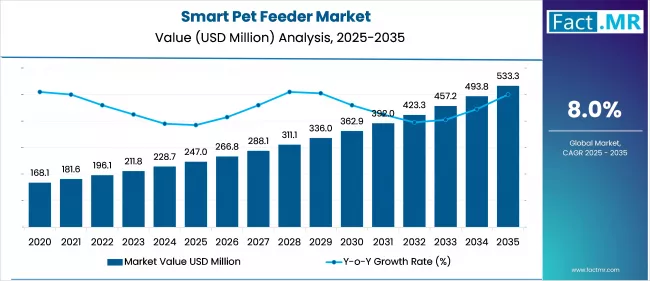
Smart Pet Feeder Market Value Analysis 2025 To 2035 | Source: Fact.MR
What are the drivers of smart pet feeder market?
The primary trend in this market is increased demand driven by the shift toward viewing pets as family members. The growing acceptance of pets in this role is encouraging spending on technology-enabled products that offer convenience and improved health management for animals.
The increasing number of working professionals and urban residents, who often spend extended hours away from home, creates the need for automated feeding solutions. Features such as voice communication, camera monitoring, and IoT connectivity enhance the appeal of these products. Growing disposable income and greater awareness of pet nutrition are also encouraging consumers to adopt intelligent, data-supported feeding systems.
Concerns regarding pet obesity have also instigated the need to purchase feeders that measure and control the number of calories. The combination of trends and product innovation, along with the growth of e-commerce platforms, is likely to spur growth in the smart pet feeder market, particularly at the international level.
What are the regional trends of smart pet feeder market?
North America holds a larger share of the smart pet feeder market due to high pet ownership rates, early adoption of modern technologies, and elevated spending on pet care. A significant portion of this growth comes from the U.S., where it is supported by the surge in dual-income households and a strong base of technologically engaged pet owners.
The UK, Germany, and France are among the European countries where adoption rates are increasing due to growing awareness of pet wellness and nutrition. The region benefits from developed retail infrastructure and high mobile usage, which supports the use of app-integrated feeders.
The Asia Pacific is also becoming a high-growth region, with pet adoption leading the way in China, Japan, South Korea, and India. Processes such as urbanization and trends towards nuclear families are driving the demand for automated pet care products.
There is an increase in the availability of cost-efficient models from local brands that cater to the needs of price-sensitive consumers. In the meantime, Latin America and the Middle East & Africa are becoming more accessible, with e-commerce expanding market reach.
What are the challenges and restraining factors of smart pet feeder market?
The high cost of the product remains a significant barrier to the adoption of smart pet feeders, particularly in emerging markets. Feeders that are advanced integrating use of app control, sensors, as well as camera, are usually expensive and are not pocket-friendly by middle-income families.
Besides this, technological complexity cannot be overlooked, as many older consumers or first-time users might have a hard time configuring the smart functionality or rectifying app failures. Other concerns (suggestive of reliability and may help deter repeat purchases and harm brand reputation) could include glitches in the app, connection failures, or jamming of the feeder.
Data privacy is also becoming a growing concern, as more feeders connect to home networks and may be exposed to cybersecurity risks. User experience can be affected by compatibility problems between feeders and various smartphone operating systems. A lack of awareness in rural and underserved areas further hampers market penetration.
Green concerns are also becoming pertinent in regard to the use of plastics and energy consumption, which have led to the need for designing products in a sustainable manner. Ingenuity, affordable solutions, and education are going to play an important role in maximizing the potential of the market by overcoming the problems mentioned.
Country-Wise Outlook
Tech Meets Treat in the United States
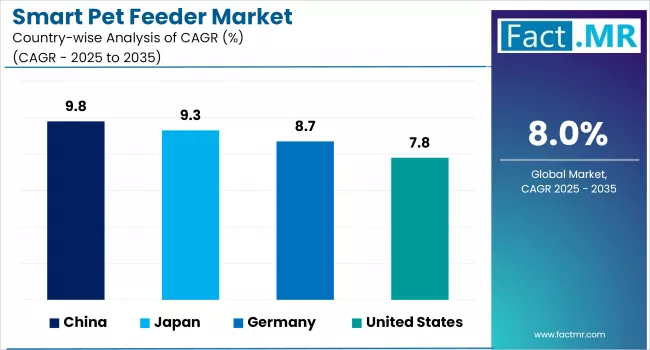
Smart Pet Feeder Market Country Wise Analysis Of CAGR | Source: Fact.MR
The U.S. is a market leader in smart pet feeding devices, with a high percentage of people owning pets, two-paycheck households, and consumer demand in smart Internet of Things (IoT) pet feeding systems. The problems exist in obese pets, and the increasing need to control portions.
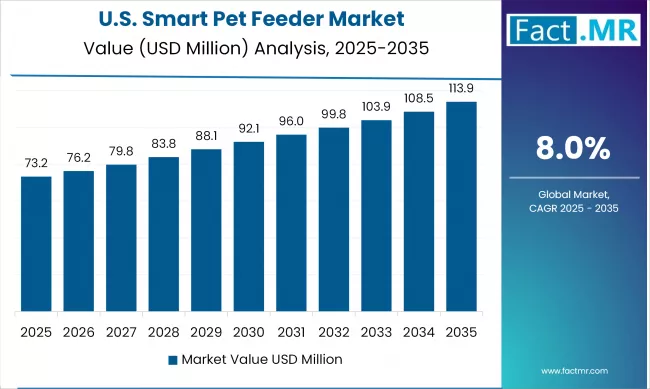
US Smart Pet Feeder Market Value Analysis 2025 To 2035 | Source: Fact.MR
Intelligent feeders of this kind include app-based scheduling, voice interface, and camera-enhanced devices. Feeders can calculate this consumption pattern and prescribe portions through artificial intelligence. Places such as Petlibro and WOPET utilize Wi-Fi and Bluetooth synchronization, with Amazon Alexa connectivity on the increase. The pet health-conscious boom is also increasing the demand for feeders that have sensors and the ability to connect with wearables and GPS collars.
China’s Urban Pet Boom Drives Feeder Innovation
The smart pet feeder market in China is expanding steadily, driven by increasing urbanization and the rise of single-person households with pets. The recent growth in disposable income has contributed to the trend of “pet humanization,” where pets are regarded as family members. Tier 1 and Tier 2 cities show high demand for automated, hygienic, and multi-pet feeding solutions.
In China, intelligent feeders feature state-of-the-art portion control functions, desiccant systems, and on-board integration with tools like WeChat. Domestic powerhouses are promoting AI-equipped feeders that utilize learning algorithms to recognize feeding schedules and alert owners through smartphone applications. The distribution and localized innovation driven by e-commerce, particularly pet tech brands sponsored by Alibaba, can shape the market.
Tech Pet Fusion in Japan
Japan has advanced the design of compact smart pet feeders to a new level of precision, making them suitable for small living spaces that cater to the aging population of pet owners. A declining birth rate and a growing elderly population have led to pets becoming emotional companions, resulting in increased expectations for consistent care.
Concerns regarding the quality of pet food and dietary control are especially relevant for aging cats and small-breed dogs. The feeders operating in Japan focus on on-demand dispensing, intelligent locking to limit an individual meal, and two-way audio provided by a camera.
The IoT enables devices that are typically integrated with these smart home helpers within the Japanese Society 5.0 framework. The trend in local technology companies is minimal design, space-efficient looks, and built-in health troubleshooting.
Category-Wise Analysis
Wi-Fi Connectivity Drives Real-Time, Remote Pet Feeding Solutions
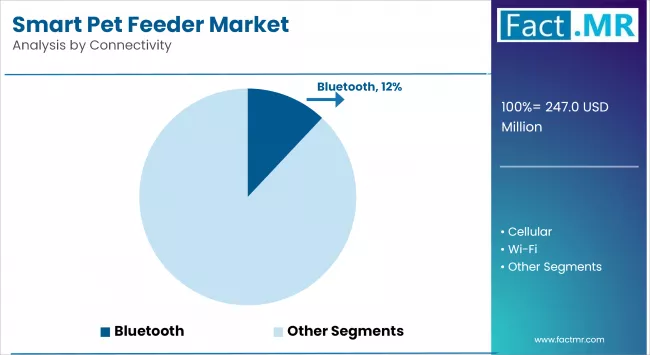
Smart Pet Feeder Market Analysis By Connectivity | Source: Fact.MR
Smart pet feeders that feature both Wi-Fi connections and application programs are increasingly becoming mandatory for owners who prefer to control and adjust when and how their pets are fed remotely, in real-time, with live notifications.
These feeders are fully compatible with smartphone systems and home automation ecosystems, allowing users to check the status of the food and dispense it through mobile applications, often equipped with cameras or voice compatibility.
This segment is gaining traction, particularly in urban areas where pet owners may have demanding schedules but still aim to maintain consistent feeding routines and portion control.
Dog-Focused Smart Feeders Cater to the Largest Companion Animal Segment
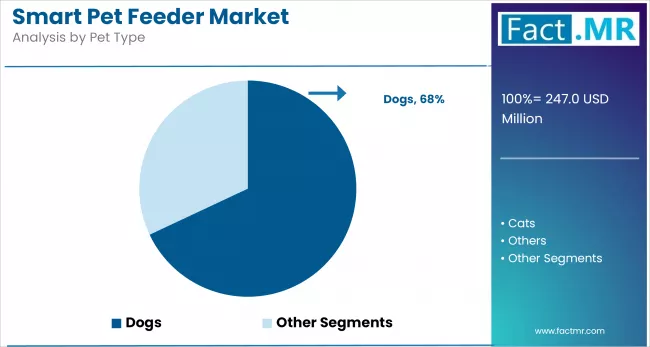
Smart Pet Feeder Market Analysis By Pet Type | Source: Fact.MR
Dogs are the most common household pet, making them the primary focus for smart feeder developers. Depending on their purpose, one may find these devices to suit different breed sizes of users, as well as benefit different diets, such as portion control for the prevention of obesity or scheduled feeding to assist with training.
Another area that affects the dog segment is the growing awareness of pet wellness and pet humanization, as well as an increase in one-dog families who must use automated devices throughout their working day or during periods of travel.
Online Sales Channels Dominate Distribution as Pet Tech Goes Digital
The sales channel distribution in smart pet feeders is led by online platforms, which include major e-commerce retailers and specialized pet care stores. These channels offer greater visibility of products, access to customer reviews, and instant feature comparisons, which are three key considerations for technology-based purchases. The evolution of digital shopping, influenced by the pandemic, continues to shape consumer behavior, particularly among millennial and Gen Z pet owners.
Competitive Analysis
The competitive landscape marked in the smart pet feeder industry is becoming saturated owing to the increasing demand in automated pet care products. Firms are also strategically using IoT integration and AI-based feeding algorithms in order to diversify their products. New features, such as camera-based feeders, real-time tracking of meals and mobile app synchronizing are changing the product likability, especially in tech-savvy pet owners and urban workforces.
Producers are working on the improvement of portion control accuracy and the ability to control multiple pets so that they can find competitive advantages. Collaborations with veterinary websites and pet health monitoring software are also becoming value-addition, as they enable companies to offer more complete pet wellness services.
Another area of competition is the distribution channels. Although online platforms continue to expand in terms of convenience and reach, companies are shifting toward specialty pet retail stores and veterinary clinics to strengthen brand credibility and provide after-sales support.
Key players in the smart pet feeder industry are DOGNESS Group, Dokoo, Faroro, Petkit, Radio Systems Corporation, Skymee, Sureflap Ltd., Sure Pet Care, Welltobe, Wopet, and other players.
Recent Development
- In December 2023, Xiaomi released the Mijia Pet Feeder 2, designed to provide food for pets for up to a month. It features active feed level monitoring, scheduled feeding, and low food level notifications, ensuring consistent meal distribution even during extended owner absences.
- In May 2023, Pet Marvel introduced a multifunctional device combining feeding, watering, and real-time monitoring. Key features include multi-cat facial recognition, voice announcements, and a built-in camera to alleviate pet separation anxiety.
Fact.MR has provided detailed information about the price points of key manufacturers in the Smart Pet Feeder market, positioned across regions, including sales growth, production capacity, and speculative technological expansion, in its recently published report.
Methodology and Industry Tracking Approach
Fact.MR market research examines the smart pet feeder market in 2025 and conducts interviews with 3,800 stakeholders across 18 countries. The survey was completed in October 2020, and its conclusions were made based on the opinions of more than 80 specialists in each of the applicable countries who work with veterinary technologists, IoT-related engineers, and developers of sustainable products.
Other types of innovations seen in the market over the last year include AI-powered meal personalization based on pet behavior, programmed feeding times in apps, voice-assistant functionality, and others, between June 2024 and May 2025. It also saw a considerable shift towards sustainable aspects, such as biodegradable feeding trays, power-efficient designs, and modular parts, allowing for easy repair or replacement of parts.
Fact.MR has been monitoring a shift in the pet feeding landscape since 2018, cataloging the evolution of this ecosystem toward more intelligent, personalized, and sustainable treatments to keep pace with the values of modern pet parents.
Segmentation
Segmentation of Smart pet feeder market
-
By Pet Type :
- Dogs
- Cats
- Others
-
By Connectivity :
- Bluetooth
- Cellular
- Wi-Fi
- Others
-
By Sales Channel :
- Online Sales Channels
- Company Websites
- e-Commerce Platforms
- Offline Sales Channels
- Hypermarkets/Supermarkets
- Modern Trade Stores
- Brand Stores
- Pet Care Stores
- Pet Care Clinics
- Online Sales Channels
-
By Region :
- North America
- Latin America
- Western Europe
- Eastern Europe
- East Asia
- South Asia & Pacific
- Middle East & Africa
Frequently Asked Questions
What was the global Smart pet feeder market size reported by Fact.MR for 2025?
Who are the major players operating in the smart pet feeder market?
What is the Estimated Valuation of the smart pet feeder market in 2035?
What value CAGR did the Smart pet feeder market exhibit over the last five years?
Who worked on this report


Preview the report firsthand - request a free sample
Free SampleGet the brochure for pricing and purchase details
Download PDF