- Market Value (2025): USD 1.2 Bn
- Estimated Value (2026): USD 1.5 Bn
- Forecast Value (2036): USD 8.8 Bn
- CAGR (2026-2036): 19.6%
What is the Solid-State Power Transformers Market forecast to be worth by 2036?
USD 1.5 billion in 2026 to USD 8.8 billion by 2036 at a 19.6% CAGR.
- The Solid-State Power Transformers Market reached USD 1.2 billion in 2025.
- Demand is projected to increase from USD 1.5 billion in 2026 to USD 8.8 billion by 2036.
- The market is forecast to record a 19.6% CAGR from 2026 to 2036 while utilities, charging-network operators and data-center teams evaluate controllable medium-voltage conversion.
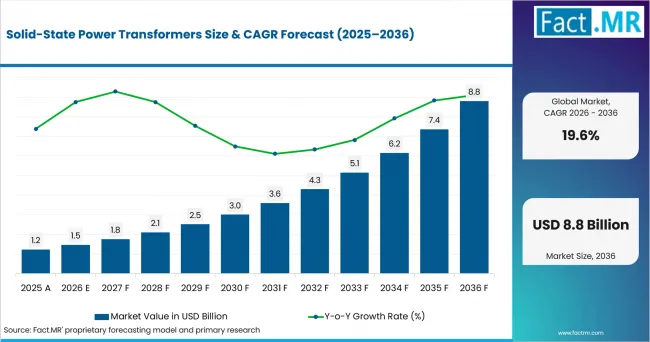
Solid State Power Transformers Value Analysis | Source: Fact.MR
What are the defining numbers behind Solid-State Power Transformers Market growth?
USD 7.3 billion absolute opportunity is expected between 2026 and 2036.
- Demand Drivers in the Market
- Grid planners need voltage regulation and power-factor correction inside the same node.
- Charging-site engineers need medium-voltage conversion that removes intermediate equipment where high-power EV depots face space limits and costly interconnection work.
- Renewable microgrid developers need bidirectional power flow so storage, solar and local loads are managed through one controllable interface.
- Transformer manufacturers need modular platforms that reduce custom engineering time while still passing utility qualification and safety review.
- Key Segments Analyzed
- By Conversion Architecture: AC-DC-DC-AC modular is expected to hold 39.0% share in 2026, owing to its ability to isolate conversion stages and simplify control protection.
- By Power Rating: 100-500 kVA is projected to account for 29.0% share in 2026, supported by depot chargers, campus microgrids and commercial distribution upgrades.
- By Application: EV charging hubs are anticipated to capture 27.0% share in 2026, due to direct demand for compact medium-voltage-to-DC conversion.
- By Semiconductor: SiC MOSFET is estimated to represent 45.0% share in 2026, shaped by high-frequency switching and thermal efficiency needs.
- Analyst Opinion at Fact.MR
- Shambhu Nath Jha, Principal Consultant at Fact.MR, states, “Solid-state power transformers are drawing attention by treating the transformer as a controllable power-conversion node. The market is expected to widen first in sites where grid capacity, footprint and DC output are evaluated together. Suppliers that combine medium-voltage hardware, SiC power modules, protection controls and utility documentation should move faster through customer trials.”
- Strategic Implications
- Transformer suppliers should document converter efficiency, insulation design and protection behavior under utility fault conditions.
- Charging-network operators should compare SST designs against conventional transformer and rectifier layouts before locking site electrical rooms.
- Semiconductor vendors should package SiC MOSFET modules for higher voltage, lower thermal loss and easier field replacement.
- Utilities should define test protocols for modular SST platforms so pilot projects move into wider service approval.
France is projected to post 24.1% CAGR through 2036, owing to grid investment and public charging expansion. Germany is estimated to record 22.5% CAGR, supported by grid approvals and fast-charging capacity. The UK is anticipated to advance at 16.0% CAGR while network funding and clean-power targets shape upgrades. Japan is forecast to hold 15.1% CAGR, reinforced by EV charging and future power-demand planning. The USA is expected to reach 14.1% CAGR where data centers and distribution-transformer constraints push utilities toward flexible conversion trials.
How does the Solid-State Power Transformers Market break down by segment?
AC-DC-DC-AC modular leads Conversion Architecture at 39.0%; SiC MOSFET leads Semiconductor at 45.0%.
Which Conversion Architecture dominates?
AC-DC-DC-AC modular holds 39.0% share in 2026.
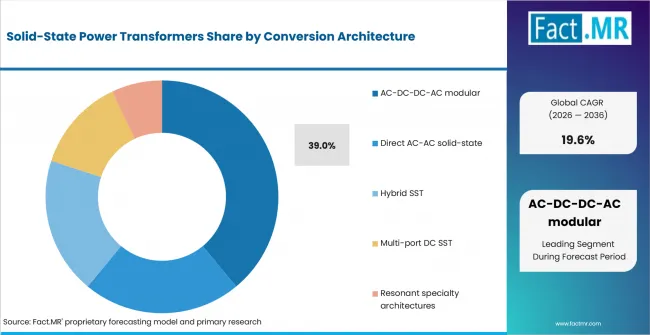
Solid State Power Transformers Analysis By Conversion Architecture | Source: Fact.MR
AC-DC-DC-AC modular systems lead owing to clearer electrical boundaries across conversion stages. Utilities and charging-site engineers value that separation when an SST must handle voltage conversion, isolation, bidirectional power and fault response inside one cabinet.
Direct AC-AC, hybrid and multi-port designs remain project-specific where conversion losses, storage links or DC loads shape engineering choices.
What leads the Power Rating segment?
100-500 kVA accounts for 18.0% share in 2026.
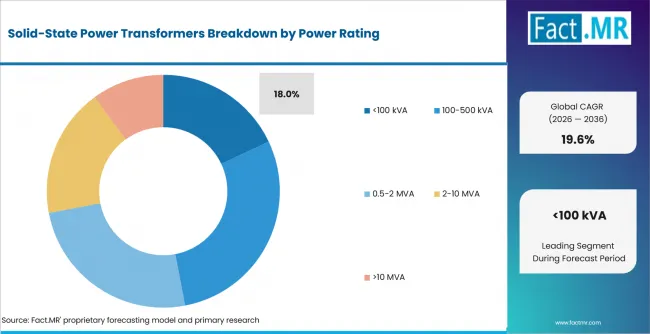
Solid State Power Transformers Analysis By Power Rating | Source: Fact.MR
The 100-500 kVA band fits commercial charging clusters, campus feeders and early utility pilots where engineers want medium-voltage control below substation scale. This rating band allows suppliers to test repeatable module designs before customers specify multi-megawatt configurations.
Below 100 kVA fits specialty use, while higher ratings depend on utility acceptance and field reliability records.
How does Application shape demand?
EV charging hubs lead with 27.0% share in 2026.
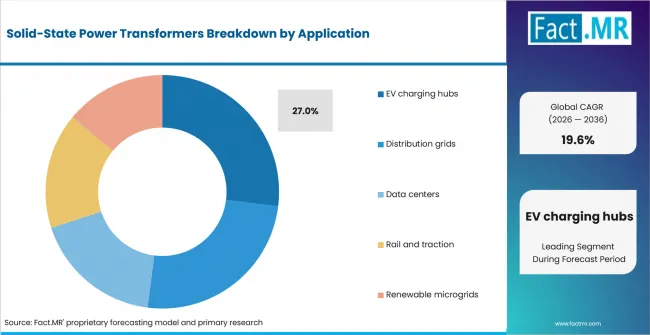
Solid State Power Transformers Analysis By Application | Source: Fact.MR
EV charging hubs lead where high-power DC charging concentrates load in locations where space, feeder capacity and conversion losses are examined early. Medium-voltage solid-state transformers reduce conversion stages and give operators a clearer route from grid connection to DC output.
Distribution grids, data centers, rail traction and microgrids remain project-led, with qualification tied to protection studies and duty cycles.
What supports SiC MOSFETs within Semiconductor?
SiC MOSFET holds 45.0% share in 2026.
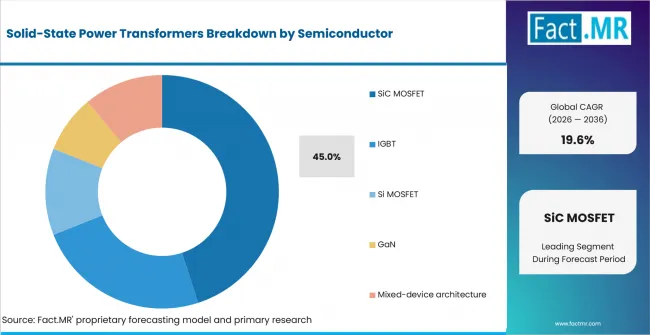
Solid State Power Transformers Analysis By Semiconductor | Source: Fact.MR
SiC MOSFET devices lead owing to SST needs for high-frequency switching, thermal stability and smaller passive components. Those traits help reduce enclosure size and improve conversion efficiency for charging hubs and data-center power rooms.
IGBTs, Si MOSFETs, GaN and mixed-device designs remain selective where price, voltage and thermal behavior set the design limit.
What is accelerating Solid-State Power Transformers Market adoption, and what is holding it back?
Demand is expected to rise through EV charging hubs and grid power electronics; adoption is constrained by qualification time and semiconductor cost.
Drivers Impact Analysis
| DRIVER | (~) % IMPACT ON CAGR | GEOGRAPHIC RELEVANCE | IMPACT TIMELINE |
|---|---|---|---|
| Medium-voltage EV charging hubs | +2.1% | North America, Europe, East Asia | Short term (<= 2 years) |
| Distribution-grid voltage control | +1.8% | Europe, USA, Japan | Medium term (2-4 years) |
| Data-center 800 VDC architecture | +1.4% | USA, Germany, UK, Japan | Medium term (2-4 years) |
| Renewable microgrid integration | +1.0% | Global | Long term (>= 4 years) |
- Medium-voltage EV charging hubs: Solid-state transformers can support direct conversion from medium-voltage AC to DC, reducing the number of conversion stages at high-power charging sites.
- Distribution-grid voltage control: SSTs can combine voltage transformation, regulation, and power-factor support within controllable feeder equipment. This functionality is valuable where utilities need more flexible power-flow management and faster response across modern distribution networks.
- Data-center 800 VDC architecture: Rising rack power is increasing interest in higher-voltage DC distribution and compact power-conversion layouts. SST platforms can support this transition by integrating conversion and control functions while helping facility teams manage space and power-density constraints.
- Renewable microgrid integration: Multi-port SST designs can coordinate renewable generation, storage, and local loads within bidirectional power architectures. This makes them relevant for microgrids that require flexible energy routing, voltage management, and integration of multiple distributed energy resources.
Opportunity Impact Analysis
| OPPORTUNITY | (~) % IMPACT ON CAGR | GEOGRAPHIC RELEVANCE | IMPACT TIMELINE |
|---|---|---|---|
| Multi-port DC SST platforms | +1.3% | Europe, East Asia | Medium term (2-4 years) |
| Retrofit-friendly modular cabinets | +1.1% | USA, UK, Germany | Short term (<= 2 years) |
| SiC module packaging and serviceability | +0.9% | Global | Long term (>= 4 years) |
- Multi-port DC SST platforms: Multi-port solid-state transformer platforms can combine connections for EV chargers, battery storage, and renewable generation within a single power-conversion architecture. This can simplify system integration and improve flexibility across distribution, microgrid, and charging applications.
- Retrofit-friendly modular cabinets: Compact modular cabinets can help utilities and charging operators deploy SST systems within existing electrical rooms and constrained sites. Smaller footprints and scalable configurations reduce installation complexity and support phased upgrades without requiring major facility redesign.
- SiC module packaging and serviceability: Silicon carbide-based designs benefit from packaging that improves heat removal, accessibility, and component replacement. Service-friendly modules can reduce lifecycle risk by simplifying thermal management, maintenance, and field replacement in high-power SST applications.
Restraints Impact Analysis
| RESTRAINT | (~) % IMPACT ON CAGR | GEOGRAPHIC RELEVANCE | IMPACT TIMELINE |
|---|---|---|---|
| Utility qualification and protection studies | -0.8% | Global | Short term (<= 2 years) |
| High wide-bandgap semiconductor cost | -0.6% | Global | Medium term (2-4 years) |
| Transformer supply-chain constraints | -0.5% | USA, Europe | Medium term (2-4 years) |
- Utility qualification and protection studies: Utilities require clear evidence on fault behavior, insulation performance, protection coordination, and failure modes before deploying solid-state transformers on distribution feeders. Extensive qualification can lengthen approval cycles and slow broader field adoption.
- High wide-bandgap semiconductor cost: Silicon carbide devices can improve switching efficiency and power density, but higher component costs can constrain adoption in price-sensitive transformer ratings. Suppliers therefore need to demonstrate lifecycle, efficiency, or maintenance benefits that justify the added hardware cost.
- Transformer supply-chain constraints: Long lead times and constrained transformer availability can delay grid-upgrade schedules and complicate solid-state transformer deployment planning. Utilities may prioritize proven conventional equipment where near-term capacity additions are required, slowing transition toward newer architectures.
Which countries are scaling the Solid-State Power Transformers Market through 2036?
- The country comparison spans 9.98 percentage points and forms three practical growth bands across the forecast period.
- France remains 1.60 percentage points above Germany while RTE investment approvals and public charging density support commercial trials.
- Germany stays 6.50 percentage points above the UK through power-line approvals and a broad fast-charging base.
- The UK remains 0.88 percentage point above Japan where RIIO-3 network funding supports higher-capacity grid connections.
- Japan remains 1.00 percentage point above the USA, supported by charging-port rollout and FY2040 power-system planning.
- The USA closes the displayed range through grid-upgrade funding, data-center load and transformer modernization pressure.
Comparable CAGRs create different entry conditions due to grid funding, charging density, power-electronics supply and utility qualification. Full report coverage includes North America, Latin America, Western Europe, Eastern Europe, East Asia, South Asia & Pacific, Middle East & Africa.
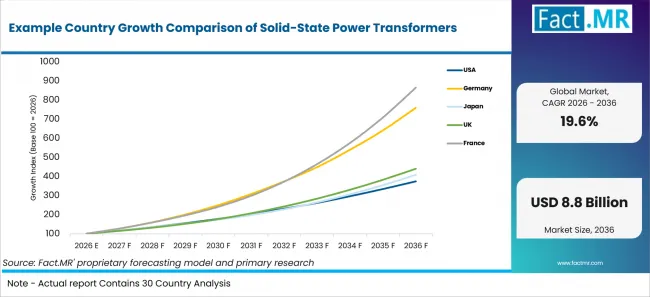
Example Country Growth Comparison Of Solid State Power Transformers | Source: Fact.MR
| Country | CAGR (2026-2036) |
|---|---|
| France | 24.1% |
| Germany | 22.5% |
| United Kingdom | 16.0% |
| Japan | 15.1% |
| USA | 14.1% |
What supports France adoption?
24.1% CAGR, shaped by grid investment and public charging density.
France is building a stronger case for controllable medium-voltage conversion where charging hubs and distribution upgrades meet. CRE approved RTE’s 2026 investment program at EUR 4.24 billion in February 2026, about 27% above RTE’s estimated 2025 investment spending. Avere-France reported 197,663 publicly accessible charging points in France as of June 30, 2026. These conditions are expected to make compact SST designs more relevant for sites that need voltage control and DC output inside limited grid-connection space.
What is supporting Germany’s adoption?
22.5% CAGR, supported by grid approvals and high-power charging capacity.
Germany combines transmission expansion with a dense public charging register, creating a clear test environment for modular SST equipment. Bundesnetzagentur reported that it approved roughly 2,000 km of power lines in 2025, describing this as approximately 45% more than in 2024. Its charging register contained 156,399 normal charging points and 55,665 fast charging points in operation as of August 1, 2026. This scale is expected to favor AC-DC-DC-AC modular layouts with staged service access.
What supports the United Kingdom’s growth?
16.0% CAGR, backed by RIIO-3 funding and public charging rollout.
The United Kingdom is tying grid reinforcement to transport electrification, which is expected to support SST trials at constrained urban and depot locations. Ofgem approved GBP 28.1 billion of upfront RIIO-3 investment across electricity transmission, gas transmission and gas distribution for the period from April 2026 to March 2031, including approximately GBP 10.3 billion of baseline funding for electricity transmission. The Department for Transport reported that the UK had 121,171 public EV chargers as of July 1, 2026.
How is Japan developing demand?
15.1% CAGR, led by EV charging and FY2040 power planning.
Japan's opportunity is centered on compact conversion for urban loads, charging sites and future industrial electricity demand. METI reported that Japan had approximately 68,000 EV charging ports at the end of FY2024, including about 12,000 fast-charging ports. ANRE’s FY2040 Energy Supply and Demand Outlook places electricity generation at approximately 1.1 trillion to 1.2 trillion kWh. That planning range is expected to keep power-electronics transformers relevant where space and stable voltage control are treated together.
What supports USA adoption?
14.1% CAGR, supported by grid funding and transformer modernization.
The USA is expected to scale SST pilots through grid-upgrade funding and large-load connection pressure. EIA reported in March 2026 that U.S. electricity demand, measured as net energy for load, grew about 1.7% annually from 2020 to 2025. The DOE Office of Electricity separately announced approximately USD 1.9 billion through the SPARK funding opportunity in March 2026 to accelerate urgently needed grid upgrades. In February 2026, DOE also documented the PowerHub generation II project to develop and demonstrate a flexible solid-state transformer integrating distribution-transformer, voltage-regulation and power-factor-correction functions.
Who leads the Solid-State Power Transformers Market?
Current SST-specific activity includes Eaton, ABB, DG Matrix, GE Vernova, Hitachi Energy, Siemens AG, Reinhausen and Siemens Energy.
Eaton markets a medium-voltage solid-state transformer with greater than 97% conversion efficiency at 800 VDC output. ABB’s March 2025 minority investment in DG Matrix includes a collaboration to develop solid-state transformer solutions for applications including AI data centers.
GE Vernova stated in April 2026 that its solid-state transformer investment remained on track, with the first product planned for delivery to a hyperscaler in fall 2026 followed by approximately six months of testing. Siemens AG and Reinhausen announced in August 2026 that they are jointly developing and will industrialize a solid-state transformer for grid voltages up to 36 kV with 800 VDC output for AI-ready data centers.
Hitachi Energy’s March 2026 recruitment for a Global Product Specialist – Solid-State Transformers covers product roadmaps, business cases, product-development projects, new-product launches and sales support. Siemens Energy has separately recruited for solid-state transformer product lifecycle management covering development coordination, roadmaps, market launch, certification and product support, indicating active SST product-development and go-to-market preparation. Schneider Electric is active in 800 VDC data-center power architectures spanning power conversion, protection and metering and is treated in this report as an adjacent 800 VDC infrastructure participant rather than a confirmed commercially available SST supplier.
Which companies are the key providers?
Key companies with current SST product or development activity include Eaton; ABB; DG Matrix; GE Vernova; Hitachi Energy; Siemens AG; Reinhausen; and Siemens Energy.
- Eaton
- ABB
- DG Matrix
- GE Vernova
- Hitachi Energy
- Siemens AG
- Reinhausen
- Siemens Energy
Bibliography
- U.S. Department of Energy, Office of NEPA Policy and Compliance. (2026, February 20). CX-035473: Solid State “PowerHub generation II” Development and Demonstration.
- U.S. Department of Energy, Office of NEPA Policy and Compliance. (2026, February 6). CX-035268: Full-scale AC Solid-State Transformer (FASST) Demonstration.
- U.S. Energy Information Administration. (2026, March 12). Fossil generation could rise with faster-than-expected growth in data center power demand.
- U.S. Department of Energy. (2026, March 12). Energy Department announces $1.9B investment in critical grid infrastructure to reduce electricity costs.
- U.S. Department of Energy, Office of Electricity. (2026, March 5). Distribution Transformer Webinar Text Alternative.
- Commission de régulation de l’énergie. (2026, March 9). La CRE approuve le programme d’investissements de RTE pour l’année 2026.
- Avere-France. (2026, July 9). [Baromètre] 197 663 points de recharge ouverts au public fin juin 2026.
- Bundesnetzagentur. (2026, January 2). Energy transition clears crucial hurdle – significant progress in electricity grid expansion in 2025.
- Bundesnetzagentur. (2026, July 29). E-Mobilität.
- Department for Transport. (2026, August 27). Public electric vehicle charging infrastructure statistics: 1 July 2026.
- Ofgem. (2025, December 4). RIIO-3 Investor Call – Final Determination Transcript.
- ABB. (2025, March 11). ABB invests in DG Matrix to advance AI data center power optimization.
- Hitachi Energy. (2026, March 30). Global Product Specialist – Solid-State Transformers (SSTs) 80–100% (f/m/d) [Job posting].
- Siemens. (2026, August 14). Siemens and Reinhausen develop direct current power solutions for AI data centers.
- Schneider Electric. (2025, October 13). Schneider Electric highlights innovation in 800 VDC power systems in support of NVIDIA’s next generation GPUs.
- GE Vernova. (2026, April 22). GE Vernova 1Q 2026 Financial Results & Outlook [Earnings call transcript].
This Report Addresses
- The report explains where solid-state power transformers are used across conversion architecture, power rating, application and semiconductor platform.
- Segment analysis identifies the leading subsegments and explains why engineering teams prioritize specific architectures and ratings.
- Country analysis examines the listed markets and the grid, charging and power-demand factors shaping adoption.
- Competitive analysis reviews current providers across transformer manufacturing, grid solutions and solid-state power-electronics development.
- Application analysis assesses how EV charging, data centers, distribution grids, rail traction and microgrids influence supplier selection.
What does the Solid-State Power Transformers Market cover?
The solid-state transformer systems covered here use power electronics to convert voltage and manage power quality in distribution environments. They are distinct from conventional transformers that rely mainly on magnetic conversion and passive voltage control.
The assessment covers grid distribution, EV charging, data-center conversion, traction and microgrid use cases. Adjacent demand signals are tracked through electric car battery chargers and high-power EV chargers where medium-voltage conversion affects charger design.
What is included in the scope?
The scope includes complete SST cabinets, converter stacks, medium-voltage power-electronic transformer assemblies, integrated controls, protection interfaces and service packages sold with the equipment. It also includes SST platforms that support DC power distribution, DC distribution network and digital power conversion use cases.
It includes equipment used by utilities, charging operators, data-center owners, rail networks and renewable microgrid developers. Related analysis references electric power distribution automation systems, electric transmission equipment and instrument transformers where grid interfaces shape equipment choices.
What is excluded from the scope?
The scope excludes conventional oil-filled transformers, dry-type transformers, raw semiconductor devices and stand-alone control software sold separately from SST hardware. It also excludes gas insulated transformers and grain oriented electrical steel sold as conventional transformer inputs.
General power converters are excluded when they lack transformer-level voltage conversion, isolation and grid-interface protection. Standard EV chargers are excluded when medium-voltage SST architecture is absent.
How Was the Analysis Built?
The analysis draws on 120+ sources, 35+ company portfolios, 25+ countries, and more than 20 industry interviews.
- Primary Research: Primary research includes discussions with manufacturers, service providers, technology developers, distributors, end users, and subject-matter experts. These conversations examine purchasing priorities, product adoption, operational challenges, approval requirements, competitive positioning, and the factors that influence wider market acceptance.
- Desk Research: Desk research covers government statistics, regulatory publications, company filings, trade data, technical studies, industry associations, standards, public policy, and other authoritative sources. Every source used in the analysis is documented in the bibliography.
- Market Sizing and Forecasting: Market estimates combine historical performance, demand indicators, pricing and volume trends, segment shares, company participation, country-level growth, adoption patterns, investment activity, and barriers to market expansion.
- Data Validation and Update Cycle: Findings are validated by comparing primary interviews with public data, company activity, regulatory changes, trade patterns, and industry developments. Regular updates review new product launches, capacity changes, partnerships, approvals, and shifts in commercial adoption.
What is the report’s scope and coverage?
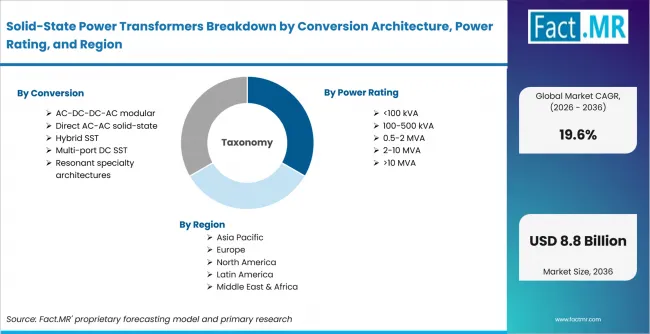
Solid State Power Transformers Breakdown By Conversion Architecture, Power Rating, And Region | Source: Fact.MR
| Attribute | Details |
|---|---|
| Quantitative Units | USD billion |
| Market Definition | Solid-state power transformers that use power electronics, high-frequency conversion and control software to convert and manage electrical power across distribution, charging, data-center, rail and microgrid settings. |
| Conversion Architecture | AC-DC-DC-AC modular; Direct AC-AC solid-state; Hybrid SST; Multi-port DC SST; Resonant specialty architectures |
| Power Rating | <100 kVA; 100-500 kVA; 0.5-2 MVA; 2-10 MVA; >10 MVA |
| Application | EV charging hubs; Distribution grids; Data centers; Rail and traction; Renewable microgrids |
| Semiconductor | SiC MOSFET; IGBT; Si MOSFET; GaN; Mixed-device architecture |
| Regions Covered | North America; Latin America; Western Europe; Eastern Europe; East Asia; South Asia & Pacific; Middle East & Africa |
| Countries Covered | France; Germany; United Kingdom; Japan; USA |
| Key Companies Profiled | Eaton; ABB; DG Matrix; GE Vernova; Hitachi Energy; Siemens AG; Reinhausen; Siemens Energy |
| Forecast Period | 2026 to 2036 |
| Approach | Hybrid top-down and bottom-up approach using grid equipment demand, EV charging buildout, data-center power design, power-electronics adoption, country policy signals and provider portfolio review. |
How is the market segmented?
-
By Conversion Architecture
- AC-DC-DC-AC modular
- Direct AC-AC solid-state
- Hybrid SST
- Multi-port DC SST
- Resonant specialty architectures
-
By Power Rating
- <100 kVA
- 100-500 kVA
- 0.5-2 MVA
- 2-10 MVA
- >10 MVA
-
By Application
- EV charging hubs
- Distribution grids
- Data centers
- Rail and traction
- Renewable microgrids
-
By Semiconductor
- SiC MOSFET
- IGBT
- Si MOSFET
- GaN
- Mixed-device architecture
-
By Region
- North America
- Latin America
- Western Europe
- Eastern Europe
- East Asia
- South Asia & Pacific
- Middle East & Africa