Power Ring Rolling Machine Market (2026 - 2036)
Power Ring Rolling Machine Market Size and Share Forecast Outlook 2026 to 2036
Core Findings
Power Ring Rolling Machine Market Forecast and Outlook 2026 to 2036
The global power ring rolling machine market is likely to be valued at USD 1,240.0 million in 2026, with a projected growth to USD 1,715.6 million by 2036, reflecting a 6.1% CAGR.
Power Ring Rolling Machine Market Key Takeaways
- Power Ring Rolling Machine Market Value (2026): USD 1,240.0 million
- Power Ring Rolling Machine Market Forecast Value (2036): USD 1,715.6 million
- Power Ring Rolling Machine Market Forecast CAGR (2026-2036): 3.3%
- Leading Machine Type in the Market: Radial-Axial Ring Rolling Machines (41.0%)
- Key Growth Region in the Market: Asia Pacific
- Key Players: SMS Group, Danieli, Siempelkamp, Schuler Group, Anyang Forging Press, Nanjing Zhongke
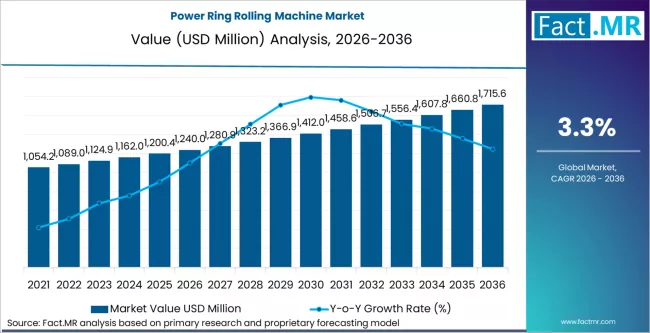
This transformation is driven by the aviation and renewable energy sectors, where the focus has shifted from sheer capacity to precision and energy efficiency. Leading companies like SMS Group are embracing advanced technologies such as Ring Monitoring Systems (RMS) that offer real-time geometry correction, and energy-efficient machines that reduce consumption by up to 50%. "The future of manufacturing will not only be about size and scale but the quality and precision of the materials we produce," says Markus Kerler, Head of Innovation at Thyssenkrupp, highlighting the market’s pivot to digital-first metallurgy.
Regionally, Asia-Pacific is a key player, capturing over 31% of the market in 2025, driven by industrialization and rapid infrastructure development in China and India. Europe remains a leader in high-precision machinery, growing at 8.5% CAGR, while the Middle East is localizing manufacturing to meet increasing demand for clean energy components. As the market evolves, the emphasis will be on closed-loop control, modularization, and sustainability, further cementing digital certifications as industry standards.
Power Ring Rolling Machine Market
| Metric | Value |
|---|---|
| Estimated Value in (2026E) | USD 1,240.0 million |
| Forecast Value in (2036F) | USD 1,715.6 million |
| Forecast CAGR 2026 to 2036 | 3.3% |
Category
| Category | Segments |
|---|---|
| Machine Type | Radial-Axial; Hydraulic Ring Rolling; CNC Ring Expanders; Ancillary Handling / Heating |
| Workpiece | Bearing Rings; Aerospace Rings; Flanges & Pipes; Gears / Other |
| Capacity | 2-5 MN; <2 MN; 5-10 MN; >10 MN |
| Buyer | Steel Forges; Aero / Defense; Bearing OEMs; Oil & Gas / Power |
| Region | North America; Europe; Asia Pacific; Latin America; Middle East & Africa |
Segmental Analysis
What Is the Impact of Machine Type on the Power Ring Rolling Machine Market?
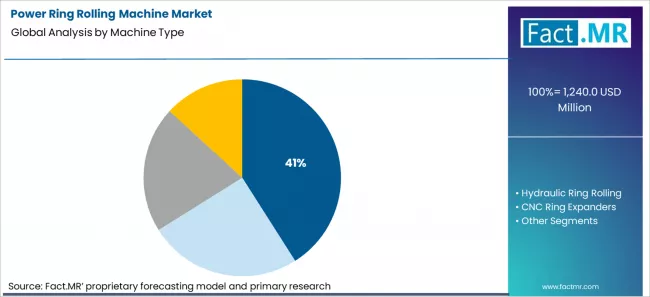
In the power ring rolling machine market, machine type plays a crucial role in determining the precision, efficiency, and versatility of the rolling process. Radial-axial ring rolling machines lead the market with a 41.0% share, primarily due to their ability to simultaneously perform radial and axial rolling, enabling faster and more precise production of complex ring geometries. These machines are particularly effective in industries such as bearing manufacturing, where high accuracy in the final dimensions is critical. The radial-axial design allows for greater flexibility in handling a wide range of ring sizes and materials, making them a preferred choice for manufacturers aiming to optimize productivity while maintaining tight tolerances. Their widespread use in high-volume manufacturing operations, particularly in the automotive, aerospace, and industrial sectors, further contributes to their dominance in the market.
How Does Workpiece Type Influence the Power Ring Rolling Machine Market?
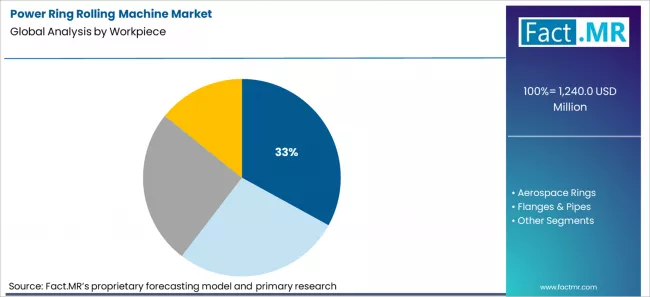
Workpiece type significantly influences the design and capabilities of ring rolling machines, as each application demands specific material handling and processing techniques. Bearing rings account for 33.0% of the market, driven by the critical role these components play in the automotive, industrial, and aerospace sectors. Power ring rolling machines are essential for shaping bearing rings, as they require high precision to ensure smooth operation and reliability under stress. These rings need to be produced with minimal tolerances, and ring rolling machines provide the necessary control and consistency to meet these standards. As demand for high-performance bearings continues to grow in sectors such as automotive and industrial machinery, the use of power ring rolling machines for bearing ring production remains a key driver in the market.
What are the Drivers, Restraints, and Key Trends in the Power Ring Rolling Machine Market?
- Drivers: Demand for power ring rolling machines is shaped by growth in sectors requiring large precision rings such as wind energy, heavy trucks, railway axle bearings, and industrial gear systems. Global wind turbine nacelle suppliers specify ring rolling systems capable of forming bearing rings up to 5 meters in diameter with strict roundness and grain flow requirements to support longer service intervals and lower failure rates. OEMs in construction and mining equipment increasingly adopt digitally controlled ring rolling to produce slewing and support rings that withstand higher dynamic loads. Buyers prioritize machines with CNC control, synchronous multi-drive torque profiling, and closed-loop thickness control to reduce scrap and improve first-pass yield on high-strength steels and nickel alloys.
- Restraints: High acquisition and installation cost constrain adoption among regional and smaller manufacturers that fabricate rings below 500 mm. Advanced power ring rolling systems require robust foundations, precision calibration, and integration with laser measurement feedback, which increases commissioning time by weeks relative to conventional presses. Skilled operators and process engineers with experience in roll gap profiling and thermal compensation are in limited supply, particularly in emerging markets where machine downtime due to setup variation remains a key barrier. Material handling needs for very large ingots and finished rings require heavy load cranes and automation, adding to total capital outlay and extending payback periods.
- Trend 1: Adoption of fully digitized ring rolling cells that integrate real time force and displacement sensors with adaptive control algorithms to maintain target section profiles across variable wall thickness requirements. These systems reduce dependency on manual adjustment and improve consistency when processing microalloyed steels and duplex stainless grades used in offshore and heavy industry.
- Trend 2: Growth in hybrid power ring rolling configurations that combine traditional rolling stations with heat assisted forming and induction preheating to support high deformation of high strength alloys and improve material flow, enabling production of large diameter rings with reduced microstructural defects and enhanced mechanical properties.
Analysis of the Power Ring Rolling Machine Market by Key Country
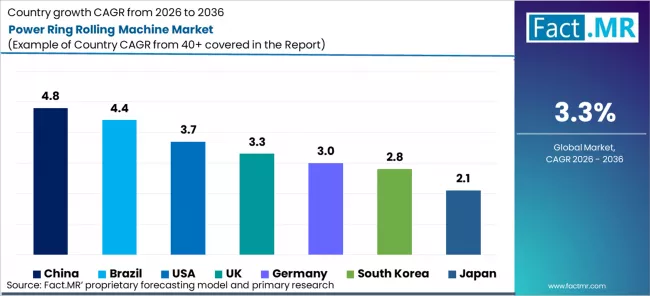
| Country | CAGR (%) |
|---|---|
| China | 4.8% |
| Brazil | 4.4% |
| USA | 3.7% |
| UK | 3.3% |
| Germany | 3.0% |
| South Korea | 2.8% |
| Japan | 2.1% |
The report covers an in-depth analysis of 40+ countries; top-performing countries are highlighted below.
What Drives Growth in China for Power Ring Rolling Machines?
China is projected to grow at 4.8%, driven by surging industrial manufacturing across automotive, energy, and heavy equipment sectors. China’s role as a global manufacturing hub encourages adoption of precision ring rolling machines to produce high strength rings for engines, turbines, and heavy machinery. Expansion of production capacity and export oriented manufacturing stimulates investment in advanced automation and CNC integration. The global ring rolling machine market is witnessing increased demand from such sectors, where durable, seamless rings are critical.
High domestic production volumes and government emphasis on industrial automation reinforce this trend, while Chinese suppliers focus on cost competitive equipment suited for large batch operations.
What fuels the rapid rise in Brazil for Power Ring Rolling Machines?
Brazil’s power ring rolling machine market is expected to grow at 4.4% CAGR, with key drivers coming from the automotive and energy sectors. As Brazil continues to expand its automotive manufacturing base and invest in the energy sector, including oil and gas and renewable energy production, the need for advanced ring rolling machinery increases. Brazil’s focus on localizing production and reducing dependency on imports also boosts demand for high-precision manufacturing equipment.
Carlos Souza, President of Brazil’s largest automotive manufacturer, says:“We’re seeing increased demand for locally produced precision parts as we scale up our production capacity, and that requires the latest in rolling machine technology.”
Brazil’s growing role as a manufacturing hub for both automotive components and energy production makes it a key market for the continued growth of power ring rolling machines.
How is the USA market evolving in the Power Ring Rolling Machine sector?
The USA market for power ring rolling machines is forecast to grow at 3.7%, a steady growth rate reflecting a mature manufacturing environment where demand is driven by the production of high-precision components for the automotive, aerospace, and energy industries. As the USA focuses on improving manufacturing efficiency and quality control, power ring rolling machines remain essential for producing seamless rings used in bearings, gears, and turbine components. This growth is influenced by the increasing complexity of machinery and components required for next-generation vehicles and renewable energy equipment.
As Chris Miller, Director of Manufacturing at General Electric, explains:“We’re seeing a push for higher quality and precision in our turbine manufacturing, and that means investing in the best possible rolling machines to handle complex materials.”
Despite this optimism, the market faces challenges such as the high capital cost of advanced rolling machines and the need for continuous upgrades in precision manufacturing. Increasing demand for specialized components like turbine rings and precision automotive parts is a key driver of growth in the sector.
What drives growth in Germany for the Power Ring Rolling Machine market?
Germany is projected to grow at 3.0% CAGR, a rate reflecting its strong position in industrial and automotive engineering, where power ring rolling machines are essential for producing high-precision components. As a leader in automotive and mechanical engineering, Germany’s market is particularly driven by the demand for high-quality seamless rings used in automotive drivetrains, industrial machinery, and aerospace. The country’s focus on sustainable energy also increases demand for rolling machines used in the production of renewable energy equipment, including wind turbine components.
Professor Lutz Eberle, Head of Engineering at Siemens, notes:“Germany’s manufacturing sector, especially in automotive and aerospace, requires precision forming machines that can handle high-tolerance components. Our industry relies on these machines for mass production and maintaining the highest standards of quality.”
Fact.MR predicts that Germany’s market growth will be influenced by continuous investment in precision engineering and expanding renewable energy sectors.
Why is the UK market critical for Power Ring Rolling Machines?
The UK market is expanding at 3.3%, driven by its strategic focus on automotive and aerospace sectors that require precision-engineered components. The UK’s manufacturing sector, while smaller than other leading industrial countries, remains vital for high-quality production, especially in the automotive and defense industries. The demand for power ring rolling machines is fueled by the need for seamless components in gears, bearings, and structural parts.
James Harris, Managing Director at Rolls-Royce, emphasizes the importance of precise manufacturing:“The UK’s aerospace sector relies on the highest standards of precision for our turbine and engine parts, and advanced power ring rolling machines are a cornerstone of that effort.”
The market is further supported by regulatory pressures for higher manufacturing standards and the push toward low-emission and fuel-efficient vehicles, which require increasingly sophisticated components.
What drives the expansion in South Korea for Power Ring Rolling Machines?
South Korea is growing at 2.8%, with demand driven primarily by the country’s robust automotive and shipbuilding sectors, both of which require high-strength, precision-formed rings for engine components and structural parts. As South Korea continues to be a leader in heavy manufacturing and advanced technology sectors, the need for high-performance, cost-effective power ring rolling machines grows.
“The demand for high-quality and precision components in automotive engines and ship turbines is accelerating. We’re investing heavily in new machine technology to keep up with global standards,” explains Ji-Soo Park, Senior Manager at Hyundai Heavy Industries.
The ongoing industrial growth, particularly in shipbuilding and automotive manufacturing, continues to fuel this market, though it faces competition from neighboring manufacturing giants.
Why is the Japan market seeing gradual growth in Power Ring Rolling Machines?
Japan’s market for power ring rolling machines is expanding at 2.1%, reflecting slower but steady growth, driven by precision manufacturing in the automotive, aerospace, and machinery sectors. Japan’s focus on high-end engineering and specialized manufacturing equipment ensures a steady, albeit smaller, demand for these machines. Japan’s automotive and heavy machinery sectors demand precise rolled rings for critical applications such as bearings and transmission parts.
"As Japan continues to develop cutting-edge automotive and aerospace technologies, the need for high-precision components becomes even more critical, which is why we invest in advanced rolling machines," says Akira Takahashi, Senior Technical Engineer at Toyota.
While the country’s adoption rate is more conservative compared to its larger counterparts, Japan’s focus on long-term durability, precision, and high-quality standards ensures that demand for power ring rolling machines remains stable.
Key Players in the Power Ring Rolling Machine Market
- SMS group
- Danieli
- Siempelkamp
- Schuler Group
- Anyang Forging Press
- Nanjing Zhongke
- GFM Maschinenbau
- Shanxi Daqiang
- Wuxi Daqiao
- Qingdao Yiyou
Scope of the Report
| Items | Values |
|---|---|
| Quantitative Units | USD million |
| Machine Type | Radial-Axial; Hydraulic Ring Rolling; CNC Ring Expanders; Ancillary Handling / Heating |
| Workpiece | Bearing Rings; Aerospace Rings; Flanges & Pipes; Gears / Other |
| Capacity | 2-5 MN; <2 MN; 5-10 MN; >10 MN |
| Buyer | Steel Forges; Aero / Defense; Bearing OEMs; Oil & Gas / Power |
| Regions Covered | Asia Pacific, Europe, North America, Latin America, Middle East & Africa |
| Countries Covered | China; Brazil; USA; UK; Germany; South Korea; Japan |
| Key Companies Profiled | SMS group; Danieli; Siempelkamp; Schuler Group; Anyang Forging Press; Nanjing Zhongke; GFM Maschinenbau; Shanxi Daqiang; Wuxi Daqiao; Qingdao Yiyou |
| Additional Attributes | Dollar sales by machine type, workpiece, and capacity segment; machine customization options; growing adoption of automation and digital control systems; market share by end-use industry; trends in material selection and demand for high-precision and large-diameter rings; impact of regional policies and regulations on demand in key countries. |
Power Ring Rolling Machine Market Key Segment
-
Machine Type :
- Radial-Axial
- Hydraulic Ring Rolling
- CNC Ring Expanders
- Ancillary Handling / Heating
-
Workpiece :
- Bearing Rings
- Aerospace Rings
- Flanges & Pipes
- Gears / Other
-
Capacity :
- 2-5 MN
- <2 MN
- 5-10 MN
- >10 MN
-
Buyer :
- Steel Forges
- Aero / Defense
- Bearing OEMs
- Oil & Gas / Power
-
Region :
- North America
- USA
- Canada
- Mexico
- Europe
- Germany
- UK
- France
- Italy
- Spain
- Nordic Countries
- BENELUX
- Rest of Europe
- Asia Pacific
- China
- Japan
- South Korea
- India
- Australia
- Rest of Asia Pacific
- Latin America
- Brazil
- Argentina
- Rest of Latin America
- Middle East and Africa
- Kingdom of Saudi Arabia
- United Arab Emirates
- South Africa
- Rest of Middle East and Africa
- Other Regions
- Oceania
- Central Asia
- Other Markets
- North America
Bibliographies
- International Organization for Standardization. (2023). ISO 4967: Steel-Determination of non-metallic inclusions-Micrographic method. ISO.
- International Forging Association. (2024). Global forging industry technology outlook: Seamless rings and advanced forming. IFA.
- European Committee for Standardization. (2023). EN 10222-2: Steel forgings for pressure purposes-Ferritic and martensitic steels. CEN.
- Schuler Group. (2024). Digitalized forging and ring rolling systems for high-precision applications. Schuler technical report.
- World Steel Association. (2023). Steel applications in wind, energy, and heavy industrial equipment. World Steel Association.
Table of Content
- Executive Summary
- Global Market Outlook
- Demand to side Trends
- Supply to side Trends
- Technology Roadmap Analysis
- Analysis and Recommendations
- Market Overview
- Market Coverage / Taxonomy
- Market Definition / Scope / Limitations
- Research Methodology
- Chapter Orientation
- Analytical Lens and Working Hypotheses
- Market Structure, Signals, and Trend Drivers
- Benchmarking and Cross-market Comparability
- Market Sizing, Forecasting, and Opportunity Mapping
- Research Design and Evidence Framework
- Desk Research Programme (Secondary Evidence)
- Company Annual and Sustainability Reports
- Peer-reviewed Journals and Academic Literature
- Corporate Websites, Product Literature, and Technical Notes
- Earnings Decks and Investor Briefings
- Statutory Filings and Regulatory Disclosures
- Technical White Papers and Standards Notes
- Trade Journals, Industry Magazines, and Analyst Briefs
- Conference Proceedings, Webinars, and Seminar Materials
- Government Statistics Portals and Public Data Releases
- Press Releases and Reputable Media Coverage
- Specialist Newsletters and Curated Briefings
- Sector Databases and Reference Repositories
- FMR Internal Proprietary Databases and Historical Market Datasets
- Subscription Datasets and Paid Sources
- Social Channels, Communities, and Digital Listening Inputs
- Additional Desk Sources
- Expert Input and Fieldwork (Primary Evidence)
- Primary Modes
- Qualitative Interviews and Expert Elicitation
- Quantitative Surveys and Structured Data Capture
- Blended Approach
- Why Primary Evidence is Used
- Field Techniques
- Interviews
- Surveys
- Focus Groups
- Observational and In-context Research
- Social and Community Interactions
- Stakeholder Universe Engaged
- C-suite Leaders
- Board Members
- Presidents and Vice Presidents
- R&D and Innovation Heads
- Technical Specialists
- Domain Subject-matter Experts
- Scientists
- Physicians and Other Healthcare Professionals
- Governance, Ethics, and Data Stewardship
- Research Ethics
- Data Integrity and Handling
- Primary Modes
- Tooling, Models, and Reference Databases
- Desk Research Programme (Secondary Evidence)
- Data Engineering and Model Build
- Data Acquisition and Ingestion
- Cleaning, Normalisation, and Verification
- Synthesis, Triangulation, and Analysis
- Quality Assurance and Audit Trail
- Market Background
- Market Dynamics
- Drivers
- Restraints
- Opportunity
- Trends
- Scenario Forecast
- Demand in Optimistic Scenario
- Demand in Likely Scenario
- Demand in Conservative Scenario
- Opportunity Map Analysis
- Product Life Cycle Analysis
- Supply Chain Analysis
- Investment Feasibility Matrix
- Value Chain Analysis
- PESTLE and Porter’s Analysis
- Regulatory Landscape
- Regional Parent Market Outlook
- Production and Consumption Statistics
- Import and Export Statistics
- Market Dynamics
- Global Market Analysis 2021 to 2025 and Forecast, 2026 to 2036
- Historical Market Size Value (USD Million) Analysis, 2021 to 2025
- Current and Future Market Size Value (USD Million) Projections, 2026 to 2036
- Y to o to Y Growth Trend Analysis
- Absolute $ Opportunity Analysis
- Global Market Pricing Analysis 2021 to 2025 and Forecast 2026 to 2036
- Global Market Analysis 2021 to 2025 and Forecast 2026 to 2036, By Machine Type
- Introduction / Key Findings
- Historical Market Size Value (USD Million) Analysis By Machine Type, 2021 to 2025
- Current and Future Market Size Value (USD Million) Analysis and Forecast By Machine Type, 2026 to 2036
- Radial-Axial
- Hydraulic Ring Rolling
- CNC Ring Expanders
- Ancillary Handling / Heating
- Radial-Axial
- Y to o to Y Growth Trend Analysis By Machine Type, 2021 to 2025
- Absolute $ Opportunity Analysis By Machine Type, 2026 to 2036
- Global Market Analysis 2021 to 2025 and Forecast 2026 to 2036, By Workpiece
- Introduction / Key Findings
- Historical Market Size Value (USD Million) Analysis By Workpiece, 2021 to 2025
- Current and Future Market Size Value (USD Million) Analysis and Forecast By Workpiece, 2026 to 2036
- Bearing Rings
- Aerospace Rings
- Flanges & Pipes
- Gears / Other
- Bearing Rings
- Y to o to Y Growth Trend Analysis By Workpiece, 2021 to 2025
- Absolute $ Opportunity Analysis By Workpiece, 2026 to 2036
- Global Market Analysis 2021 to 2025 and Forecast 2026 to 2036, By Capacity
- Introduction / Key Findings
- Historical Market Size Value (USD Million) Analysis By Capacity, 2021 to 2025
- Current and Future Market Size Value (USD Million) Analysis and Forecast By Capacity, 2026 to 2036
- 2-5 MN
- <2 MN
- 5-10 MN
- >10 MN
- 2-5 MN
- Y to o to Y Growth Trend Analysis By Capacity, 2021 to 2025
- Absolute $ Opportunity Analysis By Capacity, 2026 to 2036
- Global Market Analysis 2021 to 2025 and Forecast 2026 to 2036, By Buyer
- Introduction / Key Findings
- Historical Market Size Value (USD Million) Analysis By Buyer, 2021 to 2025
- Current and Future Market Size Value (USD Million) Analysis and Forecast By Buyer, 2026 to 2036
- Steel Forges
- Aero / Defense
- Bearing OEMs
- Oil & Gas / Power
- Steel Forges
- Y to o to Y Growth Trend Analysis By Buyer, 2021 to 2025
- Absolute $ Opportunity Analysis By Buyer, 2026 to 2036
- Global Market Analysis 2021 to 2025 and Forecast 2026 to 2036, By Region
- Introduction
- Historical Market Size Value (USD Million) Analysis By Region, 2021 to 2025
- Current Market Size Value (USD Million) Analysis and Forecast By Region, 2026 to 2036
- North America
- Latin America
- Western Europe
- Eastern Europe
- East Asia
- South Asia and Pacific
- Middle East & Africa
- Market Attractiveness Analysis By Region
- North America Market Analysis 2021 to 2025 and Forecast 2026 to 2036, By Country
- Historical Market Size Value (USD Million) Trend Analysis By Market Taxonomy, 2021 to 2025
- Market Size Value (USD Million) Forecast By Market Taxonomy, 2026 to 2036
- By Country
- USA
- Canada
- Mexico
- By Machine Type
- By Workpiece
- By Capacity
- By Buyer
- By Country
- Market Attractiveness Analysis
- By Country
- By Machine Type
- By Workpiece
- By Capacity
- By Buyer
- Key Takeaways
- Latin America Market Analysis 2021 to 2025 and Forecast 2026 to 2036, By Country
- Historical Market Size Value (USD Million) Trend Analysis By Market Taxonomy, 2021 to 2025
- Market Size Value (USD Million) Forecast By Market Taxonomy, 2026 to 2036
- By Country
- Brazil
- Chile
- Rest of Latin America
- By Machine Type
- By Workpiece
- By Capacity
- By Buyer
- By Country
- Market Attractiveness Analysis
- By Country
- By Machine Type
- By Workpiece
- By Capacity
- By Buyer
- Key Takeaways
- Western Europe Market Analysis 2021 to 2025 and Forecast 2026 to 2036, By Country
- Historical Market Size Value (USD Million) Trend Analysis By Market Taxonomy, 2021 to 2025
- Market Size Value (USD Million) Forecast By Market Taxonomy, 2026 to 2036
- By Country
- Germany
- UK
- Italy
- Spain
- France
- Nordic
- BENELUX
- Rest of Western Europe
- By Machine Type
- By Workpiece
- By Capacity
- By Buyer
- By Country
- Market Attractiveness Analysis
- By Country
- By Machine Type
- By Workpiece
- By Capacity
- By Buyer
- Key Takeaways
- Eastern Europe Market Analysis 2021 to 2025 and Forecast 2026 to 2036, By Country
- Historical Market Size Value (USD Million) Trend Analysis By Market Taxonomy, 2021 to 2025
- Market Size Value (USD Million) Forecast By Market Taxonomy, 2026 to 2036
- By Country
- Russia
- Poland
- Hungary
- Balkan & Baltic
- Rest of Eastern Europe
- By Machine Type
- By Workpiece
- By Capacity
- By Buyer
- By Country
- Market Attractiveness Analysis
- By Country
- By Machine Type
- By Workpiece
- By Capacity
- By Buyer
- Key Takeaways
- East Asia Market Analysis 2021 to 2025 and Forecast 2026 to 2036, By Country
- Historical Market Size Value (USD Million) Trend Analysis By Market Taxonomy, 2021 to 2025
- Market Size Value (USD Million) Forecast By Market Taxonomy, 2026 to 2036
- By Country
- China
- Japan
- South Korea
- By Machine Type
- By Workpiece
- By Capacity
- By Buyer
- By Country
- Market Attractiveness Analysis
- By Country
- By Machine Type
- By Workpiece
- By Capacity
- By Buyer
- Key Takeaways
- South Asia and Pacific Market Analysis 2021 to 2025 and Forecast 2026 to 2036, By Country
- Historical Market Size Value (USD Million) Trend Analysis By Market Taxonomy, 2021 to 2025
- Market Size Value (USD Million) Forecast By Market Taxonomy, 2026 to 2036
- By Country
- India
- ASEAN
- Australia & New Zealand
- Rest of South Asia and Pacific
- By Machine Type
- By Workpiece
- By Capacity
- By Buyer
- By Country
- Market Attractiveness Analysis
- By Country
- By Machine Type
- By Workpiece
- By Capacity
- By Buyer
- Key Takeaways
- Middle East & Africa Market Analysis 2021 to 2025 and Forecast 2026 to 2036, By Country
- Historical Market Size Value (USD Million) Trend Analysis By Market Taxonomy, 2021 to 2025
- Market Size Value (USD Million) Forecast By Market Taxonomy, 2026 to 2036
- By Country
- Kingdom of Saudi Arabia
- Other GCC Countries
- Turkiye
- South Africa
- Other African Union
- Rest of Middle East & Africa
- By Machine Type
- By Workpiece
- By Capacity
- By Buyer
- By Country
- Market Attractiveness Analysis
- By Country
- By Machine Type
- By Workpiece
- By Capacity
- By Buyer
- Key Takeaways
- Key Countries Market Analysis
- USA
- Pricing Analysis
- Market Share Analysis, 2025
- By Machine Type
- By Workpiece
- By Capacity
- By Buyer
- Canada
- Pricing Analysis
- Market Share Analysis, 2025
- By Machine Type
- By Workpiece
- By Capacity
- By Buyer
- Mexico
- Pricing Analysis
- Market Share Analysis, 2025
- By Machine Type
- By Workpiece
- By Capacity
- By Buyer
- Brazil
- Pricing Analysis
- Market Share Analysis, 2025
- By Machine Type
- By Workpiece
- By Capacity
- By Buyer
- Chile
- Pricing Analysis
- Market Share Analysis, 2025
- By Machine Type
- By Workpiece
- By Capacity
- By Buyer
- Germany
- Pricing Analysis
- Market Share Analysis, 2025
- By Machine Type
- By Workpiece
- By Capacity
- By Buyer
- UK
- Pricing Analysis
- Market Share Analysis, 2025
- By Machine Type
- By Workpiece
- By Capacity
- By Buyer
- Italy
- Pricing Analysis
- Market Share Analysis, 2025
- By Machine Type
- By Workpiece
- By Capacity
- By Buyer
- Spain
- Pricing Analysis
- Market Share Analysis, 2025
- By Machine Type
- By Workpiece
- By Capacity
- By Buyer
- France
- Pricing Analysis
- Market Share Analysis, 2025
- By Machine Type
- By Workpiece
- By Capacity
- By Buyer
- India
- Pricing Analysis
- Market Share Analysis, 2025
- By Machine Type
- By Workpiece
- By Capacity
- By Buyer
- ASEAN
- Pricing Analysis
- Market Share Analysis, 2025
- By Machine Type
- By Workpiece
- By Capacity
- By Buyer
- Australia & New Zealand
- Pricing Analysis
- Market Share Analysis, 2025
- By Machine Type
- By Workpiece
- By Capacity
- By Buyer
- China
- Pricing Analysis
- Market Share Analysis, 2025
- By Machine Type
- By Workpiece
- By Capacity
- By Buyer
- Japan
- Pricing Analysis
- Market Share Analysis, 2025
- By Machine Type
- By Workpiece
- By Capacity
- By Buyer
- South Korea
- Pricing Analysis
- Market Share Analysis, 2025
- By Machine Type
- By Workpiece
- By Capacity
- By Buyer
- Russia
- Pricing Analysis
- Market Share Analysis, 2025
- By Machine Type
- By Workpiece
- By Capacity
- By Buyer
- Poland
- Pricing Analysis
- Market Share Analysis, 2025
- By Machine Type
- By Workpiece
- By Capacity
- By Buyer
- Hungary
- Pricing Analysis
- Market Share Analysis, 2025
- By Machine Type
- By Workpiece
- By Capacity
- By Buyer
- Kingdom of Saudi Arabia
- Pricing Analysis
- Market Share Analysis, 2025
- By Machine Type
- By Workpiece
- By Capacity
- By Buyer
- Turkiye
- Pricing Analysis
- Market Share Analysis, 2025
- By Machine Type
- By Workpiece
- By Capacity
- By Buyer
- South Africa
- Pricing Analysis
- Market Share Analysis, 2025
- By Machine Type
- By Workpiece
- By Capacity
- By Buyer
- USA
- Market Structure Analysis
- Competition Dashboard
- Competition Benchmarking
- Market Share Analysis of Top Players
- By Regional
- By Machine Type
- By Workpiece
- By Capacity
- By Buyer
- Competition Analysis
- Competition Deep Dive
- SMS group
- Overview
- Product Portfolio
- Profitability by Market Segments (Product/Age /Sales Channel/Region)
- Sales Footprint
- Strategy Overview
- Marketing Strategy
- Product Strategy
- Channel Strategy
- Danieli
- Siempelkamp
- Schuler Group
- Anyang Forging Press
- Nanjing Zhongke
- GFM Maschinenbau
- Shanxi Daqiang
- Wuxi Daqiao
- Qingdao Yiyou
- SMS group
- Competition Deep Dive
- Assumptions & Acronyms Used
List Of Table
- Table 1: Global Market Value (USD Million) Forecast by Region, 2021 to 2036
- Table 2: Global Market Value (USD Million) Forecast by Machine Type, 2021 to 2036
- Table 3: Global Market Value (USD Million) Forecast by Workpiece, 2021 to 2036
- Table 4: Global Market Value (USD Million) Forecast by Capacity, 2021 to 2036
- Table 5: Global Market Value (USD Million) Forecast by Buyer, 2021 to 2036
- Table 6: North America Market Value (USD Million) Forecast by Country, 2021 to 2036
- Table 7: North America Market Value (USD Million) Forecast by Machine Type, 2021 to 2036
- Table 8: North America Market Value (USD Million) Forecast by Workpiece, 2021 to 2036
- Table 9: North America Market Value (USD Million) Forecast by Capacity, 2021 to 2036
- Table 10: North America Market Value (USD Million) Forecast by Buyer, 2021 to 2036
- Table 11: Latin America Market Value (USD Million) Forecast by Country, 2021 to 2036
- Table 12: Latin America Market Value (USD Million) Forecast by Machine Type, 2021 to 2036
- Table 13: Latin America Market Value (USD Million) Forecast by Workpiece, 2021 to 2036
- Table 14: Latin America Market Value (USD Million) Forecast by Capacity, 2021 to 2036
- Table 15: Latin America Market Value (USD Million) Forecast by Buyer, 2021 to 2036
- Table 16: Western Europe Market Value (USD Million) Forecast by Country, 2021 to 2036
- Table 17: Western Europe Market Value (USD Million) Forecast by Machine Type, 2021 to 2036
- Table 18: Western Europe Market Value (USD Million) Forecast by Workpiece, 2021 to 2036
- Table 19: Western Europe Market Value (USD Million) Forecast by Capacity, 2021 to 2036
- Table 20: Western Europe Market Value (USD Million) Forecast by Buyer, 2021 to 2036
- Table 21: Eastern Europe Market Value (USD Million) Forecast by Country, 2021 to 2036
- Table 22: Eastern Europe Market Value (USD Million) Forecast by Machine Type, 2021 to 2036
- Table 23: Eastern Europe Market Value (USD Million) Forecast by Workpiece, 2021 to 2036
- Table 24: Eastern Europe Market Value (USD Million) Forecast by Capacity, 2021 to 2036
- Table 25: Eastern Europe Market Value (USD Million) Forecast by Buyer, 2021 to 2036
- Table 26: East Asia Market Value (USD Million) Forecast by Country, 2021 to 2036
- Table 27: East Asia Market Value (USD Million) Forecast by Machine Type, 2021 to 2036
- Table 28: East Asia Market Value (USD Million) Forecast by Workpiece, 2021 to 2036
- Table 29: East Asia Market Value (USD Million) Forecast by Capacity, 2021 to 2036
- Table 30: East Asia Market Value (USD Million) Forecast by Buyer, 2021 to 2036
- Table 31: South Asia and Pacific Market Value (USD Million) Forecast by Country, 2021 to 2036
- Table 32: South Asia and Pacific Market Value (USD Million) Forecast by Machine Type, 2021 to 2036
- Table 33: South Asia and Pacific Market Value (USD Million) Forecast by Workpiece, 2021 to 2036
- Table 34: South Asia and Pacific Market Value (USD Million) Forecast by Capacity, 2021 to 2036
- Table 35: South Asia and Pacific Market Value (USD Million) Forecast by Buyer, 2021 to 2036
- Table 36: Middle East & Africa Market Value (USD Million) Forecast by Country, 2021 to 2036
- Table 37: Middle East & Africa Market Value (USD Million) Forecast by Machine Type, 2021 to 2036
- Table 38: Middle East & Africa Market Value (USD Million) Forecast by Workpiece, 2021 to 2036
- Table 39: Middle East & Africa Market Value (USD Million) Forecast by Capacity, 2021 to 2036
- Table 40: Middle East & Africa Market Value (USD Million) Forecast by Buyer, 2021 to 2036
List Of Figures
- Figure 1: Global Market Pricing Analysis
- Figure 2: Global Market Value (USD Million) Forecast 2021 to 2036
- Figure 3: Global Market Value Share and BPS Analysis by Machine Type, 2026 and 2036
- Figure 4: Global Market Y to o to Y Growth Comparison by Machine Type, 2026 to 2036
- Figure 5: Global Market Attractiveness Analysis by Machine Type
- Figure 6: Global Market Value Share and BPS Analysis by Workpiece, 2026 and 2036
- Figure 7: Global Market Y to o to Y Growth Comparison by Workpiece, 2026 to 2036
- Figure 8: Global Market Attractiveness Analysis by Workpiece
- Figure 9: Global Market Value Share and BPS Analysis by Capacity, 2026 and 2036
- Figure 10: Global Market Y to o to Y Growth Comparison by Capacity, 2026 to 2036
- Figure 11: Global Market Attractiveness Analysis by Capacity
- Figure 12: Global Market Value Share and BPS Analysis by Buyer, 2026 and 2036
- Figure 13: Global Market Y to o to Y Growth Comparison by Buyer, 2026 to 2036
- Figure 14: Global Market Attractiveness Analysis by Buyer
- Figure 15: Global Market Value (USD Million) Share and BPS Analysis by Region, 2026 and 2036
- Figure 16: Global Market Y to o to Y Growth Comparison by Region, 2026 to 2036
- Figure 17: Global Market Attractiveness Analysis by Region
- Figure 18: North America Market Incremental Dollar Opportunity, 2026 to 2036
- Figure 19: Latin America Market Incremental Dollar Opportunity, 2026 to 2036
- Figure 20: Western Europe Market Incremental Dollar Opportunity, 2026 to 2036
- Figure 21: Eastern Europe Market Incremental Dollar Opportunity, 2026 to 2036
- Figure 22: East Asia Market Incremental Dollar Opportunity, 2026 to 2036
- Figure 23: South Asia and Pacific Market Incremental Dollar Opportunity, 2026 to 2036
- Figure 24: Middle East & Africa Market Incremental Dollar Opportunity, 2026 to 2036
- Figure 25: North America Market Value Share and BPS Analysis by Country, 2026 and 2036
- Figure 26: North America Market Value Share and BPS Analysis by Machine Type, 2026 and 2036
- Figure 27: North America Market Y to o to Y Growth Comparison by Machine Type, 2026 to 2036
- Figure 28: North America Market Attractiveness Analysis by Machine Type
- Figure 29: North America Market Value Share and BPS Analysis by Workpiece, 2026 and 2036
- Figure 30: North America Market Y to o to Y Growth Comparison by Workpiece, 2026 to 2036
- Figure 31: North America Market Attractiveness Analysis by Workpiece
- Figure 32: North America Market Value Share and BPS Analysis by Capacity, 2026 and 2036
- Figure 33: North America Market Y to o to Y Growth Comparison by Capacity, 2026 to 2036
- Figure 34: North America Market Attractiveness Analysis by Capacity
- Figure 35: North America Market Value Share and BPS Analysis by Buyer, 2026 and 2036
- Figure 36: North America Market Y to o to Y Growth Comparison by Buyer, 2026 to 2036
- Figure 37: North America Market Attractiveness Analysis by Buyer
- Figure 38: Latin America Market Value Share and BPS Analysis by Country, 2026 and 2036
- Figure 39: Latin America Market Value Share and BPS Analysis by Machine Type, 2026 and 2036
- Figure 40: Latin America Market Y to o to Y Growth Comparison by Machine Type, 2026 to 2036
- Figure 41: Latin America Market Attractiveness Analysis by Machine Type
- Figure 42: Latin America Market Value Share and BPS Analysis by Workpiece, 2026 and 2036
- Figure 43: Latin America Market Y to o to Y Growth Comparison by Workpiece, 2026 to 2036
- Figure 44: Latin America Market Attractiveness Analysis by Workpiece
- Figure 45: Latin America Market Value Share and BPS Analysis by Capacity, 2026 and 2036
- Figure 46: Latin America Market Y to o to Y Growth Comparison by Capacity, 2026 to 2036
- Figure 47: Latin America Market Attractiveness Analysis by Capacity
- Figure 48: Latin America Market Value Share and BPS Analysis by Buyer, 2026 and 2036
- Figure 49: Latin America Market Y to o to Y Growth Comparison by Buyer, 2026 to 2036
- Figure 50: Latin America Market Attractiveness Analysis by Buyer
- Figure 51: Western Europe Market Value Share and BPS Analysis by Country, 2026 and 2036
- Figure 52: Western Europe Market Value Share and BPS Analysis by Machine Type, 2026 and 2036
- Figure 53: Western Europe Market Y to o to Y Growth Comparison by Machine Type, 2026 to 2036
- Figure 54: Western Europe Market Attractiveness Analysis by Machine Type
- Figure 55: Western Europe Market Value Share and BPS Analysis by Workpiece, 2026 and 2036
- Figure 56: Western Europe Market Y to o to Y Growth Comparison by Workpiece, 2026 to 2036
- Figure 57: Western Europe Market Attractiveness Analysis by Workpiece
- Figure 58: Western Europe Market Value Share and BPS Analysis by Capacity, 2026 and 2036
- Figure 59: Western Europe Market Y to o to Y Growth Comparison by Capacity, 2026 to 2036
- Figure 60: Western Europe Market Attractiveness Analysis by Capacity
- Figure 61: Western Europe Market Value Share and BPS Analysis by Buyer, 2026 and 2036
- Figure 62: Western Europe Market Y to o to Y Growth Comparison by Buyer, 2026 to 2036
- Figure 63: Western Europe Market Attractiveness Analysis by Buyer
- Figure 64: Eastern Europe Market Value Share and BPS Analysis by Country, 2026 and 2036
- Figure 65: Eastern Europe Market Value Share and BPS Analysis by Machine Type, 2026 and 2036
- Figure 66: Eastern Europe Market Y to o to Y Growth Comparison by Machine Type, 2026 to 2036
- Figure 67: Eastern Europe Market Attractiveness Analysis by Machine Type
- Figure 68: Eastern Europe Market Value Share and BPS Analysis by Workpiece, 2026 and 2036
- Figure 69: Eastern Europe Market Y to o to Y Growth Comparison by Workpiece, 2026 to 2036
- Figure 70: Eastern Europe Market Attractiveness Analysis by Workpiece
- Figure 71: Eastern Europe Market Value Share and BPS Analysis by Capacity, 2026 and 2036
- Figure 72: Eastern Europe Market Y to o to Y Growth Comparison by Capacity, 2026 to 2036
- Figure 73: Eastern Europe Market Attractiveness Analysis by Capacity
- Figure 74: Eastern Europe Market Value Share and BPS Analysis by Buyer, 2026 and 2036
- Figure 75: Eastern Europe Market Y to o to Y Growth Comparison by Buyer, 2026 to 2036
- Figure 76: Eastern Europe Market Attractiveness Analysis by Buyer
- Figure 77: East Asia Market Value Share and BPS Analysis by Country, 2026 and 2036
- Figure 78: East Asia Market Value Share and BPS Analysis by Machine Type, 2026 and 2036
- Figure 79: East Asia Market Y to o to Y Growth Comparison by Machine Type, 2026 to 2036
- Figure 80: East Asia Market Attractiveness Analysis by Machine Type
- Figure 81: East Asia Market Value Share and BPS Analysis by Workpiece, 2026 and 2036
- Figure 82: East Asia Market Y to o to Y Growth Comparison by Workpiece, 2026 to 2036
- Figure 83: East Asia Market Attractiveness Analysis by Workpiece
- Figure 84: East Asia Market Value Share and BPS Analysis by Capacity, 2026 and 2036
- Figure 85: East Asia Market Y to o to Y Growth Comparison by Capacity, 2026 to 2036
- Figure 86: East Asia Market Attractiveness Analysis by Capacity
- Figure 87: East Asia Market Value Share and BPS Analysis by Buyer, 2026 and 2036
- Figure 88: East Asia Market Y to o to Y Growth Comparison by Buyer, 2026 to 2036
- Figure 89: East Asia Market Attractiveness Analysis by Buyer
- Figure 90: South Asia and Pacific Market Value Share and BPS Analysis by Country, 2026 and 2036
- Figure 91: South Asia and Pacific Market Value Share and BPS Analysis by Machine Type, 2026 and 2036
- Figure 92: South Asia and Pacific Market Y to o to Y Growth Comparison by Machine Type, 2026 to 2036
- Figure 93: South Asia and Pacific Market Attractiveness Analysis by Machine Type
- Figure 94: South Asia and Pacific Market Value Share and BPS Analysis by Workpiece, 2026 and 2036
- Figure 95: South Asia and Pacific Market Y to o to Y Growth Comparison by Workpiece, 2026 to 2036
- Figure 96: South Asia and Pacific Market Attractiveness Analysis by Workpiece
- Figure 97: South Asia and Pacific Market Value Share and BPS Analysis by Capacity, 2026 and 2036
- Figure 98: South Asia and Pacific Market Y to o to Y Growth Comparison by Capacity, 2026 to 2036
- Figure 99: South Asia and Pacific Market Attractiveness Analysis by Capacity
- Figure 100: South Asia and Pacific Market Value Share and BPS Analysis by Buyer, 2026 and 2036
- Figure 101: South Asia and Pacific Market Y to o to Y Growth Comparison by Buyer, 2026 to 2036
- Figure 102: South Asia and Pacific Market Attractiveness Analysis by Buyer
- Figure 103: Middle East & Africa Market Value Share and BPS Analysis by Country, 2026 and 2036
- Figure 104: Middle East & Africa Market Value Share and BPS Analysis by Machine Type, 2026 and 2036
- Figure 105: Middle East & Africa Market Y to o to Y Growth Comparison by Machine Type, 2026 to 2036
- Figure 106: Middle East & Africa Market Attractiveness Analysis by Machine Type
- Figure 107: Middle East & Africa Market Value Share and BPS Analysis by Workpiece, 2026 and 2036
- Figure 108: Middle East & Africa Market Y to o to Y Growth Comparison by Workpiece, 2026 to 2036
- Figure 109: Middle East & Africa Market Attractiveness Analysis by Workpiece
- Figure 110: Middle East & Africa Market Value Share and BPS Analysis by Capacity, 2026 and 2036
- Figure 111: Middle East & Africa Market Y to o to Y Growth Comparison by Capacity, 2026 to 2036
- Figure 112: Middle East & Africa Market Attractiveness Analysis by Capacity
- Figure 113: Middle East & Africa Market Value Share and BPS Analysis by Buyer, 2026 and 2036
- Figure 114: Middle East & Africa Market Y to o to Y Growth Comparison by Buyer, 2026 to 2036
- Figure 115: Middle East & Africa Market Attractiveness Analysis by Buyer
- Figure 116: Global Market - Tier Structure Analysis
- Figure 117: Global Market - Company Share Analysis
- FAQs -
How big is the power ring rolling machine market in 2026?
The global power ring rolling machine market is estimated to be valued at USD 1,240.0 million in 2026.
What will be the size of power ring rolling machine market in 2036?
The market size for the power ring rolling machine market is projected to reach USD 1,715.6 million by 2036.
How much will be the power ring rolling machine market growth between 2026 and 2036?
The power ring rolling machine market is expected to grow at a 3.3% CAGR between 2026 and 2036.
What are the key product types in the power ring rolling machine market?
The key product types in power ring rolling machine market are radial-axial, hydraulic ring rolling, cnc ring expanders and ancillary handling / heating.
Which workpiece segment to contribute significant share in the power ring rolling machine market in 2026?
In terms of workpiece, bearing rings segment to command 33.0% share in the power ring rolling machine market in 2026.