- Market Value (2025): USD 12.9 Bn
- Estimated Value (2026): USD 14.8 Bn
- Forecast Value (2036): USD 58.3 Bn
- CAGR (2026-2036): 14.7%
What is the High Power Charger for Electric Vehicle Market forecast to be worth by 2036?
USD 14.8 billion in 2026 to USD 58.3 billion by 2036 at 14.7% CAGR.
- The High Power Charger for Electric Vehicle market reached USD 12.9 billion in 2025.
- Demand is projected to increase from USD 14.8 billion in 2026 to USD 58.3 billion by 2036.
- The market is forecast to record 14.7% CAGR from 2026 to 2036 through public fast charging and higher-output corridor sites.
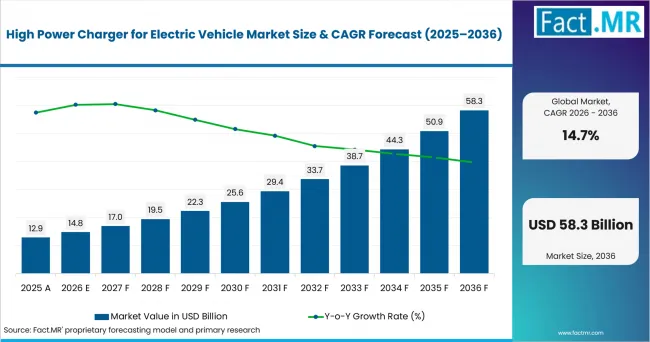
High Power Charger For Electric Vehicle Market Value Analysis | Source: Fact.MR
What are the defining numbers behind High Power Charger for Electric Vehicle Market growth?
A USD 43.8 billion absolute opportunity is expected between 2026 and 2036.
- Demand Drivers in the Market
- High-power charging sites are expected to gain demand as drivers and fleet operators look for shorter charging stops on highways and depot routes.
- Public network operators are expected to prioritize uptime and payment reliability because revenue depends on completed charging sessions.
- Grid-aware hardware is expected to support larger sites where chargers work with storage and load management.
- Power cabinets depend on high-efficiency power electronics as output rises and cooling requirements become stricter.
- Key Segments Analyzed
- By Product Type: DC Fast Chargers are expected to hold 67.0% share in 2026 because public and fleet sites need shorter dwell times.
- By Application: Public Charging Stations are projected to account for 46.0% share in 2026 as corridor and retail charging remain central to driver confidence.
- By End User: Charge Point Operators are anticipated to capture 44.0% share in 2026 since they manage uptime and pricing with user access.
- By Installation Type: Fixed Charging Stations are estimated to represent 71.0% share in 2026 due to grid connection and site-work requirements.
- By Charging Technology: DC Fast Charging is forecast to hold 68.0% share in 2026 as high-power sites depend on direct-current delivery.
- Analyst Opinion at Fact.MR
- Shambhu Nath Jha, Principal Consultant at Fact.MR, states, “High-power EV charging is moving from plug deployment toward site performance. Buyers are expected to weigh charging speed against uptime and grid readiness before scaling new sites.”
- Strategic Implications
- Manufacturers should align charger portfolios with public fast charging and fleet depots without fragmenting service support.
- Charge point operators need analytics that connect utilization with pricing and maintenance response.
- Cable suppliers serving EV charging cables should prepare for regional standards across China and Europe along with North America.
- Fleet operators should evaluate charger output and depot layout together before procurement.
USA follows at 15.3%. Germany records 14.9%. Japan reaches 14.4%. South Korea posts 14.0%. India records 13.5%. France reaches 13.1%.
How does the High Power Charger for Electric Vehicle Market break down by segment?
DC Fast Chargers are expected to lead Product Type at 67.0% share in 2026. Public Charging Stations are projected to lead Application at 46.0% share in 2026.
Why do DC Fast Chargers lead Product Type?
DC Fast Chargers are projected to account for 67.0% share in 2026.
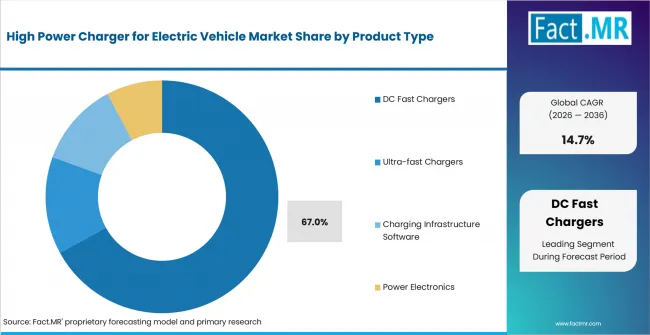
High Power Charger For Electric Vehicle Market Analysis By Product Type | Source: Fact.MR
Public sites prefer them because they reduce waiting time without requiring every vehicle to support the highest charging rate. Operators can use familiar service routines and remote monitoring across busy corridors.
Why do Public Charging Stations lead Application?
Public Charging Stations are expected to hold 46.0% share in 2026.
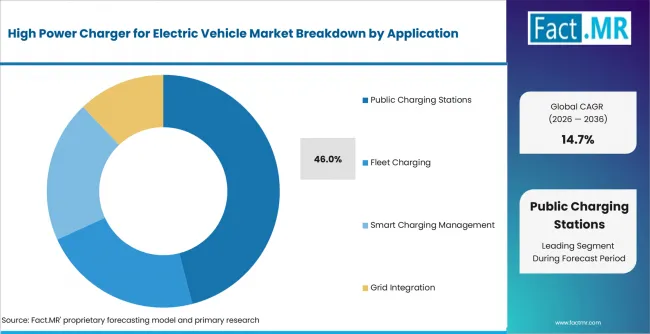
High Power Charger For Electric Vehicle Market Analysis By Application | Source: Fact.MR
Many drivers lack private parking or workplace charging. Retail and highway locations turn fast charging into a planned stop when stations provide visible access with reliable payment and enough plugs.
Why do Charge Point Operators lead End User?
Charge Point Operators are anticipated to capture 44.0% share in 2026.
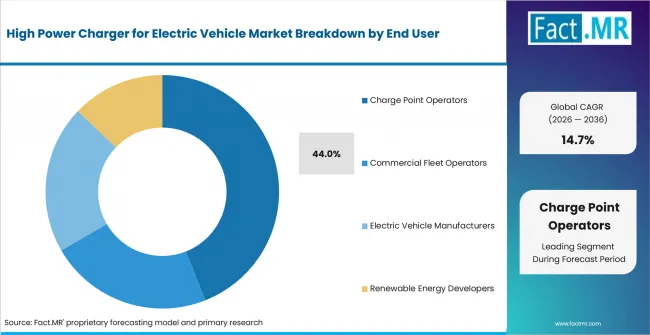
High Power Charger For Electric Vehicle Market Analysis By End User | Source: Fact.MR
They decide hardware configuration and pricing with roaming access and maintenance response. Their revenue depends on completed charging sessions, not installed plugs. That operating pressure raises interest in uptime and diagnostics.
Why do Fixed Charging Stations lead Installation Type?
Fixed Charging Stations are estimated to represent 71.0% share in 2026.
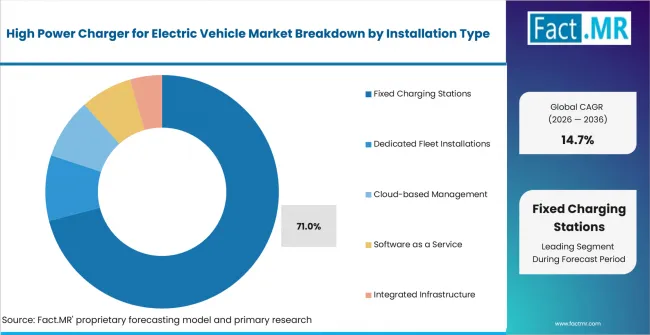
High Power Charger For Electric Vehicle Market Analysis By Installation Type | Source: Fact.MR
High-power sites need permanent grid connections with safety systems and cable routing. Fixed locations suit retail plazas and depots where chargers must serve repeated traffic across predictable parking layouts.
Why does DC Fast Charging lead Charging Technology?
DC Fast Charging is forecast to hold 68.0% share in 2026.
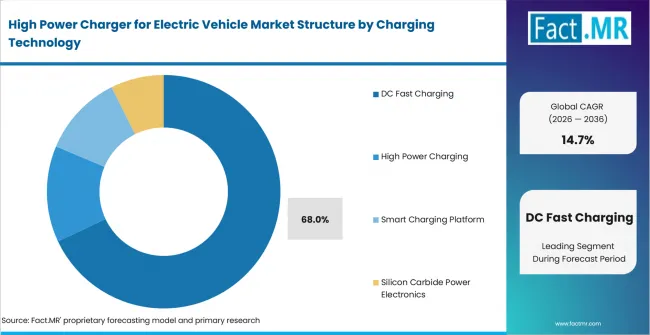
High Power Charger For Electric Vehicle Market Analysis By Charging Technology | Source: Fact.MR
Direct-current delivery moves conversion work from the vehicle to the charger. This supports higher output through larger cabinets with cooling systems and site controls that manage several dispensers at once.
What is accelerating High Power Charger for Electric Vehicle Market adoption, and what is holding it back?
Adoption is expected to rise as EV sales expand and public networks add higher-output equipment. Growth may be limited by grid connection delays, reliability gaps and connector transition planning.
Drivers Impact Analysis
| DRIVER | (~) IMPACT ON CAGR | GEOGRAPHIC RELEVANCE | IMPACT TIMELINE |
|---|---|---|---|
| Fast and ultra-fast charging rollout | High | Global | Short term (<= 2 years) |
| Public network investment | High | China, USA, Europe | Short term (<= 2 years) |
| Fleet and heavy-duty electrification | Medium-High | USA, Europe, South Korea | Medium term (2-4 years) |
| Power electronics and cooling improvements | Medium | Global | Medium term (2-4 years) |
| Software and payment reliability | Medium | Public charging networks | Long term (>= 4 years) |
Source: Fact.MR analysis. Updated Aug 11, 2026
- Fast and ultra-fast charging rollout: Larger charger stock is expected to raise demand for power cabinets and dispensers with cables and field service.
- Public network investment: Site owners are expected to buy hardware that balances driver access with grid and payment reliability.
- Fleet and heavy-duty electrification: Depot and corridor users are expected to need higher output when vehicle downtime affects route planning.
Opportunity Impact Analysis
| OPPORTUNITY | (~) IMPACT ON CAGR | GEOGRAPHIC RELEVANCE | IMPACT TIMELINE |
|---|---|---|---|
| Megawatt charging systems | Medium-High | USA, Europe, China | Medium term (2-4 years) |
| Battery-buffered charging sites | Medium | Urban and highway sites | Medium term (2-4 years) |
| Reliability software | Medium | Public networks | Short term (<= 2 years) |
| Standardized connectors | Low-Medium | North America, Europe, Japan | Long term (>= 4 years) |
Source: Fact.MR analysis. Updated Aug 11, 2026
- Megawatt charging systems: Heavy-duty routes are expected to create a new hardware tier where power delivery and cable cooling matter most.
- Battery-buffered charging sites: Storage can reduce peak-load exposure and help operators place high-power chargers at constrained locations.
- Reliability software: Remote diagnostics and fault response are expected to improve station uptime and protect session revenue.
Restraints Impact Analysis
| RESTRAINT | (~) IMPACT ON CAGR | GEOGRAPHIC RELEVANCE | IMPACT TIMELINE |
|---|---|---|---|
| Grid connection capacity | Medium-High | Dense cities and highways | Short term (<= 2 years) |
| High site construction cost | Medium | Developing markets | Short term (<= 2 years) |
| Reliability and maintenance gaps | Medium | Public networks | Medium term (2-4 years) |
| Connector compatibility | Low-Medium | North America, Europe, Japan | Medium term (2-4 years) |
Source: Fact.MR analysis. Updated Aug 11, 2026
- Grid connection capacity: High-output chargers can require distribution upgrades before a site operates at its intended power level.
- High site construction cost: Civil work and utility equipment can delay sites where expected utilization is still uncertain.
- Reliability and maintenance gaps: Operators can lose session revenue when faults remain unresolved across busy public networks.
Which countries are scaling the High Power Charger for Electric Vehicle Market fastest?
- USA is forecast to grow at 15.3% CAGR, outpacing Germany by 0.4 percentage points.
- Germany is forecast to grow at 14.9% CAGR, outpacing Japan by 0.5 percentage points.
- Japan is forecast to grow at 14.4% CAGR, outpacing South Korea by 0.4 percentage points.
- South Korea is forecast to grow at 14.0% CAGR, outpacing India by 0.5 percentage points.
- India is forecast to grow at 13.5% CAGR, outpacing France by 0.4 percentage points.
- France is forecast to grow at 13.1% CAGR through public charging density and highway charging plans.
Comparable CAGRs can create different entry conditions due to site economics and grid readiness. Full report coverage spans North America; Latin America; Europe; East Asia; South Asia and Pacific; Middle East and Africa.
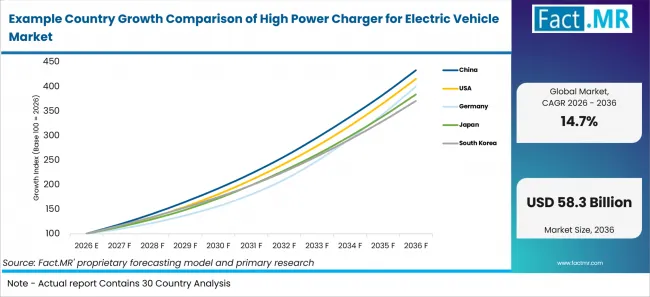
Example Country Growth Comparison Of High Power Charger For Electric Vehicle Market | Source: Fact.MR
| Country | CAGR (2026-2036) |
|---|---|
| USA | 15.3% |
| Germany | 14.9% |
| Japan | 14.4% |
| South Korea | 14.0% |
| France | 13.1% |
Source: Fact.MR analysis. Updated Aug 11, 2026
What supports USA adoption?
15.3% CAGR, supported by public-port expansion and heavy-duty charging pilots.
USA growth is supported by a widening public charging network and investment in heavy-duty charging infrastructure. Fleet operators are expected to favor modular systems across depots and highway corridors. Utility interconnection delays, connector-transition planning, and the need for sustained annual charger additions can still slow deployment at high-power sites.
How is Germany scaling charging demand?
14.9% CAGR, backed by corridor charging and heavy-duty charging locations.
Germany’s growth is tied to expanding DC charging infrastructure and rising demand from commercial transport corridors. Automotive engineering capability supports advanced cable and cabinet qualification. High-power truck sites still depend on grid approvals, sufficient route traffic, and larger transformers, which can extend development timelines for heavy-duty charging locations.
How does Japan develop high-power charging demand?
14.4% CAGR, supported by charger targets and public access needs.
Japan’s growth is supported by national public-charger targets and demand for better access at highways and retail locations. Domestic power-electronics capability can strengthen high-output charger reliability. Older charging sites may require upgrades, while comparatively lower EV penetration can limit utilization outside dense urban and major travel corridors.
How is South Korea developing demand?
14.0% CAGR, driven by fast-charger funding and domestic EV technology.
South Korea’s growth reflects strong public funding for fast chargers and a domestic base in batteries and electronics. Expanding charging infrastructure supports wider deployment of high-output systems. Urban parking constraints, stricter maintenance obligations, and inspection requirements can make larger charging hubs and indoor depot installations more difficult to scale.
How does France perform?
13.1% CAGR, led by public charging density and highway charging plans.
France’s growth reflects a large public charging network and national targets for further high-power deployment. Highway and road-network programs support additional charger installation across travel corridors. Site-access requirements, grid connections, and competition between public charging networks may still pressure utilization and investment returns at weaker locations.
Who leads the High Power Charger for Electric Vehicle Market?
Exicom Tele-Systems Limited, through Tritium, has direct fast-charging relevance. ABB E-mobility and Siemens AG, including Heliox, extend the field through high-output charging systems.
ABB E-mobility announced the MCS1200 megawatt charging system in April 2025. Siemens unveiled SICHARGE FLEX in October 2025. Kempower began MORE Power deliveries in June 2025. ChargePoint and Eaton launched Express Grid in August 2025.
Which companies are the key providers?
Key companies include Exicom Tele-Systems Limited (Tritium), ABB E-mobility, Siemens AG (including Heliox), Delta Electronics, Inc., ChargePoint Holdings, Inc., Kempower Oyj, BTC Power, Alpitronic GmbH, and Schneider Electric SE.
- Exicom Tele-Systems Limited (Tritium)
- ABB E-mobility
- Siemens AG
- Delta Electronics, Inc.
- ChargePoint Holdings, Inc.
- Kempower Oyj
- BTC Power
- Alpitronic GmbH
- Schneider Electric SE
How is the market segmented?
-
By Product Type:
- DC Fast Chargers
- 150 kW to 350 kW Chargers
- Above 350 kW Chargers
- Ultra-fast Chargers
- Liquid-cooled Chargers
- Modular High Power Chargers
- Charging Infrastructure Software
- Charging Management Systems
- Remote Monitoring Platforms
- Power Electronics
- Silicon Carbide Inverters
- High-efficiency Power Modules
- DC Fast Chargers
-
By Application:
- Public Charging Stations
- Highway Charging Corridors
- Urban Fast Charging Hubs
- Fleet Charging
- Electric Bus Charging
- Heavy-duty Vehicle Charging
- Smart Charging Management
- Load Management
- Energy Optimization
- Grid Integration
- Renewable Energy Integration
- Vehicle-to-grid Charging
- Public Charging Stations
-
By End User:
- Charge Point Operators
- Charging Network Operators
- Electric Utility Companies
- Commercial Fleet Operators
- Public Transport Authorities
- Logistics Companies
- Electric Vehicle Manufacturers
- Fleet Management Companies
- Commercial Property Owners
- Renewable Energy Developers
- Energy Storage Operators
- Smart City Authorities
- Charge Point Operators
-
By Installation Type:
- Fixed Charging Stations
- Grid-connected Installations
- Commercial Installations
- Dedicated Fleet Installations
- Depot Installations
- Highway Service Area Installations
- Cloud-based Management
- Software as a Service
- Managed Services
- Integrated Infrastructure
- Hybrid Energy Installations
- Microgrid Installations
- Fixed Charging Stations
-
By Charging Technology:
- DC Fast Charging
- Combined Charging System
- Constant Current Charging
- High Power Charging
- Liquid-cooled Cable Technology
- Dynamic Power Sharing
- Smart Charging Platform
- Intelligent Load Balancing
- Remote Diagnostics
- Silicon Carbide Power Electronics
- Bidirectional Power Conversion
- Vehicle-to-grid Technology
- DC Fast Charging
-
By Region:
- North America
- Latin America
- Europe
- East Asia
- South Asia and Oceania
- Middle East and Africa
Bibliography
- International Energy Agency. (2025, May 14). Global EV Outlook 2025.
- International Energy Agency. (2025, May 14). Electric vehicle charging. In Global EV Outlook 2025.
- International Energy Agency. (2026, May 20). Electric vehicle charging. In Global EV Outlook 2026.
- Xinhua. (2025, July 7). China to promote construction of high-power charging facilities. The State Council of the People’s Republic of China.
- U.S. Department of Energy. (2025, January 15). DOE invests $68 million in innovative heavy-duty electric vehicle charging solutions.
- European Alternative Fuels Observatory. (2026, July 15). Infrastructure [Germany].
- European Alternative Fuels Observatory. (2025, December 18). Heavy-duty electric truck charging infrastructure in Europe: EAFO data update – November 2025.
- Ministry of Environment. (2025, February 26). Full-scale promotion of electric vehicle charging facility support in 2025.
- Ministry of Heavy Industries. (2026, July 21). Charging stations for electric vehicles (EVs). Press Information Bureau.
- European Alternative Fuels Observatory. (2026, March 20). France EV market accelerates in February 2026.
- ABB E-mobility. (2025, April 24). Unified architecture meets segment-specific needs as ABB E-mobility launches trio of new EV chargers.
- Kempower Oyj. (2025, June 17). Kempower starts delivering the MORE Power charging solution.
- Siemens AG. (2025, October 4). SICHARGE FLEX: Siemens unveils next-gen EV charging system for the megawatt era. Siemens' official page explicitly gives October 4, 2025.
- ChargePoint Holdings, Inc. (2025, August 28). ChargePoint and Eaton launch breakthrough ultrafast DC V2G chargers and power infrastructure to accelerate the future of EV charging.
- Siemens AG. (2024, January 11). Siemens acquires Heliox, specialist in eBus and eTruck fast charging solutions.
This Report Answers
- The report provides strategic intelligence on the High Power Charger for Electric Vehicle Market across choices that shape charging-site economics.
- Segment analysis covers DC Fast Chargers and Public Charging Stations as the 2026 share leaders.
- Country outlook evaluates China and USA alongside Germany, Japan, South Korea, India, and France.
- Competitive analysis profiles Exicom Tele-Systems Limited (Tritium); ABB E-mobility; Siemens AG (including Heliox); Delta Electronics, Inc.; ChargePoint Holdings, Inc.; Kempower Oyj; BTC Power; Alpitronic GmbH; and Schneider Electric SE.
- Charging technology assessment covers DC Fast Charging alongside Ultra-Fast Charging, Megawatt Charging, Battery-Buffered Charging, and Smart and Bidirectional Charging.
What does the High Power Charger for Electric Vehicle Market cover?
High-power EV chargers deliver direct-current charging at output levels designed to shorten dwell time for passenger vehicles and fleets.
The market covers cabinets, dispensers, cooling equipment, controls, payment interfaces, and service equipment. It includes public stations and fleet depots where high output is required.
What is included in the scope?
High-power chargers are used across public networks and private fleets. Automakers and utilities are included when they operate high-output equipment.
The scope includes Product Type, Application, End User, Installation Type, and Charging Technology. Hardware and service support are included when they affect uptime.
What is excluded from the scope?
Low-power home chargers and unrelated electrical infrastructure remain outside the scope of this market.
The scope excludes basic AC wall boxes and slow overnight chargers. General grid upgrades are excluded unless tied to a high-power EV charging site.
How Was the Analysis Built?
The analysis draws on 120+ sources, 35+ company portfolios, 25+ countries, and more than 20 industry interviews.
- Primary Research: Primary research includes discussions with manufacturers, service providers, technology developers, end users, procurement teams, and subject-matter experts.
- Desk Research: Desk research covers government statistics, regulatory publications, company filings, trade data, standards, public policy, and other authoritative sources.
- Market Sizing and Forecasting: Market estimates combine historical performance, demand indicators, segment shares, company participation, country-level growth, and adoption patterns.
- Data Validation and Update Cycle: Findings are validated by comparing primary interviews with public data, company activity, regulatory changes, and industry developments.
Segmentation
What is the report’s scope and coverage?
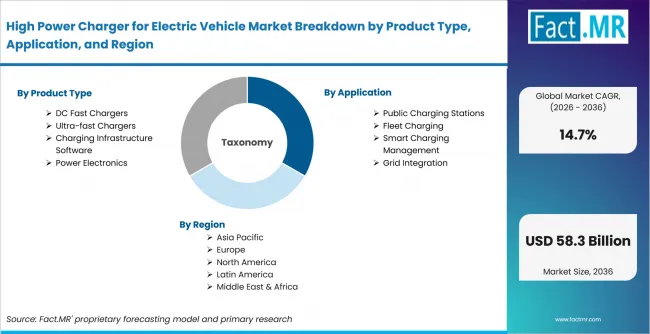
High Power Charger For Electric Vehicle Market Breakdown By Product Type, Application, And Region | Source: Fact.MR
| Attribute | Details |
|---|---|
| Quantitative Units | USD billion |
| Market Definition | High-power EV charging hardware used to deliver fast direct-current charging at public, fleet, highway, depot, retail, workplace, and destination sites |
| Product Type | DC Fast Chargers; Ultra-Fast Chargers; Megawatt Charging Systems; Modular Power Cabinets; High-Power Dispensers |
| Application | Public Charging Stations; Fleet Charging Depots; Highway Charging Corridors; Workplace Charging; Retail and Destination Charging |
| End User | Charge Point Operators; Fleet Operators; Automakers and Dealerships; Utilities; Commercial Property Owners |
| Installation Type | Fixed Charging Stations; Depot Charging Systems; Corridor Charging Hubs; Mobile or Temporary High-Power Units |
| Charging Technology | DC Fast Charging; Ultra-Fast Charging; Megawatt Charging; Battery-Buffered Charging; Smart and Bidirectional Charging |
| Regions Covered | North America; Latin America; Europe; East Asia; South Asia and Pacific; Middle East and Africa |
| Countries Covered | China; USA; Germany; Japan; South Korea; India; France |
| Key Companies Profiled | Exicom Tele-Systems Limited (Tritium); ABB E-mobility; Siemens AG (including Heliox); Delta Electronics, Inc.; ChargePoint Holdings, Inc.; Kempower Oyj; BTC Power; Alpitronic GmbH; Schneider Electric SE. |
| Forecast Period | 2026 to 2036 |
| Approach | Hybrid top-down and bottom-up approach using EV charging demand; public charging points; fleet depot use cases; charger power classes; grid connection needs; uptime requirements; connector transition; country adoption patterns; and company portfolio review |
Source: Fact.MR analysis. Updated Aug 11, 2026
Frequently Asked Questions
How big is the high power charger for electric vehicle market in 2026?
What is the CAGR of the high power charger for electric vehicle market from 2026 to 2036?
Which product type leads the high power charger for electric vehicle market?
Which application leads the high power charger for electric vehicle market?
Who are the leading companies in the high power charger for electric vehicle market?
Who worked on this report


Preview the report firsthand - request a free sample
Free SampleGet the brochure for pricing and purchase details
Download PDF