- Base Value(2026): 0.4 Bn
- Estimated Value(2026): 0.4 Bn
- Forecast Value (2036): 1.2 Bn
- CAGR (2026 - 2036): 10.6%
Sorting Technologies for Multilayer Flexible Films Market Forecast and Outlook 2026 to 2036
The global sorting technologies for multilayer flexible films market is projected to grow from USD 0.44 billion in 2026 to USD 1.20 billion by 2036, progressing at a CAGR of 10.6%. This growth is driven by the urgent global challenge of managing the complex waste stream of multilayer packaging, which combines different polymers and materials to achieve barrier properties but traditionally hampers recyclability.
Key Takeaways from the Sorting Technologies for Multilayer Flexible Films Market
- Market Value for 2026: USD 0.44 Billion
- Market Value for 2036: USD 1.20 Billion
- Forecast CAGR 2026 to 2036: 10.6%
- Leading Technology Segment (2026): NIR + AI Material Fingerprinting (49.0%)
- Leading Sorting Technology Type (2026): Advanced Optical Sorters (48.8%)
- Leading Material Stream Segment (2026): Multilayer PE/PP Films (51.0%)
- Leading End-Use Segment (2026): Flexible Packaging Recycling (35.0%)
- Key Growth Countries: India (12.8% CAGR), China (11.8% CAGR), USA (9.2% CAGR), Brazil (8.2% CAGR), Germany (8.0% CAGR), Japan (5.2% CAGR)
- Key Players in the Market: TOMRA Systems ASA, STEINERT GmbH, BoReTech, TOSHIBA Infrastructure Systems & Solutions Corporation, Pellenc ST
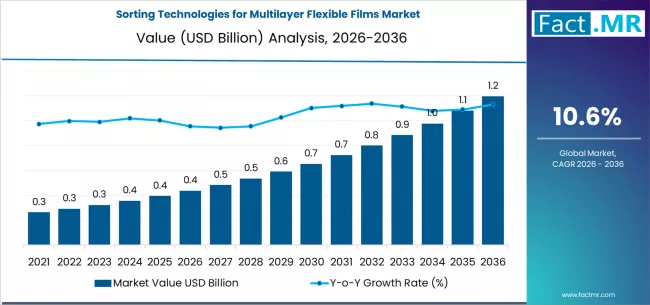
Sorting Technologies For Multilayer Flexible Films Market Market Value Analysis | Source: Fact.MR
Expansion is tied to the enforcement of EPR schemes and packaging waste directives that now explicitly include flexible films, compelling the recycling industry to invest in advanced separation capabilities.
Key developments center on overcoming the technical limitations of sorting co-extruded and laminated structures. The evolution is marked by the integration of artificial intelligence with hyperspectral imaging and LIBS to identify not just the primary polymer, but also the layers and contaminants within.
The landscape is responding to the rise of chemical recycling, which requires highly sorted and clean film fractions to be economically viable, turning advanced sorting from a recycling enhancement into a critical feedstock preparation step for next-generation recovery processes.
Metric
| Metric | Value |
|---|---|
| Market Value (2026) | USD 0.44 Billion |
| Market Forecast Value (2036) | USD 1.20 Billion |
| Forecast CAGR 2026 to 2036 | 10.6% |
Source: Fact.MR analysis. Updated Jan 10, 2026
Category
| Category | Segments |
|---|---|
| End-Use | Flexible Packaging Recycling, Post-Consumer Film Streams, Film Waste Recovery, Informal-to-Formal Recycling, FMCG Waste Streams, High-Precision Sorting |
| Sorting Technology Type | Advanced Optical Sorters, Sensor-Based Sorters, Conveyor-Based Film Sorters, Compact Film Sorters, Others |
| Material Stream | Multilayer PE/PP Films, Multilayer Laminates, Mixed Flexible Waste, PE-Dominant Films, Others |
| Technology | NIR + AI Material Fingerprinting; Multi-Sensor Fusion; AI-Assisted Film Recognition; Cost-Efficient Sensor Arrays; Others |
| Region | North America, Latin America, Western Europe, Eastern Europe, East Asia, South Asia & Pacific, Middle East & Africa |
Source: Fact.MR analysis. Updated Jan 10, 2026
Segmental Analysis
By Technology, Which Innovation is Critical for Identifying Composite Structures?
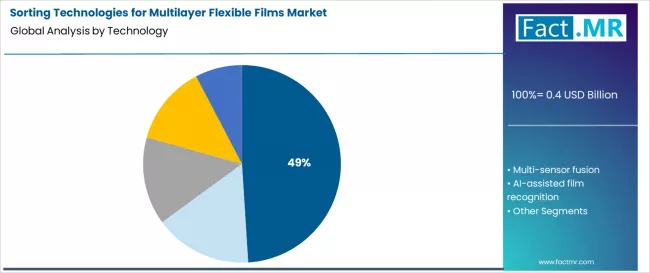
Sorting Technologies For Multilayer Flexible Films Market Analysis By Technology | Source: Fact.MR
NIR combined with AI material fingerprinting commands a leading 49.0% share. This segment is critical because traditional NIR sorting struggles with multilayer films, often identifying only the dominant surface layer.
AI-enhanced fingerprinting analyzes the full spectral signature captured by sensors to detect the unique fingerprint of specific multilayer combinations, such as PE/EVOH/PP. This allows for the accurate sorting of films by their specific composition, which is essential for both high-quality mechanical recycling and for preparing feedstock for chemical recycling processes.
By End-Use, Which Sector Faces the Most Acute Pressure to Adopt Advanced Sorting?
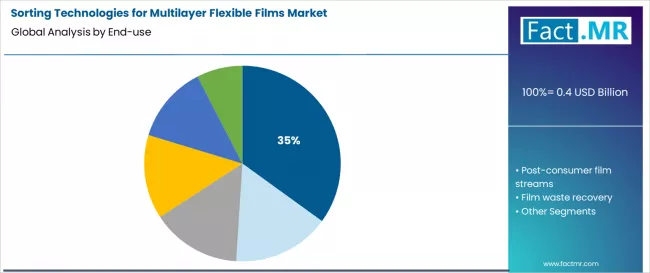
Sorting Technologies For Multilayer Flexible Films Market Analysis By End Use | Source: Fact.MR
Flexible packaging recycling constitutes the primary end-use segment at 35.0%. This sector is under the most direct regulatory and brand owner pressure to improve recycling rates for films and wrappers.
As EPR fees become tied to recyclability, the ability to effectively sort multilayer films directly impacts the cost burden on producers. This economic driver is accelerating investments in sorting technologies that can handle the light, tangled, and complex nature of post-consumer flexible film waste.
By Material Stream, Which Category Represents the Core Technical Challenge?
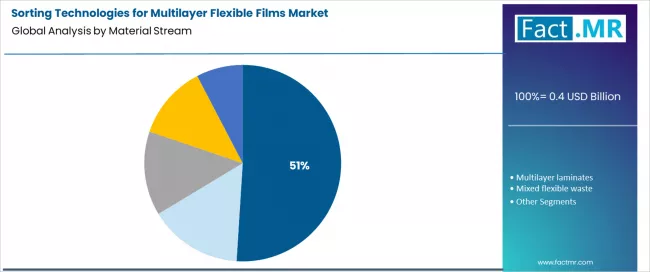
Sorting Technologies For Multilayer Flexible Films Market Analysis By Material Stream | Source: Fact.MR
Multilayer PE/PP films form the dominant material stream segment with a 51.0% share. These films are ubiquitous in snack bags, pouches, and packaging for dry goods, representing the largest volume of multilayer waste.
Their sorting is particularly challenging due to the similarity of PE and PP in density and the varying layer thicknesses. Successfully isolating this stream is considered the cornerstone for establishing a viable recycling pathway for flexible packaging, making it the primary focus of R&D and system deployment.
What are the Principal Drivers, Constraints, and Evolving Dynamics of this Market?
The principal driver for the sorting technologies for multilayer flexible films market is stringent EPR legislation that financially penalizes non-recyclable packaging, making investment in sorting a cost-saving imperative.
A major constraint is the low bulk density and high contamination level of post-consumer film bales, which challenge material handling and sensor accuracy, leading to higher operational costs.
Opportunity lies in providing sorting-as-a-service to smaller recyclers or municipalities, leveraging centralized, high-tech facilities. The dominant trend is the integration of sorting data with digital product passports and blockchain traceability, allowing brands to verify the recycled content origin of new packaging, thereby adding value beyond mere waste separation.
Analysis of the Sorting Technologies for Multilayer Flexible Films Market by Key Countries
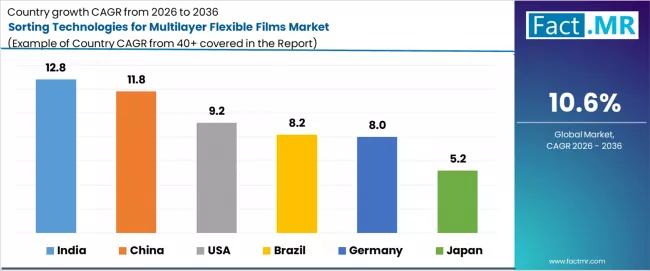
Sorting Technologies For Multilayer Flexible Films Market Cagr Analysis By Country | Source: Fact.MR
| Country | CAGR 2026 to 2036 |
|---|---|
| India | 12.8% |
| China | 11.8% |
| USA | 9.2% |
| Brazil | 8.2% |
| Germany | 8.0% |
| Japan | 5.2% |
Source: Fact.MR analysis. Updated Jan 10, 2026
Can the USA's Market Growth Sustain Itself Without Federal Film Recycling Mandates?
State-level EPR laws and ambitious corporate sustainability goals currently drive the USA’s 9.2% CAGR. However, growth faces a potential ceiling without cohesive federal policy on film recycling. Investment is focused on advanced optical sorters that can add value by producing clean polyolefin streams for domestic remanufacturing, but the lack of a nationwide collection and labeling standard for flexible packaging continues to hamper feedstock consistency and system efficiency.
Is Germany's High-Investment Approach Creating an Export Model for Sorted Film?
Germany’s 8.0% CAGR is characterized by significant investment in hyperspectral and AI-powered sorters within large, centralized facilities. This high-tech approach aims to produce ultra-pure sorted fractions that meet the strict input specifications of both European mechanical recyclers and emerging chemical recycling plants. The market is increasingly focused on whether this model can generate high-value, export-grade sorted bales for the broader European market, turning sorting technology into a key export competency.
Will China's 'Megafacility' Strategy Redefine the Economics of Film Sorting?
China’s 11.8% CAGR is being shaped by the development of massive, integrated recycling parks designed to process hundreds of thousands of tons of waste annually. The sorting technologies for multilayer flexible films market here is defined by the deployment of multi-sensor fusion systems on an unprecedented scale, aiming to achieve low per-ton sorting costs through sheer volume and automation, potentially setting a new global benchmark for cost-efficient operation.
How is India's Market Uniquely Driven by the Valorization of 'Low-Value' Mixed Waste?
India’s leading 12.8% CAGR is propelled by the economic opportunity in valorizing the vast stream of mixed, low-value flexible waste currently handled by the informal sector. The demand is not for ultra-high-purity sorting but for robust, cost-efficient sensor arrays and AI-assisted recognition systems that can reliably separate film from other waste and create a basic "film-rich" stream suitable for recycling into lower-grade products, thus formalizing and monetizing an existing waste flow.
Can Brazil Leverage Its Agri-Film Stream to Build a Specialized Sorting Sector?
Brazil’s 8.2% CAGR is closely linked to its large-scale agricultural sector, which generates consistent volumes of used silage bags and mulch films. This presents an opportunity to develop specialized sorting lines calibrated for these cleaner, more homogeneous PE-dominant agricultural films. Success hinges on creating a circular economy loop within the agribusiness sector itself, reducing the complexity compared to sorting mixed municipal flexible waste.
Does Japan's Pursuit of 'Pouch-to-Pouch' Recycling Justify Its Niche Market Focus?
Japan’s 5.2% CAGR is concentrated on high-precision sorting to enable closed-loop recycling for specific, high-volume flexible items like stand-up pouches from the FMCG sector. The extreme focus on achieving purity levels sufficient for direct food-contact recycled content justifies investments in cutting-edge LIBS and AI recognition technologies, but it confines the market to a high-cost, high-precision niche with limited volume scalability.
Competitive Landscape of the Sorting Technologies for Multilayer Flexible Films Market
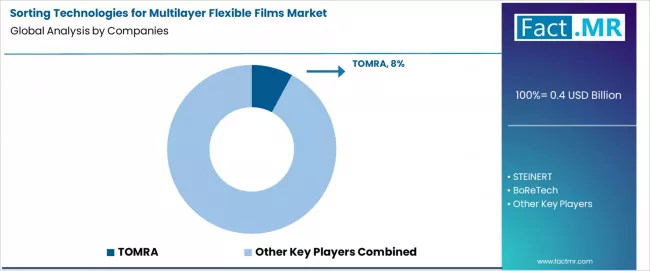
Sorting Technologies For Multilayer Flexible Films Market Analysis By Company | Source: Fact.MR
The competitive landscape is defined by a race to master the "flexibles challenge." Established leaders like TOMRA and STEINERT are adapting their robust optical and sensor-based platforms with new software algorithms specifically trained on film signatures. Meanwhile, specialized firms and startups are entering the market with novel approaches, such as focused sensor suites for conveyor-based film sorting or AI platforms that can learn from variable waste streams.
Competition is intensifying around the ability to provide not just hardware, but a holistic solution that includes data analytics on sorting purity, integration with ballistic separators and air classifiers, and maintenance services tailored to the abrasive and dusty environment of film processing. Success is increasingly linked to forming strategic partnerships with major waste management corporations and chemical recycling ventures that are building new plants dependent on reliably sorted film feedstock.
Key Players in the Sorting Technologies for Multilayer Flexible Films Market
- TOMRA Systems ASA
- STEINERT GmbH
- BoReTech
- TOSHIBA Infrastructure Systems & Solutions Corporation
- Pellenc ST
References
- European Recycling Industries’ Confederation (EuRIC). (2025). Technical Guidelines on the Sorting of Flexible Plastic Packaging Waste. EuRIC Plastics Branch.
- Flexible Packaging Association (FPA). (2024). Design and End-of-Life Considerations for Multilayer Films: The Role of Advanced Sorting. FPA Sustainability Report.
- International Solid Waste Association (ISWA). (2025). Global Review of Infrastructure for Recycling of Lightweight Flexible Packaging. ISWA Working Group on Plastics.
- Society of Plastics Engineers (SPE) - Recycling Division. (2024). Advances in Sensor Technology for the Sorting of Complex Film Structures. ANTEC Conference Proceedings.
Segmentation
Scope of Report
| Items | Metrics |
|---|---|
| Quantitative Units | USD Billion |
| Technology | NIR + AI Fingerprinting, Multi-Sensor Fusion, AI-Assisted Recognition, Cost-Efficient Sensor Arrays, Others |
| Sorting Technology Type | Advanced Optical Sorters, Sensor-Based Sorters, Conveyor-Based Film Sorters, Compact Film Sorters, Others |
| End-Use | Flexible Packaging Recycling, Post-Consumer Film Streams, Film Waste Recovery, Informal-to-Formal Recycling, FMCG Waste Streams, High-Precision Sorting |
| Material Stream | Multilayer PE/PP Films, Multilayer Laminates, Mixed Flexible Waste, PE-Dominant Films, Others |
| Key Countries | India, China, USA, Brazil, Germany, Japan |
| Key Companies | TOMRA, STEINERT, BoReTech, TOSHIBA Infrastructure, Pellenc ST, Others |
| Additional Analysis | Comparative analysis of sorting accuracy for different film structures (laminated vs. co-extruded); impact of moisture and dirt on sensor performance; total cost of ownership models including energy consumption and maintenance; analysis of the link between sorting purity and output value for mechanical vs. chemical recycling. |
Source: Fact.MR analysis. Updated Jan 10, 2026
Market by Segments
-
End-Use :
- Flexible Packaging Recycling
- Post-Consumer Film Streams
- Film Waste Recovery
- Informal-to-Formal Recycling
- FMCG Waste Streams
- High-Precision Sorting
-
Sorting Technology Type :
- Advanced Optical Sorters
- Sensor-Based Sorters
- Conveyor-Based Film Sorters
- Compact Film Sorters
- Others
-
Material Stream :
- Multilayer PE/PP Films
- Multilayer Laminates
- Mixed Flexible Waste
- PE-Dominant Films
- Others
-
Region :
- North America
- USA
- Canada
- Latin America
- Brazil
- Mexico
- Argentina
- Rest of Latin America
- Western Europe
- Germany
- France
- Italy
- Spain
- UK
- BENELUX
- Rest of Western Europe
- Eastern Europe
- Russia
- Poland
- Czech Republic
- Rest of Eastern Europe
- East Asia
- China
- Japan
- South Korea
- Rest of East Asia
- South Asia & Pacific
- India
- ASEAN
- Australia
- Rest of South Asia & Pacific
- MEA
- GCC Countries
- South Africa
- Turkiye
- Rest of MEA
- North America
Frequently Asked Questions
How big is the sorting technologies for multilayer flexible films market in 2026?
What will be the size of sorting technologies for multilayer flexible films market in 2036?
How much will be the sorting technologies for multilayer flexible films market growth between 2026 and 2036?
What are the key product types in the sorting technologies for multilayer flexible films market?
Which sorting technology type segment to contribute significant share in the sorting technologies for multilayer flexible films market in 2026?
Who worked on this report


Preview the report firsthand - request a free sample
Free SampleGet the brochure for pricing and purchase details
Download PDF