AI-Enabled Sorting Systems for Dark Plastics Market
AI-Enabled Sorting Systems for Dark Plastics Market Size and Share Forecast Outlook 2026 to 2036
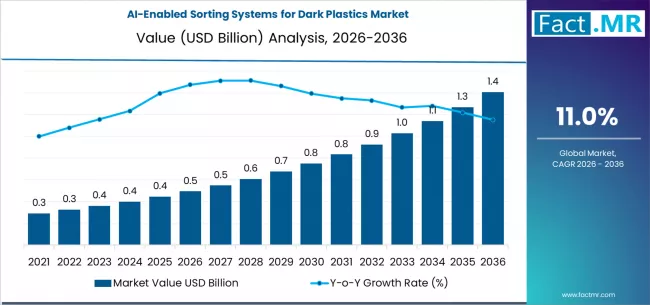
Ai-enabled sorting systems for dark plastics market is projected to grow from USD 0.5 billion in 2026 to USD 1.4 billion by 2036, at a CAGR of 11.0%. MRFs & recycling plants will dominate with a 42.0% market share, while optical + ai sorters will lead the sorting system type segment with a 37.3% share.
AI-Enabled Sorting Systems for Dark Plastics Market Forecast and Outlook 2026 to 2036
The global AI-enabled sorting systems for dark plastics market is projected to total USD 0.49 billion in 2026, and to USD 1.41 billion by 2036, progressing at an 11.0% CAGR. This accelerated growth is driven by stringent policy shifts worldwide that mandate higher recycling rates and recycled content, particularly for packaging.
Key Takeaways from the AI-Enabled Sorting Systems for Dark Plastics Market (Last Updated on 09 January 2026)
- Market Value for 2026: USD 0.49 Billion
- Market Value for 2036: USD 1.41 Billion
- Forecast CAGR 2026 to 2036: 11.0%
- Leading Technology Segment (2026): Hyperspectral Imaging + AI Classification (45.0%)
- Leading Sorting System Type (2026): Optical + AI Sorters (37.3%)
- Leading Material Stream Segment (2026): Black & Dark Plastics (PP, PE) (47.0%)
- Leading End-Use Segment (2026): MRFs & Recycling Plants (42.0%)
- Key Growth Countries: India (13.0% CAGR), China (12.0% CAGR), USA (9.5% CAGR), Brazil (8.5% CAGR), Germany (8.0% CAGR), Japan (5.0% CAGR)
- Key Players in the Market: TOMRA Systems ASA, STEINERT GmbH, MSS China, Recycleye Ltd., Mitsubishi Electric Corporation, AMP Robotics Corp.
Regulations like the EU’s Single-Use Plastics Directive and EPR schemes in North America and Asia are creating a non-negotiable economic incentive to recover valuable polymers from the waste stream. Dark plastics represent a critical loss of material, making advanced sorting capability a cornerstone of regulatory compliance and circular economy targets.
Specific policy decisions are directly catalyzing investment. The inclusion of specific recycled content thresholds for all packaging, regardless of color, in legislation is forcing material recovery facilities and plastics recyclers to upgrade their infrastructure. Landfill bans on recyclable materials in numerous jurisdictions are increasing the volume of material requiring sorting, intensifying the need for the higher accuracy and throughput provided by AI-enabled systems.
Progress is therefore less about voluntary technological adoption and more a strategic response to a rapidly tightening regulatory environment that penalizes the inability to sort complex, dark-colored polymer streams.
Metric
| Metric | Value |
|---|---|
| Market Value (2026) | USD 0.49 Billion |
| Market Forecast Value (2036) | USD 1.41 Billion |
| Forecast CAGR 2026 to 2036 | 11.0% |
Category
| Category | Segments |
|---|---|
| End-Use | MRFs & Recycling Plants, Packaging Recycling Facilities, Large-Scale Sorting Hubs, Urban Recycling Centers, Municipal Recycling, Precision Recycling |
| Sorting System Type | Optical + AI Sorters, NIR + AI Hybrid Systems, Conveyor-Integrated AI Sorters, Compact AI Sorters, Others |
| Material Stream | Black & Dark Plastics (PP, PE), Dark Rigid Packaging, Mixed Dark Polymers, Dark Mixed Plastics, Others |
| Technology | Hyperspectral Imaging + AI Classification; Deep-Learning Vision Systems; Real-Time AI Material Recognition; Cost-Optimized AI Algorithms; Others |
| Region | North America, Latin America, Western Europe, Eastern Europe, East Asia, South Asia & Pacific, Middle East & Africa |
Segmental Analysis
By Technology, Which Segment Overcomes the Fundamental Limitation of NIR Sorting?
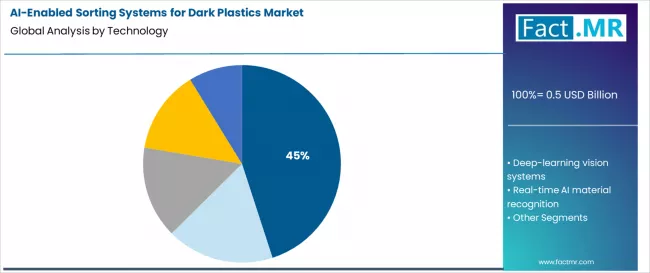
Hyperspectral imaging combined with AI classification commands a leading 45.0% share. This segment is critical because it operates outside the wavelength limitations of traditional NIR. While NIR fails on carbon-black pigmented plastics, hyperspectral sensors capture a broader spectrum of reflected light, detecting subtle molecular signatures.
AI algorithms are then trained to identify polymer types based on these complex spectral fingerprints, effectively unlocking the sorting of previously unrecoverable black and dark-colored plastics, which constitute a major portion of packaging waste.
By End-Use, Which Segment is the Immediate Primary Adopter of This Technology?
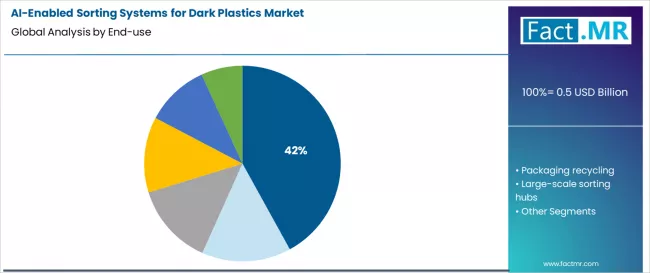
Material recovery facilities (MRFs) and dedicated recycling plants constitute the primary end-user segment at 42.0%. These facilities face the most direct pressure to improve purity and yield of their output bales to meet offtake specifications from recyclers.
For MRFs, integrating AI-enabled sorting for dark plastics is a direct upgrade to their core sorting line, allowing them to capture significant additional revenue from a previously lost material stream and comply with quality requirements driven by EPR schemes.
By Material Stream, Which Category Represents the Largest Untapped Recovery Opportunity?
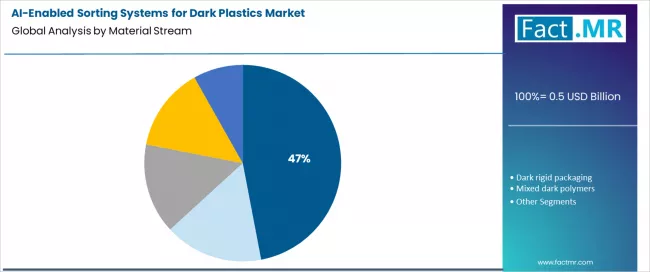
Black and dark plastics, specifically polypropylene and polyethylene, form the core material stream segment with a 47.0% share. These polymers are extensively used in non-food packaging, automotive parts, and electronics housings but are often pigmented black for UV protection or aesthetics.
This segment represents the largest untapped reservoir of high-value recyclate, making it the primary target for AI-enabled sorting systems whose economic justification is based on recovering this lost value.
What are the Principal Drivers, Constraints, and Evolving Dynamics of the AI-Enabled Sorting Systems for Dark Plastics Market?
| Factor | Market Influence |
|---|---|
| Stringent Recycled Content Mandates | Government policies create compliance-driven demand, making AI sorting essential to recover high-purity materials from complex waste streams. |
| High CAPEX & Integration Complexity | Significant upfront costs and retrofitting challenges hinder adoption, especially for smaller operators, despite strong long-term returns. |
| Expansion in Emerging Markets | New recycling facilities in regions like India and China allow direct integration of AI systems, avoiding retrofit costs and creating fresh demand. |
| Integration with Robotics & Fleet Learning | Convergence with robotic pickers enables full automation. Shared data across systems ("fleet learning") improves algorithms and builds a competitive advantage. |
Analysis of the AI-Enabled Sorting Systems for Dark Plastics Market by Key Countries
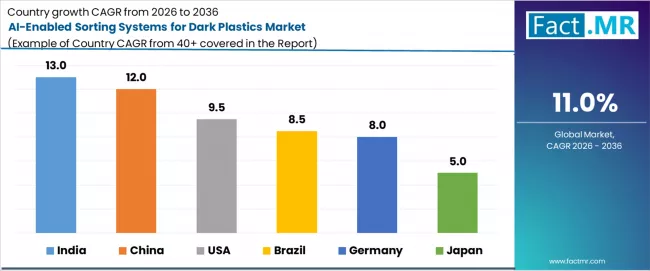
| Country | CAGR 2026 to 2036 |
|---|---|
| USA | 9.5% |
| Germany | 8.0% |
| China | 12.0% |
| India | 13.0% |
| Brazil | 8.5% |
| Japan | 5.0% |
How do Federal Grants and State-Level Policies Accelerate Adoption of AI-Enabled Sorting Systems for Dark Plastics in USA?
The USA’s 9.5% CAGR is supported by federal funding through initiatives like the Bipartisan Infrastructure Law, which allocates grants for modernizing recycling infrastructure. Coupled with state-level EPR laws for packaging, these financial and regulatory drivers are enabling both public and private MRFs to invest in advanced sorting capabilities. The focus is on high-throughput systems that can process diverse material streams and provide data analytics for compliance reporting.
What characterizes Germany's Technologically Driven, Regulation-Led Market?
Germany’s 8.0% CAGR reflects its position at the forefront of the EU’s circular economy push. The market is driven by the need to achieve legally binding recycling quotas and the high value of recovered engineering plastics.
German facilities often serve as pilot sites for the most advanced hyperspectral and deep-learning systems, with demand centered on achieving maximum purity and integrating sorting data with digital product passports.
What underpins China's Massive Investment in Smart Waste Management?
China’s 12.0% CAGR is fueled by national Zero-Waste City initiatives and massive governmental investment in smart, municipal waste management infrastructure. The AI-enabled sorting systems market is scaling rapidly to equip hundreds of new, large-scale sorting hubs. Demand is for robust, high-capacity systems that can handle the volume and complexity of China’s urban waste, with a strong emphasis on domestic manufacturing of key components.
How is India's Formalization of Waste Management Creating a High-Growth Market?
The formalization of its waste management sector and the establishment of large, centralized sorting facilities under public-private partnerships drive India’s 13.0% CAGR. The need to process vast volumes of mixed waste, which contains a high proportion of dark plastics from packaging, creates immediate demand. The price-sensitive market fosters innovation in cost-optimized AI algorithms and compact system designs suitable for emerging market economics.
Why is Brazil's Market Growth Linked to National Solid Waste Policy Enforcement?
Brazil’s 8.5% CAGR is closely tied to the strengthening enforcement of its National Solid Waste Policy (PNRS), which mandates recycling targets and extended producer responsibility. As urban recycling centers modernize to comply, the AI-enabled sorting systems market is experiencing growth driven by the need to improve the economics of recycling by recovering valuable dark plastics from mixed municipal streams, particularly in major metropolitan areas.
What defines Japan's Focus on Precision and High-Quality Output?
Japan’s 5.0% CAGR represents a mature market focused on precision and achieving exceptionally high purity levels for closed-loop recycling, especially in the automotive and electronics sectors.
Demand for AI-enabled sorting systems stems from the need to meticulously separate dark engineering plastics by specific polymer grade and color. The focus is on ultra-high-accuracy systems with sophisticated material recognition software, often integrated into smaller, highly automated precision recycling lines.
Competitive Landscape of the AI-Enabled Sorting Systems for Dark Plastics Market
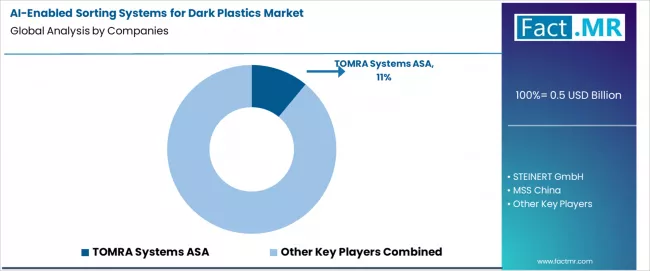
Established global leaders in sensor-based sorting competing with agile AI-software startups define the competitive landscape. Incumbents like TOMRA and STEINERT leverage their deep expertise in hardware integration, global service networks, and existing customer relationships, enhancing their traditional optical sorters with proprietary AI classification engines.
New entrants like AMP Robotics and Recycleye compete primarily through advanced, cloud-based AI platforms that can be integrated with various third-party robotic arms and conveyor systems, emphasizing algorithmic superiority and rapid updates.
Success increasingly depends on the richness of proprietary material datasets. Companies that can train their algorithms on the largest and most diverse sets of spectral images from global waste streams gain a significant performance advantage.
The competitive frontier is shifting towards total system intelligence, including predictive maintenance, real-time material flow analytics, and providing customers with data to verify recycled content claims, transforming sorting system providers into essential data partners for the circular economy.
Key Players in the AI-Enabled Sorting Systems for Dark Plastics Market
- TOMRA Systems ASA
- STEINERT GmbH
- MSS China
- Recycleye Ltd.
- Mitsubishi Electric Corporation
- AMP Robotics Corp.
- Other Regional and Specialized Players
Scope of Report
| Items | Metrics |
|---|---|
| Quantitative Units | USD Billion |
| Technology | Hyperspectral Imaging + AI, Deep-Learning Vision Systems, Real-Time AI Recognition, Cost-Optimized AI Algorithms, Others |
| Sorting System Type | Optical + AI Sorters, NIR + AI Hybrid Systems, Conveyor-Integrated Sorters, Compact AI Sorters, Others |
| End-Use | MRFs & Recycling Plants, Packaging Recycling, Large-Scale Sorting Hubs, Urban Recycling Centers, Municipal Recycling, Precision Recycling |
| Material Stream | Black & Dark Plastics (PP, PE), Dark Rigid Packaging, Mixed Dark Polymers, Dark Mixed Plastics, Others |
| Key Countries | India, China, USA, Brazil, Germany, Japan |
| Key Companies | TOMRA, STEINERT, MSS China, Recycleye, Mitsubishi Electric, AMP Robotics, Others |
| Additional Analysis | Comparative analysis of sorting accuracy (AI vs. traditional) for dark streams; total cost of ownership models for AI-enabled systems; impact on downstream recyclate purity and value; study of data ownership and cybersecurity in cloud-based sorting platforms; analysis of lifecycle and upgrade paths for AI sorting hardware. |
Market by Segments
-
End-Use :
- MRFs & Recycling Plants
- Packaging Recycling Facilities
- Large-Scale Sorting Hubs
- Urban Recycling Centers
- Municipal Recycling
- Precision Recycling
-
Sorting System Type :
- Optical + AI Sorters
- NIR + AI Hybrid Systems
- Conveyor-Integrated AI Sorters
- Compact AI Sorters
- Others
-
Material Stream :
- Black & Dark Plastics (PP, PE)
- Dark Rigid Packaging
- Mixed Dark Polymers
- Dark Mixed Plastics
- Others
-
Region :
-
North America
- USA
- Canada
-
Latin America
- Brazil
- Mexico
- Argentina
- Rest of Latin America
-
Western Europe
- Germany
- France
- Italy
- Spain
- UK
- BENELUX
- Rest of Western Europe
-
Eastern Europe
- Russia
- Poland
- Czech Republic
- Rest of Eastern Europe
-
East Asia
- China
- Japan
- South Korea
- Rest of East Asia
-
South Asia & Pacific
- India
- ASEAN
- Australia
- Rest of South Asia & Pacific
-
MEA
- GCC Countries
- South Africa
- Turkiye
- Rest of MEA
-
Bibliography
- European Commission. (2025).Implementing Decision on Harmonised Standards for the Sorting of Waste Streams Under the Circular Economy Action Plan.
- International Solid Waste Association (ISWA). (2024).Artificial Intelligence in Waste Management: Applications, Case Studies, and Impact Assessment. ISWA Task Force Report.
- National Waste & Recycling Association (NWRA). (2025).Technology Guide: Automation and AI in Material Recovery Facilities. NWRA.
- U.S. Environmental Protection Agency (EPA). (2024).Resource Conservation and Recovery Act (RCRA): Advancing Recycling Infrastructure Through Innovation. EPA Guide.
Table of Content
- Executive Summary
- Global Market Outlook
- Demand to side Trends
- Supply to side Trends
- Technology Roadmap Analysis
- Analysis and Recommendations
- Market Overview
- Market Coverage / Taxonomy
- Market Definition / Scope / Limitations
- Market Background
- Market Dynamics
- Drivers
- Restraints
- Opportunity
- Trends
- Scenario Forecast
- Demand in Optimistic Scenario
- Demand in Likely Scenario
- Demand in Conservative Scenario
- Opportunity Map Analysis
- Product Life Cycle Analysis
- Supply Chain Analysis
- Investment Feasibility Matrix
- Value Chain Analysis
- PESTLE and Porter’s Analysis
- Regulatory Landscape
- Regional Parent Market Outlook
- Production and Consumption Statistics
- Import and Export Statistics
- Market Dynamics
- Global Market Analysis 2021 to 2025 and Forecast, 2026 to 2036
- Historical Market Size Value (USD Million) Analysis, 2021 to 2025
- Current and Future Market Size Value (USD Million) Projections, 2026 to 2036
- Y to o to Y Growth Trend Analysis
- Absolute $ Opportunity Analysis
- Global Market Pricing Analysis 2021 to 2025 and Forecast 2026 to 2036
- Global Market Analysis 2021 to 2025 and Forecast 2026 to 2036, By End-use
- Introduction / Key Findings
- Historical Market Size Value (USD Million) Analysis By End-use, 2021 to 2025
- Current and Future Market Size Value (USD Million) Analysis and Forecast By End-use, 2026 to 2036
- MRFs & recycling plants
- Packaging recycling
- Large-scale sorting hubs
- Urban recycling
- Municipal recycling
- Precision recycling
- MRFs & recycling plants
- Y to o to Y Growth Trend Analysis By End-use, 2021 to 2025
- Absolute $ Opportunity Analysis By End-use, 2026 to 2036
- Global Market Analysis 2021 to 2025 and Forecast 2026 to 2036, By Sorting System Type
- Introduction / Key Findings
- Historical Market Size Value (USD Million) Analysis By Sorting System Type, 2021 to 2025
- Current and Future Market Size Value (USD Million) Analysis and Forecast By Sorting System Type, 2026 to 2036
- Optical + AI sorters
- NIR + AI hybrid systems
- Conveyor-integrated AI sorters
- Compact AI sorters
- Others
- Optical + AI sorters
- Y to o to Y Growth Trend Analysis By Sorting System Type, 2021 to 2025
- Absolute $ Opportunity Analysis By Sorting System Type, 2026 to 2036
- Global Market Analysis 2021 to 2025 and Forecast 2026 to 2036, By Material Stream
- Introduction / Key Findings
- Historical Market Size Value (USD Million) Analysis By Material Stream, 2021 to 2025
- Current and Future Market Size Value (USD Million) Analysis and Forecast By Material Stream, 2026 to 2036
- Black & dark plastics (PP, PE)
- Dark rigid packaging
- Mixed dark polymers
- Dark mixed plastics
- Others
- Black & dark plastics (PP, PE)
- Y to o to Y Growth Trend Analysis By Material Stream, 2021 to 2025
- Absolute $ Opportunity Analysis By Material Stream, 2026 to 2036
- Global Market Analysis 2021 to 2025 and Forecast 2026 to 2036, By Technology
- Introduction / Key Findings
- Historical Market Size Value (USD Million) Analysis By Technology, 2021 to 2025
- Current and Future Market Size Value (USD Million) Analysis and Forecast By Technology, 2026 to 2036
- Hyperspectral imaging + AI classification
- Deep-learning vision systems
- Real-time AI material recognition
- Cost-optimised AI algorithms
- Others
- Hyperspectral imaging + AI classification
- Y to o to Y Growth Trend Analysis By Technology, 2021 to 2025
- Absolute $ Opportunity Analysis By Technology, 2026 to 2036
- Global Market Analysis 2021 to 2025 and Forecast 2026 to 2036, By Region
- Introduction
- Historical Market Size Value (USD Million) Analysis By Region, 2021 to 2025
- Current Market Size Value (USD Million) Analysis and Forecast By Region, 2026 to 2036
- North America
- Latin America
- Western Europe
- Eastern Europe
- East Asia
- South Asia and Pacific
- Middle East & Africa
- Market Attractiveness Analysis By Region
- North America Market Analysis 2021 to 2025 and Forecast 2026 to 2036, By Country
- Historical Market Size Value (USD Million) Trend Analysis By Market Taxonomy, 2021 to 2025
- Market Size Value (USD Million) Forecast By Market Taxonomy, 2026 to 2036
- By Country
- USA
- Canada
- Mexico
- By End-use
- By Sorting System Type
- By Material Stream
- By Technology
- By Country
- Market Attractiveness Analysis
- By Country
- By End-use
- By Sorting System Type
- By Material Stream
- By Technology
- Key Takeaways
- Latin America Market Analysis 2021 to 2025 and Forecast 2026 to 2036, By Country
- Historical Market Size Value (USD Million) Trend Analysis By Market Taxonomy, 2021 to 2025
- Market Size Value (USD Million) Forecast By Market Taxonomy, 2026 to 2036
- By Country
- Brazil
- Chile
- Rest of Latin America
- By End-use
- By Sorting System Type
- By Material Stream
- By Technology
- By Country
- Market Attractiveness Analysis
- By Country
- By End-use
- By Sorting System Type
- By Material Stream
- By Technology
- Key Takeaways
- Western Europe Market Analysis 2021 to 2025 and Forecast 2026 to 2036, By Country
- Historical Market Size Value (USD Million) Trend Analysis By Market Taxonomy, 2021 to 2025
- Market Size Value (USD Million) Forecast By Market Taxonomy, 2026 to 2036
- By Country
- Germany
- UK
- Italy
- Spain
- France
- Nordic
- BENELUX
- Rest of Western Europe
- By End-use
- By Sorting System Type
- By Material Stream
- By Technology
- By Country
- Market Attractiveness Analysis
- By Country
- By End-use
- By Sorting System Type
- By Material Stream
- By Technology
- Key Takeaways
- Eastern Europe Market Analysis 2021 to 2025 and Forecast 2026 to 2036, By Country
- Historical Market Size Value (USD Million) Trend Analysis By Market Taxonomy, 2021 to 2025
- Market Size Value (USD Million) Forecast By Market Taxonomy, 2026 to 2036
- By Country
- Russia
- Poland
- Hungary
- Balkan & Baltic
- Rest of Eastern Europe
- By End-use
- By Sorting System Type
- By Material Stream
- By Technology
- By Country
- Market Attractiveness Analysis
- By Country
- By End-use
- By Sorting System Type
- By Material Stream
- By Technology
- Key Takeaways
- East Asia Market Analysis 2021 to 2025 and Forecast 2026 to 2036, By Country
- Historical Market Size Value (USD Million) Trend Analysis By Market Taxonomy, 2021 to 2025
- Market Size Value (USD Million) Forecast By Market Taxonomy, 2026 to 2036
- By Country
- China
- Japan
- South Korea
- By End-use
- By Sorting System Type
- By Material Stream
- By Technology
- By Country
- Market Attractiveness Analysis
- By Country
- By End-use
- By Sorting System Type
- By Material Stream
- By Technology
- Key Takeaways
- South Asia and Pacific Market Analysis 2021 to 2025 and Forecast 2026 to 2036, By Country
- Historical Market Size Value (USD Million) Trend Analysis By Market Taxonomy, 2021 to 2025
- Market Size Value (USD Million) Forecast By Market Taxonomy, 2026 to 2036
- By Country
- India
- ASEAN
- Australia & New Zealand
- Rest of South Asia and Pacific
- By End-use
- By Sorting System Type
- By Material Stream
- By Technology
- By Country
- Market Attractiveness Analysis
- By Country
- By End-use
- By Sorting System Type
- By Material Stream
- By Technology
- Key Takeaways
- Middle East & Africa Market Analysis 2021 to 2025 and Forecast 2026 to 2036, By Country
- Historical Market Size Value (USD Million) Trend Analysis By Market Taxonomy, 2021 to 2025
- Market Size Value (USD Million) Forecast By Market Taxonomy, 2026 to 2036
- By Country
- Kingdom of Saudi Arabia
- Other GCC Countries
- Turkiye
- South Africa
- Other African Union
- Rest of Middle East & Africa
- By End-use
- By Sorting System Type
- By Material Stream
- By Technology
- By Country
- Market Attractiveness Analysis
- By Country
- By End-use
- By Sorting System Type
- By Material Stream
- By Technology
- Key Takeaways
- Key Countries Market Analysis
- USA
- Pricing Analysis
- Market Share Analysis, 2025
- By End-use
- By Sorting System Type
- By Material Stream
- By Technology
- Canada
- Pricing Analysis
- Market Share Analysis, 2025
- By End-use
- By Sorting System Type
- By Material Stream
- By Technology
- Mexico
- Pricing Analysis
- Market Share Analysis, 2025
- By End-use
- By Sorting System Type
- By Material Stream
- By Technology
- Brazil
- Pricing Analysis
- Market Share Analysis, 2025
- By End-use
- By Sorting System Type
- By Material Stream
- By Technology
- Chile
- Pricing Analysis
- Market Share Analysis, 2025
- By End-use
- By Sorting System Type
- By Material Stream
- By Technology
- Germany
- Pricing Analysis
- Market Share Analysis, 2025
- By End-use
- By Sorting System Type
- By Material Stream
- By Technology
- UK
- Pricing Analysis
- Market Share Analysis, 2025
- By End-use
- By Sorting System Type
- By Material Stream
- By Technology
- Italy
- Pricing Analysis
- Market Share Analysis, 2025
- By End-use
- By Sorting System Type
- By Material Stream
- By Technology
- Spain
- Pricing Analysis
- Market Share Analysis, 2025
- By End-use
- By Sorting System Type
- By Material Stream
- By Technology
- France
- Pricing Analysis
- Market Share Analysis, 2025
- By End-use
- By Sorting System Type
- By Material Stream
- By Technology
- India
- Pricing Analysis
- Market Share Analysis, 2025
- By End-use
- By Sorting System Type
- By Material Stream
- By Technology
- ASEAN
- Pricing Analysis
- Market Share Analysis, 2025
- By End-use
- By Sorting System Type
- By Material Stream
- By Technology
- Australia & New Zealand
- Pricing Analysis
- Market Share Analysis, 2025
- By End-use
- By Sorting System Type
- By Material Stream
- By Technology
- China
- Pricing Analysis
- Market Share Analysis, 2025
- By End-use
- By Sorting System Type
- By Material Stream
- By Technology
- Japan
- Pricing Analysis
- Market Share Analysis, 2025
- By End-use
- By Sorting System Type
- By Material Stream
- By Technology
- South Korea
- Pricing Analysis
- Market Share Analysis, 2025
- By End-use
- By Sorting System Type
- By Material Stream
- By Technology
- Russia
- Pricing Analysis
- Market Share Analysis, 2025
- By End-use
- By Sorting System Type
- By Material Stream
- By Technology
- Poland
- Pricing Analysis
- Market Share Analysis, 2025
- By End-use
- By Sorting System Type
- By Material Stream
- By Technology
- Hungary
- Pricing Analysis
- Market Share Analysis, 2025
- By End-use
- By Sorting System Type
- By Material Stream
- By Technology
- Kingdom of Saudi Arabia
- Pricing Analysis
- Market Share Analysis, 2025
- By End-use
- By Sorting System Type
- By Material Stream
- By Technology
- Turkiye
- Pricing Analysis
- Market Share Analysis, 2025
- By End-use
- By Sorting System Type
- By Material Stream
- By Technology
- South Africa
- Pricing Analysis
- Market Share Analysis, 2025
- By End-use
- By Sorting System Type
- By Material Stream
- By Technology
- USA
- Market Structure Analysis
- Competition Dashboard
- Competition Benchmarking
- Market Share Analysis of Top Players
- By Regional
- By End-use
- By Sorting System Type
- By Material Stream
- By Technology
- Competition Analysis
- Competition Deep Dive
- TOMRA Systems ASA
- Overview
- Product Portfolio
- Profitability by Market Segments (Product/Age /Sales Channel/Region)
- Sales Footprint
- Strategy Overview
- Marketing Strategy
- Product Strategy
- Channel Strategy
- STEINERT GmbH
- MSS China
- Recycleye Ltd.
- Mitsubishi Electric Corporation
- AMP Robotics Corp.
- TOMRA Systems ASA
- Competition Deep Dive
- Assumptions & Acronyms Used
- Research Methodology
List Of Table
- Table 1: Global Market Value (USD Million) Forecast by Region, 2021 to 2036
- Table 2: Global Market Value (USD Million) Forecast by End-use, 2021 to 2036
- Table 3: Global Market Value (USD Million) Forecast by Sorting System Type, 2021 to 2036
- Table 4: Global Market Value (USD Million) Forecast by Material Stream, 2021 to 2036
- Table 5: Global Market Value (USD Million) Forecast by Technology, 2021 to 2036
- Table 6: North America Market Value (USD Million) Forecast by Country, 2021 to 2036
- Table 7: North America Market Value (USD Million) Forecast by End-use, 2021 to 2036
- Table 8: North America Market Value (USD Million) Forecast by Sorting System Type, 2021 to 2036
- Table 9: North America Market Value (USD Million) Forecast by Material Stream, 2021 to 2036
- Table 10: North America Market Value (USD Million) Forecast by Technology, 2021 to 2036
- Table 11: Latin America Market Value (USD Million) Forecast by Country, 2021 to 2036
- Table 12: Latin America Market Value (USD Million) Forecast by End-use, 2021 to 2036
- Table 13: Latin America Market Value (USD Million) Forecast by Sorting System Type, 2021 to 2036
- Table 14: Latin America Market Value (USD Million) Forecast by Material Stream, 2021 to 2036
- Table 15: Latin America Market Value (USD Million) Forecast by Technology, 2021 to 2036
- Table 16: Western Europe Market Value (USD Million) Forecast by Country, 2021 to 2036
- Table 17: Western Europe Market Value (USD Million) Forecast by End-use, 2021 to 2036
- Table 18: Western Europe Market Value (USD Million) Forecast by Sorting System Type, 2021 to 2036
- Table 19: Western Europe Market Value (USD Million) Forecast by Material Stream, 2021 to 2036
- Table 20: Western Europe Market Value (USD Million) Forecast by Technology, 2021 to 2036
- Table 21: Eastern Europe Market Value (USD Million) Forecast by Country, 2021 to 2036
- Table 22: Eastern Europe Market Value (USD Million) Forecast by End-use, 2021 to 2036
- Table 23: Eastern Europe Market Value (USD Million) Forecast by Sorting System Type, 2021 to 2036
- Table 24: Eastern Europe Market Value (USD Million) Forecast by Material Stream, 2021 to 2036
- Table 25: Eastern Europe Market Value (USD Million) Forecast by Technology, 2021 to 2036
- Table 26: East Asia Market Value (USD Million) Forecast by Country, 2021 to 2036
- Table 27: East Asia Market Value (USD Million) Forecast by End-use, 2021 to 2036
- Table 28: East Asia Market Value (USD Million) Forecast by Sorting System Type, 2021 to 2036
- Table 29: East Asia Market Value (USD Million) Forecast by Material Stream, 2021 to 2036
- Table 30: East Asia Market Value (USD Million) Forecast by Technology, 2021 to 2036
- Table 31: South Asia and Pacific Market Value (USD Million) Forecast by Country, 2021 to 2036
- Table 32: South Asia and Pacific Market Value (USD Million) Forecast by End-use, 2021 to 2036
- Table 33: South Asia and Pacific Market Value (USD Million) Forecast by Sorting System Type, 2021 to 2036
- Table 34: South Asia and Pacific Market Value (USD Million) Forecast by Material Stream, 2021 to 2036
- Table 35: South Asia and Pacific Market Value (USD Million) Forecast by Technology, 2021 to 2036
- Table 36: Middle East & Africa Market Value (USD Million) Forecast by Country, 2021 to 2036
- Table 37: Middle East & Africa Market Value (USD Million) Forecast by End-use, 2021 to 2036
- Table 38: Middle East & Africa Market Value (USD Million) Forecast by Sorting System Type, 2021 to 2036
- Table 39: Middle East & Africa Market Value (USD Million) Forecast by Material Stream, 2021 to 2036
- Table 40: Middle East & Africa Market Value (USD Million) Forecast by Technology, 2021 to 2036
List Of Figures
- Figure 1: Global Market Pricing Analysis
- Figure 2: Global Market Value (USD Million) Forecast 2021 to 2036
- Figure 3: Global Market Value Share and BPS Analysis by End-use, 2026 and 2036
- Figure 4: Global Market Y to o to Y Growth Comparison by End-use, 2026 to 2036
- Figure 5: Global Market Attractiveness Analysis by End-use
- Figure 6: Global Market Value Share and BPS Analysis by Sorting System Type, 2026 and 2036
- Figure 7: Global Market Y to o to Y Growth Comparison by Sorting System Type, 2026 to 2036
- Figure 8: Global Market Attractiveness Analysis by Sorting System Type
- Figure 9: Global Market Value Share and BPS Analysis by Material Stream, 2026 and 2036
- Figure 10: Global Market Y to o to Y Growth Comparison by Material Stream, 2026 to 2036
- Figure 11: Global Market Attractiveness Analysis by Material Stream
- Figure 12: Global Market Value Share and BPS Analysis by Technology, 2026 and 2036
- Figure 13: Global Market Y to o to Y Growth Comparison by Technology, 2026 to 2036
- Figure 14: Global Market Attractiveness Analysis by Technology
- Figure 15: Global Market Value (USD Million) Share and BPS Analysis by Region, 2026 and 2036
- Figure 16: Global Market Y to o to Y Growth Comparison by Region, 2026 to 2036
- Figure 17: Global Market Attractiveness Analysis by Region
- Figure 18: North America Market Incremental Dollar Opportunity, 2026 to 2036
- Figure 19: Latin America Market Incremental Dollar Opportunity, 2026 to 2036
- Figure 20: Western Europe Market Incremental Dollar Opportunity, 2026 to 2036
- Figure 21: Eastern Europe Market Incremental Dollar Opportunity, 2026 to 2036
- Figure 22: East Asia Market Incremental Dollar Opportunity, 2026 to 2036
- Figure 23: South Asia and Pacific Market Incremental Dollar Opportunity, 2026 to 2036
- Figure 24: Middle East & Africa Market Incremental Dollar Opportunity, 2026 to 2036
- Figure 25: North America Market Value Share and BPS Analysis by Country, 2026 and 2036
- Figure 26: North America Market Value Share and BPS Analysis by End-use, 2026 and 2036
- Figure 27: North America Market Y to o to Y Growth Comparison by End-use, 2026 to 2036
- Figure 28: North America Market Attractiveness Analysis by End-use
- Figure 29: North America Market Value Share and BPS Analysis by Sorting System Type, 2026 and 2036
- Figure 30: North America Market Y to o to Y Growth Comparison by Sorting System Type, 2026 to 2036
- Figure 31: North America Market Attractiveness Analysis by Sorting System Type
- Figure 32: North America Market Value Share and BPS Analysis by Material Stream, 2026 and 2036
- Figure 33: North America Market Y to o to Y Growth Comparison by Material Stream, 2026 to 2036
- Figure 34: North America Market Attractiveness Analysis by Material Stream
- Figure 35: North America Market Value Share and BPS Analysis by Technology, 2026 and 2036
- Figure 36: North America Market Y to o to Y Growth Comparison by Technology, 2026 to 2036
- Figure 37: North America Market Attractiveness Analysis by Technology
- Figure 38: Latin America Market Value Share and BPS Analysis by Country, 2026 and 2036
- Figure 39: Latin America Market Value Share and BPS Analysis by End-use, 2026 and 2036
- Figure 40: Latin America Market Y to o to Y Growth Comparison by End-use, 2026 to 2036
- Figure 41: Latin America Market Attractiveness Analysis by End-use
- Figure 42: Latin America Market Value Share and BPS Analysis by Sorting System Type, 2026 and 2036
- Figure 43: Latin America Market Y to o to Y Growth Comparison by Sorting System Type, 2026 to 2036
- Figure 44: Latin America Market Attractiveness Analysis by Sorting System Type
- Figure 45: Latin America Market Value Share and BPS Analysis by Material Stream, 2026 and 2036
- Figure 46: Latin America Market Y to o to Y Growth Comparison by Material Stream, 2026 to 2036
- Figure 47: Latin America Market Attractiveness Analysis by Material Stream
- Figure 48: Latin America Market Value Share and BPS Analysis by Technology, 2026 and 2036
- Figure 49: Latin America Market Y to o to Y Growth Comparison by Technology, 2026 to 2036
- Figure 50: Latin America Market Attractiveness Analysis by Technology
- Figure 51: Western Europe Market Value Share and BPS Analysis by Country, 2026 and 2036
- Figure 52: Western Europe Market Value Share and BPS Analysis by End-use, 2026 and 2036
- Figure 53: Western Europe Market Y to o to Y Growth Comparison by End-use, 2026 to 2036
- Figure 54: Western Europe Market Attractiveness Analysis by End-use
- Figure 55: Western Europe Market Value Share and BPS Analysis by Sorting System Type, 2026 and 2036
- Figure 56: Western Europe Market Y to o to Y Growth Comparison by Sorting System Type, 2026 to 2036
- Figure 57: Western Europe Market Attractiveness Analysis by Sorting System Type
- Figure 58: Western Europe Market Value Share and BPS Analysis by Material Stream, 2026 and 2036
- Figure 59: Western Europe Market Y to o to Y Growth Comparison by Material Stream, 2026 to 2036
- Figure 60: Western Europe Market Attractiveness Analysis by Material Stream
- Figure 61: Western Europe Market Value Share and BPS Analysis by Technology, 2026 and 2036
- Figure 62: Western Europe Market Y to o to Y Growth Comparison by Technology, 2026 to 2036
- Figure 63: Western Europe Market Attractiveness Analysis by Technology
- Figure 64: Eastern Europe Market Value Share and BPS Analysis by Country, 2026 and 2036
- Figure 65: Eastern Europe Market Value Share and BPS Analysis by End-use, 2026 and 2036
- Figure 66: Eastern Europe Market Y to o to Y Growth Comparison by End-use, 2026 to 2036
- Figure 67: Eastern Europe Market Attractiveness Analysis by End-use
- Figure 68: Eastern Europe Market Value Share and BPS Analysis by Sorting System Type, 2026 and 2036
- Figure 69: Eastern Europe Market Y to o to Y Growth Comparison by Sorting System Type, 2026 to 2036
- Figure 70: Eastern Europe Market Attractiveness Analysis by Sorting System Type
- Figure 71: Eastern Europe Market Value Share and BPS Analysis by Material Stream, 2026 and 2036
- Figure 72: Eastern Europe Market Y to o to Y Growth Comparison by Material Stream, 2026 to 2036
- Figure 73: Eastern Europe Market Attractiveness Analysis by Material Stream
- Figure 74: Eastern Europe Market Value Share and BPS Analysis by Technology, 2026 and 2036
- Figure 75: Eastern Europe Market Y to o to Y Growth Comparison by Technology, 2026 to 2036
- Figure 76: Eastern Europe Market Attractiveness Analysis by Technology
- Figure 77: East Asia Market Value Share and BPS Analysis by Country, 2026 and 2036
- Figure 78: East Asia Market Value Share and BPS Analysis by End-use, 2026 and 2036
- Figure 79: East Asia Market Y to o to Y Growth Comparison by End-use, 2026 to 2036
- Figure 80: East Asia Market Attractiveness Analysis by End-use
- Figure 81: East Asia Market Value Share and BPS Analysis by Sorting System Type, 2026 and 2036
- Figure 82: East Asia Market Y to o to Y Growth Comparison by Sorting System Type, 2026 to 2036
- Figure 83: East Asia Market Attractiveness Analysis by Sorting System Type
- Figure 84: East Asia Market Value Share and BPS Analysis by Material Stream, 2026 and 2036
- Figure 85: East Asia Market Y to o to Y Growth Comparison by Material Stream, 2026 to 2036
- Figure 86: East Asia Market Attractiveness Analysis by Material Stream
- Figure 87: East Asia Market Value Share and BPS Analysis by Technology, 2026 and 2036
- Figure 88: East Asia Market Y to o to Y Growth Comparison by Technology, 2026 to 2036
- Figure 89: East Asia Market Attractiveness Analysis by Technology
- Figure 90: South Asia and Pacific Market Value Share and BPS Analysis by Country, 2026 and 2036
- Figure 91: South Asia and Pacific Market Value Share and BPS Analysis by End-use, 2026 and 2036
- Figure 92: South Asia and Pacific Market Y to o to Y Growth Comparison by End-use, 2026 to 2036
- Figure 93: South Asia and Pacific Market Attractiveness Analysis by End-use
- Figure 94: South Asia and Pacific Market Value Share and BPS Analysis by Sorting System Type, 2026 and 2036
- Figure 95: South Asia and Pacific Market Y to o to Y Growth Comparison by Sorting System Type, 2026 to 2036
- Figure 96: South Asia and Pacific Market Attractiveness Analysis by Sorting System Type
- Figure 97: South Asia and Pacific Market Value Share and BPS Analysis by Material Stream, 2026 and 2036
- Figure 98: South Asia and Pacific Market Y to o to Y Growth Comparison by Material Stream, 2026 to 2036
- Figure 99: South Asia and Pacific Market Attractiveness Analysis by Material Stream
- Figure 100: South Asia and Pacific Market Value Share and BPS Analysis by Technology, 2026 and 2036
- Figure 101: South Asia and Pacific Market Y to o to Y Growth Comparison by Technology, 2026 to 2036
- Figure 102: South Asia and Pacific Market Attractiveness Analysis by Technology
- Figure 103: Middle East & Africa Market Value Share and BPS Analysis by Country, 2026 and 2036
- Figure 104: Middle East & Africa Market Value Share and BPS Analysis by End-use, 2026 and 2036
- Figure 105: Middle East & Africa Market Y to o to Y Growth Comparison by End-use, 2026 to 2036
- Figure 106: Middle East & Africa Market Attractiveness Analysis by End-use
- Figure 107: Middle East & Africa Market Value Share and BPS Analysis by Sorting System Type, 2026 and 2036
- Figure 108: Middle East & Africa Market Y to o to Y Growth Comparison by Sorting System Type, 2026 to 2036
- Figure 109: Middle East & Africa Market Attractiveness Analysis by Sorting System Type
- Figure 110: Middle East & Africa Market Value Share and BPS Analysis by Material Stream, 2026 and 2036
- Figure 111: Middle East & Africa Market Y to o to Y Growth Comparison by Material Stream, 2026 to 2036
- Figure 112: Middle East & Africa Market Attractiveness Analysis by Material Stream
- Figure 113: Middle East & Africa Market Value Share and BPS Analysis by Technology, 2026 and 2036
- Figure 114: Middle East & Africa Market Y to o to Y Growth Comparison by Technology, 2026 to 2036
- Figure 115: Middle East & Africa Market Attractiveness Analysis by Technology
- Figure 116: Global Market - Tier Structure Analysis
- Figure 117: Global Market - Company Share Analysis
- FAQs -
How big is the ai-enabled sorting systems for dark plastics market in 2026?
The global ai-enabled sorting systems for dark plastics market is estimated to be valued at USD 0.5 billion in 2026.
What will be the size of ai-enabled sorting systems for dark plastics market in 2036?
The market size for the ai-enabled sorting systems for dark plastics market is projected to reach USD 1.4 billion by 2036.
How much will be the ai-enabled sorting systems for dark plastics market growth between 2026 and 2036?
The ai-enabled sorting systems for dark plastics market is expected to grow at a 11.0% CAGR between 2026 and 2036.
What are the key product types in the ai-enabled sorting systems for dark plastics market?
The key product types in ai-enabled sorting systems for dark plastics market are mrfs & recycling plants, packaging recycling, large-scale sorting hubs, urban recycling, municipal recycling and precision recycling.
Which sorting system type segment to contribute significant share in the ai-enabled sorting systems for dark plastics market in 2026?
In terms of sorting system type, optical + ai sorters segment to command 37.3% share in the ai-enabled sorting systems for dark plastics market in 2026.