Spill Containment Systems Market
Spill Containment Systems Market Size and Share Forecast Outlook 2026 to 2036
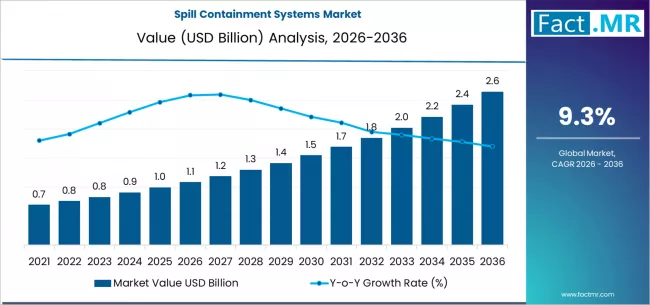
Spill containment systems market is projected to grow from USD 1.1 billion in 2026 to USD 2.6 billion by 2036, at a CAGR of 9.3%. Chemical & oil storage will dominate with a 38.0% market share, while bunds, berms & pallets will lead the containment type segment with a 45.0% share.
Spill Containment Systems Market Forecast and Outlook 2026 to 2036
The global spill containment systems market is will likely total USD 1.08 billion in 2026, expected to increase to USD 2.64 billion by 2036 at a 9.3% CAGR. This growth is fundamentally driven by the non-negotiable imperative for secondary containment across industries handling hazardous liquids.
Key Takeaways from the Spill Containment Systems Market
- Market Value for 2026: USD 1.08 Billion
- Market Value for 2036: USD 2.64 Billion
- Forecast CAGR 2026 to 2036: 9.3%
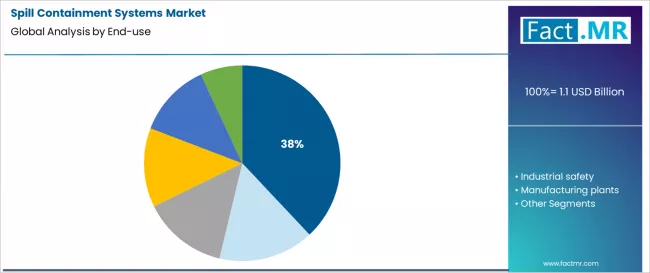
- Leading End-Use Segment (2026): Chemical & Oil Storage (38.0%)
- Leading Containment Type (2026): Bunds, Berms & Pallets (45.0%)
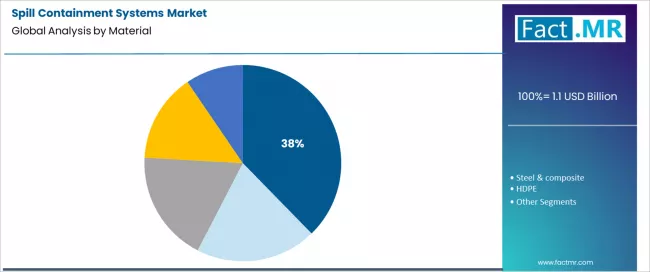
- Leading Material Segment (2026): HDPE, Steel (37.7%)
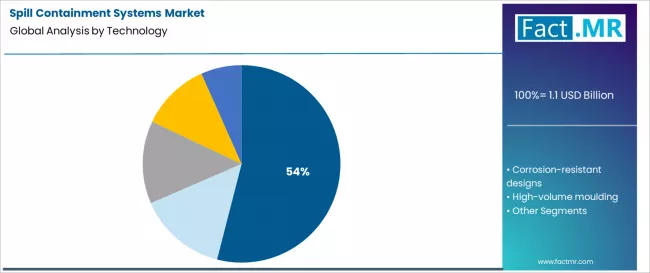
- Leading Technology Segment (2026): Modular Containment & Leak Prevention (54.0%)
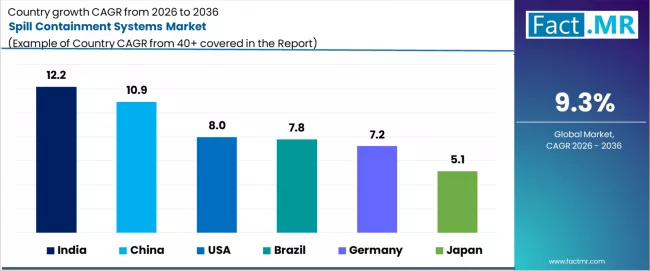
- Key Growth Countries: India (12.2% CAGR), China (10.9% CAGR), USA (8.0% CAGR), Brazil (7.8% CAGR), Germany (7.2% CAGR), Japan (5.1% CAGR)
- Key Players: Justrite Manufacturing Company, L.L.C., Eagle Manufacturing Company, Denios AG, Jiangsu Safety Tech, Nilkamal Limited, TRUSCO Nakayama Co., Ltd.

Environmental regulations, such as the EPA’s Spill Prevention, Control, and Countermeasure mandates and stringent international standards, mandate engineered passive protection to prevent soil and water contamination, transforming these systems from optional safeguards into legally required infrastructure.
Beyond compliance, the economic rationale centers on catastrophic risk mitigation. A single major spill can result in astronomical remediation costs, operational shutdowns, and irreversible reputational damage. Modern containment solutions, therefore, represent a critical investment in operational resilience and environmental stewardship.
The market’s expansion is elevated by industrial growth in emerging economies, where new facilities are integrating containment from the design phase, and by technological advancements making systems more adaptable, durable, and integrable with wider plant safety architectures.
Spill Containment Systems Market
| Metric | Value |
|---|---|
| Market Value (2026) | USD 1.08 Billion |
| Market Forecast Value (2036) | USD 2.64 Billion |
| Forecast CAGR 2026 to 2036 | 9.3% |
Category
| Category | Segments |
|---|---|
| End-Use | Chemical & Oil Storage, Industrial Safety, Manufacturing Plants, Warehousing & Logistics, Oil & Gas, Precision Chemicals |
| Containment Type | Bunds, Berms & Pallets, Spill Pallets & Decks, Portable Containment, Modular Spill Decks, Others |
| Material | HDPE, Steel, Steel & Composite, HDPE, Others |
| Technology | Modular Containment & Leak Prevention, Corrosion-Resistant Designs, High-Volume Moulding, Cost-Efficient Modular Systems, Others |
| Region | North America, Latin America, Western Europe, Eastern Europe, East Asia, South Asia & Pacific, Middle East & Africa |
How is the Industrial Automation Ecosystem Elevating Containment from Passive Barrier to Proactive Safety Node?
The integration of spill containment within the broader industrial automation framework is a key growth vector. Modern systems are no longer inert physical assets but are increasingly equipped with sensor technology. Liquid detection sensors embedded in sumps or on pallets can trigger facility-wide alerts, integrate with distributed control systems to shut down pumps, or provide data for predictive maintenance logs.
This connectivity transforms containment into an active, data-generating component of the IIoT, enabling a shift from scheduled inspections to condition-based monitoring and ensuring immediate response to integrity breaches, thereby preventing minor leaks from escalating into major incidents.
Segmental Analysis
By Technology, Which Innovation is Redefining Flexibility and Scalability in Industrial Settings?

Modular containment and leak prevention technology commands a dominant 54.0% share. This approach utilizes interlocking decks, berm sections, and sump liners that can be configured to fit specific facility layouts, machinery footprints, and evolving operational needs.
It eliminates the need for costly, permanent concrete bunding and allows for easy reconfiguration during plant upgrades. The technology's core value is providing compliant, high-capacity secondary containment with unparalleled adaptability, making it the preferred solution for dynamic manufacturing environments and multi-use storage areas.
By End-Use, Which Sector Bears the Highest Regulatory and Environmental Liability?

Chemical and oil storage constitutes the primary end-use segment at 38.0%. This sector involves the bulk storage of highly hazardous substances where the potential impact of a failure is catastrophic.
Regulations governing these facilities are the most stringent, often requiring calculated containment volumes and rigorous integrity testing. The high stakes drive demand for the most robust, chemically resistant, and code-compliant systems, making this segment the benchmark for engineering quality and a primary driver for advanced material and design innovation.
By Material, Which Combination Addresses the Core Requirements of Strength and Chemical Resistance?

HDPE and steel collectively hold a leading 37.7% share, representing the two pillars of containment material science. HDPE is favored for its superior chemical resistance, corrosion immunity, and seamless moulding capabilities for sumps and pallets.
Steel is chosen for its exceptional structural strength, fire resistance, and suitability for heavy-duty applications like IBC containment. The choice between or combination of these materials allows engineers to precisely match the system to the specific chemical, load, and environmental challenges of the application.
What are the Principal Drivers, Constraints, and Evolving Dynamics of the Spill Containment Systems Market?
| Attribute | Impact |
|---|---|
| Driver | Globally harmonizing environmental regulations mandating secondary containment for hazardous liquid storage and transfer points. |
| Restraint | High initial capital expenditure for large-scale, site-wide systems, which can deter investment, especially among smaller operators. |
| Opportunity | Retrofitting aging industrial infrastructure in developed economies with modern, compliant, and space-efficient modular systems. |
| Trend | Development of smart containment units with integrated weight monitoring, leak detection sensors, and connectivity for real-time asset management. |
Analysis of the Spill Containment Systems Market by Key Countries

| Country | CAGR 2026 to 2036 |
|---|---|
| USA | 8.0% |
| Germany | 7.2% |
| China | 10.9% |
| India | 12.2% |
| Brazil | 7.8% |
| Japan | 5.1% |
How do Evolving EPA Enforcement and a Mature Industrial Base Shape the US Market?
Consistent EPA enforcement of the SPCC rule and a vast installed base of industrial facilities undergoing compliance upgrades underpin an 8.0% CAGR. The demand driver is strongest in chemical & oil storage and oil & gas sectors.
Industry capacity is robust, with established domestic manufacturers like Justrite and Eagle offering comprehensive product lines. The market sees steady demand for both new installations and the replacement of aging concrete or steel bunds with more effective and maintainable modular HDPE systems.
What Characterizes Germany's Engineering-First, Regulation-Led Approach to Containment?
Germany's 7.2% CAGR reflects its rigorous adherence to EU directives (e.g., SEVESO III) and national technical rules (TRbF). The market is driven by the needs of the precision chemicals and high-tech manufacturing sectors, where absolute reliability is required.
Engineering emphasis is on corrosion-resistant designs and systems that facilitate clean, efficient operations. Domestic specialists like Denios lead in providing engineered solutions that are often certified for specific aggressive chemicals, focusing on preventing failure in high-consequence environments.
What Underpins China's Massive Scale-Up in Industrial Safety Infrastructure?
The simultaneous scaling of its industrial safety mandates and the construction of thousands of new chemical and manufacturing plants fuel China’s 10.9% CAGR. The primary demand driver is regulatory compliance in these new builds.
Massive industry capacity for manufacturing steel & composite and HDPE products supports high-volume production of spill pallets & decks. Domestic manufacturers are scaling rapidly to meet the needs of both state-owned enterprises and private industry, focusing on durability and cost-effectiveness.
Why is India's Manufacturing Expansion the Primary Engine for Growth?
India's leading 12.2% CAGR is directly tied to the rapid build-out and modernization of its manufacturing plants across chemicals, pharmaceuticals, and automotive sectors. The demand driver is the foundational need to integrate compliant containment into greenfield and brownfield projects.
This fuels demand for portable containment and high-volume moulding of HDPE products. Price sensitivity is high, benefiting large domestic plastics processors like Nilkamal, which can leverage scale to produce cost-effective solutions for the vast domestic market.
How is Brazil's Logistics and Storage Sector Growth Influencing Demand?
A 7.8% CAGR is closely linked to the expansion of warehousing & logistics for agri-chemicals, fuels, and imported chemicals. The demand driver centers on protecting storage facilities and loading bays.
The focus is on versatile, cost-efficient modular systems that can be deployed across distributed logistics networks. Adoption is driven by the need to meet evolving environmental licensing requirements and to protect operations in a region with significant water table sensitivities.
What defines Japan's Niche in Precision and High-Density Urban Compliance?
Japan's 5.1% CAGR represents a mature market focused on space optimization and precision for oil & gas and precision chemical facilities often located in dense urban or coastal areas. The demand driver is the extreme premium on space and the catastrophic risk of any leak.
Japanese engineering, exemplified by firms like TRUSCO Nakayama, focuses on ultra-compact, highly efficient designs, exceptional build quality, and systems that integrate seamlessly with automated material handling and stringent facility housekeeping standards.
Competitive Landscape of the Spill Containment Systems Market
The competitive landscape features established safety equipment leaders competing with specialized containment engineers and regional industrial plastics manufacturers. Global players like Justrite and Eagle compete through broad product portfolios, strong brand recognition in safety procurement, and extensive distributor networks. Specialists such as Denios differentiate through deep application engineering, custom fabrication for complex chemicals, and a focus on total risk management solutions.
The competitive frontier is increasingly defined by digital integration, with leaders developing IoT-enabled platforms for remote monitoring of containment integrity and fluid levels. Strategic moves include vertical integration into polymer production for cost control, partnerships with engineering procurement and construction (EPC) firms to be specified in new plant designs, and expansion into adjacent markets like hazardous waste storage and handling equipment.
Key Players in the Spill Containment Systems Market
- Justrite Manufacturing Company, L.L.C.
- Eagle Manufacturing Company
- Denios AG
- Jiangsu Safety Tech
- Nilkamal Limited
- TRUSCO Nakayama Co., Ltd.
Scope of Report
| Items | Metrics |
|---|---|
| Quantitative Units | USD Billion |
| Technology | Modular Containment & Leak Prevention, Corrosion-Resistant Designs, High-Volume Moulding, Cost-Efficient Modular Systems, Others |
| Containment Type | Bunds, Berms & Pallets, Spill Pallets & Decks, Portable Containment, Modular Spill Decks, Others |
| End-Use | Chemical & Oil Storage, Industrial Safety, Manufacturing Plants, Warehousing & Logistics, Oil & Gas, Precision Chemicals |
| Material | HDPE, Steel, Steel & Composite, HDPE, Others |
| Key Countries | India, China, USA, Brazil, Germany, Japan |
| Key Companies | Justrite, Eagle, Denios, Jiangsu Safety Tech, Nilkamal, TRUSCO Nakayama |
| Additional Analysis | Comparative analysis of containment capacity and chemical compatibility across materials; total cost of ownership including installation and maintenance; study of international regulatory benchmarks (EPA, EU, etc.); impact of system design on facility workflow and operational efficiency; analysis of end-of-life recycling and disposal pathways for composite and polymer-based systems. |
Market by Segments
-
End-Use :
- Chemical & Oil Storage
- Industrial Safety
- Manufacturing Plants
- Warehousing & Logistics
- Oil & Gas
- Precision Chemicals
-
Containment Type :
- Bunds, Berms & Pallets
- Spill Pallets & Decks
- Portable Containment
- Modular Spill Decks
- Others
-
Material :
- HDPE & Steel
- Steel & Composite
- HDPE
- Others
-
Technology :
- Modular Containment & Leak Prevention
- Corrosion-Resistant Designs
- High-Volume Moulding
- Cost-Efficient Modular Systems
- Others
-
Region :
-
North America
- USA
- Canada
-
Latin America
- Brazil
- Mexico
- Argentina
- Rest of Latin America
-
Western Europe
- Germany
- France
- Italy
- Spain
- UK
- BENELUX
- Rest of Western Europe
-
Eastern Europe
- Russia
- Poland
- Czech Republic
- Rest of Eastern Europe
-
East Asia
- China
- Japan
- South Korea
- Rest of East Asia
-
South Asia & Pacific
- India
- ASEAN
- Australia
- Rest of South Asia & Pacific
-
MEA
- GCC Countries
- South Africa
- Turkiye
- Rest of MEA
-
Bibliography
- American Petroleum Institute (API). (2025). API Standard 2350: Overfill Protection for Storage Tanks in Petroleum Facilities.
- European Chemicals Agency (ECHA). (2024). Guidance on Safe Storage and Containment of Hazardous Substances.
- National Fire Protection Association (NFPA). (2025). NFPA 30: Flammable and Combustible Liquids Code.
- Occupational Safety and Health Administration (OSHA). (2024). Standard 1910.106: Flammable Liquids.
- U.S. Environmental Protection Agency (EPA). (2024). Spill Prevention, Control, and Countermeasure (SPCC) Rule. 40 CFR Part 112.
- World Bank Group. (2024). Environmental, Health, and Safety Guidelines for Base Metal and Iron Ore Manufacturing.
Table of Content
- Executive Summary
- Global Market Outlook
- Demand to side Trends
- Supply to side Trends
- Technology Roadmap Analysis
- Analysis and Recommendations
- Market Overview
- Market Coverage / Taxonomy
- Market Definition / Scope / Limitations
- Market Background
- Market Dynamics
- Drivers
- Restraints
- Opportunity
- Trends
- Scenario Forecast
- Demand in Optimistic Scenario
- Demand in Likely Scenario
- Demand in Conservative Scenario
- Opportunity Map Analysis
- Product Life Cycle Analysis
- Supply Chain Analysis
- Investment Feasibility Matrix
- Value Chain Analysis
- PESTLE and Porter’s Analysis
- Regulatory Landscape
- Regional Parent Market Outlook
- Production and Consumption Statistics
- Import and Export Statistics
- Market Dynamics
- Global Market Analysis 2021 to 2025 and Forecast, 2026 to 2036
- Historical Market Size Value (USD Million) Analysis, 2021 to 2025
- Current and Future Market Size Value (USD Million) Projections, 2026 to 2036
- Y to o to Y Growth Trend Analysis
- Absolute $ Opportunity Analysis
- Global Market Pricing Analysis 2021 to 2025 and Forecast 2026 to 2036
- Global Market Analysis 2021 to 2025 and Forecast 2026 to 2036, By End-use
- Introduction / Key Findings
- Historical Market Size Value (USD Million) Analysis By End-use, 2021 to 2025
- Current and Future Market Size Value (USD Million) Analysis and Forecast By End-use, 2026 to 2036
- Chemical & oil storage
- Industrial safety
- Manufacturing plants
- Warehousing & logistics
- Oil & gas
- Precision chemicals
- Chemical & oil storage
- Y to o to Y Growth Trend Analysis By End-use, 2021 to 2025
- Absolute $ Opportunity Analysis By End-use, 2026 to 2036
- Global Market Analysis 2021 to 2025 and Forecast 2026 to 2036, By Containment Type
- Introduction / Key Findings
- Historical Market Size Value (USD Million) Analysis By Containment Type, 2021 to 2025
- Current and Future Market Size Value (USD Million) Analysis and Forecast By Containment Type, 2026 to 2036
- Bunds, berms & pallets
- Spill pallets & decks
- Portable containment
- Modular spill decks
- Others
- Bunds, berms & pallets
- Y to o to Y Growth Trend Analysis By Containment Type, 2021 to 2025
- Absolute $ Opportunity Analysis By Containment Type, 2026 to 2036
- Global Market Analysis 2021 to 2025 and Forecast 2026 to 2036, By Material
- Introduction / Key Findings
- Historical Market Size Value (USD Million) Analysis By Material, 2021 to 2025
- Current and Future Market Size Value (USD Million) Analysis and Forecast By Material, 2026 to 2036
- HDPE, steel
- Steel & composite
- HDPE
- HDPE
- Others
- HDPE, steel
- Y to o to Y Growth Trend Analysis By Material, 2021 to 2025
- Absolute $ Opportunity Analysis By Material, 2026 to 2036
- Global Market Analysis 2021 to 2025 and Forecast 2026 to 2036, By Technology
- Introduction / Key Findings
- Historical Market Size Value (USD Million) Analysis By Technology, 2021 to 2025
- Current and Future Market Size Value (USD Million) Analysis and Forecast By Technology, 2026 to 2036
- Modular containment & leak prevention
- Corrosion-resistant designs
- High-volume moulding
- Cost-efficient modular systems
- Others
- Modular containment & leak prevention
- Y to o to Y Growth Trend Analysis By Technology, 2021 to 2025
- Absolute $ Opportunity Analysis By Technology, 2026 to 2036
- Global Market Analysis 2021 to 2025 and Forecast 2026 to 2036, By Region
- Introduction
- Historical Market Size Value (USD Million) Analysis By Region, 2021 to 2025
- Current Market Size Value (USD Million) Analysis and Forecast By Region, 2026 to 2036
- North America
- Latin America
- Western Europe
- Eastern Europe
- East Asia
- South Asia and Pacific
- Middle East & Africa
- Market Attractiveness Analysis By Region
- North America Market Analysis 2021 to 2025 and Forecast 2026 to 2036, By Country
- Historical Market Size Value (USD Million) Trend Analysis By Market Taxonomy, 2021 to 2025
- Market Size Value (USD Million) Forecast By Market Taxonomy, 2026 to 2036
- By Country
- USA
- Canada
- Mexico
- By End-use
- By Containment Type
- By Material
- By Technology
- By Country
- Market Attractiveness Analysis
- By Country
- By End-use
- By Containment Type
- By Material
- By Technology
- Key Takeaways
- Latin America Market Analysis 2021 to 2025 and Forecast 2026 to 2036, By Country
- Historical Market Size Value (USD Million) Trend Analysis By Market Taxonomy, 2021 to 2025
- Market Size Value (USD Million) Forecast By Market Taxonomy, 2026 to 2036
- By Country
- Brazil
- Chile
- Rest of Latin America
- By End-use
- By Containment Type
- By Material
- By Technology
- By Country
- Market Attractiveness Analysis
- By Country
- By End-use
- By Containment Type
- By Material
- By Technology
- Key Takeaways
- Western Europe Market Analysis 2021 to 2025 and Forecast 2026 to 2036, By Country
- Historical Market Size Value (USD Million) Trend Analysis By Market Taxonomy, 2021 to 2025
- Market Size Value (USD Million) Forecast By Market Taxonomy, 2026 to 2036
- By Country
- Germany
- UK
- Italy
- Spain
- France
- Nordic
- BENELUX
- Rest of Western Europe
- By End-use
- By Containment Type
- By Material
- By Technology
- By Country
- Market Attractiveness Analysis
- By Country
- By End-use
- By Containment Type
- By Material
- By Technology
- Key Takeaways
- Eastern Europe Market Analysis 2021 to 2025 and Forecast 2026 to 2036, By Country
- Historical Market Size Value (USD Million) Trend Analysis By Market Taxonomy, 2021 to 2025
- Market Size Value (USD Million) Forecast By Market Taxonomy, 2026 to 2036
- By Country
- Russia
- Poland
- Hungary
- Balkan & Baltic
- Rest of Eastern Europe
- By End-use
- By Containment Type
- By Material
- By Technology
- By Country
- Market Attractiveness Analysis
- By Country
- By End-use
- By Containment Type
- By Material
- By Technology
- Key Takeaways
- East Asia Market Analysis 2021 to 2025 and Forecast 2026 to 2036, By Country
- Historical Market Size Value (USD Million) Trend Analysis By Market Taxonomy, 2021 to 2025
- Market Size Value (USD Million) Forecast By Market Taxonomy, 2026 to 2036
- By Country
- China
- Japan
- South Korea
- By End-use
- By Containment Type
- By Material
- By Technology
- By Country
- Market Attractiveness Analysis
- By Country
- By End-use
- By Containment Type
- By Material
- By Technology
- Key Takeaways
- South Asia and Pacific Market Analysis 2021 to 2025 and Forecast 2026 to 2036, By Country
- Historical Market Size Value (USD Million) Trend Analysis By Market Taxonomy, 2021 to 2025
- Market Size Value (USD Million) Forecast By Market Taxonomy, 2026 to 2036
- By Country
- India
- ASEAN
- Australia & New Zealand
- Rest of South Asia and Pacific
- By End-use
- By Containment Type
- By Material
- By Technology
- By Country
- Market Attractiveness Analysis
- By Country
- By End-use
- By Containment Type
- By Material
- By Technology
- Key Takeaways
- Middle East & Africa Market Analysis 2021 to 2025 and Forecast 2026 to 2036, By Country
- Historical Market Size Value (USD Million) Trend Analysis By Market Taxonomy, 2021 to 2025
- Market Size Value (USD Million) Forecast By Market Taxonomy, 2026 to 2036
- By Country
- Kingdom of Saudi Arabia
- Other GCC Countries
- Turkiye
- South Africa
- Other African Union
- Rest of Middle East & Africa
- By End-use
- By Containment Type
- By Material
- By Technology
- By Country
- Market Attractiveness Analysis
- By Country
- By End-use
- By Containment Type
- By Material
- By Technology
- Key Takeaways
- Key Countries Market Analysis
- USA
- Pricing Analysis
- Market Share Analysis, 2025
- By End-use
- By Containment Type
- By Material
- By Technology
- Canada
- Pricing Analysis
- Market Share Analysis, 2025
- By End-use
- By Containment Type
- By Material
- By Technology
- Mexico
- Pricing Analysis
- Market Share Analysis, 2025
- By End-use
- By Containment Type
- By Material
- By Technology
- Brazil
- Pricing Analysis
- Market Share Analysis, 2025
- By End-use
- By Containment Type
- By Material
- By Technology
- Chile
- Pricing Analysis
- Market Share Analysis, 2025
- By End-use
- By Containment Type
- By Material
- By Technology
- Germany
- Pricing Analysis
- Market Share Analysis, 2025
- By End-use
- By Containment Type
- By Material
- By Technology
- UK
- Pricing Analysis
- Market Share Analysis, 2025
- By End-use
- By Containment Type
- By Material
- By Technology
- Italy
- Pricing Analysis
- Market Share Analysis, 2025
- By End-use
- By Containment Type
- By Material
- By Technology
- Spain
- Pricing Analysis
- Market Share Analysis, 2025
- By End-use
- By Containment Type
- By Material
- By Technology
- France
- Pricing Analysis
- Market Share Analysis, 2025
- By End-use
- By Containment Type
- By Material
- By Technology
- India
- Pricing Analysis
- Market Share Analysis, 2025
- By End-use
- By Containment Type
- By Material
- By Technology
- ASEAN
- Pricing Analysis
- Market Share Analysis, 2025
- By End-use
- By Containment Type
- By Material
- By Technology
- Australia & New Zealand
- Pricing Analysis
- Market Share Analysis, 2025
- By End-use
- By Containment Type
- By Material
- By Technology
- China
- Pricing Analysis
- Market Share Analysis, 2025
- By End-use
- By Containment Type
- By Material
- By Technology
- Japan
- Pricing Analysis
- Market Share Analysis, 2025
- By End-use
- By Containment Type
- By Material
- By Technology
- South Korea
- Pricing Analysis
- Market Share Analysis, 2025
- By End-use
- By Containment Type
- By Material
- By Technology
- Russia
- Pricing Analysis
- Market Share Analysis, 2025
- By End-use
- By Containment Type
- By Material
- By Technology
- Poland
- Pricing Analysis
- Market Share Analysis, 2025
- By End-use
- By Containment Type
- By Material
- By Technology
- Hungary
- Pricing Analysis
- Market Share Analysis, 2025
- By End-use
- By Containment Type
- By Material
- By Technology
- Kingdom of Saudi Arabia
- Pricing Analysis
- Market Share Analysis, 2025
- By End-use
- By Containment Type
- By Material
- By Technology
- Turkiye
- Pricing Analysis
- Market Share Analysis, 2025
- By End-use
- By Containment Type
- By Material
- By Technology
- South Africa
- Pricing Analysis
- Market Share Analysis, 2025
- By End-use
- By Containment Type
- By Material
- By Technology
- USA
- Market Structure Analysis
- Competition Dashboard
- Competition Benchmarking
- Market Share Analysis of Top Players
- By Regional
- By End-use
- By Containment Type
- By Material
- By Technology
- Competition Analysis
- Competition Deep Dive
- Justrite Manufacturing Company, L.L.C.
- Overview
- Product Portfolio
- Profitability by Market Segments (Product/Age /Sales Channel/Region)
- Sales Footprint
- Strategy Overview
- Marketing Strategy
- Product Strategy
- Channel Strategy
- Eagle Manufacturing Company
- Denios AG
- Jiangsu Safety Tech
- Nilkamal Limited
- TRUSCO Nakayama Co., Ltd.
- Justrite Manufacturing Company, L.L.C.
- Competition Deep Dive
- Assumptions & Acronyms Used
- Research Methodology
List Of Table
- Table 1: Global Market Value (USD Million) Forecast by Region, 2021 to 2036
- Table 2: Global Market Value (USD Million) Forecast by End-use, 2021 to 2036
- Table 3: Global Market Value (USD Million) Forecast by Containment Type, 2021 to 2036
- Table 4: Global Market Value (USD Million) Forecast by Material, 2021 to 2036
- Table 5: Global Market Value (USD Million) Forecast by Technology, 2021 to 2036
- Table 6: North America Market Value (USD Million) Forecast by Country, 2021 to 2036
- Table 7: North America Market Value (USD Million) Forecast by End-use, 2021 to 2036
- Table 8: North America Market Value (USD Million) Forecast by Containment Type, 2021 to 2036
- Table 9: North America Market Value (USD Million) Forecast by Material, 2021 to 2036
- Table 10: North America Market Value (USD Million) Forecast by Technology, 2021 to 2036
- Table 11: Latin America Market Value (USD Million) Forecast by Country, 2021 to 2036
- Table 12: Latin America Market Value (USD Million) Forecast by End-use, 2021 to 2036
- Table 13: Latin America Market Value (USD Million) Forecast by Containment Type, 2021 to 2036
- Table 14: Latin America Market Value (USD Million) Forecast by Material, 2021 to 2036
- Table 15: Latin America Market Value (USD Million) Forecast by Technology, 2021 to 2036
- Table 16: Western Europe Market Value (USD Million) Forecast by Country, 2021 to 2036
- Table 17: Western Europe Market Value (USD Million) Forecast by End-use, 2021 to 2036
- Table 18: Western Europe Market Value (USD Million) Forecast by Containment Type, 2021 to 2036
- Table 19: Western Europe Market Value (USD Million) Forecast by Material, 2021 to 2036
- Table 20: Western Europe Market Value (USD Million) Forecast by Technology, 2021 to 2036
- Table 21: Eastern Europe Market Value (USD Million) Forecast by Country, 2021 to 2036
- Table 22: Eastern Europe Market Value (USD Million) Forecast by End-use, 2021 to 2036
- Table 23: Eastern Europe Market Value (USD Million) Forecast by Containment Type, 2021 to 2036
- Table 24: Eastern Europe Market Value (USD Million) Forecast by Material, 2021 to 2036
- Table 25: Eastern Europe Market Value (USD Million) Forecast by Technology, 2021 to 2036
- Table 26: East Asia Market Value (USD Million) Forecast by Country, 2021 to 2036
- Table 27: East Asia Market Value (USD Million) Forecast by End-use, 2021 to 2036
- Table 28: East Asia Market Value (USD Million) Forecast by Containment Type, 2021 to 2036
- Table 29: East Asia Market Value (USD Million) Forecast by Material, 2021 to 2036
- Table 30: East Asia Market Value (USD Million) Forecast by Technology, 2021 to 2036
- Table 31: South Asia and Pacific Market Value (USD Million) Forecast by Country, 2021 to 2036
- Table 32: South Asia and Pacific Market Value (USD Million) Forecast by End-use, 2021 to 2036
- Table 33: South Asia and Pacific Market Value (USD Million) Forecast by Containment Type, 2021 to 2036
- Table 34: South Asia and Pacific Market Value (USD Million) Forecast by Material, 2021 to 2036
- Table 35: South Asia and Pacific Market Value (USD Million) Forecast by Technology, 2021 to 2036
- Table 36: Middle East & Africa Market Value (USD Million) Forecast by Country, 2021 to 2036
- Table 37: Middle East & Africa Market Value (USD Million) Forecast by End-use, 2021 to 2036
- Table 38: Middle East & Africa Market Value (USD Million) Forecast by Containment Type, 2021 to 2036
- Table 39: Middle East & Africa Market Value (USD Million) Forecast by Material, 2021 to 2036
- Table 40: Middle East & Africa Market Value (USD Million) Forecast by Technology, 2021 to 2036
List Of Figures
- Figure 1: Global Market Pricing Analysis
- Figure 2: Global Market Value (USD Million) Forecast 2021 to 2036
- Figure 3: Global Market Value Share and BPS Analysis by End-use, 2026 and 2036
- Figure 4: Global Market Y to o to Y Growth Comparison by End-use, 2026 to 2036
- Figure 5: Global Market Attractiveness Analysis by End-use
- Figure 6: Global Market Value Share and BPS Analysis by Containment Type, 2026 and 2036
- Figure 7: Global Market Y to o to Y Growth Comparison by Containment Type, 2026 to 2036
- Figure 8: Global Market Attractiveness Analysis by Containment Type
- Figure 9: Global Market Value Share and BPS Analysis by Material, 2026 and 2036
- Figure 10: Global Market Y to o to Y Growth Comparison by Material, 2026 to 2036
- Figure 11: Global Market Attractiveness Analysis by Material
- Figure 12: Global Market Value Share and BPS Analysis by Technology, 2026 and 2036
- Figure 13: Global Market Y to o to Y Growth Comparison by Technology, 2026 to 2036
- Figure 14: Global Market Attractiveness Analysis by Technology
- Figure 15: Global Market Value (USD Million) Share and BPS Analysis by Region, 2026 and 2036
- Figure 16: Global Market Y to o to Y Growth Comparison by Region, 2026 to 2036
- Figure 17: Global Market Attractiveness Analysis by Region
- Figure 18: North America Market Incremental Dollar Opportunity, 2026 to 2036
- Figure 19: Latin America Market Incremental Dollar Opportunity, 2026 to 2036
- Figure 20: Western Europe Market Incremental Dollar Opportunity, 2026 to 2036
- Figure 21: Eastern Europe Market Incremental Dollar Opportunity, 2026 to 2036
- Figure 22: East Asia Market Incremental Dollar Opportunity, 2026 to 2036
- Figure 23: South Asia and Pacific Market Incremental Dollar Opportunity, 2026 to 2036
- Figure 24: Middle East & Africa Market Incremental Dollar Opportunity, 2026 to 2036
- Figure 25: North America Market Value Share and BPS Analysis by Country, 2026 and 2036
- Figure 26: North America Market Value Share and BPS Analysis by End-use, 2026 and 2036
- Figure 27: North America Market Y to o to Y Growth Comparison by End-use, 2026 to 2036
- Figure 28: North America Market Attractiveness Analysis by End-use
- Figure 29: North America Market Value Share and BPS Analysis by Containment Type, 2026 and 2036
- Figure 30: North America Market Y to o to Y Growth Comparison by Containment Type, 2026 to 2036
- Figure 31: North America Market Attractiveness Analysis by Containment Type
- Figure 32: North America Market Value Share and BPS Analysis by Material, 2026 and 2036
- Figure 33: North America Market Y to o to Y Growth Comparison by Material, 2026 to 2036
- Figure 34: North America Market Attractiveness Analysis by Material
- Figure 35: North America Market Value Share and BPS Analysis by Technology, 2026 and 2036
- Figure 36: North America Market Y to o to Y Growth Comparison by Technology, 2026 to 2036
- Figure 37: North America Market Attractiveness Analysis by Technology
- Figure 38: Latin America Market Value Share and BPS Analysis by Country, 2026 and 2036
- Figure 39: Latin America Market Value Share and BPS Analysis by End-use, 2026 and 2036
- Figure 40: Latin America Market Y to o to Y Growth Comparison by End-use, 2026 to 2036
- Figure 41: Latin America Market Attractiveness Analysis by End-use
- Figure 42: Latin America Market Value Share and BPS Analysis by Containment Type, 2026 and 2036
- Figure 43: Latin America Market Y to o to Y Growth Comparison by Containment Type, 2026 to 2036
- Figure 44: Latin America Market Attractiveness Analysis by Containment Type
- Figure 45: Latin America Market Value Share and BPS Analysis by Material, 2026 and 2036
- Figure 46: Latin America Market Y to o to Y Growth Comparison by Material, 2026 to 2036
- Figure 47: Latin America Market Attractiveness Analysis by Material
- Figure 48: Latin America Market Value Share and BPS Analysis by Technology, 2026 and 2036
- Figure 49: Latin America Market Y to o to Y Growth Comparison by Technology, 2026 to 2036
- Figure 50: Latin America Market Attractiveness Analysis by Technology
- Figure 51: Western Europe Market Value Share and BPS Analysis by Country, 2026 and 2036
- Figure 52: Western Europe Market Value Share and BPS Analysis by End-use, 2026 and 2036
- Figure 53: Western Europe Market Y to o to Y Growth Comparison by End-use, 2026 to 2036
- Figure 54: Western Europe Market Attractiveness Analysis by End-use
- Figure 55: Western Europe Market Value Share and BPS Analysis by Containment Type, 2026 and 2036
- Figure 56: Western Europe Market Y to o to Y Growth Comparison by Containment Type, 2026 to 2036
- Figure 57: Western Europe Market Attractiveness Analysis by Containment Type
- Figure 58: Western Europe Market Value Share and BPS Analysis by Material, 2026 and 2036
- Figure 59: Western Europe Market Y to o to Y Growth Comparison by Material, 2026 to 2036
- Figure 60: Western Europe Market Attractiveness Analysis by Material
- Figure 61: Western Europe Market Value Share and BPS Analysis by Technology, 2026 and 2036
- Figure 62: Western Europe Market Y to o to Y Growth Comparison by Technology, 2026 to 2036
- Figure 63: Western Europe Market Attractiveness Analysis by Technology
- Figure 64: Eastern Europe Market Value Share and BPS Analysis by Country, 2026 and 2036
- Figure 65: Eastern Europe Market Value Share and BPS Analysis by End-use, 2026 and 2036
- Figure 66: Eastern Europe Market Y to o to Y Growth Comparison by End-use, 2026 to 2036
- Figure 67: Eastern Europe Market Attractiveness Analysis by End-use
- Figure 68: Eastern Europe Market Value Share and BPS Analysis by Containment Type, 2026 and 2036
- Figure 69: Eastern Europe Market Y to o to Y Growth Comparison by Containment Type, 2026 to 2036
- Figure 70: Eastern Europe Market Attractiveness Analysis by Containment Type
- Figure 71: Eastern Europe Market Value Share and BPS Analysis by Material, 2026 and 2036
- Figure 72: Eastern Europe Market Y to o to Y Growth Comparison by Material, 2026 to 2036
- Figure 73: Eastern Europe Market Attractiveness Analysis by Material
- Figure 74: Eastern Europe Market Value Share and BPS Analysis by Technology, 2026 and 2036
- Figure 75: Eastern Europe Market Y to o to Y Growth Comparison by Technology, 2026 to 2036
- Figure 76: Eastern Europe Market Attractiveness Analysis by Technology
- Figure 77: East Asia Market Value Share and BPS Analysis by Country, 2026 and 2036
- Figure 78: East Asia Market Value Share and BPS Analysis by End-use, 2026 and 2036
- Figure 79: East Asia Market Y to o to Y Growth Comparison by End-use, 2026 to 2036
- Figure 80: East Asia Market Attractiveness Analysis by End-use
- Figure 81: East Asia Market Value Share and BPS Analysis by Containment Type, 2026 and 2036
- Figure 82: East Asia Market Y to o to Y Growth Comparison by Containment Type, 2026 to 2036
- Figure 83: East Asia Market Attractiveness Analysis by Containment Type
- Figure 84: East Asia Market Value Share and BPS Analysis by Material, 2026 and 2036
- Figure 85: East Asia Market Y to o to Y Growth Comparison by Material, 2026 to 2036
- Figure 86: East Asia Market Attractiveness Analysis by Material
- Figure 87: East Asia Market Value Share and BPS Analysis by Technology, 2026 and 2036
- Figure 88: East Asia Market Y to o to Y Growth Comparison by Technology, 2026 to 2036
- Figure 89: East Asia Market Attractiveness Analysis by Technology
- Figure 90: South Asia and Pacific Market Value Share and BPS Analysis by Country, 2026 and 2036
- Figure 91: South Asia and Pacific Market Value Share and BPS Analysis by End-use, 2026 and 2036
- Figure 92: South Asia and Pacific Market Y to o to Y Growth Comparison by End-use, 2026 to 2036
- Figure 93: South Asia and Pacific Market Attractiveness Analysis by End-use
- Figure 94: South Asia and Pacific Market Value Share and BPS Analysis by Containment Type, 2026 and 2036
- Figure 95: South Asia and Pacific Market Y to o to Y Growth Comparison by Containment Type, 2026 to 2036
- Figure 96: South Asia and Pacific Market Attractiveness Analysis by Containment Type
- Figure 97: South Asia and Pacific Market Value Share and BPS Analysis by Material, 2026 and 2036
- Figure 98: South Asia and Pacific Market Y to o to Y Growth Comparison by Material, 2026 to 2036
- Figure 99: South Asia and Pacific Market Attractiveness Analysis by Material
- Figure 100: South Asia and Pacific Market Value Share and BPS Analysis by Technology, 2026 and 2036
- Figure 101: South Asia and Pacific Market Y to o to Y Growth Comparison by Technology, 2026 to 2036
- Figure 102: South Asia and Pacific Market Attractiveness Analysis by Technology
- Figure 103: Middle East & Africa Market Value Share and BPS Analysis by Country, 2026 and 2036
- Figure 104: Middle East & Africa Market Value Share and BPS Analysis by End-use, 2026 and 2036
- Figure 105: Middle East & Africa Market Y to o to Y Growth Comparison by End-use, 2026 to 2036
- Figure 106: Middle East & Africa Market Attractiveness Analysis by End-use
- Figure 107: Middle East & Africa Market Value Share and BPS Analysis by Containment Type, 2026 and 2036
- Figure 108: Middle East & Africa Market Y to o to Y Growth Comparison by Containment Type, 2026 to 2036
- Figure 109: Middle East & Africa Market Attractiveness Analysis by Containment Type
- Figure 110: Middle East & Africa Market Value Share and BPS Analysis by Material, 2026 and 2036
- Figure 111: Middle East & Africa Market Y to o to Y Growth Comparison by Material, 2026 to 2036
- Figure 112: Middle East & Africa Market Attractiveness Analysis by Material
- Figure 113: Middle East & Africa Market Value Share and BPS Analysis by Technology, 2026 and 2036
- Figure 114: Middle East & Africa Market Y to o to Y Growth Comparison by Technology, 2026 to 2036
- Figure 115: Middle East & Africa Market Attractiveness Analysis by Technology
- Figure 116: Global Market - Tier Structure Analysis
- Figure 117: Global Market - Company Share Analysis
- FAQs -
How big is the spill containment systems market in 2026?
The global spill containment systems market is estimated to be valued at USD 1.1 billion in 2026.
What will be the size of spill containment systems market in 2036?
The market size for the spill containment systems market is projected to reach USD 2.6 billion by 2036.
How much will be the spill containment systems market growth between 2026 and 2036?
The spill containment systems market is expected to grow at a 9.3% CAGR between 2026 and 2036.
What are the key product types in the spill containment systems market?
The key product types in spill containment systems market are chemical & oil storage, industrial safety, manufacturing plants, warehousing & logistics, oil & gas and precision chemicals.
Which containment type segment to contribute significant share in the spill containment systems market in 2026?
In terms of containment type, bunds, berms & pallets segment to command 45.0% share in the spill containment systems market in 2026.