- Market Value (2025): USD 2.66 Bn
- Estimated Value (2026): USD 2.82 Bn
- Forecast Value (2036): USD 4.98 Bn
- CAGR (2026-2036): 5.9%
What is the Spinal Orthotics Market forecast to be worth by 2036?
USD 2.82 billion in 2026 to USD 4.98 billion by 2036 at a 5.9% CAGR.
- As per Fact.MR analysis, the spinal orthotics market was valued at USD 2.66 billion in 2025.
- Market value is forecast to increase from USD 2.82 billion in 2026 to USD 4.98 billion by 2036.
- The market is projected to grow at a 5.9% CAGR between 2026 and 2036. Fitting and follow-up services remain part of spinal care.
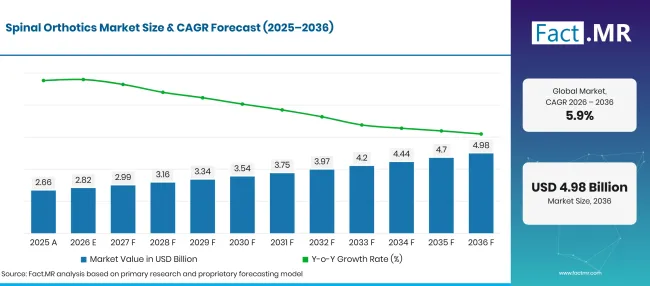
Spinal Orthotics Market Forecast Global | Source: Fact.MR
| Year | Basis | Market Value (USD billion) |
|---|---|---|
| 2025 | Actual | 2.66 |
| 2026 | Estimate | 2.82 |
| 2036 | Forecast | 4.98 |
| CAGR 2026 to 2036 | Forecast period | 5.9% |
Source: Fact.MR analysis. Updated Nov 3, 2026
What are the defining numbers behind Spinal Orthotics Market growth?
The market is projected to add USD 2.2 billion in annual value between 2026 and 2036.
- Demand Drivers in the Market
- Physicians use prescribed spinal orthoses when motion control is needed after an injury or during care for an unstable spinal condition. The Centers for Medicare & Medicaid Services distinguishes rigid and semi-rigid braces by their support and movement-restriction functions [1].
- Older adults may need support during conservative care or recovery. Germany counted 19.3 million residents aged at least 65 in 2025, according to Destatis [3].
- Patients and clinicians also weigh ease of fastening, skin comfort and support during ordinary activities. A brace that is difficult to put on or wear for the prescribed period creates a practical adherence challenge. The fit and adjustment service can influence whether a manufacturer wins repeat clinical orders.
- Key Segments Analyzed
- By Product Type: Rigid Braces account for 42.5% of the 2026 product mix where stronger immobilization or corrective support is required.
- By Application: Scoliosis lead with 40.0% of the 2026 application mix through specialist prescription and continuing review.
- By End-User: Clinics capture 42.1% of the 2026 end-user market as assessment and fitting stay central to care.
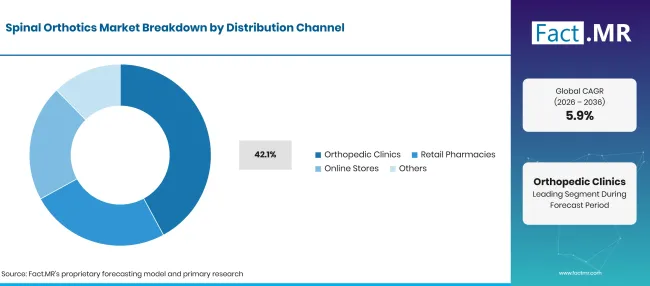
- By Distribution Channel: Orthopedic Clinics represent 42.1% of the 2026 distribution-channel market through direct patient fitting and follow-up.
- Analyst Opinion at Fact.MR
- Shambhu Nath Jha, Principal Consultant at Fact.MR, states, “A spinal brace must provide the prescribed support while remaining practical to wear during normal activities. Fitting and later adjustment therefore matter alongside the prescribed treatment. Manufacturers and specialist clinics compete partly on how reliably they can maintain comfort and clinical function throughout treatment.”
- Strategic Implications
- Manufacturers can provide clear adjustment instructions for orthotists fitting spinal braces and addressing patient concerns.
- Orthopedic clinics need to document the clinical purpose of each brace and review its use when a patient’s condition changes.
- Distributors benefit from keeping multiple sizing options available for patients who require prompt fitting after discharge or specialist assessment.
- Health systems can assess brace products together with the follow-up support needed for safe and consistent wear.
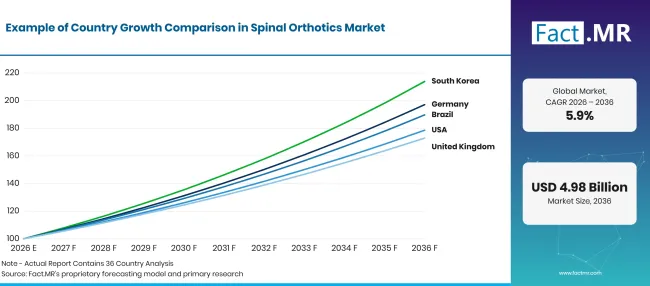
Germany leads the five-country outlook with a 7.0% CAGR, followed by Brazil at 6.6%, the USA at 6.0%, the UK at 5.6% and Japan at 5.2%. Differences in specialist services, patient access and coverage conditions influence these country forecasts.
How does the Spinal Orthotics Market break down by segment?
Rigid Braces lead Product Type at 42.5%; Scoliosis leads Application at 40.0%; Clinics and Orthopedic Clinics each account for 42.1% in their separate dimensions.
Which Product Type dominates?
Rigid Braces account for 42.5% of 2026 product type value.
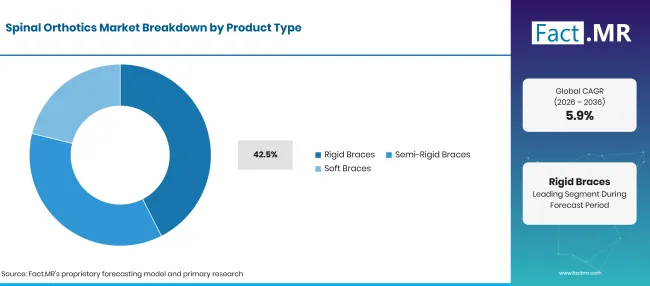
Spinal Orthotics Market Breakdown Product Type | Source: Fact.MR
| Product Type | Share (2026) |
|---|---|
| Rigid Braces (Leading segment) | 42.5% |
| Other segments combined | 57.5% |
| Total | 100.0% |
Source: Fact.MR analysis. Updated Nov 3, 2026
Rigid braces restrict spinal motion or hold the torso in a prescribed position. Clinical teams choose an appropriate design for correction, protection or post-treatment support. Semi-rigid braces allow some movement while offering structural guidance, and soft braces provide more flexible support. The decision concerns clinical need and tolerable wear, not one product grade being suitable for every patient.
Which Application accounts for the largest share?
Scoliosis lead with 40.0% of 2026 application value.
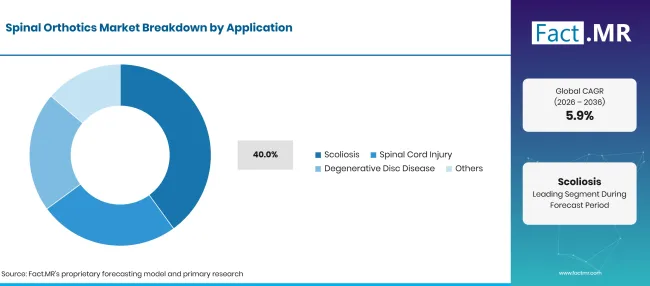
Spinal Orthotics Market Breakdown Application | Source: Fact.MR
| Application | Share (2026) |
|---|---|
| Scoliosis (Leading segment) | 40.0% |
| Other segments combined | 60.0% |
| Total | 100.0% |
Source: Fact.MR analysis. Updated Nov 3, 2026
Scoliosis bracing involves prolonged treatment and ongoing assessment in selected patients. A specialist considers growth, curve progression and the need for corrective pressure when recommending a brace. Spinal cord injury care creates a separate need for stabilization after appropriate clinical evaluation. Patients with degenerative disc disease may be offered support for particular symptoms, although a brace is not a universal treatment.
How do End-Users shape spinal orthotics purchasing?
Clinics capture 42.1% of 2026 end-user value.
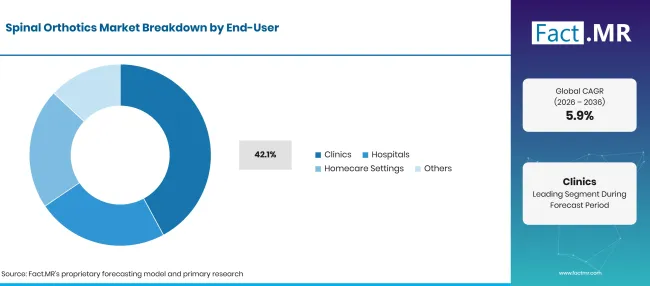
Spinal Orthotics Market Breakdown End User | Source: Fact.MR
| End-User | Share (2026) |
|---|---|
| Clinics (Leading segment) | 42.1% |
| Other segments combined | 57.9% |
| Total | 100.0% |
Source: Fact.MR analysis. Updated Nov 3, 2026
Clinics account for a sizeable share because they assess body measurements and monitor how the brace fits. Hospitals prescribe orthoses in selected acute and postoperative pathways, while patients use many devices at home after instruction. The prescribing setting differs from where the patient ultimately uses the brace. These differences explain why specialist fitting services can remain central even when much of the wearing time takes place at home.
Which Distribution Channel leads?
Orthopedic Clinics represent 42.1% of 2026 distribution channel value.
Spinal Orthotics Market Breakdown Distribution Channel | Source: Fact.MR
| Distribution Channel | Share (2026) |
|---|---|
| Orthopedic Clinics (Leading segment) | 42.1% |
| Other segments combined | 57.9% |
| Total | 100.0% |
Source: Fact.MR analysis. Updated Nov 3, 2026
Orthopedic clinics link brace choice to examination and fitting. Retail pharmacies can distribute certain ready-made support devices, while online sellers offer convenient access to standard sizes. Complex corrective braces still call for an assessment of the patient’s body shape and the prescribed clinical objective. The Royal National Orthopaedic Hospital describes patient-specific measurement, fabrication and follow-up for corrective spinal TLSOs, which explains why specialist services remain important.
What is accelerating Spinal Orthotics Market adoption, and what is holding it back?
Prescribed spinal braces require clinical assessment and fitting. Documentation requirements, discomfort and repeat adjustment costs can affect access.
Drivers Impact Analysis
| DRIVER | (~) % IMPACT ON CAGR | GEOGRAPHIC RELEVANCE | IMPACT TIMELINE |
|---|---|---|---|
| Use after injury or surgery | +1.1% | Clinical | Short term |
| Scoliosis care pathways | +0.9% | Specialist clinics | Medium term |
| Age-related spine needs | +0.7% | Europe and East Asia | Long term |
| Fitting and follow-up services | +0.5% | Global | Medium term |
| Range of brace stiffness options | +0.3% | Global | Medium term |
Source: Fact.MR analysis. Updated Nov 3, 2026
Opportunity Impact Analysis
| OPPORTUNITY | (~) % IMPACT ON CAGR | GEOGRAPHIC RELEVANCE | IMPACT TIMELINE |
|---|---|---|---|
| Better fastening and fitting design | +0.7% | Global | Medium term |
| More consistent patient instructions | +0.6% | Global | Short term |
| Improved access to orthotists | +0.4% | North America and Europe | Long term |
| Clinic-linked follow-up pathways | +0.3% | Global | Medium term |
Source: Fact.MR analysis. Updated Nov 3, 2026
Restraints Impact Analysis
| RESTRAINTS | (~) % IMPACT ON CAGR | GEOGRAPHIC RELEVANCE | IMPACT TIMELINE |
|---|---|---|---|
| Documentation and coverage checks | -0.8% | USA | Short term |
| Discomfort during prolonged wear | -0.6% | Global | Short term |
| Need for trained fitting staff | -0.4% | Global | Medium term |
| Variation in patient suitability | -0.3% | Global | Long term |
Source: Fact.MR analysis. Updated Nov 3, 2026
Which countries are scaling the Spinal Orthotics Market through 2036?
Spinal Orthotics Market Growth Index | Source: Fact.MR
| Country | CAGR (2026 to 2036) |
|---|---|
| Germany | 7.0% |
| Brazil | 6.6% |
| USA | 6.0% |
| UK | 5.6% |
| Japan | 5.2% |
Source: Fact.MR analysis. Updated Nov 3, 2026
What supports Germany spinal orthotics demand?
7.0% CAGR, supported by specialist spinal care and an ageing patient population.
German orthotic clinics provide specialist assessment and repeated fitting for spinal stabilization and scoliosis care. Destatis reported that 23% of the population was aged 65 or older in 2025, while another official release placed the population at 83.5 million at year-end [4]. Clinicians must still evaluate each patient’s condition and the need for a rigid, semi-rigid or corrective device.
What supports Brazil spinal orthotics demand?
6.6% CAGR, tied to access to orthotic care across a large and ageing population.
In Brazil, specialist access and travel distance shape the route from a spinal assessment to a usable brace. Urban orthopedic services support fitting and adjustment, while patients farther from clinics face more complicated follow-up. IBGE reported that people aged 60 or over accounted for 16.6% of Brazil’s population in 2025 [5].
What supports USA spinal orthotics demand?
6.0% CAGR, shaped by coverage rules and the availability of trained orthotists.
In the United States, clinical records and coverage rules affect access to prescribed spinal orthoses. Orthotists and treating clinicians coordinate assessment, fitting and patient instructions. The Bureau of Labor Statistics counted approximately 9,500 orthotist and prosthetist jobs in 2025 [2], describing the care workforce rather than brace sales. CMS reported a 54.4% improper payment rate for lumbar-sacral orthoses in the 2024 Medicare fee-for-service reporting period [6].
What supports UK spinal orthotics demand?
5.6% CAGR, linked to specialist scoliosis clinics and community follow-up.
The UK relies on specialist teams to assess scoliosis and fit prescribed spinal braces. The Office for National Statistics estimated the population at 69.5 million in mid-2025 [7]. Corrective TLSOs are made for selected patients and adjusted as their needs change. Specialist appointments help clinicians check pressure, comfort and adherence during extended wear.
What supports Japan spinal orthotics demand?
5.2% CAGR, influenced by ageing and careful device selection for home use.
Japan’s older population makes comfort and clinical suitability important considerations in spinal orthotic care. The Statistics Bureau reported that 29.6% of residents were aged 65 or older in September 2026 [8]. Clinicians choose support according to the patient’s condition, while specialist teams fit corrective devices for selected scoliosis cases.
Who leads the spinal orthotics market?
Spinal-orthotics suppliers differ in product range and the service required after purchase. Aspen Medical Products lists lumbar-sacral and thoraco-lumbar-sacral products that address different levels of spinal support.
Bauerfeind offers back orthoses and supports, while Boston Orthotics & Prosthetics and Orthomerica are associated with custom orthotic fitting and scoliosis bracing. Orthotic service providers such as Hanger work closer to patient assessment and fitting. Product-level confirmation remains central when comparing broader orthopedic portfolios.
Which companies are the key providers?
Key companies include Enovis Corporation; Bauerfeind AG; Boston Orthotics & Prosthetics; Aspen Medical Products; DeRoyal Industries, Inc.; Breg, Inc.; Hanger, Inc.; Orthomerica Products, Inc.; Thuasne Group; Ottobock SE & Co. KGaA.
- Enovis Corporation
- Bauerfeind AG
- Boston Orthotics & Prosthetics
- Aspen Medical Products
- DeRoyal Industries, Inc.
- Breg, Inc.
- Hanger, Inc.
- Orthomerica Products, Inc.
- Thuasne Group
- Ottobock SE & Co. KGaA
Bibliography
- [1] Centers for Medicare & Medicaid Services. (n.d.). Prosthetics & orthotics, prosthetic devices, & therapeutic shoes
- [2] U.S. Bureau of Labor Statistics. (2026, August 27). Orthotists and prosthetists. Occupational Outlook Handbook
- [3] Statistisches Bundesamt (Destatis). (2026, August 18). Bevölkerung: Ältere Menschen
- [4] Statistisches Bundesamt (Destatis). (2026, June 16). Bevölkerung Deutschlands sinkt im Jahr 2025 um 0,1 %
- [5] Gomes, I., & Pirrho, S. (2026, April 17). Rented housing units grew more than 50% since 2016. Instituto Brasileiro de Geografia e Estatística.
- [6] Centers for Medicare & Medicaid Services. (n.d.). Spinal orthoses. Medicare Provider Compliance Tips
- [7] Office for National Statistics. (2026, October 1). Population estimates for the UK, England, Wales, Scotland and Northern Ireland: mid-2025
- [8] Statistics Bureau of Japan. (2026, September 20)[Statistical Topics No. 149: Older persons in Japan]
This Report Answers
- How rigid and flexible spinal braces differ in their support and intended care settings.
- Why specialist fitting influences purchases in scoliosis and spinal stabilization care.
- How clinical use and distribution channel shares differ despite similar clinic-related labels.
- Which local demographic and service conditions shape the five country outlooks.
- How manufacturers and patient-facing orthotic providers take different roles in the supply chain.
What does the Spinal Orthotics Market cover?
The market covers braces worn on the spine to provide prescribed support or movement control. It includes rigid, semi-rigid and soft products used in care for selected spinal conditions. Value is considered at the product-sales level, while assessment and follow-up help explain buying decisions.
What is included in the scope?
Lumbar-sacral and thoraco-lumbar-sacral braces are included where they are used for spinal support or correction. Clinically fitted products and eligible ready-made braces fall within the scope across the listed end users and channels. The care setting and route to the patient are treated as separate dimensions.
What is excluded from the scope?
Surgical implants, powered mobility aids and prosthetic limbs are outside the spinal-orthotics boundary. General back-care services without a brace sale are not counted as product revenue. Orthopedic devices for other joints are excluded unless they form part of the prescribed spinal orthosis.
How Was the Analysis Built?
The analysis draws on 120+ sources, 35+ company portfolios, 25+ countries, and more than 20 industry interviews.
- Primary Research: Primary research includes discussions with manufacturers, service providers, technology developers, distributors, end users, and subject-matter experts. These conversations examine purchasing priorities, product adoption, operational challenges, approval requirements, competitive positioning, and the factors that influence wider market acceptance.
- Desk Research: Desk research covers government statistics, regulatory publications, company filings, trade data, technical studies, industry associations, standards, public policy, and other authoritative sources. Every source used in the analysis is documented in the bibliography.
- Market Sizing and Forecasting: Market estimates combine historical performance, demand indicators, pricing and volume trends, segment shares, company participation, country-level growth, adoption patterns, investment activity, and barriers to market expansion.
- Data Validation and Update Cycle: Findings are validated by comparing primary interviews with public data, company activity, regulatory changes, trade patterns, and industry developments. Regular updates review new product launches, capacity changes, partnerships, approvals, and shifts in commercial adoption.
Segmentation
What is the report’s scope and coverage?
Spinal Orthotics Market Taxonomy | Source: Fact.MR
| Attribute | Details |
|---|---|
| Quantitative Units | USD billion |
| Market Definition | Spinal orthoses designed to support, stabilize, restrict movement or provide corrective pressure to the spine. |
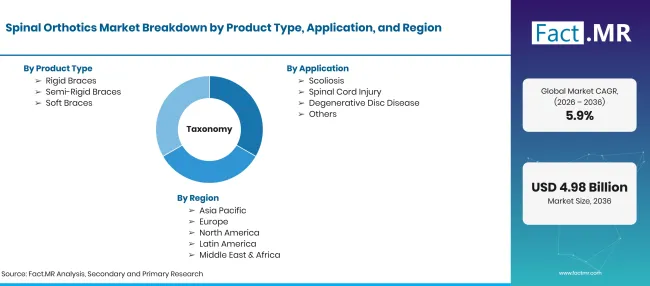
| Product Type | Rigid Braces; Semi-Rigid Braces; Soft Braces |
| Application | Scoliosis; Spinal Cord Injury; Degenerative Disc Disease; Others |
| End-User | Clinics; Hospitals; Homecare Settings |
| Distribution Channel | Orthopedic Clinics; Retail Pharmacies; Online Stores; Others |
| Countries Covered | Germany; Brazil; USA; UK; Japan |
| Companies Profiled | Enovis Corporation; Bauerfeind AG; Boston Orthotics & Prosthetics; Aspen Medical Products; DeRoyal Industries, Inc.; Breg, Inc.; Hanger, Inc.; Orthomerica Products, Inc.; Thuasne Group; Ottobock SE & Co. KGaA. |
| Approach | Clinical application mapping, product review and country growth comparisons. |
Source: Fact.MR analysis. Updated Nov 3, 2026
How is the market segmented?
-
By Product Type
- Rigid Braces
- Semi-Rigid Braces
- Soft Braces
-
By Application
- Scoliosis
- Spinal Cord Injury
- Degenerative Disc Disease
- Others
-
By End-User
- Clinics
- Hospitals
- Homecare Settings
-
By Distribution Channel
- Orthopedic Clinics
- Retail Pharmacies
- Online Stores
- Others
-
By Region
- North America
- Latin America
- Western Europe
- Eastern Europe
- East Asia
- South Asia & Pacific
- Middle East & Africa
Frequently Asked Questions
How big is the spinal orthotics market in 2026?
What is the CAGR from 2026 to 2036?
Which product type has the largest share?
Which application leads demand?
Who are the main companies in the spinal orthotics market?
Who worked on this report


Preview the report firsthand - request a free sample
Free SampleGet the brochure for pricing and purchase details
Download PDF