- Market Value (2025): USD 3.82 Bn
- Estimated Value (2026): USD 4.08 Bn
- Forecast Value (2036): USD 7.88 Bn
- CAGR (2026-2036): 6.8%
What is the Dynamic Orthotics Market forecast to be worth by 2036?
The market is estimated at USD 4.08 billion in 2026 and forecast to reach USD 7.88 billion by 2036, at a 6.8% CAGR.
- Fact.MR estimates, the dynamic orthotics market was valued at USD 3.82 billion in 2025.
- Revenue is forecast to increase from USD 4.08 billion in 2026 to USD 7.88 billion by 2036 as rehabilitation services continue to use fitted devices for mobility support.
- The market is projected to grow at a 6.8% CAGR from 2026 to 2036, with initial fittings, adjustments and replacements contributing to equipment demand.
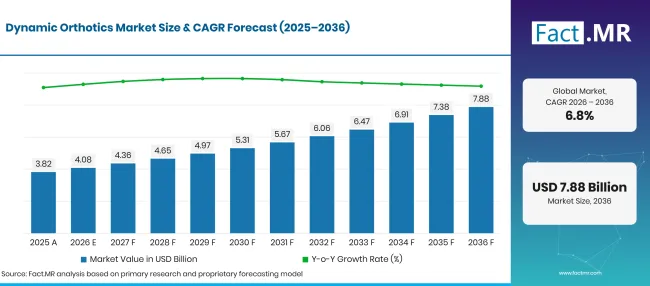
Dynamic Orthotics Market Forecast Global 1 | Source: Fact.MR
| Year | Basis | Market Value (USD billion) |
|---|---|---|
| 2025 | Actual | 3.82 |
| 2026 | Estimate | 4.08 |
| 2036 | Forecast | 7.88 |
| CAGR 2026 to 2036 | Forecast period | 6.8% |
Source: Fact.MR analysis. Updated Nov 2, 2026
What are the defining numbers behind Dynamic Orthotics Market growth?
USD 3.8 billion in additional market value by 2036, with ankle-foot orthoses and specialist fitting channels contributing to sales.
- Demand Drivers in the Market
- For rehabilitation teams, dynamic ankle-foot orthoses address foot drop while allowing greater flexibility than a fully rigid support. Clinical assessment and gait testing inform the design and stiffness selected.
- A patient’s walking pattern may change during rehabilitation, which makes follow-up fitting an important part of treatment. Clinics can adjust alignment as swelling decreases or strength improves, allowing a customized brace to continue meeting the patient’s needs.
- Specialist distributors help patients identify the correct size and understand when professional adjustment is needed. This fitting advice matters most for functional braces, while standard replacement accessories may be easier to purchase through other channels.
- Key Segments Analyzed
- By Product Type: Ankle-Foot Orthoses account for a projected 32.5% of 2026 value, reflecting their use in helping patients manage foot clearance and walking stability.
- By Application: Adults represent an estimated 48.3% of 2026 sales, as rehabilitation after injury and treatment of acquired mobility conditions create fitting needs.
- By End-User: Hospitals are projected to account for 34.2% of 2026 revenue, with device assessment and early rehabilitation forming part of inpatient care.
- By Distribution Channel: Specialty Stores are projected to generate 52.8% of 2026 sales, given the role of product selection and fitting support.
- Analyst Opinion at Fact.MR
- Shambhu Nath Jha, Principal Consultant at Fact.MR, states, “Dynamic orthoses require both an appropriate device and professional fitting. A brace that guides movement during a clinical assessment may need further adjustment when the patient resumes daily activities. Consistent sizing and dependable mechanical performance help manufacturers support clinicians and specialist suppliers.”
- Strategic Implications
- Manufacturers should explain each brace’s fitting range and material performance clearly so clinicians can match a model to the patient’s walking pattern.
- Orthopedic clinics should check comfort and gait performance at follow-up visits, recording adjustments that may affect continued use.
- Specialist retailers should recognize when a patient needs an assessment by a qualified orthotist rather than a standard brace selected from stock.
- Hospital teams should connect discharge instructions with outpatient rehabilitation so patients know when their brace may require adjustment.
Germany is forecast to grow at a 7.8% CAGR through 2036 as established clinical fitting channels serve rehabilitation needs. Brazil follows at 7.1% as mobility support reaches patients through orthopedic services. The USA is forecast at 6.5%, supported by professional fitting practices. The UK is estimated at 5.8% while Japan is projected at 5.1% as older patients seek practical movement support.
How does the Dynamic Orthotics Market break down by segment?
Ankle-Foot Orthoses account for 32.5%; Adults account for 48.3%; Hospitals represent 34.2%; Specialty Stores account for 52.8% in 2026.
Which Product Type dominates?
Ankle-Foot Orthoses account for 32.5% of 2026 value.
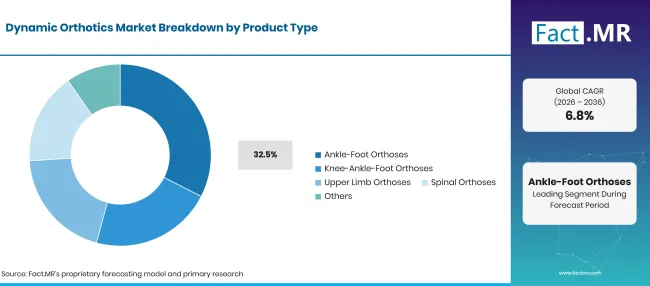
Dynamic Orthotics Market Breakdown Product Type | Source: Fact.MR
| Product Type | Share (2026) |
|---|---|
| Ankle-Foot Orthoses (Leading segment) | 32.5% |
| Other segments combined | 67.5% |
| Total | 100.0% |
Source: Fact.MR analysis. Updated Nov 2, 2026
Ankle-foot designs provide controlled assistance during the swing and stance phases of walking. Their stiffness and shape are chosen in response to the patient’s movement pattern. Knee-ankle-foot orthoses extend control above the knee and generally need more fitting work. Upper-limb devices support selected arm or hand functions, while spinal devices address trunk alignment and motion management. Other products serve narrower rehabilitation requirements. In ankle-foot care, follow-up is particularly important because changing gait and footwear can affect how the device performs.
What leads the Application segment?
Adults represent 48.3% of 2026 sales.
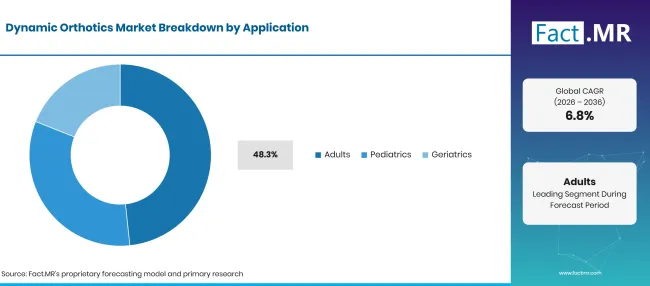
Dynamic Orthotics Market Breakdown Application | Source: Fact.MR
| Application | Share (2026) |
|---|---|
| Adults (Leading segment) | 48.3% |
| Other segments combined | 51.7% |
| Total | 100.0% |
Source: Fact.MR analysis. Updated Nov 2, 2026
Adult orthotic users include people recovering from injury and those managing neurological changes that affect walking. Device choice depends on strength and the clinical goal. Pediatric fittings must account for growth and repeated size changes, while geriatric care places added attention on putting the device on safely.
How does End-User influence purchasing?
Hospitals lead with 34.2% of 2026 value.
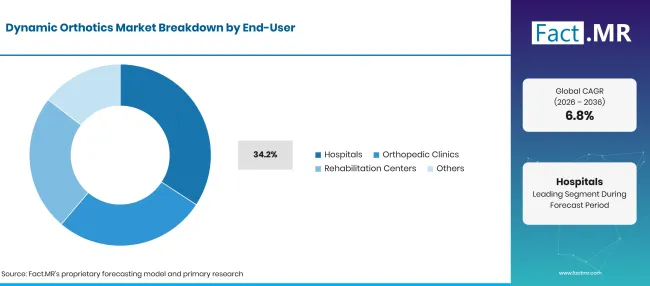
Dynamic Orthotics Market Breakdown End User | Source: Fact.MR
| End-User | Share (2026) |
|---|---|
| Hospitals (Leading segment) | 34.2% |
| Other segments combined | 65.8% |
| Total | 100.0% |
Source: Fact.MR analysis. Updated Nov 2, 2026
Hospitals initiate orthotic treatment after surgery or during an inpatient rehabilitation program. Clinicians test the device before patients return home and explain how to use it safely. Orthopedic clinics handle repeat visits and more focused assessments, while rehabilitation centers may monitor a brace during exercise and gait training. Other care settings also use orthoses for selected mobility needs.
Which Distribution Channel holds the larger share?
Specialty Stores capture 52.8% of 2026 sales.
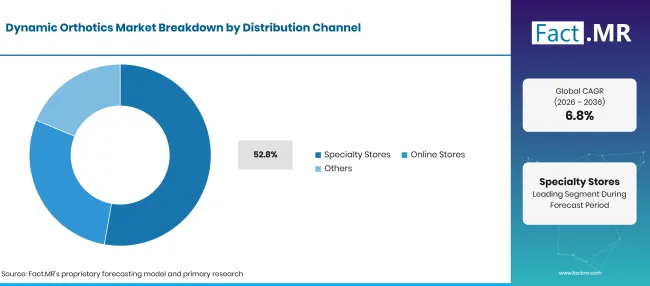
Dynamic Orthotics Market Breakdown Distribution Channel | Source: Fact.MR
| Distribution Channel | Share (2026) |
|---|---|
| Specialty Stores (Leading segment) | 52.8% |
| Other segments combined | 47.2% |
| Total | 100.0% |
Source: Fact.MR analysis. Updated Nov 2, 2026
For specialized ankle-foot orthoses, clinicians or qualified orthotists may need to assess gait, select the device and verify its fit. For functional ankle-foot devices, the clinical prescription and fitting process often determine where patients obtain the product. Online stores offer access to standard sizes and replacement accessories but require careful product selection. Other channels include direct clinical supply arrangements. Across channels, the distinction between a custom orthosis and a general support brace affects whether professional fitting is necessary.
What is accelerating Dynamic Orthotics Market adoption, and what is holding it back?
Gait rehabilitation and access to professional fitting support demand. Device costs and the need for repeat adjustments can limit adoption.
Drivers Impact Analysis
| DRIVER | (~) % IMPACT ON CAGR | GEOGRAPHIC RELEVANCE | IMPACT TIMELINE |
|---|---|---|---|
| Rehabilitation needs following mobility loss | +1.3% | Global | Long term |
| Personalized ankle-foot fitting | +1.1% | North America, Europe | Medium term |
| Outpatient orthopedic follow-up | +0.9% | North America, Europe | Medium term |
| Lighter functional brace designs | +0.7% | Global | Medium term |
| Specialist retail fitting access | +0.5% | Global | Short term |
Source: Fact.MR analysis. Updated Nov 2, 2026
Opportunity Impact Analysis
| OPPORTUNITY | (~) % IMPACT ON CAGR | GEOGRAPHIC RELEVANCE | IMPACT TIMELINE |
|---|---|---|---|
| Custom ankle-foot fitting services | +0.7% | North America, Europe | Medium term |
| Post-discharge rehabilitation support | +0.6% | Global | Medium term |
| Pediatric size-adjustment programs | +0.4% | Global | Long term |
| Remote ordering for repeat sizes | +0.3% | Global | Medium term |
Source: Fact.MR analysis. Updated Nov 2, 2026
Restraints Impact Analysis
| RESTRAINT | (~) % IMPACT ON CAGR | GEOGRAPHIC RELEVANCE | IMPACT TIMELINE |
|---|---|---|---|
| Patient expense and coverage rules | -0.7% | Global | Short term |
| Availability of trained fitting staff | -0.6% | Global | Medium term |
| Comfort and footwear compatibility | -0.5% | Global | Short term |
| Repeat review after size changes | -0.3% | Global | Medium term |
Source: Fact.MR analysis. Updated Nov 2, 2026
Which countries are scaling the Dynamic Orthotics Market through 2036?
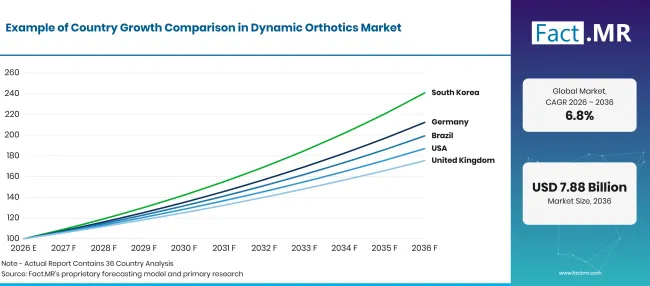
Dynamic Orthotics Market Growth Index | Source: Fact.MR
| Country | CAGR (2026 to 2036) |
|---|---|
| Germany | 7.8% |
| Brazil | 7.1% |
| USA | 6.5% |
| UK | 5.8% |
| Japan | 5.1% |
Source: Fact.MR analysis. Updated Nov 2, 2026
What supports dynamic orthotics adoption in Germany?
7.8% CAGR, associated with clinical fitting and rehabilitation services.
German rehabilitation teams consider walking ability and joint stability before recommending an orthosis. Destatis reported in July 2026 that around 7.8 million people had severe disabilities at the end of 2025, accounting for 9.4% of Germany’s population [2]. Hospital and outpatient teams can coordinate these appointments so patients receive support beyond the initial fitting.
How is Brazil developing demand for dynamic orthotics?
7.1% CAGR, linked to access to mobility assessment and fitted support.
Brazilian rehabilitation providers assess gait and balance when deciding whether an ankle-foot orthosis could help a patient move more safely. IBGE reported in June 2025 that Brazil’s 2022 census identified 14.4 million people aged two years or older with disabilities, equivalent to 7.3% of that age group [3]. Orthopedic clinics and specialist distributors support individual assessment and replacement of established devices.
What shapes demand for dynamic orthotics in the USA?
6.5% CAGR, supported by established professional fitting services.
In the United States, orthotists work with hospital and outpatient teams to choose braces for specific movement problems. The Bureau of Labor Statistics projects 13% employment growth for orthotists and prosthetists between 2025 and 2035 [1]. It identifies population aging, obesity, diabetes and traumatic injuries as factors influencing demand for these professionals.
How is the UK market progressing?
5.8% CAGR, related to mobility needs and community rehabilitation.
UK orthotic care is delivered through hospital departments and community rehabilitation services. The Department for Work and Pensions reported 16.7 million disabled people, or 25% of the UK population, in its 2024 to 2025 Family Resources Survey [4]. Clinicians identify movement difficulties and refer patients for an appropriate device, while community teams can assess its performance at home and during ordinary activities.
What is influencing dynamic orthotics in Japan?
5.1% CAGR, associated with mobility support for older adults.
Japanese rehabilitation services pay close attention to safe walking and everyday comfort, particularly for older adults. The Statistics Bureau reported in September 2026 that approximately 36.24 million people in Japan were aged 65 or older, accounting for 29.6% of the population [5]. Clinicians assess foot clearance and walking stability before choosing an ankle-foot device, including fastening methods that patients can handle independently.
Who leads the Dynamic Orthotics Market?
The market includes clinical fitting providers and manufacturers of functional orthoses. Hanger Clinic provides patient assessment and fitting services, while Enovis, Ottobock, Breg and Bauerfeind offer orthopedic bracing products.
Thuasne supplies the SpryStep ankle-foot range, and Essity offers Actimove supports. DeRoyal supplies medical braces, Fillauer provides orthotic and prosthetic technology, and Allard USA offers carbon-composite ankle-foot orthoses, including ToeOFF and BlueROCKER. Their portfolios differ, so direct dynamic-orthosis suppliers should be distinguished from companies with broader bracing ranges.
Which companies are the key providers?
Key companies include Hanger Clinic (Hanger, Inc.), Enovis Corporation, Ottobock SE & Co. KGaA, Breg Inc., Bauerfeind AG, Essity AB (Actimove / BSN Medical), Thuasne Group, DeRoyal Industries, Inc., Fillauer LLC and Allard USA Inc.
- Hanger Clinic (Hanger, Inc.)
- Enovis Corporation
- Ottobock SE & Co. KGaA
- Breg Inc.
- Bauerfeind AG
- Essity AB (Actimove / BSN Medical)
- Thuasne Group
- DeRoyal Industries, Inc.
- Fillauer LLC
- Allard USA Inc.
Bibliography
- [1] U.S. Bureau of Labor Statistics. (2026, August 27). Orthotists and prosthetists. Occupational Outlook Handbook
- [2] Statistisches Bundesamt (Destatis). (2026, July 13). 7,8 Millionen schwerbehinderte Menschen leben in Deutschland.
- [3] Instituto Brasileiro de Geografia e Estatística. (2025, June 24). Censo 2022: 7,3% da população com 2 anos ou mais tinha alguma deficiência.
- [4] Department for Work and Pensions. (2026, March 26). Family Resources Survey: Financial year 2024 to 2025
- [5] Statistics Bureau of Japan. (2026, September 20).[Statistical Topics No. 149: Older persons in Japan].
This Report Answers
- How dynamic ankle-foot designs differ from broader orthopedic supports in clinical use.
- How adult rehabilitation and pediatric follow-up influence orthosis selection.
- Why fitting services are central to hospital and specialist-store purchasing routes.
- How country-level disability and demographic indicators relate to potential rehabilitation needs.
- Which product groups and suppliers participate in functional orthotic care.
What does the Dynamic Orthotics Market cover?
Dynamic orthoses are braces intended to assist or guide selected movements while providing support. The scope includes functional ankle-foot braces and other fitted orthopedic devices that rely on controlled movement or flex. Sales are considered across clinical and specialist distribution routes. Lower-limb devices sit alongside the broader lower-limb orthotics category in rehabilitation spending.
What is included in the scope?
Ankle-foot orthoses and knee-ankle-foot orthoses used in rehabilitation form the central product groups.
Relevant upper-limb and spinal devices also enter the category where the design allows functional movement. Hospital and outpatient purchases are included, as are specialist-store sales and suitable online orders. Orthopedic support selection also overlaps with orthopedic braces and supports used for joint stability.
What is excluded from the scope?
Artificial limbs are outside this category because prostheses replace missing body parts. General footwear and clothing are also excluded, as are fully rigid immobilization products that provide no intended movement assistance.
How Was the Analysis Built?
The analysis draws on 120+ sources, 35+ company portfolios, 25+ countries, and more than 20 industry interviews.
- Primary Research: Primary research includes discussions with manufacturers, service providers, technology developers, distributors, end users, and subject-matter experts. These conversations examine purchasing priorities, product adoption, operational challenges, approval requirements, competitive positioning, and the factors that influence wider market acceptance.
- Desk Research: Desk research covers government statistics, regulatory publications, company filings, trade data, technical studies, industry associations, standards, public policy, and other authoritative sources. Every source used in the analysis is documented in the bibliography.
- Market Sizing and Forecasting: Market estimates combine historical performance, demand indicators, pricing and volume trends, segment shares, company participation, country-level growth, adoption patterns, investment activity, and barriers to market expansion.
- Data Validation and Update Cycle: Findings are validated by comparing primary interviews with public data, company activity, regulatory changes, trade patterns, and industry developments. Regular updates review new product launches, capacity changes, partnerships, approvals, and shifts in commercial adoption.
Segmentation
What is the report’s scope and coverage?
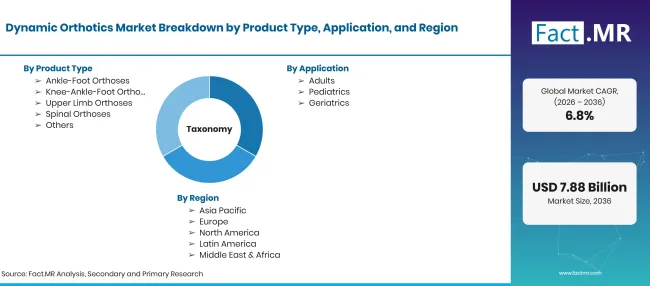
Dynamic Orthotics Market Taxonomy | Source: Fact.MR
| Attribute | Details |
|---|---|
| Quantitative Units | USD billion |
| Market Definition | Functional orthotic devices providing controlled movement assistance or dynamic response, primarily ankle-foot and knee-ankle-foot orthoses and selected upper-limb and spinal designs. |
| Product Type | Ankle-Foot Orthoses; Knee-Ankle-Foot Orthoses; Upper Limb Orthoses; Spinal Orthoses; Others |
| Application | Adults; Pediatrics; Geriatrics |
| End-User | Hospitals; Orthopedic Clinics; Rehabilitation Centers; Others |
| Distribution Channel | Specialty Stores; Online Stores; Others |
| Regions Covered | North America; Latin America; Western Europe; Eastern Europe; East Asia; South Asia & Pacific; Middle East & Africa |
| Countries Covered | Germany; Brazil; USA; UK; Japan |
| Companies Profiled | Hanger Clinic (Hanger, Inc.); Enovis Corporation; Ottobock SE & Co. KGaA; Breg Inc.; Bauerfeind AG; Essity AB (Actimove / BSN Medical); Thuasne Group; DeRoyal Industries, Inc.; Fillauer LLC; Allard USA Inc. |
| Forecast Period | 2026 to 2036 |
| Approach | Forecast segmentation and directional review of clinical demand, device fitting and supplier portfolios. |
Source: Fact.MR analysis. Updated Nov 2, 2026
How is the market segmented?
-
By Product Type
- Ankle-Foot Orthoses
- Knee-Ankle-Foot Orthoses
- Upper Limb Orthoses
- Spinal Orthoses
- Others
-
By Application
- Adults
- Pediatrics
- Geriatrics
-
By End-User
- Hospitals
- Orthopedic Clinics
- Rehabilitation Centers
- Others
-
By Distribution Channel
- Specialty Stores
- Online Stores
- Others
-
By Region
- North America
- Latin America
- Western Europe
- Eastern Europe
- East Asia
- South Asia & Pacific
- Middle East & Africa
Frequently Asked Questions
How big is the dynamic orthotics market in 2026?
What is the market CAGR from 2026 to 2036?
Which product type has the largest share?
Which application accounts for the largest share?
Which companies participate in the market?
Who worked on this report


Preview the report firsthand - request a free sample
Free SampleGet the brochure for pricing and purchase details
Download PDF