- Market Value (2025): USD 578.5 Mn
- Estimated Value (2026): USD 653.1 Mn
- Forecast Value (2036): USD 2197.5 Mn
- CAGR (2026-2036): 12.9%
What is the Sports Nutrition and Dietary Supplements Testing and Certification market forecast to be worth by 2036?
USD 653.1 million in 2026 to USD 2,197.5 million by 2036, at 12.9% CAGR.
- The sports nutrition and dietary supplements testing and certification market crossed a valuation of USD 578.5 million in 2025.
- Demand is expected to increase from USD 653.1 million in 2026 to USD 2,197.5 million by 2036.
- The market is forecast to record a 12.9% CAGR from 2026 to 2036 supported by expanded documented quality programs for complex products.
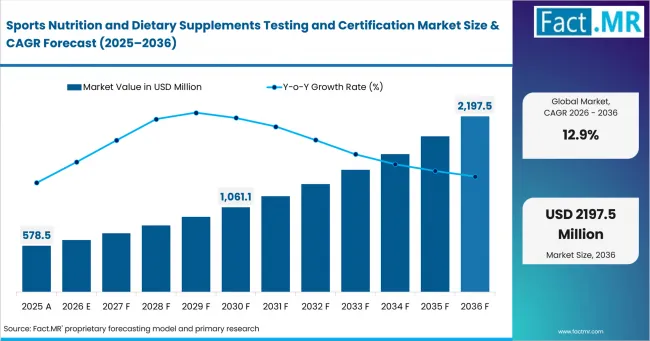
Sports Nutrition And Dietary Supplements Testing And Certification Market Market Value Analysis | Source: Fact.MR
What are the defining numbers behind Sports Nutrition and Dietary Supplements Testing and Certification market growth?
USD 1,544.4 million absolute opportunity by 2036, led by analytical testing and supplement-manufacturer quality programs.
- Demand Drivers in the Market
- Supplement manufacturers require identity and potency evidence supported by validated methods that remain effective across changing product matrices.
- Contract manufacturers benefit from standardized batch records due to frequent customer audits and multi-product production environments.
- Distributors and importers must secure market-entry documentation that reflects national labeling rules and ingredient-specific compliance obligations.
- Private-label owners increasingly rely on independent evidence because outsourced manufacturing reduces direct oversight of laboratory controls and release decisions.
- Key Segments Analyzed
- By Type: Analytical Testing is expected to account for 34% share in 2026 driven by identity checks and multi-analyte quantification needs.
- By Ingredient: Vitamins are projected to hold 22% share in 2026 supported by label-claim verification and stability-sensitive content measurement.
- By Service Provider: Testing Laboratories and Companies are anticipated to capture 55% share in 2026 owing to instrument depth and accredited method coverage.
- By End Use: Supplement Manufacturers are estimated to represent 52% share in 2026 shaped by release testing and retailer-facing compliance files.
- Analyst Opinion at Fact.MR
- Shambhu Nath Jha, Senior Analyst at Fact.MR states, “The real challenge is not simply getting one sample tested. Brands need methods that remain reliable after formulation changes and records that link each result to a defined batch. Providers combining strong analytical methods with sport-specific screening are expected to secure more recurring programs across repeat production cycles.”
- Strategic Implications
- Testing laboratories should build matrix-specific method packages that combine identity work with potency and contaminant verification.
- Supplement manufacturers should define testing plans before scale-up so formulation changes do not create late validation work.
- Contract manufacturers should separate customer-specific release criteria from shared facility controls and document both evidence layers clearly.
- Certification providers should publish program scope and sampling frequency so brands compare coverage before committing to a seal.
Growing demand for certified sports supplements is driving testing providers to expand banned-substance screening and strengthen product traceability across athlete-focused distribution channels. For instance, Eurofins Supplement Testing and Eurofins Assurance launched the Clean Sport Certified product certification programme in October 2025 after expanding screening beyond 400 prohibited compounds across competitive sport. The move reflects a wider shift toward certification programs that connect broad banned-substance screening with traceable product records for athlete-facing distribution and recurring retailer compliance review.
China is projected to record a 17.2% CAGR by 2036, supported by health-food registration work and export-oriented supplement manufacturing. India is expected to post a 15.8% CAGR during the forecast period, driven by nutraceutical formulation activity and wider quality-control outsourcing. Japan is anticipated to advance at a 14.2% CAGR over the assessment period, shaped by detailed ingredient rules and evidence-based product review. Germany is estimated to record a 13.9% CAGR between 2026 and 2036, attributable to notification duties and European compliance documentation. The United States is forecast to post a 13.4% CAGR by 2036, reinforced by manufacturer responsibility and retailer verification requirements.
How does the Sports Nutrition and Dietary Supplements Testing and Certification market break down by segment?
Analytical Testing leads at 34%; Testing Laboratories and Companies lead at 55%.
Which testing type dominates?
Analytical Testing holds 34% share in 2026.
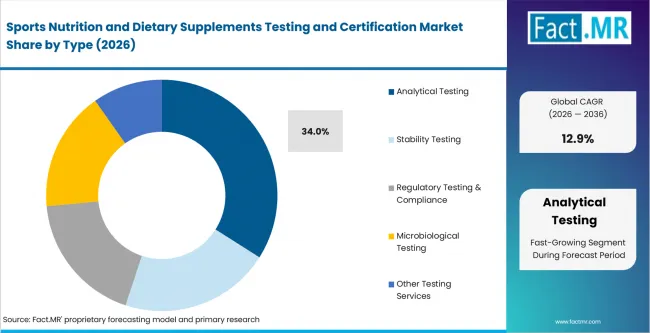
Sports Nutrition And Dietary Supplements Testing And Certification Market Analysis By Type | Source: Fact.MR
Analytical Testing is expected to hold 34% share in 2026 driven by routine identity work and quantitative label-claim verification. Stability Testing follows when brands need documented evidence across accelerated studies and real-time shelf-life monitoring programs. Regulatory Testing and Compliance supports market-entry files for supplement products moving between jurisdictions that apply different ingredient rules. Microbiological Testing remains necessary for powders and other products where moisture exposure creates release risk. BSCG explained in June 2026 that certification programs evaluate formulation and manufacturing practices before ongoing compliance moves into continued lot or batch testing.
What leads the ingredient segment?
Vitamins account for 22% share in 2026.
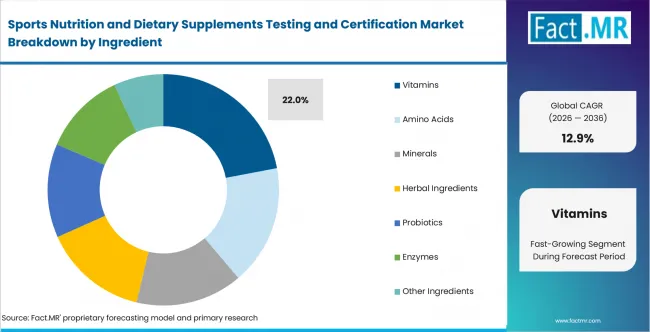
Sports Nutrition And Dietary Supplements Testing And Certification Market Analysis By Ingredient | Source: Fact.MR
Vitamins are projected to hold 22% share in 2026 supported by wide formulation use and direct label-claim exposure. Amino Acids follow in sports products where formulas commonly combine multiple free-form components with protein-derived ingredients. Mineral testing requires element-specific measurement methods and careful interference control across increasingly complex supplement product matrices. CDC reported in May 2026 that 60.2% of U.S. adults used at least one dietary supplement during the August 2021 to August 2023 survey period. Herbal Ingredients add identification work because botanical identity and extraction conditions directly affect method selection and testing plans.
How does service-provider choice shape demand?
Testing Laboratories and Companies leads with 55% share in 2026.
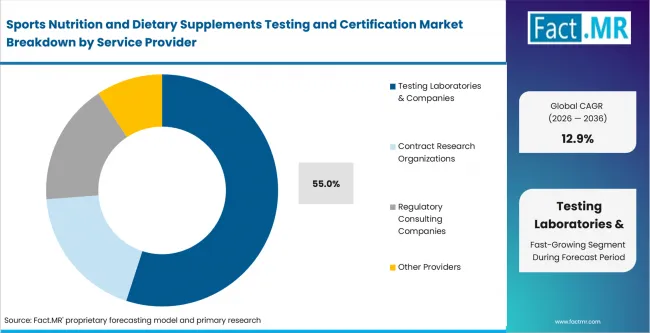
Sports Nutrition And Dietary Supplements Testing And Certification Market Analysis By Service Provider | Source: Fact.MR
Testing Laboratories and Companies are anticipated to hold 55% share in 2026 owing to instrument investment and specialist method teams. Contract Research Organizations follow where testing connects with development studies and broader formal research support programs. Regulatory Consulting Companies contribute when brands need interpretation alongside laboratory evidence for complex cross-border market entry requirements. Other Providers cover narrower specialist roles and local certification services for brands with limited geographic distribution needs. UL Solutions reported in April 2025 that its Shanghai facility had added dietary supplement capabilities within a broader laboratory service expansion.
What supports supplement manufacturers within end use?
Supplement Manufacturers dominates with 52% share in 2026.
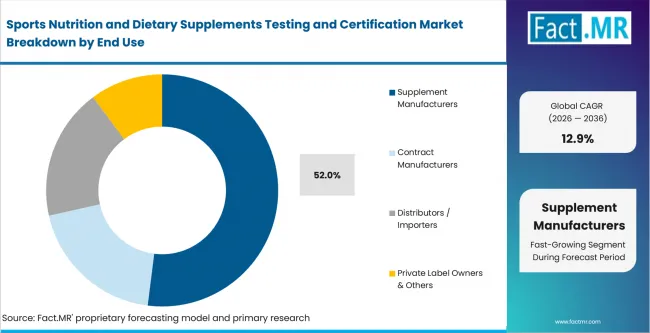
Sports Nutrition And Dietary Supplements Testing And Certification Market Analysis By End Use | Source: Fact.MR
Supplement Manufacturers are estimated to account for 52% share in 2026 shaped by direct responsibility for product specifications and release evidence. Contract Manufacturers follow because shared facilities need customer-specific records across varied products and recurring production schedules. Distributors and Importers commission testing when cross-border documentation and retailer checks require independent evidence for commercial product acceptance. FDA’s April 2025 warning letter to Anti L’Age identified label lot number 75001 as unrelated to an actual finished-product batch identifier. Private Label Owners use outside laboratories to verify outsourced production against agreed specifications and documented release criteria.
What supports supplement manufacturers within end use?
Supplement Manufacturers hold 52% share in 2026.
Supplement Manufacturers are estimated to account for 52% share in 2026 shaped by direct responsibility for product specifications and release evidence. Contract Manufacturers follow because shared facilities need customer-specific records across varied products and recurring production schedules. Distributors and Importers commission testing when cross-border documentation and retailer checks require independent evidence for commercial product acceptance. FDA’s April 2025 warning letter to Anti L’Age identified label lot number 75001 as unrelated to an actual finished-product batch identifier. Private Label Owners use outside laboratories to verify outsourced production against agreed specifications and documented release criteria.
What is accelerating Sports Nutrition and Dietary Supplements Testing and Certification Market adoption, and what is holding it back?
Drivers Impact Analysis
| DRIVER | (~) % IMPACT ON CAGR | GEOGRAPHIC RELEVANCE | IMPACT TIMELINE |
|---|---|---|---|
| Regulatory and retailer documentation requirements | +1.3% | North America, Europe, East Asia | Short term (≤ 2 years) |
| Banned-substance risk in athlete-facing products | +1.1% | United States, Europe, Australia, Japan | Short term (≤ 2 years) |
| Multi-ingredient formulation complexity | +0.9% | Global, particularly relevant to sports nutrition portfolios | Medium term (2–4 years) |
| Cross-border market-entry testing | +0.7% | China, India, Germany, United States | Medium term (2–4 years) |
| Outsourced quality and certification programs | +0.6% | Global, particularly relevant to mid-sized brands | Long term (≥ 4 years) |
Source: Fact.MR analysis. Updated Jul 7, 2026
- Regulatory and retailer documentation
- Documentation requirements raise the value of repeatable records that connect product specifications to defined samples and production lots. Supplement brands need one evidence chain linking incoming ingredient identity results with finished-product release decisions across recurring production cycles. Retail platforms are also formalizing verification pathways before certain supplement listings receive streamlined approval and faster compliance review. USP announced in November 2025 that it had been named a participating certifier in Amazon’s Compliance Fast-Track Program for dietary supplements. Program participation is expected to increase demand for recognized third-party evidence among brands seeking faster retailer compliance review.
- Banned-substance risk
- Athlete-facing products carry a distinct contamination and labeling risk profile because prohibited compounds trigger serious eligibility consequences for drug-tested athletes. Sport Integrity Australia reported in April 2025 that 35% of its tested online supplement sample contained prohibited substances. That exposure increases the value of defined screening panels and lot traceability for brands serving athletes subject to drug testing. Every-batch programs are projected to gain wider use where brands sell to professional athletes and other drug-tested groups.
- Multi-ingredient formulation complexity
- Sports powders often combine vitamins and amino acids with botanicals or stimulant-like compounds inside one finished product matrix. Each added component changes extraction recovery and introduces interference risks during routine quantitative testing across complex supplement matrices. A validated method for one formulation often needs partial redevelopment after flavor or ingredient changes. Testing demand is anticipated to rise as manufacturers move more complex formulas through shorter product-refresh cycles.
- Cross-border market-entry testing
- Cross-border sales create repeated documentation work because ingredient status and claim rules differ across major markets. China uses health-food registration and filing routes for defined products that require structured technical documentation before commercial placement. Germany requires supplement notification before products are marketed which adds a formal documentation step for brands entering the country. Brands therefore need evidence packages that travel with the product and still support local interpretation across destination-country requirements. Multi-country laboratory programs are estimated to expand around export-focused manufacturers that need consistent methods across several destination markets.
- Outsourced quality programs
- Smaller supplement brands often lack the instruments and specialist staff needed for broad analytical coverage. External laboratories provide access to chromatography and microbiology within one coordinated program that reduces handoffs between specialist service providers. Certification providers also add defined sampling rules and public product records that help commercial teams verify active program status. Recurring outsourced programs are forecast to expand as brands seek consistent records without building every capability internally.
Opportunity Impact Analysis
| OPPORTUNITY | (~) % IMPACT ON CAGR | GEOGRAPHIC RELEVANCE | IMPACT TIMELINE |
|---|---|---|---|
| Batch-level sport certification programs | +0.9% | United States, Europe, Japan, Australia | Short term (≤ 2 years) |
| Multi-analyte screening panels | +0.8% | North America, Europe, East Asia | Medium term (2–4 years) |
| Electronic certificate and lot-traceability records | +0.7% | Global retail and e-commerce channels | Medium term (2–4 years) |
| Probiotic identity and potency test packages | +0.6% | United States, Europe, Japan, China | Long term (≥ 4 years) |
Source: Fact.MR analysis. Updated Jul 7, 2026
- Batch-level sport certification
- Batch-linked certification extends beyond one-time product qualification by tying laboratory evidence to defined production runs. Brands serving athletes need records linked to each lot and a clearly stated screening scope for compliance review. NSF reported in January 2025 that its Certified for Sport program includes batch testing alongside banned-substance screening and contaminant checks. Certification demand is expected to deepen where institutional purchasers require traceable evidence before approving products.
- Multi-analyte screening panels
- Broad screening panels reduce handoffs between separate laboratories and shorten review cycles for brands managing complex athlete-facing portfolios. WADA published its 2026 Prohibited List in September 2025 after adding examples or clarifications across several substance classes. Wider panel adoption is projected to favor laboratories that update methods quickly when prohibited lists change. Method transparency remains essential when brands compare panel scope with practical coverage and reporting thresholds.
- Electronic lot traceability
- Certification records become more useful when product and batch status is easy to verify online. Public databases allow athletes and procurement teams to check whether a specific lot sits inside an active program. Electronic certificates reduce uncertainty during retailer review by giving compliance teams a clear route for checking current status. Adoption is anticipated to expand where e-commerce channels connect listing approval to structured third-party documentation.
- Probiotic test packages
- Probiotic products create a distinct service opportunity around strain identity and viable-count measurement across formulation and shelf-life stages. Formulators also need stability evidence because probiotic potency changes during shelf life and directly affects label-claim compliance at expiry. SGS listed the International Probiotics Testing Standards programme within its Nutrasource portfolio for SupplySide Global in October 2025. Demand is estimated to rise for packages combining strain identity work with end-of-shelf-life potency verification across finished products.
Restraints Impact Analysis
| RESTRAINT | (~) % IMPACT ON CAGR | GEOGRAPHIC RELEVANCE | IMPACT TIMELINE |
|---|---|---|---|
| Method validation and matrix interference costs | -0.8% | Global | Short term (≤ 2 years) |
| Testing cost pressure for small supplement brands | -0.7% | India, Latin America, smaller US brands | Short term (≤ 2 years) |
| Reference-standard and method coverage gaps | -0.5% | Botanicals and emerging ingredients globally | Medium term (2–4 years) |
| Regulatory divergence across national markets | -0.4% | Global exporters | Long term (≥ 4 years) |
Source: Fact.MR analysis. Updated Jul 7, 2026
- Method validation and matrix interference
- Method validation cost is the clearest restraint for complex formulations that require recovery studies and interference checks before routine release testing. A procedure that works for a simple capsule sometimes performs differently in flavored powders or botanical blends. Additional validation work adds time before routine testing begins across flavored powders and multi-ingredient supplement matrices. Service providers are expected to manage this constraint by developing validated method groups for similar product types without treating every formula as identical.
- Testing cost pressure
- Testing budgets limit program depth for small brands that manage many flavors or frequently change product lines. Every-lot testing becomes expensive when each flavor variant requires a separate sample and report across repeated production cycles. Brands often narrow testing panels to immediate compliance needs when broader certification programs exceed available quality-assurance budgets. Tiered service packages are projected to expand where laboratories separate mandatory release work from optional certification layers.
- Reference-standard gaps
- Emerging botanicals and novel ingredients often lack readily available reference materials or fully harmonized methods. Laboratories then face slower method setup and greater uncertainty when comparing internal procedures with external reference methods. USP announced more than 350 expert volunteers for its 2025–2030 committee cycle in July 2025. Provider demand is anticipated to favor laboratories that combine reference-material access with proficiency-testing experience across difficult supplement ingredients.
- Regulatory divergence
- A test result does not automatically satisfy every jurisdiction because ingredient classifications and claim rules differ. Japan uses separate food-safety requirements for supplement ingredients and additives which changes the documentation context for commercial products. Germany requires supplement notification before marketing which adds another procedural step alongside analytical evidence and product documentation. Exporters therefore carry interpretation costs beyond the laboratory result when the same product enters markets with different ingredient rules. Regulatory advisory services are forecast to remain attached to cross-border testing programs serving brands with multi-country distribution strategies.
Which countries are scaling Sports Nutrition and Dietary Supplements Testing and Certification fastest?
China 17.2%; India 15.8%; Japan 14.2%; Germany 13.9%; United States 13.4% ;Brazil 12.8%; Saudi Arabia 12.1% through 2036.
The market is segmented into North America; Asia Pacific; Europe; Latin America; and the Middle East & Africa.
| Country | CAGR |
|---|---|
| China | 17.2% |
| India | 15.8% |
| Japan | 14.2% |
| Germany | 13.9% |
| United States | 13.4% |
| Brazil | 12.8% |
| Saudi Arabia | 12.1% |
Source: Fact.MR analysis. Updated Jul 7, 2026
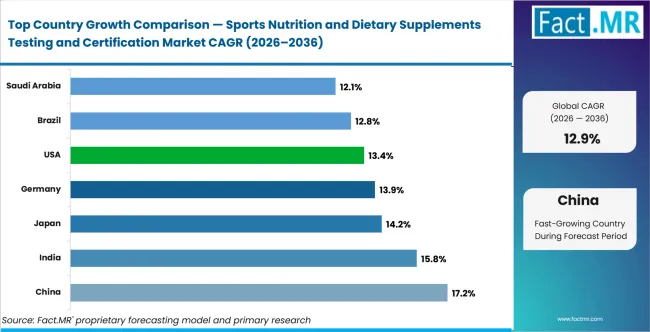
Sports Nutrition And Dietary Supplements Testing And Certification Market Cagr Analysis By Country | Source: Fact.MR
What is powering China’s lead?
17.2% CAGR through 2036, driven by health-food registration work and export-oriented manufacturing.
Formal health-food registration and filing work shape testing demand across products that require structured technical documentation. China’s State Administration for Market Regulation reported 237 applications in November 2025 for one registration category covering new-ingredient and first-imported health foods. The market is projected to record 17.2% CAGR through 2036 supported by laboratories that combine local regulatory knowledge with export testing.
How is India scaling supplement testing demand?
15.8% CAGR through 2036, supported by nutraceutical formulation activity and outsourced quality control.
India’s supplement manufacturers are widening outsourced testing as product portfolios expand across health supplements and nutraceutical formats. FSSAI published an updated non-specified food and ingredient application register in January 2026 which confirms active product-approval administration across complex ingredients. Quality programs are expected to expand at 15.8% CAGR through 2036 supported by laboratories that combine routine chemistry with regulatory interpretation for export programs.
What supports the Japan outlook?
14.2% CAGR through 2036, shaped by ingredient rules and detailed food-safety evaluation.
Japan’s supplement testing programs operate inside detailed food-safety rules that require careful interpretation of ingredient categories and product specifications. The Consumer Affairs Agency convened a supplement regulation review session in November 2025 which placed current regulatory requirements on the formal agenda. Testing demand is anticipated to advance at 14.2% CAGR through 2036 owing to providers that combine local specification knowledge with clear import documentation.
What underpins Germany’s growth?
13.9% CAGR between 2026 and 2036, attributable to notification duties and European compliance documentation.
Germany combines European food rules with a national notification step for dietary supplements entering commercial sale. The Federal Office of Consumer Protection and Food Safety reiterated this notification requirement in January 2025 before products are marketed. Demand is estimated to record 13.9% CAGR through 2036 attributable to laboratories that pair analytical reports with clear ingredient and claim documentation.
How does the United States market expand?
13.4% CAGR by 2036, reinforced by manufacturer responsibility and retailer verification requirements.
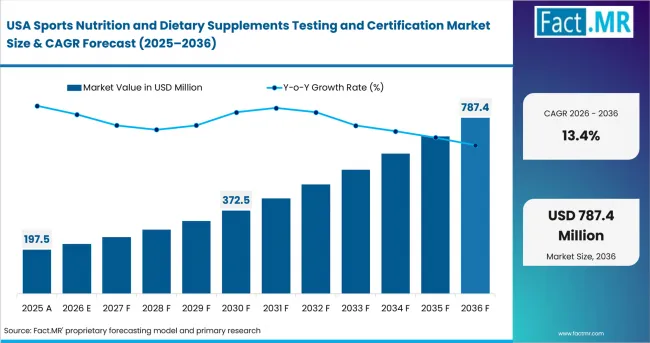
Sports Nutrition And Dietary Supplements Testing And Certification Market Country Value Analysis | Source: Fact.MR
United States supplement companies carry initial responsibility for product quality and labeling compliance under FDA oversight. FDA’s August 2025 dietary supplement compliance program directs inspections toward labeling requirements and CGMP compliance across domestic and foreign establishments. The market is forecast to post 13.4% CAGR through 2036 reinforced by external testing needs for release specifications and retailer verification pathways.
Who leads the Sports Nutrition and Dietary Supplements Testing and Certification market?
NSF and Eurofins Scientific anchor direct testing and certification coverage, while SGS Nutrasource and LGC Limited strengthen specialized supplement assurance programs.
NSF combines supplement certification with sport-focused screening and batch testing for brands selling into athlete-facing channels. Eurofins Scientific combines broad analytical services with product certification programs designed for sports nutrition brands seeking repeatable assurance. SGS Nutrasource covers specialized testing and regulatory support alongside ingredient-specific certification programs for probiotic and natural-product categories. These providers compete through method scope and reporting clarity while certification frequency creates another practical difference for commercial accounts. Service models also differ by sampling frequency and the level of regulatory support attached to laboratory work.
Intertek Group plc supports supplement companies through testing and scientific regulatory services tied to product development and market-entry planning. BSCG LLC focuses on banned-substance screening and certification programs designed for athlete-facing products and other drug-tested groups. UL Solutions adds laboratory capacity across major manufacturing regions through its wider consumer-product testing network. Competition through 2036 is expected to be shaped by matrix-specific validation and lot traceability across recurring supplement production programs. Provider reach is forecast to influence selection for multinational contracts that require consistent methods and coordinated reporting.
Which companies are the key providers?
NSF and Eurofins Scientific are key providers while SGS Nutrasource and LGC Limited are also profiled; Intertek Group plc and BSCG LLC join UL Solutions in the company set.
- NSF
- Eurofins Scientific
- Intertek Group plc
- BSCG LLC
- UL Solutions
- SGS Nutrasource
- LGC Limited
What is the report’s scope and coverage?
| Attribute | Details |
|---|---|
| Quantitative Units | USD Million |
| Market Definition | Laboratory testing and certification services that verify supplement identity; potency; stability; microbiological quality; compliance and athlete-focused product assurance |
| Type | Analytical Testing; Stability Testing; Regulatory Testing & Compliance; Microbiological Testing; Banned-substance Screening and Certification |
| Ingredient | Vitamins; Amino Acids; Minerals; Herbal Ingredients; Probiotics; Enzymes |
| Service Provider | Testing Laboratories and Companies; Contract Research Organizations; Regulatory Consulting Companies; Other Providers |
| End Use | Supplement Manufacturers; Contract Manufacturers; Distributors and Importers; Private Label Owners |
| Regions Covered | North America; Europe; East Asia; South Asia and Pacific; Latin America; Middle East and Africa |
| Countries Covered | China; India; Japan; Germany; United States |
| Key Companies Profiled | NSF; Eurofins Scientific; Intertek Group plc; BSCG LLC; UL Solutions; SGS Nutrasource; LGC Limited |
| Forecast Period | 2026 to 2036 |
| Approach | Hybrid top-down and bottom-up approach using supplement production activity; outsourced testing intensity; test frequency; average service value; analytical complexity; certification schedules and laboratory provider validation |
Source: Fact.MR analysis. Updated Jul 7, 2026
How is the market segmented?
-
By Type
- Analytical Testing
- Stability Testing
- Regulatory Testing & Compliance
- Microbiological Testing
- Other Testing Services
-
By Ingredient
- Vitamins
- Amino Acids
- Minerals
- Herbal Ingredients
- Probiotics
- Enzymes
- Other Ingredients
-
By Service Provider
- Testing Laboratories and Companies
- Contract Research Organizations
- Regulatory Consulting Companies
- Other Providers
-
By End Use
- Supplement Manufacturers
- Contract Manufacturers
- Distributors and Importers
- Private Label Owners
- Others
-
Region
- North America
- United States
- Canada
- Europe
- Germany
- United Kingdom
- France
- Italy
- Netherlands
- Asia Pacific
- China
- India
- Japan
- Australia
- South Korea
- Singapore
- Latin America
- Brazil
- Mexico
- Argentina
- Middle East & Africa
- UAE
- Saudi Arabia
- South Africa
- North America
Bibliography
- Sport Integrity Australia. (2025, April 9). New supplement survey finds one in three products contain banned substances. Sport Integrity Australia.
- Banned Substances Control Group. (2026, June 8). Supplement Testing Lab Choice: BSCG, Informed Sport, NSF. BSCG.
- Bundesamt für Verbraucherschutz und Lebensmittelsicherheit. (2025, January 27). Keine Zulassung von Nahrungsergänzungsmitteln notwendig. BVL.
- Centers for Disease Control and Prevention. (2026, May 21). Dietary Supplement Use: United States, August 2021–August 2023. National Center for Health Statistics.
- Eurofins Scientific. (2025, October 20). Eurofins Supplement Testing and Eurofins Assurance launch Clean Sport Certified product certification programme. Eurofins Scientific.
- Food and Drug Administration. (2025, April 17). Anti L’Age - 698661 - 04/17/2025. U.S. Food and Drug Administration.
- Food and Drug Administration. (2025, August 18). CP 7321.008, Dietary Supplements – Foreign and Domestic Inspections, Sampling, and Imports. U.S. Food and Drug Administration.
- Food Safety and Standards Authority of India. (2026, January 15). List of product(s)/ingredient(s) applications “Approved” under Food Safety and Standards (Approval for Non-Specified Food and Food Ingredients) Regulations, 2017 as on 15th January, 2026. FSSAI.
- NSF. (2025, January 21). David Beckham Co-Founded Supplements Brand IM8 Earns NSF Certified for Sport®. NSF.
- SGS Société Générale de Surveillance SA. (2025, October 27). SupplySide Global 2025. SGS.
- UL Solutions. (2025, April 18). UL Solutions Expands Testing Capabilities to Support Retail Industry. UL Solutions.
- United States Pharmacopeia. (2025, July 16). USP announces Expert Committee Rosters for 2025–2030 cycle. USP.
- United States Pharmacopeia. (2025, November 18). USP Named a Participating Certifier in Amazon’s New Compliance Fast-Track Program for Dietary Supplements. USP.
- World Anti-Doping Agency. (2025, September 24). WADA publishes 2026 Prohibited List. World Anti-Doping Agency.
This Report Addresses
- The report provides strategic intelligence on supplement assurance across Testing Type and Ingredient coverage for commercial quality teams.
- The segment analysis examines Analytical Testing and Testing Laboratories and Companies across the 2026 market structure and forecast period.
- The regional outlook evaluates China and India alongside Japan across distinct regulatory and manufacturing conditions. It also examines Germany and the United States throughout the 2026 to 2036 forecast period.
- The competitive analysis profiles NSF and Eurofins Scientific alongside Intertek Group plc and BSCG LLC serving multinational supplement accounts. It also examines UL Solutions together with SGS Nutrasource and LGC Limited across specialized assurance programs.
- The technology assessment covers Analytical Testing and Stability Testing alongside Regulatory Testing and Compliance for supplement quality programs. It also evaluates Microbiological Testing together with Other Testing Services used across commercial product portfolios.
- The ingredient assessment covers Vitamins and Amino Acids alongside Minerals and Herbal Ingredients across varied formulation matrices. It also evaluates Probiotics and Enzymes together with Other Ingredients requiring specialized analytical methods across complex supplement matrices.
- The buyer assessment examines Supplement Manufacturers and Contract Manufacturers across recurring commercial quality and release programs. It also covers Distributors and Importers alongside Private Label Owners and Others purchasing independent verification services.
What does the Sports Nutrition and Dietary Supplements Testing and Certification market cover?
Analytical and stability testing alongside regulatory and microbiological services used for sports nutrition products and dietary supplements.
The market covers laboratory testing and certification programs used to verify supplement identity and potency. It also includes contaminant screening and stability evidence tied to defined products or batches across recurring commercial quality programs.
The market differs from broad food testing because it focuses on sports nutrition and dietary supplement matrices. General food analysis is excluded unless the service is purchased specifically for a supplement product or a certification program tied to that product.
What is included in the scope?
Testing and certification services used by supplement manufacturers and related commercial quality teams.
Type coverage includes Analytical Testing, Stability Testing, and Regulatory Testing & Compliance services used to support product release programs. Ingredient coverage spans Vitamins, Amino Acids, Minerals, and Herbal Ingredients, while Probiotics and Enzymes require specialized potency-testing methods. Service-provider coverage encompasses testing laboratories, contract research organizations (CROs), and regulatory consultants that support compliance through documented test evidence. End-use coverage includes Supplement Manufacturers, Contract Manufacturers, distributors, and private-label owners that commission independent verification services. Related dietary supplement products establish the core market boundary across routine commercial testing and certification programs. Sports supplement formats extend the scope to athlete-focused screening programs and recurring batch-level certification requirements.
What is excluded from the scope?
Clinical diagnostic testing and ordinary food-quality checks are outside the scope.
The scope excludes human clinical diagnostic testing and athlete biological drug testing performed on biological samples for medical or anti-doping decisions. It also excludes routine food analysis that is not purchased for a dietary supplement or sports nutrition product. Ingredient manufacturing and broader performance nutrition applications remain outside scope unless standalone testing or certification services are separately contracted and billed.
How was the analysis built?
120+ sources, 45+ company portfolios, 25+ countries, 22+ interviews.
- Primary Research
- Primary research includes interviews with supplement manufacturers and contract manufacturers that purchase or manage recurring commercial testing programs. It also includes input from laboratory managers and regulatory affairs teams working across release testing and market-entry documentation.
- Desk Research
- Desk research reviews regulator guidance and official enforcement materials alongside provider service pages and certification program rules for supplement testing. Standards-body updates and official technical documents are then used to test method relevance and scope assumptions.
- Market-Sizing and Forecasting
- Forecasting uses supplement production activity and outsourced testing intensity alongside test frequency and average service value across defined programs. Pricing tiers are weighted against analytical complexity and recurring certification schedules before the forecast curve is finalized.
- Data Validation and Update Cycle
- Forecasts are validated through provider checks and technical interviews that test assumptions on service mix and recurring account behavior. Portfolio mapping and country-specific regulatory review help confirm the segment outlook and cross-border testing intensity before publication updates.
Frequently Asked Questions
Which testing type leads the Sports Nutrition and Dietary Supplements Testing and Certification Market?
Which ingredient category leads this testing and certification market?
Which service-provider category leads this market?
Which end-use group leads this market?
Which country records the highest CAGR in this market?
How does India perform in this market?
How does Japan perform in this market?
How does Germany perform in this market?
How does the United States perform in this market?
What is the primary driver in this market?
What is the main restraint in this market?
Why is Analytical Testing important?
Why do Supplement Manufacturers dominate demand?
Who worked on this report


Preview the report firsthand - request a free sample
Free SampleGet the brochure for pricing and purchase details
Download PDF