Sports Optics Market Size, Share, Growth and Forecast (2026 - 2036)

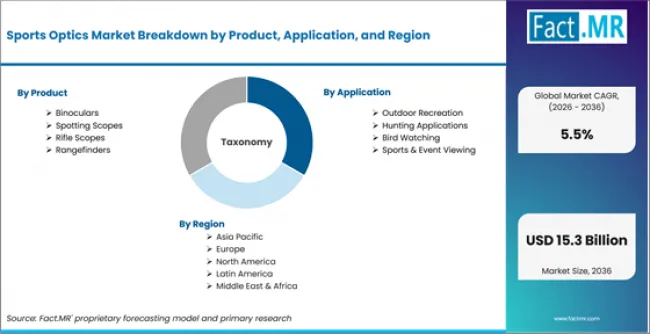
Sports Optics Market is segmented by Product (Binoculars, Spotting Scopes, Rifle Scopes, Rangefinders), Application (Outdoor Recreation, Hunting Applications, Bird Watching, Sports & Event Viewing), End Use (Individual Consumers, Professional Users, Sports Organizations, Tourism & Wildlife Agencies), and Region, with forecasts covering the period from 2026 to 2036.

Sports Optics Market Analysis and Forecast by Fact.MR

  • The Sports Optics Market is expected to grow from USD 9.0 billion in 2026 to USD 15.3 billion by 2036, at a 5.5% CAGR.
  • Driven by expanding outdoor recreation and wildlife observation activity, rising demand for premium optical magnification and image stabilization technology, and growing adoption of integrated digital features including rangefinding, ballistic computation, and GPS tagging, with binoculars accounting for 61.7% share and outdoor recreation.
  • contributing 44.9% share as manufacturers prioritize optical clarity, functional convergence, and lightweight construction.
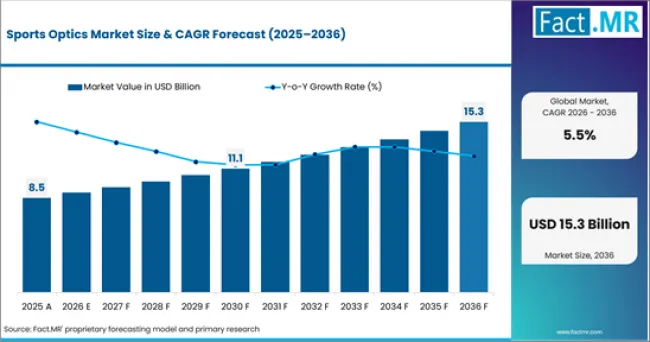
Sports Optics Market Value Analysis

Summary of Sports Optics Market

  • Market Snapshot
    • In 2025, the global Sports Optics Market was valued at approximately USD 8.5 billion.
    • The market is estimated to reach USD 9.0 billion in 2026 and is projected to attain USD 15.3 billion by 2036.
    • The sports optics market is likely to expand at a CAGR of 5.5% during the forecast period.
    • The market is anticipated to create an absolute dollar opportunity of USD 6.4 billion between 2026 and 2036.
    • Binoculars account for 61.7% of product segment share in 2026.
    • China (7.4%) and India (6.9%) are the key growth markets during the forecast period.
  • Demand and Growth Drivers
    • Growing birdwatching participation, particularly across North America and Europe, is sustaining demand for mid-range and premium binoculars with advanced coating and image stabilization capabilities.
    • Hunting-related optics procurement remains a stable demand channel in the U.S. and select European markets, with replacement cycles for rifle scopes and rangefinders supporting consistent product turnover.
    • Integration of smart technology, including GPS, ballistic calculators, and laser rangefinding within binocular and scope platforms, is driving trade-up activity among experienced users.
    • Rising nature tourism and guided wildlife observation programs in Asia Pacific, Latin America, and Africa are creating new buyer pools for entry-level and mid-range optical products.
    • Government and institutional procurement for forestry, border surveillance, and conservation monitoring is adding a parallel demand channel beyond consumer retail markets.
  • Product and Segment View
    • Binoculars account for 61.7% of the product segment in 2026, maintaining category leadership through broad applicability across birdwatching, hunting, nature observation, and event viewing.
    • Outdoor recreation represents 44.9% of the application segment in 2026, supported by growing participation in wildlife observation, hiking, and guided nature tourism.
    • Precision optical systems hold 76.8% share of the formulation segment, reflecting buyer preference for high-clarity glass elements and multi-coated lens assemblies.
    • Key segmentation includes:
      • Product: Binoculars, Spotting Scopes, Rifle Scopes, Rangefinders, Night Vision Devices, Red Dot Sights
      • Application: Outdoor Recreation, Hunting Applications, Bird Watching, Sports and Event Viewing
      • End Use: Individual Consumers, Professional Users, Sports Organizations, Tourism and Wildlife Agencies
      • Distribution Channel: Specialty Optical Retailers, Online Retail Platforms, Sporting Goods Stores, Institutional Sales
    • These products enable:
      • Long-range visual clarity for wildlife identification, terrain assessment, and target acquisition
      • Integrated distance measurement and ballistic computation for hunting and precision shooting
      • Compact, weather-resistant field observation across variable lighting and environmental conditions
  • Geography and Competitive Outlook
    • North America remains the largest regional market, anchored by hunting culture, strong outdoor recreation participation, and a well-developed specialty retail infrastructure.
    • Europe maintains stable demand through birdwatching, wildlife observation, and forestry applications, with Germany serving as a premium optics manufacturing hub.
    • Asia Pacific is the fastest-growing region, led by China (7.4%) and India (6.9%), supported by rising outdoor recreation trends and expanding nature tourism.
    • Key players include Carl Zeiss AG, Nikon Corporation, Leica Camera AG, Swarovski Optik, Bushnell Corporation, Vortex Optics, and Celestron.
  • Analyst Opinion
    • Shambhu Nath Jha, Principal Consultant at Fact.MR, says 'The sports optics market is transitioning from a product category defined by optical magnification alone to one where functional integration, smart features, and connected ecosystems are shaping purchase decisions. Binoculars with built-in rangefinding, scopes with ballistic computation, and digital night vision systems are blurring category lines and enabling premium pricing. The growth in Asia Pacific is structural, not cyclical, as rising disposable incomes and government-supported nature tourism programs create durable demand in markets where outdoor optics penetration has historically been low.'

Key Growth Drivers, Constraints, and Opportunities
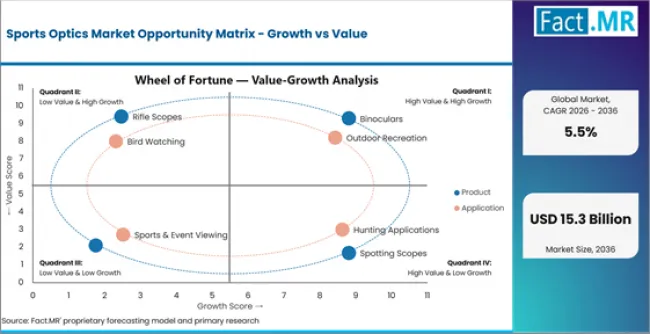
Sports Optics Market Opportunity Matrix Growth Vs Value

Key Factors Driving Growth

  • Birdwatching and wildlife viewing are growing in popularity around the world. National Audubon societies and wildlife trusts report that each year there are more organized viewing events and more new members.
  • Functional convergence in premium optics, with rangefinding bins and ballistic-computing scopes, is fueling trade-up purchases by experienced hunters and outdoor professionals.
  • Institutional buying of mid-level and ruggedized optics is developing in some regions from government-funded conservation monitoring and forestry observation programs.

Key Market Constraints

  • In price-sensitive regions, the addressable market size is capped by the high-priced premium optics of established European manufacturers, which puts a ceiling on average selling prices in emerging markets.
  • Advances in smartphone camera technology are decreasing the casual interest in entry-level binoculars among younger demographics, who generally default to digital photography for documenting nature.
  • Mid-tier manufacturers face procurement concentration risk if they depend on a limited number of suppliers for high-grade optical glass and specialty coatings.

Key Opportunity Areas

  • Rising nature tourism in Southeast Asia, East Africa and Latin America is generating new pools of demand for entry-level and mid-range binoculars and spotting scopes sold through tour operators and lodge retailers.
  • The introduction of digital night vision and thermal imaging in compact binocular platforms is opening up a premium sector in hunting and security applications beyond traditional optical magnification.
  • New online retail channels are also granting specialty brands direct access to consumers, minimizing reliance on traditional sporting goods chains and allowing for more targeted product positioning.

Segment-wise Analysis of the Sports Optics Market

  • Binoculars accounted for 61.7% of the product segment in 2026, driven by wide applicability in birdwatching, hunting, nature tourism and event viewing.
  • Outdoor recreation segment application was 44.9% in 2026 with increasing participation in wildlife observation, hiking, and guided nature experiences.
  • Individual consumers are expected to represent 68.3% of the end-use segment in 2026, showcasing the recreational and personal nature of sports optics purchases.

The sports optics market is segmented based on product type, application, end use, technology, formulation, distribution channel and region. The market includes binoculars, spotting scopes, rifle scopes, rangefinders, night vision devices and red dot sights as a by product. Coverage includes outdoor recreation, hunting, birdwatching, and sports and event viewing by application. Binoculars lead the value because of their broad appeal and multiple uses. Range finders and rifle scopes are more for the specialized hunting and shooting segments.

Which Product Segment Dominates the Sports Optics Market?
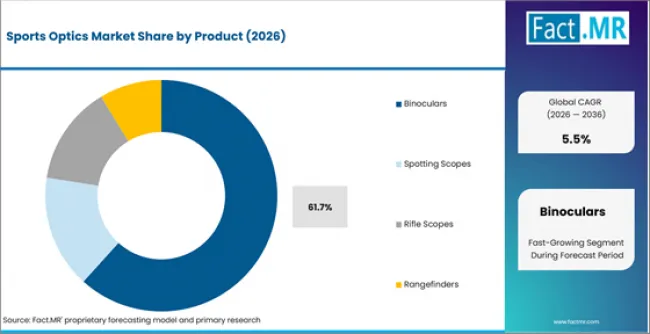
Sports Optics Market Analysis By Product

In 2026, binoculars will account for 61.7% of the product segment and will therefore continue to be the most popular optical device across all the major sports optics applications. You’ll appreciate their leadership for ease of use, portability and usefulness for birdwatching, hunting, wildlife observation, marine activities, and spectator sports. Entry-level compacts pull in first-time buyers, while premium full-size binoculars with ED glass elements and phase-corrected prisms are for experienced users who demand optical fidelity.

Integrated rangefinding, image stabilization and GPS tagging are boosting the utility of premium binocular platforms and functional convergence is reinforcing binocular leadership. Rifle scopes and rangefinders are for hunting-specific procurement, whereas spotting scopes are for a narrower segment of long-range birding and target shooting. Binoculars are expected to remain category leaders through 2036 with a growing addressable user base.

Which Application Segment Dominates the Sports Optics Market?
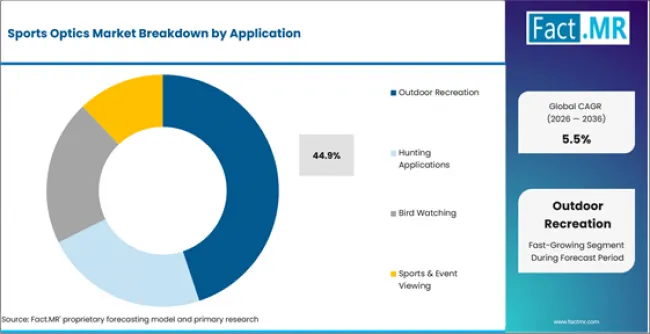
Sports Optics Market Analysis By Application

Outdoor recreation segment will continue to lead application share at 44.9% during 2026 Demand is buoyed by growing participation in birdwatching, hiking, nature observation and guided wildlife tourism. New buyer cohorts are being exposed and awareness is being created as national parks, nature reserves and eco-tourism operators are increasingly promoting the use of optics as part of the visitor experience. It has year-round activity cycles in temperate and tropical parts.

The second biggest segment is hunting applications, with license-based participation in North America and some parts of Europe. Birdwatching in its own right has become a growing standalone category with species-identification-grade optics driven by dedicated clubs and societies. As nature tourism continues to grow globally, optics are becoming a standard item in outdoor activity equipment, and outdoor recreation is expected to remain the leader.

Which Product Trend is Shaping the Next Phase of Growth in the Sports Optics Market?

The defining trend in the sports optics market is the emergence of functional convergence of optical product categories. Laser rangefinding binoculars with GPS positioning and ballistic computation are merging formerly separate purchasing decisions into one product. This trend is most advanced in the premium hunting segment, where products such as integrated range-finding binoculars combine observation and distance measurement in a single compact device and command price points above USD 3,000.

But this convergence is not just about the hunt. Digital night vision binoculars, image-stabilized marine optics and connected spotting scopes with app-based image capture are expanding the functional envelope of traditional optical products. Manufacturers that are investing in electronic integration as well as optical quality are well placed to pick up trade-up demand from users who previously purchased separate devices. As smart feature expectations go mainstream, convergence will increasingly define competitive positioning and pricing power across all tiers of product.

Regional Outlook Across Key Markets

  • China is the leader in growth at 7.4%, with the development of outdoor recreation and nature tourism, and growth in domestic manufacturing of mid-range optical products for domestic consumption and export.
  • Next comes India at 6.9% driven by rising wildlife tourism around national parks, increased participation in birdwatching, and institutional procurement for forestry and conservation monitoring.
  • Germany at 6.3% reflects the premium optics manufacturing base and strong demand for high specification binoculars and scopes in hunting, wildlife observation and professional applications.
  • North America has mature but steady demand with the USA at 5.2% driven by hunting optics replacement cycles, growth in birdwatching and functional convergence driving trade-up purchasing.

Top Country Growth Comparison Sports Optics Market Cagr (2026 2036)

Country CAGR (%)
China 7.4%
India 6.9%
Germany 6.3%
Brazil 5.8%
USA 5.2%
UK 4.7%
Japan 4.1%

Source: Fact MR (FMR) analysis, based on proprietary forecasting model and primary research.
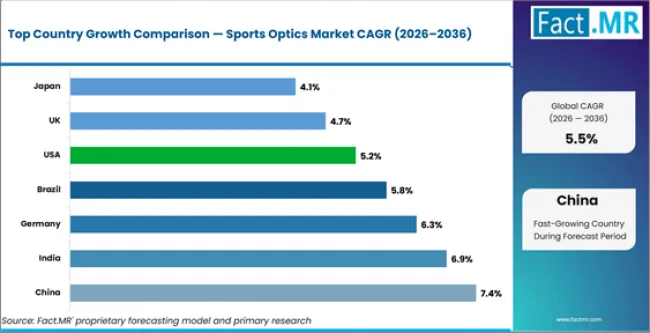
Sports Optics Market Cagr Analysis By Country

Market Outlook for Sports Optics in the United States
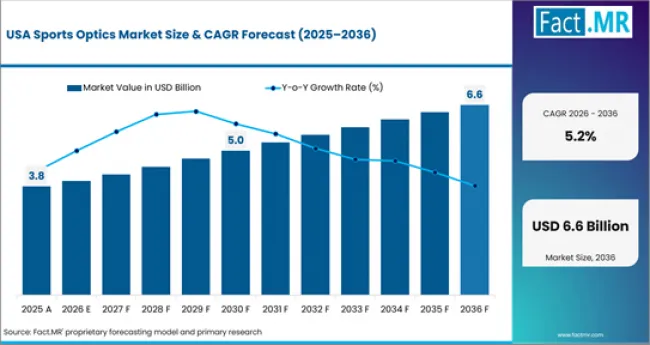
Sports Optics Market Country Value Analysis

The U.S. sports optics market is projected to grow at a CAGR of 5.2% till 2036. The installed base of hunters, birdwatchers and outdoor recreation participants creates replacement demand for binoculars, rifle scopes and rangefinders that is sustained over time. Functional convergence products that incorporate rangefinding and ballistic computation are commanding premium prices and driving average selling price increases across specialty retail channels.

  • Hunting license renewals in excess of 15 million annually provide the basis for rifle scope and rangefinder replacement cycles across managed wildlife areas.
  • Sustainability mandates and retailer ESG requirements are impacting procurement specifications for institutional outdoor education and conservation programs.

China Sports Optics Market Growth Assessment

Entry-level and mid-range binoculars and spotting scopes are expected to grow at a CAGR of 7.4% through 2036 across China owing to government support for domestic tourism and nature reserve development, creating new buyer segments. Domestic manufacturers are closing the technology gap with well-established European and Japanese brands to supply multi-coated optics at competitive prices to local recreational and export markets.

  • In the western and southern provinces, nature reserve development and eco-tourism are creating structured demand channels through park visitor centers and organized tour operators.
  • Manufacturing of optical components in the country enables competitive prices, as mid-range products can be priced 30 to 40 percent lower than imported products yet provide similar optical quality.

India Sports Optics Demand Trends

Demand is concentrated in wildlife tourism circuits focusing on tiger reserves and national parks such as Ranthambore, Jim Corbett and Kaziranga, supporting the India sports optics market at a 6.9% CAGR through 2036. Birdwatching is booming with organized events and citizen science programs driving the adoption of optics among younger populations in urban and peri-urban areas. Investment in eco-lodge infrastructure by private health care and hospitality is deepening optics access through lodge-provided and retail rental models.

  • The PLI scheme has incentivized electronics and precision instruments, paving the way for domestic assembly of optics, reducing import dependence for mid-range binoculars.
  • The addressable market is being expanded beyond metro-centric buyer pools through wildlife tourism participation in tier-2 and tier-3 cities.

Germany Sports Optics Market Analysis

In Germany, procurement specifications are set by DIN and EU CE performance standards. The sports optics market is expected to grow at a CAGR of 6.3% through 2036. The country is the manufacturing base for two of the highest specification optics producers in the world, Carl Zeiss and Leica. Within the domestic market demand is driven by hunting, observing wildlife and professional use where optics, build quality and durability throughout the lifecycle are highly valued and can demand premium pricing.

  • Optics manufacturing is adopting Industrie 4.0, which enables precision automation that minimizes production variability and enables consistent optical performance at scale.
  • The EU packaging and sustainability regulations are impacting the decisions on product packaging and materials sourcing throughout the optical supply chain.

United Kingdom Sports Optics Market Outlook

The UK sports optics market will remain at a CAGR of 4.7% through 2036 due to demand from the conservation sector. Birdwatching is a huge part of the outdoor culture in Britain and the Royal Society for the Protection of Birds (RSPB) and local wildlife trusts encourage people to get involved. Younger birdwatchers are drawn to connected and digital optics with app-based species identification, while estate and nature reserve monitoring applications provide institutional demand.

  • Specialty and online retail channels also offer year-round procurement of binoculars through organized birdwatching events and membership of the RSPB.
  • Post-Brexit regulatory divergence is creating separate product certification pathways which impact which imported optics products can be sold at retail in the UK.

Japan Sports Optics Market Demand Analysis
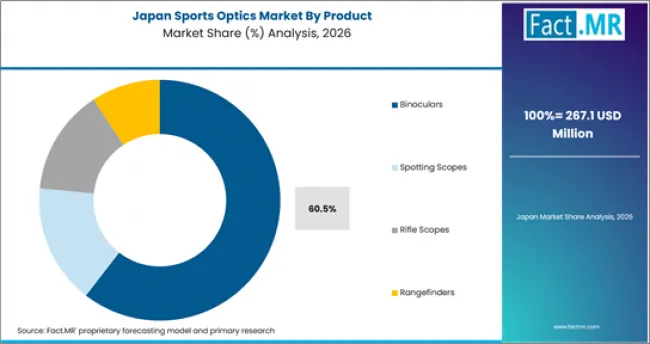
Sports Optics Market Japan Market Share Analysis By Product

The Japan sports optics market is characterized by JIS compliance standards and strict quality expectations projected to grow at a CAGR of 4.1% through 2036. Nikon is in a dominant position as a domestic manufacturer with long-term retailer relationships. It is also competing against imported European brands. Birdwatching and nature photography are underpinning steady consumer buying, while aging demographics in the hunting segment continue to drive replacement demand for premium optics.

  • We produce high-spec optics for domestic consumption and export using our in-house semiconductor and precision glass manufacturing capabilities.
  • The lengthy qualification processes and strict retailer specifications lead to stable but slow supplier relationships that prioritize consistent quality over competitive pricing.

Competitive Benchmarking and Company Positioning
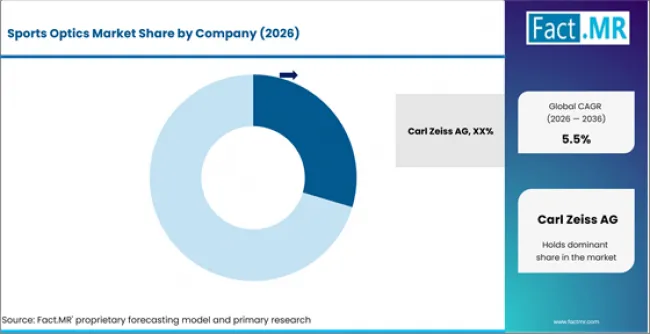
Sports Optics Market Analysis By Company

Sports Optics Market Analysis By Company

  • Carl Zeiss AG, Nikon Corporation, Leica Camera AG, and Swarovski Optik hold premium positions in the global sports optics market through optical quality leadership, brand heritage, and multi-category product portfolios spanning binoculars, scopes, and rangefinders.
  • Bushnell Corporation, Vortex Optics, and Celestron compete strongly across mid-range and value segments, with brand loyalty built on warranty programs, product accessibility, and responsive customer service.
  • Functional convergence and digital integration create an increasingly important barrier to entry, as manufacturers that combine optical precision with electronic features command pricing premiums and deeper customer retention.

The competitive landscape is segmented into a premium European tier, a mid-range performance tier, and a value-oriented tier. Carl Zeiss, Leica, and Swarovski Optik compete at the top end through optical fidelity, build precision, and heritage positioning, commanding price points that reflect decades of manufacturing expertise. Nikon bridges premium and mid-range through a broad product portfolio spanning consumer and professional categories.

Bushnell, Vortex, and Celestron dominate the mid-range segment through aggressive warranty programs, competitive pricing, and strong distribution across both specialty and general sporting goods channels. Vortex's lifetime warranty program has become a category benchmark that influences purchase decisions among cost-conscious but quality-aware buyers.

Competition is intensifying around functional convergence, with integrated rangefinding, image stabilization, and digital night vision creating new performance benchmarks. Manufacturers that invest in electronic integration alongside optical quality are better positioned to capture trade-up demand from users seeking multi-function devices rather than single-purpose optics.

Key Companies in the Sports Optics Market

Carl Zeiss AG, Nikon Corporation, Leica Camera AG, and Swarovski Optik are among the leading players, supported by optical quality leadership, brand heritage, and manufacturing precision that commands premium market positioning globally.

Bushnell Corporation, Vortex Optics, Celestron, Trijicon, Leupold and Stevens, and Steiner Optics hold established mid-range and performance-tier positions across hunting, outdoor recreation, and tactical applications. Meopta, Kowa, and Hawke Optics compete across niche segments and regional markets with focused product portfolios.

Recent Industry Developments

  • Vortex Optics, Facility Expansion, Manufacturing Capacity (November 2025)
    • Vortex Optics announced a USD 15 million expansion of its manufacturing facility in Barneveld, Wisconsin, adding approximately 50,000 square feet of production space dedicated to rifle scope assembly and optical testing operations. The investment strengthens domestic U.S. manufacturing capacity and supports increasing demand for precision-engineered sporting optics.
  • Swarovski Optik, Product Launch, EL Range TA Binoculars (2025)
    • Swarovski Optik introduced the EL Range TA binoculars featuring integrated laser rangefinding technology and ballistic calculation capabilities. The launch reinforces the company’s premium positioning by combining advanced observation and ranging functions for hunters and outdoor professionals.
  • Carl Zeiss AG, Technology Advancement, Smart Optics Integration (2025)
    • Carl Zeiss AG advanced its connected optics ecosystem by enhancing digital integration features across selected binocular and spotting scope products, enabling app-based image sharing and field documentation capabilities to improve the user experience for birdwatchers and nature enthusiasts.
  • Nikon Corporation, Product Line Expansion, Monarch and Prostaff Updates (2025)
    • Nikon Corporation expanded its Monarch and Prostaff binocular and riflescope portfolios with upgraded optical coatings and enhanced low-light performance, strengthening its competitive position across mid-range and premium outdoor recreation and hunting applications.

Leading Companies Shaping the Sports Optics Market

  • Carl Zeiss AG
  • Nikon Corporation
  • Leica Camera AG
  • Swarovski Optik
  • Bushnell Corporation
  • Vortex Optics
  • Celestron
  • Trijicon, Inc.
  • Leupold and Stevens, Inc.
  • Steiner Optics

Sources and Research References

  • Carl Zeiss AG. Product portfolio updates and connected optics platform developments.
  • Vortex Optics. Manufacturing expansion and warranty program data.
  • Swarovski Optik. EL Range TA product launch and functional convergence developments.
  • U.S. Fish and Wildlife Service. Hunting participation statistics and license renewal data.
  • Royal Society for the Protection of Birds (RSPB). Birdwatching participation and membership statistics.
  • Primary interviews with manufacturers, distributors, retailers, outdoor recreation operators, and institutional buyers.

This bibliography is provided for reader reference and is not exhaustive. The full report contains the complete reference list and detailed citations.

Key Questions This Report Addresses

  • What is the current and future size of the Sports Optics Market?
  • How fast is the Sports Optics Market expected to grow between 2026 and 2036?
  • Which product type is likely to lead the market by 2026?
  • Which application segment is expected to account for the highest demand by 2026?
  • What factors are driving demand for sports optics globally?
  • How is functional convergence influencing product development and pricing?
  • Why are China and India emerging as the fastest-growing markets?
  • How are digital features reshaping competitive dynamics in premium optics?
  • Which countries are projected to show the fastest growth through 2036?
  • Who are the key companies active in the Sports Optics Market?
  • How does Fact.MR estimate and validate the market forecast?

Sports Optics Market Definition

The sports optics market covers optical devices designed for outdoor observation, hunting, wildlife monitoring, sports viewing, and precision shooting, including binoculars, spotting scopes, rifle scopes, rangefinders, night vision devices, and red dot sights. It spans products manufactured using precision glass elements, multi-coated lens assemblies, and digital imaging components, distributed through specialty retailers, online platforms, and institutional channels.

Sports Optics Market Inclusions

  • The scope covers global and regional market size and forecasts for 2026 to 2036 across product type, application, end use, technology, formulation, distribution channel, and region.
  • It includes regional demand analysis across major geographies, based on factors such as hunting activity, outdoor recreation participation, wildlife observation programs, and institutional procurement.
  • The report covers pricing and cost analysis across entry-level, mid-range, and premium products, including optical component costs, digital feature integration, and manufacturing precision factors.
  • It includes technology trends, market drivers and constraints, and competitive landscape covering product portfolios, pricing strategies, and geographic reach of key players.

Sports Optics Market Exclusions

  • The scope excludes professional cinema and broadcast camera lenses, scientific laboratory microscopes, and industrial inspection optics not designed for sports or outdoor use.
  • It excludes general-purpose consumer cameras, smartphone camera modules, and drone-mounted imaging systems without dedicated sports optics functionality.
  • The report excludes military-grade targeting optics, classified defense surveillance systems, and restricted-distribution tactical devices not available through commercial channels.

Sports Optics Market Research Methodology

  • The methodology includes a combination of secondary research, primary interviews and forecast modelling.
  • It is based on 120+ secondary sources and benchmarks 70+ company product portfolios.
  • Market sizing for 30+ countries using a demand-side model, supported by top-down validation.
  • Major inputs include hunting license data, outdoor recreation participation data, tourism data, institutional procurement and e-commerce penetration.
  • The model checks demand against shipment data, pricing trends, channel mix, and product launches.
  • Primary Validation 25+ Interviews with Manufacturers, Distributors, Retailers & Institutional Buyers.
  • Final estimates are subject to trade-flow checks, sales-pattern review, and sensitivity testing.

Scope of Analysis

Sports Optics Market Breakdown By Product, Application, And Region

Parameter Details
Quantitative Units USD 9.0 billion to USD 15.3 billion, at a CAGR of 5.5%
Market Definition The Sports Optics Market covers optical devices for outdoor observation, hunting, wildlife monitoring, and precision shooting, including binoculars, spotting scopes, rifle scopes, rangefinders, and night vision devices.
Regions Covered North America, Latin America, Europe, East Asia, South Asia and Pacific, Middle East and Africa
Countries Covered USA, China, India, Germany, Brazil, UK, Japan, 30 plus countries
Key Companies Carl Zeiss AG, Nikon Corporation, Leica Camera AG, Swarovski Optik, Bushnell Corporation, Vortex Optics, Celestron, Trijicon, Leupold and Stevens, Steiner Optics
Forecast Period 2026 to 2036
Approach Hybrid demand-side and top-down methodology built on country-level outdoor recreation participation, hunting license data, product benchmarking, pricing analysis, shipment validation, and primary interviews across manufacturers, distributors, retailers, and institutional buyers

Sports Optics Market Segmentation

  • Sports Optics Market Segmented by Product:

    • Binoculars
      • Roof Prism Binoculars
        • Compact Travel Binoculars
        • Full Size Field Binoculars
      • Porro Prism Binoculars
        • Astronomy Binoculars
        • Hunting Binoculars
    • Spotting Scopes
      • Straight Body Spotting Scopes
        • Long Range Target Scopes
        • Bird Watching Scopes
      • Angled Body Spotting Scopes
        • Wildlife Observation Scopes
        • Marine Spotting Scopes
    • Rifle Scopes
      • Hunting Rifle Scopes
        • Variable Magnification Scopes
        • Fixed Power Scopes
      • Tactical Rifle Scopes
        • Sniper Grade Scopes
        • Long Range Tactical Scopes
    • Rangefinders
      • Laser Rangefinders
        • Golf Rangefinders
        • Hunting Rangefinders
      • Optical Rangefinders
        • Military Rangefinders
        • Surveying Rangefinders
  • Sports Optics Market Segmented by Application:

    • Outdoor Recreation
      • Hiking & Trekking
        • Mountain Observation Activities
        • Trail Wildlife Viewing
      • Camping Activities
        • Night Sky Observation
        • Nature Exploration Use
    • Hunting Applications
      • Game Tracking
        • Big Game Hunting
        • Small Game Hunting
      • Precision Targeting
        • Long Distance Shooting
        • Field Target Identification
    • Bird Watching
      • Wildlife Observation
        • Forest Bird Viewing
        • Wetland Bird Observation
      • Eco Tourism Activities
        • Nature Reserve Exploration
        • Safari Wildlife Viewing
    • Sports & Event Viewing
      • Outdoor Sports Viewing
        • Golf Course Observation
        • Racing Event Viewing
      • Stadium Viewing
        • Long Distance Seating Observation
        • VIP Spectator Viewing
  • Sports Optics Market Segmented by End Use:

    • Individual Consumers
      • Outdoor Enthusiasts
        • Hikers and Campers
        • Adventure Travelers
      • Hobby Astronomers
        • Amateur Stargazers
        • Backyard Astronomy Users
    • Professional Users
      • Military & Defense Users
        • Surveillance Units
        • Reconnaissance Teams
      • Law Enforcement Agencies
        • Border Patrol Units
        • Tactical Observation Units
    • Sports Organizations
      • Event Management Companies
        • Stadium Operations Teams
        • Sports Broadcasting Units
      • Professional Sports Analysts
        • Field Performance Analysts
        • Coaching Staff Observation Units
    • Tourism & Wildlife Agencies
      • National Park Authorities
        • Wildlife Conservation Units
        • Forest Monitoring Agencies
      • Eco Tourism Operators
        • Safari Tour Operators
        • Guided Nature Tour Companies
  • Sports Optics Market Segmented by Technology:

    • Optical Magnification Technology
      • Lens Coating Technology
        • Anti Reflective Coatings
        • Multi Layer Optical Coatings
      • High Precision Lens Systems
        • ED Glass Lens Systems
        • Fluorite Lens Technology
    • Digital Imaging Technology
      • Digital Zoom Integration
        • Hybrid Optical Digital Systems
        • Smart Imaging Enhancers
      • Sensor Based Imaging Systems
        • Low Light Enhancement Sensors
        • Infrared Assisted Imaging Systems
    • Stabilization Technology
      • Image Stabilization Systems
        • Gyroscopic Stabilization Units
        • Electronic Stabilization Modules
      • Motion Compensation Systems
        • Handheld Shake Reduction Systems
        • Dynamic Tracking Stabilizers
    • Range Measurement Technology
      • Laser Based Measurement Systems
        • Long Range Laser Sensors
        • High Accuracy Distance Calculators
      • GPS Integrated Systems
        • Geospatial Positioning Systems
        • Smart Mapping Integration Modules
  • Sports Optics Market Segmented by Formulation:

    • Precision Optical Systems
      • High Clarity Optical Assemblies
        • Ultra Clear Lens Structures
        • Low Distortion Optical Systems
      • Light Transmission Optimization Systems
        • High Transmission Prism Systems
        • Enhanced Light Capture Designs
    • Lightweight Construction Systems
      • Composite Housing Systems
        • Carbon Fiber Optical Housings
        • Polymer Based Optical Frames
      • Ergonomic Design Systems
        • Grip Optimized Optical Bodies
        • Balanced Weight Distribution Designs
    • Weather Resistant Systems
      • Waterproof Optical Formulations
        • Fog Proof Lens Sealing Systems
        • Dust Resistant Housing Systems
      • Temperature Resistant Systems
        • Extreme Climate Optical Designs
        • Thermal Stability Lens Systems
  • Sports Optics Market Segmented by Distribution Channel:

    • Specialty Optical Retailers
      • Outdoor Equipment Stores
        • Hunting Gear Retail Chains
        • Camping Equipment Stores
      • Photography Equipment Stores
        • Camera Specialty Retailers
        • Professional Imaging Stores
    • Online Retail Platforms
      • E Commerce Marketplaces
        • Global Optical Product Platforms
        • Outdoor Gear Online Stores
      • Brand Owned Online Stores
        • Direct Manufacturer Websites
        • Exclusive Brand Portals
    • Sporting Goods Stores
      • Large Retail Chains
        • Hypermarket Sporting Sections
        • Department Store Outdoor Sections
      • Regional Sports Shops
        • Local Hunting Gear Stores
        • Community Outdoor Equipment Shops
    • Institutional Sales
      • Defense Procurement Channels
        • Military Equipment Suppliers
        • Government Tender Suppliers
      • Research & Academic Sales
        • University Optical Equipment Supply
        • Conservation Agency Procurement
  • Sports Optics Market by Region:

    • North America
      • USA
      • Canada
      • Mexico
    • Latin America
      • Brazil
      • Chile
      • Rest of Latin America
    • Western Europe
      • Germany
      • UK
      • Italy
      • Spain
      • France
      • Nordic
      • BENELUX
      • Rest of Western Europe
    • Eastern Europe
      • Russia
      • Poland
      • Hungary
      • Balkan & Baltic
      • Rest of Eastern Europe
    • East Asia
      • China
      • Japan
      • South Korea
    • South Asia and Pacific
      • India
      • ASEAN
      • Australia & New Zealand
      • Rest of South Asia and Pacific
    • Middle East & Africa
      • Kingdom of Saudi Arabia
      • Other GCC Countries
      • Turkiye
      • South Africa
      • Other African Union
      • Rest of Middle East & Africa

- Frequently Asked Questions -

How big is the sports optics market in 2026?

The global sports optics market is estimated to be valued at USD 9.0 billion in 2026.

What will be the size of sports optics market in 2036?

The market size for the sports optics market is projected to reach USD 15.3 billion by 2036.

How much will be the sports optics market growth between 2026 and 2036?

The sports optics market is expected to grow at a 5.5% CAGR between 2026 and 2036.

What are the key product in the sports optics market?

The key product in sports optics market are Binoculars, Spotting Scopes, Rifle Scopes and Rangefinders.

Which application segment is expected to contribute significant share in the sports optics market in 2026?

In terms of application, outdoor recreation segment is expected to command 44.9% share in the sports optics market in 2026.

Table of Content

  1. Key Takeaways
    • Market Size and CAGR
    • Top Growth Driver
    • Fastest Growing Segment
    • Leading Region
    • Key Companies
    • Emerging Opportunities
  2. Executive Summary
    • Global Market Outlook
    • Demand-side Trends
    • Supply-side Trends
    • Technology Roadmap Analysis
    • Analysis and Recommendations
    • Analyst Perspective (What is happening? Why now? What should investors know?)
    • Key Questions Answered
      • How large is the market?
      • What is the CAGR?
      • What are key trends?
      • Which region dominates?
      • Who are the leaders?
  3. Market Overview
    • Market Coverage / Taxonomy
    • Market Definition / Scope / Limitations
  4. Research Methodology
    • Chapter Orientation
    • Analytical Lens and Working Hypotheses
      • Market Structure, Signals, and Trend Drivers
      • Benchmarking and Cross-market Comparability
      • Market Sizing, Forecasting, and Opportunity Mapping
    • Research Design and Evidence Framework
      • Desk Research Programme (Secondary Evidence)
      • Expert Input and Fieldwork (Primary Evidence)
      • Tooling, Models, and Reference Databases
    • Data Engineering and Model Build
    • Quality Assurance and Audit Trail
  5. Market Background
    • Market Dynamics (Drivers, Restraints, Opportunity, Trends)
    • Scenario Forecast (Optimistic, Likely, Conservative)
    • Impact Analysis
      • AI Impact
      • Sustainability Impact
      • Regulatory Impact
      • Technology Impact
    • Consumer / Buyer Analysis
      • Purchase Drivers
      • Adoption Barriers
      • Buyer Journey
    • Opportunity Map Analysis
    • Product Life Cycle Analysis
    • Supply Chain Analysis
    • Investment Feasibility Matrix
    • Value Chain Analysis
    • PESTLE and Porter's Analysis
    • Regulatory Landscape
    • Regional Parent Market Outlook
    • Production and Consumption Statistics
    • Import and Export Statistics
  6. Global Market Analysis and Forecast, 2021 to 2036
    • Historical Market Size Value (USD Million) Analysis, 2021 to 2025
    • Current and Future Market Size Value (USD Million) Projections, 2026 to 2036
      • Y-o-Y Growth Trend Analysis
      • Absolute $ Opportunity Analysis
  7. Global Market Pricing Analysis, 2021 to 2036
  8. Global Market Analysis and Forecast, By Product, 2021 to 2036
    • Introduction / Key Findings
    • Historical Market Size Value (USD Million) Analysis By Product, 2021 to 2025
    • Current and Future Market Size Value (USD Million) Analysis and Forecast By Product, 2026 to 2036
      • Binoculars
        • Roof Prism Binoculars
        • Porro Prism Binoculars
      • Spotting Scopes
        • Straight Body Spotting Scopes
        • Angled Body Spotting Scopes
      • Rifle Scopes
        • Hunting Rifle Scopes
        • Tactical Rifle Scopes
      • Rangefinders
        • Laser Rangefinders
        • Optical Rangefinders
    • Y-o-Y Growth Trend Analysis By Product, 2021 to 2025
    • Absolute $ Opportunity Analysis By Product, 2026 to 2036
  9. Global Market Analysis and Forecast, By Application, 2021 to 2036
    • Introduction / Key Findings
    • Historical Market Size Value (USD Million) Analysis By Application, 2021 to 2025
    • Current and Future Market Size Value (USD Million) Analysis and Forecast By Application, 2026 to 2036
      • Outdoor Recreation
        • Hiking & Trekking
        • Camping Activities
      • Hunting Applications
        • Game Tracking
        • Precision Targeting
      • Bird Watching
        • Wildlife Observation
        • Eco Tourism Activities
      • Sports & Event Viewing
        • Outdoor Sports Viewing
        • Stadium Viewing
    • Y-o-Y Growth Trend Analysis By Application, 2021 to 2025
    • Absolute $ Opportunity Analysis By Application, 2026 to 2036
  10. Global Market Analysis and Forecast, By End Use, 2021 to 2036
    • Introduction / Key Findings
    • Historical Market Size Value (USD Million) Analysis By End Use, 2021 to 2025
    • Current and Future Market Size Value (USD Million) Analysis and Forecast By End Use, 2026 to 2036
      • Individual Consumers
        • Outdoor Enthusiasts
        • Hobby Astronomers
      • Professional Users
        • Military & Defense Users
        • Law Enforcement Agencies
      • Sports Organizations
        • Event Management Companies
        • Professional Sports Analysts
      • Tourism & Wildlife Agencies
        • National Park Authorities
        • Eco Tourism Operators
    • Y-o-Y Growth Trend Analysis By End Use, 2021 to 2025
    • Absolute $ Opportunity Analysis By End Use, 2026 to 2036
  11. Global Market Analysis and Forecast, By Technology, 2021 to 2036
    • Introduction / Key Findings
    • Historical Market Size Value (USD Million) Analysis By Technology, 2021 to 2025
    • Current and Future Market Size Value (USD Million) Analysis and Forecast By Technology, 2026 to 2036
      • Optical Magnification Technology
        • Lens Coating Technology
        • High Precision Lens Systems
      • Digital Imaging Technology
        • Digital Zoom Integration
        • Sensor Based Imaging Systems
      • Stabilization Technology
        • Image Stabilization Systems
        • Motion Compensation Systems
      • Range Measurement Technology
        • Laser Based Measurement Systems
        • GPS Integrated Systems
    • Y-o-Y Growth Trend Analysis By Technology, 2021 to 2025
    • Absolute $ Opportunity Analysis By Technology, 2026 to 2036
  12. Global Market Analysis and Forecast, By Formulation, 2021 to 2036
    • Introduction / Key Findings
    • Historical Market Size Value (USD Million) Analysis By Formulation, 2021 to 2025
    • Current and Future Market Size Value (USD Million) Analysis and Forecast By Formulation, 2026 to 2036
      • Precision Optical Systems
        • High Clarity Optical Assemblies
        • Light Transmission Optimization Systems
      • Lightweight Construction Systems
        • Composite Housing Systems
        • Ergonomic Design Systems
      • Weather Resistant Systems
        • Waterproof Optical Formulations
        • Temperature Resistant Systems
    • Y-o-Y Growth Trend Analysis By Formulation, 2021 to 2025
    • Absolute $ Opportunity Analysis By Formulation, 2026 to 2036
  13. Global Market Analysis and Forecast, By Distribution Channel
    • Introduction / Key Findings
    • Historical Market Size Value (USD Million) Analysis By Distribution Channel, 2021 to 2025
    • Current and Future Market Size Value (USD Million) Analysis and Forecast By Distribution Channel, 2026 to 2036
      • Specialty Optical Retailers
        • Outdoor Equipment Stores
        • Photography Equipment Stores
      • Online Retail Platforms
        • E Commerce Marketplaces
        • Brand Owned Online Stores
      • Sporting Goods Stores
        • Large Retail Chains
        • Regional Sports Shops
      • Institutional Sales
        • Defense Procurement Channels
        • Research & Academic Sales
    • Y-o-Y Growth Trend Analysis By Distribution Channel, 2021 to 2025
    • Absolute $ Opportunity Analysis By Distribution Channel, 2026 to 2036
  14. Global Market Analysis and Forecast, By Region, 2021 to 2036
    • Introduction
    • Historical Market Size Value (USD Million) Analysis By Region, 2021 to 2025
    • Current Market Size Value (USD Million) Analysis and Forecast By Region, 2026 to 2036
      • North America
      • Latin America
      • Western Europe
      • Eastern Europe
      • East Asia
      • South Asia and Pacific
      • Middle East & Africa
    • Market Attractiveness Analysis By Region
  15. North America Market Analysis and Forecast, By Country, 2021 to 2036
    • Historical Market Size Value (USD Million) Trend Analysis By Market Taxonomy, 2021 to 2025
    • Market Size Value (USD Million) Forecast By Market Taxonomy, 2026 to 2036
      • By Country
        • USA
        • Canada
        • Mexico
      • By Product
      • By Application
      • By End Use
      • By Technology
      • By Formulation
      • By Distribution Channel
    • Market Attractiveness Analysis
      • By Country
      • By Product
      • By Application
      • By End Use
      • By Technology
      • By Formulation
      • By Distribution Channel
    • Key Takeaways
  16. Latin America Market Analysis and Forecast, By Country
    • Historical Market Size Value (USD Million) Trend Analysis By Market Taxonomy, 2021 to 2025
    • Market Size Value (USD Million) Forecast By Market Taxonomy, 2026 to 2036
      • By Country
        • Brazil
        • Chile
        • Rest of Latin America
      • By Product
      • By Application
      • By End Use
      • By Technology
      • By Formulation
      • By Distribution Channel
    • Market Attractiveness Analysis
      • By Country
      • By Product
      • By Application
      • By End Use
      • By Technology
      • By Formulation
      • By Distribution Channel
    • Key Takeaways
  17. Western Europe Market Analysis and Forecast, By Country
    • Historical Market Size Value (USD Million) Trend Analysis By Market Taxonomy, 2021 to 2025
    • Market Size Value (USD Million) Forecast By Market Taxonomy, 2026 to 2036
      • By Country
        • Germany
        • UK
        • Italy
        • Spain
        • France
        • Nordic
        • BENELUX
        • Rest of Western Europe
      • By Product
      • By Application
      • By End Use
      • By Technology
      • By Formulation
      • By Distribution Channel
    • Market Attractiveness Analysis
      • By Country
      • By Product
      • By Application
      • By End Use
      • By Technology
      • By Formulation
      • By Distribution Channel
    • Key Takeaways
  18. Eastern Europe Market Analysis and Forecast, By Country
    • Historical Market Size Value (USD Million) Trend Analysis By Market Taxonomy, 2021 to 2025
    • Market Size Value (USD Million) Forecast By Market Taxonomy, 2026 to 2036
      • By Country
        • Russia
        • Poland
        • Hungary
        • Balkan & Baltic
        • Rest of Eastern Europe
      • By Product
      • By Application
      • By End Use
      • By Technology
      • By Formulation
      • By Distribution Channel
    • Market Attractiveness Analysis
      • By Country
      • By Product
      • By Application
      • By End Use
      • By Technology
      • By Formulation
      • By Distribution Channel
    • Key Takeaways
  19. East Asia Market Analysis and Forecast, By Country
    • Historical Market Size Value (USD Million) Trend Analysis By Market Taxonomy, 2021 to 2025
    • Market Size Value (USD Million) Forecast By Market Taxonomy, 2026 to 2036
      • By Country
        • China
        • Japan
        • South Korea
      • By Product
      • By Application
      • By End Use
      • By Technology
      • By Formulation
      • By Distribution Channel
    • Market Attractiveness Analysis
      • By Country
      • By Product
      • By Application
      • By End Use
      • By Technology
      • By Formulation
      • By Distribution Channel
    • Key Takeaways
  20. South Asia and Pacific Market Analysis and Forecast, By Country
    • Historical Market Size Value (USD Million) Trend Analysis By Market Taxonomy, 2021 to 2025
    • Market Size Value (USD Million) Forecast By Market Taxonomy, 2026 to 2036
      • By Country
        • India
        • ASEAN
        • Australia & New Zealand
        • Rest of South Asia and Pacific
      • By Product
      • By Application
      • By End Use
      • By Technology
      • By Formulation
      • By Distribution Channel
    • Market Attractiveness Analysis
      • By Country
      • By Product
      • By Application
      • By End Use
      • By Technology
      • By Formulation
      • By Distribution Channel
    • Key Takeaways
  21. Middle East & Africa Market Analysis and Forecast, By Country
    • Historical Market Size Value (USD Million) Trend Analysis By Market Taxonomy, 2021 to 2025
    • Market Size Value (USD Million) Forecast By Market Taxonomy, 2026 to 2036
      • By Country
        • Kingdom of Saudi Arabia
        • Other GCC Countries
        • Turkiye
        • South Africa
        • Other African Union
        • Rest of Middle East & Africa
      • By Product
      • By Application
      • By End Use
      • By Technology
      • By Formulation
      • By Distribution Channel
    • Market Attractiveness Analysis
      • By Country
      • By Product
      • By Application
      • By End Use
      • By Technology
      • By Formulation
      • By Distribution Channel
    • Key Takeaways
  22. Key Countries Market Analysis
    • USA
      • Pricing Analysis
      • Market Share Analysis, 2025
        • By Product
        • By Application
        • By End Use
        • By Technology
        • By Formulation
        • By Distribution Channel
    • Canada
      • Pricing Analysis
      • Market Share Analysis, 2025
        • By Product
        • By Application
        • By End Use
        • By Technology
        • By Formulation
        • By Distribution Channel
    • Mexico
      • Pricing Analysis
      • Market Share Analysis, 2025
        • By Product
        • By Application
        • By End Use
        • By Technology
        • By Formulation
        • By Distribution Channel
    • Brazil
      • Pricing Analysis
      • Market Share Analysis, 2025
        • By Product
        • By Application
        • By End Use
        • By Technology
        • By Formulation
        • By Distribution Channel
    • Chile
      • Pricing Analysis
      • Market Share Analysis, 2025
        • By Product
        • By Application
        • By End Use
        • By Technology
        • By Formulation
        • By Distribution Channel
    • Germany
      • Pricing Analysis
      • Market Share Analysis, 2025
        • By Product
        • By Application
        • By End Use
        • By Technology
        • By Formulation
        • By Distribution Channel
    • UK
      • Pricing Analysis
      • Market Share Analysis, 2025
        • By Product
        • By Application
        • By End Use
        • By Technology
        • By Formulation
        • By Distribution Channel
    • Italy
      • Pricing Analysis
      • Market Share Analysis, 2025
        • By Product
        • By Application
        • By End Use
        • By Technology
        • By Formulation
        • By Distribution Channel
    • Spain
      • Pricing Analysis
      • Market Share Analysis, 2025
        • By Product
        • By Application
        • By End Use
        • By Technology
        • By Formulation
        • By Distribution Channel
    • France
      • Pricing Analysis
      • Market Share Analysis, 2025
        • By Product
        • By Application
        • By End Use
        • By Technology
        • By Formulation
        • By Distribution Channel
    • India
      • Pricing Analysis
      • Market Share Analysis, 2025
        • By Product
        • By Application
        • By End Use
        • By Technology
        • By Formulation
        • By Distribution Channel
    • ASEAN
      • Pricing Analysis
      • Market Share Analysis, 2025
        • By Product
        • By Application
        • By End Use
        • By Technology
        • By Formulation
        • By Distribution Channel
    • Australia & New Zealand
      • Pricing Analysis
      • Market Share Analysis, 2025
        • By Product
        • By Application
        • By End Use
        • By Technology
        • By Formulation
        • By Distribution Channel
    • China
      • Pricing Analysis
      • Market Share Analysis, 2025
        • By Product
        • By Application
        • By End Use
        • By Technology
        • By Formulation
        • By Distribution Channel
    • Japan
      • Pricing Analysis
      • Market Share Analysis, 2025
        • By Product
        • By Application
        • By End Use
        • By Technology
        • By Formulation
        • By Distribution Channel
    • South Korea
      • Pricing Analysis
      • Market Share Analysis, 2025
        • By Product
        • By Application
        • By End Use
        • By Technology
        • By Formulation
        • By Distribution Channel
    • Russia
      • Pricing Analysis
      • Market Share Analysis, 2025
        • By Product
        • By Application
        • By End Use
        • By Technology
        • By Formulation
        • By Distribution Channel
    • Poland
      • Pricing Analysis
      • Market Share Analysis, 2025
        • By Product
        • By Application
        • By End Use
        • By Technology
        • By Formulation
        • By Distribution Channel
    • Hungary
      • Pricing Analysis
      • Market Share Analysis, 2025
        • By Product
        • By Application
        • By End Use
        • By Technology
        • By Formulation
        • By Distribution Channel
    • Kingdom of Saudi Arabia
      • Pricing Analysis
      • Market Share Analysis, 2025
        • By Product
        • By Application
        • By End Use
        • By Technology
        • By Formulation
        • By Distribution Channel
    • Turkiye
      • Pricing Analysis
      • Market Share Analysis, 2025
        • By Product
        • By Application
        • By End Use
        • By Technology
        • By Formulation
        • By Distribution Channel
    • South Africa
      • Pricing Analysis
      • Market Share Analysis, 2025
        • By Product
        • By Application
        • By End Use
        • By Technology
        • By Formulation
        • By Distribution Channel
  23. Market Structure Analysis
    • Competition Dashboard
    • Competition Benchmarking
    • Market Share Analysis of Top Players
      • By Regional
      • By Product
      • By Application
      • By End Use
      • By Technology
      • By Formulation
      • By Distribution Channel
      • Emerging Startups
      • Innovation Benchmarking
    • Competition Analysis
      • Competition Deep Dive
        • Carl Zeiss AG
          • Overview
          • Product Portfolio
          • Profitability by Market Segments (Product/Age /Sales Channel/Region)
          • Sales Footprint
          • Strategy Overview
            • Marketing Strategy
            • Product Strategy
            • Channel Strategy
        • Nikon Corporation
        • Leica Camera AG
        • Swarovski Optik
        • Bushnell Corporation
        • Vortex Optics
        • Leupold & Stevens, Inc.
        • Trijicon, Inc.
        • Celestron, LLC
        • Meopta - optika, s.r.o.
        • Steiner Optik GmbH
        • Hawke Optics
        • Barska Optics
        • ATN Corporation
        • Nightforce Optics, Inc.
        • SIG SAUER Electro-Optics
        • Kowa Company, Ltd.
        • Pulsar
    • Case Studies
    • Success Stories
    • Recent Developments
  24. Assumptions & Acronyms Used

List Of Table

  • Table 1: Global Market Value (USD Million) Forecast by Region, 2021 to 2036
  • Table 2: Global Market Value (USD Million) Forecast by Product, 2021 to 2036
  • Table 3: Global Market Value (USD Million) Forecast by Application, 2021 to 2036
  • Table 4: Global Market Value (USD Million) Forecast by End Use, 2021 to 2036
  • Table 5: Global Market Value (USD Million) Forecast by Technology, 2021 to 2036
  • Table 6: Global Market Value (USD Million) Forecast by Formulation, 2021 to 2036
  • Table 7: Global Market Value (USD Million) Forecast by Distribution Channel, 2021 to 2036
  • Table 8: Global Market rma_anu Forecast by rma_anu, 2021 to 2036
  • Table 9: North America Market Value (USD Million) Forecast by Country, 2021 to 2036
  • Table 10: North America Market Value (USD Million) Forecast by Product, 2021 to 2036
  • Table 11: North America Market Value (USD Million) Forecast by Application, 2021 to 2036
  • Table 12: North America Market Value (USD Million) Forecast by End Use, 2021 to 2036
  • Table 13: North America Market Value (USD Million) Forecast by Technology, 2021 to 2036
  • Table 14: North America Market Value (USD Million) Forecast by Formulation, 2021 to 2036
  • Table 15: North America Market Value (USD Million) Forecast by Distribution Channel, 2021 to 2036
  • Table 16: Latin America Market Value (USD Million) Forecast by Country, 2021 to 2036
  • Table 17: Latin America Market Value (USD Million) Forecast by Product, 2021 to 2036
  • Table 18: Latin America Market Value (USD Million) Forecast by Application, 2021 to 2036
  • Table 19: Latin America Market Value (USD Million) Forecast by End Use, 2021 to 2036
  • Table 20: Latin America Market Value (USD Million) Forecast by Technology, 2021 to 2036
  • Table 21: Latin America Market Value (USD Million) Forecast by Formulation, 2021 to 2036
  • Table 22: Latin America Market Value (USD Million) Forecast by Distribution Channel, 2021 to 2036
  • Table 23: Western Europe Market Value (USD Million) Forecast by Country, 2021 to 2036
  • Table 24: Western Europe Market Value (USD Million) Forecast by Product, 2021 to 2036
  • Table 25: Western Europe Market Value (USD Million) Forecast by Application, 2021 to 2036
  • Table 26: Western Europe Market Value (USD Million) Forecast by End Use, 2021 to 2036
  • Table 27: Western Europe Market Value (USD Million) Forecast by Technology, 2021 to 2036
  • Table 28: Western Europe Market Value (USD Million) Forecast by Formulation, 2021 to 2036
  • Table 29: Western Europe Market Value (USD Million) Forecast by Distribution Channel, 2021 to 2036
  • Table 30: Eastern Europe Market Value (USD Million) Forecast by Country, 2021 to 2036
  • Table 31: Eastern Europe Market Value (USD Million) Forecast by Product, 2021 to 2036
  • Table 32: Eastern Europe Market Value (USD Million) Forecast by Application, 2021 to 2036
  • Table 33: Eastern Europe Market Value (USD Million) Forecast by End Use, 2021 to 2036
  • Table 34: Eastern Europe Market Value (USD Million) Forecast by Technology, 2021 to 2036
  • Table 35: Eastern Europe Market Value (USD Million) Forecast by Formulation, 2021 to 2036
  • Table 36: Eastern Europe Market Value (USD Million) Forecast by Distribution Channel, 2021 to 2036
  • Table 37: East Asia Market Value (USD Million) Forecast by Country, 2021 to 2036
  • Table 38: East Asia Market Value (USD Million) Forecast by Product, 2021 to 2036
  • Table 39: East Asia Market Value (USD Million) Forecast by Application, 2021 to 2036
  • Table 40: East Asia Market Value (USD Million) Forecast by End Use, 2021 to 2036
  • Table 41: East Asia Market Value (USD Million) Forecast by Technology, 2021 to 2036
  • Table 42: East Asia Market Value (USD Million) Forecast by Formulation, 2021 to 2036
  • Table 43: East Asia Market Value (USD Million) Forecast by Distribution Channel, 2021 to 2036
  • Table 44: South Asia and Pacific Market Value (USD Million) Forecast by Country, 2021 to 2036
  • Table 45: South Asia and Pacific Market Value (USD Million) Forecast by Product, 2021 to 2036
  • Table 46: South Asia and Pacific Market Value (USD Million) Forecast by Application, 2021 to 2036
  • Table 47: South Asia and Pacific Market Value (USD Million) Forecast by End Use, 2021 to 2036
  • Table 48: South Asia and Pacific Market Value (USD Million) Forecast by Technology, 2021 to 2036
  • Table 49: South Asia and Pacific Market Value (USD Million) Forecast by Formulation, 2021 to 2036
  • Table 50: South Asia and Pacific Market Value (USD Million) Forecast by Distribution Channel, 2021 to 2036
  • Table 51: Middle East & Africa Market Value (USD Million) Forecast by Country, 2021 to 2036
  • Table 52: Middle East & Africa Market Value (USD Million) Forecast by Product, 2021 to 2036
  • Table 53: Middle East & Africa Market Value (USD Million) Forecast by Application, 2021 to 2036
  • Table 54: Middle East & Africa Market Value (USD Million) Forecast by End Use, 2021 to 2036
  • Table 55: Middle East & Africa Market Value (USD Million) Forecast by Technology, 2021 to 2036
  • Table 56: Middle East & Africa Market Value (USD Million) Forecast by Formulation, 2021 to 2036
  • Table 57: Middle East & Africa Market Value (USD Million) Forecast by Distribution Channel, 2021 to 2036

List Of Figures

  • Figure 1: Global Market Pricing Analysis
  • Figure 2: Global Market Value (USD Million) Forecast 2021 to 2036
  • Figure 3: Global Market Value Share and BPS Analysis by Product, 2026 and 2036
  • Figure 4: Global Market Y-o-Y Growth Comparison by Product, 2026 to 2036
  • Figure 5: Global Market Attractiveness Analysis by Product
  • Figure 6: Global Market Value Share and BPS Analysis by Application, 2026 and 2036
  • Figure 7: Global Market Y-o-Y Growth Comparison by Application, 2026 to 2036
  • Figure 8: Global Market Attractiveness Analysis by Application
  • Figure 9: Global Market Value Share and BPS Analysis by End Use, 2026 and 2036
  • Figure 10: Global Market Y-o-Y Growth Comparison by End Use, 2026 to 2036
  • Figure 11: Global Market Attractiveness Analysis by End Use
  • Figure 12: Global Market Value Share and BPS Analysis by Technology, 2026 and 2036
  • Figure 13: Global Market Y-o-Y Growth Comparison by Technology, 2026 to 2036
  • Figure 14: Global Market Attractiveness Analysis by Technology
  • Figure 15: Global Market Value Share and BPS Analysis by Formulation, 2026 and 2036
  • Figure 16: Global Market Y-o-Y Growth Comparison by Formulation, 2026 to 2036
  • Figure 17: Global Market Attractiveness Analysis by Formulation
  • Figure 18: Global Market Value Share and BPS Analysis by Distribution Channel, 2026 and 2036
  • Figure 19: Global Market Y-o-Y Growth Comparison by Distribution Channel, 2026 to 2036
  • Figure 20: Global Market Attractiveness Analysis by Distribution Channel
  • Figure 21: Global Market Value (USD Million) Share and BPS Analysis by Region, 2026 and 2036
  • Figure 22: Global Market Y-o-Y Growth Comparison by Region, 2026 to 2036
  • Figure 23: Global Market Attractiveness Analysis by Region
  • Figure 24: North America Market Incremental Dollar Opportunity, 2026 to 2036
  • Figure 25: Latin America Market Incremental Dollar Opportunity, 2026 to 2036
  • Figure 26: Western Europe Market Incremental Dollar Opportunity, 2026 to 2036
  • Figure 27: Eastern Europe Market Incremental Dollar Opportunity, 2026 to 2036
  • Figure 28: East Asia Market Incremental Dollar Opportunity, 2026 to 2036
  • Figure 29: South Asia and Pacific Market Incremental Dollar Opportunity, 2026 to 2036
  • Figure 30: Middle East & Africa Market Incremental Dollar Opportunity, 2026 to 2036
  • Figure 31: North America Market Value Share and BPS Analysis by Country, 2026 and 2036
  • Figure 32: North America Market Value Share and BPS Analysis by Product, 2026 and 2036
  • Figure 33: North America Market Y-o-Y Growth Comparison by Product, 2026 to 2036
  • Figure 34: North America Market Attractiveness Analysis by Product
  • Figure 35: North America Market Value Share and BPS Analysis by Application, 2026 and 2036
  • Figure 36: North America Market Y-o-Y Growth Comparison by Application, 2026 to 2036
  • Figure 37: North America Market Attractiveness Analysis by Application
  • Figure 38: North America Market Value Share and BPS Analysis by End Use, 2026 and 2036
  • Figure 39: North America Market Y-o-Y Growth Comparison by End Use, 2026 to 2036
  • Figure 40: North America Market Attractiveness Analysis by End Use
  • Figure 41: North America Market Value Share and BPS Analysis by Technology, 2026 and 2036
  • Figure 42: North America Market Y-o-Y Growth Comparison by Technology, 2026 to 2036
  • Figure 43: North America Market Attractiveness Analysis by Technology
  • Figure 44: North America Market Value Share and BPS Analysis by Formulation, 2026 and 2036
  • Figure 45: North America Market Y-o-Y Growth Comparison by Formulation, 2026 to 2036
  • Figure 46: North America Market Attractiveness Analysis by Formulation
  • Figure 47: North America Market Value Share and BPS Analysis by Distribution Channel, 2026 and 2036
  • Figure 48: North America Market Y-o-Y Growth Comparison by Distribution Channel, 2026 to 2036
  • Figure 49: North America Market Attractiveness Analysis by Distribution Channel
  • Figure 50: Latin America Market Value Share and BPS Analysis by Country, 2026 and 2036
  • Figure 51: Latin America Market Value Share and BPS Analysis by Product, 2026 and 2036
  • Figure 52: Latin America Market Y-o-Y Growth Comparison by Product, 2026 to 2036
  • Figure 53: Latin America Market Attractiveness Analysis by Product
  • Figure 54: Latin America Market Value Share and BPS Analysis by Application, 2026 and 2036
  • Figure 55: Latin America Market Y-o-Y Growth Comparison by Application, 2026 to 2036
  • Figure 56: Latin America Market Attractiveness Analysis by Application
  • Figure 57: Latin America Market Value Share and BPS Analysis by End Use, 2026 and 2036
  • Figure 58: Latin America Market Y-o-Y Growth Comparison by End Use, 2026 to 2036
  • Figure 59: Latin America Market Attractiveness Analysis by End Use
  • Figure 60: Latin America Market Value Share and BPS Analysis by Technology, 2026 and 2036
  • Figure 61: Latin America Market Y-o-Y Growth Comparison by Technology, 2026 to 2036
  • Figure 62: Latin America Market Attractiveness Analysis by Technology
  • Figure 63: Latin America Market Value Share and BPS Analysis by Formulation, 2026 and 2036
  • Figure 64: Latin America Market Y-o-Y Growth Comparison by Formulation, 2026 to 2036
  • Figure 65: Latin America Market Attractiveness Analysis by Formulation
  • Figure 66: Latin America Market Value Share and BPS Analysis by Distribution Channel, 2026 and 2036
  • Figure 67: Latin America Market Y-o-Y Growth Comparison by Distribution Channel, 2026 to 2036
  • Figure 68: Latin America Market Attractiveness Analysis by Distribution Channel
  • Figure 69: Western Europe Market Value Share and BPS Analysis by Country, 2026 and 2036
  • Figure 70: Western Europe Market Value Share and BPS Analysis by Product, 2026 and 2036
  • Figure 71: Western Europe Market Y-o-Y Growth Comparison by Product, 2026 to 2036
  • Figure 72: Western Europe Market Attractiveness Analysis by Product
  • Figure 73: Western Europe Market Value Share and BPS Analysis by Application, 2026 and 2036
  • Figure 74: Western Europe Market Y-o-Y Growth Comparison by Application, 2026 to 2036
  • Figure 75: Western Europe Market Attractiveness Analysis by Application
  • Figure 76: Western Europe Market Value Share and BPS Analysis by End Use, 2026 and 2036
  • Figure 77: Western Europe Market Y-o-Y Growth Comparison by End Use, 2026 to 2036
  • Figure 78: Western Europe Market Attractiveness Analysis by End Use
  • Figure 79: Western Europe Market Value Share and BPS Analysis by Technology, 2026 and 2036
  • Figure 80: Western Europe Market Y-o-Y Growth Comparison by Technology, 2026 to 2036
  • Figure 81: Western Europe Market Attractiveness Analysis by Technology
  • Figure 82: Western Europe Market Value Share and BPS Analysis by Formulation, 2026 and 2036
  • Figure 83: Western Europe Market Y-o-Y Growth Comparison by Formulation, 2026 to 2036
  • Figure 84: Western Europe Market Attractiveness Analysis by Formulation
  • Figure 85: Western Europe Market Value Share and BPS Analysis by Distribution Channel, 2026 and 2036
  • Figure 86: Western Europe Market Y-o-Y Growth Comparison by Distribution Channel, 2026 to 2036
  • Figure 87: Western Europe Market Attractiveness Analysis by Distribution Channel
  • Figure 88: Eastern Europe Market Value Share and BPS Analysis by Country, 2026 and 2036
  • Figure 89: Eastern Europe Market Value Share and BPS Analysis by Product, 2026 and 2036
  • Figure 90: Eastern Europe Market Y-o-Y Growth Comparison by Product, 2026 to 2036
  • Figure 91: Eastern Europe Market Attractiveness Analysis by Product
  • Figure 92: Eastern Europe Market Value Share and BPS Analysis by Application, 2026 and 2036
  • Figure 93: Eastern Europe Market Y-o-Y Growth Comparison by Application, 2026 to 2036
  • Figure 94: Eastern Europe Market Attractiveness Analysis by Application
  • Figure 95: Eastern Europe Market Value Share and BPS Analysis by End Use, 2026 and 2036
  • Figure 96: Eastern Europe Market Y-o-Y Growth Comparison by End Use, 2026 to 2036
  • Figure 97: Eastern Europe Market Attractiveness Analysis by End Use
  • Figure 98: Eastern Europe Market Value Share and BPS Analysis by Technology, 2026 and 2036
  • Figure 99: Eastern Europe Market Y-o-Y Growth Comparison by Technology, 2026 to 2036
  • Figure 100: Eastern Europe Market Attractiveness Analysis by Technology
  • Figure 101: Eastern Europe Market Value Share and BPS Analysis by Formulation, 2026 and 2036
  • Figure 102: Eastern Europe Market Y-o-Y Growth Comparison by Formulation, 2026 to 2036
  • Figure 103: Eastern Europe Market Attractiveness Analysis by Formulation
  • Figure 104: Eastern Europe Market Value Share and BPS Analysis by Distribution Channel, 2026 and 2036
  • Figure 105: Eastern Europe Market Y-o-Y Growth Comparison by Distribution Channel, 2026 to 2036
  • Figure 106: Eastern Europe Market Attractiveness Analysis by Distribution Channel
  • Figure 107: East Asia Market Value Share and BPS Analysis by Country, 2026 and 2036
  • Figure 108: East Asia Market Value Share and BPS Analysis by Product, 2026 and 2036
  • Figure 109: East Asia Market Y-o-Y Growth Comparison by Product, 2026 to 2036
  • Figure 110: East Asia Market Attractiveness Analysis by Product
  • Figure 111: East Asia Market Value Share and BPS Analysis by Application, 2026 and 2036
  • Figure 112: East Asia Market Y-o-Y Growth Comparison by Application, 2026 to 2036
  • Figure 113: East Asia Market Attractiveness Analysis by Application
  • Figure 114: East Asia Market Value Share and BPS Analysis by End Use, 2026 and 2036
  • Figure 115: East Asia Market Y-o-Y Growth Comparison by End Use, 2026 to 2036
  • Figure 116: East Asia Market Attractiveness Analysis by End Use
  • Figure 117: East Asia Market Value Share and BPS Analysis by Technology, 2026 and 2036
  • Figure 118: East Asia Market Y-o-Y Growth Comparison by Technology, 2026 to 2036
  • Figure 119: East Asia Market Attractiveness Analysis by Technology
  • Figure 120: East Asia Market Value Share and BPS Analysis by Formulation, 2026 and 2036
  • Figure 121: East Asia Market Y-o-Y Growth Comparison by Formulation, 2026 to 2036
  • Figure 122: East Asia Market Attractiveness Analysis by Formulation
  • Figure 123: East Asia Market Value Share and BPS Analysis by Distribution Channel, 2026 and 2036
  • Figure 124: East Asia Market Y-o-Y Growth Comparison by Distribution Channel, 2026 to 2036
  • Figure 125: East Asia Market Attractiveness Analysis by Distribution Channel
  • Figure 126: South Asia and Pacific Market Value Share and BPS Analysis by Country, 2026 and 2036
  • Figure 127: South Asia and Pacific Market Value Share and BPS Analysis by Product, 2026 and 2036
  • Figure 128: South Asia and Pacific Market Y-o-Y Growth Comparison by Product, 2026 to 2036
  • Figure 129: South Asia and Pacific Market Attractiveness Analysis by Product
  • Figure 130: South Asia and Pacific Market Value Share and BPS Analysis by Application, 2026 and 2036
  • Figure 131: South Asia and Pacific Market Y-o-Y Growth Comparison by Application, 2026 to 2036
  • Figure 132: South Asia and Pacific Market Attractiveness Analysis by Application
  • Figure 133: South Asia and Pacific Market Value Share and BPS Analysis by End Use, 2026 and 2036
  • Figure 134: South Asia and Pacific Market Y-o-Y Growth Comparison by End Use, 2026 to 2036
  • Figure 135: South Asia and Pacific Market Attractiveness Analysis by End Use
  • Figure 136: South Asia and Pacific Market Value Share and BPS Analysis by Technology, 2026 and 2036
  • Figure 137: South Asia and Pacific Market Y-o-Y Growth Comparison by Technology, 2026 to 2036
  • Figure 138: South Asia and Pacific Market Attractiveness Analysis by Technology
  • Figure 139: South Asia and Pacific Market Value Share and BPS Analysis by Formulation, 2026 and 2036
  • Figure 140: South Asia and Pacific Market Y-o-Y Growth Comparison by Formulation, 2026 to 2036
  • Figure 141: South Asia and Pacific Market Attractiveness Analysis by Formulation
  • Figure 142: South Asia and Pacific Market Value Share and BPS Analysis by Distribution Channel, 2026 and 2036
  • Figure 143: South Asia and Pacific Market Y-o-Y Growth Comparison by Distribution Channel, 2026 to 2036
  • Figure 144: South Asia and Pacific Market Attractiveness Analysis by Distribution Channel
  • Figure 145: Middle East & Africa Market Value Share and BPS Analysis by Country, 2026 and 2036
  • Figure 146: Middle East & Africa Market Value Share and BPS Analysis by Product, 2026 and 2036
  • Figure 147: Middle East & Africa Market Y-o-Y Growth Comparison by Product, 2026 to 2036
  • Figure 148: Middle East & Africa Market Attractiveness Analysis by Product
  • Figure 149: Middle East & Africa Market Value Share and BPS Analysis by Application, 2026 and 2036
  • Figure 150: Middle East & Africa Market Y-o-Y Growth Comparison by Application, 2026 to 2036
  • Figure 151: Middle East & Africa Market Attractiveness Analysis by Application
  • Figure 152: Middle East & Africa Market Value Share and BPS Analysis by End Use, 2026 and 2036
  • Figure 153: Middle East & Africa Market Y-o-Y Growth Comparison by End Use, 2026 to 2036
  • Figure 154: Middle East & Africa Market Attractiveness Analysis by End Use
  • Figure 155: Middle East & Africa Market Value Share and BPS Analysis by Technology, 2026 and 2036
  • Figure 156: Middle East & Africa Market Y-o-Y Growth Comparison by Technology, 2026 to 2036
  • Figure 157: Middle East & Africa Market Attractiveness Analysis by Technology
  • Figure 158: Middle East & Africa Market Value Share and BPS Analysis by Formulation, 2026 and 2036
  • Figure 159: Middle East & Africa Market Y-o-Y Growth Comparison by Formulation, 2026 to 2036
  • Figure 160: Middle East & Africa Market Attractiveness Analysis by Formulation
  • Figure 161: Middle East & Africa Market Value Share and BPS Analysis by Distribution Channel, 2026 and 2036
  • Figure 162: Middle East & Africa Market Y-o-Y Growth Comparison by Distribution Channel, 2026 to 2036
  • Figure 163: Middle East & Africa Market Attractiveness Analysis by Distribution Channel
  • Figure 164: Global Market - Tier Structure Analysis
  • Figure 165: Global Market - Company Share Analysis

Sports Optics Market

About The Report

down arrow