- Market Value (2025): USD 137.0 Mn
- Estimated Value (2026): USD 158.0 Mn
- Forecast Value (2036): USD 655.0 Mn
- CAGR (2026-2036): 15.3%
What is the Substrate Bridge Inspection Market forecast to be worth by 2036?
USD 158.0 million in 2026 to USD 655.0 million by 2036, at a 15.3% CAGR.
- The Substrate Bridge Inspection Market crossed a valuation of USD 137.0 million in 2025, supported by demand from Substrate manufacturers serving Bridge misalignment workflows that require verifying buried bridge position and integrity while protecting fine-pitch and conventional-pitch interconnect registration.
- Demand is projected to increase from USD 158.0 million in 2026 to USD 655.0 million by 2036.
- The market is forecast to record a 15.3% CAGR from 2026 to 2036 as two-pitch registration is the defining inspection problem, buried-bridge process chain and yield logic driving inspection intensity remain central purchase reasons.
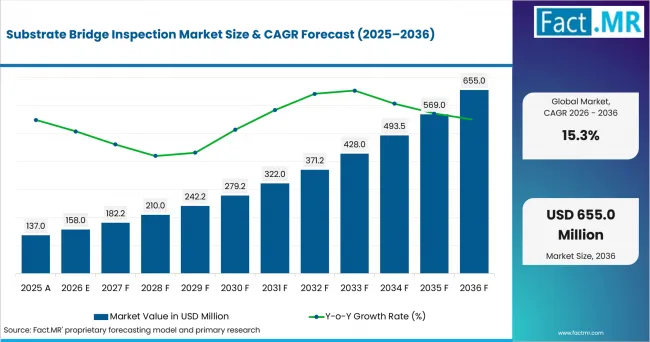
Substrate Bridge Inspection Market Value Analysis | Source: Fact.MR
What are the defining numbers behind Substrate Bridge Inspection Market growth?
USD 497.0 million absolute opportunity is expected by 2036.
- Demand Drivers in the Market
- Buried-bridge process chain: Inspection demand tracks a long, multi-step build sequence—cavities are cut in the organic laminate, the bridge is placed with adhesive, build-up layers are laminated over it, vias are drilled and plated to reach the bridge pads, fine-pitch microbumps are aligned to the bridge pads while C4 bumps connect to the substrate pads, and the assembly is completed with underfill and encapsulation. Each handoff in this chain creates a separate inspection checkpoint.
- Yield logic driving inspection intensity: EMIB's core yield advantage - only the small bridge area, not a full interposer, needs to be defect-free - concentrates risk at bridge placement accuracy and substrate-integration defects, which is exactly what bridge inspection tools are built to catch, making inspection intensity track directly with EMIB-style adoption.
- Inspection physics available: Buyers can now assemble a complete inspection stack from proven physics: X-ray CT/laminography resolves micro-bump voids, die shift, and interconnect integrity through the stack, C-SAM screens delamination at the bridge/adhesive and build-up interfaces, and e-beam voltage contrast detects opens and shorts at 1-3 nm-class sensitivity, giving fabs a documented toolkit to specify against rather than relying on a single modality.
- Key Segments Analyzed
- By Inspection Technique: 3D X-ray inspection is projected to hold 32.0% share in 2026, supported by a clear process advantage: Three-dimensional X-ray can locate a buried bridge and reconstruct its relationship to surrounding vias, pads and substrate layers without sectioning the package. That visibility is essential once the bridge is no longer accessible optically.
- By Defect Target: Bridge misalignment is projected to hold 37.6% share in 2026, supported by a clear process advantage: Bridge misalignment can disconnect fine-pitch lanes or create registration conflict between the bridge and the coarser substrate wiring. It is therefore a direct functional defect rather than a cosmetic geometry variation.
- By Inspection Stage: Post-embedding is projected to hold 45.4% share in 2026, supported by a clear process advantage: Post-embedding is the first point at which the bridge position and surrounding material can be evaluated as a completed internal structure. Detecting an error here avoids adding further redistribution, build-up layers and components.
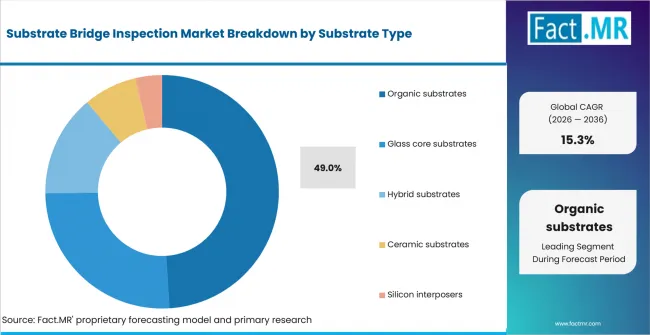
- By Substrate Type: Organic substrates are projected to hold 49.0% share in 2026, supported by a clear process advantage: Organic substrates are the mainstream host for embedded silicon-bridge concepts because they combine low-cost build-up wiring with a localized high-density interconnect region. Their material contrast also creates a clear need for internal inspection.
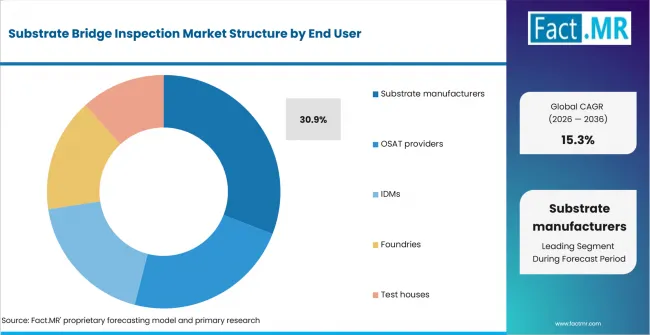
- By End User: Substrate manufacturers are projected to hold 30.9% share in 2026, supported by a clear process advantage: Substrate manufacturers place or embed the bridge before the package reaches final assembly, so they own the earliest economically useful inspection gate. Their process data also links bridge position to lamination and build-up registration.
- Analyst Opinion at Fact.MR
- Shambhu Nath Jha, Sr. Consultant at Fact.MR, states, Technical review should focus on repeatability, integration, defect control and production throughput rather than a single headline specification.
- Strategic Implications
- Inspection should be staged after embedding, lamination and final substrate build-up so defects are caught before high-value dies are attached.
- Procurement teams can compare process capability, integration burden, service coverage and qualification evidence before prioritizing nominal throughput or a single accuracy claim.
Japan is projected to record a 16.4% CAGR as semiconductor equipment, materials, inspection and memory-process expertise supports relevant capital spending; Taiwan is projected to record a 16.6% CAGR as leading foundry production, advanced packaging and a dense OSAT and substrate supply chain supports relevant capital spending; South Korea is projected to record a 16.2% CAGR as high-volume memory, HBM and vertically integrated semiconductor manufacturing supports relevant capital spending; Austria is projected to record a 14.6% CAGR as European wafer-bonding and substrate-equipment expertise, while USA is projected to record a 16.6% CAGR as leading-edge logic, high-performance computing, federally supported semiconductor R&D and a large domestic equipment base supports relevant capital spending through 2036.
How does the Substrate Bridge Inspection Market break down by segment?
3D X-ray inspection leads Inspection Technique with a 32.0% share, while Bridge misalignment accounts for 37.6% of Defect Target in 2026.
Why does 3D X-ray inspection lead Inspection Technique?
3D X-ray inspection is projected to account for 32.0% share in 2026.
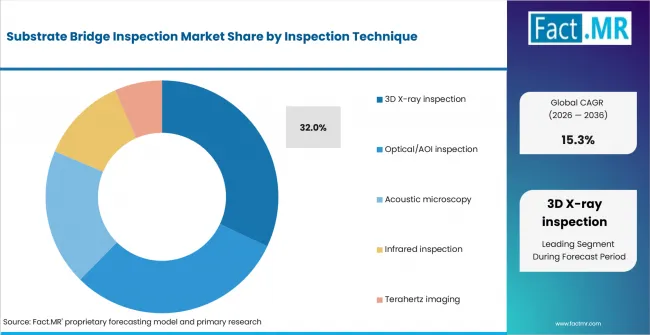
Substrate Bridge Inspection Market Analysis By Inspection Technique | Source: Fact.MR
Three-dimensional X-ray can locate a buried bridge and reconstruct its relationship to surrounding vias, pads and substrate layers without sectioning the package. That visibility is essential once the bridge is no longer accessible optically. AOI is faster for surface features, but it cannot directly verify the internal bridge after embedding or lamination.
Why does Bridge misalignment lead Defect Target?
Bridge misalignment is projected to account for 37.6% share in 2026.
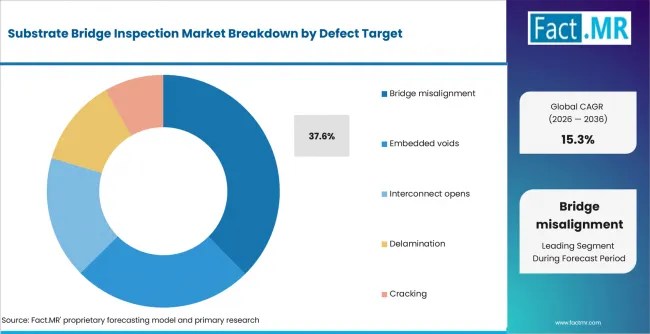
Substrate Bridge Inspection Market Analysis By Defect Target | Source: Fact.MR
Bridge misalignment can disconnect fine-pitch lanes or create registration conflict between the bridge and the coarser substrate wiring. It is therefore a direct functional defect rather than a cosmetic geometry variation. Embedded voids affect reliability, but misalignment is the first-order risk unique to placing a discrete bridge inside the substrate.
Why does Post-embedding lead Inspection Stage?
Post-embedding is projected to account for 45.4% share in 2026.
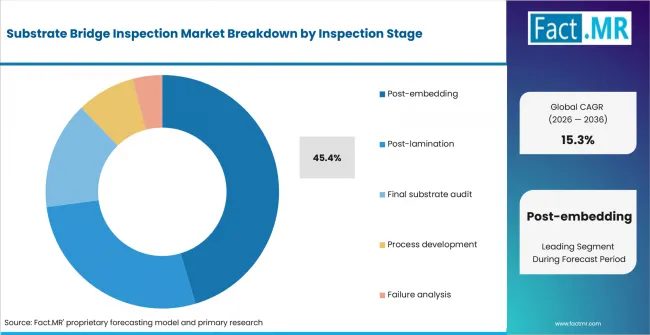
Substrate Bridge Inspection Market Analysis By Inspection Stage | Source: Fact.MR
Post-embedding inspection examines the completed substrate bridge after it has been placed and fixed within the package, allowing manufacturers to detect defects created during embedding, bonding or material curing. Earlier inspection stages can identify surface damage or placement errors, but they do not reveal hidden voids, interface separation, bridge deformation or connection shifts that appear after the full assembly process. This stage provides a more complete view of the final structure and confirms whether electrical paths, bond interfaces and mechanical alignment remain within the required limits.
Why do Organic substrates lead Substrate Type?
Organic substrates are projected to account for 49.0% share in 2026.
Substrate Bridge Inspection Market Analysis By Substrate Type | Source: Fact.MR
Organic substrates are the mainstream host for embedded silicon-bridge concepts because they combine low-cost build-up wiring with a localized high-density interconnect region. Their material contrast also creates a clear need for internal inspection. Glass cores offer dimensional stability, but their bridge-integration ecosystem is less mature and follows a different defect signature. EMIB manufacture: cavities in organic laminate to bridge placed with adhesive to build-up layers laminated over the bridges to vias drilled/plated to reach bridge pads to flip-chip attach with fine-pitch microbumps aligned to bridge pads while C4 bumps align to substrate pads to underfill + encapsulation (process analysis).
Why do Substrate manufacturers lead End User?
Substrate manufacturers are projected to account for 30.9% share in 2026.
Substrate Bridge Inspection Market Analysis By End User | Source: Fact.MR
Substrate manufacturers place or embed the bridge before the package reaches final assembly, so they own the earliest economically useful inspection gate. Their process data also links bridge position to lamination and build-up registration. OSATs see the completed substrate later and may perform acceptance checks, but cannot correct the upstream embedding process as directly.
What is accelerating Substrate Bridge Inspection Market adoption, and what is holding it back?
The strongest accelerator is the two-pitch registration, is the defining inspection problem, while the main restraint is that organic or glass layers can obscure the bridge, forcing trade-offs among X-ray resolution, acoustic access and inspection speed.
Drivers Impact Analysis
| DRIVER | (~) % IMPACT ON CAGR | GEOGRAPHIC RELEVANCE | IMPACT TIMELINE |
|---|---|---|---|
| Two-pitch registration is the defining inspection problem | +4.3% | Global leading-edge fabs | Medium term (2-4 years) |
| Buried-bridge process chain | +3.5% | Global leading-edge fabs | Medium term (2-4 years) |
| Yield logic driving inspection intensity | +2.9% | Global leading-edge fabs | Medium term (2-4 years) |
| Inspection physics available | +2.3% | Global leading-edge fabs | Medium term (2-4 years) |
Source: Fact.MR analysis. Updated Jul 22, 2026
- Two-pitch registration is the defining inspection problem: In EMIB-class assembly, a die must land correctly on standard FCBGA pads (tens-of-µm pitch) and on fine-pitch bridge pads;
- Buried-bridge process chain: EMIB manufacture: cavities in organic laminate to bridge placed with adhesive to build-up layers laminated over the bridges to vias drilled/plated to reach bridge pads to flip-chip attach with fine-pitch microbumps aligned to bridge pads while C4 bumps align to substrate pads to underfill + encapsulation (process analysis).
- Yield logic driving inspection intensity: EMIB's yield advantage is that only the small bridge area must be defect-free (vs. full interposer area for silicon interposers) - but this concentrates risk at bridge placement accuracy and substrate-integration defects, which are exactly what bridge inspection tools must catch (interposer-vs-EMIB yield analysis).
- Inspection physics available: X-ray CT/laminography resolves micro-bump voids, die shift, and interconnect integrity through the stack (voids/cracks in 20 µm micro-bumps.
Opportunity Impact Analysis
| OPPORTUNITY | (~) % IMPACT ON CAGR | GEOGRAPHIC RELEVANCE | IMPACT TIMELINE |
|---|---|---|---|
| Bridge inspection moving upstream into the substrate fab | +2.6% | Global leading-edge fabs | Medium term (2-4 years) |
| Bridge proliferation | +2.0% | Global leading-edge fabs | Medium term (2-4 years) |
| TCB at finest bridge pitches | +1.5% | Global leading-edge fabs | Medium term (2-4 years) |
Source: Fact.MR analysis. Updated Jul 22, 2026
- Bridge inspection moving upstream into the substrate fab: Connectivity verified before shipment (semiconductorX), pushing X-ray/AOI into substrate lines rather than only OSAT lines.
- Bridge proliferation: Intel EMIB, TSMC CoWoS-L (LSI bridges), Samsung I-Cube/X-Cube, and fan-out embedded-bridge variants multiply the number of bridge zones per package - inspection throughput per package rises non-linearly.
- TCB at finest bridge pitches: Requires sub-micron placement verification over bridges (semiconductorX notes TCB variant used at finest bridge pitches).
Restraints Impact Analysis
| RESTRAINT | (~) % IMPACT ON CAGR | GEOGRAPHIC RELEVANCE | IMPACT TIMELINE |
|---|---|---|---|
| Primary qualification constraint | -2.3% | Global leading-edge fabs | Medium term (2-4 years) |
| Process-window sensitivity | -1.8% | Global leading-edge fabs | Medium term (2-4 years) |
| Buried-defect escape | -1.4% | Global leading-edge fabs | Medium term (2-4 years) |
Source: Fact.MR analysis. Updated Jul 22, 2026
- Primary qualification constraint: Organic or glass layers can obscure the bridge, forcing trade-offs among X-ray resolution, acoustic access and inspection speed.
- Process-window sensitivity: Full interposer area for silicon interposers - but this concentrates risk at bridge placement accuracy and substrate-integration defects, which are exactly what bridge inspection tools must catch (interposer-vs-EMIB yield analysis).
Which countries are scaling Substrate Bridge Inspection Market fastest?
For Substrate Bridge Inspection Market, South Korea's 16.2% CAGR reflects high-volume memory, HBM and vertically integrated semiconductor manufacturing.
- Countries differ less by the headline CAGR than by the type of semiconductor work creating demand for the Substrate Bridge Inspection Market.
- Taiwan takes a different path through leading foundry production, advanced packaging and a dense OSAT and substrate supply chain.
- USA and Japan remain aligned through distinct combinations of device production, equipment development and advanced packaging investment.
- South Korea develops through high-volume memory, HBM and vertically integrated semiconductor manufacturing, while Austria relies on European wafer-bonding and substrate-equipment expertise.
- Markets with similar CAGRs can follow different development paths because installed fabs, device mix, local equipment capability, export controls and qualification cycles differ.
The full report compares the six named country markets within the wider regional coverage of North America, Latin America, Europe, East Asia, South Asia & Oceania, and the Middle East & Africa.
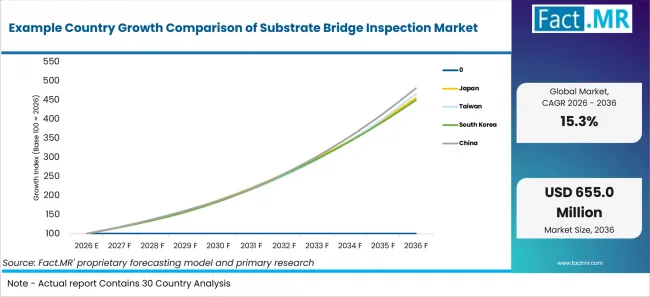
Example Country Growth Comparison Of Substrate Bridge Inspection Market | Source: Fact.MR
| COUNTRY | CAGR, 2026 to 2036 |
|---|---|
| Taiwan | 16.6% |
| USA | 16.6% |
| Japan | 16.4% |
| South Korea | 16.2% |
| Austria | 14.6% |
Source: Fact.MR analysis. Updated Jul 22, 2026
What is driving Taiwan's growth through 2036?
16.6% CAGR, supported by leading foundry production, advanced packaging and a dense OSAT and substrate supply chain.
TSMC CoWoS-L with local interconnect (LSI) bridges; ASE handling assembly-side inspection.
What is driving USA's growth through 2036?
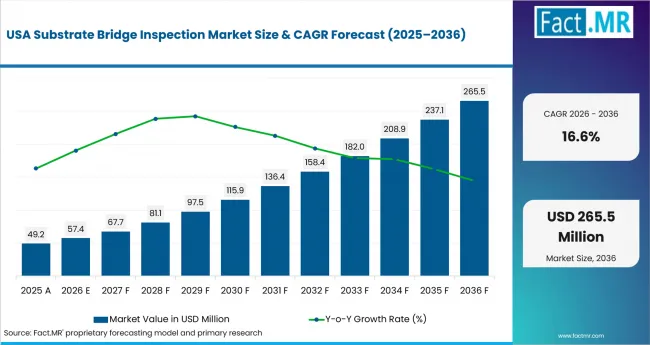
16.6% CAGR, supported by leading-edge logic, high-performance computing, federally supported semiconductor R&D and a large domestic equipment base.
Substrate Bridge Inspection Market Country Value Analysis | Source: Fact.MR
Intel EMIB in production (Stratix FPGA, Kaby Lake-G heritage; Ponte Vecchio, Sapphire Rapids); inspection tool vendors (KLA, Nordson, Onto) co-develop. This environment creates a clear qualification pathway for the Substrate Bridge Inspection Market because buyers must solve the problem of verifying buried bridge position and integrity while protecting fine-pitch and conventional-pitch interconnect registration at production scale.
What is driving Japan's growth through 2036?
16.4% CAGR, supported by semiconductor equipment, materials, inspection and memory-process expertise.
Japan combines semiconductor equipment, materials, inspection and memory-process expertise with a 26.6% share of 2026 demand across the six profiled countries.
What is driving South Korea's growth through 2036?
16.2% CAGR, supported by high-volume memory, HBM and vertically integrated semiconductor manufacturing.
Samsung I-Cube-class; Amkor Korea lines. This environment creates a clear qualification pathway for the Substrate Bridge Inspection Market because buyers must solve the problem of verifying buried bridge position and integrity while protecting fine-pitch and conventional-pitch interconnect registration at production scale.
What is driving Austria's growth through 2036?
14.6% CAGR, supported by European wafer-bonding and substrate-equipment expertise.
Austria combines European wafer-bonding and substrate-equipment expertise, with a 10.2% share of 2026 demand across the six profiled countries.
Who leads the Substrate Bridge Inspection Market?
Nordson Test & Inspection and Camtek lead the competitive landscape, followed by Zeiss and Hitachi High-Tech as the next tier of challengers.
Nordson Test & Inspection participates through X-ray, acoustic and optical inspection. Adapting wafer-level overlay, AOI, and X-ray platforms to buried-bridge use cases.” is a sentence fragment after the Nordson sentence. It needs to be joined to the preceding sentence or rewritten with a subject. Zeiss participates through X-ray microscopy, electron imaging and semiconductor metrology, with relevance determined by its ability to address the challenge. Hitachi High-Tech participates through CD-SEM and semiconductor inspection, with relevance determined by its ability to address the challenge.
Viscom holds a more specialized role through specialized semiconductor equipment, particularly where custom integration and service coverage affect qualification. Onto Innovation holds a more specialized role through advanced packaging inspection, overlay and process-control metrology, particularly where custom integration and service coverage affect qualification.
Competition is expected to center on repeatable process performance, integration with adjacent modules, installed-base service and documented capability to address the challenge of verifying buried bridge position and integrity while protecting fine-pitch and conventional-pitch interconnect registration. Buyers are likely to compare accuracy, defect prevention, throughput, recipe stability and the completeness of the delivered process cell.
Which companies are the key providers?
Key companies include Nordson Test & Inspection; Camtek; Zeiss; Hitachi High-Tech; Viscom; Onto Innovation.
- Nordson Test & Inspection
- Camtek
- Zeiss
- Hitachi High-Tech
- Viscom
- Onto Innovation
Bibliography
- Bruker Corporation. (2025, June 24). Bruker experiences growth in semiconductor advanced packaging market fueled by AI demands.
- KLA Corporation. (2025, May 5). Advanced packaging: Process control and yield management.
- Onto Innovation Inc. (2025, September 18). Onto Innovation invites customers and investors to schedule meetings at SEMICON West.
- SEMI. (2025, December 16). Global semiconductor equipment sales projected to reach a record $156 billion in 2027, SEMI reports.
This Report Addresses
- The report provides strategic intelligence on Substrate Bridge Inspection Market across Inspection Technique and Defect Target choices that shape purchasing decisions.
- Segment analysis covers 3D X-ray inspection as the share leader within the 2026 market structure.
- Regional outlook evaluates Japan and Taiwan alongside South Korea, while Austria and USA complete the growth comparison.
- Competitive analysis profiles Nordson Test & Inspection and Camtek alongside Zeiss and Hitachi High-Tech, followed by additional active providers.
- Use-case assessment covers the categories and applications that shape demand in the Substrate Bridge Inspection Market across the forecast period.
What does the Substrate Bridge Inspection Market cover?
The market covers equipment and process systems configured to address the challenge of verifying buried bridge position and integrity, while protecting fine-pitch and conventional-pitch interconnect registration.
Substrate bridge inspection covers metrology and defect inspection for silicon bridges embedded in package substrates (Intel EMIB and equivalents - TSMC LSI, Samsung I-Cube-class, fan-out embedded bridges): bridge connectivity at the substrate fabricator, bridge-to-pad registration after build-up lamination, cavity/bridge coplanarity, and post-assembly joint integrity over bridge zones. Distinct from general substrate AOI because the bridge is buried under build-up layers and its fine-pitch pads coexist with coarse FCBGA pads.
Commercial value arises from the complete configured system, including process control, handling, software and integrated modules required for repeatable operation. Finished semiconductor devices, package value and unrelated parent-market equipment are excluded.
What is included in the scope?
The scope includes systems used by substrate manufacturers and the other end-user groups listed in the segmentation.
The market is segmented by Inspection Technique, including 3D X-ray inspection, Optical/AOI inspection, Acoustic microscopy, Infrared inspection, Terahertz imaging; Defect Target, including Bridge misalignment, Embedded voids, Interconnect opens, Delamination, Cracking; Inspection Stage, including Post-embedding, Post-lamination, Final substrate audit, Process development, Failure analysis; Substrate Type, including Organic substrates, Glass core substrates, Hybrid substrates, Ceramic substrates, Silicon interposers; End User, including Substrate manufacturers, OSAT providers, IDMs, Foundries, Test houses.
Integrated handling, metrology, cleaning, activation, process-control or support modules are included when delivered as part of the configured market system.
What is excluded from the scope?
The scope excludes unrelated semiconductor equipment, standalone materials and components sold independently of the configured system.
It also excludes facility construction, cleanroom infrastructure, the value of processed wafers or packages, and adjacent process steps that are not part of the defined equipment category.
How Was the Analysis Built?
Fact.MR is of the opinion that this assessment combines structured market analysis with a review of public information and industry evidence relevant to the market.
- Market Assessment: The analysis considers demand patterns, supply conditions, segment mix, country activity, company participation, and adoption trends.
- Evidence Review: Public company disclosures, government and regulatory publications, trade information, technical literature, and industry records inform the assessment.
- Validation and Updates: Findings are cross-checked against available market indicators and reviewed when material market developments emerge.
Segmentation
What is the report's scope and coverage?
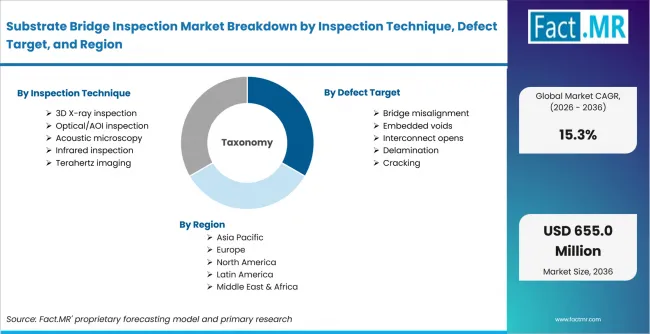
Substrate Bridge Inspection Market Breakdown By Inspection Technique, Defect Target, And Region | Source: Fact.MR
| Attribute | Details |
|---|---|
| Quantitative Units | USD 158.0 million in 2026 to USD 655.0 million by 2036 at a 15.3% CAGR |
| Market Definition | Substrate bridge inspection covers metrology and defect inspection for silicon bridges embedded in package substrates (Intel EMIB and equivalents - TSMC LSI, Samsung I-Cube-class, fan-out embedded bridges): bridge connectivity at the substrate fabricator, bridge-to-pad registration after build-up lamination, cavity/bridge coplanarity, and post-assembly joint integrity over bridge zones. Distinct from general substrate AOI because the bridge is buried under build-up layers and its fine-pitch pads coexist with coarse FCBGA pads. |
| Inspection Technique | 3D X-ray inspection; Optical/AOI inspection; Acoustic microscopy; Infrared inspection; Terahertz imaging |
| Defect Target | Bridge misalignment; Embedded voids; Interconnect opens; Delamination; Cracking |
| Inspection Stage | Post-embedding; Post-lamination; Final substrate audit; Process development; Failure analysis |
| Substrate Type | Organic substrates; Glass core substrates; Hybrid substrates; Ceramic substrates; Silicon interposers |
| End User | Substrate manufacturers; OSAT providers; IDMs; Foundries; Test houses |
| Regions Covered | North America; Latin America; Europe; East Asia; South Asia & Oceania; Middle East & Africa |
| Countries Covered | Japan; Taiwan; South Korea; Austria; USA |
| Key Companies Profiled | Nordson Test & Inspection; Camtek; Zeiss; Hitachi High-Tech; Viscom; Onto Innovation |
| Forecast Period | 2026 to 2036 |
| Approach | Hybrid top-down and bottom-up approach using demand indicators across Inspection Technique; Defect Target; Inspection Stage; Substrate Type; End User; country-level growth; company participation and adoption trends |
Source: Fact.MR analysis. Updated Jul 22, 2026
How is the market segmented?
-
By Inspection Technique:
- 3D X-ray inspection
- Optical/AOI inspection
- Acoustic microscopy
- Infrared inspection
- Terahertz imaging
-
By Defect Target:
- Bridge misalignment
- Embedded voids
- Interconnect opens
- Delamination
- Cracking
-
By Inspection Stage:
- Post-embedding
- Post-lamination
- Final substrate audit
- Process development
- Failure analysis
-
By Substrate Type:
- Organic substrates
- Glass core substrates
- Hybrid substrates
- Ceramic substrates
- Silicon interposers
-
By End User:
- Substrate manufacturers
- OSAT providers
- IDMs
- Foundries
- Test houses
-
By Region:
- North America
- USA
- Latin America
- Other regional markets assessed at aggregate level
- Europe
- Austria
- East Asia
- Japan
- Taiwan
- South Korea
- South Asia & Oceania
- Other regional markets assessed at aggregate level
- Middle East & Africa
- Other regional markets assessed at aggregate level
- North America
Frequently Asked Questions
Which Inspection Technique leads the Substrate Bridge Inspection Market?
Which Defect Target leads the Substrate Bridge Inspection Market?
Which Inspection Stage leads the Substrate Bridge Inspection Market?
Which Substrate Type leads the Substrate Bridge Inspection Market?
Which End User leads the Substrate Bridge Inspection Market?
What CAGR is projected for Taiwan in the Substrate Bridge Inspection Market?
What CAGR is projected for USA in the Substrate Bridge Inspection Market?
What CAGR is projected for Japan in the Substrate Bridge Inspection Market?
What CAGR is projected for South Korea in the Substrate Bridge Inspection Market?
What CAGR is projected for Austria in the Substrate Bridge Inspection Market?
What is the main restraint in the Substrate Bridge Inspection Market?
Who worked on this report


Preview the report firsthand - request a free sample
Free SampleGet the brochure for pricing and purchase details
Download PDF