- Base Value(2026): 60.00 Mn
- Estimated Value(2026): 60.0 Mn
- Forecast Value (2036): 110.5 Mn
- CAGR (2026 - 2036): 6.3%
Low-Temperature Cure Coil Coatings for Heat-Sensitive Substrates Market Forecast and Outlook 2026 to 2036
The global low-temperature cure coil coatings for heat-sensitive substrates market is projected to reach USD 110.53 million by 2036. The market is valued at USD 60.00 million in 2026 and is set to rise at a CAGR of 6.3% during the assessment period.
By coating technology, UV/EB-curable (energy-cure) coil coatings hold a leading 20% share. Thin gauge plastics or polymer-clad strips represent the dominant substrate segment at 28.0%, while building envelope or decorative cladding is the primary end-use at 30.00%. Continuous coil UV/EB cure lines are the leading process method at 25.0%.
Key Takeaways from the Low-Temperature Cure Coil Coatings for Heat-Sensitive Substrates Market
- Market Value for 2026: USD 60.00 Million
- Market Value for 2036: USD 110.53 Million
- Forecast CAGR (2026-2036): 6.3%
- Leading Coating Technology Segment Share (2026): UV/EB-curable (energy-cure) coil coatings (20%)
- Leading Substrate Segment Share (2026): Thin gauge plastics or polymer-clad strips (28.0%)
- Leading End-Use Segment Share (2026): Building envelope or decorative cladding (pre-finished panels) (30.00%)
- Leading Cure Method Segment Share (2026): Continuous coil UV/EB cure lines (energy-cure) (25.0%)
- Key Players in the Market: Akzo Nobel N.V., PPG Industries Inc., The Sherwin-Williams Companies (Valspar or coil), Nippon Paint
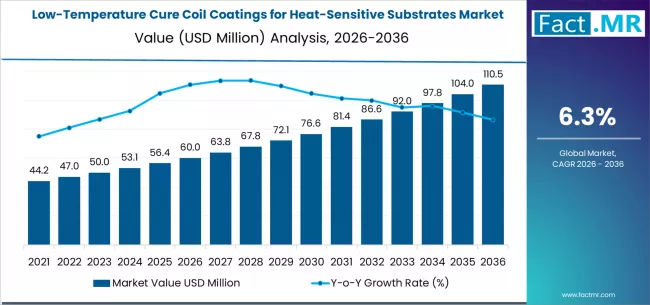
Low Temperature Cure Coil Coatings For Heat Sensitive Substrates Market Market Value Analysis | Source: Fact.MR
Defining trends involve the development of advanced curing chemistries that enable high-performance finishes on substrates unable to withstand conventional high-temperature oven cycles. Innovation is focused on enhancing cure speed, film properties, and adhesion while operating at significantly reduced temperatures. Integration of these coatings into sustainable manufacturing processes that reduce energy consumption is becoming a key competitive strategy.
Demand for energy-efficient production and the expansion of applications using lightweight, composite, and temperature-sensitive materials are primary market drivers. The need to protect sensitive substrates from thermal deformation or degradation during coating creates a critical demand for formulations that deliver durability and aesthetics without compromising substrate integrity.
Low-Temperature Cure Coil Coatings for Heat-Sensitive Substrates Market
| Metric | Value |
|---|---|
| Market Value (2026) | USD 60.00 Million |
| Market Forecast Value (2036) | USD 110.53 Million |
| Forecast CAGR (2026-2036) | 6.3% |
Source: Fact.MR analysis. Updated Dec 26, 2025
Category
| Category | Segments |
|---|---|
| Coating Technology | UV/EB-curable (energy-cure) coil coatings, Low-temperature polyester (low-bake), Low-temperature epoxy (modified resins), Powder coatings formulated for low cure (IR/induction assist), Sol-gel or ceramic hybrid low-temp systems, Waterborne or low-temp aqueous systems, Primer or conversion coatings for adhesion on heat-sensitive substrates |
| Heat-Sensitive Substrate | Thin gauge plastics or polymer-clad strips, Composite panels (plastic/aluminum composite), Wood or MDF laminates (pre-coated metal substitutes), Paper or label substrates (metalized paper), Light-gauge aluminum intended for thermo-sensitive forming, Specialty substrates (textiles, foams, flexible substrates) |
| End-Use or Application | Building envelope or decorative cladding (pre-finished panels), Appliances & white goods (low-temp formed parts), Lighting & luminaires (thin gauge substrates), Automotive non-structural trim or interior metalized parts, Packaging & labels (metalized or low-temp paper), Specialty industrial (furniture, signage, HVAC ducts) |
| Coil-Line Process or Cure Method | Continuous coil UV/EB cure lines (energy-cure), Conventional low-bake thermal ovens, IR or induction-assisted cure lines, Post-coat on formed parts (lower-volume) |
| Region | North America, Latin America, Western Europe, Eastern Europe, East Asia, South Asia & Pacific, MEA |
Source: Fact.MR analysis. Updated Dec 26, 2025
Segmental Analysis
By Coating Technology, Which Chemistry Enables High-Speed, Low-Heat Curing?
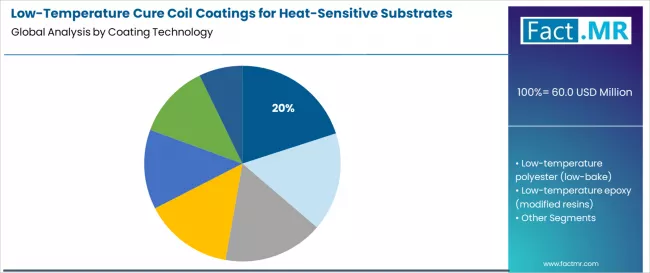
Low Temperature Cure Coil Coatings For Heat Sensitive Substrates Market Analysis By Coating Technology | Source: Fact.MR
UV/EB-curable (energy-cure) coil coatings lead the segment with a 20% share. This dominance is due to their ability to achieve near-instantaneous cure at ambient or mildly elevated temperatures, perfectly preserving the dimensional stability of heat-sensitive substrates. They offer superior production speed, energy efficiency, and excellent film properties, making them ideal for high-volume, sensitive applications.
By Substrate, Which Material Category Drives the Most Demand?
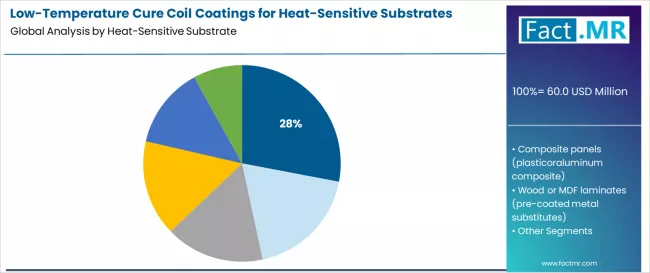
Low Temperature Cure Coil Coatings For Heat Sensitive Substrates Market Analysis By Heat Sensitive Substrate | Source: Fact.MR
Thin gauge plastics or polymer-clad strips command the largest substrate share at 28.0%. This category represents a growing frontier for metal substitution in lightweighting and design-flexibility applications. The extreme sensitivity of these materials to warping or melting under conventional coil oven temperatures creates a mandatory demand for specialized low-temperature cure coatings.
By End-Use, Which Application Represents the Largest Market Volume?
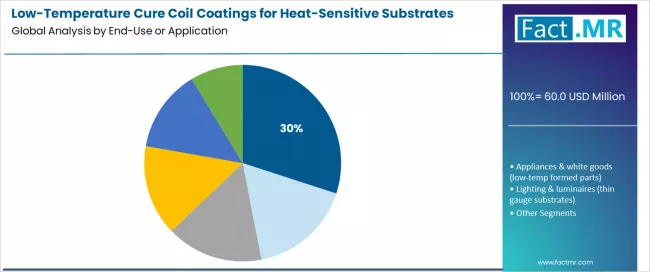
Low Temperature Cure Coil Coatings For Heat Sensitive Substrates Market Analysis By End Use Or Application | Source: Fact.MR
Building envelope or decorative cladding represents the leading end-use segment at 30.00%. This is driven by the increasing use of pre-finished composite panels and insulated metal panels in construction, where the core materials cannot tolerate high heat. The demand for aesthetic, durable, and weather-resistant finishes on these assemblies propels market growth.
By Cure Method, Which Process is Most Synergistic with Sensitive Substrates?
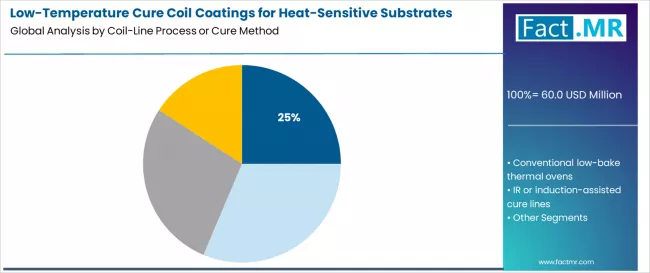
Low Temperature Cure Coil Coatings For Heat Sensitive Substrates Market Analysis By Coil Line Process Or Cure Method | Source: Fact.MR
Continuous coil UV/EB cure lines represent the leading process method at 25.0%. This method is fundamentally aligned with the market's core value proposition, enabling true high-speed continuous coating of temperature-sensitive materials without thermal damage, thereby unlocking new design and manufacturing possibilities.
What are the Drivers, Restraints, and Key Trends of the Low-Temperature Cure Coil Coatings for Heat-Sensitive Substrates Market?
The drive towards energy-efficient manufacturing and reduced carbon footprints in coil coating lines is a primary growth driver. The expanding use of lightweight, polymer-based, and composite substrates in multiple industries creates new application frontiers. Stringent performance requirements for coatings on these novel substrates necessitate tailored low-temperature solutions.
A significant restraint is the higher formulation cost of advanced energy-cure or hybrid chemistries compared to standard polyester coil coatings. The capital investment required for UV/EB or specialized low-bake oven infrastructure can be a barrier for smaller coaters. Potential limitations in film build or certain performance characteristics (e.g., very deep draw formability) compared to fully cured high-bake systems require careful application engineering.
Key trends include the development of dual-cure (e.g., UV + thermal) and low-temperature powder coating systems to expand performance windows. There is a strong focus on improving the adhesion and flexibility of these coatings to withstand post-forming operations. The market is also seeing increased collaboration between coating formulators, substrate producers, and equipment manufacturers to create integrated processing solutions.
Analysis of the Low-Temperature Cure Coil Coatings for Heat-Sensitive Substrates Market by Key Countries
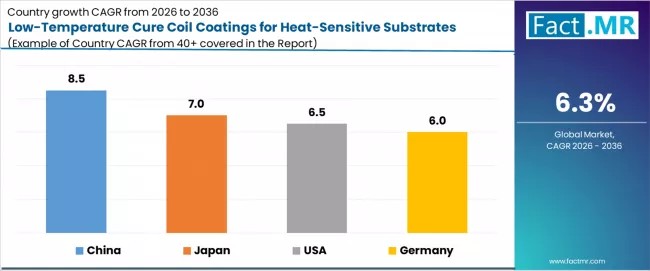
Low Temperature Cure Coil Coatings For Heat Sensitive Substrates Market Cagr Analysis By Country | Source: Fact.MR
| Country | CAGR (2026-2036) |
|---|---|
| China | 8.50% |
| Japan | 7.00% |
| USA | 6.50% |
| Germany | 6.00% |
Source: Fact.MR analysis. Updated Dec 26, 2025
How does China's Manufacturing Scale and Material Innovation Drive Growth?
China leads with an 8.50% CAGR, driven by its vast manufacturing base for appliances, construction materials, and packaging. Rapid adoption of new, cost-effective composite and plastic substrates in these sectors, coupled with a strong push for manufacturing energy efficiency, creates significant demand for compatible low-temperature curing coating technologies.
Why is Japan's Leadership in Precision Manufacturing and Electronics a Key Driver?
Japan's 7.00% growth is fueled by its advanced electronics, automotive component, and high-end appliance industries. The prevalent use of precision-formed, thin-gauge, and heat-sensitive metals and composites in these sectors requires coatings that cure without affecting tight tolerances or material properties, driving adoption of specialized low-temperature solutions.
What Role does the USA's Diverse Industrial Base and Sustainability Focus Play?
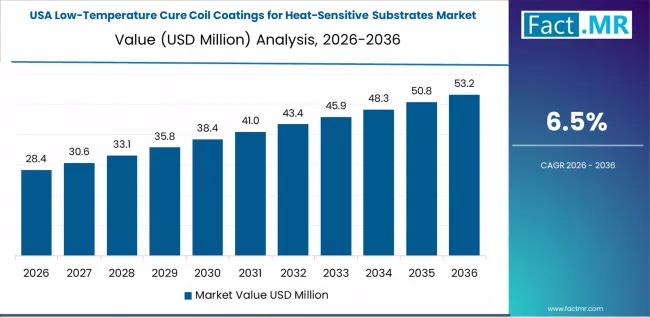
Low Temperature Cure Coil Coatings For Heat Sensitive Substrates Market Country Value Analysis | Source: Fact.MR
The USA's 6.50% growth is underpinned by a strong construction sector using advanced building panels, a robust automotive industry adopting lighter materials, and a focus on sustainable manufacturing. Demand is driven by the need to coat new substrate generations while reducing factory energy consumption and expanding design possibilities for engineered products.
How does Germany's Engineering and Green Manufacturing Standards Influence the Market?
Germany's 6.00% growth reflects its leadership in high-performance industrial machinery, automotive, and appliance manufacturing. The demand is for technically sophisticated coating systems that meet the extreme performance standards of German engineering while aligning with strict national and EU targets for industrial energy efficiency and sustainable production.
Competitive Landscape of the Low-Temperature Cure Coil Coatings for Heat-Sensitive Substrates Market
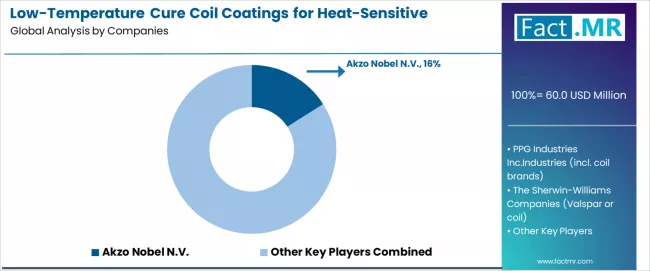
Low Temperature Cure Coil Coatings For Heat Sensitive Substrates Market Analysis By Company | Source: Fact.MR
Global coating giants competing through dedicated R&D to solve specific substrate and process challenges characterize the competitive landscape. Leaders like Akzo Nobel, PPG Industries, and Sherwin-Williams (Valspar) leverage their deep coil coating expertise, broad resin technology portfolios, and global technical service networks to develop and scale tailored low-temperature solutions.
Competition centers on proprietary resin and curing agent chemistry that unlocks lower cure temperatures without sacrificing key performance attributes like weatherability, hardness, or flexibility. Success is increasingly tied to the ability to offer complete system solutions, including primers and topcoats validated for specific substrate families, and to provide extensive technical support for coaters transitioning to new processes.
Key Players in the Low-Temperature Cure Coil Coatings for Heat-Sensitive Substrates Market
- Akzo Nobel N.V.
- PPG Industries Inc.
- The Sherwin-Williams Companies (Valspar or coil)
- Nippon Paint
Segmentation
Scope of Report
| Items | Values |
|---|---|
| Quantitative Units | USD Million |
| Coating Technology | UV/EB-curable (energy-cure) coil coatings, Low-temperature polyester (low-bake), Low-temperature epoxy (modified resins), Powder coatings formulated for low cure (IR/induction assist), Sol-gel or ceramic hybrid low-temp systems, Waterborne or low-temp aqueous systems, Primer or conversion coatings for adhesion on heat-sensitive substrates |
| Heat-Sensitive Substrate | Thin gauge plastics or polymer-clad strips, Composite panels (plastic/aluminum composite), Wood or MDF laminates (pre-coated metal substitutes), Paper or label substrates (metalized paper), Light-gauge aluminum intended for thermo-sensitive forming, Specialty substrates (textiles, foams, flexible substrates) |
| End-Use or Application | Building envelope or decorative cladding (pre-finished panels), Appliances & white goods (low-temp formed parts), Lighting & luminaires (thin gauge substrates), Automotive non-structural trim or interior metalized parts, Packaging & labels (metalized or low-temp paper), Specialty industrial (furniture, signage, HVAC ducts) |
| Coil-Line Process or Cure Method | Continuous coil UV/EB cure lines (energy-cure), Conventional low-bake thermal ovens, IR or induction-assisted cure lines, Post-coat on formed parts (lower-volume) |
| Key Countries | China, Japan, USA, Germany |
| Key Companies | Akzo Nobel N.V., PPG Industries Inc., The Sherwin-Williams Companies (Valspar or coil), Nippon Paint |
| Additional Analysis | Analysis of cure kinetics and thermal profile modeling for sensitive substrates, compatibility and adhesion testing across substrate families, total cost of operation models comparing energy use vs. conventional curing, competitive assessment against standard high-bake coil coatings, and analysis of regional regulations impacting industrial energy use and VOC emissions. |
Source: Fact.MR analysis. Updated Dec 26, 2025
Low-Temperature Cure Coil Coatings for Heat-Sensitive Substrates Market by Segments
Coating Technology :
- UV/EB-curable (energy-cure) coil coatings
- Low-temperature polyester (low-bake)
- Low-temperature epoxy (modified resins)
- Powder coatings formulated for low cure (IR/induction assist)
- Sol-gel or ceramic hybrid low-temp systems
- Waterborne or low-temp aqueous systems
- Primer or conversion coatings for adhesion on heat-sensitive substrates
Heat-Sensitive Substrate :
- Thin gauge plastics or polymer-clad strips
- Composite panels (plastic/aluminum composite)
- Wood or MDF laminates (pre-coated metal substitutes)
- Paper or label substrates (metalized paper)
- Light-gauge aluminum intended for thermo-sensitive forming
- Specialty substrates (textiles, foams, flexible substrates)
End-Use :
- Building envelope or decorative cladding (pre-finished panels)
- Appliances & white goods (low-temp formed parts)
- Lighting & luminaires (thin gauge substrates)
- Automotive non-structural trim or interior metalized parts
- Packaging & labels (metalized or low-temp paper)
- Specialty industrial (furniture, signage, HVAC ducts)
Coil-Line Process or Cure Method :
- Continuous coil UV/EB cure lines (energy-cure)
- Conventional low-bake thermal ovens
- IR or induction-assisted cure lines
- Post-coat on formed parts (lower-volume)
Region :
- North America
- USA
- Canada
- Latin America
- Brazil
- Mexico
- Argentina
- Rest of Latin America
- Western Europe
- Germany
- UK
- France
- Spain
- Italy
- BENELUX
- Rest of Western Europe
- Eastern Europe
- Russia
- Poland
- Czech Republic
- Rest of Eastern Europe
- East Asia
- China
- Japan
- South Korea
- Rest of East Asia
- South Asia & Pacific
- India
- ASEAN
- Australia
- Rest of South Asia & Pacific
- MEA
- Saudi Arabia
- UAE
- Turkiye
- Rest of MEA
Frequently Asked Questions
How big is the low-temperature cure coil coatings for heat-sensitive substrates market in 2026?
What will be the size of low-temperature cure coil coatings for heat-sensitive substrates market in 2036?
How much will be the low-temperature cure coil coatings for heat-sensitive substrates market growth between 2026 and 2036?
What are the key product types in the low-temperature cure coil coatings for heat-sensitive substrates market?
Which heat-sensitive substrate segment to contribute significant share in the low-temperature cure coil coatings for heat-sensitive substrates market in 2026?
Who worked on this report


Preview the report firsthand - request a free sample
Free SampleGet the brochure for pricing and purchase details
Download PDF