- Base Value(2025): 1.3 Bn
- Forecast Value (2036): 8.5 Bn
- CAGR (2036): 18.9%
What is the surf parks market forecast to be worth by 2036?
USD 1.5 billion in 2026 to USD 8.5 billion by 2036 at 18.9% CAGR.
- The Surf Parks Market was valued at USD 1.3 billion in 2025.
- The surf parks market is estimated at USD 1.5 billion in 2026 and is projected to reach USD 8.5 billion by 2036.
- The market is forecast to expand at 18.9% CAGR during 2026 to 2036 as artificial wave technologies enable commercial surfing experiences in inland and urban locations.
- Surf parks combine engineered wave systems with hospitality, recreation and sports training facilities. These venues provide controlled surfing environments that support beginners, professional athletes and recreational users. Growing interest in adventure sports and destination entertainment is supporting global market expansion.
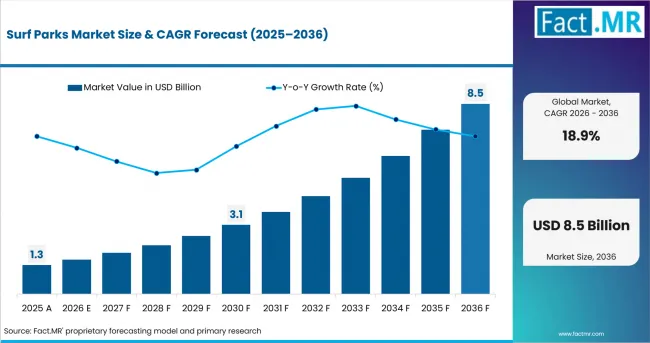
Surf Parks Market Value Analysis | Source: Fact.MR
What are the defining numbers behind surf parks growth?
USD 7.0 billion absolute opportunity by 2036 led by the United States and South Korea.
- Demand Drivers in the Market
- Surfing participation is expanding beyond coastal regions.
- Artificial wave technology improves accessibility and consistency.
- Destination entertainment projects increasingly incorporate surf attractions.
- Olympic visibility has increased global awareness of surfing.
- Key Segments Analyzed
- By Facility Type: Destination Surf Parks are expected to hold 46.0% share in 2026 because they combine sports, hospitality and entertainment offerings.
- By Wave Technology: Lagoon-Based Wave Systems are projected to account for 38.0% share in 2026 due to their ability to support large visitor volumes.
- By Revenue Stream: Session-Based Surfing Access is expected to hold 35.0% share in 2026 because surfing sessions remain the primary revenue source.
- By End User: Recreational Surfers are projected to account for 57.0% share in 2026 as leisure participation drives facility utilization.
- By Application: Sports and Recreation are expected to hold 49.0% share in 2026 due to growing consumer demand for active entertainment experiences.
- By Geography: The United States is projected to record 20.3% CAGR through 2036.
- Analyst Opinion at Fact.MR
- Shambhu Nath Jha, Senior Analyst at Fact.MR, states, “Surf parks are becoming destination assets that combine sports participation, hospitality and experiential entertainment. Advances in wave technology are improving operational efficiency and expanding commercial viability beyond traditional coastal markets.”
- Strategic Implications
- Developers should prioritize mixed-use destination concepts that combine surfing, hospitality and entertainment.
- Operators should expand coaching programs and membership offerings to increase repeat visitation.
- Technology providers should focus on wave efficiency, energy optimization and operating cost reduction.
- Investors should target projects located near major population centers with strong recreational demand.
The United States remains the largest market and is projected to record 20.3% CAGR through 2036, supported by extensive surf park development activity across Texas and Florida. South Korea is expected to expand at 18.7% CAGR, driven by the success of Wave Park Siheung and growing domestic surfing participation. Saudi Arabia is projected to register 19.9% CAGR through 2036 as large-scale entertainment developments, including Qiddiya, incorporate surf attractions. Japan is forecast to advance at 17.2% CAGR, supported by growing interest in surfing following increased Olympic visibility. The United Kingdom is expected to grow at 17.0% CAGR, driven by successful projects such as The Wave Bristol and rising demand for year-round surfing experiences.
How does the surf parks market break down by segment?
Destination Surf Parks lead at 46.0%; Recreational Surfers lead at 57.0%.
Which facility type dominates?
Destination Surf Parks hold 46.0% share in 2026.
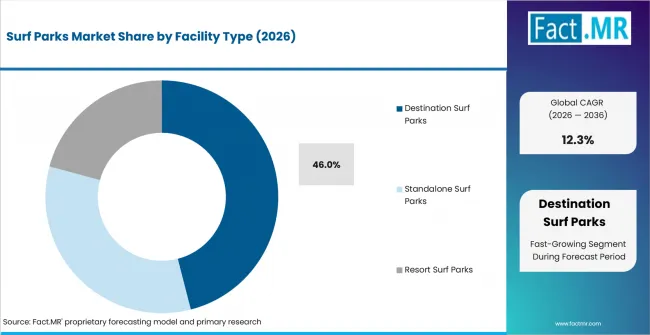
Surf Parks Market Analysis By Facility Type | Source: Fact.MR
Destination Surf Parks lead because they generate revenue from surfing, accommodations, food services and entertainment activities. Integrated destination models attract both local visitors and tourism-driven demand. Wavegarden announced that Beyond The Club in São Paulo signed a partnership with two-time world surfing champion Filipe Toledo. The project, scheduled to open in 2025, will feature the world's largest Wavegarden Cove surf lagoon and represents one of Brazil's largest surf park developments.
Which wave technology dominates?
Lagoon-Based Wave Systems lead with 38.0% share in 2026.
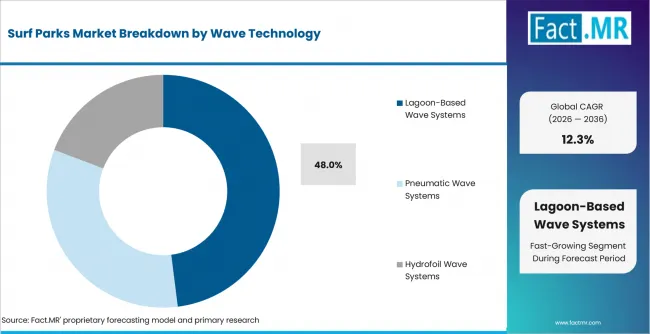
Surf Parks Market Analysis By Wave Technology | Source: Fact.MR
Lagoon-based wave systems lead because they support larger capacities and multiple wave configurations suitable for different skill levels. Their scalability makes them attractive for large commercial developments. Endless Surf / WhiteWater West announced the successful generation of the first waves at O2 SURFTOWN MUC near Munich, marking the debut of the company's commercial surf park technology. The facility became the first operational Endless Surf / WhiteWater West lagoon globally.
Which revenue stream dominates?
Session-Based Surfing Access holds 35.0% share in 2026.
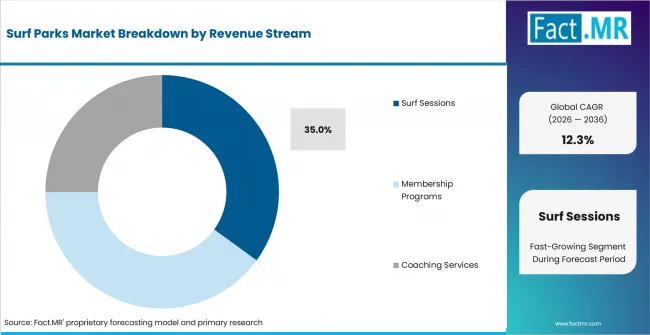
Surf Parks Market Analysis By Revenue Stream | Source: Fact.MR
Session-Based Surfing Access is expected to hold 35.0% share in 2026 because scheduled surf sessions remain the core source of revenue for most operators. Visitors typically purchase time-based access to artificial wave facilities for recreation, training or skill development. The model provides predictable capacity utilization and allows operators to optimize pricing based on demand and wave availability.
Which end user dominates?
Recreational Surfers account for 57.0% share in 2026.
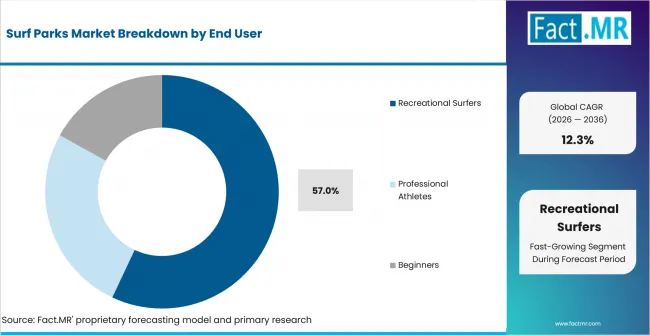
Surf Parks Market Analysis By End User | Source: Fact.MR
Recreational Surfers are projected to account for 57.0% share in 2026 because most surf park visitors participate for leisure, fitness and entertainment purposes. Controlled wave environments make surfing more accessible to beginners and occasional participants who may not have access to natural surf locations. Growing interest in experiential recreation continues to support attendance growth across commercial facilities. URBNSURF officially opened its Sydney surf park utilizing Wavegarden Cove technology. The €46 million development became Australia's second public surf park and expanded commercial surf park operations in the Asia-Pacific region.
Which application dominates?
Sports and Recreation hold 49.0% share in 2026.
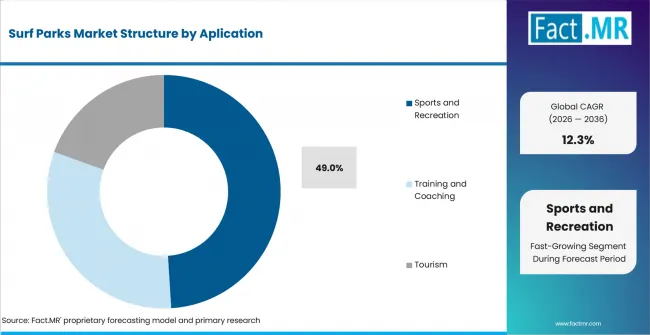
Surf Parks Market Analysis By Aplication | Source: Fact.MR
Sports and Recreation is expected to hold 49.0% share in 2026 because surf parks are primarily designed to provide accessible and consistent surfing experiences. Facilities cater to a wide range of users, from first-time participants to experienced surfers seeking regular practice. Recreational usage remains the largest contributor to facility traffic and revenue generation. The City of Palm Desert announced that DSRT Surf will open Phase 1 of its Wavegarden-powered surf resort in Summer 2026. The project features a 5.5-acre Wavegarden Cove surf lagoon capable of producing up to 1,000 waves per hour, along with a leisure pool.
What is accelerating surf park demand and what is holding it back?
Adventure sports participation drives demand while development costs restrain adoption.
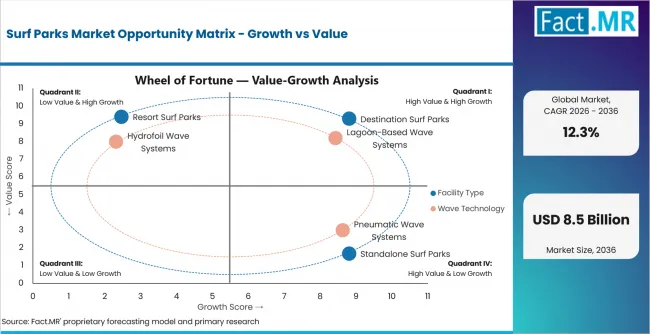
Surf Parks Market Opportunity Matrix Growth Vs Value | Source: Fact.MR
The primary growth driver is increasing consumer interest in surfing, adventure sports and active lifestyle experiences. Artificial wave technologies enable reliable surfing conditions regardless of weather, geography or ocean access, expanding participation opportunities beyond coastal regions. Growing tourism demand and destination entertainment investments are further supporting market expansion.
The main restraint is the substantial capital investment required to develop and operate surf park facilities. Wave generation technologies, land acquisition, water management systems and ongoing maintenance costs can create barriers for new projects. Long development timelines may also affect investment decisions.
Where do the biggest surf park opportunities sit?
Destination resorts, surfing academies and premium entertainment districts.
- Destination Resort Development: Integrated surf destinations create opportunities to combine surfing, hospitality, retail and entertainment within a single venue. These projects can attract both local visitors and sports tourism demand while generating multiple revenue streams.
- Surf Training Academies: Professional coaching programs and athlete development initiatives continue to increase demand for controlled surfing environments. Surf parks provide consistent wave conditions that improve training quality and support skill progression.
- Premium Entertainment Projects: Large-scale mixed-use developments increasingly incorporate surf attractions to differentiate visitor experiences and increase destination appeal. Surf parks are becoming important anchor attractions within entertainment districts, lifestyle developments and tourism-focused projects.
Which countries are scaling surf park adoption fastest?
United States 20.3%, Saudi Arabia 19.9%, South Korea 18.7%, Japan 17.2%, United Kingdom 17.0%.
Based on regional analysis, the surf parks market is segmented into North America, Western Europe, Asia Pacific, Latin America and Middle East & Africa.
.webp "Top Country Growth Comparison Surf Parks Market Cagr (2026 2036)")
Top Country Growth Comparison Surf Parks Market Cagr (2026 2036) | Source: Fact.MR
| Country | CAGR |
|---|---|
| United States | 20.3% |
| Saudi Arabia | 19.9% |
| South Korea | 18.7% |
| Japan | 17.2% |
| United Kingdom | 17.0% |
Source: Fact.MR analysis. Updated Jun 25, 2026
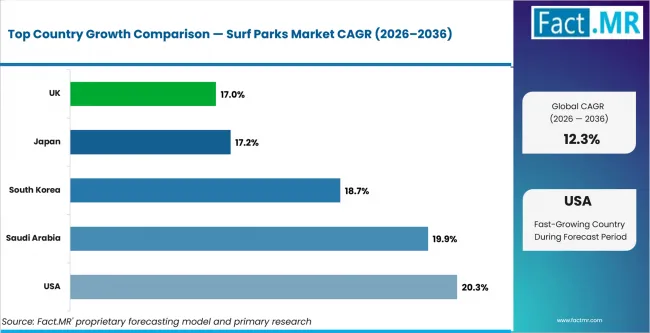
Surf Parks Market Cagr Analysis By Country | Source: Fact.MR
What is powering the United States lead?
20.3% CAGR, driven by wave park development activity
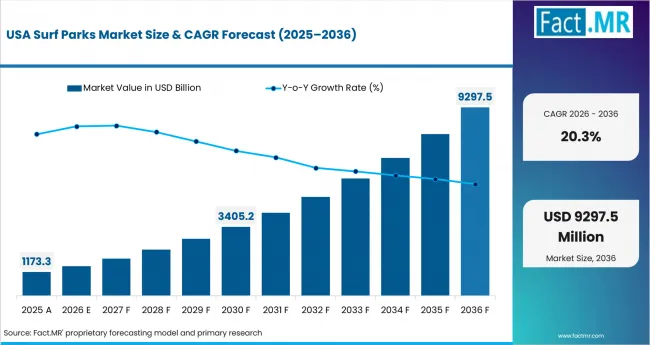
Surf Parks Market Country Value Analysis | Source: Fact.MR
The United States is projected to record 20.3% CAGR by 2036 as surf park developments expand across Texas, Florida and other inland markets. Strong consumer participation in outdoor recreation and growing investment in destination surf facilities continue to support market growth. Commercial operators are increasingly combining surf experiences with hospitality and entertainment offerings.
What underpins Saudi Arabia's growth?
19.9% CAGR, supported by investment in artificial surfing infrastructure
Saudi Arabia is projected to register 19.9% CAGR as major entertainment developments including Qiddiya incorporate advanced surf attractions. Government-backed tourism and recreation initiatives continue to support investment in large-scale destination projects. Surf parks align with broader efforts to diversify leisure and entertainment offerings.
How does South Korea perform?
18.7% CAGR, due to increasing consumer interest in surfing and water-based recreation.
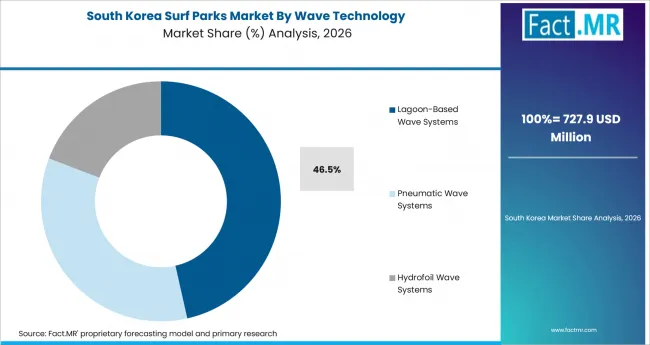
Surf Parks Market South Korea Market Share Analysis By Wave Technology | Source: Fact.MR
South Korea is expected to register 18.7% CAGR by 2036 due to the success of Wave Park Siheung and rising participation in surfing activities. The country benefits from strong consumer interest in experiential recreation and growing awareness of surf culture. Continued investment in modern surf infrastructure supports market expansion.
Why is Japan important?
17.2% CAGR, supported by controlled training environments
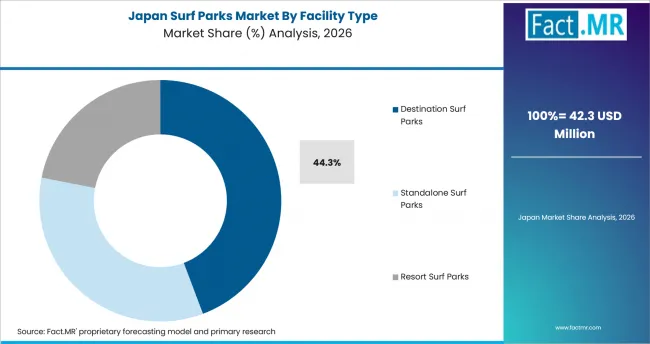
Surf Parks Market Japan Market Share Analysis By Facility Type | Source: Fact.MR
Japan is forecast to advance at 17.2% CAGR as surfing continues to benefit from visibility gained during recent Olympic competitions. Growing interest among younger consumers and expanding participation in board sports are supporting demand. Surf parks provide accessible training and recreation opportunities in urban regions.
How is the United Kingdom scaling surf park demand?
17.0% CAGR, driven by growing network of inland surf destinations
The United Kingdom is expected to post 17.0% CAGR through 2036 as successful projects such as The Wave Bristol demonstrate commercial viability and attract new participants. Demand for year-round surfing experiences is encouraging additional investment in artificial wave facilities and training centers.
Who leads the surf parks landscape?
Wavegarden, Surf Lakes, Endless Surf / WhiteWater West, Kelly Slater Wave Company and American Wave Machines lead through artificial wave technology expertise.
Surf Parks Market Analysis By Company | Source: Fact.MR
The surf parks market is characterized by competition focused on wave quality, operational efficiency and project scalability. Technology providers continue improving wave generation capabilities while reducing energy consumption, maintenance requirements and operating costs. Operators increasingly seek systems that can deliver consistent surfing experiences while maximizing throughput and profitability.
Wavegarden has established a strong position through large-scale commercial installations and proven operational performance. Surf Lakes and Endless Surf / WhiteWater West continue to attract interest through innovative wave generation approaches that support multiple user groups simultaneously. Kelly Slater Wave Company benefits from strong brand recognition and premium wave performance, while American Wave Machines maintains a broad presence across surf and aquatic recreation projects.
Competition through 2036 will depend on wave technology performance, development economics and integration with destination entertainment projects. Companies that deliver reliable wave systems, lower operating costs and strong visitor experiences will be better positioned to expand market share. Partnerships with hospitality developers, tourism operators and mixed-use entertainment projects are expected to become increasingly important growth strategies.
Which companies are the key players?
Wavegarden, Surf Lakes, Endless Surf / WhiteWater West, Kelly Slater Wave Company, American Wave Machines
- Wavegarden
- Surf Lakes
- Endless Surf / WhiteWater West
- Kelly Slater Wave Company
- American Wave Machines
- Aventuur
Bibliography
- [1] Wavegarden. (2024). Wavegarden and Beyond The Club partner with Filipe Toledo to accelerate surf park growth. Wavegarden.
- [2] Endless Surf. (2024, May 29). Endless Surf unveils next-generation wave technology, firing off first waves in Munich Surf Park. Endless Surf.
- [3] DSRT Surf. (2026, February 18). Palm Desert welcomes DSRT Surf, new Wavegarden resort opening summer 2026. DSRT Surf.
- [4] URBNSURF. (2024). URBNSURF Sydney. URBNSURF.
- [5] Qiddiya. (2026). Aquarabia. Qiddiya.
This Report Addresses
- Strategic intelligence on surf park technologies and destination recreation projects.
- Segment analysis covering facility types, wave technologies and revenue streams.
- Regional outlook covering the United States, United Kingdom, Saudi Arabia, South Korea and Japan.
- Competitive assessment of Wavegarden, Surf Lakes and leading artificial wave technology providers.
- Analysis of surfing participation, destination tourism and wave technology innovation trends.
- Evaluation of surf park economics, operator strategies and commercialization models.
- Primary interviews, company benchmarking and industry validation supporting forecast development.
What does the surf parks market cover?
Artificial wave facilities designed for surfing, training and recreation.
The market covers commercial surf parks that use engineered wave technologies to create controlled surfing conditions. It includes destination resorts, standalone surf facilities and mixed-use recreational developments.
What is included in the scope?
Wave generation systems, surf facilities and associated recreational infrastructure.
The scope includes surf lagoons, artificial wave pools, training facilities, hospitality services and surf-related commercial activities.
What is excluded from the scope?
Natural surfing beaches and traditional water parks.
The scope excludes coastal surfing destinations, conventional water attractions and marine tourism activities not involving artificial wave systems.
How was the analysis built?
100+ sources, 40+ company assessments, 25+ countries and industry interviews.
- Primary Research: Interviews with surf park developers, wave technology providers, operators and industry experts.
- Desk Research: Analysis of surf participation trends, destination projects and wave technology deployments.
- Market-Sizing and Forecasting: Estimates based on facility development, attendance volumes and operator revenues.
- Data Validation and Update Cycle: Forecasts validated through project benchmarking, company disclosures and investment analysis.
Segmentation
What is the report's scope and coverage?
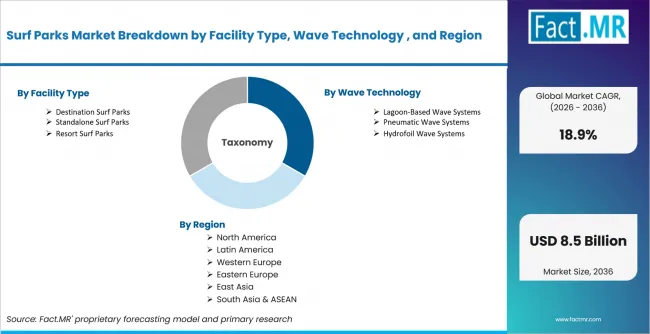
Surf Parks Market Breakdown By Facility Type, Wave Technology , And Region | Source: Fact.MR
| Attribute | Details |
|---|---|
| Quantitative Units | USD Billion in 2026 to USD Billion by 2036 at CAGR |
| Market Definition | Artificial wave facilities designed for surfing, training and recreation |
| Facility Type | Destination Surf Parks, Standalone Surf Parks, Resort Surf Parks |
| Wave Technology | Lagoon-Based Systems, Pneumatic Systems, Hydrofoil Systems, Mechanical Systems |
| Revenue Stream | Surf Sessions, Memberships, Coaching Services, Hospitality Services |
| End User | Recreational Surfers, Professional Athletes, Beginners, Tourists |
| Application | Sports & Recreation, Training, Tourism, Events |
| Regions Covered | North America, Western Europe, Asia Pacific, Latin America, Middle East & Africa |
| Countries Covered | United States, United Kingdom, Saudi Arabia, South Korea, Japan |
| Companies Covered | Wavegarden, Surf Lakes, Endless Surf / WhiteWater West, Kelly Slater Wave Company, American Wave Machines, Aventuur |
| Forecast Period | 2026 to 2036 |
| Approach | Hybrid top-down and bottom-up approach using facility deployment, attendance and operator revenue analysis. |
Source: Fact.MR analysis. Updated Jun 25, 2026
How is market segmented?
-
By Facility Type
- Destination Surf Parks
- Standalone Surf Parks
- Resort Surf Parks
-
By Wave Technology
- Lagoon-Based Wave Systems
- Pneumatic Wave Systems
- Hydrofoil Wave Systems
- Mechanical Wave Systems
-
By Revenue Stream
- Surf Sessions
- Membership Programs
- Coaching Services
- Hospitality Services
- Events and Competitions
-
By End User
- Recreational Surfers
- Professional Athletes
- Beginners
- Tourists
-
By Application
- Sports and Recreation
- Training and Coaching
- Tourism
- Events and Competitions
-
Region:
- North America
- United States
- Canada
- Europe
- United Kingdom
- Germany
- France
- Netherlands
- Spain
- Asia Pacific
- Australia
- Japan
- South Korea
- Singapore
- India
- Latin America
- Brazil
- Mexico
- Chile
- Middle East & Africa
- GCC Countries
- South Africa
- Israel
- North America
Frequently Asked Questions
Which facility type leads the market?
Which wave technology dominates the market?
Which revenue stream generates the highest share?
Why are surf parks gaining popularity globally?
Which country leads the Surf Parks Market?
What is driving demand for surf parks?
What is the primary challenge facing the market?
How do surf parks support athlete training?
Why are destination resorts investing in surf attractions?
How are artificial wave technologies influencing the market?
What opportunities exist for surf park developers?
How does tourism contribute to market growth?
Who worked on this report


Preview the report firsthand - request a free sample
Free SampleGet the brochure for pricing and purchase details
Download PDF