Golf Simulator Lounges Market Size, Share, Growth and Forecast (2026 - 2036)
The Golf Simulator Lounges Market is segmented by Facility Format, by Technology Platform, by Revenue Stream, by Customer Type, by Operating Model and Region. Forecast for 2026 to 2036.
What is the golf simulator lounges market forecast to be worth by 2036?
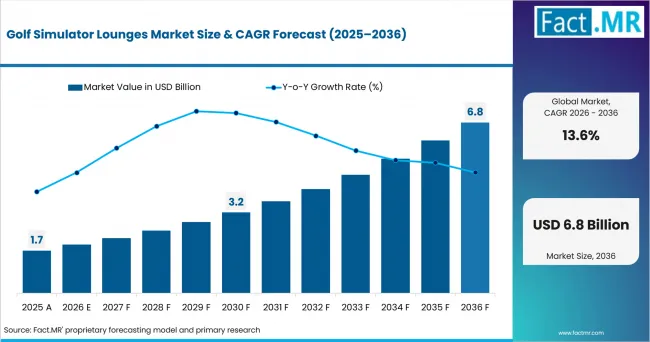
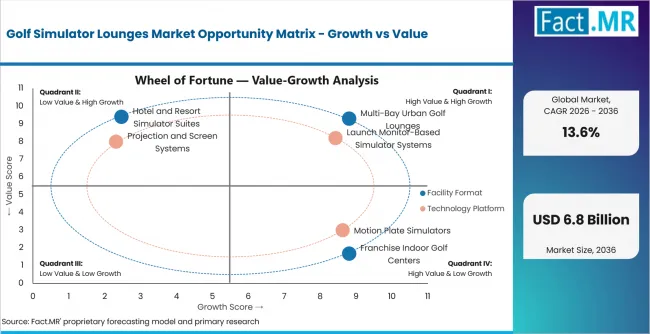
USD 1.9 billion in 2026 to USD 6.8 billion by 2036, at 13.6% CAGR.
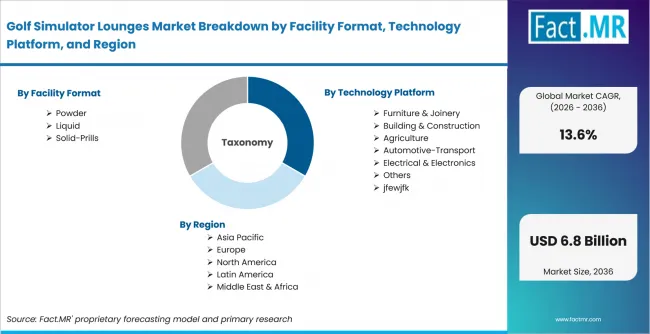
- The golf simulator lounges market crossed a valuation of USD 1.7 billion in 2025. Demand is expected to increase from USD 1.9 billion in 2026 to USD 6.8 billion by 2036.
- The market is forecast to record 13.6% CAGR from 2026 to 2036 as indoor golf operators use simulator lounges to serve social play and structured practice across all seasons.
- Golf simulator lounges combine indoor golf technology with a hospitality-led venue model. The category connects with golf equipment because simulator play still depends on real clubs and ball-striking habits.
- The strongest adoption case comes from consumers who want golf access without course timing constraints.
What are the defining numbers behind golf simulator lounges market growth?
USD 4.9 billion absolute opportunity by 2036, led by the United States and South Korea.
- Demand Drivers in the Market
- Indoor golf operators need venues that generate play during poor weather.
- Franchise owners need a repeatable model with bay booking revenue.
- Coaches need simulator spaces that support lesson scheduling.
- Corporate event planners need golf venues that work after office hours.
- Key Segments Analyzed
- By Facility Format: Multi-Bay Urban Golf Lounges are expected to hold 43.0% share in 2026 because social groups need multiple simulator rooms.
- By Technology Platform: Launch Monitor-Based Simulator Systems lead because shot data is central to practice quality. The share is projected at 39.0% in 2026.
- By Revenue Stream: Bay Rental and Play Packages are likely to account for 45.0% share in 2026 because hourly access remains the core transaction.
- By Customer Type: Recreational Groups lead with 37.0% share in 2026 because lounges attract casual golfers and social players.
- By Operating Model: Franchise and Multi-Unit Operators are expected to hold 34.0% share in 2026 because standardized layouts support expansion.
- By Geography: The United States is projected to record 15.7% CAGR through 2036 as indoor golf participation and franchising expand.
- Analyst Opinion at Fact.MR
- Shambhu Nath Jha, Senior Analyst at Fact.MR, states, “Golf simulator lounges are turning off-course golf into a hospitality business. We see operators treating the bay as both a training asset and a social event space. Brands that balance simulator accuracy with venue service will gain stronger repeat traffic.”
- Strategic Implications
- Lounge operators should design bay layouts around group booking flow.
- Technology providers should support venue-level maintenance and data reliability.
- Franchise owners should test foodservice economics before site rollout.
- Coaches can use simulator lounges to build recurring lesson programs.
Five Iron Golf announced in 2024 that it was expanding through franchise locations in Dallas-Fort Worth and St. Louis. [2] This supports the lounge model because the brand combines simulator bays with lessons and social events. X-Golf America announced in 2024 that it opened its 100th location at X-Golf Katy in Texas. [3] The milestone shows how indoor golf can scale through a franchise-led venue structure.
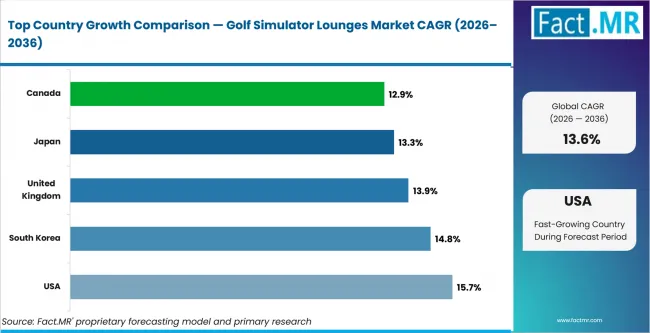
The United States is projected to record 15.7% CAGR through 2036 as off-course golf participation and franchise expansion support multi-bay lounges. South Korea is expected to post 14.8% CAGR through 2036 as simulator culture and GOLFZON technology strengthen indoor play. The United Kingdom is likely to record 13.9% CAGR as urban venues use simulator golf for social events. Japan is forecast to advance at 13.3% CAGR as compact city locations favor indoor golf formats. Canada is set to record 12.9% CAGR as winter seasonality supports year-round indoor play.
How does the golf simulator lounges market break down by segment?
Multi-Bay Urban Golf Lounges lead at 43.0%; Bay Rental and Play Packages lead at 45.0%.
Which facility format dominates?
Multi-Bay Urban Golf Lounges hold 43.0% share in 2026.
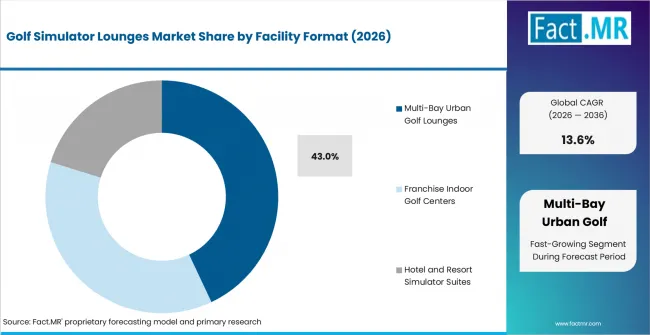
Multi-Bay Urban Golf Lounges are expected to hold 43.0% share in 2026 because they support group play and private events. Urban locations also shorten travel time for working adults. The format works well when foodservice and lessons share the same space. It connects with sports equipment because the venue still relies on clubs and training accessories to complete the experience.
Which technology platform dominates?
Launch Monitor-Based Simulator Systems hold 39.0% share in 2026.
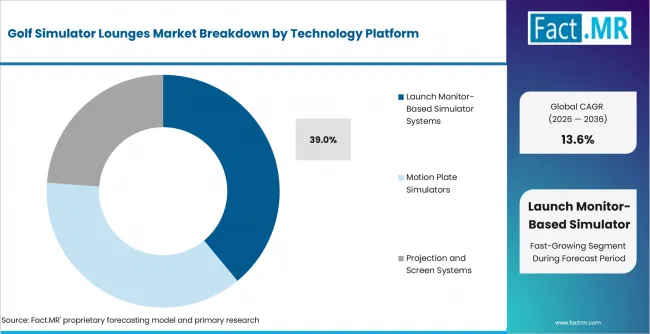
Launch Monitor-Based Simulator Systems lead because customers expect accurate ball and club feedback. The platform is projected to capture 39.0% share in 2026. Trackman iO and similar systems allow operators to support play and coaching use cases. GOLFZON’s TwoVisionNX adds motion and course simulation to the same indoor experience. Technology choice directly affects replay value for serious golfers.
Which revenue stream dominates?
Bay Rental and Play Packages hold 45.0% share in 2026.
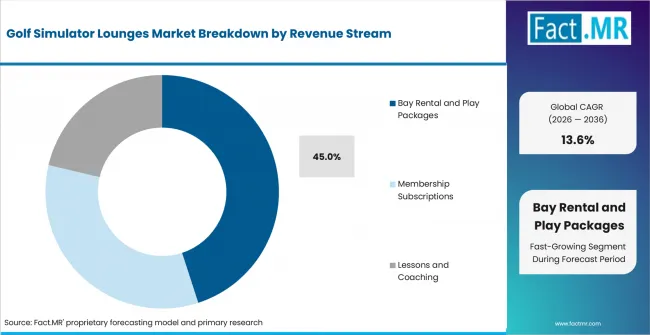
Bay Rental and Play Packages lead because paid time remains the main revenue source for lounge operators. The stream is likely to account for 45.0% share in 2026. Customers book bays for practice, casual rounds and private groups. Memberships support recurring use, but hourly packages remain easier for first-time visitors. The model connects with interactive kiosk systems when self-check-in improves bay turnover.
Which customer type dominates?
Recreational Groups hold 37.0% share in 2026.
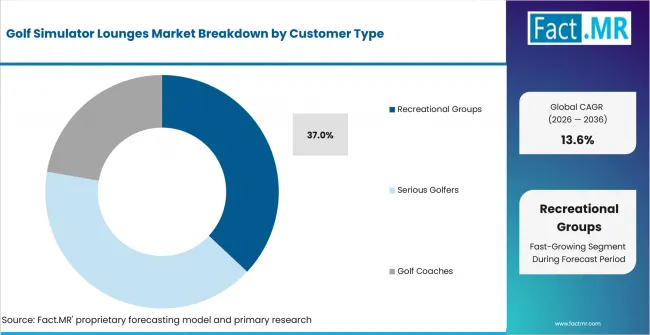
Recreational Groups lead because simulator lounges make golf easier for casual players. This customer type is expected to hold 37.0% share in 2026. Groups can play in shorter sessions than a full outdoor round. Foodservice and lounge seating make the venue easier for mixed-skill groups. Corporate event users follow because golf simulators support team outings without course logistics.
Which operating model dominates?
Franchise and Multi-Unit Operators hold 34.0% share in 2026.
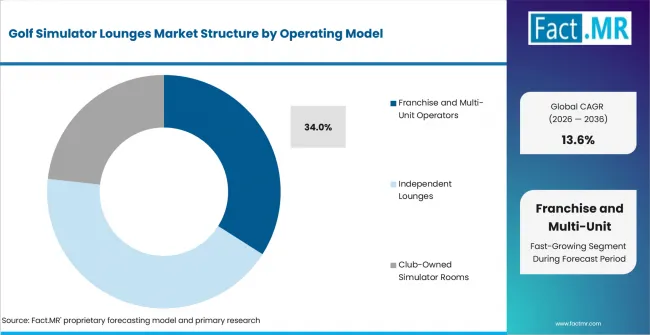
Franchise and Multi-Unit Operators lead because simulator lounges benefit from standardized buildouts. The model is expected to hold 34.0% share in 2026. Franchise groups can repeat bay layouts and training programs across cities. Multi-unit operators also negotiate better simulator and software support. The model fits advanced predictive analytics use when booking patterns guide staffing and pricing.
What is accelerating golf simulator lounges demand, and what is holding it back?
Off-course participation drives demand; site economics restrain rollout.
Off-course participation is the main driver. NGF’s 2025 state-of-industry update shows that simulator venues are part of a larger off-course participation base. [1] This gives indoor lounges a broader customer pool than traditional golfers alone.
Technology upgrades support repeat play. GOLFZON announced a Pebble Beach simulator lounge in 2026 that will use TwoVisionNX simulators and motion plate technology. [4] This shows how premium venues use simulator realism to improve the hospitality offer. Commercial installation support is also improving. Trackman and The Indoor Golf Shop announced a reseller partnership in 2024 for North America and Latin America. [5] This supports venue owners that need hardware access and installation support.
The main restraint is site economics. Simulator lounges require expensive buildouts and enough evening traffic to cover rent. Operators also need strong maintenance routines because downtime quickly affects bay revenue.
Where do the biggest golf simulator lounge opportunities sit?
Urban social golf, corporate events and coaching-led memberships.
- Urban Social Golf: Operators can serve golfers who want shorter sessions near work or home.
- Corporate Events: Lounges can sell group bookings without outdoor course logistics.
- Coaching Memberships: Instructors can use simulator data to build recurring lesson plans.
Which countries are scaling golf simulator lounges fastest?
United States 15.7%, South Korea 14.8%, United Kingdom 13.9%, Japan 13.3%, Canada 12.9%.
Based on regional analysis, the golf simulator lounges market is segmented into North America, Western Europe, Asia Pacific, Latin America, and Middle East and Africa.
.webp)
| Country | CAGR |
|---|---|
| United States | 15.7% |
| South Korea | 14.8% |
| United Kingdom | 13.9% |
| Japan | 13.3% |
| Canada | 12.9% |

What is powering the United States lead?
15.7% CAGR, driven by Five Iron Golf and X-Golf franchise expansion.
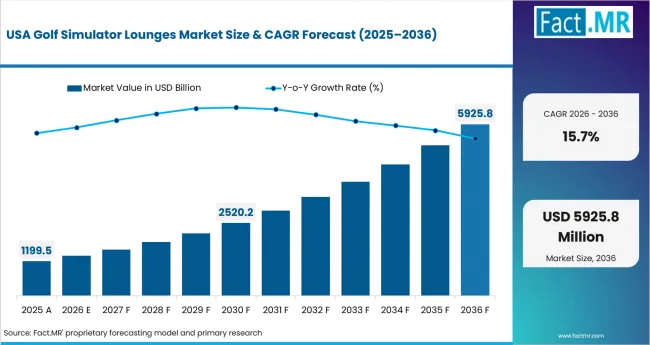
The United States is projected to record 15.7% CAGR through 2036 as off-course participation and franchise expansion support indoor lounge growth. Operators can serve practice demand during weekday evenings. Social bookings create another revenue path. Growth will favor brands with repeatable bay design and strong foodservice execution.
How is South Korea scaling golf simulator lounge demand?
14.8% CAGR, led by GOLFZON and mature indoor golf culture.
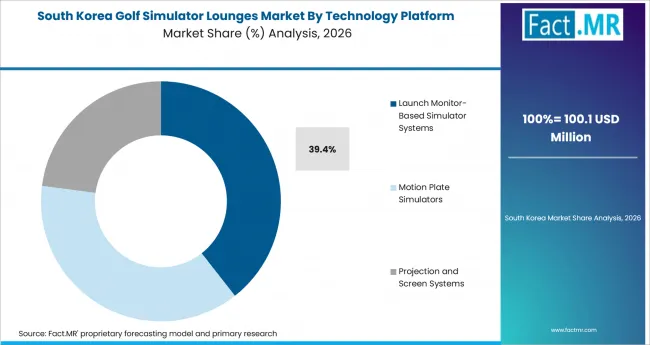
South Korea is expected to post 14.8% CAGR by 2036 as simulator play is already familiar to urban golfers. GOLFZON technology supports competitive indoor formats and realistic course play. Dense cities improve utilization for smaller lounge footprints. Growth will favor operators that pair simulator realism with league play.
What supports the United Kingdom outlook?
13.9% CAGR, supported by Five Iron Golf and urban social golf demand.
The United Kingdom is likely to record 13.9% CAGR through 2036 as urban golf lounges appeal to working adults and corporate groups. Indoor venues help overcome weather limits and course access barriers. Operators can build repeat traffic through lessons and leagues. Growth will favor sites near office districts and transport hubs.
What underpins Japan’s growth?
13.3% CAGR, due to compact venues and simulator-based practice.
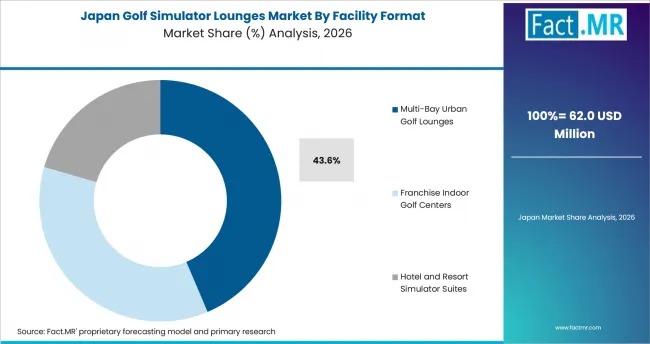
Japan is forecast to advance at 13.3% CAGR by 2036 as compact city venues favor simulator formats. Urban golfers need practice options that fit shorter time windows. Simulator lounges can operate in smaller footprints than outdoor ranges. Growth will favor premium technology and efficient bay scheduling.
How is Canada scaling golf simulator lounge adoption?
12.9% CAGR, backed by winter seasonality and indoor practice demand.
Canada is set to record 12.9% CAGR from 2026 to 2036 as indoor golf fills long off-season periods. Lounges can serve serious golfers and social groups during winter months. League play helps stabilize recurring traffic. Growth will favor operators with strong memberships and event packages.
Who leads the golf simulator lounges market?
Five Iron Golf and X-Golf America lead through multi-location lounge models.
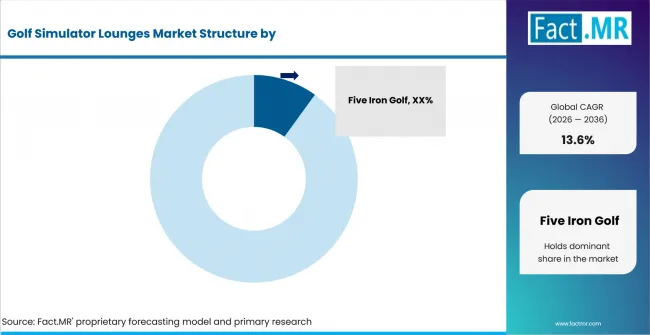
Golf simulator lounges are supplied by venue operators and simulator technology providers. Five Iron Golf leads through urban indoor golf venues with lessons and event programs. X-Golf America supports a franchise-led indoor simulator bar model.
GOLFZON America supports lounges through simulator technology and location partnerships. Topgolf Swing Suite brings simulator lounge formats into hospitality venues. Trackman supports commercial simulator businesses with launch monitor systems and facility tools. aboutGOLF competes through custom simulator installations and software content.
Competition through 2036 will depend on utilization and service consistency. Lounge operators need evening bookings and private event conversion. Technology providers need reliable measurement and low downtime.
Venue differentiation will come from coaching and league programming. Operators that combine reliable shot data with hospitality service can defend repeat traffic.
Which companies are the key providers?
Five Iron Golf and X-Golf America are key providers. GOLFZON America and Topgolf Swing Suite are also profiled. Trackman and aboutGOLF complete the company set.
- Five Iron Golf
- X-Golf America
- GOLFZON America
- Topgolf Swing Suite
- Trackman
- aboutGOLF
Bibliography
- [1] National Golf Foundation. (2025, January 18). Golf’s state-of-industry in 3 minutes. National Golf Foundation.
- [2] Five Iron Golf. (2024, August 6). Five Iron Golf announces franchise expansion in Dallas-Fort Worth and St. Louis, with construction underway in Oklahoma City Metro. Five Iron Golf.
- [3] X-Golf America. (2024, January 17). X-Golf America opens 100th location and tops Entrepreneur Magazine’s Franchise 500 list. X-Golf America.
- [4] GOLFZON America. (2026, February 25). Pebble Beach Company, GOLFZON announce landmark partnership. GOLFZON America.
- [5] Trackman. (2024, February 28). Trackman and The Indoor Golf Shop announce authorized reseller partnership across the U.S., Canada and Latin America. Trackman.
This Report Addresses
- Strategic intelligence on golf simulator lounges across facility format and operating model.
- Segment analysis covering Multi-Bay Urban Golf Lounges and Launch Monitor-Based Simulator Systems.
- Regional outlook covering the United States, South Korea, the United Kingdom, Japan and Canada.
- Competitive analysis of Five Iron Golf, X-Golf America, GOLFZON America, Topgolf Swing Suite, Trackman and aboutGOLF.
- Technology assessment covering launch monitors, motion plate simulators and bay management software.
- Use case assessment covering social play, coaching, leagues and corporate events.
- Primary interviews, provider checks and official source review support the forecast.
What does the golf simulator lounges market cover?
Indoor golf venues that combine simulator bays with hospitality service.
The golf simulator lounges market covers commercial indoor venues that offer simulator-based golf play, lessons, leagues and event bookings. It includes multi-bay lounges and venue-integrated simulator suites. The scope connects with smart sports equipment because launch monitors and sensor systems turn golf swings into measurable training data.
The market differs from home golf simulators because the paid experience includes venue service and group use. Lounge operators sell time and event space. Technology matters, but repeat visits depend on the quality of the full venue experience.
What is included in the scope?
Multi-bay golf lounges and simulator-based entertainment venues.
The scope includes indoor golf lounges and premium simulator suites inside hospitality locations. It covers launch monitor systems and booking software when they support commercial lounge operations. It includes location-based VR entertainment overlap where immersive play and social entertainment define the venue experience.
The scope includes league play and private events. It covers lesson-led lounges and foodservice-led venues. It also includes membership plans when bay access and recurring play are sold as part of the same venue model.
What is excluded from the scope?
Home simulator rooms and outdoor driving ranges.
The scope excludes home simulator setups used only for private play. It excludes ordinary outdoor driving ranges without enclosed simulator lounges. It excludes golf course clubhouse screens unless they are operated as paid indoor lounge bays. It also excludes equipment-only sales where no commercial venue service is provided.
How was the analysis built?
100+ sources, 40+ company portfolios, 25+ countries, 20+ interviews.
- Primary Research:
- Primary research includes interviews with indoor golf operators and franchise development heads. It includes input from simulator technology providers and hospitality venue planners.
- Desk Research:
- Desk research reviews indoor golf location launches and official provider sources. It covers simulator systems, lounge franchise formats and sports analytics tools used for swing feedback.
- Market-Sizing and Forecasting:
- Forecasting uses off-course golf participation and venue expansion activity. Bay utilization and membership attachment support the market assessment.
- Data Validation and Update Cycle:
- Forecasts are validated through operator checks and technology provider references. Franchise launches and simulator lounge investments help confirm market direction.
What is the report’s scope and coverage?
| Attribute | Details |
|---|---|
| Quantitative Units | USD Billion in 2026 to USD Billion by 2036 at CAGR |
| Market Definition | Commercial indoor golf venues that combine simulator bays with hospitality service |
| Facility Format | Multi-Bay Urban Golf Lounges; Franchise Indoor Golf Centers; Hotel and Resort Simulator Suites; Clubhouse Simulator Rooms; Corporate Event Lounges |
| Technology Platform | Launch Monitor-Based Simulator Systems; Camera-Based Simulator Systems; Motion Plate Simulators; Projection and Screen Systems; Booking and Bay Management Software |
| Revenue Stream | Bay Rental and Play Packages; Membership Subscriptions; Lessons and Coaching; Corporate Events; Foodservice Revenue |
| Customer Type | Recreational Groups; Serious Golfers; Corporate Event Hosts; Golf Coaches; Families and Beginners |
| Operating Model | Franchise and Multi-Unit Operators; Independent Lounges; Club-Owned Simulator Rooms; Hotel Partnerships; Technology-Licensed Venues |
| Regions Covered | North America; Western Europe; Asia Pacific; Latin America; Middle East and Africa |
| Countries Covered | United States; South Korea; United Kingdom; Japan; Canada |
| Key Companies Profiled | Five Iron Golf; X-Golf America; GOLFZON America; Topgolf Swing Suite; Trackman; aboutGOLF |
| Forecast Period | 2026 to 2036 |
| Approach | Hybrid top-down and bottom-up approach using off-course participation, venue openings, bay utilization and provider validation |
How is the market segmented?
-
By Facility Format:
- Multi-Bay Urban Golf Lounges
- Franchise Indoor Golf Centers
- Hotel and Resort Simulator Suites
- Clubhouse Simulator Rooms
- Corporate Event Lounges
-
By Technology Platform:
- Launch Monitor-Based Simulator Systems
- Camera-Based Simulator Systems
- Motion Plate Simulators
- Projection and Screen Systems
- Booking and Bay Management Software
-
By Revenue Stream:
- Bay Rental and Play Packages
- Membership Subscriptions
- Lessons and Coaching
- Corporate Events
- Foodservice Revenue
-
By Customer Type:
- Recreational Groups
- Serious Golfers
- Corporate Event Hosts
- Golf Coaches
- Families and Beginners
-
By Operating Model:
- Franchise and Multi-Unit Operators
- Independent Lounges
- Club-Owned Simulator Rooms
- Hotel Partnerships
- Technology-Licensed Venues
-
Region:
- North America
- United States
- Canada
- Europe
- United Kingdom
- Germany
- France
- Spain
- Italy
- Asia Pacific
- South Korea
- Japan
- Australia
- China
- Singapore
- Latin America
- Brazil
- Mexico
- Chile
- Middle East & Africa
- Saudi Arabia
- UAE
- South Africa
- Qatar
- North America
- Frequently Asked Questions -
Which facility format leads the Golf Simulator Lounges Market?
Multi-Bay Urban Golf Lounges lead with 43.0% share in 2026 because social groups need multiple simulator rooms.
Which technology platform leads the Golf Simulator Lounges Market?
Launch Monitor-Based Simulator Systems lead with 39.0% share in 2026 because shot data is central to practice quality.
Which revenue stream leads the Golf Simulator Lounges Market?
Bay Rental and Play Packages hold 45.0% share in 2026 because hourly access remains the core transaction.
Which customer type leads the Golf Simulator Lounges Market?
Recreational Groups hold 37.0% share in 2026 because lounges attract casual golfers and social players.
Which operating model leads the Golf Simulator Lounges Market?
Franchise and Multi-Unit Operators hold 34.0% share in 2026 because standardized layouts support expansion.
Which country expands fastest in the Golf Simulator Lounges Market?
The United States is projected to record 15.7% CAGR through 2036 as off-course golf participation and franchising expand.
How does South Korea perform in the Golf Simulator Lounges Market?
South Korea is expected to post 14.8% CAGR through 2036 as simulator play remains familiar to urban golfers.
How does the United Kingdom perform in the Golf Simulator Lounges Market?
The United Kingdom is likely to record 13.9% CAGR through 2036 as urban golf lounges appeal to working adults.
How does Japan perform in the Golf Simulator Lounges Market?
Japan is forecast to advance at 13.3% CAGR through 2036 as compact city venues favor simulator formats.
How does Canada perform in the Golf Simulator Lounges Market?
Canada is set to record 12.9% CAGR through 2036 as indoor golf fills long off-season periods.
What is the primary driver in the Golf Simulator Lounges Market?
The primary driver is off-course participation because indoor lounges make golf easier to access year-round.
What is the main restraint in the Golf Simulator Lounges Market?
The main restraint is site economics because buildouts require strong evening and event traffic.
Why are multi-bay lounges important in this market?
Multi-bay lounges are important because they support group play and private event bookings.
Why are launch monitor systems important in golf simulator lounges?
Launch monitor systems are important because golfers expect accurate shot data and trusted feedback.
Table of Content
- Key Takeaways
- Market Size and CAGR
- Top Growth Driver
- Fastest Growing Segment
- Leading Region
- Key Companies
- Emerging Opportunities
- Executive Summary
- Global Market Outlook
- Demand-side Trends
- Supply-side Trends
- Technology Roadmap Analysis
- Analysis and Recommendations
- Analyst Perspective (What is happening? Why now? What should investors know?)
- Key Questions Answered
- How large is the market?
- What is the CAGR?
- What are key trends?
- Which region dominates?
- Who are the leaders?
- Market Overview
- Market Coverage / Taxonomy
- Market Definition / Scope / Limitations
- Research Methodology
- Chapter Orientation
- Analytical Lens and Working Hypotheses
- Market Structure, Signals, and Trend Drivers
- Benchmarking and Cross-market Comparability
- Market Sizing, Forecasting, and Opportunity Mapping
- Research Design and Evidence Framework
- Desk Research Programme (Secondary Evidence)
- Expert Input and Fieldwork (Primary Evidence)
- Tooling, Models, and Reference Databases
- Data Engineering and Model Build
- Quality Assurance and Audit Trail
- Market Background
- Market Dynamics (Drivers, Restraints, Opportunity, Trends)
- Scenario Forecast (Optimistic, Likely, Conservative)
- Impact Analysis
- AI Impact
- Sustainability Impact
- Regulatory Impact
- Technology Impact
- Consumer / Buyer Analysis
- Purchase Drivers
- Adoption Barriers
- Buyer Journey
- Opportunity Map Analysis
- Product Life Cycle Analysis
- Supply Chain Analysis
- Investment Feasibility Matrix
- Value Chain Analysis
- PESTLE and Porter's Analysis
- Regulatory Landscape
- Regional Parent Market Outlook
- Production and Consumption Statistics
- Import and Export Statistics
- Global Market Analysis and Forecast, 2021 to 2036
- Historical Market Size Value (USD Billion) Analysis, 2021 to 2025
- Current and Future Market Size Value (USD Billion) Projections, 2026 to 2036
- Y-o-Y Growth Trend Analysis
- Absolute $ Opportunity Analysis
- Global Market Pricing Analysis, 2021 to 2036
- Global Market Analysis and Forecast, By Facility Format, 2021 to 2036
- Introduction / Key Findings
- Historical Market Size Value (USD Billion) Analysis By Facility Format, 2021 to 2025
- Current and Future Market Size Value (USD Billion) Analysis and Forecast By Facility Format, 2026 to 2036
- Multi-Bay Urban Golf Lounges
- Franchise Indoor Golf Centers
- Hotel and Resort Simulator Suites
- Y-o-Y Growth Trend Analysis By Facility Format, 2021 to 2025
- Absolute $ Opportunity Analysis By Facility Format, 2026 to 2036
- Global Market Analysis and Forecast, By Technology Platform, 2021 to 2036
- Introduction / Key Findings
- Historical Market Size Value (USD Billion) Analysis By Technology Platform, 2021 to 2025
- Current and Future Market Size Value (USD Billion) Analysis and Forecast By Technology Platform, 2026 to 2036
- Launch Monitor-Based Simulator Systems
- Motion Plate Simulators
- Projection and Screen Systems
- Y-o-Y Growth Trend Analysis By Technology Platform, 2021 to 2025
- Absolute $ Opportunity Analysis By Technology Platform, 2026 to 2036
- Global Market Analysis and Forecast, By Revenue Stream, 2021 to 2036
- Introduction / Key Findings
- Historical Market Size Value (USD Billion) Analysis By Revenue Stream, 2021 to 2025
- Current and Future Market Size Value (USD Billion) Analysis and Forecast By Revenue Stream, 2026 to 2036
- Bay Rental and Play Packages
- Membership Subscriptions
- Lessons and Coaching
- Y-o-Y Growth Trend Analysis By Revenue Stream, 2021 to 2025
- Absolute $ Opportunity Analysis By Revenue Stream, 2026 to 2036
- Global Market Analysis and Forecast, By Customer Type, 2021 to 2036
- Introduction / Key Findings
- Historical Market Size Value (USD Billion) Analysis By Customer Type, 2021 to 2025
- Current and Future Market Size Value (USD Billion) Analysis and Forecast By Customer Type, 2026 to 2036
- Recreational Groups
- Serious Golfers
- Golf Coaches
- Y-o-Y Growth Trend Analysis By Customer Type, 2021 to 2025
- Absolute $ Opportunity Analysis By Customer Type, 2026 to 2036
- Global Market Analysis and Forecast, By Operating Model, 2021 to 2036
- Introduction / Key Findings
- Historical Market Size Value (USD Billion) Analysis By Operating Model, 2021 to 2025
- Current and Future Market Size Value (USD Billion) Analysis and Forecast By Operating Model, 2026 to 2036
- Franchise and Multi-Value (USD Billion) Operators
- Independent Lounges
- Club-Owned Simulator Rooms
- Y-o-Y Growth Trend Analysis By Operating Model, 2021 to 2025
- Absolute $ Opportunity Analysis By Operating Model, 2026 to 2036
- Global Market Analysis and Forecast, By Region, 2021 to 2036
- Introduction
- Historical Market Size Value (USD Billion) Analysis By Region, 2021 to 2025
- Current Market Size Value (USD Billion) Analysis and Forecast By Region, 2026 to 2036
- North America
- Latin America
- Western Europe
- Eastern Europe
- East Asia
- South Asia and Pacific
- Middle East & Africa
- Market Attractiveness Analysis By Region
- North America Market Analysis and Forecast, By Country, 2021 to 2036
- Historical Market Size Value (USD Billion) Trend Analysis By Market Taxonomy, 2021 to 2025
- Market Size Value (USD Billion) Forecast By Market Taxonomy, 2026 to 2036
- By Country
- USA
- Canada
- Mexico
- By Facility Format
- By Technology Platform
- By Revenue Stream
- By Customer Type
- By Operating Model
- By Country
- Market Attractiveness Analysis
- By Country
- By Facility Format
- By Technology Platform
- By Revenue Stream
- By Customer Type
- By Operating Model
- Key Takeaways
- Latin America Market Analysis and Forecast, By Country
- Historical Market Size Value (USD Billion) Trend Analysis By Market Taxonomy, 2021 to 2025
- Market Size Value (USD Billion) Forecast By Market Taxonomy, 2026 to 2036
- By Country
- Brazil
- Chile
- Rest of Latin America
- By Facility Format
- By Technology Platform
- By Revenue Stream
- By Customer Type
- By Operating Model
- By Country
- Market Attractiveness Analysis
- By Country
- By Facility Format
- By Technology Platform
- By Revenue Stream
- By Customer Type
- By Operating Model
- Key Takeaways
- Western Europe Market Analysis and Forecast, By Country
- Historical Market Size Value (USD Billion) Trend Analysis By Market Taxonomy, 2021 to 2025
- Market Size Value (USD Billion) Forecast By Market Taxonomy, 2026 to 2036
- By Country
- Germany
- UK
- Italy
- Spain
- France
- Nordic
- BENELUX
- Rest of Western Europe
- By Facility Format
- By Technology Platform
- By Revenue Stream
- By Customer Type
- By Operating Model
- By Country
- Market Attractiveness Analysis
- By Country
- By Facility Format
- By Technology Platform
- By Revenue Stream
- By Customer Type
- By Operating Model
- Key Takeaways
- Eastern Europe Market Analysis and Forecast, By Country
- Historical Market Size Value (USD Billion) Trend Analysis By Market Taxonomy, 2021 to 2025
- Market Size Value (USD Billion) Forecast By Market Taxonomy, 2026 to 2036
- By Country
- Russia
- Poland
- Hungary
- Balkan & Baltic
- Rest of Eastern Europe
- By Facility Format
- By Technology Platform
- By Revenue Stream
- By Customer Type
- By Operating Model
- By Country
- Market Attractiveness Analysis
- By Country
- By Facility Format
- By Technology Platform
- By Revenue Stream
- By Customer Type
- By Operating Model
- Key Takeaways
- East Asia Market Analysis and Forecast, By Country
- Historical Market Size Value (USD Billion) Trend Analysis By Market Taxonomy, 2021 to 2025
- Market Size Value (USD Billion) Forecast By Market Taxonomy, 2026 to 2036
- By Country
- China
- Japan
- South Korea
- By Facility Format
- By Technology Platform
- By Revenue Stream
- By Customer Type
- By Operating Model
- By Country
- Market Attractiveness Analysis
- By Country
- By Facility Format
- By Technology Platform
- By Revenue Stream
- By Customer Type
- By Operating Model
- Key Takeaways
- South Asia and Pacific Market Analysis and Forecast, By Country
- Historical Market Size Value (USD Billion) Trend Analysis By Market Taxonomy, 2021 to 2025
- Market Size Value (USD Billion) Forecast By Market Taxonomy, 2026 to 2036
- By Country
- India
- ASEAN
- Australia & New Zealand
- Rest of South Asia and Pacific
- By Facility Format
- By Technology Platform
- By Revenue Stream
- By Customer Type
- By Operating Model
- By Country
- Market Attractiveness Analysis
- By Country
- By Facility Format
- By Technology Platform
- By Revenue Stream
- By Customer Type
- By Operating Model
- Key Takeaways
- Middle East & Africa Market Analysis and Forecast, By Country
- Historical Market Size Value (USD Billion) Trend Analysis By Market Taxonomy, 2021 to 2025
- Market Size Value (USD Billion) Forecast By Market Taxonomy, 2026 to 2036
- By Country
- Kingdom of Saudi Arabia
- Other GCC Countries
- Turkiye
- South Africa
- Other African Union
- Rest of Middle East & Africa
- By Facility Format
- By Technology Platform
- By Revenue Stream
- By Customer Type
- By Operating Model
- By Country
- Market Attractiveness Analysis
- By Country
- By Facility Format
- By Technology Platform
- By Revenue Stream
- By Customer Type
- By Operating Model
- Key Takeaways
- Key Countries Market Analysis
- USA
- Pricing Analysis
- Market Share Analysis, 2025
- By Facility Format
- By Technology Platform
- By Revenue Stream
- By Customer Type
- By Operating Model
- Canada
- Pricing Analysis
- Market Share Analysis, 2025
- By Facility Format
- By Technology Platform
- By Revenue Stream
- By Customer Type
- By Operating Model
- Mexico
- Pricing Analysis
- Market Share Analysis, 2025
- By Facility Format
- By Technology Platform
- By Revenue Stream
- By Customer Type
- By Operating Model
- Brazil
- Pricing Analysis
- Market Share Analysis, 2025
- By Facility Format
- By Technology Platform
- By Revenue Stream
- By Customer Type
- By Operating Model
- Chile
- Pricing Analysis
- Market Share Analysis, 2025
- By Facility Format
- By Technology Platform
- By Revenue Stream
- By Customer Type
- By Operating Model
- Germany
- Pricing Analysis
- Market Share Analysis, 2025
- By Facility Format
- By Technology Platform
- By Revenue Stream
- By Customer Type
- By Operating Model
- UK
- Pricing Analysis
- Market Share Analysis, 2025
- By Facility Format
- By Technology Platform
- By Revenue Stream
- By Customer Type
- By Operating Model
- Italy
- Pricing Analysis
- Market Share Analysis, 2025
- By Facility Format
- By Technology Platform
- By Revenue Stream
- By Customer Type
- By Operating Model
- Spain
- Pricing Analysis
- Market Share Analysis, 2025
- By Facility Format
- By Technology Platform
- By Revenue Stream
- By Customer Type
- By Operating Model
- France
- Pricing Analysis
- Market Share Analysis, 2025
- By Facility Format
- By Technology Platform
- By Revenue Stream
- By Customer Type
- By Operating Model
- India
- Pricing Analysis
- Market Share Analysis, 2025
- By Facility Format
- By Technology Platform
- By Revenue Stream
- By Customer Type
- By Operating Model
- ASEAN
- Pricing Analysis
- Market Share Analysis, 2025
- By Facility Format
- By Technology Platform
- By Revenue Stream
- By Customer Type
- By Operating Model
- Australia & New Zealand
- Pricing Analysis
- Market Share Analysis, 2025
- By Facility Format
- By Technology Platform
- By Revenue Stream
- By Customer Type
- By Operating Model
- China
- Pricing Analysis
- Market Share Analysis, 2025
- By Facility Format
- By Technology Platform
- By Revenue Stream
- By Customer Type
- By Operating Model
- Japan
- Pricing Analysis
- Market Share Analysis, 2025
- By Facility Format
- By Technology Platform
- By Revenue Stream
- By Customer Type
- By Operating Model
- South Korea
- Pricing Analysis
- Market Share Analysis, 2025
- By Facility Format
- By Technology Platform
- By Revenue Stream
- By Customer Type
- By Operating Model
- Russia
- Pricing Analysis
- Market Share Analysis, 2025
- By Facility Format
- By Technology Platform
- By Revenue Stream
- By Customer Type
- By Operating Model
- Poland
- Pricing Analysis
- Market Share Analysis, 2025
- By Facility Format
- By Technology Platform
- By Revenue Stream
- By Customer Type
- By Operating Model
- Hungary
- Pricing Analysis
- Market Share Analysis, 2025
- By Facility Format
- By Technology Platform
- By Revenue Stream
- By Customer Type
- By Operating Model
- Kingdom of Saudi Arabia
- Pricing Analysis
- Market Share Analysis, 2025
- By Facility Format
- By Technology Platform
- By Revenue Stream
- By Customer Type
- By Operating Model
- Turkiye
- Pricing Analysis
- Market Share Analysis, 2025
- By Facility Format
- By Technology Platform
- By Revenue Stream
- By Customer Type
- By Operating Model
- South Africa
- Pricing Analysis
- Market Share Analysis, 2025
- By Facility Format
- By Technology Platform
- By Revenue Stream
- By Customer Type
- By Operating Model
- USA
- Market Structure Analysis
- Competition Dashboard
- Competition Benchmarking
- Market Share Analysis of Top Players
- By Regional
- By Facility Format
- By Technology Platform
- By Revenue Stream
- By Customer Type
- By Operating Model
- Emerging Startups
- Innovation Benchmarking
- Competition Analysis
- Competition Deep Dive
- Five Iron Golf
- Overview
- Product Portfolio
- Profitability by Market Segments (Product/Age /Sales Channel/Region)
- Sales Footprint
- Strategy Overview
- Marketing Strategy
- Product Strategy
- Channel Strategy
- X-Golf America
- GOLFZON America
- Topgolf Swing Suite
- Trackman
- aboutGOLF
- Five Iron Golf
- Competition Deep Dive
- Case Studies
- Success Stories
- Recent Developments
- Assumptions & Acronyms Used
List Of Table
- Table 1: Global Market Value (USD Billion) Forecast by Region, 2021-2036
- Table 2: Global Market Value (USD Billion) Forecast by Facility Format, 2021-2036
- Table 3: Global Market Value (USD Billion) Forecast by Technology Platform, 2021-2036
- Table 4: Global Market Value (USD Billion) Forecast by Revenue Stream, 2021-2036
- Table 5: Global Market Value (USD Billion) Forecast by Customer Type, 2021-2036
- Table 6: Global Market Value (USD Billion) Forecast by Operating Model, 2021-2036
- Table 7: North America Market Value (USD Billion) Forecast by Country, 2021-2036
- Table 8: North America Market Value (USD Billion) Forecast by Facility Format, 2021-2036
- Table 9: North America Market Value (USD Billion) Forecast by Technology Platform, 2021-2036
- Table 10: North America Market Value (USD Billion) Forecast by Revenue Stream, 2021-2036
- Table 11: North America Market Value (USD Billion) Forecast by Customer Type, 2021-2036
- Table 12: North America Market Value (USD Billion) Forecast by Operating Model, 2021-2036
- Table 13: Latin America Market Value (USD Billion) Forecast by Country, 2021-2036
- Table 14: Latin America Market Value (USD Billion) Forecast by Facility Format, 2021-2036
- Table 15: Latin America Market Value (USD Billion) Forecast by Technology Platform, 2021-2036
- Table 16: Latin America Market Value (USD Billion) Forecast by Revenue Stream, 2021-2036
- Table 17: Latin America Market Value (USD Billion) Forecast by Customer Type, 2021-2036
- Table 18: Latin America Market Value (USD Billion) Forecast by Operating Model, 2021-2036
- Table 19: Western Europe Market Value (USD Billion) Forecast by Country, 2021-2036
- Table 20: Western Europe Market Value (USD Billion) Forecast by Facility Format, 2021-2036
- Table 21: Western Europe Market Value (USD Billion) Forecast by Technology Platform, 2021-2036
- Table 22: Western Europe Market Value (USD Billion) Forecast by Revenue Stream, 2021-2036
- Table 23: Western Europe Market Value (USD Billion) Forecast by Customer Type, 2021-2036
- Table 24: Western Europe Market Value (USD Billion) Forecast by Operating Model, 2021-2036
- Table 25: Eastern Europe Market Value (USD Billion) Forecast by Country, 2021-2036
- Table 26: Eastern Europe Market Value (USD Billion) Forecast by Facility Format, 2021-2036
- Table 27: Eastern Europe Market Value (USD Billion) Forecast by Technology Platform, 2021-2036
- Table 28: Eastern Europe Market Value (USD Billion) Forecast by Revenue Stream, 2021-2036
- Table 29: Eastern Europe Market Value (USD Billion) Forecast by Customer Type, 2021-2036
- Table 30: Eastern Europe Market Value (USD Billion) Forecast by Operating Model, 2021-2036
- Table 31: East Asia Market Value (USD Billion) Forecast by Country, 2021-2036
- Table 32: East Asia Market Value (USD Billion) Forecast by Facility Format, 2021-2036
- Table 33: East Asia Market Value (USD Billion) Forecast by Technology Platform, 2021-2036
- Table 34: East Asia Market Value (USD Billion) Forecast by Revenue Stream, 2021-2036
- Table 35: East Asia Market Value (USD Billion) Forecast by Customer Type, 2021-2036
- Table 36: East Asia Market Value (USD Billion) Forecast by Operating Model, 2021-2036
- Table 37: South Asia and Pacific Market Value (USD Billion) Forecast by Country, 2021-2036
- Table 38: South Asia and Pacific Market Value (USD Billion) Forecast by Facility Format, 2021-2036
- Table 39: South Asia and Pacific Market Value (USD Billion) Forecast by Technology Platform, 2021-2036
- Table 40: South Asia and Pacific Market Value (USD Billion) Forecast by Revenue Stream, 2021-2036
- Table 41: South Asia and Pacific Market Value (USD Billion) Forecast by Customer Type, 2021-2036
- Table 42: South Asia and Pacific Market Value (USD Billion) Forecast by Operating Model, 2021-2036
- Table 43: Middle East & Africa Market Value (USD Billion) Forecast by Country, 2021-2036
- Table 44: Middle East & Africa Market Value (USD Billion) Forecast by Facility Format, 2021-2036
- Table 45: Middle East & Africa Market Value (USD Billion) Forecast by Technology Platform, 2021-2036
- Table 46: Middle East & Africa Market Value (USD Billion) Forecast by Revenue Stream, 2021-2036
- Table 47: Middle East & Africa Market Value (USD Billion) Forecast by Customer Type, 2021-2036
- Table 48: Middle East & Africa Market Value (USD Billion) Forecast by Operating Model, 2021-2036
List Of Figures
- Figure 1: Global Market Pricing Analysis
- Figure 2: Global Market Value (USD Billion) Forecast 2021-2036
- Figure 3: Global Market Value Share and BPS Analysis by Facility Format, 2026 and 2036
- Figure 4: Global Market Y-o-Y Growth Comparison by Facility Format, 2026-2036
- Figure 5: Global Market Attractiveness Analysis by Facility Format
- Figure 6: Global Market Value Share and BPS Analysis by Technology Platform, 2026 and 2036
- Figure 7: Global Market Y-o-Y Growth Comparison by Technology Platform, 2026-2036
- Figure 8: Global Market Attractiveness Analysis by Technology Platform
- Figure 9: Global Market Value Share and BPS Analysis by Revenue Stream, 2026 and 2036
- Figure 10: Global Market Y-o-Y Growth Comparison by Revenue Stream, 2026-2036
- Figure 11: Global Market Attractiveness Analysis by Revenue Stream
- Figure 12: Global Market Value Share and BPS Analysis by Customer Type, 2026 and 2036
- Figure 13: Global Market Y-o-Y Growth Comparison by Customer Type, 2026-2036
- Figure 14: Global Market Attractiveness Analysis by Customer Type
- Figure 15: Global Market Value Share and BPS Analysis by Operating Model, 2026 and 2036
- Figure 16: Global Market Y-o-Y Growth Comparison by Operating Model, 2026-2036
- Figure 17: Global Market Attractiveness Analysis by Operating Model
- Figure 18: Global Market Value (USD Billion) Share and BPS Analysis by Region, 2026 and 2036
- Figure 19: Global Market Y-o-Y Growth Comparison by Region, 2026-2036
- Figure 20: Global Market Attractiveness Analysis by Region
- Figure 21: North America Market Incremental Dollar Opportunity, 2026-2036
- Figure 22: Latin America Market Incremental Dollar Opportunity, 2026-2036
- Figure 23: Western Europe Market Incremental Dollar Opportunity, 2026-2036
- Figure 24: Eastern Europe Market Incremental Dollar Opportunity, 2026-2036
- Figure 25: East Asia Market Incremental Dollar Opportunity, 2026-2036
- Figure 26: South Asia and Pacific Market Incremental Dollar Opportunity, 2026-2036
- Figure 27: Middle East & Africa Market Incremental Dollar Opportunity, 2026-2036
- Figure 28: North America Market Value Share and BPS Analysis by Country, 2026 and 2036
- Figure 29: North America Market Value Share and BPS Analysis by Facility Format, 2026 and 2036
- Figure 30: North America Market Y-o-Y Growth Comparison by Facility Format, 2026-2036
- Figure 31: North America Market Attractiveness Analysis by Facility Format
- Figure 32: North America Market Value Share and BPS Analysis by Technology Platform, 2026 and 2036
- Figure 33: North America Market Y-o-Y Growth Comparison by Technology Platform, 2026-2036
- Figure 34: North America Market Attractiveness Analysis by Technology Platform
- Figure 35: North America Market Value Share and BPS Analysis by Revenue Stream, 2026 and 2036
- Figure 36: North America Market Y-o-Y Growth Comparison by Revenue Stream, 2026-2036
- Figure 37: North America Market Attractiveness Analysis by Revenue Stream
- Figure 38: North America Market Value Share and BPS Analysis by Customer Type, 2026 and 2036
- Figure 39: North America Market Y-o-Y Growth Comparison by Customer Type, 2026-2036
- Figure 40: North America Market Attractiveness Analysis by Customer Type
- Figure 41: North America Market Value Share and BPS Analysis by Operating Model, 2026 and 2036
- Figure 42: North America Market Y-o-Y Growth Comparison by Operating Model, 2026-2036
- Figure 43: North America Market Attractiveness Analysis by Operating Model
- Figure 44: Latin America Market Value Share and BPS Analysis by Country, 2026 and 2036
- Figure 45: Latin America Market Value Share and BPS Analysis by Facility Format, 2026 and 2036
- Figure 46: Latin America Market Y-o-Y Growth Comparison by Facility Format, 2026-2036
- Figure 47: Latin America Market Attractiveness Analysis by Facility Format
- Figure 48: Latin America Market Value Share and BPS Analysis by Technology Platform, 2026 and 2036
- Figure 49: Latin America Market Y-o-Y Growth Comparison by Technology Platform, 2026-2036
- Figure 50: Latin America Market Attractiveness Analysis by Technology Platform
- Figure 51: Latin America Market Value Share and BPS Analysis by Revenue Stream, 2026 and 2036
- Figure 52: Latin America Market Y-o-Y Growth Comparison by Revenue Stream, 2026-2036
- Figure 53: Latin America Market Attractiveness Analysis by Revenue Stream
- Figure 54: Latin America Market Value Share and BPS Analysis by Customer Type, 2026 and 2036
- Figure 55: Latin America Market Y-o-Y Growth Comparison by Customer Type, 2026-2036
- Figure 56: Latin America Market Attractiveness Analysis by Customer Type
- Figure 57: Latin America Market Value Share and BPS Analysis by Operating Model, 2026 and 2036
- Figure 58: Latin America Market Y-o-Y Growth Comparison by Operating Model, 2026-2036
- Figure 59: Latin America Market Attractiveness Analysis by Operating Model
- Figure 60: Western Europe Market Value Share and BPS Analysis by Country, 2026 and 2036
- Figure 61: Western Europe Market Value Share and BPS Analysis by Facility Format, 2026 and 2036
- Figure 62: Western Europe Market Y-o-Y Growth Comparison by Facility Format, 2026-2036
- Figure 63: Western Europe Market Attractiveness Analysis by Facility Format
- Figure 64: Western Europe Market Value Share and BPS Analysis by Technology Platform, 2026 and 2036
- Figure 65: Western Europe Market Y-o-Y Growth Comparison by Technology Platform, 2026-2036
- Figure 66: Western Europe Market Attractiveness Analysis by Technology Platform
- Figure 67: Western Europe Market Value Share and BPS Analysis by Revenue Stream, 2026 and 2036
- Figure 68: Western Europe Market Y-o-Y Growth Comparison by Revenue Stream, 2026-2036
- Figure 69: Western Europe Market Attractiveness Analysis by Revenue Stream
- Figure 70: Western Europe Market Value Share and BPS Analysis by Customer Type, 2026 and 2036
- Figure 71: Western Europe Market Y-o-Y Growth Comparison by Customer Type, 2026-2036
- Figure 72: Western Europe Market Attractiveness Analysis by Customer Type
- Figure 73: Western Europe Market Value Share and BPS Analysis by Operating Model, 2026 and 2036
- Figure 74: Western Europe Market Y-o-Y Growth Comparison by Operating Model, 2026-2036
- Figure 75: Western Europe Market Attractiveness Analysis by Operating Model
- Figure 76: Eastern Europe Market Value Share and BPS Analysis by Country, 2026 and 2036
- Figure 77: Eastern Europe Market Value Share and BPS Analysis by Facility Format, 2026 and 2036
- Figure 78: Eastern Europe Market Y-o-Y Growth Comparison by Facility Format, 2026-2036
- Figure 79: Eastern Europe Market Attractiveness Analysis by Facility Format
- Figure 80: Eastern Europe Market Value Share and BPS Analysis by Technology Platform, 2026 and 2036
- Figure 81: Eastern Europe Market Y-o-Y Growth Comparison by Technology Platform, 2026-2036
- Figure 82: Eastern Europe Market Attractiveness Analysis by Technology Platform
- Figure 83: Eastern Europe Market Value Share and BPS Analysis by Revenue Stream, 2026 and 2036
- Figure 84: Eastern Europe Market Y-o-Y Growth Comparison by Revenue Stream, 2026-2036
- Figure 85: Eastern Europe Market Attractiveness Analysis by Revenue Stream
- Figure 86: Eastern Europe Market Value Share and BPS Analysis by Customer Type, 2026 and 2036
- Figure 87: Eastern Europe Market Y-o-Y Growth Comparison by Customer Type, 2026-2036
- Figure 88: Eastern Europe Market Attractiveness Analysis by Customer Type
- Figure 89: Eastern Europe Market Value Share and BPS Analysis by Operating Model, 2026 and 2036
- Figure 90: Eastern Europe Market Y-o-Y Growth Comparison by Operating Model, 2026-2036
- Figure 91: Eastern Europe Market Attractiveness Analysis by Operating Model
- Figure 92: East Asia Market Value Share and BPS Analysis by Country, 2026 and 2036
- Figure 93: East Asia Market Value Share and BPS Analysis by Facility Format, 2026 and 2036
- Figure 94: East Asia Market Y-o-Y Growth Comparison by Facility Format, 2026-2036
- Figure 95: East Asia Market Attractiveness Analysis by Facility Format
- Figure 96: East Asia Market Value Share and BPS Analysis by Technology Platform, 2026 and 2036
- Figure 97: East Asia Market Y-o-Y Growth Comparison by Technology Platform, 2026-2036
- Figure 98: East Asia Market Attractiveness Analysis by Technology Platform
- Figure 99: East Asia Market Value Share and BPS Analysis by Revenue Stream, 2026 and 2036
- Figure 100: East Asia Market Y-o-Y Growth Comparison by Revenue Stream, 2026-2036
- Figure 101: East Asia Market Attractiveness Analysis by Revenue Stream
- Figure 102: East Asia Market Value Share and BPS Analysis by Customer Type, 2026 and 2036
- Figure 103: East Asia Market Y-o-Y Growth Comparison by Customer Type, 2026-2036
- Figure 104: East Asia Market Attractiveness Analysis by Customer Type
- Figure 105: East Asia Market Value Share and BPS Analysis by Operating Model, 2026 and 2036
- Figure 106: East Asia Market Y-o-Y Growth Comparison by Operating Model, 2026-2036
- Figure 107: East Asia Market Attractiveness Analysis by Operating Model
- Figure 108: South Asia and Pacific Market Value Share and BPS Analysis by Country, 2026 and 2036
- Figure 109: South Asia and Pacific Market Value Share and BPS Analysis by Facility Format, 2026 and 2036
- Figure 110: South Asia and Pacific Market Y-o-Y Growth Comparison by Facility Format, 2026-2036
- Figure 111: South Asia and Pacific Market Attractiveness Analysis by Facility Format
- Figure 112: South Asia and Pacific Market Value Share and BPS Analysis by Technology Platform, 2026 and 2036
- Figure 113: South Asia and Pacific Market Y-o-Y Growth Comparison by Technology Platform, 2026-2036
- Figure 114: South Asia and Pacific Market Attractiveness Analysis by Technology Platform
- Figure 115: South Asia and Pacific Market Value Share and BPS Analysis by Revenue Stream, 2026 and 2036
- Figure 116: South Asia and Pacific Market Y-o-Y Growth Comparison by Revenue Stream, 2026-2036
- Figure 117: South Asia and Pacific Market Attractiveness Analysis by Revenue Stream
- Figure 118: South Asia and Pacific Market Value Share and BPS Analysis by Customer Type, 2026 and 2036
- Figure 119: South Asia and Pacific Market Y-o-Y Growth Comparison by Customer Type, 2026-2036
- Figure 120: South Asia and Pacific Market Attractiveness Analysis by Customer Type
- Figure 121: South Asia and Pacific Market Value Share and BPS Analysis by Operating Model, 2026 and 2036
- Figure 122: South Asia and Pacific Market Y-o-Y Growth Comparison by Operating Model, 2026-2036
- Figure 123: South Asia and Pacific Market Attractiveness Analysis by Operating Model
- Figure 124: Middle East & Africa Market Value Share and BPS Analysis by Country, 2026 and 2036
- Figure 125: Middle East & Africa Market Value Share and BPS Analysis by Facility Format, 2026 and 2036
- Figure 126: Middle East & Africa Market Y-o-Y Growth Comparison by Facility Format, 2026-2036
- Figure 127: Middle East & Africa Market Attractiveness Analysis by Facility Format
- Figure 128: Middle East & Africa Market Value Share and BPS Analysis by Technology Platform, 2026 and 2036
- Figure 129: Middle East & Africa Market Y-o-Y Growth Comparison by Technology Platform, 2026-2036
- Figure 130: Middle East & Africa Market Attractiveness Analysis by Technology Platform
- Figure 131: Middle East & Africa Market Value Share and BPS Analysis by Revenue Stream, 2026 and 2036
- Figure 132: Middle East & Africa Market Y-o-Y Growth Comparison by Revenue Stream, 2026-2036
- Figure 133: Middle East & Africa Market Attractiveness Analysis by Revenue Stream
- Figure 134: Middle East & Africa Market Value Share and BPS Analysis by Customer Type, 2026 and 2036
- Figure 135: Middle East & Africa Market Y-o-Y Growth Comparison by Customer Type, 2026-2036
- Figure 136: Middle East & Africa Market Attractiveness Analysis by Customer Type
- Figure 137: Middle East & Africa Market Value Share and BPS Analysis by Operating Model, 2026 and 2036
- Figure 138: Middle East & Africa Market Y-o-Y Growth Comparison by Operating Model, 2026-2036
- Figure 139: Middle East & Africa Market Attractiveness Analysis by Operating Model
- Figure 140: Global Market - Tier Structure Analysis
- Figure 141: Global Market - Company Share Analysis