- Base Value(2025): 0.9 Bn
- Forecast Value (2036): 5.3 Bn
- CAGR (2036): 17.0%
What is the Esports Arenas Market forecast to be worth by 2036?
USD 1.1 billion in 2026 to USD 5.3 billion by 2036 at 17.0% CAGR.
- The Esports Arenas Market was valued at USD 0.9 billion in 2025. The market is estimated at USD 1.1 billion in 2026 and is projected to reach USD 5.3 billion by 2036.
- The market is forecast to expand at 17.0% CAGR during the forecast period as competitive gaming audiences increase and investments in dedicated esports infrastructure continue accelerating globally.
- Esports arenas are purpose-built venues designed to host competitive gaming tournaments, live events, content creation activities and community engagement programs. These facilities increasingly function as entertainment destinations that combine gaming, broadcasting, hospitality and fan experiences.
- Growing audience engagement and rising publisher investment continue supporting long-term market expansion.
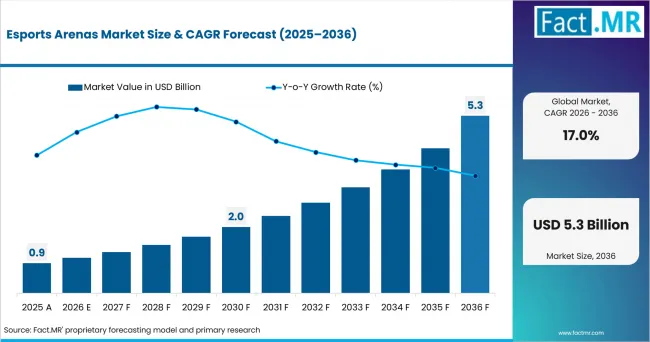
Esports Arenas Market Market Value Analysis | Source: Fact.MR
What are the defining numbers behind esports arena growth?
USD 4.2 billion absolute opportunity by 2036 led by Saudi Arabia, South Korea and the United States.
- Demand Drivers in the Market
- Global esports audiences continue expanding across multiple game genres.
- Publishers increasingly invest in professional tournament ecosystems.
- Dedicated venues improve spectator experiences and broadcasting quality.
- Government-backed esports initiatives support infrastructure development.
- Key Segments Analyzed
- By Arena Type: Dedicated Esports Arenas are expected to hold 44.0% share in 2026.
- By Capacity: Medium Capacity Arenas (2,000–10,000 Seats) are projected to account for 41.0% share in 2026.
- By Revenue Stream: Event Hosting Revenue is expected to hold 38.0% share in 2026.
- By End User: Professional Esports Organizations are projected to account for 47.0% share in 2026.
- By Application: Competitive Tournaments are expected to hold 53.0% share in 2026.
- By Geography: Saudi Arabia is projected to record 18.9% CAGR through 2036.
- Analyst Opinion at Fact.MR
- Shambhu Nath Jha, Senior Analyst at Fact.MR, states, "Esports arenas are evolving into multi-purpose entertainment assets that support tournaments, content production and community engagement. Investments are increasingly shifting toward venue ecosystems that can generate revenue beyond major esports events. Operators that diversify revenue streams and strengthen fan experiences will be better positioned for long-term growth."
- Strategic Implications
- Expand non-tournament programming to improve venue utilization.
- Integrate content production facilities to support creator ecosystems.
- Develop premium spectator experiences to increase revenue per visitor.
The Saudi Arabia market is projected to record 18.9% CAGR through 2036, supported by the Esports World Cup and extensive gaming investments. South Korea is expected to expand at 18.2% CAGR as the global birthplace of esports continues strengthening its venue ecosystem. The United States is forecast to grow at 17.4% CAGR due to rising tournament activity and entertainment venue investments. Japan is projected to advance at 16.3% CAGR through increasing competitive gaming participation and venue modernization. The United Kingdom is expected to register 15.6% CAGR through 2036 as esports event hosting activity continues expanding.
How does the esports arenas market break down by segment?
Dedicated Esports Arenas lead at 44.0%; Professional Esports Organizations lead at 47.0%.
Which arena type dominates?
Dedicated Esports Arenas hold 44.0% share in 2026.
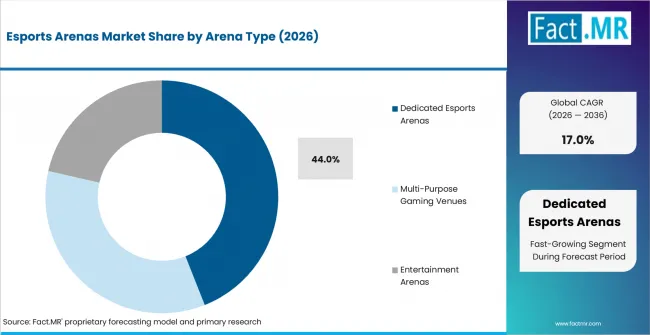
Esports Arenas Market Analysis By Arena Type | Source: Fact.MR
Dedicated esports arenas lead because they are specifically designed to support professional tournaments, broadcasting operations and large spectator audiences. These facilities provide optimized gaming environments and stronger event production capabilities. Increasing publisher investment continues supporting new arena development. The Esports World Cup Foundation announced that the inaugural Esports World Cup would be held in Riyadh across a 645,000-square-foot venue featuring four dedicated esports arenas. The event was designed to host millions of visitors and represented one of the largest esports venue deployments globally. [1]
Which capacity segment dominates?
Medium Capacity Arenas (2,000–10,000 Seats) hold 41.0% share in 2026.
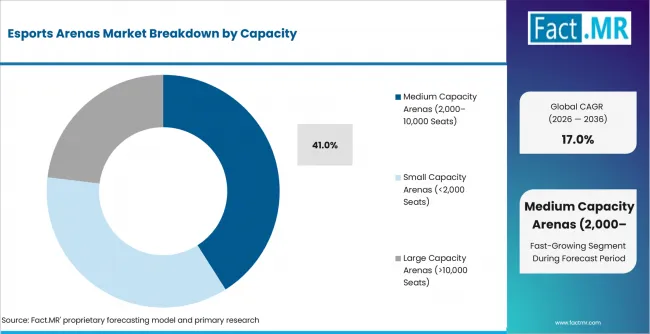
Esports Arenas Market Analysis By Capacity | Source: Fact.MR
Medium-capacity venues dominate because they balance operational efficiency with audience demand. They can accommodate major tournaments while maintaining strong utilization rates throughout the year. Many operators prefer this format due to lower operating costs compared with larger arenas.
Which revenue stream dominates?
Event Hosting Revenue holds 38.0% share in 2026.
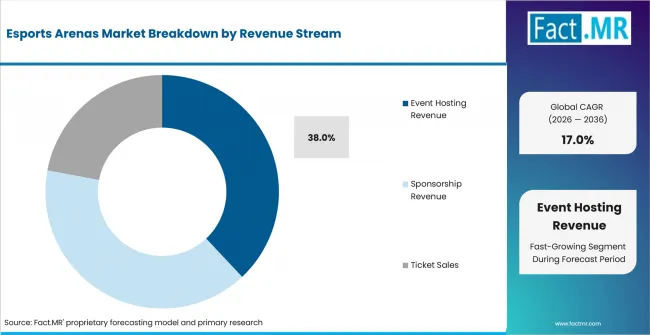
Esports Arenas Market Analysis By Revenue Stream | Source: Fact.MR
Event hosting revenue dominates because tournaments remain the primary activity within esports venues. Major competitions attract sponsors, media partners and ticket sales that contribute significantly to arena income. High-profile events also increase venue visibility and utilization. Integrated Systems Europe (ISE) announced a new 1,000-square-meter Esports Arena at ISE 2025 in partnership with LVP (GRUP MEDIAPRO). The venue hosted live esports tournaments, featured professional players competing before a live audience, and showcased advanced AV and broadcast technologies used in modern esports arenas. [2]
Which end user dominates?
Professional Esports Organizations hold 47.0% share in 2026.
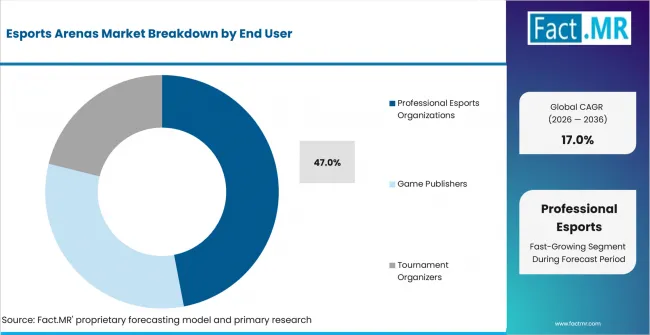
Esports Arenas Market Analysis By End User | Source: Fact.MR
Professional esports organizations dominate because they are the primary users of dedicated arenas for tournaments, training events and fan engagement activities. Their growing commercial presence continues supporting venue demand and infrastructure investment. Full Sail University opened Armada HQ, a dedicated 2,743-square-foot gaming and esports center on its campus. The facility includes 45 gaming stations, broadcast and streaming studios, gameplay areas, and spaces for esports competitions, LAN events, and community activities, expanding the university's esports venue infrastructure. [3]
Which application dominates?
Competitive Tournaments hold 53.0% share in 2026.
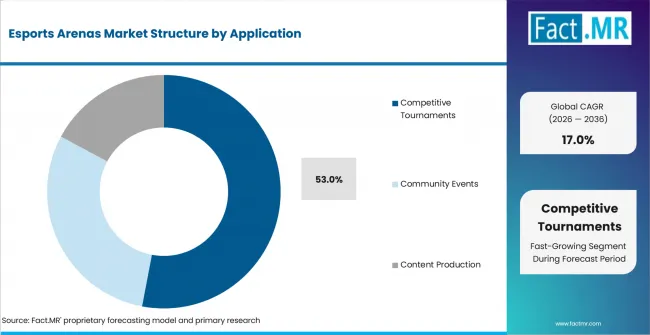
Esports Arenas Market Analysis By Application | Source: Fact.MR
Competitive tournaments lead because they generate the highest audience engagement and commercial activity within the esports ecosystem. Venue operators continue prioritizing tournament hosting to maximize attendance and sponsorship opportunities. BLAST signed a three-year partnership with GamingMalta to host nine major esports events in Malta. As part of the agreement, BLAST will establish a permanent 1,000-square-meter esports broadcasting studio and operations center capable of hosting Tier-1 international esports tournaments, strengthening the country's esports arena infrastructure. [5]
What is accelerating esports arena demand and what is holding it back?
Rising esports audiences drive demand while venue economics restrain expansion.
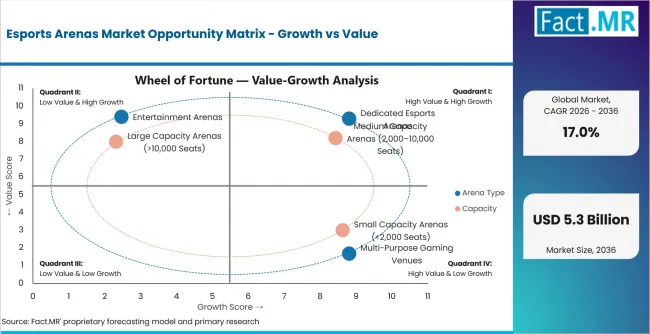
Esports Arenas Market Opportunity Matrix Growth Vs Value | Source: Fact.MR
The primary growth driver is increasing global viewership of esports competitions and professional gaming content. Publishers, teams and sponsors continue investing in live events to strengthen fan engagement and commercial opportunities. Dedicated venues improve event quality and support larger audiences.
The primary restraint is the substantial capital investment required to develop and operate esports venues. Event scheduling challenges and fluctuating tournament calendars can also affect utilization rates. Operators must diversify revenue sources to improve long-term profitability.
Where do the biggest esports arena opportunities sit?
Global tournaments, entertainment districts and content production hubs.
- International Tournament Hosting:
- Major esports competitions continue driving demand for modern venues capable of supporting large audiences and global broadcasts.
- Entertainment and Gaming Districts:
- Mixed-use developments increasingly incorporate esports arenas to attract younger audiences and diversify entertainment offerings.
- Content Production Ecosystems:
- Arena operators are investing in broadcasting studios and creator facilities to generate revenue beyond live events.
Which countries are scaling esports arena investments fastest?
Saudi Arabia 18.9%, South Korea 18.2%, United States 17.4%, Japan 16.3%, United Kingdom 15.6%.
Based on regional analysis, the esports arenas market is segmented into North America, Western Europe, Asia Pacific, Latin America and Middle East & Africa.
.webp "Top Country Growth Comparison Esports Arenas Market Cagr (2026 2036)")
Top Country Growth Comparison Esports Arenas Market Cagr (2026 2036) | Source: Fact.MR
| Country | CAGR |
|---|---|
| Saudi Arabia | 18.9% |
| South Korea | 18.2% |
| United States | 17.4% |
| Japan | 16.3% |
| United Kingdom | 15.6% |
Source: Fact.MR analysis. Updated Jun 25, 2026
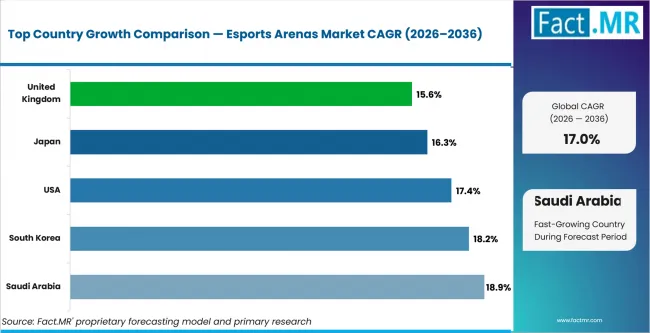
Esports Arenas Market Cagr Analysis By Country | Source: Fact.MR
What makes Saudi Arabia the fastest-growing esports arena market?
18.9% CAGR, fueled by substantial investments in gaming infrastructure.
Saudi Arabia is projected to record 18.9% CAGR by 2036 as the Esports World Cup continues attracting global teams, publishers and audiences. Government-backed gaming investments and large-scale entertainment developments are accelerating venue construction. The country is positioning itself as a major global hub for esports events.
Why does South Korea remain strategically important?
18.2% CAGR, supported by its established esports culture
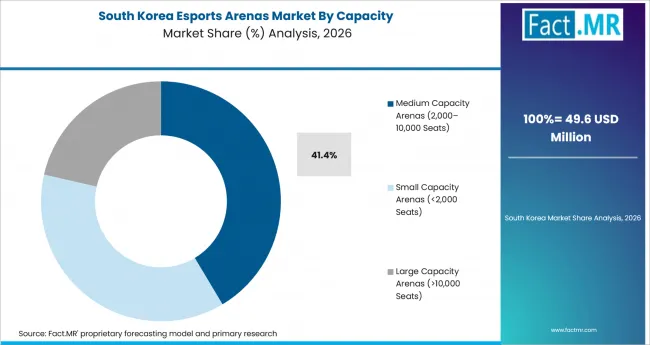
Esports Arenas Market South Korea Market Share Analysis By Capacity | Source: Fact.MR
South Korea is expected to post 18.2% CAGR as its established esports culture continues supporting venue demand. Strong audience engagement and professional gaming infrastructure sustain consistent event activity. The country remains one of the most influential esports markets globally and continues to set benchmarks for competitive gaming ecosystems. Long-standing support from publishers, teams and broadcasters helps maintain high arena utilization and regular tournament activity. Gen.G Esports opened GGX (Gen.G Gaming Xperience), a 1,570-square-meter esports and gaming venue in Seoul featuring 252 premium gaming stations, a community lounge, merchandise store, coaching facilities, and event spaces. The venue was designed as a flagship esports hub that combines competitive gaming, fan engagement, and live community events, expanding esports arena infrastructure in South Korea. [4]
How is the United States expanding esports infrastructure?
17.4% CAGR, fueled by rising tournament activity
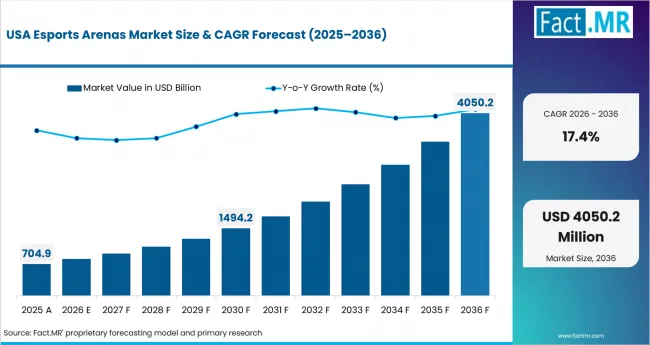
Esports Arenas Market Country Value Analysis | Source: Fact.MR
The United States is projected to register 17.4% CAGR by 2036 as arena operators increase investments in dedicated esports and entertainment facilities. Strong publisher activity and growing audience participation continue supporting venue utilization. Major cities remain important hosts for large-scale tournaments and international esports events. Investments in multi-purpose gaming venues and creator-focused facilities are further strengthening the country's esports infrastructure.
What supports growth in Japan?
16.3% CAGR, driven by increasing acceptance of competitive gaming
Japan is forecast to advance at 16.3% CAGR through 2036 due to increasing acceptance of competitive gaming and rising event activity. Venue modernization and growing publisher support continue strengthening the local esports ecosystem. Fan engagement remains a key driver of arena demand as more consumers attend live gaming events and tournaments. Continued growth in professional leagues and community competitions is also supporting venue expansion.
How is the United Kingdom developing its esports venue ecosystem?
15.6% CAGR, supported by expanding esports audiences
The United Kingdom is expected to grow at 15.6% CAGR by 2036 as tournament hosting activity and esports audience participation increase. Operators continue improving venue capabilities to attract international competitions and large-scale gaming events. Investments in gaming, digital entertainment and event production infrastructure support long-term market growth. Strong university esports programs and growing community engagement are also contributing to venue demand.
Who leads the esports arenas landscape?
ESL FACEIT Group, Riot Games, BLAST, Allied Esports, and Nerd Street lead through venue development and event ecosystem expertise.
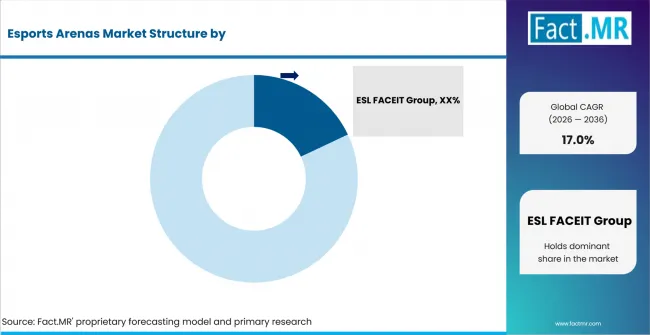
Esports Arenas Market Analysis By Company | Source: Fact.MR
The market is characterized by competition focused on venue quality, event hosting capabilities and audience engagement. Operators continue investing in broadcasting technology, premium seating and digital fan experiences. Strategic partnerships with publishers and tournament organizers remain important competitive advantages.
ESL FACEIT Group and BLAST benefit from extensive global tournament portfolios. Riot Games continues supporting venue development through its professional esports ecosystems. Allied Esports remains a prominent dedicated venue while Nerd Street is emerging through large-scale esports infrastructure investments.
Competition through 2036 will depend on venue utilization, content creation capabilities and the ability to attract major international tournaments. Operators that combine esports events with entertainment, hospitality and creator-focused services will be better positioned to strengthen market share.
Which key companies are covered?
ESL FACEIT Group, Riot Games, BLAST, Allied Esports and Nerd Street
- ESL FACEIT Group
- Riot Games
- BLAST
- Allied Esports
- Nerd Street
Bibliography
- [1] Esports World Cup Foundation. (2024). Esports World Cup. Esports World Cup Foundation.
- [2] Integrated Systems Europe. (2025). ISE 2025 esports arena. Integrated Systems Europe.
- [3] Full Sail University. (2025). Armada HQ gaming and esports center opens on campus. Full Sail University.
- [4] Gen.G Esports. (2025). Gen.G Gaming Xperience. Gen.G Esports.
- [5] BLAST. (2025). BLAST and GamingMalta announce strategic partnership to expand esports events and ecosystem development. BLAST.
This Report Addresses
- Market size estimates and long-term growth outlook for esports arenas.
- Analysis of arena investment trends across dedicated and multi-purpose esports venues.
- Evaluation of tournament hosting activity and venue utilization strategies.
- Assessment of esports infrastructure development across major countries.
- Competitive benchmarking of leading arena operators, event organizers and esports ecosystem participants.
- Analysis of growth drivers, restraints and emerging opportunities.
- Country-level demand outlook across the United States, United Kingdom, Saudi Arabia, South Korea and Japan.
- Evaluation of revenue generation models including event hosting, sponsorships, ticket sales and media rights.
What does the esports arenas market cover?
Dedicated esports venues supporting tournaments, broadcasting, content creation and fan engagement.
The market covers purpose-built esports arenas, gaming event venues and mixed-use esports entertainment facilities. Revenue is generated through event hosting, sponsorships, ticketing, media rights, food services and venue partnerships.
What is included in the scope?
Esports arenas, tournament venues, esports entertainment centers and related infrastructure.
The scope includes broadcasting facilities, audience seating, event operations, content production capabilities and associated venue services.
What is excluded from the scope?
Online gaming platforms and home gaming equipment.
The scope excludes game publishing revenues, gaming hardware sales and online-only tournament operations.
How was the analysis built?
100+ sources, 35+ venue assessments, 25+ countries and industry interviews.
- Primary Research:
- Interviews with arena operators, event organizers, esports teams and venue developers.
- Desk Research:
- Analysis of esports audience trends, venue investments and tournament activity.
- Market Sizing and Forecasting:
- Estimates based on venue revenues, event activity and infrastructure investments.
- Data Validation and Update Cycle:
- Forecasts validated through venue benchmarking, operator disclosures and event analysis.
Segmentation
What is the report's scope and coverage?
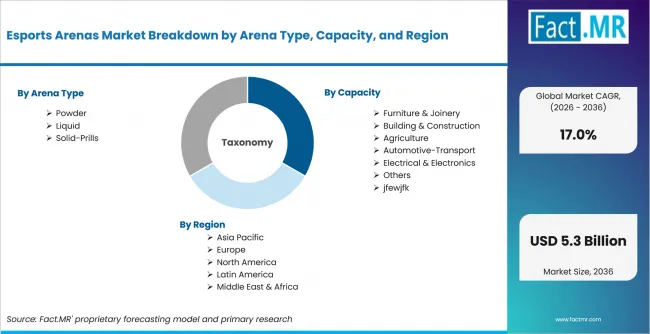
Esports Arenas Market Breakdown By Arena Type, Capacity, And Region | Source: Fact.MR
| Attribute | Details |
|---|---|
| Quantitative Units | USD Billion in 2026 to USD Billion by 2036 at CAGR |
| Market Definition | The Esports Arenas Market refers to dedicated and multi-purpose venues designed to host competitive gaming tournaments, esports leagues, live audience events, content production activities and fan engagement experiences. |
| Arena Types Covered | Dedicated Esports Arenas, Multi-Purpose Gaming Venues, Entertainment Arenas |
| Capacity Covered | Small Capacity Arenas, Medium Capacity Arenas, Large Capacity Arenas |
| Revenue Streams Covered | Event Hosting Revenue, Sponsorship Revenue, Ticket Sales, Media Rights Revenue, Food & Beverage Revenue |
| End Users Covered | Professional Esports Organizations, Game Publishers, Tournament Organizers, Spectators and Fans |
| Applications Covered | Competitive Tournaments, Community Events, Content Production, Training and Bootcamps |
| Regions Covered | North America, Western Europe, Asia Pacific, Latin America, Middle East & Africa |
| Key Countries Covered | United States, United Kingdom, Saudi Arabia, South Korea, Japan |
| Companies Covered | ESL FACEIT Group, Riot Games, BLAST, Allied Esports, HyperX Esports Arena, Nerd Street |
| Forecast Period | 2026 to 2036 |
| Approach | The market assessment is based on a hybrid top-down and bottom-up methodology. Revenue generated from dedicated esports arenas, gaming event venues and associated infrastructure investments was analyzed across major countries. |
Source: Fact.MR analysis. Updated Jun 25, 2026
How is market segmented?
-
By Arena Type:
- Dedicated Esports Arenas
- Multi-Purpose Gaming Venues
- Entertainment Arenas
-
By Capacity:
- Small Capacity Arenas (<2,000 Seats)
- Medium Capacity Arenas (2,000–10,000 Seats)
- Large Capacity Arenas (>10,000 Seats)
-
By Revenue Stream:
- Event Hosting Revenue
- Sponsorship Revenue
- Ticket Sales
- Media Rights Revenue
- Food & Beverage Revenue
-
By End User:
- Professional Esports Organizations
- Game Publishers
- Tournament Organizers
- Spectators and Fans
-
By Application:
- Competitive Tournaments
- Community Events
- Content Production
- Training and Bootcamps
-
Region:
- North America
- United States
- Canada
- Europe
- United Kingdom
- Germany
- France
- Netherlands
- Spain
- Asia Pacific
- Australia
- Japan
- South Korea
- Singapore
- India
- Latin America
- Brazil
- Mexico
- Chile
- Middle East & Africa
- GCC Countries
- South Africa
- Israel
- North America
Frequently Asked Questions
Which arena type leads the market?
Which end user dominates the market?
What is driving esports arena demand?
Which country is growing the fastest?
What is the primary challenge facing operators?
How do esports arenas generate revenue?
Why are governments investing in esports venues?
What opportunities exist for arena operators?
What is the long-term outlook for the market?
Who worked on this report


Preview the report firsthand - request a free sample
Free SampleGet the brochure for pricing and purchase details
Download PDF