- Market Value (2025): USD 1.91 Bn
- Estimated Value (2026): USD 2.03 Bn
- Forecast Value (2036): USD 3.73 Bn
- CAGR (2026-2036): 6.3%
What is the Surgical Fluid Disposal Market forecast to be worth by 2036?
USD 2.0 billion in 2026 to USD 3.7 billion by 2036 at a 6.3% CAGR.
- Surgical fluid disposal revenue totalled USD 1.91 billion in 2025, built on steady use of canisters, liners and solidifying agents in hospital theatres.
- Revenue will expand from USD 2.03 billion in 2026 to USD 3.73 billion by 2036 as surgical volumes grow and closed collection spreads to more theatres.
- A 6.3% CAGR reflects recurring consumable demand per procedure, with automated disposal systems adding capital spend in larger hospitals.
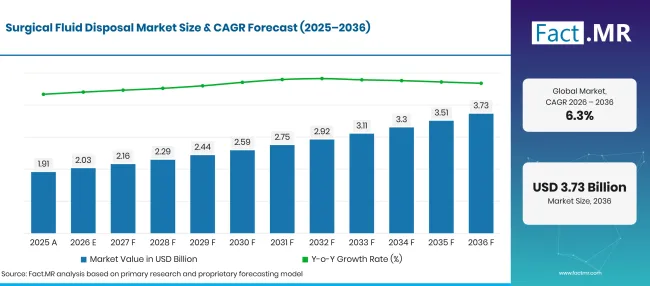
Surgical Fluid Disposal Market Forecast Global | Source: Fact.MR
| Year | Basis | Market Value (USD billion) |
|---|---|---|
| 2025 | Actual | 1.91 |
| 2026 | Estimate | 2.03 |
| 2036 | Forecast | 3.73 |
| CAGR 2026 to 2036 | Forecast period | 6.3% |
Source: Fact.MR analysis. Updated Nov 9, 2026
What are the defining numbers behind Surgical Fluid Disposal Market growth?
An absolute opportunity of USD 1.7 billion will be added between 2026 and 2036, mostly from consumables reordered with every surgical case.
- Demand Drivers in the Market
- Basic waste services are still missing in many facilities worldwide. WHO and UNICEF reported that 71% of health facilities had basic health-care waste management services in 2025 [1]. Closing that gap will lift demand for containment products that turn liquid surgical waste into a safer form.
- Outpatient surgery keeps moving into smaller sites that need compact collection kits. The Centers for Medicare & Medicaid Services added 289 procedures to the ambulatory surgical center covered procedures list for 2026 [2]. Each added procedure brings canister, liner and solidifier use into centers with tight turnover schedules.
- Staff protection rules are pushing hospitals to cut direct contact with infectious fluids. Sealed canisters, pre-gelled bags and closed manifolds lower splash and spill risk when containers are moved or emptied.
- Minimally invasive, arthroscopic and spinal procedures use large volumes of irrigation fluid. Suction capacity and quick canister change-outs keep the field clear, which turns fluid handling into a scheduling issue as well as a safety one.
- Operating room managers want fewer manual steps between cases. Direct-to-drain systems and docking units remove canister lifting, so hospitals with heavy caseloads will weigh their capital cost against labor and disposal savings.
- Key Segments Analyzed
- By Product Type: Solidifiers will hold 43.2% share in 2026, as turning liquid waste into gel cuts spill risk during transport and lets canisters move with solid waste streams.
- By End-User: Hospitals will account for 45.3% of 2026 value, given the number of theatres they run each day and the mix of complex cases they treat.
- By Application: Orthopedic Surgeries will capture 44.3% in 2026, since joint replacement and spinal work produce heavy blood and irrigation loads per case.
- Analyst Opinion at Fact.MR
- Shambhu Nath Jha, Principal Consultant at Fact.MR, states, “Fluid waste is one of the few operating room costs that grows directly with every case added to the schedule. Hospitals will keep buying solidifiers and sealed canisters for routine work, while the busiest theatres will move toward closed docking and direct-to-drain systems. Suppliers that can show lower staff exposure and faster turnover with clear data will win the contract renewals.”
- Strategic Implications
- Manufacturers should design solidifier formats that fit common canister sizes and gel quickly, so nurses can treat waste without opening containers.
- Distributors should bundle canisters, liners and solidifiers into procedure-specific kits for ambulatory surgical centers that lack storage space.
- Hospital buyers should compare per-case consumable cost with the labor and disposal fees saved by closed or direct-to-drain systems before renewing contracts.
- Investors should track procedure growth in outpatient settings, where recurring consumable revenue builds with each new surgical site.
The United Kingdom leads the country set at 8.1%, where record elective throughput lifts consumable use per theatre. Germany follows at 7.6%, only 0.5 points behind, as a large inpatient base keeps reorder volumes high. Japan, at 6.8%, draws on an older population that needs more joint and spine surgery. A wider 1.5-point step separates Japan from Brazil at 5.3%, reflecting a public system that is still adding surgical beds and waste capacity. The United States trails at 4.7% because closed collection and solidifier use are already common in its hospitals.
How does the Surgical Fluid Disposal Market break down by segment?
Solidifiers will lead Product Type at 43.2%; Hospitals will head End-User at 45.3%; Orthopedic Surgeries will hold Application at 44.3% in 2026.
Which Product Type leads?
Solidifiers take 43.2% of 2026 sales.
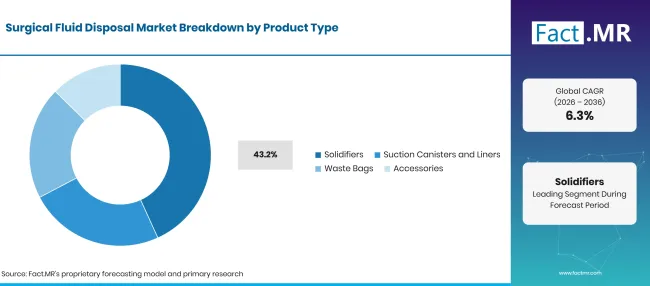
Surgical Fluid Disposal Market Breakdown Product Type | Source: Fact.MR
| Product Type | Share (2026) |
|---|---|
| Solidifiers (Leading segment) | 43.2% |
| Other segments combined | 56.8%* |
| Total | 100.0% |
Source: Fact.MR analysis. Updated Nov 9, 2026
Liquid waste in an open or poorly sealed canister can splash during transport, so many hospitals treat it before it leaves the room. Solidifying agents in pouches, bottles or pre-filled liners turn blood and irrigation fluid into a gel within minutes. The treated canister can then go out with regulated solid waste, which simplifies handling for environmental services staff and waste haulers. Suction canisters and liners form the second core group, with rigid and flexible formats sized for the procedure. Waste bags and accessories such as specimen traps, brackets and tubing complete the range. Buyers comparing these products often review them alongside wider medical waste containers for sharps and regulated waste.
What supports Hospitals within End-User?
Hospitals account for 45.3% of 2026 revenue.
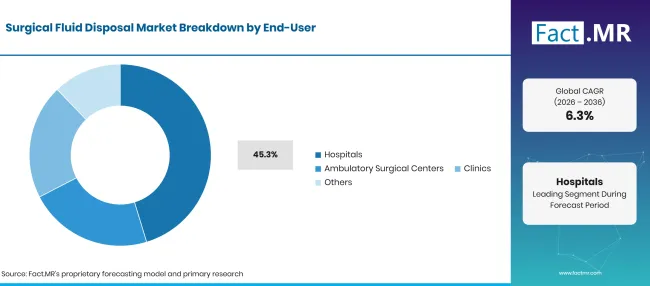
Surgical Fluid Disposal Market Breakdown End User | Source: Fact.MR
| End-User | Share (2026) |
|---|---|
| Hospitals (Leading segment) | 45.3% |
| Other segments combined | 54.7%* |
| Total | 100.0% |
Source: Fact.MR analysis. Updated Nov 9, 2026
Large hospitals run trauma, cancer, cardiac and orthopedic cases side by side, often across a dozen or more theatres a day. That mix creates steady orders for canisters, liners and solidifiers, and it justifies capital spend on docking or direct-to-drain systems. Many of these buyers also manage contracts for medical waste management services, so fluid disposal is reviewed within one waste budget. Ambulatory surgical centers and clinics need smaller, easy-to-store formats and simple solidifier dosing. Global gaps remain in basic facility services: WHO and UNICEF found that about 40% of health facilities met the basic sanitation standard [3]. Such gaps give clinics outside major cities a reason to adopt contained, low-maintenance collection products.
What leads the Application segment?
Orthopedic Surgeries represent 44.3% of 2026 demand.
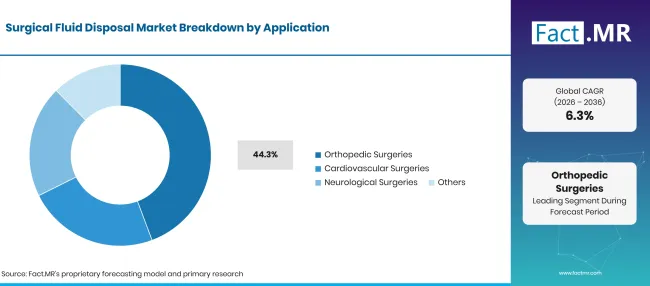
Surgical Fluid Disposal Market Breakdown Application | Source: Fact.MR
| Application | Share (2026) |
|---|---|
| Orthopedic Surgeries (Leading segment) | 44.3% |
| Other segments combined | 55.7%* |
| Total | 100.0% |
Source: Fact.MR analysis. Updated Nov 9, 2026
Knee and hip replacements, spinal fusions and fracture repairs combine bleeding with heavy irrigation, so a single case can fill several canisters. The National Joint Registry has recorded over 4.5 million joint procedures since 2003, a measure of how large the elective orthopedic caseload has become [4]. Theatres running these lists rely on high-capacity medical suction devices paired with quick-change collection. Cardiovascular surgery generates large blood volumes, while neurological procedures need precise suction around delicate tissue. General and specialty surgery adds a wide base of smaller cases. Upgrades to operating room equipment often open the door to closed collection across all these specialties.
What is accelerating Surgical Fluid Disposal Market adoption, and what is holding it back?
Rising caseloads, outpatient surgery growth and stricter staff protection rules are moving hospitals toward sealed collection and solidifier use. Cost slows the shift. Automated disposal units need capital budgets and plumbing work, while canisters, liners and solidifiers add a recurring charge to every case. Smaller facilities and regions with uneven waste rules adopt more slowly, often choosing the lowest-cost compliant option.
Drivers Impact Analysis
| DRIVER | (~) % IMPACT ON CAGR | GEOGRAPHIC RELEVANCE | IMPACT TIMELINE |
|---|---|---|---|
| Growth in surgical procedure volumes across hospitals and specialty centers | +1.6% | Global | Medium term (2-4 years) |
| Wider use of solidifiers and closed fluid collection systems | +1.3% | North America, Western Europe, East Asia | Medium term (2-4 years) |
| Staff safety and infection prevention requirements | +1.1% | Global | Long term (>=4 years) |
| Shift of procedures to ambulatory surgical centers | +0.8% | North America, Western Europe | Short term (<=2 years) |
| Expansion of operating room capacity in emerging health systems | +0.6% | Latin America, South Asia & Pacific, Middle East & Africa | Long term (>=4 years) |
Source: Fact.MR analysis. Updated Nov 9, 2026
Opportunity Impact Analysis
| OPPORTUNITY | (~) % IMPACT ON CAGR | GEOGRAPHIC RELEVANCE | IMPACT TIMELINE |
|---|---|---|---|
| Pre-gelled liners and faster solidifier formats | +0.7% | Global | Medium term (2-4 years) |
| Direct-to-drain and docking systems in high-volume hospitals | +0.6% | North America, Western Europe | Medium term (2-4 years) |
| Procedure kits for ambulatory surgical centers | +0.4% | North America, East Asia | Long term (>=4 years) |
| Bio-based and lower-carbon collection bags | +0.3% | Western Europe, North America | Long term (>=4 years) |
Source: Fact.MR analysis. Updated Nov 9, 2026
Restraints Impact Analysis
| RESTRAINT | (~) % IMPACT ON CAGR | GEOGRAPHIC RELEVANCE | IMPACT TIMELINE |
|---|---|---|---|
| High upfront cost of automated disposal systems | -0.6% | Global | Short term (<=2 years) |
| Recurring spend on canisters, liners and solidifiers | -0.4% | Global | Medium term (2-4 years) |
| Uneven medical waste rules and treatment capacity | -0.3% | Latin America, South Asia & Pacific, Middle East & Africa | Long term (>=4 years) |
| Tight budgets in smaller healthcare facilities | -0.2% | Emerging markets | Medium term (2-4 years) |
Source: Fact.MR analysis. Updated Nov 9, 2026
Which countries are scaling the Surgical Fluid Disposal Market through 2036?
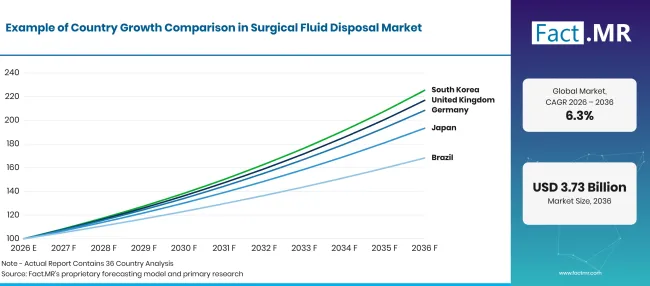
Surgical Fluid Disposal Market Growth Index | Source: Fact.MR
| Country | CAGR (2026 to 2036) |
|---|---|
| United Kingdom | 8.1% |
| Germany | 7.6% |
| Japan | 6.8% |
| Brazil | 5.3% |
| United States | 4.7% |
Source: Fact.MR analysis. Updated Nov 9, 2026
What supports adoption in the United Kingdom?
8.1% CAGR, driven by record elective activity in NHS theatres.
NHS trusts are running more lists to cut waiting times, and every added list raises canister and solidifier use. NHS England reported 18.4 million treatments and operations in 2025, up from 18 million in 2024 [5]. Trusts are also weighing closed collection against the cost of handling liquid clinical waste, and sustainability teams want fewer single-use canisters per case. Products that save nurse time between cases fit the throughput push.
How is Germany developing demand?
7.6% CAGR, backed by a large and growing inpatient caseload.
German hospitals follow strict rules on waste segregation, which favors sealed containers and treated fluid. The Federal Statistical Office counted about 17.5 million inpatient hospital treatments in 2024, up 2.0% on the previous year [6]. Higher patient numbers feed straight into surgical lists and consumable reorders. Purchasing groups prefer products that slot into existing suction units without extra workflow steps.
What is shaping Japan’s adoption?
6.8% CAGR, reflecting surgical need in an aging population.
Older patients need more hip, knee and spine surgery, along with cardiac and cancer procedures. Japan’s Cabinet Office reported that people aged 65 and over accounted for 29.3% of the population on October 1, 2024, or about 36.24 million people [7]. Hospitals serving this group plan for steady orthopedic volumes. Compact canisters and quick-gel solidifiers suit facilities with limited storage space.
How does Brazil perform?
5.3% CAGR, helped by new surgical beds in the public system.
Brazil’s Ministry of Health reported a record 14.7 million elective surgeries in the SUS in 2025, and said about 74.9% of the 10,057 beds opened since 2023 were surgical [8]. São Paulo state alone carried out 1.3 million elective surgeries in 2025 [9]. More theatre capacity brings fresh demand for canisters and solidifiers, though price remains a deciding factor for public buyers.
What supports adoption in the United States?
4.7% CAGR, as procedures keep moving to outpatient sites.
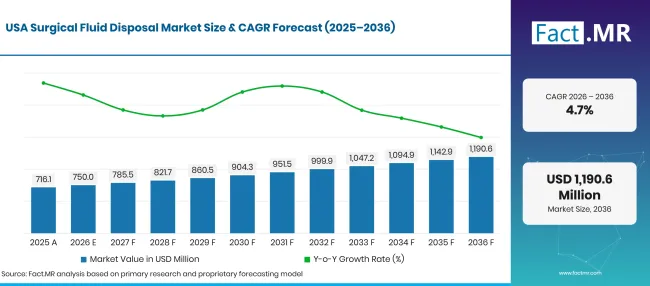
Surgical Fluid Disposal Market Forecast Usa | Source: Fact.MR
US hospitals already use sealed canisters and solidifiers widely, so growth comes from new sites and system upgrades. CMS proposed removing 638 services from the inpatient only list in its 2027 outpatient and ambulatory surgical center rule [10]. Ambulatory surgical centers taking on those cases need compact collection kits and fast turnover. Large hospital systems keep evaluating closed docking units to cut manual canister handling.
Who leads the Surgical Fluid Disposal Market?
Suppliers fall into three groups. System makers such as Stryker and DeRoyal sell closed or direct-to-drain platforms that remove canister handling, then earn recurring revenue on manifolds and filters. Stryker described Neptune S in October 2026 as a closed waste system that spares GI teams from changing canisters two or three times during some procedures [11].
Collection specialists such as Serres and Bemis Health Care compete on bag and canister design and sealing. Serres secured ISCC PLUS certification at both Finnish production sites in June 2026, allowing it to offer mass-balanced, bio-based single-use plastics [12]. Broadline suppliers Cardinal Health and Medline cover canisters, liners and solidifiers under contract pricing that hospitals bundle with other consumables. Competition through 2036 will turn on proof of lower staff exposure, compatibility with installed suction, and total cost per case.
Which companies are the key providers?
Key companies include Stryker, Cardinal Health, Medline, Serres, DeRoyal and Bemis Health Care.
- Stryker
- Cardinal Health
- Medline
- Serres
- DeRoyal
- Bemis Health Care
Bibliography
- [1] World Health Organization. (2026, August 18). WHO/UNICEF report highlights gaps in health facility sanitation.
- [2] Centers for Medicare & Medicaid Services. (2025, November 21). Calendar Year 2026 Hospital Outpatient Prospective Payment System (OPPS) and Ambulatory Surgical Center Final Rule (CMS-1834-FC).
- [3] World Health Organization. (2026, August 18). Progress on water, sanitation, hygiene, environmental cleaning and waste management in health care facilities 2015 to 2025.
- [4] Healthcare Quality Improvement Partnership. (2025, November 4). National Joint Registry Annual Report 2025.
- [5] NHS England. (2026, February 12). NHS waiting list lowest in almost 3 years as NHS battled busiest winter on record.
- [6] Statistisches Bundesamt (Destatis). (2025, November 6). 2,0 % mehr stationäre Krankenhausbehandlungen im Jahr 2024.
- [7] Cabinet Office, Government of Japan. (2025, June). Annual Report on the Ageing Society 2025: Current situation and future outlook of population ageing.
- [8] Ministério da Saúde. (2026, March 6). Com mais de 360 mil leitos em funcionamento, SUS alcança maior crescimento sustentado da década.
- [9] Governo do Estado de São Paulo. (2025, December 26). SP realiza 1,3 milhão de cirurgias eletivas em 2025, maior número da história do SUS paulista.
- [10] Centers for Medicare & Medicaid Services. (2026, July 2). Calendar Year 2027 Hospital Outpatient Prospective Payment System (OPPS) and Ambulatory Surgical Center (ASC) Proposed Rule (CMS-1850-P).
- [11] Stryker. (2026, October 27). Meeting the colonoscopy boom: Helping healthcare teams manage growing demand.
- [12] Serres. (2026, June 24). Serres Achieves ISCC PLUS Certification at Both Production Sites, Advancing Circularity in Healthcare.
This Report Answers
- How is revenue split between solidifiers, suction canisters and liners, waste bags and accessories?
- Why do hospitals treat liquid surgical waste with solidifiers before it leaves the theatre?
- Which end users buy the most collection products, and how do ambulatory centers differ from hospitals?
- Where do closed docking and direct-to-drain systems replace canisters, and what limits their spread?
- Which of the five profiled countries add demand quickest, and which public data explain the gaps?
- How do system makers, collection specialists and broadline suppliers compete for hospital contracts?
What does the Surgical Fluid Disposal Market cover?
This report tracks products and systems that collect, solidify, contain and dispose of fluids generated during surgery. Solidifiers, suction canisters, liners, waste bags and related accessories form the product base.
Value is measured at manufacturer selling prices across orthopedic, cardiovascular, neurological and other surgery. End users include hospitals, ambulatory surgical centers and clinics, and both consumables and automated disposal equipment are counted.
What is included in the scope?
Fluid solidifiers in pouch, bottle and pre-filled formats are counted.
Rigid and flexible suction canisters, liners and pre-gelled suction bags are included. Closed docking and direct-to-drain disposal systems, with their manifolds, filters and tissue traps, are part of the market. Accessories such as canister brackets, trolleys and connecting tubing are counted when sold for fluid collection. Products designed to support surgical site infection control fall inside the boundary only when they collect or contain surgical fluid.
What is excluded from the scope?
Hospital waste hauling, treatment and incineration services are left out.
Surgical instruments and general operating room furniture are not counted. General-purpose suction pumps and irrigation delivery equipment are excluded unless sold as part of a fluid collection system. Gloves, gowns, drapes and other medical disposables are outside this market.
How Was the Analysis Built?
The analysis draws on 120+ sources, 35+ company portfolios, 25+ countries, and more than 20 industry interviews.
- Primary Research: Primary research includes discussions with manufacturers, service providers, technology developers, distributors, end users, and subject-matter experts. These conversations examine purchasing priorities, product adoption, operational challenges, approval requirements, competitive positioning, and the factors that influence wider market acceptance.
- Desk Research: Desk research covers government statistics, regulatory publications, company filings, trade data, technical studies, industry associations, standards, public policy, and other authoritative sources. Every source used in the analysis is documented in the bibliography.
- Market Sizing and Forecasting: Market estimates combine historical performance, demand indicators, pricing and volume trends, segment shares, company participation, country-level growth, adoption patterns, investment activity, and barriers to market expansion.
- Data Validation and Update Cycle: Findings are validated by comparing primary interviews with public data, company activity, regulatory changes, trade patterns, and industry developments. Regular updates review new product launches, capacity changes, partnerships, approvals, and shifts in commercial adoption.
Segmentation
What is the report’s scope and coverage?
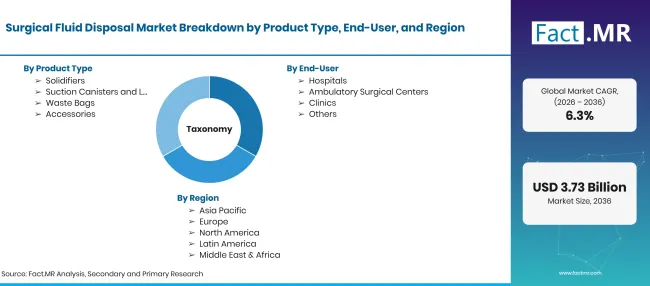
Surgical Fluid Disposal Market Taxonomy | Source: Fact.MR
| Attribute | Details |
|---|---|
| Quantitative Units | USD billion |
| Market Definition | Products and systems used to collect, solidify, contain and dispose of blood, irrigation fluid and other body fluids generated during surgical procedures. |
| Product Type | Solidifiers; Suction Canisters and Liners; Waste Bags; Accessories |
| End-User | Hospitals; Ambulatory Surgical Centers; Clinics; Others |
| Application | Orthopedic Surgeries; Cardiovascular Surgeries; Neurological Surgeries; Others |
| Regions Covered | North America; Latin America; Western Europe; Eastern Europe; East Asia; South Asia & Pacific; Middle East & Africa |
| Countries Covered | United Kingdom; Germany; Japan; Brazil; United States |
| Companies Profiled | Stryker; Cardinal Health; Medline; Serres; DeRoyal; Bemis Health Care |
| Forecast Period | 2026 to 2036 |
| Approach | Procedure volumes by country and specialty are multiplied by consumable use per case, then checked against hospital purchasing data and supplier portfolios. |
Source: Fact.MR analysis. Updated Nov 9, 2026
How is the market segmented?
-
By Product Type
- Solidifiers
- Suction Canisters and Liners
- Waste Bags
- Accessories
-
By End-User
- Hospitals
- Ambulatory Surgical Centers
- Clinics
- Others
-
By Application
- Orthopedic Surgeries
- Cardiovascular Surgeries
- Neurological Surgeries
- Others
-
By Region
- North America
- Latin America
- Western Europe
- Eastern Europe
- East Asia
- South Asia & Pacific
- Middle East & Africa
Frequently Asked Questions
How large is the surgical fluid disposal market in 2026?
What growth rate will the surgical fluid disposal market record?
Which product type leads?
Which end-user leads?
Which application leads?
Which country will grow quickest?
Who are the main companies?
What holds the market back?
Who worked on this report


Preview the report firsthand - request a free sample
Free SampleGet the brochure for pricing and purchase details
Download PDF