- Base Value(2025): 0.2 Bn
- Estimated Value(2026): 0.2 Bn
- Forecast Value (2036): 0.5 Bn
- CAGR (2026 - 2036): 7.3%
Surgical Smoke Exposure Monitoring Devices Market Forecast and Outlook By FACT.MR
In 2025, the surgical smoke exposure monitoring devices market was valued at USD 0.2 billion. Based on Fact.MR analysis, demand for surgical smoke exposure monitoring devices is estimated to grow to USD 0.2 billion in 2026 and USD 0.5 billion by 2036. FACT.MR projects a CAGR of 7.3% during the forecast period.
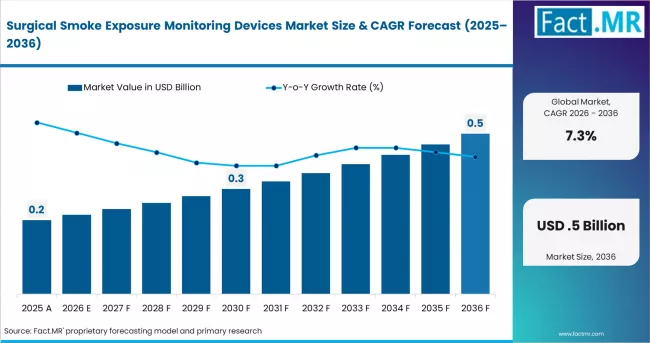
Surgical Smoke Exposure Monitoring Devices Market Value Analysis | Source: Fact.MR
Summary of Surgical Smoke Exposure Monitoring Devices Market
- Market Definition
- The market includes real-time surgical smoke exposure monitoring devices integrated with or paired to evacuation systems used in electro surgery, laser, and laparoscopic OR settings globally.
- Demand Drivers
- OSHA’s updated surgical smoke safety guidance and state-level mandates in the United States are requiring hospitals to implement validated real-time smoke monitoring in electrosurgery and laser procedure rooms.
- EU-OSHA Framework Directive enforcement is accelerating hospital procurement of integrated smoke evacuation and monitoring systems across European healthcare networks.
- Rising laparoscopic and minimally invasive surgical volumes in India and China are expanding the addressable hospital base for smoke monitoring device deployment.
- Key Segments Analyzed
- By Product Type: Smoke evacuation systems with integrated monitoring lead with 38% share in 2026, driven by OR workflow integration requirements and hospital group purchasing standards.
- By Application: Laparoscopic & minimally invasive surgeries lead with 45% share in 2026, as high-volume smoke generation in closed-cavity procedures creates the strongest compliance and monitoring need.
- By End User: Hospitals account for 48% share in 2026, supported by structured procurement through GPOs and mandatory OR safety compliance programmes.
- By Geography: India leads at 8.9% CAGR through 2036, driven by hospital infrastructure investment and rising surgical procedure volumes under national health programmes.
- Analyst Opinion at FACT.MR
- Shambhu Nath Jha, Principal Consultant at Fact.MR, opines, ‘CXOs will find that surgical smoke monitoring device adoption is shifting from voluntary best practice to enforceable compliance. Demand is moving toward integrated evacuation and monitoring systems. Validated sensor performance is becoming a key requirement.
- Strategic Implications
- Develop integrated smoke evacuation and real-time monitoring systems validated under OSHA standards and EU-OSHA directives to qualify for hospital GPO-preferred vendor programmes.
- Build clinical evidence and OR safety outcome data to support reimbursement and procurement justification in cost-sensitive hospital and ambulatory surgical center segments.
- Establish distribution partnerships in India and China to capture hospital capacity expansion and rising minimally invasive surgical procedure volumes in public and private health networks.
- Methodology
- Market sizing uses hospital procedure volume data, smoke monitoring device penetration rates, and average selling price benchmarks by product type.
- Analysis incorporates OSHA surgical smoke guidance, EU-OSHA directive enforcement data, AORN practice guidelines, and national hospital expansion programme inputs.
- Forecasts consider compliance mandate timelines, hospital procurement cycle lengths, and device adoption rates across OR procedure categories.
| Metric | Value |
|---|---|
| Estimated Value in 2026 | USD 0.2 billion |
| Forecast Value in 2036 | USD 0.5 billion |
| Forecast CAGR (2026 to 2036) | 7.3% |
Source: Fact.MR analysis. Updated Apr 22, 2026
Between 2026 and 2036, the market is projected to create USD 0.23 billion in absolute opportunity. Growth is steady and compliance-driven. It is not volume-led. Expansion is anchored by OSHA and EU workplace safety enforcement. Hospital safety programme adoption is increasing. High device qualification costs remain a constraint. Limited reimbursement for monitoring devices also restricts adoption.
India leads with 8.9% CAGR through 2036. Growth is driven by hospital expansion and rising surgical volumes. China follows at 8.5%, supported by infrastructure investment and OR safety adoption. The United States records 7.8%, driven by OSHA compliance and advanced OR systems. Germany grows at 7.4%, supported by EU safety directive enforcement. Japan records 7.1%, driven by high surgical volumes and ongoing technology upgrades in hospitals.
Segmental Analysis
Surgical Smoke Exposure Monitoring Devices Market Analysis by Product Type
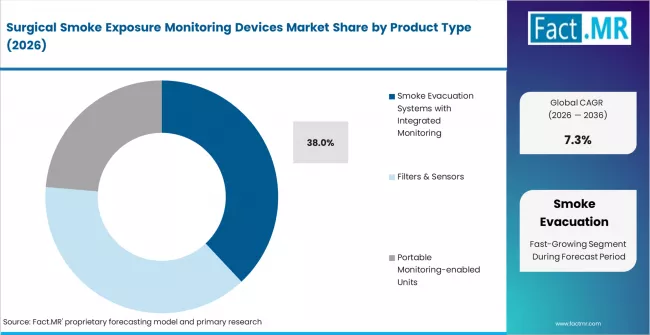
Surgical Smoke Exposure Monitoring Devices Market Analysis By Product Type | Source: Fact.MR
Integrated smoke evacuation systems hold 38% share in 2026. They lead due to seamless OR workflow integration. Combined evacuation and monitoring simplifies procurement. Training requirements are also reduced. Compliance is easier with single-system solutions.
- Medtronic Investment: Medtronic expanded its smoke portfolio in 2024. Real-time particulate monitoring was added to existing systems. The focus is on GPO-driven hospital procurement. Compliance-ready systems are gaining traction. [1]
- CONMED Development: CONMED Corporation launched an upgraded Helios module in 2025. It combines ULPA filtration with real-time detection. The system targets laparoscopic and robotic ORs. [2]
- Portable Monitoring Trend: Hospital policy adoption is increasing rapidly. Smoke-free OR standards rose by 26% in 2024. Portable monitoring units are seeing strong demand. Adoption is high in ambulatory and specialty clinics. [3]
Surgical Smoke Exposure Monitoring Devices Market Analysis by Application
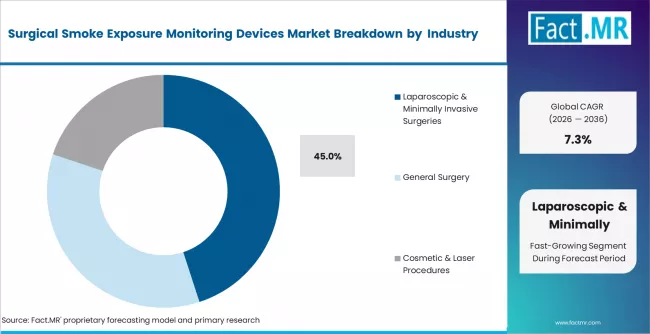
Surgical Smoke Exposure Monitoring Devices Market Analysis By Application | Source: Fact.MR
Laparoscopic and minimally invasive surgeries hold 45% share in 2026. These procedures generate high smoke levels. Closed environments require active monitoring. Demand is strong across hospitals and ASCs.
- Stryker Investment: Stryker expanded its OR safety portfolio in 2024. Smoke management was integrated into the Neptune platform. The focus is on laparoscopic compliance. [4]
- Johnson & Johnson Innovation: Johnson & Johnson introduced sensor-compatible energy devices in 2025. These support real-time plume monitoring. Applications include general and bariatric surgery. [5]
- Laser Procedure Growth Trend: Laser procedure volumes are rising globally. Growth reached 19% in 2024. Demand for portable monitoring devices is increasing. Clinics and dermatology centres are key users. [6]
Drivers, Restraints, and Opportunities
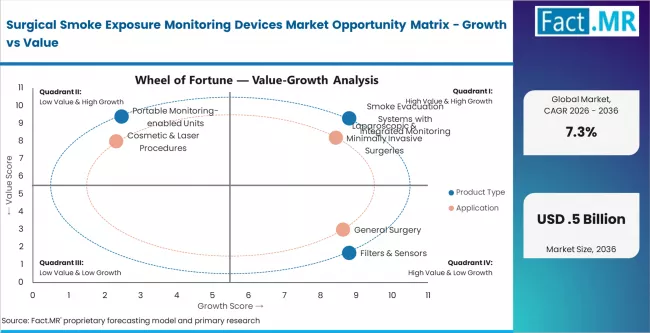
Surgical Smoke Exposure Monitoring Devices Market Opportunity Matrix Growth Vs Value | Source: Fact.MR
Fact.MR analysis indicates the market has shifted to compliance-driven procurement. It was valued at USD 0.20 billion in 2025. OSHA enforcement is a key driver in the U.S. EU safety directives are also influencing adoption. Asia Pacific surgical expansion is increasing demand.
Passive smoke management is declining. Integrated evacuation and monitoring systems are replacing standalone units. These systems carry 20–30% price premiums. Cost is offset by compliance and safety benefits. Growth is driven by regulatory necessity.
- OSHA Surgical Smoke Mandate Expansion: Regulatory enforcement is strengthening in the U.S. Updated OSHA guidance was issued in 2024. State-level laws now mandate monitoring in many regions. Hospitals are aligning procurement with compliance. GPO contracts are reflecting these changes.
- Asia Pacific Hospital Infrastructure Growth: Healthcare infrastructure is expanding across Asia. India and China are investing in new hospitals. Surgical capacity is increasing in tier-2 and tier-3 cities. This is expanding the addressable market.
- EU-OSHA Workplace Safety Directive Compliance: EU directives are enforcing stricter safety standards. Monitoring devices are becoming mandatory in OR settings. Hospitals are upgrading equipment to meet compliance. Demand is strong across Germany, France, and the Netherlands.
Regional Analysis
The surgical smoke exposure monitoring devices market is assessed across North America, Europe, Asia Pacific, Latin America, and Middle East and Africa, covering 40+ countries with distinct demand profiles shaped by OR safety regulation maturity, surgical procedure volumes, national hospital infrastructure investment, and occupational health compliance frameworks. The full report provides market attractiveness analysis by region and country.
.webp "Top Country Growth Comparison Surgical Smoke Exposure Monitoring Devices Market Cagr (2026 2036)")
Top Country Growth Comparison Surgical Smoke Exposure Monitoring Devices Market Cagr (2026 2036) | Source: Fact.MR
| Country | CAGR (2026–2036) |
|---|---|
| India | 8.9% |
| China | 8.5% |
| United States | 7.8% |
| Germany | 7.4% |
| Japan | 7.1% |
Source: Fact.MR analysis. Updated Apr 22, 2026
Source: Fact.MR (FACT.MR) analysis, based on proprietary forecasting model and primary research
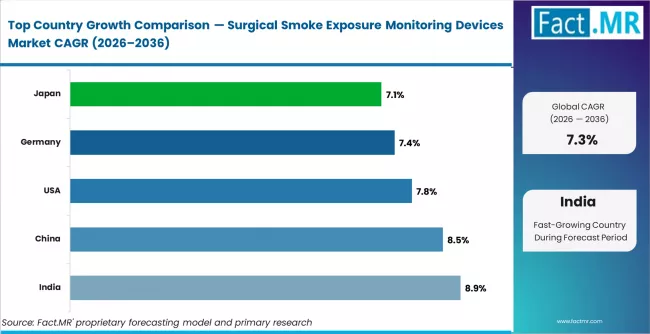
Surgical Smoke Exposure Monitoring Devices Market Cagr Analysis By Country | Source: Fact.MR
Asia Pacific Surgical Smoke Exposure Monitoring Devices Market Analysis
Asia Pacific is the fastest-growing region for surgical smoke monitoring devices. Hospital construction and rising MIS volumes are driving demand. India and China lead first-time procurement. Olympus Corporation and Medtronic lead through strong distributor networks. The region is shifting from basic evacuation to integrated monitoring systems.
- India: Public hospital upgrades are expanding OR safety procurement. Growth is projected at 8.9% CAGR through 2036. National Health Mission funding in 2024 included OR safety equipment. This enabled structured procurement. Apollo Hospitals and Fortis Healthcare expanded MIS capacity in 2024. Private demand is rising for integrated systems. Updated safety standards now reference smoke evacuation. Growth is driven by public and private hospital expansion.
- China: Accreditation-linked compliance is driving adoption. Growth is projected at 8.5% CAGR through 2036. Hospital standards now include OR air quality requirements. This is increasing procurement in Grade III hospitals. Over 400 new surgical facilities were added by 2024. Olympus Corporation expanded its China distribution network in 2025. Demand is driven by public procurement cycles and compliance needs.
- Japan: Guideline updates are formalising smoke monitoring adoption. Growth is projected at 7.1% CAGR through 2036. Occupational health rules now include smoke exposure. Surgical volumes remain high. Olympus Corporation expanded product range in 2024. Demand is driven by replacement cycles and regulatory alignment.
Fact.MR’s analysis of Asia Pacific covers India, China, Japan, South Korea, and ASEAN. Includes procurement trends, regulation timelines, and procedure data.
North America Surgical Smoke Exposure Monitoring Devices Market Analysis
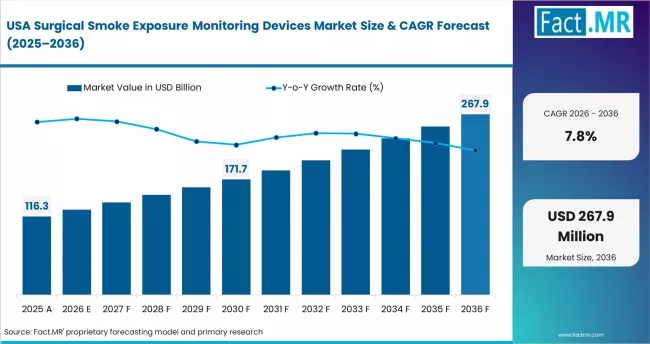
Surgical Smoke Exposure Monitoring Devices Market Country Value Analysis | Source: Fact.MR
North America is the largest value market. It is the global regulatory benchmark. OSHA mandates and state laws drive demand. Medtronic, CONMED Corporation, and Stryker lead through GPO contracts.
- United States: Legislative enforcement is accelerating adoption. Growth is projected at 7.8% CAGR through 2036. Over 17 states enacted smoke evacuation laws by 2025. Monitoring is increasingly mandated. Clinical guidelines were updated in 2024. CONMED Corporation launched updated systems in 2025. Growth is driven by compliance and guideline alignment.
Fact.MR’s analysis of North America covers the United States, Canada, and Mexico. Includes OSHA data, GPO trends, and regulation timelines.
Europe Surgical Smoke Exposure Monitoring Devices Market Analysis
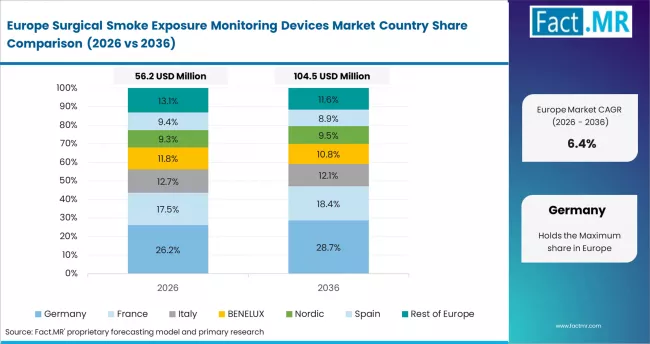
Surgical Smoke Exposure Monitoring Devices Market Europe Country Market Share Analysis, 2026 & 2036 | Source: Fact.MR
Europe is a compliance-led market. Occupational health regulations define procurement. EU-OSHA directives are key drivers. STERIS and Karl Storz support supply with certified systems.
- Germany: Regulatory enforcement is driving procurement cycles. Growth is projected at 7.4% CAGR through 2036. Occupational safety laws include smoke exposure control. Hospital accreditation requires compliance. Clinical recommendations were updated in 2024. STERIS expanded offerings in 2025. Demand is driven by compliance upgrades.
Fact.MR’s analysis of Europe covers Germany, France, the UK, Italy, Spain, and Rest of Europe. Includes EU-OSHA data, procurement benchmarks, and safety adoption trends.
Competitive Aligners for Market Players
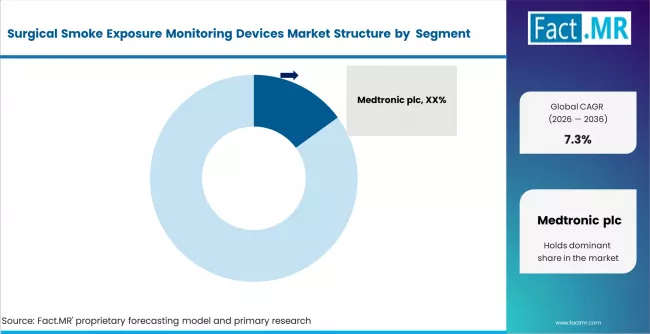
Surgical Smoke Exposure Monitoring Devices Market Analysis By Company | Source: Fact.MR
The surgical smoke exposure monitoring devices market is becoming more structured and compliance-focused, which is changing how companies compete. It is no longer just about selling equipment. Success depends on how well companies can align with hospital safety standards and integrate their solutions into operating room workflows. Leading players such as Medtronic, CONMED Corporation, Stryker, Olympus Corporation, and STERIS have an advantage because they offer complete systems that combine smoke evacuation with real-time monitoring.
What sets these companies apart is their ability to meet regulatory expectations. Hospitals are under pressure to comply with OSHA and EU workplace safety rules. This means buyers prefer suppliers who can provide certified, ready-to-deploy solutions rather than standalone devices. Products that are already validated for safety and performance are more likely to be approved quickly.
Another important factor is how well devices fit into existing surgical setups. Operating rooms are busy and highly standardised environments. Equipment that is easy to use, integrates with current systems, and requires minimal training is more attractive to hospitals. Companies that provide training support and clinical validation data also build stronger relationships with healthcare providers. Smaller or regional players still compete, mainly in basic evacuation systems. However, they often struggle to meet the growing demand for integrated monitoring and compliance documentation. On the buyer side, large hospital groups and purchasing organizations prefer working with a limited number of trusted suppliers. This creates steady demand for established players, while making it harder for new entrants to gain market access.
Key Players
- Medtronic plc
- CONMED Corporation
- Stryker Corporation
- Olympus Corporation
- Johnson & Johnson MedTech
- STERIS plc
Bibliography
- [1] Medtronic plc. Surgical Smoke Management Portfolio Expansion with Real-time Monitoring Integration. 2024. medtronic.com/investor-relations
- [2] CONMED Corporation. Helios Smoke Evacuation Platform Updated Integrated Monitoring Module Launch. January 2025. conmed.com/news
- [3] Association of periOperative Registered Nurses (AORN). Surgical Smoke-Free OR Standard Adoption Survey Report 2024. November 2024. aorn.org
- [4] Stryker Corporation. Neptune Waste Management Platform Smoke Monitoring Integration Update. 2024. stryker.com/investor-relations
- [5] Johnson & Johnson MedTech. Energy Device with Integrated Smoke Sensor Compatibility Launch. 2025. jnjmedtech.com
- [6] American Society for Laser Medicine and Surgery. Cosmetic and Dermatological Laser Procedure Volume Report 2024. 2024. aslms.org
This Report Addresses
- Strategic intelligence on surgical smoke exposure monitoring device demand across hospital OR compliance procurement, ambulatory surgical center safety adoption, and specialty clinic laser procedure monitoring.
- Market forecast from USD 0.2 billion in 2026 to USD 0.5 billion by 2036 at a CAGR of 7.3%.
- Opportunity mapping across India hospital infrastructure expansion, China NHC accreditation-linked OR safety investment, US OSHA state-mandate compliance procurement, Germany EU-OSHA directive enforcement, and Japan MHLW occupational health regulation adoption.
- Segment analysis by product type (integrated systems, filters & sensors, portable units), application (laparoscopic, general surgery, laser/cosmetic), and end user (hospitals, ASCs, specialty clinics).
- Regional outlook covering Asia Pacific hospital construction-led first procurement, North America OSHA and legislative mandate compliance, and Europe EU-OSHA directive-driven OR safety device adoption.
- Competitive analysis of Medtronic, CONMED Corporation, Stryker, Olympus, Johnson & Johnson, and STERIS. Focus on GPO contract positioning, monitoring integration capability, and compliance documentation strategy.
- Regulatory impact analysis covering OSHA surgical smoke safety guidance updates, EU-OSHA Framework Directive enforcement, AORN practice guideline revisions, and MHLW Japan occupational health standard updates for OR environments.
- Report delivered in PDF, Excel datasets, and presentation formats. Supported by primary interviews, hospital procurement data, OSHA enforcement statistics, and OR safety association survey benchmarks.
Market Definition
The market covers devices used to monitor airborne surgical smoke exposure in operating rooms, including real-time particulate sensors, integrated evacuation-monitoring systems, ULPA filter-based units, and portable monitoring-enabled evacuation devices.
Surgical Smoke Exposure Monitoring Devices Market Inclusions
Covers global and regional forecasts from 2026 to 2036. Includes product type, application, and end-user segment breakdowns. Covers hospitals, ambulatory surgical centers, and specialty clinics. Includes OSHA and EU regulatory compliance data, device certification, and hospital procurement trends.
Surgical Smoke Exposure Monitoring Devices Market Exclusions
Excludes standalone smoke evacuation systems without integrated monitoring capability. Omits personal protective equipment and surgical masks used as passive smoke barriers. Also excludes general OR air filtration and HVAC systems not designed specifically for surgical smoke plume detection and monitoring.
Surgical Smoke Exposure Monitoring Devices Market Research Methodology
- Primary Research
- Interviews with OR safety managers, surgical procurement directors, infection control specialists, and occupational health officers across key hospital and ambulatory surgical markets.
- Desk Research
- Uses OSHA surgical smoke safety guidance, EU-OSHA framework directive reports, AORN practice guidelines, and company disclosures from Medtronic, CONMED, and Stryker (2024–2025).
- Market-Sizing and Forecasting
- Hybrid model using hospital procedure volume data, device penetration rates by product type, average selling prices by system configuration, and compliance-driven procurement cycle benchmarks.
- Data Validation and Update Cycle
- Validated using hospital procurement data, OSHA enforcement statistics, and AORN membership survey data. Cross-checked with expert interviews. Updated annually.
Segmentation
Scope of Report
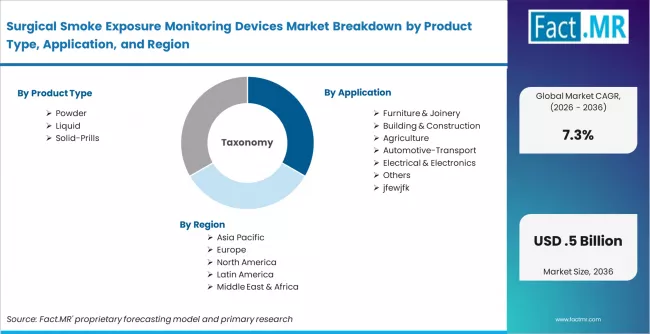
Surgical Smoke Exposure Monitoring Devices Market Breakdown By Product Type, Application, And Region | Source: Fact.MR
| Attribute | Details |
|---|---|
| Quantitative Units | USD 0.22 billion (2026) to USD 0.45 billion (2036), at a CAGR of 7.3% |
| Market Definition | Real-time surgical smoke exposure monitoring devices including integrated evacuation-monitoring systems, ULPA filter-based sensor units, and portable monitoring-enabled devices used in hospital OR, ASC, and specialty clinic settings globally. |
| Product Type Segmentation | Smoke Evacuation Systems with Integrated Monitoring, Filters & Sensors, Portable Monitoring-enabled Units |
| Application Segmentation | Laparoscopic & Minimally Invasive Surgeries, General Surgery, Cosmetic & Laser Procedures |
| End User Segmentation | Hospitals, Ambulatory Surgical Centers, Specialty Clinics |
| Application Coverage | Electrosurgery plume monitoring in laparoscopic suites, laser procedure smoke detection in cosmetic and dermatology clinics, general surgery OR air quality compliance, and ambulatory center real-time exposure monitoring. |
| Regions Covered | North America, Europe, Asia Pacific, Latin America, Middle East and Africa |
| Countries Covered | USA, Canada, Mexico, Germany, UK, France, Italy, Spain, Nordic, BENELUX, China, Japan, South Korea, India, ASEAN, Australia and New Zealand, Brazil, Argentina, Saudi Arabia, GCC, Turkey, South Africa, Rest of MEA |
| Key Companies Profiled | Medtronic, CONMED Corporation, Stryker, Olympus Corporation, Johnson & Johnson, STERIS |
| Forecast Period | 2026 to 2036 |
| Approach | Hybrid top-down and bottom-up model using hospital procedure volumes by OR type, smoke monitoring device penetration rates, average selling prices by system configuration, OSHA and EU-OSHA compliance mandate timelines, and primary interviews with OR safety managers and surgical procurement directors. |
Source: Fact.MR analysis. Updated Apr 22, 2026
Surgical Smoke Exposure Monitoring Devices Market by Segments
-
By Product Type:
- Smoke Evacuation Systems with Integrated Monitoring
- Filters & Sensors
- Portable Monitoring-enabled Units
-
By Application:
- Laparoscopic & Minimally Invasive Surgeries
- General Surgery
- Cosmetic & Laser Procedures
-
By End User:
- Hospitals
- Ambulatory Surgical Centers
- Specialty Clinics
-
By Region:
- North America
- United States
- Canada
- Mexico
- Latin America
- Brazil
- Mexico
- Argentina
- Chile
- Rest of Latin America
- Western Europe
- Germany
- United Kingdom
- France
- Italy
- Spain
- Nordic Countries
- BENELUX
- Rest of Western Europe
- Eastern Europe
- Russia
- Poland
- Hungary
- Balkan and Baltic
- Rest of Eastern Europe
- East Asia
- China
- Japan
- South Korea
- South Asia and Pacific
- India
- ASEAN
- Australia and New Zealand
- Rest of South Asia and Pacific
- Middle East and Africa
- Kingdom of Saudi Arabia
- Other GCC Countries
- Turkey
- South Africa
- Rest of Middle East and Africa
- North America
Frequently Asked Questions
How large is the global surgical smoke exposure monitoring devices market in 2025?
What will the market size be in 2026?
What is the projected market size by 2036?
What is the expected CAGR from 2026 to 2036?
Which product type segment is poised to lead the market?
Which application segment holds the largest share?
Which end-user segment dominates?
Which country shows the fastest growth?
What is driving demand for surgical smoke monitoring devices?
What is the key challenge in this market?
Who worked on this report


Preview the report firsthand - request a free sample
Free SampleGet the brochure for pricing and purchase details
Download PDF