Targeted Oncology Biologics Market

Targeted Oncology Biologics Market Size and Share Forecast Outlook 2026 to 2036

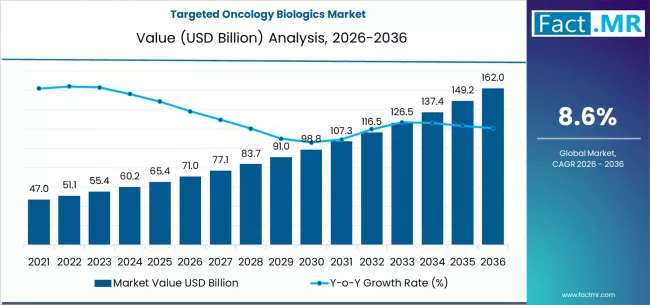
Targeted oncology biologics market is projected to grow from USD 71.0 billion in 2026 to USD 162.0 billion by 2036, at a CAGR of 8.6%. Monoclonal antibodies will dominate with a 43.7% market share, while breast cancer will lead the application segment with a 26.6% share.

Targeted Oncology Biologics Market Forecast and Outlook 2026 to 2036

The global targeted oncology biologics market is projected to grow from USD 71.01 billion in 2026 to USD 162.04 billion by 2036, progressing at a CAGR of 8.6%. This robust expansion is fueled by the deepening integration of precision medicine and the continuous development of novel, high-efficacy therapeutic modalities.

Key Takeaways from the Targeted Oncology Biologics Market

  • Market Value for 2026: USD 71.01 Billion
  • Market Value for 2036: USD 162.04 Billion
  • Forecast CAGR 2026 to 2036: 8.6%
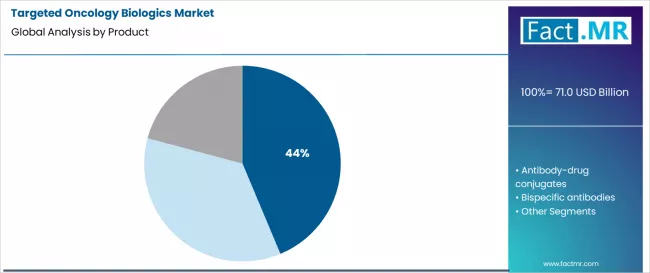
  • Leading Product Segment (2026): Monoclonal Antibodies (43.7%)
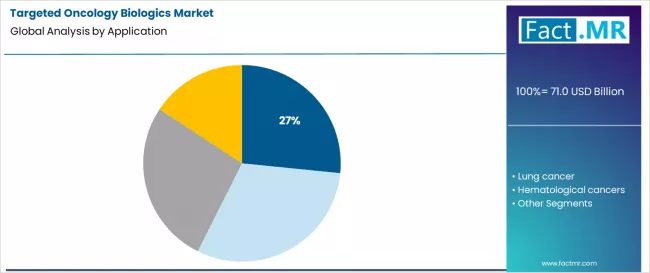
  • Leading Application Segment (2026): Breast Cancer (26.6%)
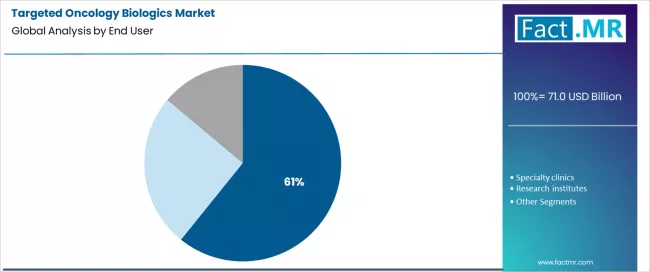
  • Leading End-User Segment (2026): Hospital Oncology Centers (60.8%)
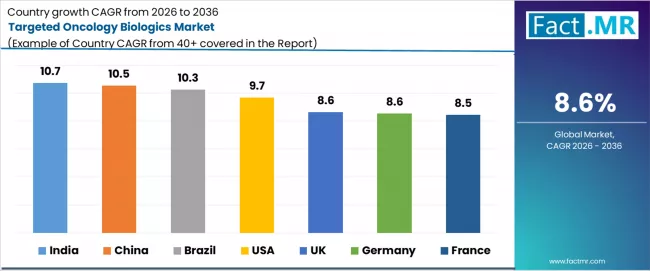
  • Key Growth Countries: India (10.7% CAGR), China (10.5% CAGR), Brazil (10.3% CAGR), USA (9.7% CAGR), Germany (8.6% CAGR), UK (8.6% CAGR), France (8.5% CAGR)
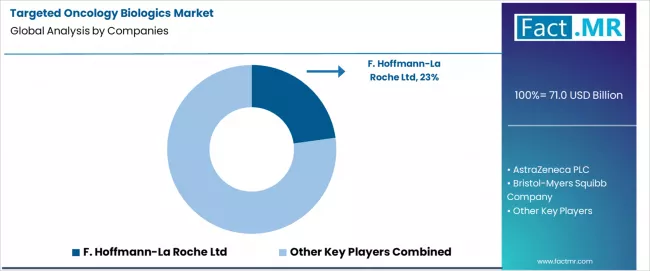
  • Key Players in the Market: F. Hoffmann-La Roche Ltd, AstraZeneca PLC, Bristol-Myers Squibb Company, Pfizer Inc., Amgen Inc.

Targeted Oncology Biologics Market Market Value Analysis

Monoclonal antibodies form the largest product segment, commanding a 43.7% share. Breast cancer represents the leading application at 26.6%, with the majority of therapies administered through hospital oncology centers, accounting for 60.8% of distribution.

Geographic growth is led by India at a 10.7% CAGR, followed by China at 10.5%, Brazil at 10.3%, and the USA at 9.7%. European markets show strong growth between 8.5% and 8.6%. The competitive landscape is consolidated, with key players including Roche, AstraZeneca, Bristol-Myers Squibb, Pfizer, and Amgen.

The market's trajectory is defined by the evolution from first-generation antibodies to sophisticated engineered constructs like antibody-drug conjugates and bispecific antibodies, offering improved targeting and efficacy.

Metric

Metric Value
Market Value (2026) USD 71.01 Billion
Market Forecast Value (2036) USD 162.04 Billion
Forecast CAGR 2026 to 2036 8.6%

Category

Category Segments
Product Monoclonal Antibodies, Antibody-Drug Conjugates, Bispecific Antibodies
Application Breast Cancer, Lung Cancer, Hematological Cancers, Others
End User Hospital Oncology Centers, Specialty Clinics, Research Institutes
Region North America, Latin America, Western Europe, Eastern Europe, East Asia, South Asia & Pacific, Middle East & Africa

Segmental Analysis

By Product, Which Segment Remains the Cornerstone of Targeted Biologic Therapy?

Targeted Oncology Biologics Market Analysis By Product

Monoclonal antibodies command a dominant 43.7% share. This segment remains the foundational pillar due to its well-established mechanisms, including checkpoint inhibition and receptor blockade.

Their first-mover advantage, extensive clinical validation across numerous cancer types, and continuous innovation through Fc-engineering and new target discovery ensure sustained dominance, even as next-generation formats emerge.

By Application, Which High-Prevalence Cancer Drives Significant Biologic Innovation?

Targeted Oncology Biologics Market Analysis By Application

Breast cancer constitutes the leading application segment at 26.6%. The disease's high global incidence and significant molecular heterogeneity have made it a primary focus for targeted biologic development.

The success of antibodies and ADCs against targets like HER2 has created a robust treatment paradigm and a large, addressable patient population, ensuring continued investment and volume demand.

By End User, Which Setting is Essential for Administering Complex Biologic Regimens?

Targeted Oncology Biologics Market Analysis By End User

Hospital oncology centers form the overwhelming end-user segment at 60.8%. The administration of most targeted biologics, particularly intravenous infusions and complex therapies like ADCs, requires specialized nursing, acute monitoring for infusion reactions, and management of unique toxicities. This centralized setting controls the primary channel for these high-cost, specialty pharmaceuticals.

What are the Principal Drivers, Constraints, and Evolving Dynamics of this Market?

The principal driver is the relentless clinical validation of precision medicine, where therapies targeting specific molecular alterations yield superior outcomes over traditional chemotherapy, justifying premium pricing.

A major constraint is the extraordinary cost of therapy, creating severe access disparities and straining global healthcare budgets. A significant opportunity lies in expanding the utility of existing biologics through new combination regimens and label extensions into earlier lines of therapy or adjuvant settings.

The dominant trend is the rapid advancement towards next-generation engineered constructs, particularly bispecific antibodies and antibody-drug conjugates, which offer enhanced tumor targeting, novel mechanisms of action, and potential to overcome resistance to earlier-generation biologics.

Analysis of the Targeted Oncology Biologics Market by Key Countries

Targeted Oncology Biologics Market Cagr Analysis By Country

Country CAGR 2026 to 2036
India 10.7%
China 10.5%
Brazil 10.3%
USA 9.7%
Germany 8.6%
UK 8.6%
France 8.5%

Is the USA's Market Synonymous with Premium Innovation and Rapid Novel Therapy Uptake?

A reimbursement environment that supports premium pricing for innovative biologics with demonstrable clinical benefits drives the USA’s 9.7% CAGR. Growth is characterized by the rapid adoption of newly approved ADCs and bispecific antibodies within hospital oncology centers, with market dynamics heavily influenced by payer negotiations, physician preference, and comprehensive patient support services offered by manufacturers.

Can Brazil's Public Health System Forge a Path for High-Cost Biologic Accessibility?

Brazil’s 10.3% CAGR is challenged by the imperative to integrate extremely high-cost biologics into its public Unified Health System (SUS). Growth is contingent on successful government price negotiations and health technology assessments that demonstrate value. Market expansion often follows a staged pattern, with initial access in the private sector preceding gradual incorporation into public treatment protocols for high-burden cancers.

Does China's Domestic Biologics Pipeline Redefine Market Competition and Access?

China’s 10.5% CAGR is fueled by explosive growth in its domestic biopharmaceutical sector. The market is being reshaped by the launch of home-grown checkpoint inhibitors, ADCs, and biosimilars, which increase competition and pressure prices. Concurrent expansion of national reimbursement for innovative therapies is dramatically improving patient access and driving volume growth in major urban cancer centers.

Will India's Growth be Catalyzed by Biosimilar Penetration and Improving Diagnostic Infrastructure?

India’s leading 10.7% CAGR is propelled by the widespread availability and adoption of biosimilar versions of key monoclonal antibodies. This significantly lowers treatment costs and expands access.

Growth is further accelerated by the improving molecular diagnostic infrastructure in private hospitals, enabling patient identification for targeted therapies and moving oncology care beyond empirical treatment.

Is Germany's Guideline-Driven System Optimizing the Sequencing of Biologic Therapies?

Germany’s 8.6% CAGR operates within a highly structured, guideline-driven framework. Adoption of new targeted biologics is methodical, based on robust clinical data and assessments by the Institute for Quality and Efficiency in Health Care (IQWiG). The market focuses on defining optimal treatment sequences and integrating new agents into established care pathways within hospital-based oncology networks.

Does France's Emphasis on Real-World Effectiveness Shape a Cautious Adoption Curve?

France’s 8.5% CAGR is influenced by a requirement for post-launch real-world evidence to confirm the effectiveness and safety observed in clinical trials. This can moderate initial uptake speeds as the market awaits data from French registries. Growth is steady, with the Haute Autorité de Santé’s assessments ensuring that new biologics offer tangible therapeutic advantage before securing broad reimbursement.

Is the UK's Cost-Effectiveness Hurdle the Defining Factor for Biologic Market Entry?

The UK’s 8.6% CAGR is fundamentally governed by stringent cost-effectiveness evaluations from the National Institute for Health and Care Excellence (NICE). Market growth for new, high-cost biologics is dependent on demonstrating sufficient quality-adjusted life year (QALY) gains to justify their price within the NHS budget. This often leads to patient access schemes or restricted use, shaping a market focused on proven value.

Competitive Landscape of the Targeted Oncology Biologics Market

Targeted Oncology Biologics Market Analysis By Company

The competitive landscape is intensely focused on innovation, with companies vying to develop the next breakthrough in antibody engineering. Leaders compete by building deep pipelines in high-potential modalities like ADCs and bispecifics, often leveraging proprietary conjugation or platform technologies. The race to identify novel tumor-specific targets and to combine biologics effectively with other treatment modalities forms the core of R&D strategy.

Success is increasingly dependent on owning complementary diagnostics to identify responsive patient populations, thereby maximizing clinical success and commercial value. Strategic collaborations between large pharmaceutical firms and agile biotechnology companies are commonplace to access novel technologies. Establishing dominance in specific therapeutic areas, such as hematology or breast cancer, through a portfolio of related biologics creates powerful market positioning and deep clinical expertise.

Key Players in the Targeted Oncology Biologics Market

  • F. Hoffmann-La Roche Ltd
  • AstraZeneca PLC
  • Bristol-Myers Squibb Company
  • Pfizer Inc.
  • Amgen Inc.
  • Others

Scope of Report

Items Metrics
Quantitative Units USD Billion
Product Monoclonal Antibodies, Antibody-Drug Conjugates, Bispecific Antibodies
Application Breast Cancer, Lung Cancer, Hematological Cancers, Others
End User Hospital Oncology Centers, Specialty Clinics, Research Institutes
Key Countries India, China, Brazil, USA, Germany, France, UK
Key Companies Roche, AstraZeneca, Bristol-Myers Squibb, Pfizer, Amgen, Others
Additional Analysis Comparative analysis of ADC linker-payload technologies; impact of biomarker testing rates on biologic adoption; pharmacoeconomic models for novel biologics in different healthcare systems; analysis of resistance mechanisms to targeted biologics and next-generation solutions.

Market by Segments

  • Product :

    • Monoclonal Antibodies
    • Antibody-Drug Conjugates
    • Bispecific Antibodies
  • Application :

    • Breast Cancer
    • Lung Cancer
    • Hematological Cancers
    • Others
  • End User :

    • Hospital Oncology Centers
    • Specialty Clinics
    • Research Institutes
  • Region :

    • North America
      • USA
      • Canada
    • Latin America
      • Brazil
      • Mexico
      • Argentina
      • Rest of Latin America
    • Western Europe
      • Germany
      • France
      • UK
      • Italy
      • Spain
      • BENELUX
      • Rest of Western Europe
    • Eastern Europe
      • Russia
      • Poland
      • Czech Republic
      • Rest of Eastern Europe
    • East Asia
      • China
      • Japan
      • South Korea
      • Rest of East Asia
    • South Asia & Pacific
      • India
      • ASEAN
      • Australia
      • Rest of South Asia & Pacific
    • MEA
      • GCC Countries
      • South Africa
      • Turkiye
      • Rest of MEA

References

  • American Society of Clinical Oncology (ASCO). (2025). Annual Report on the Clinical Application of Targeted Biologics in Oncology.
  • European Society for Medical Oncology (ESMO). (2024). Guidelines for the Use of Antibody-Drug Conjugates and Bispecific Antibodies.
  • National Comprehensive Cancer Network (NCCN). (2025). NCCN Clinical Practice Guidelines in Oncology.
  • The Lancet Oncology. (2024). Series on the Next Generation of Cancer Biologics.

Table of Content

  1. Executive Summary
    • Global Market Outlook
    • Demand to side Trends
    • Supply to side Trends
    • Technology Roadmap Analysis
    • Analysis and Recommendations
  2. Market Overview
    • Market Coverage / Taxonomy
    • Market Definition / Scope / Limitations
  3. Market Background
    • Market Dynamics
      • Drivers
      • Restraints
      • Opportunity
      • Trends
    • Scenario Forecast
      • Demand in Optimistic Scenario
      • Demand in Likely Scenario
      • Demand in Conservative Scenario
    • Opportunity Map Analysis
    • Product Life Cycle Analysis
    • Supply Chain Analysis
    • Investment Feasibility Matrix
    • Value Chain Analysis
    • PESTLE and Porter’s Analysis
    • Regulatory Landscape
    • Regional Parent Market Outlook
    • Production and Consumption Statistics
    • Import and Export Statistics
  4. Global Market Analysis 2021 to 2025 and Forecast, 2026 to 2036
    • Historical Market Size Value (USD Million) Analysis, 2021 to 2025
    • Current and Future Market Size Value (USD Million) Projections, 2026 to 2036
      • Y to o to Y Growth Trend Analysis
      • Absolute $ Opportunity Analysis
  5. Global Market Pricing Analysis 2021 to 2025 and Forecast 2026 to 2036
  6. Global Market Analysis 2021 to 2025 and Forecast 2026 to 2036, By Product
    • Introduction / Key Findings
    • Historical Market Size Value (USD Million) Analysis By Product, 2021 to 2025
    • Current and Future Market Size Value (USD Million) Analysis and Forecast By Product, 2026 to 2036
      • Monoclonal antibodies
      • Antibody-drug conjugates
      • Bispecific antibodies
    • Y to o to Y Growth Trend Analysis By Product, 2021 to 2025
    • Absolute $ Opportunity Analysis By Product, 2026 to 2036
  7. Global Market Analysis 2021 to 2025 and Forecast 2026 to 2036, By Application
    • Introduction / Key Findings
    • Historical Market Size Value (USD Million) Analysis By Application, 2021 to 2025
    • Current and Future Market Size Value (USD Million) Analysis and Forecast By Application, 2026 to 2036
      • Breast cancer
      • Lung cancer
      • Hematological cancers
      • Others
    • Y to o to Y Growth Trend Analysis By Application, 2021 to 2025
    • Absolute $ Opportunity Analysis By Application, 2026 to 2036
  8. Global Market Analysis 2021 to 2025 and Forecast 2026 to 2036, By End User
    • Introduction / Key Findings
    • Historical Market Size Value (USD Million) Analysis By End User, 2021 to 2025
    • Current and Future Market Size Value (USD Million) Analysis and Forecast By End User, 2026 to 2036
      • Hospital oncology centers
      • Specialty clinics
      • Research institutes
    • Y to o to Y Growth Trend Analysis By End User, 2021 to 2025
    • Absolute $ Opportunity Analysis By End User, 2026 to 2036
  9. Global Market Analysis 2021 to 2025 and Forecast 2026 to 2036, By Region
    • Introduction
    • Historical Market Size Value (USD Million) Analysis By Region, 2021 to 2025
    • Current Market Size Value (USD Million) Analysis and Forecast By Region, 2026 to 2036
      • North America
      • Latin America
      • Western Europe
      • Eastern Europe
      • East Asia
      • South Asia and Pacific
      • Middle East & Africa
    • Market Attractiveness Analysis By Region
  10. North America Market Analysis 2021 to 2025 and Forecast 2026 to 2036, By Country
    • Historical Market Size Value (USD Million) Trend Analysis By Market Taxonomy, 2021 to 2025
    • Market Size Value (USD Million) Forecast By Market Taxonomy, 2026 to 2036
      • By Country
        • USA
        • Canada
        • Mexico
      • By Product
      • By Application
      • By End User
    • Market Attractiveness Analysis
      • By Country
      • By Product
      • By Application
      • By End User
    • Key Takeaways
  11. Latin America Market Analysis 2021 to 2025 and Forecast 2026 to 2036, By Country
    • Historical Market Size Value (USD Million) Trend Analysis By Market Taxonomy, 2021 to 2025
    • Market Size Value (USD Million) Forecast By Market Taxonomy, 2026 to 2036
      • By Country
        • Brazil
        • Chile
        • Rest of Latin America
      • By Product
      • By Application
      • By End User
    • Market Attractiveness Analysis
      • By Country
      • By Product
      • By Application
      • By End User
    • Key Takeaways
  12. Western Europe Market Analysis 2021 to 2025 and Forecast 2026 to 2036, By Country
    • Historical Market Size Value (USD Million) Trend Analysis By Market Taxonomy, 2021 to 2025
    • Market Size Value (USD Million) Forecast By Market Taxonomy, 2026 to 2036
      • By Country
        • Germany
        • UK
        • Italy
        • Spain
        • France
        • Nordic
        • BENELUX
        • Rest of Western Europe
      • By Product
      • By Application
      • By End User
    • Market Attractiveness Analysis
      • By Country
      • By Product
      • By Application
      • By End User
    • Key Takeaways
  13. Eastern Europe Market Analysis 2021 to 2025 and Forecast 2026 to 2036, By Country
    • Historical Market Size Value (USD Million) Trend Analysis By Market Taxonomy, 2021 to 2025
    • Market Size Value (USD Million) Forecast By Market Taxonomy, 2026 to 2036
      • By Country
        • Russia
        • Poland
        • Hungary
        • Balkan & Baltic
        • Rest of Eastern Europe
      • By Product
      • By Application
      • By End User
    • Market Attractiveness Analysis
      • By Country
      • By Product
      • By Application
      • By End User
    • Key Takeaways
  14. East Asia Market Analysis 2021 to 2025 and Forecast 2026 to 2036, By Country
    • Historical Market Size Value (USD Million) Trend Analysis By Market Taxonomy, 2021 to 2025
    • Market Size Value (USD Million) Forecast By Market Taxonomy, 2026 to 2036
      • By Country
        • China
        • Japan
        • South Korea
      • By Product
      • By Application
      • By End User
    • Market Attractiveness Analysis
      • By Country
      • By Product
      • By Application
      • By End User
    • Key Takeaways
  15. South Asia and Pacific Market Analysis 2021 to 2025 and Forecast 2026 to 2036, By Country
    • Historical Market Size Value (USD Million) Trend Analysis By Market Taxonomy, 2021 to 2025
    • Market Size Value (USD Million) Forecast By Market Taxonomy, 2026 to 2036
      • By Country
        • India
        • ASEAN
        • Australia & New Zealand
        • Rest of South Asia and Pacific
      • By Product
      • By Application
      • By End User
    • Market Attractiveness Analysis
      • By Country
      • By Product
      • By Application
      • By End User
    • Key Takeaways
  16. Middle East & Africa Market Analysis 2021 to 2025 and Forecast 2026 to 2036, By Country
    • Historical Market Size Value (USD Million) Trend Analysis By Market Taxonomy, 2021 to 2025
    • Market Size Value (USD Million) Forecast By Market Taxonomy, 2026 to 2036
      • By Country
        • Kingdom of Saudi Arabia
        • Other GCC Countries
        • Turkiye
        • South Africa
        • Other African Union
        • Rest of Middle East & Africa
      • By Product
      • By Application
      • By End User
    • Market Attractiveness Analysis
      • By Country
      • By Product
      • By Application
      • By End User
    • Key Takeaways
  17. Key Countries Market Analysis
    • USA
      • Pricing Analysis
      • Market Share Analysis, 2025
        • By Product
        • By Application
        • By End User
    • Canada
      • Pricing Analysis
      • Market Share Analysis, 2025
        • By Product
        • By Application
        • By End User
    • Mexico
      • Pricing Analysis
      • Market Share Analysis, 2025
        • By Product
        • By Application
        • By End User
    • Brazil
      • Pricing Analysis
      • Market Share Analysis, 2025
        • By Product
        • By Application
        • By End User
    • Chile
      • Pricing Analysis
      • Market Share Analysis, 2025
        • By Product
        • By Application
        • By End User
    • Germany
      • Pricing Analysis
      • Market Share Analysis, 2025
        • By Product
        • By Application
        • By End User
    • UK
      • Pricing Analysis
      • Market Share Analysis, 2025
        • By Product
        • By Application
        • By End User
    • Italy
      • Pricing Analysis
      • Market Share Analysis, 2025
        • By Product
        • By Application
        • By End User
    • Spain
      • Pricing Analysis
      • Market Share Analysis, 2025
        • By Product
        • By Application
        • By End User
    • France
      • Pricing Analysis
      • Market Share Analysis, 2025
        • By Product
        • By Application
        • By End User
    • India
      • Pricing Analysis
      • Market Share Analysis, 2025
        • By Product
        • By Application
        • By End User
    • ASEAN
      • Pricing Analysis
      • Market Share Analysis, 2025
        • By Product
        • By Application
        • By End User
    • Australia & New Zealand
      • Pricing Analysis
      • Market Share Analysis, 2025
        • By Product
        • By Application
        • By End User
    • China
      • Pricing Analysis
      • Market Share Analysis, 2025
        • By Product
        • By Application
        • By End User
    • Japan
      • Pricing Analysis
      • Market Share Analysis, 2025
        • By Product
        • By Application
        • By End User
    • South Korea
      • Pricing Analysis
      • Market Share Analysis, 2025
        • By Product
        • By Application
        • By End User
    • Russia
      • Pricing Analysis
      • Market Share Analysis, 2025
        • By Product
        • By Application
        • By End User
    • Poland
      • Pricing Analysis
      • Market Share Analysis, 2025
        • By Product
        • By Application
        • By End User
    • Hungary
      • Pricing Analysis
      • Market Share Analysis, 2025
        • By Product
        • By Application
        • By End User
    • Kingdom of Saudi Arabia
      • Pricing Analysis
      • Market Share Analysis, 2025
        • By Product
        • By Application
        • By End User
    • Turkiye
      • Pricing Analysis
      • Market Share Analysis, 2025
        • By Product
        • By Application
        • By End User
    • South Africa
      • Pricing Analysis
      • Market Share Analysis, 2025
        • By Product
        • By Application
        • By End User
  18. Market Structure Analysis
    • Competition Dashboard
    • Competition Benchmarking
    • Market Share Analysis of Top Players
      • By Regional
      • By Product
      • By Application
      • By End User
  19. Competition Analysis
    • Competition Deep Dive
      • F. Hoffmann-La Roche Ltd
        • Overview
        • Product Portfolio
        • Profitability by Market Segments (Product/Age /Sales Channel/Region)
        • Sales Footprint
        • Strategy Overview
          • Marketing Strategy
          • Product Strategy
          • Channel Strategy
      • AstraZeneca PLC
      • Bristol-Myers Squibb Company
      • Pfizer Inc.
      • Amgen Inc.
      • Others
  20. Assumptions & Acronyms Used
  21. Research Methodology

List Of Table

  • Table 1: Global Market Value (USD Million) Forecast by Region, 2021 to 2036
  • Table 2: Global Market Value (USD Million) Forecast by Product, 2021 to 2036
  • Table 3: Global Market Value (USD Million) Forecast by Application, 2021 to 2036
  • Table 4: Global Market Value (USD Million) Forecast by End User, 2021 to 2036
  • Table 5: North America Market Value (USD Million) Forecast by Country, 2021 to 2036
  • Table 6: North America Market Value (USD Million) Forecast by Product, 2021 to 2036
  • Table 7: North America Market Value (USD Million) Forecast by Application, 2021 to 2036
  • Table 8: North America Market Value (USD Million) Forecast by End User, 2021 to 2036
  • Table 9: Latin America Market Value (USD Million) Forecast by Country, 2021 to 2036
  • Table 10: Latin America Market Value (USD Million) Forecast by Product, 2021 to 2036
  • Table 11: Latin America Market Value (USD Million) Forecast by Application, 2021 to 2036
  • Table 12: Latin America Market Value (USD Million) Forecast by End User, 2021 to 2036
  • Table 13: Western Europe Market Value (USD Million) Forecast by Country, 2021 to 2036
  • Table 14: Western Europe Market Value (USD Million) Forecast by Product, 2021 to 2036
  • Table 15: Western Europe Market Value (USD Million) Forecast by Application, 2021 to 2036
  • Table 16: Western Europe Market Value (USD Million) Forecast by End User, 2021 to 2036
  • Table 17: Eastern Europe Market Value (USD Million) Forecast by Country, 2021 to 2036
  • Table 18: Eastern Europe Market Value (USD Million) Forecast by Product, 2021 to 2036
  • Table 19: Eastern Europe Market Value (USD Million) Forecast by Application, 2021 to 2036
  • Table 20: Eastern Europe Market Value (USD Million) Forecast by End User, 2021 to 2036
  • Table 21: East Asia Market Value (USD Million) Forecast by Country, 2021 to 2036
  • Table 22: East Asia Market Value (USD Million) Forecast by Product, 2021 to 2036
  • Table 23: East Asia Market Value (USD Million) Forecast by Application, 2021 to 2036
  • Table 24: East Asia Market Value (USD Million) Forecast by End User, 2021 to 2036
  • Table 25: South Asia and Pacific Market Value (USD Million) Forecast by Country, 2021 to 2036
  • Table 26: South Asia and Pacific Market Value (USD Million) Forecast by Product, 2021 to 2036
  • Table 27: South Asia and Pacific Market Value (USD Million) Forecast by Application, 2021 to 2036
  • Table 28: South Asia and Pacific Market Value (USD Million) Forecast by End User, 2021 to 2036
  • Table 29: Middle East & Africa Market Value (USD Million) Forecast by Country, 2021 to 2036
  • Table 30: Middle East & Africa Market Value (USD Million) Forecast by Product, 2021 to 2036
  • Table 31: Middle East & Africa Market Value (USD Million) Forecast by Application, 2021 to 2036
  • Table 32: Middle East & Africa Market Value (USD Million) Forecast by End User, 2021 to 2036

List Of Figures

  • Figure 1: Global Market Pricing Analysis
  • Figure 2: Global Market Value (USD Million) Forecast 2021 to 2036
  • Figure 3: Global Market Value Share and BPS Analysis by Product, 2026 and 2036
  • Figure 4: Global Market Y to o to Y Growth Comparison by Product, 2026 to 2036
  • Figure 5: Global Market Attractiveness Analysis by Product
  • Figure 6: Global Market Value Share and BPS Analysis by Application, 2026 and 2036
  • Figure 7: Global Market Y to o to Y Growth Comparison by Application, 2026 to 2036
  • Figure 8: Global Market Attractiveness Analysis by Application
  • Figure 9: Global Market Value Share and BPS Analysis by End User, 2026 and 2036
  • Figure 10: Global Market Y to o to Y Growth Comparison by End User, 2026 to 2036
  • Figure 11: Global Market Attractiveness Analysis by End User
  • Figure 12: Global Market Value (USD Million) Share and BPS Analysis by Region, 2026 and 2036
  • Figure 13: Global Market Y to o to Y Growth Comparison by Region, 2026 to 2036
  • Figure 14: Global Market Attractiveness Analysis by Region
  • Figure 15: North America Market Incremental Dollar Opportunity, 2026 to 2036
  • Figure 16: Latin America Market Incremental Dollar Opportunity, 2026 to 2036
  • Figure 17: Western Europe Market Incremental Dollar Opportunity, 2026 to 2036
  • Figure 18: Eastern Europe Market Incremental Dollar Opportunity, 2026 to 2036
  • Figure 19: East Asia Market Incremental Dollar Opportunity, 2026 to 2036
  • Figure 20: South Asia and Pacific Market Incremental Dollar Opportunity, 2026 to 2036
  • Figure 21: Middle East & Africa Market Incremental Dollar Opportunity, 2026 to 2036
  • Figure 22: North America Market Value Share and BPS Analysis by Country, 2026 and 2036
  • Figure 23: North America Market Value Share and BPS Analysis by Product, 2026 and 2036
  • Figure 24: North America Market Y to o to Y Growth Comparison by Product, 2026 to 2036
  • Figure 25: North America Market Attractiveness Analysis by Product
  • Figure 26: North America Market Value Share and BPS Analysis by Application, 2026 and 2036
  • Figure 27: North America Market Y to o to Y Growth Comparison by Application, 2026 to 2036
  • Figure 28: North America Market Attractiveness Analysis by Application
  • Figure 29: North America Market Value Share and BPS Analysis by End User, 2026 and 2036
  • Figure 30: North America Market Y to o to Y Growth Comparison by End User, 2026 to 2036
  • Figure 31: North America Market Attractiveness Analysis by End User
  • Figure 32: Latin America Market Value Share and BPS Analysis by Country, 2026 and 2036
  • Figure 33: Latin America Market Value Share and BPS Analysis by Product, 2026 and 2036
  • Figure 34: Latin America Market Y to o to Y Growth Comparison by Product, 2026 to 2036
  • Figure 35: Latin America Market Attractiveness Analysis by Product
  • Figure 36: Latin America Market Value Share and BPS Analysis by Application, 2026 and 2036
  • Figure 37: Latin America Market Y to o to Y Growth Comparison by Application, 2026 to 2036
  • Figure 38: Latin America Market Attractiveness Analysis by Application
  • Figure 39: Latin America Market Value Share and BPS Analysis by End User, 2026 and 2036
  • Figure 40: Latin America Market Y to o to Y Growth Comparison by End User, 2026 to 2036
  • Figure 41: Latin America Market Attractiveness Analysis by End User
  • Figure 42: Western Europe Market Value Share and BPS Analysis by Country, 2026 and 2036
  • Figure 43: Western Europe Market Value Share and BPS Analysis by Product, 2026 and 2036
  • Figure 44: Western Europe Market Y to o to Y Growth Comparison by Product, 2026 to 2036
  • Figure 45: Western Europe Market Attractiveness Analysis by Product
  • Figure 46: Western Europe Market Value Share and BPS Analysis by Application, 2026 and 2036
  • Figure 47: Western Europe Market Y to o to Y Growth Comparison by Application, 2026 to 2036
  • Figure 48: Western Europe Market Attractiveness Analysis by Application
  • Figure 49: Western Europe Market Value Share and BPS Analysis by End User, 2026 and 2036
  • Figure 50: Western Europe Market Y to o to Y Growth Comparison by End User, 2026 to 2036
  • Figure 51: Western Europe Market Attractiveness Analysis by End User
  • Figure 52: Eastern Europe Market Value Share and BPS Analysis by Country, 2026 and 2036
  • Figure 53: Eastern Europe Market Value Share and BPS Analysis by Product, 2026 and 2036
  • Figure 54: Eastern Europe Market Y to o to Y Growth Comparison by Product, 2026 to 2036
  • Figure 55: Eastern Europe Market Attractiveness Analysis by Product
  • Figure 56: Eastern Europe Market Value Share and BPS Analysis by Application, 2026 and 2036
  • Figure 57: Eastern Europe Market Y to o to Y Growth Comparison by Application, 2026 to 2036
  • Figure 58: Eastern Europe Market Attractiveness Analysis by Application
  • Figure 59: Eastern Europe Market Value Share and BPS Analysis by End User, 2026 and 2036
  • Figure 60: Eastern Europe Market Y to o to Y Growth Comparison by End User, 2026 to 2036
  • Figure 61: Eastern Europe Market Attractiveness Analysis by End User
  • Figure 62: East Asia Market Value Share and BPS Analysis by Country, 2026 and 2036
  • Figure 63: East Asia Market Value Share and BPS Analysis by Product, 2026 and 2036
  • Figure 64: East Asia Market Y to o to Y Growth Comparison by Product, 2026 to 2036
  • Figure 65: East Asia Market Attractiveness Analysis by Product
  • Figure 66: East Asia Market Value Share and BPS Analysis by Application, 2026 and 2036
  • Figure 67: East Asia Market Y to o to Y Growth Comparison by Application, 2026 to 2036
  • Figure 68: East Asia Market Attractiveness Analysis by Application
  • Figure 69: East Asia Market Value Share and BPS Analysis by End User, 2026 and 2036
  • Figure 70: East Asia Market Y to o to Y Growth Comparison by End User, 2026 to 2036
  • Figure 71: East Asia Market Attractiveness Analysis by End User
  • Figure 72: South Asia and Pacific Market Value Share and BPS Analysis by Country, 2026 and 2036
  • Figure 73: South Asia and Pacific Market Value Share and BPS Analysis by Product, 2026 and 2036
  • Figure 74: South Asia and Pacific Market Y to o to Y Growth Comparison by Product, 2026 to 2036
  • Figure 75: South Asia and Pacific Market Attractiveness Analysis by Product
  • Figure 76: South Asia and Pacific Market Value Share and BPS Analysis by Application, 2026 and 2036
  • Figure 77: South Asia and Pacific Market Y to o to Y Growth Comparison by Application, 2026 to 2036
  • Figure 78: South Asia and Pacific Market Attractiveness Analysis by Application
  • Figure 79: South Asia and Pacific Market Value Share and BPS Analysis by End User, 2026 and 2036
  • Figure 80: South Asia and Pacific Market Y to o to Y Growth Comparison by End User, 2026 to 2036
  • Figure 81: South Asia and Pacific Market Attractiveness Analysis by End User
  • Figure 82: Middle East & Africa Market Value Share and BPS Analysis by Country, 2026 and 2036
  • Figure 83: Middle East & Africa Market Value Share and BPS Analysis by Product, 2026 and 2036
  • Figure 84: Middle East & Africa Market Y to o to Y Growth Comparison by Product, 2026 to 2036
  • Figure 85: Middle East & Africa Market Attractiveness Analysis by Product
  • Figure 86: Middle East & Africa Market Value Share and BPS Analysis by Application, 2026 and 2036
  • Figure 87: Middle East & Africa Market Y to o to Y Growth Comparison by Application, 2026 to 2036
  • Figure 88: Middle East & Africa Market Attractiveness Analysis by Application
  • Figure 89: Middle East & Africa Market Value Share and BPS Analysis by End User, 2026 and 2036
  • Figure 90: Middle East & Africa Market Y to o to Y Growth Comparison by End User, 2026 to 2036
  • Figure 91: Middle East & Africa Market Attractiveness Analysis by End User
  • Figure 92: Global Market - Tier Structure Analysis
  • Figure 93: Global Market - Company Share Analysis

- FAQs -

How big is the targeted oncology biologics market in 2026?

The global targeted oncology biologics market is estimated to be valued at USD 71.0 billion in 2026.

What will be the size of targeted oncology biologics market in 2036?

The market size for the targeted oncology biologics market is projected to reach USD 162.0 billion by 2036.

How much will be the targeted oncology biologics market growth between 2026 and 2036?

The targeted oncology biologics market is expected to grow at a 8.6% CAGR between 2026 and 2036.

What are the key product types in the targeted oncology biologics market?

The key product types in targeted oncology biologics market are monoclonal antibodies, antibody-drug conjugates and bispecific antibodies.

Which application segment to contribute significant share in the targeted oncology biologics market in 2026?

In terms of application, breast cancer segment to command 26.6% share in the targeted oncology biologics market in 2026.
Targeted Oncology Biologics Market