AI Oncology Vibe CT Scanners Market
AI Oncology Vibe CT Scanners Market Size and Share Forecast Outlook 2026 to 2036
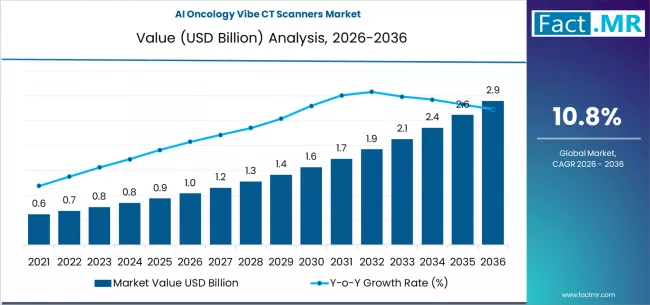
Ai oncology vibe ct scanners market is projected to grow from USD 1.0 billion in 2026 to USD 2.9 billion by 2036, at a CAGR of 10.8%. AI-Assisted Image Reconstruction will dominate with a 38.0% market share, while oncology diagnosis & staging will lead the application segment with a 51.0% share.
AI Oncology Vibe CT Scanners Market Forecast and Outlook 2026 to 2036
The global market for AI oncology vibe CT scanners is projected to experience substantial growth, advancing from USD 1.04 billion in 2026 to USD 2.90 billion by 2036, at a notable CAGR of 10.8%. This expansion is driven by the critical convergence of artificial intelligence and advanced computed tomography, specifically optimized for the complex demands of oncologic care.
Key Takeaways from the AI Oncology Vibe CT Scanners Market
- Market Value for 2026: USD 1.04 Billion
- Market Value for 2036: USD 2.90 Billion
- Forecast CAGR (2026-2036): 10.8%
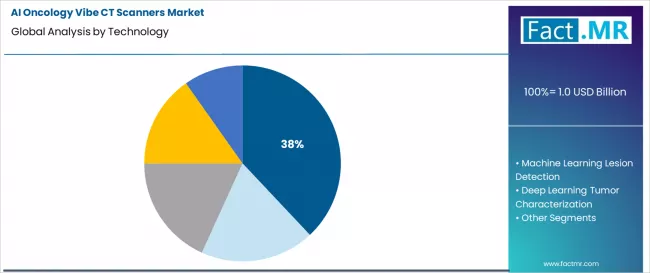
- Leading Technology Segment (2026): AI-Assisted Image Reconstruction (38%)
- Leading Application Segment (2026): Oncology Diagnosis & Staging (51%)
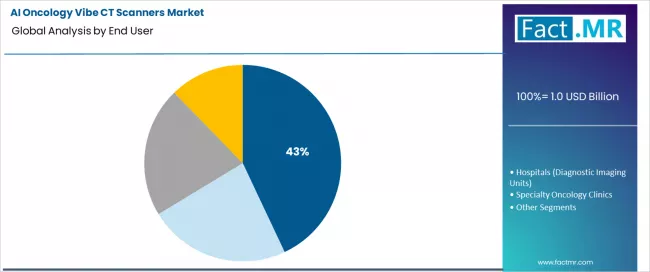
- Leading End User Segment (2026): Cancer Treatment Centers (43%)
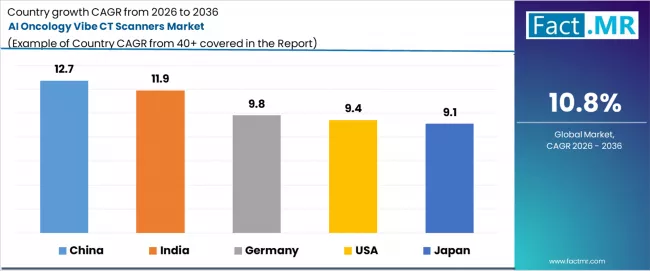
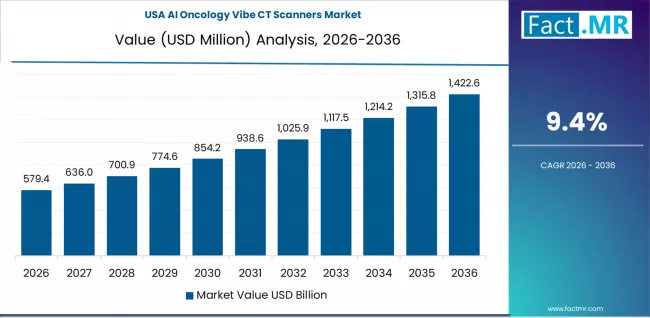
- Key Growth Countries: India (11.90% CAGR), China (12.70% CAGR), USA (9.40% CAGR), Germany (9.80% CAGR), Japan (9.10% CAGR)
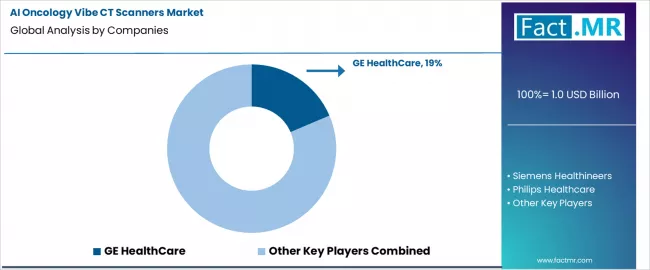
- Key Players in the Market: GE HealthCare, Siemens Healthineers, Philips Healthcare, Canon Medical Systems, United Imaging Healthcare, Others

The integration of AI algorithms directly into imaging workflow enables unprecedented capabilities in low-dose scanning, automated lesion quantification, and predictive analytics, directly addressing the need for faster, more accurate, and personalized cancer management. This evolution is transforming CT from a purely anatomical tool into a quantitative, decision-support system essential for modern precision oncology.
Metric
| Metric | Value |
|---|---|
| Market Value (2026) | USD 1.04 Billion |
| Market Forecast Value (2036) | USD 2.90 Billion |
| Forecast CAGR (2026-2036) | 10.8% |
Category
| Category | Segments |
|---|---|
| Technology | AI-Assisted Image Reconstruction, Machine Learning Lesion Detection, Deep Learning Tumor Characterization, Workflow Automation & Triage, Other Advanced AI Modules |
| Application | Oncology Diagnosis & Staging, Tumor Monitoring & Treatment Response, Radiation Therapy Planning Support, Research & Clinical Trials |
| End User | Cancer Treatment Centers, Hospitals (Diagnostic Imaging Units), Specialty Oncology Clinics, Research & Academic Institutes |
| Region | North America, Latin America, Western Europe, Eastern Europe, East Asia, South Asia & Pacific, MEA |
Segmental Analysis
By Technology, Which AI Function is Most Fundamental?

AI-assisted image reconstruction leads the technology segment with a 38% share. This foundational application allows for significant radiation dose reduction while maintaining or improving diagnostic image quality, which is a paramount concern in oncology where patients undergo repeated scans.
By using deep learning to reconstruct images from noisy or sparse data, this technology enables safer longitudinal monitoring and is often the entry point for broader AI adoption in clinical CT workflows.
By Application, Where is Core Clinical Value Demonstrated?

Oncology diagnosis & staging is the dominant application, holding 51% of the market. The primary value proposition of AI in oncology CT is to enhance the accuracy, speed, and consistency of initial cancer detection, localization, and staging such as via RECIST criteria.
AI tools that automate measurements, identify subtle lesions, and standardize reporting are directly critical to determining the appropriate treatment pathway, making this the central application driving investment.
By End User, Which Setting is the Early Adoption Hub?

Cancer treatment centers constitute the leading end-user segment at 43%. These specialized facilities, including comprehensive cancer centers, are at the forefront of adopting precision medicine tools. They possess the clinical volume, expertise, and imperative to integrate advanced AI-CT capabilities for improving patient outcomes.
The need for efficient, high-throughput, and quantitatively precise imaging to support complex treatment regimens makes them the primary drivers of initial procurement and utilization.
What are the Drivers, Restraints, and Trends in the AI Oncology Vibe CT Scanners Market?
The primary market driver is the escalating global cancer burden coupled with a severe shortage of specialized radiologists, creating an urgent need for AI tools that improve diagnostic efficiency and consistency.
A key restraint is the black box nature of some complex AI algorithms, which can raise regulatory and clinical trust hurdles regarding validation and explainability of results. A significant opportunity lies in developing integrated AI platforms that not only analyze images but also fuse CT data with electronic health records, genomics, and outcomes data to provide prognostic insights.
The dominant trend is the shift from single-task AI applications such as nodule detection towards comprehensive, vendor-neutral AI orchestration platforms that manage multiple algorithms across the entire oncology imaging workflow, from protocoling and acquisition to quantification and reporting.
Analysis of the AI Oncology Vibe CT Scanners Market by Key Countries

| Country | CAGR (2026-2036) |
|---|---|
| India | 11.90% |
| China | 12.70% |
| USA | 9.40% |
| Germany | 9.80% |
| Japan | 9.10% |
How does the USA's Focus on Value-Based Cancer Care Influence Growth?

The USA's 9.40% CAGR is driven by the transition to value-based oncology care models that reward improved outcomes and efficiency. Adoption is fueled by the need to standardize imaging assessments across healthcare networks, reduce radiologist workload, and support data-driven treatment decisions. Reimbursement pathways for AI-assisted procedures and a strong presence of leading OEMs and AI software firms accelerate market integration.
What Drives China's Rapid Adoption of Smart Healthcare Technologies?
China's leading 12.70% CAGR is propelled by national healthcare policies actively promoting Internet & Healthcare and AI integration. Massive investment in smart hospital infrastructure, a focus on elevating the standard of care in provincial hospitals, and a growing domestic innovation ecosystem in medical AI create a highly conducive environment for the rapid deployment of advanced AI-enhanced imaging systems.
Why does Germany Represent a High-Standard Regulatory Market?
Germany's 9.80% growth reflects its stringent regulatory environment for medical devices and its leadership in precision medicine. Growth is driven by university hospitals and comprehensive cancer centers seeking to integrate cutting-edge AI tools into their clinical research and therapy pipelines, with a strong emphasis on solutions that meet EU MDR requirements and demonstrate clear clinical utility.
How is Japan's Aging Demography and Technical Precision Shaping Demand?
Japan's 9.10% CAGR is linked to its super-aging society and high cancer prevalence. The market demands AI solutions that enable ultra-low-dose screening for high-risk populations and provide exquisitely precise measurements for minimally invasive therapies.
Japanese providers seek highly reliable, integrated AI systems that align with meticulous quality standards and help manage growing patient volumes with limited specialist manpower.
What Factors Underpin India's High-Growth Trajectory in Medical AI?
India's 11.90% growth is fueled by the critical need to bridge the vast gap in specialist radiologist coverage nationwide. The expansion of private multi-specialty hospital chains and oncology networks creates demand for technology that maximizes radiologist productivity and diagnostic accuracy. Cost-effective AI solutions that can be deployed at scale to support a growing cancer patient burden are key to market penetration.
Competitive Landscape of the AI Oncology Vibe CT Scanners Market

The competitive landscape features established medical imaging OEMs competing alongside specialized AI software firms. Competition centers on the depth and clinical validation of proprietary AI algorithms, the seamlessness of AI integration into the scanner's native workflow, and the ability to offer a comprehensive portfolio covering reconstruction, detection, and analytics.
Success depends on securing strategic partnerships with leading cancer centers for co-development and clinical trials, ensuring algorithms are trained on diverse, global datasets to ensure robustness, and navigating complex regulatory approvals for AI-based clinical decision support tools.
Key Players in the AI Oncology Vibe CT Scanners Market
- GE HealthCare
- Siemens Healthineers
- Philips Healthcare
- Canon Medical Systems
- United Imaging Healthcare
- Others
Scope of Report
| Items | Values |
|---|---|
| Quantitative Units | USD Billion |
| Technology | AI-Assisted Image Reconstruction, Machine Learning Lesion Detection, Deep Learning Tumor Characterization, Workflow Automation & Triage, Other Advanced AI Modules |
| Application | Oncology Diagnosis & Staging, Tumor Monitoring & Treatment Response, Radiation Therapy Planning Support, Research & Clinical Trials |
| End User | Cancer Treatment Centers, Hospitals (Diagnostic Imaging Units), Specialty Oncology Clinics, Research & Academic Institutes |
| Key Countries | India, China, USA, Germany, Japan |
| Key Companies | GE HealthCare, Siemens Healthineers, Philips Healthcare, Canon Medical Systems, United Imaging Healthcare, Others |
| Additional Analysis | Analysis of regulatory pathways for AI/ML-based software as a medical device (SaMD); comparative study of algorithm performance on diverse patient populations; total cost of ownership model for AI-enhanced vs. standard CT systems; impact of AI on radiologist reporting time and diagnostic confidence; data privacy and security challenges in cloud-based AI analytics. |
Market by Segments
-
Technology :
- AI-Assisted Image Reconstruction
- Machine Learning Lesion Detection
- Deep Learning Tumor Characterization
- Workflow Automation & Triage
- Other Advanced AI Modules
-
Application :
- Oncology Diagnosis & Staging
- Tumor Monitoring & Treatment Response
- Radiation Therapy Planning Support
- Research & Clinical Trials
-
End User :
- Cancer Treatment Centers
- Hospitals (Diagnostic Imaging Units)
- Specialty Oncology Clinics
- Research & Academic Institutes
-
Region :
-
North America
- USA
- Canada
-
Latin America
- Brazil
- Mexico
- Argentina
- Rest of Latin America
-
Western Europe
- Germany
- France
- Italy
- Spain
- UK
- BENELUX
- Rest of Western Europe
-
Eastern Europe
- Russia
- Poland
- Czech Republic
- Rest of Eastern Europe
-
East Asia
- China
- Japan
- South Korea
- Rest of East Asia
-
South Asia & Pacific
- India
- ASEAN
- Australia
- Rest of South Asia & Pacific
-
MEA
- GCC Countries
- South Africa
- Turkiye
- Rest of MEA
-
References
- American College of Radiology (ACR). (2024). ACR Data Science Institute AI Central: Use cases in oncologic imaging. ACR Press.
- European Society of Radiology (ESR). (2024). Paper on artificial intelligence and medical imaging in oncology. Insights into Imaging.
- Food and Drug Administration (FDA). (2024). Artificial Intelligence and Machine Learning (AI/ML) in Medical Devices: Oncology Imaging Focus. U.S. Department of Health and Human Services.
- Kohli, M., & Summers, R. M. (2023). Artificial intelligence in medical imaging: From proof-of-concept to service. Journal of the American College of Radiology, 20(5), S15-S24.
- Lambin, P., et al. (2023). Radiomics: The bridge between medical imaging and personalized medicine. Nature Reviews Clinical Oncology.
- World Health Organization (WHO). (2024). Global strategy on digital health and cancer management. WHO Press.
Table of Content
- Executive Summary
- Global Market Outlook
- Demand to side Trends
- Supply to side Trends
- Technology Roadmap Analysis
- Analysis and Recommendations
- Market Overview
- Market Coverage / Taxonomy
- Market Definition / Scope / Limitations
- Market Background
- Market Dynamics
- Drivers
- Restraints
- Opportunity
- Trends
- Scenario Forecast
- Demand in Optimistic Scenario
- Demand in Likely Scenario
- Demand in Conservative Scenario
- Opportunity Map Analysis
- Product Life Cycle Analysis
- Supply Chain Analysis
- Investment Feasibility Matrix
- Value Chain Analysis
- PESTLE and Porter’s Analysis
- Regulatory Landscape
- Regional Parent Market Outlook
- Production and Consumption Statistics
- Import and Export Statistics
- Market Dynamics
- Global Market Analysis 2021 to 2025 and Forecast, 2026 to 2036
- Historical Market Size Value (USD Million) Analysis, 2021 to 2025
- Current and Future Market Size Value (USD Million) Projections, 2026 to 2036
- Y to o to Y Growth Trend Analysis
- Absolute $ Opportunity Analysis
- Global Market Pricing Analysis 2021 to 2025 and Forecast 2026 to 2036
- Global Market Analysis 2021 to 2025 and Forecast 2026 to 2036, By Technology
- Introduction / Key Findings
- Historical Market Size Value (USD Million) Analysis By Technology, 2021 to 2025
- Current and Future Market Size Value (USD Million) Analysis and Forecast By Technology, 2026 to 2036
- AI-Assisted Image Reconstruction
- Machine Learning Lesion Detection
- Deep Learning Tumor Characterization
- Workflow Automation & Triage
- Other Advanced AI Modules
- AI-Assisted Image Reconstruction
- Y to o to Y Growth Trend Analysis By Technology, 2021 to 2025
- Absolute $ Opportunity Analysis By Technology, 2026 to 2036
- Global Market Analysis 2021 to 2025 and Forecast 2026 to 2036, By Application
- Introduction / Key Findings
- Historical Market Size Value (USD Million) Analysis By Application, 2021 to 2025
- Current and Future Market Size Value (USD Million) Analysis and Forecast By Application, 2026 to 2036
- Oncology Diagnosis & Staging
- Tumor Monitoring & Treatment Response
- Radiation Therapy Planning Support
- Research & Clinical Trials
- Oncology Diagnosis & Staging
- Y to o to Y Growth Trend Analysis By Application, 2021 to 2025
- Absolute $ Opportunity Analysis By Application, 2026 to 2036
- Global Market Analysis 2021 to 2025 and Forecast 2026 to 2036, By End User
- Introduction / Key Findings
- Historical Market Size Value (USD Million) Analysis By End User, 2021 to 2025
- Current and Future Market Size Value (USD Million) Analysis and Forecast By End User, 2026 to 2036
- Cancer Treatment Centers
- Hospitals (Diagnostic Imaging Value (USD Million)s)
- Specialty Oncology Clinics
- Research & Academic Institutes
- Cancer Treatment Centers
- Y to o to Y Growth Trend Analysis By End User, 2021 to 2025
- Absolute $ Opportunity Analysis By End User, 2026 to 2036
- Global Market Analysis 2021 to 2025 and Forecast 2026 to 2036, By Region
- Introduction
- Historical Market Size Value (USD Million) Analysis By Region, 2021 to 2025
- Current Market Size Value (USD Million) Analysis and Forecast By Region, 2026 to 2036
- North America
- Latin America
- Western Europe
- Eastern Europe
- East Asia
- South Asia and Pacific
- Middle East & Africa
- Market Attractiveness Analysis By Region
- North America Market Analysis 2021 to 2025 and Forecast 2026 to 2036, By Country
- Historical Market Size Value (USD Million) Trend Analysis By Market Taxonomy, 2021 to 2025
- Market Size Value (USD Million) Forecast By Market Taxonomy, 2026 to 2036
- By Country
- USA
- Canada
- Mexico
- By Technology
- By Application
- By End User
- By Country
- Market Attractiveness Analysis
- By Country
- By Technology
- By Application
- By End User
- Key Takeaways
- Latin America Market Analysis 2021 to 2025 and Forecast 2026 to 2036, By Country
- Historical Market Size Value (USD Million) Trend Analysis By Market Taxonomy, 2021 to 2025
- Market Size Value (USD Million) Forecast By Market Taxonomy, 2026 to 2036
- By Country
- Brazil
- Chile
- Rest of Latin America
- By Technology
- By Application
- By End User
- By Country
- Market Attractiveness Analysis
- By Country
- By Technology
- By Application
- By End User
- Key Takeaways
- Western Europe Market Analysis 2021 to 2025 and Forecast 2026 to 2036, By Country
- Historical Market Size Value (USD Million) Trend Analysis By Market Taxonomy, 2021 to 2025
- Market Size Value (USD Million) Forecast By Market Taxonomy, 2026 to 2036
- By Country
- Germany
- UK
- Italy
- Spain
- France
- Nordic
- BENELUX
- Rest of Western Europe
- By Technology
- By Application
- By End User
- By Country
- Market Attractiveness Analysis
- By Country
- By Technology
- By Application
- By End User
- Key Takeaways
- Eastern Europe Market Analysis 2021 to 2025 and Forecast 2026 to 2036, By Country
- Historical Market Size Value (USD Million) Trend Analysis By Market Taxonomy, 2021 to 2025
- Market Size Value (USD Million) Forecast By Market Taxonomy, 2026 to 2036
- By Country
- Russia
- Poland
- Hungary
- Balkan & Baltic
- Rest of Eastern Europe
- By Technology
- By Application
- By End User
- By Country
- Market Attractiveness Analysis
- By Country
- By Technology
- By Application
- By End User
- Key Takeaways
- East Asia Market Analysis 2021 to 2025 and Forecast 2026 to 2036, By Country
- Historical Market Size Value (USD Million) Trend Analysis By Market Taxonomy, 2021 to 2025
- Market Size Value (USD Million) Forecast By Market Taxonomy, 2026 to 2036
- By Country
- China
- Japan
- South Korea
- By Technology
- By Application
- By End User
- By Country
- Market Attractiveness Analysis
- By Country
- By Technology
- By Application
- By End User
- Key Takeaways
- South Asia and Pacific Market Analysis 2021 to 2025 and Forecast 2026 to 2036, By Country
- Historical Market Size Value (USD Million) Trend Analysis By Market Taxonomy, 2021 to 2025
- Market Size Value (USD Million) Forecast By Market Taxonomy, 2026 to 2036
- By Country
- India
- ASEAN
- Australia & New Zealand
- Rest of South Asia and Pacific
- By Technology
- By Application
- By End User
- By Country
- Market Attractiveness Analysis
- By Country
- By Technology
- By Application
- By End User
- Key Takeaways
- Middle East & Africa Market Analysis 2021 to 2025 and Forecast 2026 to 2036, By Country
- Historical Market Size Value (USD Million) Trend Analysis By Market Taxonomy, 2021 to 2025
- Market Size Value (USD Million) Forecast By Market Taxonomy, 2026 to 2036
- By Country
- Kingdom of Saudi Arabia
- Other GCC Countries
- Turkiye
- South Africa
- Other African Union
- Rest of Middle East & Africa
- By Technology
- By Application
- By End User
- By Country
- Market Attractiveness Analysis
- By Country
- By Technology
- By Application
- By End User
- Key Takeaways
- Key Countries Market Analysis
- USA
- Pricing Analysis
- Market Share Analysis, 2025
- By Technology
- By Application
- By End User
- Canada
- Pricing Analysis
- Market Share Analysis, 2025
- By Technology
- By Application
- By End User
- Mexico
- Pricing Analysis
- Market Share Analysis, 2025
- By Technology
- By Application
- By End User
- Brazil
- Pricing Analysis
- Market Share Analysis, 2025
- By Technology
- By Application
- By End User
- Chile
- Pricing Analysis
- Market Share Analysis, 2025
- By Technology
- By Application
- By End User
- Germany
- Pricing Analysis
- Market Share Analysis, 2025
- By Technology
- By Application
- By End User
- UK
- Pricing Analysis
- Market Share Analysis, 2025
- By Technology
- By Application
- By End User
- Italy
- Pricing Analysis
- Market Share Analysis, 2025
- By Technology
- By Application
- By End User
- Spain
- Pricing Analysis
- Market Share Analysis, 2025
- By Technology
- By Application
- By End User
- France
- Pricing Analysis
- Market Share Analysis, 2025
- By Technology
- By Application
- By End User
- India
- Pricing Analysis
- Market Share Analysis, 2025
- By Technology
- By Application
- By End User
- ASEAN
- Pricing Analysis
- Market Share Analysis, 2025
- By Technology
- By Application
- By End User
- Australia & New Zealand
- Pricing Analysis
- Market Share Analysis, 2025
- By Technology
- By Application
- By End User
- China
- Pricing Analysis
- Market Share Analysis, 2025
- By Technology
- By Application
- By End User
- Japan
- Pricing Analysis
- Market Share Analysis, 2025
- By Technology
- By Application
- By End User
- South Korea
- Pricing Analysis
- Market Share Analysis, 2025
- By Technology
- By Application
- By End User
- Russia
- Pricing Analysis
- Market Share Analysis, 2025
- By Technology
- By Application
- By End User
- Poland
- Pricing Analysis
- Market Share Analysis, 2025
- By Technology
- By Application
- By End User
- Hungary
- Pricing Analysis
- Market Share Analysis, 2025
- By Technology
- By Application
- By End User
- Kingdom of Saudi Arabia
- Pricing Analysis
- Market Share Analysis, 2025
- By Technology
- By Application
- By End User
- Turkiye
- Pricing Analysis
- Market Share Analysis, 2025
- By Technology
- By Application
- By End User
- South Africa
- Pricing Analysis
- Market Share Analysis, 2025
- By Technology
- By Application
- By End User
- USA
- Market Structure Analysis
- Competition Dashboard
- Competition Benchmarking
- Market Share Analysis of Top Players
- By Regional
- By Technology
- By Application
- By End User
- Competition Analysis
- Competition Deep Dive
- GE HealthCare
- Overview
- Product Portfolio
- Profitability by Market Segments (Product/Age /Sales Channel/Region)
- Sales Footprint
- Strategy Overview
- Marketing Strategy
- Product Strategy
- Channel Strategy
- Siemens Healthineers
- Philips Healthcare
- Canon Medical Systems
- Value (USD Million)ed Imaging Healthcare
- Others
- GE HealthCare
- Competition Deep Dive
- Assumptions & Acronyms Used
- Research Methodology
List Of Table
- Table 1: Global Market Value (USD Million) Forecast by Region, 2021 to 2036
- Table 2: Global Market Value (USD Million) Forecast by Technology, 2021 to 2036
- Table 3: Global Market Value (USD Million) Forecast by Application, 2021 to 2036
- Table 4: Global Market Value (USD Million) Forecast by End User, 2021 to 2036
- Table 5: North America Market Value (USD Million) Forecast by Country, 2021 to 2036
- Table 6: North America Market Value (USD Million) Forecast by Technology, 2021 to 2036
- Table 7: North America Market Value (USD Million) Forecast by Application, 2021 to 2036
- Table 8: North America Market Value (USD Million) Forecast by End User, 2021 to 2036
- Table 9: Latin America Market Value (USD Million) Forecast by Country, 2021 to 2036
- Table 10: Latin America Market Value (USD Million) Forecast by Technology, 2021 to 2036
- Table 11: Latin America Market Value (USD Million) Forecast by Application, 2021 to 2036
- Table 12: Latin America Market Value (USD Million) Forecast by End User, 2021 to 2036
- Table 13: Western Europe Market Value (USD Million) Forecast by Country, 2021 to 2036
- Table 14: Western Europe Market Value (USD Million) Forecast by Technology, 2021 to 2036
- Table 15: Western Europe Market Value (USD Million) Forecast by Application, 2021 to 2036
- Table 16: Western Europe Market Value (USD Million) Forecast by End User, 2021 to 2036
- Table 17: Eastern Europe Market Value (USD Million) Forecast by Country, 2021 to 2036
- Table 18: Eastern Europe Market Value (USD Million) Forecast by Technology, 2021 to 2036
- Table 19: Eastern Europe Market Value (USD Million) Forecast by Application, 2021 to 2036
- Table 20: Eastern Europe Market Value (USD Million) Forecast by End User, 2021 to 2036
- Table 21: East Asia Market Value (USD Million) Forecast by Country, 2021 to 2036
- Table 22: East Asia Market Value (USD Million) Forecast by Technology, 2021 to 2036
- Table 23: East Asia Market Value (USD Million) Forecast by Application, 2021 to 2036
- Table 24: East Asia Market Value (USD Million) Forecast by End User, 2021 to 2036
- Table 25: South Asia and Pacific Market Value (USD Million) Forecast by Country, 2021 to 2036
- Table 26: South Asia and Pacific Market Value (USD Million) Forecast by Technology, 2021 to 2036
- Table 27: South Asia and Pacific Market Value (USD Million) Forecast by Application, 2021 to 2036
- Table 28: South Asia and Pacific Market Value (USD Million) Forecast by End User, 2021 to 2036
- Table 29: Middle East & Africa Market Value (USD Million) Forecast by Country, 2021 to 2036
- Table 30: Middle East & Africa Market Value (USD Million) Forecast by Technology, 2021 to 2036
- Table 31: Middle East & Africa Market Value (USD Million) Forecast by Application, 2021 to 2036
- Table 32: Middle East & Africa Market Value (USD Million) Forecast by End User, 2021 to 2036
List Of Figures
- Figure 1: Global Market Pricing Analysis
- Figure 2: Global Market Value (USD Million) Forecast 2021 to 2036
- Figure 3: Global Market Value Share and BPS Analysis by Technology, 2026 and 2036
- Figure 4: Global Market Y to o to Y Growth Comparison by Technology, 2026 to 2036
- Figure 5: Global Market Attractiveness Analysis by Technology
- Figure 6: Global Market Value Share and BPS Analysis by Application, 2026 and 2036
- Figure 7: Global Market Y to o to Y Growth Comparison by Application, 2026 to 2036
- Figure 8: Global Market Attractiveness Analysis by Application
- Figure 9: Global Market Value Share and BPS Analysis by End User, 2026 and 2036
- Figure 10: Global Market Y to o to Y Growth Comparison by End User, 2026 to 2036
- Figure 11: Global Market Attractiveness Analysis by End User
- Figure 12: Global Market Value (USD Million) Share and BPS Analysis by Region, 2026 and 2036
- Figure 13: Global Market Y to o to Y Growth Comparison by Region, 2026 to 2036
- Figure 14: Global Market Attractiveness Analysis by Region
- Figure 15: North America Market Incremental Dollar Opportunity, 2026 to 2036
- Figure 16: Latin America Market Incremental Dollar Opportunity, 2026 to 2036
- Figure 17: Western Europe Market Incremental Dollar Opportunity, 2026 to 2036
- Figure 18: Eastern Europe Market Incremental Dollar Opportunity, 2026 to 2036
- Figure 19: East Asia Market Incremental Dollar Opportunity, 2026 to 2036
- Figure 20: South Asia and Pacific Market Incremental Dollar Opportunity, 2026 to 2036
- Figure 21: Middle East & Africa Market Incremental Dollar Opportunity, 2026 to 2036
- Figure 22: North America Market Value Share and BPS Analysis by Country, 2026 and 2036
- Figure 23: North America Market Value Share and BPS Analysis by Technology, 2026 and 2036
- Figure 24: North America Market Y to o to Y Growth Comparison by Technology, 2026 to 2036
- Figure 25: North America Market Attractiveness Analysis by Technology
- Figure 26: North America Market Value Share and BPS Analysis by Application, 2026 and 2036
- Figure 27: North America Market Y to o to Y Growth Comparison by Application, 2026 to 2036
- Figure 28: North America Market Attractiveness Analysis by Application
- Figure 29: North America Market Value Share and BPS Analysis by End User, 2026 and 2036
- Figure 30: North America Market Y to o to Y Growth Comparison by End User, 2026 to 2036
- Figure 31: North America Market Attractiveness Analysis by End User
- Figure 32: Latin America Market Value Share and BPS Analysis by Country, 2026 and 2036
- Figure 33: Latin America Market Value Share and BPS Analysis by Technology, 2026 and 2036
- Figure 34: Latin America Market Y to o to Y Growth Comparison by Technology, 2026 to 2036
- Figure 35: Latin America Market Attractiveness Analysis by Technology
- Figure 36: Latin America Market Value Share and BPS Analysis by Application, 2026 and 2036
- Figure 37: Latin America Market Y to o to Y Growth Comparison by Application, 2026 to 2036
- Figure 38: Latin America Market Attractiveness Analysis by Application
- Figure 39: Latin America Market Value Share and BPS Analysis by End User, 2026 and 2036
- Figure 40: Latin America Market Y to o to Y Growth Comparison by End User, 2026 to 2036
- Figure 41: Latin America Market Attractiveness Analysis by End User
- Figure 42: Western Europe Market Value Share and BPS Analysis by Country, 2026 and 2036
- Figure 43: Western Europe Market Value Share and BPS Analysis by Technology, 2026 and 2036
- Figure 44: Western Europe Market Y to o to Y Growth Comparison by Technology, 2026 to 2036
- Figure 45: Western Europe Market Attractiveness Analysis by Technology
- Figure 46: Western Europe Market Value Share and BPS Analysis by Application, 2026 and 2036
- Figure 47: Western Europe Market Y to o to Y Growth Comparison by Application, 2026 to 2036
- Figure 48: Western Europe Market Attractiveness Analysis by Application
- Figure 49: Western Europe Market Value Share and BPS Analysis by End User, 2026 and 2036
- Figure 50: Western Europe Market Y to o to Y Growth Comparison by End User, 2026 to 2036
- Figure 51: Western Europe Market Attractiveness Analysis by End User
- Figure 52: Eastern Europe Market Value Share and BPS Analysis by Country, 2026 and 2036
- Figure 53: Eastern Europe Market Value Share and BPS Analysis by Technology, 2026 and 2036
- Figure 54: Eastern Europe Market Y to o to Y Growth Comparison by Technology, 2026 to 2036
- Figure 55: Eastern Europe Market Attractiveness Analysis by Technology
- Figure 56: Eastern Europe Market Value Share and BPS Analysis by Application, 2026 and 2036
- Figure 57: Eastern Europe Market Y to o to Y Growth Comparison by Application, 2026 to 2036
- Figure 58: Eastern Europe Market Attractiveness Analysis by Application
- Figure 59: Eastern Europe Market Value Share and BPS Analysis by End User, 2026 and 2036
- Figure 60: Eastern Europe Market Y to o to Y Growth Comparison by End User, 2026 to 2036
- Figure 61: Eastern Europe Market Attractiveness Analysis by End User
- Figure 62: East Asia Market Value Share and BPS Analysis by Country, 2026 and 2036
- Figure 63: East Asia Market Value Share and BPS Analysis by Technology, 2026 and 2036
- Figure 64: East Asia Market Y to o to Y Growth Comparison by Technology, 2026 to 2036
- Figure 65: East Asia Market Attractiveness Analysis by Technology
- Figure 66: East Asia Market Value Share and BPS Analysis by Application, 2026 and 2036
- Figure 67: East Asia Market Y to o to Y Growth Comparison by Application, 2026 to 2036
- Figure 68: East Asia Market Attractiveness Analysis by Application
- Figure 69: East Asia Market Value Share and BPS Analysis by End User, 2026 and 2036
- Figure 70: East Asia Market Y to o to Y Growth Comparison by End User, 2026 to 2036
- Figure 71: East Asia Market Attractiveness Analysis by End User
- Figure 72: South Asia and Pacific Market Value Share and BPS Analysis by Country, 2026 and 2036
- Figure 73: South Asia and Pacific Market Value Share and BPS Analysis by Technology, 2026 and 2036
- Figure 74: South Asia and Pacific Market Y to o to Y Growth Comparison by Technology, 2026 to 2036
- Figure 75: South Asia and Pacific Market Attractiveness Analysis by Technology
- Figure 76: South Asia and Pacific Market Value Share and BPS Analysis by Application, 2026 and 2036
- Figure 77: South Asia and Pacific Market Y to o to Y Growth Comparison by Application, 2026 to 2036
- Figure 78: South Asia and Pacific Market Attractiveness Analysis by Application
- Figure 79: South Asia and Pacific Market Value Share and BPS Analysis by End User, 2026 and 2036
- Figure 80: South Asia and Pacific Market Y to o to Y Growth Comparison by End User, 2026 to 2036
- Figure 81: South Asia and Pacific Market Attractiveness Analysis by End User
- Figure 82: Middle East & Africa Market Value Share and BPS Analysis by Country, 2026 and 2036
- Figure 83: Middle East & Africa Market Value Share and BPS Analysis by Technology, 2026 and 2036
- Figure 84: Middle East & Africa Market Y to o to Y Growth Comparison by Technology, 2026 to 2036
- Figure 85: Middle East & Africa Market Attractiveness Analysis by Technology
- Figure 86: Middle East & Africa Market Value Share and BPS Analysis by Application, 2026 and 2036
- Figure 87: Middle East & Africa Market Y to o to Y Growth Comparison by Application, 2026 to 2036
- Figure 88: Middle East & Africa Market Attractiveness Analysis by Application
- Figure 89: Middle East & Africa Market Value Share and BPS Analysis by End User, 2026 and 2036
- Figure 90: Middle East & Africa Market Y to o to Y Growth Comparison by End User, 2026 to 2036
- Figure 91: Middle East & Africa Market Attractiveness Analysis by End User
- Figure 92: Global Market - Tier Structure Analysis
- Figure 93: Global Market - Company Share Analysis
- FAQs -
How big is the ai oncology vibe ct scanners market in 2026?
The global ai oncology vibe ct scanners market is estimated to be valued at USD 1.0 billion in 2026.
What will be the size of ai oncology vibe ct scanners market in 2036?
The market size for the ai oncology vibe ct scanners market is projected to reach USD 2.9 billion by 2036.
How much will be the ai oncology vibe ct scanners market growth between 2026 and 2036?
The ai oncology vibe ct scanners market is expected to grow at a 10.8% CAGR between 2026 and 2036.
What are the key product types in the ai oncology vibe ct scanners market?
The key product types in ai oncology vibe ct scanners market are ai-assisted image reconstruction, machine learning lesion detection, deep learning tumor characterization, workflow automation & triage and other advanced ai modules.
Which application segment to contribute significant share in the ai oncology vibe ct scanners market in 2026?
In terms of application, oncology diagnosis & staging segment to command 51.0% share in the ai oncology vibe ct scanners market in 2026.