- Market Value (2025): USD 1.5 Bn
- Estimated Value (2026): USD 1.6 Bn
- Forecast Value (2036): USD 4.1 Bn
- CAGR (2026-2036): 9.7%
What is the Taste Masking Agents Market forecast to be worth by 2036?
USD 1.6 billion in 2026 to USD 4.1 billion by 2036 at a 9.7% CAGR.
- The Taste Masking Agents Market crossed a valuation of USD 1.5 billion in 2025.
- Demand is projected to increase from USD 1.6 billion in 2026 to USD 4.1 billion by 2036.
- The market is forecast to record a 9.7% CAGR from 2026 to 2036 as nutrition brands, beverage formulators and oral-dose teams work to improve palatability.
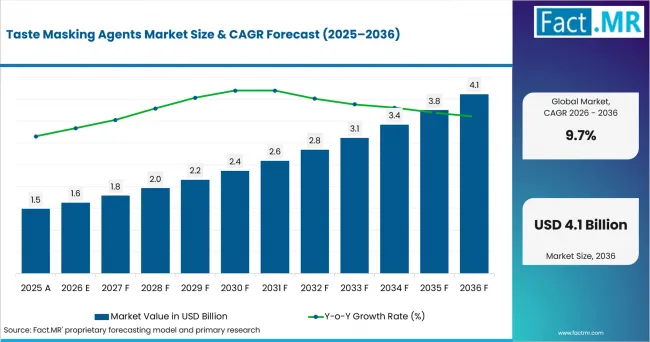
Taste Masking Agents Market Value Analysis | Source: Fact.MR
What are the defining numbers behind Taste Masking Agents Market growth?
An absolute opportunity of USD 2.5 billion is expected between 2026 and 2036.
- Demand Drivers in the Market
- Supplement formulators need better off-note control because high-active products often combine minerals, botanicals and amino acids in small serving formats.
- CDC’s National Center for Health Statistics reported on May 21, 2026 that, during August 2021–August 2023, 60.2% of U.S. adults age 20 and older used a dietary supplement in the past 30 days. That usage base makes sensory acceptance relevant for tablets, powders, gummies and ready-to-drink nutrition products.
- USDA ERS reported on June 11, 2026 that inflation-adjusted U.S. food spending reached USD 2.51 trillion in 2025. Large food and beverage channels give masking systems a wider route into reformulated products.
- Pharmaceutical teams need taste technologies that improve patient experience while preserving active stability, release behavior and documentation for oral dosage changes.
- Key Segments Analyzed
- By Masking Technology: Flavor modulation is expected to hold 36.00% share in 2026 because it can rebalance bitterness and lingering notes inside beverages, powders and chewable products.
- By Off-note Target: Bitterness is projected to account for 38.00% share in 2026, supported by the prevalence of bitter actives, botanicals and high-intensity sweeteners.
- By Active Format: Liquid flavor system is anticipated to capture 31.00% share in 2026 owing to easier blending in beverages, syrups and liquid supplements.
- By Application: Nutritional beverages are estimated to represent 27.00% share in 2026 due to protein, mineral and botanical systems that require a cleaner taste finish.
- Analyst Opinion at Fact.MR
- S. N. Jha, Principal Consultant at Fact.MR, states, “Taste masking is becoming a formulation decision rather than a final flavor touch. Brands are expected to spend more on systems that target one problem note while leaving the rest of the profile recognizable. The suppliers with an edge combine sensory testing, receptor knowledge and application support across beverages, supplements and oral medicines.”
- Strategic Implications
- Flavor houses should document how each masking system performs against bitterness, beany notes, metallic notes and astringency under real processing conditions.
- Supplement brands should test masking early in product design so active loading and flavor direction move together.
- Beverage formulators should compare cost-in-use against sensory panel results because weak masking often leads to higher flavor loading.
- Pharma excipient teams should align taste work with stability, release and manufacturing records before oral-dose reformulation moves into scale-up.
USA is projected to record 11.0% CAGR through 2036, supported by supplement use and beverage reformulation. Germany is anticipated to post 10.4% CAGR through food-manufacturing scale and processed-beverage demand. The UK is forecast to advance at 10.0% CAGR through nutrition-policy reformulation. France is estimated to record 9.2% CAGR through agri-food SMEs and premium formulation work. Japan is expected to reach 8.7% CAGR through health-food, soft-drink and oral-medicine needs.
How does the Taste Masking Agents Market break down by segment?
Flavor modulation leads Masking Technology at 36.00% share in 2026; Bitterness leads Off-note Target at 38.00% share.
Which Masking Technology leads?
Flavor modulation is expected to hold 36.0% share in 2026.
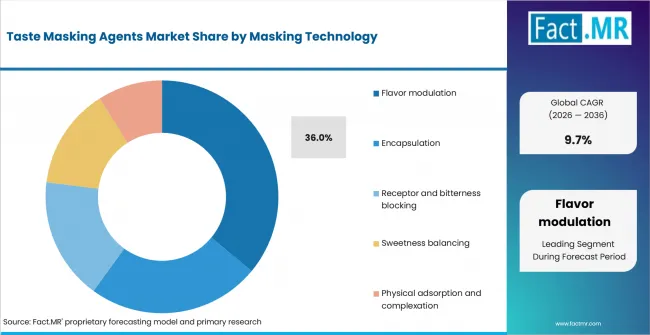
Taste Masking Agents Market Analysis By Masking Technology | Source: Fact.MR
Flavor modulation leads because formulators often need to rebalance a difficult note while keeping the product identity intact. A protein beverage still needs to taste like vanilla, fruit or chocolate after the bitterness or earthy finish is softened. That need makes modulation useful in mainstream beverages and nutrition lines.
IFF’s FLAVORFIT™ Masking portfolio shows this role in food and beverage applications. The company describes the technology as neutralizing bitterness, astringency, sourness, metallic linger and plant-protein off-notes while protecting the product’s intended character.
What leads the Off-note Target segment?
Bitterness is projected to account for 38.0% share in 2026.
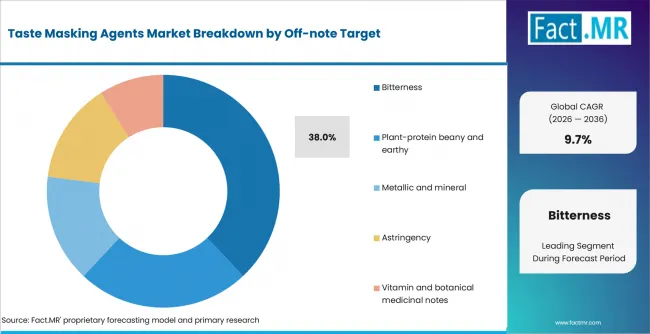
Taste Masking Agents Market Analysis By Off Note Target | Source: Fact.MR
Bitterness leads because many functional ingredients carry a sharp taste before flavor design begins. Botanicals, minerals, caffeine, amino acids and several drug actives can make a product harder to finish. Masking systems are therefore selected early when a brand wants a higher active level in a small serving size.
dsm-firmenich launched ModulaSENSE® Bitter in March 2026 for pharmaceutical taste work. The company positioned it as a receptor-based technology for drug formulators, noting that more than 60% of active pharmaceutical ingredients are considered intrinsically bitter.
How does Active Format shape demand?
Liquid flavor system is anticipated to capture 31.0% share in 2026.
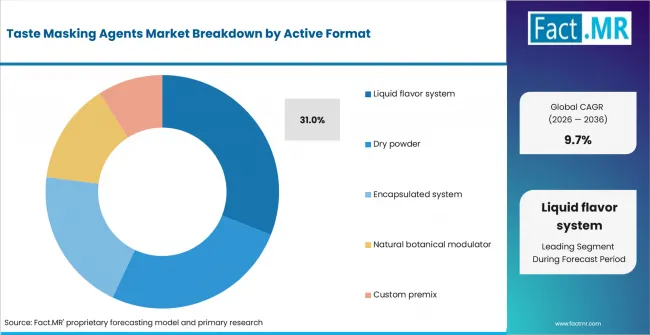
Taste Masking Agents Market Analysis By Active Format | Source: Fact.MR
Liquid flavor systems hold a practical advantage in beverages, syrups and other wet applications. They disperse more easily during pilot work and are easier to adjust after sensory testing. That flexibility is useful when a brand must balance sweetness, acidity and bitterness across the same formula.
Liquid systems suit iterative beverage development because sensory panels can compare small changes before a full dry-blend redesign. That keeps flavor direction, acid profile and masking level connected during scale-up.
What supports Nutritional beverages within Application?
Nutritional beverages are estimated to represent 27.0% share in 2026.
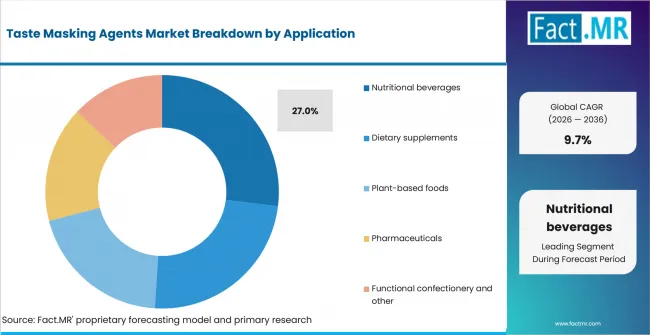
Taste Masking Agents Market Analysis By Application | Source: Fact.MR
Nutritional beverages lead because protein, minerals and botanical actives often create a dry or bitter finish in ready-to-drink formats. Consumers judge these products at first sip, so taste masking influences repeat purchase as much as ingredient count. Liquid systems also help brands tune mouthfeel and aftertaste together.
Official supplier portfolios show similar application demand. IFF positions FLAVORFIT™ Masking for unwanted notes including plant-protein off-notes and metallic linger. Sensient likewise highlights taste-masking needs in sports and active nutrition, where added nutrients and protein-rich formulations can introduce bitter, metallic, chalky and other undesirable notes.
What is accelerating Taste Masking Agents Market adoption, and what is slowing it down?
Demand is expected to rise through supplement use, reformulation needs and oral-dose palatability work. Growth is restrained by validation cost, label limits and sensory trade-offs.
Drivers Impact Analysis
| DRIVER | (~) % IMPACT ON CAGR | GEOGRAPHIC RELEVANCE | IMPACT TIMELINE |
|---|---|---|---|
| Supplement and nutrition active loading | +1.4% | North America, Europe, Japan | Short term (<= 2 years) |
| Reduced-sugar and reduced-sodium reformulation | +1.1% | USA, UK, Germany, France | Medium term (2-4 years) |
| Oral medicine palatability and patient adherence | +0.9% | USA, Europe, Japan | Medium term (2-4 years) |
| Plant-protein off-note correction | +0.8% | North America, Europe, East Asia | Long term (>= 4 years) |
- Supplement and nutrition active loading: Higher active levels in small servings raise bitterness and metallic notes. Formulators therefore need masking systems that protect palatability in powders, gummies and ready-to-drink products.
- Reduced-sugar and reduced-sodium reformulation: Nutrition rules and label pressure push brands toward recipes with less sugar or salt. That shift supports sweetness balancing and masking systems that protect consumer acceptance.
- Oral medicine palatability: Bitter active ingredients can weaken patient experience in tablets, chewables and liquid medicines. Taste masking therefore needs to fit technical records, stability review and manufacturing scale-up.
Opportunity Impact Analysis
| OPPORTUNITY | (~) % IMPACT ON CAGR | GEOGRAPHIC RELEVANCE | IMPACT TIMELINE |
|---|---|---|---|
| Targeted bitterness-blocking platforms | +1.2% | USA, Europe, Japan | Short term (<= 2 years) |
| Natural botanical modulators | +0.9% | Europe, North America | Medium term (2-4 years) |
| Application-specific premixes | +0.7% | Global | Long term (>= 4 years) |
- Targeted bitterness-blocking platforms: Receptor-led screening helps formulators identify bitterness mechanisms before flavor screening expands. Similar tools are expected to shorten the path from active selection to a workable oral-dose taste profile.
- Natural botanical modulators: Natural positioning gives brands a route to mask botanical and mineral notes in supplements. Supplier success is linked to proof that the modulator works at realistic active levels.
- Application-specific premixes: Custom premixes reduce trial time for contract manufacturers working across powders, gummies and beverages. The opportunity is stronger when suppliers provide stability and sensory data with the premix.
Restraints Impact Analysis
| RESTRAINT | (~) % IMPACT ON CAGR | GEOGRAPHIC RELEVANCE | IMPACT TIMELINE |
|---|---|---|---|
| Higher validation cost for oral-dose changes | -0.6% | USA, Europe, Japan | Short term (<= 2 years) |
| Label and natural-positioning limits | -0.4% | Europe, North America | Medium term (2-4 years) |
| Risk of flavor flattening at high use levels | -0.3% | Global | Long term (>= 4 years) |
- Higher validation cost for oral-dose changes: Changes between oral dosage formats can require additional validation and supporting evidence before commercialization. This increases development effort for products such as chewable, orally disintegrating, and film-based formats, particularly where taste-masking performance must remain consistent after reformulation.
- Label and natural-positioning limits: Clean-label and naturally positioned products often allow fewer masking ingredients, carriers, or flavor systems. This narrows formulation options for premium nutrition, botanical, and wellness products and increases demand for masking solutions that fit stricter ingredient-positioning requirements.
- Risk of flavor flattening at high use levels: Excessive use of masking agents can suppress the intended flavor profile and create a dull or unbalanced finish. Formulators therefore need sensory testing and cost-in-use evaluation to identify effective inclusion levels before commercial launch.
Which countries are scaling the Taste Masking Agents Market through 2036?
- The country comparison spans 2.23 percentage points and forms a close growth band across the forecast period.
- USA remains 0.58 percentage point above Germany through supplement use and beverage reformulation.
- Germany remains 0.36 percentage point above the UK through food-manufacturing scale and processed-beverage demand.
- The UK remains 0.80 percentage point above France through nutrition-policy reformulation and beverage systems.
- France remains 0.49 percentage point above Japan as agri-food SMEs use taste systems for premium formulations.
- Japan closes the displayed range through health-food, soft-drink and oral-medicine formulation needs.
Comparable CAGRs create different entry conditions because each country has a different mix of nutrition products, processed-food scale, health rules and oral-dose expectations. Full report coverage includes North America, Latin America, Western Europe, Eastern Europe, East Asia, South Asia & Pacific, Middle East & Africa.
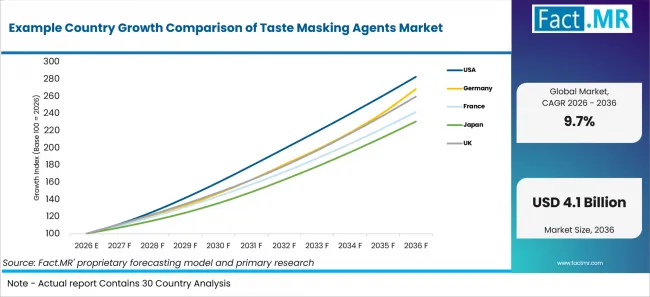
Example Country Growth Comparison Of Taste Masking Agents Market | Source: Fact.MR
| Country | CAGR (2026-2036) |
|---|---|
| United States | 11.0% |
| Germany | 10.4% |
| United Kingdom | 10.0% |
| France | 9.2% |
| Japan | 8.7% |
What supports USA adoption?
11.0% CAGR, supported by supplement use, food spending and oral dosage reformulation.
The USA has several entry points for taste masking agents across beverages, supplements and oral products. BLS reported in July 2026 that the nonalcoholic beverages index increased 2.9% over the 12 months ending in June 2026. Beverage price pressure as increasing the commercial importance of cost-in-use and sensory performance in masking-system selection.
What is supporting Germany’s growth?
10.4% CAGR, led by food-manufacturing scale and processed-beverage demand.
Germany offers a large processed-food base for suppliers that can support clean sensory correction at scale. BVE reported in July 2026 that around 6,100 German food businesses generated EUR 240.8 billion in annual turnover. This industrial base as a broad addressable channel for masking systems used in reduced-sugar drinks, high-protein products and botanical nutrition lines.
What supports the United Kingdom’s growth?
10.0% CAGR, backed by nutrition-policy reformulation and food manufacturing scale.
The UK outlook is tied to food manufacturing scale and nutrition-led reformulation. ONS reported in July 2026 that food manufacture represented 22.9% of total UK manufacturers' sales in 2025. This manufacturing base as supportive of sweetness-balancing and off-note-control applications in beverages, nutritional products and better-for-you foods.
How is France developing demand?
9.2% CAGR, shaped by agri-food SMEs and premium formulation needs.
France has a broad agri-food base where small and mid-sized manufacturers need practical sensory support. USDA FAS reported in 2026 that the French food industry comprised approximately 17,000 companies in 2025, nearly 98% of which were small- and medium-sized enterprises (SMEs). France’s SME-heavy food-processing structure to support demand for ready-to-use sensory solutions across botanical, mineral and plant-protein formulations.
How does Japan perform?
8.7% CAGR, led by health-food, soft-drink and oral-medicine applications.
Japan’s demand is concentrated in health-oriented foods, soft drinks and oral products where subtle flavor balance is commercially valuable. USDA FAS reported on April 1, 2026 that Japan’s food processing sector contracted 3% in 2025 to USD 174 billion, while soft drinks and health foods were among the areas showing growth.
Who leads the Taste Masking Agents Market?
Givaudan is active in taste masking through flavor and taste-modulation solutions for functional beverages, high-protein products and wellness-oriented applications. Its GLP-1 solutions page cites Givaudan consumer research from 2025 and describes mineral off-note masking as well as taste masking for high-protein bitterness and astringency.
IFF participates through FLAVORFIT™ Masking, which targets bitterness, astringency, sourness, metallic linger and plant-protein off-notes. dsm-firmenich supports pharmaceutical applications with bitterness-management technologies, including ModulaSENSE® Bitter, while Kerry Group offers Tastesense™ solutions spanning masking, sweetness and salt modulation within its broader taste-modulation platform.
Symrise showcased taste solutions for plant-based yoghurt, cheese, milk drinks and vegan meat alternatives at the Bridge2Food Course & Summit Europe in June 2025. Sensient Technologies is active through PureMask™, a portfolio designed to address off-note challenges including bitterness, astringency, metallic notes, chalkiness and sourness. Across these suppliers, competitive differentiation includes targeted off-note control, sensory and analytical capabilities, and application support across food, nutrition and pharmaceutical formulations.
Which companies are the key providers?
Key companies include Givaudan; IFF; dsm-firmenich; Kerry Group; Symrise; and Sensient Technologies.
- Givaudan
- IFF
- dsm-firmenich
- Kerry Group
- Symrise
- Sensient Technologies
Bibliography
- Stierman, B., Couch, C. A., Gahche, J. J., & Mishra, S. (2026, May). Dietary supplement use: United States, August 2021–August 2023 (NCHS Data Brief No. 561). National Center for Health Statistics.
- U.S. Bureau of Labor Statistics. (2026, July 14). Consumer Price Index—June 2026.
- Zeballos, E., & Sinclair, W. (2026, June 11). Total U.S. food spending reached $2.51 trillion in 2025. U.S. Department of Agriculture, Economic Research Service.
- U.S. Food and Drug Administration. (2025, June). Recommendations for complying with over-the-counter monograph procedure for minor changes C001: Minor changes to solid oral dosage forms for certain over-the-counter monograph drugs: Draft guidance for industry.
- Department of Health and Social Care. (2026, January 5). Landmark junk food ad ban to protect kids’ health.
- Kerry. (2025, September 30). Kerry launches Smart Taste™ to help customers navigate market complexities without compromising on taste.
- dsm-firmenich. (2026, March 19). dsm-firmenich launches ModulaSENSE® Bitter – a novel taste modulation technology to enhance drug palatability.
- Bundesvereinigung der Deutschen Ernährungsindustrie e. V. (2026, July 9). Ernährungsindustrie.2026.
- Office for National Statistics. (2026, July 24). UK manufacturers’ sales by product: 2025.
- U.S. Department of Agriculture, Foreign Agricultural Service. (2026, April 3). Food processing ingredients annual: France (GAIN Report No. FR2026-0003).
- U.S. Department of Agriculture, Foreign Agricultural Service. (2026, April 1). Food processing ingredients annual: Japan (GAIN Report No. JA2026-0012).
- Symrise. (2025, June 2). Symrise showcases future-forward taste solutions for plant-based products at Bridge2Food Course & Summit Europe 2025.
This Report Answers
- The report explains where taste masking agents are used across technology, off-note target, active format and application.
- Segment analysis identifies the leading subsegments and the commercial reasons formulators prioritize them.
- Country analysis examines the listed markets and the formulation, food-manufacturing and policy mechanisms supporting adoption.
- Competitive analysis reviews active providers across flavor modulation, receptor-based bitterness blocking, plant-protein masking and pharma taste systems.
- Application analysis assesses how bitterness, metallic notes, astringency and plant-protein aftertaste influence supplier selection.
What does the Taste Masking Agents Market cover?
The Taste Masking Agents Market covers ingredient systems that improve palatability by reducing, blocking or rebalancing unwanted notes in finished products. Taste modulation solutions helps frame the broader sensory-correction category around sweetness, salt and flavor balance.
The assessment covers food, beverage, dietary supplement and oral pharmaceutical uses. It also links to adjacent work on protein flavor masking agents, plant protein off-note masking systems and aftertaste masking agents where protein and lingering-note problems require specialized sensory correction.
What is included in the scope?
The scope includes flavor modulation systems, encapsulated masking agents, receptor and bitterness blockers, sweetness-balancing systems, adsorption or complexation technologies and custom premixes.
It includes liquid systems, powders, natural botanical modulators and encapsulated systems used by nutritional beverage, dietary supplement, plant-based food, pharmaceutical and functional confectionery formulators.
What is excluded from the scope?
The scope excludes standard flavors sold only for aroma or taste identity, bulk sweeteners, finished beverages, finished supplements and finished drug products. Flavors and fragrances coverage is broader than the masking-agent boundary used here.
General formulation aids are outside scope when they lack a defined taste-masking or taste-modulation function. Sodium-reduction tools are included only when they act as taste systems.
How Was the Analysis Built?
The analysis draws on 120+ sources, 35+ company portfolios, 25+ countries, and more than 20 industry interviews.
- Primary Research: Primary research includes discussions with manufacturers, service providers, technology developers, distributors, end users, and subject-matter experts. These conversations examine purchasing priorities, product adoption, operational challenges, approval requirements, competitive positioning, and the factors that influence wider market acceptance.
- Desk Research: Desk research covers government statistics, regulatory publications, company filings, trade data, technical studies, industry associations, standards, public policy, and other authoritative sources. Every source used in the analysis is documented in the bibliography.
- Market Sizing and Forecasting: Market estimates combine historical performance, demand indicators, pricing and volume trends, segment shares, company participation, country-level growth, adoption patterns, investment activity, and barriers to market expansion.
- Data Validation and Update Cycle: Findings are validated by comparing primary interviews with public data, company activity, regulatory changes, trade patterns, and industry developments. Regular updates review new product launches, capacity changes, partnerships, approvals, and shifts in commercial adoption.
What is the report’s scope and coverage?
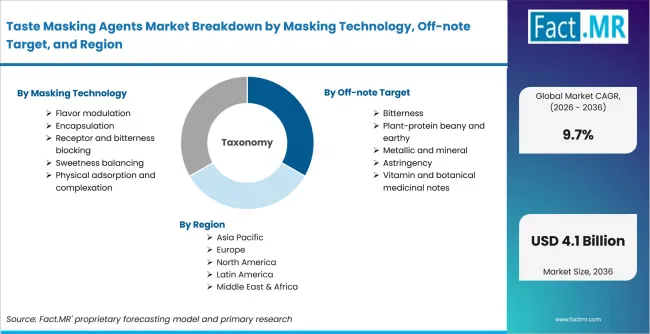
Taste Masking Agents Market Breakdown By Masking Technology, Off Note Target, And Region | Source: Fact.MR
| Attribute | Details |
|---|---|
| Quantitative Units | USD billion |
| Market Definition | Ingredient systems used to reduce or rebalance undesirable taste notes in food, beverages, dietary supplements and oral pharmaceutical products. The scope includes flavor modulation, encapsulation, receptor and bitterness blocking, sweetness balancing, and adsorption or complexation systems. |
| Masking Technology | Flavor modulation; Encapsulation; Receptor and bitterness blocking; Sweetness balancing; Physical adsorption and complexation |
| Off-note Target | Bitterness; Plant-protein beany and earthy notes; Metallic and mineral notes; Astringency; Vitamin and botanical medicinal notes |
| Active Format | Liquid flavor system; Dry powder; Encapsulated system; Natural botanical modulator; Custom premix |
| Application | Nutritional beverages; Dietary supplements; Plant-based foods; Pharmaceuticals; Functional confectionery and other |
| Regions Covered | North America; Latin America; Western Europe; Eastern Europe; East Asia; South Asia & Pacific; Middle East & Africa |
| Countries Covered | United States; Germany; United Kingdom; France; Japan |
| Key Companies Profiled | Givaudan; IFF; dsm-firmenich; Kerry Group; Symrise; Sensient Technologies |
| Forecast Period | 2026 to 2036 |
| Approach | Hybrid top-down and bottom-up approach using food and beverage reformulation demand, supplement use, oral-dose formulation needs, segment mix, country indicators and provider portfolio review. |
How is the market segmented?
-
By Masking Technology
- Flavor modulation
- Encapsulation
- Receptor and bitterness blocking
- Sweetness balancing
- Physical adsorption and complexation
-
By Off-note Target
- Bitterness
- Plant-protein beany and earthy notes
- Metallic and mineral notes
- Astringency
- Vitamin and botanical medicinal notes
-
By Active Format
- Liquid flavor system
- Dry powder
- Encapsulated system
- Natural botanical modulator
- Custom premix
-
By Application
- Nutritional beverages
- Dietary supplements
- Plant-based foods
- Pharmaceuticals
- Functional confectionery and other
-
By Region
- North America
- Latin America
- Western Europe
- Eastern Europe
- East Asia
- South Asia & Pacific
- Middle East & Africa