- Base Value(2026): 10.4 Bn
- Estimated Value(2026): 10.4 Bn
- Forecast Value (2036): 27.6 Bn
- CAGR (2026 - 2036): 10.3%
Thermal Energy Storage Market Overview, Growth Outlook, and Forecast By Fact.MR
- Global Thermal Energy Storage Market revenue stood at USD 9.4 Bn in 2025 and is forecast to reach USD 27.6 Bn by 2036.
- At a 10.3% CAGR from 2026 to 2036, this market is set to expand ~2.7x in value, adding USD 2.7 Bn in absolute opportunity.
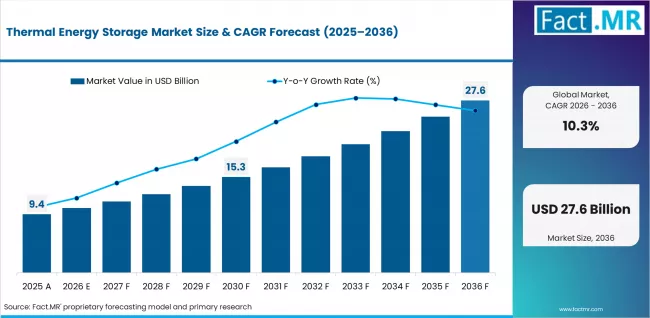
Thermal Energy Storage Market Value Analysis | Source: Fact.MR
Summary of Thermal Energy Storage Market
- Demand and Growth Drivers
- Increasing integration of renewable energy sources such as solar and wind is driving demand for thermal energy storage systems to balance energy supply fluctuations.
- Growing emphasis on decarbonization and energy efficiency is supporting adoption of energy storage solutions across utilities and industrial sectors.
- Expansion of district heating and cooling networks is increasing demand for medium- and long-duration thermal storage systems.
- Rising need for industrial waste heat recovery and process optimization is driving deployment of advanced thermal storage technologies.
- Increasing investments in smart grids and energy infrastructure modernization are supporting long-term market growth.
- Advancements in thermal storage materials and system design are improving efficiency and scalability.
- Product and Segment View
- Sensible heat storage holds 52% share of storage type segment, driven by cost-effectiveness and widespread use in large-scale applications.
- Latent heat storage (PCM) accounts for 28% share, supported by higher energy density and efficiency.
- Thermochemical storage represents 20% share, reflecting growing adoption in advanced energy storage applications.
- Active TES systems dominate with 72% share by technology, supported by better control and integration with energy systems.
- Passive TES systems account for 28% share, widely used in building energy efficiency applications.
- Medium-duration storage holds 45% share by storage duration, driven by demand in heating, cooling, and industrial applications.
- Long-duration storage accounts for 30% share, supported by renewable energy integration needs.
- Short-duration storage contributes 25% share, primarily used in peak load management.
- Geography and Competitive Outlook
- Europe and North America represent key markets supported by strong renewable energy adoption and energy efficiency initiatives.
- Asia Pacific is witnessing rapid growth driven by industrialization, urbanization, and expansion of energy infrastructure.
- China and India are emerging as high-growth markets due to increasing investments in renewable energy and grid modernization.
- Market growth is influenced by advancements in phase change materials (PCM), thermochemical storage systems, and integration with smart energy systems.
- Key companies active in this market include Siemens Energy, Veolia, Trane Technologies, Baltimore Aircoil Company, and Ice Energy.
- Analyst Opinion
- Shambhu Nath Jha, Principal Consultant at Fact.MR, says, “The thermal energy storage market is no longer defined solely by conventional heat storage methods and basic energy balancing applications. Growth is increasingly driven by the rapid integration of renewable energy sources, rising demand for grid stability and decarbonization, and the shift toward advanced, long-duration storage technologies that enhance energy efficiency, optimize load management, and support sustainable power and industrial energy systems.
Thermal Energy Storage Market— At a Glance
| Attribute | Details |
|---|---|
| Market Value 2025 | USD 9.4 billion |
| Market Value 2036 | USD 27.6 billion |
| Absolute Dollar Opportunity | USD 17 billion |
| CAGR | 10.3% |
| Growth Multiple | 2.7x |
| Key Demand Theme | Increasing demand for energy storage solutions supporting renewable integration and efficiency |
| Leading Storage Type | Sensible Heat Storage |
| Segment Share | 52% |
| Leading Technology | Active TES Systems |
| Segment Share | 72% |
| Leading Storage Duration | Medium Duration |
| Segment Share | 45% |
| Leading Application | Power Generation |
| Segment Share | 34% |
| Leading End-use Industry | Utilities |
| Segment Share | 38% |
| Key Growth Regions | Europe, North America, Asia Pacific |
| Key Companies | Siemens Energy, Veolia, Trane Technologies, Baltimore Aircoil, Ice Energy |
| Segmentation by Storage Type | Sensible Heat Storage, Latent Heat Storage (PCM), Thermochemical Storage |
| Segmentation by Technology | Active TES Systems, Passive TES Systems |
| Segmentation by Storage Duration | Short Duration, Medium Duration, Long Duration |
| Segmentation by Application | Power Generation, Heating & Cooling, Industrial Process Heat, Energy Management |
| Segmentation by End-use Industry | Utilities, Industrial, Commercial, Residential |
| Segmentation by Region | North America, Latin America, Europe, East Asia, South Asia & Pacific, Middle East & Africa |
Source: Fact.MR analysis. Updated May 7, 2026
Key Growth Drivers, Constraints, and Opportunities
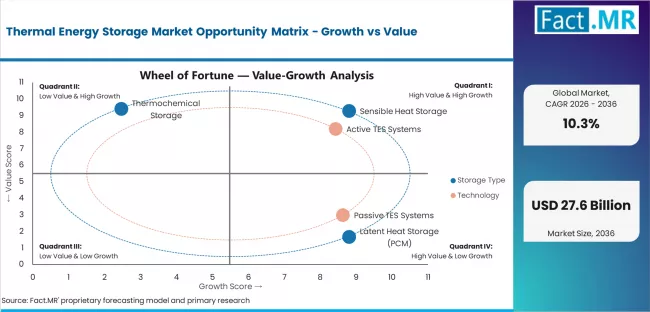
Thermal Energy Storage Market Opportunity Matrix Growth Vs Value | Source: Fact.MR
Key Factors Driving Growth
- The growing use of renewable energy sources such as solar and wind is causing the need for thermal energy storage systems due to the variable nature of their power output.
- Increased emphasis on energy efficiency and decarbonization in industries and businesses will cause more installations of thermal energy storage systems.
- The increasing implementation of district heating/cooling infrastructures and smart energy networks is expected to result in greater usage of long-duration energy storage facilities.
| Growth Driver | Demand Impact | Time Horizon | Key Impact Area | Fact.MR Insight |
|---|---|---|---|---|
| Rapid expansion of renewable energy capacity and grid integration needs | High | Short-Mid Term | Energy storage deployment | Increasing solar and wind installations are driving demand for TES to enable grid stability and energy balancing |
| Growth of industrial heat electrification and decarbonization initiatives | High | Short-Mid Term | Industrial adoption | Rising shift from fossil fuels to clean heat solutions is accelerating TES deployment in energy-intensive industries |
| Increasing regulatory support and net-zero commitments | High | Short-Mid Term | Policy-driven adoption | Government mandates and carbon reduction targets are pushing adoption of TES across utilities and industrial sectors |
| Advancements in long-duration and thermochemical storage technologies | Medium-High | Mid-Long Term | Technology transformation | Emerging high-efficiency storage solutions are enhancing performance and enabling wider industrial and seasonal applications |
| Rising investments in district energy systems and urban infrastructure | Medium | Short-Mid Term | Infrastructure expansion | Expansion of district heating and cooling networks is boosting TES integration in commercial and residential sectors |
Source: Fact.MR analysis. Updated May 7, 2026
Key Market Constraints
- Higher cost barriers associated with large-scale thermal energy storage infrastructure might prevent adoption in some markets.
- Possible issues with efficiency losses, heat losses, and the longevity of components in such facilities could affect their performance negatively.
- Lack of knowledge of thermal storage systems and uncertain policies in some regions may hinder further development of these systems.
Key Opportunity Areas
- The increasing interest in grid modernization and renewable energy sources is causing a high demand for long-duration thermal energy storage facilities.
- Growing implementation of industrial waste heat recovery systems could provide an opportunity for the deployment of new thermal energy storage systems.
- Developments in phase change materials, thermochemical storage, and high-efficiency designs are enabling the development of next-generation thermal energy storage systems.
Segment-wise Analysis of the Thermal Energy Storage Market
- By the year 2026, sensible heat storage accounts for a 52% market share of the storage type segment due to its technological maturity, cost-effectiveness, and widespread adoption in molten salt and water-based TES systems for large-scale energy storage applications.
- Power generation represents a 34% market share of the application segment by 2026, driven by increasing deployment of concentrated solar power (CSP) plants and the need for grid stability through renewable energy integration and dispatchable energy supply.
The segmentation of the Thermal Energy Storage Market includes storage type, technology, storage duration, application, end user, and region. On the basis of storage type, the Thermal Energy Storage Market is categorized as sensible heat storage, latent heat storage (PCM), and thermochemical storage. On the basis of technology, the market is segmented as active TES systems and passive TES systems. By storage duration, it includes short duration, medium duration, and long duration systems. Based on application, it includes power generation, heating and cooling, industrial process heat, and energy management. Based on end user, the market includes utilities, industrial, commercial, and residential.
Which Storage Type Dominates the Thermal Energy Storage Market?
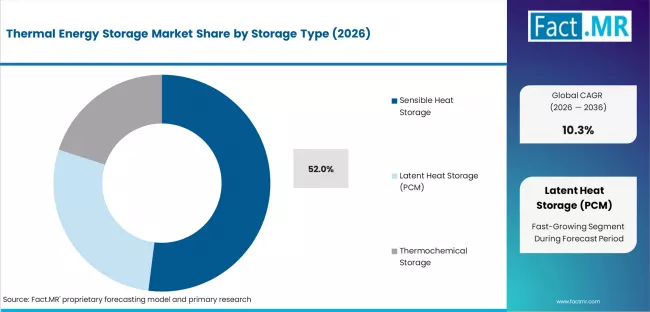
Thermal Energy Storage Market Analysis By Storage Type | Source: Fact.MR
Sensible heat storage technology dominates with the highest market share of 52% in 2026. It is due to technology’s maturity, effectiveness in cost reduction, and the widespread usage of such technologies as molten salt and water-based systems in large-scale applications like CSP and district energy system. Such technologies have proven themselves effective for storage across broad temperature ranges and require reliable storage. Latent heat storage (PCMs) will have 28% of shares due to high energy density and compactness. Thermochemical storage represents 20%, but it remains at an early stage.
Which Technology Dominates the Thermal Energy Storage Market?
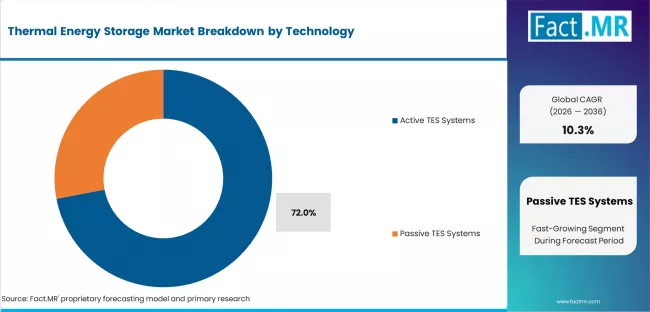
Thermal Energy Storage Market Analysis By Technology | Source: Fact.MR
The majority of technologies in the market are active TES systems. Active thermal energy storage systems can be found in almost all utility-scale and industrial projects because they allow controlling the heat transfer, provide efficient energy storage, and flexible control of heat exchange. Passive TES systems comprise 28% of the market in 2026, which results from the installation of passive systems in HVAC systems and in buildings. Active TES technologies are more expensive than passive; however, active systems have a wider application scope.
Which Storage Duration Leads the Thermal Energy Storage Market?
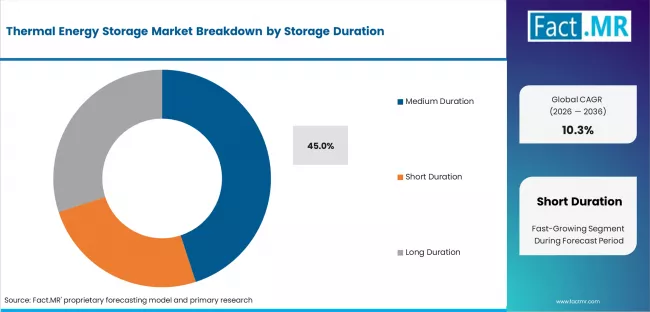
Thermal Energy Storage Market Analysis By Storage Duration | Source: Fact.MR
Medium-duration systems lead with the highest share of 45% in 2026. They are effective in daily energy shifting and have high demand in industrial sectors. Medium-duration storage is the best option that is able to achieve a balance between performance and cost. Moreover, long-duration systems comprise 30% of the market because of their increased demand due to seasonal applications and industrial uses. Lastly, short-duration thermal storage accounts for 25% in 2026 because of their presence in HVAC and cooling applications.
Which Application Drives the Thermal Energy Storage Market?
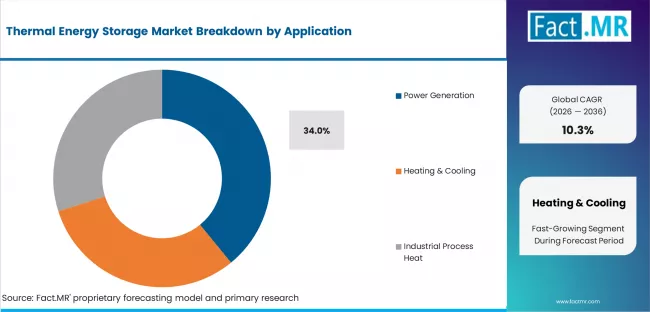
Thermal Energy Storage Market Analysis By Application | Source: Fact.MR
Power generation represents 34% of the TES market in 2026. Power generation requires TES technology for grid stabilization and energy dispatching in concentrated solar power plant. Heating and cooling application comprises 27% of the market in 2026 due to the increasing need for energy shifting in district energy networks and buildings. The next most popular application is industrial process heat, with 26% market share in 2026, due to rising implementation for energy-saving purposes and industry decarbonization. Lastly, energy management accounts for 13%.
Which End User Dominates the Thermal Energy Storage Market?
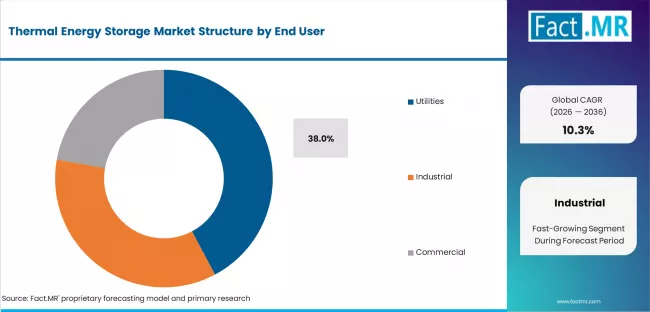
Thermal Energy Storage Market Analysis By End User | Source: Fact.MR
Utilities represent the highest market segment, reaching 38% of the TES market in 2026 because of the extensive use of TES in grid energy balancing and renewable energy integration. The second-largest segment belongs to industries and reaches 32% of the market share in 2026 because of growing implementation of TES in process heat applications and energy savings in energy-intensive industries. Lastly, the residential and commercial segments comprise 10% and 20% respectively.
Regional Outlook Across Key Markets
The market analysis covers key global regions, including South Asia and Pacific, Middle East & Africa, North America, Latin America, Western Europe, and Eastern Europe. It is segmented geographically, with specific market dynamics for each region. The full report provides a detailed market attractiveness analysis.
.webp "Top Country Growth Comparison Thermal Energy Storage Market Cagr (2026 2036)")
Top Country Growth Comparison Thermal Energy Storage Market Cagr (2026 2036) | Source: Fact.MR
CAGR Table
| Country | CAGR (%) |
|---|---|
| Germany | 8.4% |
| U.S. | 9.0% |
| Japan | 9.4% |
| U.K. | 9.8% |
| China | 10.8% |
| India | 11.6% |
| KSA | 12.3% |
Source: Fact.MR analysis. Updated May 7, 2026
Source: Fact MR (FMR) analysis, based on proprietary forecasting model and primary research.
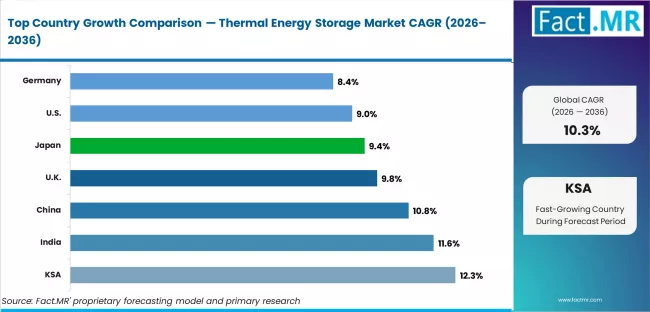
Thermal Energy Storage Market Cagr Analysis By Country | Source: Fact.MR
North America – The Innovation and Early Adoption Hub
North America acts as the innovation hub for advanced TES technologies, driven by strong policy support and private sector investments. The region benefits from early adoption of grid-scale storage and industrial electrification initiatives. Key players such as Burns & McDonnell, CALMAC Corporation, and Ice Energy maintain strong competitive positioning through engineering expertise and commercial HVAC storage solutions.
U.S.: Demand for thermal energy storage in U.S. is projected to rise at 9.0% CAGR through 2036.
Growth is supported by federal and state-level clean energy programs. The U.S. Department of Energy (DOE, March 2025) expanded funding under its Long Duration Storage initiative, accelerating TES deployment [1]. Additionally, California Energy Commission (January 2025) mandated increased storage integration in grid planning, promoting TES adoption for peak load management [2]. Industrial players are also investing in TES to reduce demand charges, particularly in high-energy-consuming sectors such as manufacturing and data infrastructure.
Western Europe – The Global Regulatory Laboratory
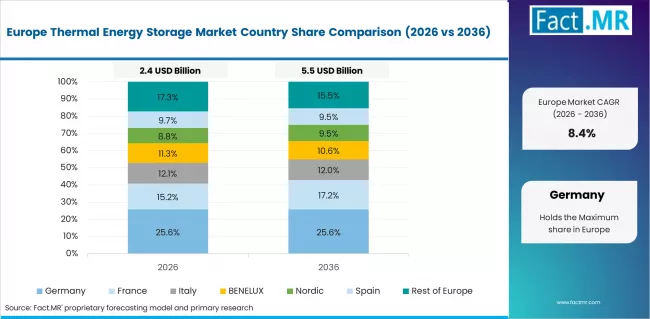
Thermal Energy Storage Market Europe Country Market Share Analysis, 2026 & 2036 | Source: Fact.MR
Western Europe represents the global regulatory laboratory for TES adoption, characterized by stringent decarbonization policies and extensive district heating networks. Companies such as Siemens Energy, Aalborg CSP, and EnergyNest lead through integrated solutions and strong regional presence.
Germany: Demand for thermal energy storage in Germany is projected to rise at 8.4% CAGR through 2036.
Growth is driven by energy transition policies. The Federal Ministry for Economic Affairs and Climate Action (BMWK, February 2025) expanded funding for industrial heat decarbonization projects, including TES integration [3]. Additionally, Germany’s District Heating Act update (April 2025) mandates renewable integration in heating networks, boosting TES adoption [4]. However, market maturity and infrastructure saturation slightly moderate growth compared to emerging markets.
East Asia – The Manufacturing and Deployment Powerhouse
East Asia functions as the global deployment powerhouse, driven by large-scale renewable projects and industrial expansion. Regional leaders such as Shanghai Electric, Sumitomo Corporation, and Mitsubishi Heavy Industries dominate through large-scale project execution and manufacturing capabilities.
China: Demand for thermal energy storage in China is projected to rise at 10.8% CAGR through 2036.
The National Energy Administration (NEA, January 2025) mandated increased deployment of CSP with storage, directly boosting TES demand. Additionally, China’s 14th Five-Year Renewable Plan update (March 2025) emphasizes long-duration storage technologies. Large-scale solar thermal projects and industrial heat applications are key drivers, supported by state-backed investments.
South Asia & Pacific – The Fastest-Growing Demand Frontier
South Asia & Pacific is emerging as the fastest-growing TES demand frontier, fueled by rapid industrialization and rising cooling demand. Regional activity is supported by increasing investments in renewable energy and infrastructure development.
India: Demand for thermal energy storage in India is projected to rise at 11.6% CAGR through 2036.
Growth is driven by national energy transition policies. The Ministry of New and Renewable Energy (MNRE, January 2025) expanded incentives for solar thermal and storage integration [5]. Additionally, Bureau of Energy Efficiency (April 2025) introduced guidelines promoting TES in industrial and commercial buildings [6]. Rising cooling demand and industrial heat electrification are key contributors.
Middle East & Africa – The Solar-Driven Growth Engine
The Middle East & Africa region acts as a solar-driven growth engine, leveraging high solar irradiance and large-scale infrastructure investments. Key players such as ACWA Power, Masdar, and Abengoa are central to project development and execution.
Saudi Arabia (KSA): Demand for thermal energy storage in Saudi Arabia (KSA) is projected to rise at 12.3% CAGR through 2036.
Growth is supported by national energy diversification strategies. The Saudi Ministry of Energy (February 2025) accelerated renewable project tenders under Vision 2030, including CSP with TES. Additionally, ACWA Power (June 2025) announced new solar thermal projects incorporating molten salt storage. High cooling demand and grid stability requirements further drive TES adoption.
Fact.MR’s analysis of the thermal energy storage market across regions highlights a comprehensive country-wise assessment covering North America, Western Europe, East Asia, South Asia & Pacific, and the Middle East & Africa. The report provides detailed insights into regional growth differentials, policy frameworks, technology adoption trends, and investment patterns. Readers can find actionable intelligence on demand distribution, competitive positioning, and emerging opportunities across both mature and high-growth markets shaping the global TES landscape.
Competitive Benchmarking and Company Positioning
Leading Companies Shaping the Thermal Energy Storage Market
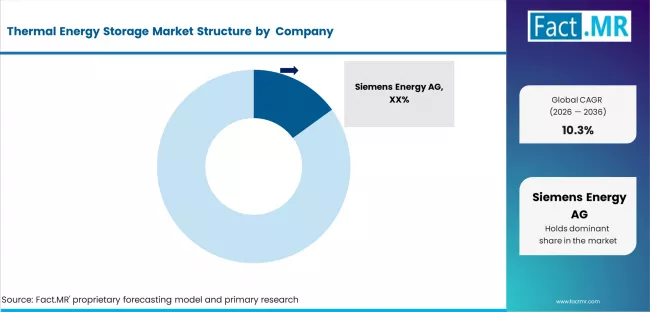
Thermal Energy Storage Market Analysis By Company | Source: Fact.MR
The Thermal Energy Storage market is moderately fragmented, with top players like Siemens Energy, Aalborg CSP, and Trane Technologies collectively holding ~40–55% share. Competition is driven by efficiency, cost per kWhₜ, and project execution. EPC players such as Siemens Energy and Burns & McDonnell gain advantage through integrated capabilities, while specialists like EnergyNest focus on niche industrial applications. Buyers, mainly utilities and industrial firms, adopt multi-vendor strategies and competitive bidding, limiting pricing power. However, companies with proven performance and integrated solutions retain an edge in securing large-scale and high-value contracts.
Key Players of the Thermal Energy Storage Market
- Siemens Energy AG
- Aalborg CSP A/S
- BrightSource Energy Inc.
- Baltimore Aircoil Company
- Burns & McDonnell
- Trane Technologies plc
- EVAPCO, Inc.
- Steffes LLC
- Ice Energy
- ENERGYNEST AS
Recent Industry Developments
- Brenmiller Energy Ltd. signs MOU to expand TES deployment in Japan (June 2025): Brenmiller Energy entered into a strategic collaboration with a major Japanese engineering company to deploy its thermal energy storage systems for industrial decarbonization and replace fossil-fuel-based heating solutions.
- EnergyNest AS signs commercial agreement for industrial TES deployment (March 2025): EnergyNest partnered with LEONHARD KURZ to implement a power-to-heat solution using thermal storage, targeting decarbonization of industrial manufacturing processes.
- EnergyNest AS launches industrial TES project at LEONHARD KURZ site (July 2025): EnergyNest initiated a large-scale thermal storage installation project, marking a key milestone in scaling industrial heat decarbonization through TES technology.
Sources and Research References
- [1] U.S. Department of Energy, Long Duration Energy Storage Initiative Funding Update, March 2025,
- [2] California Energy Commission, Integrated Resource Planning and Storage Mandate Update, January 2025,
- [3] Federal Ministry for Economic Affairs and Climate Action (BMWK), Industrial Decarbonization Funding Program Expansion, February 2025,
- [4] German Federal Government, District Heating Act Amendment and Renewable Integration Guidelines, April 2025,
- [5] Ministry of New and Renewable Energy (MNRE), Solar Thermal and Energy Storage Incentive Expansion, January 2025,
- [6] Bureau of Energy Efficiency (BEE), Guidelines for Energy Storage Integration in Industrial and Commercial Buildings, April 2025,
- [7] Brenmiller Energy Ltd., Brenmiller Energy Signs Memorandum of Understanding to Advance Thermal Energy Storage Deployment in Japan, June 2025
- [8] EnergyNest AS, EnergyNest Partners with LEONHARD KURZ for Industrial Thermal Energy Storage Deployment, March 2025
- [9] EnergyNest AS, EnergyNest Launches Industrial Thermal Energy Storage Project at LEONHARD KURZ Site, July 2025
Thermal Energy Storage Market Definition
The thermal energy storage market is defined as the market dealing with energy storage systems or materials designed to hold thermal energy or cold energy. Thermal energy storage systems capture and store thermal energy generated by sources like solar energy, industries, or electricity for usage at some future point in time. They have been primarily designed to provide benefits such as improved energy efficiency, balance between energy supply and demand, and renewable energy integration.
Thermal Energy Storage Market Inclusions
The current report provides global and regional estimates of the thermal energy storage systems market, along with future forecasts up till 2036. Market segmentation is done based on technology, storage type, storage duration, application, and end-use industry. The analysis is conducted for the trends in demand, technology usage, regional growth drivers, and others. Other details provided include competition analysis and price trend analysis among others, along with assessment of major factors impacting market growth.
Thermal Energy Storage Market Exclusions
Scope of this report excludes storage of electrical energy, like lithium-ion batteries, flow batteries, etc. unless coupled with the storage of thermal energy in any way. This report does not consider standalone equipment for heating or cooling purposes like boilers and chillers among others. Only thermal energy storage systems used for storing thermal energy are included in the scope.
Thermal Energy Storage Research Methodology
- Primary Research
- Interviews were held with energy providers, companies manufacturing thermal storage systems, EPC firms, energy management professionals in industries, and technology experts for opinions on adoption patterns, efficiency of thermal storage, and the outlook on investments in the sector.
- Desk Research
- Secondary research involved examining energy reports by governments, renewable energy databases, company records, industry periodicals, and energy storage and decarbonization policy documents.
- Market-Sizing and Forecasting
- The use of a mixed strategy that involves analyzing the energy market from top down and revenues of the firms from bottom up was applied to forecast market size and growth projections.
- Data Validation and Update Cycle
- All findings were verified through triangulation, and data was updated periodically to capture changes in energy policies, technological breakthroughs, and market developments.
Segmentation
Scope of Analysis
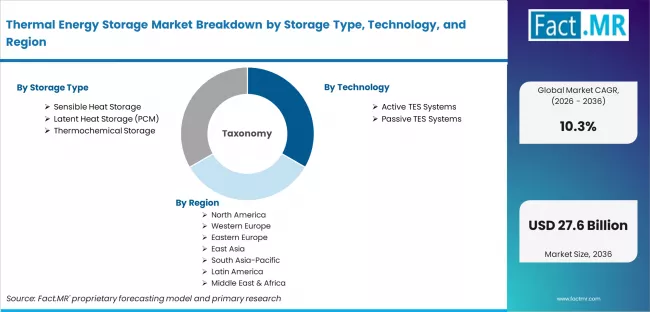
Thermal Energy Storage Market Breakdown By Storage Type, Technology, And Region | Source: Fact.MR
| Parameter | Details |
|---|---|
| Quantitative Units | USD 10.4 billion in 2025 to USD 27.6 billion in 2036, at a CAGR of 10.3% |
| Market Definition | Thermal Energy Storage (TES) refers to technologies that store heat or cold for later use, enabling energy efficiency, renewable integration, peak load shifting, and decarbonization across power, industrial, and building applications. |
| Regions Covered | North America, Latin America, Europe, East Asia, South Asia and Pacific, MiddleEastand Africa |
| Countries Covered | USA, Canada, UK, Germany, China, India, 30 plus countries |
| Key Companies | Siemens Energy AG, Aalborg CSP A/S, BrightSource Energy Inc, Baltimore Aircoil Company, Burns & McDonnell, Trane Technologies plc, EVAPCO, Inc., Steffes LLC, Ice Energy, ENERGYNEST AS |
| Forecast Period | 2026 to 2036 |
| Approach | Hybrid demand-side and top-downmethodologybuilt on country-level application demand, product benchmarking, pricing analysis, shipment validation, and primary interviews across manufacturers, distributors, retailers, and end users |
Source: Fact.MR analysis. Updated May 7, 2026
Analysis by Storage Type, by Technology, by Storage Duration, by Sequencing Type, by Application, End User and by Region
-
Thermal Energy Storage Market by Storage Type
- Sensible Heat Storage
- Molten Salt Storage
- Water-Based Storage
- Solid Media Storage
- Latent Heat Storage (PCM)
- Organic PCM
- Inorganic PCM
- Eutectic PCM
- Thermochemical Storage
- Sorption Storage
- Chemical Reaction Storage
- Sensible Heat Storage
-
Thermal Energy Storage Market by Technology
- Active TES Systems
- Direct Systems
- Indirect Systems
- Passive TES Systems
- Building-Integrated Systems
- Material-Integrated Systems
- Active TES Systems
-
Thermal Energy Storage Market by Storage Duration
- Short Duration
- Medium Duration
- Long Duration
-
Thermal Energy Storage Market by Application
- Power Generation
- Heating & Cooling
- Industrial Process Heat
- Energy Management
-
Thermal Energy Storage Market by End User
- Utilities
- Industrial
- Commercial
- Residential
-
Thermal Energy Storage Market by Region
- North America
- USA
- Canada
- Mexico
- Latin America
- Brazil
- Chile
- Rest of LATAM
- East Asia
- China
- Japan
- South Korea
- Western Europe
- Germany
- Italy
- France
- U.K.
- Spain
- BENELUX
- Nordic
- Rest of W. Europe
- Eastern Europe
- Russia
- Hungary
- Poland
- Balkan & Baltics
- Rest of E. Europe
- South Asia & Pacific
- India
- ASEAN
- ANZ
- Rest of SAP
- Middle East and Africa
- Kingdom of Saudi Arabia
- United Arab Emirates
- South Africa
- Rest of Middle East and Africa
- North America
Frequently Asked Questions
How large is the demand for Thermal Energy Storage in the global market in 2026?
What will be the market size of Thermal Energy Storage in the global market by 2036?
What is the expected demand growth for Thermal Energy Storage in the global market between 2026 and 2036?
Which storage type is expected to dominate the market?
How significant is the growth outlook for India in this market?
What is the growth outlook for China in this report?
Which company is identified as a leading player in the Thermal Energy Storage market?
Who worked on this report


Preview the report firsthand - request a free sample
Free SampleGet the brochure for pricing and purchase details
Download PDF