The Toxicology Screening Systems Market is analyzed across its key product, application and end-use segments, with the study covering market dynamics, regional trends and demand outlook, forecast 2026 to 2036.
By Fact.MR Healthcare DeskFact-checked under the Fact.MR editorial processUpdated
10 min read
Toxicology Screening Systems Market Forecast and Outlook 2026 to 2036
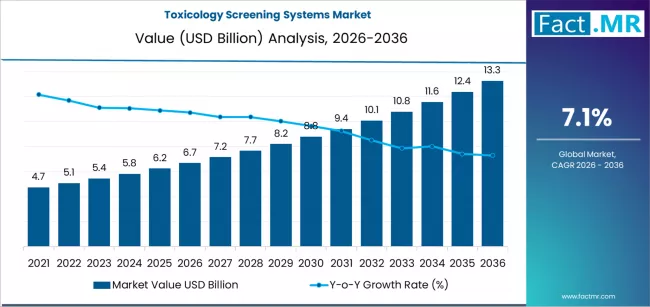
The global toxicology screening systems market is projected ttotal USD 6.68 billion in 2026, advancing to USD 13.25 billion by 2036, progressing at a 7.1% CAGR.
This expansion is driven by the escalating need for rapid and accurate substance detection across clinical, forensic, and workplace settings.
Toxicology Screening Systems Market Market Value Analysis | Source: Fact.MR
Summary of Toxicology Screening Systems Market
Market Snapshot
Global toxicology screening systems market revenue stood at USD 6.68 billion in 2026 and is forecast treach USD 13.25 billion by 2036.
At a 7.1% CAGR from 2026 t2036, this market is set texpand ~2.0x in value, adding USD 6.57 billion in absolute opportunity.
Growth is being driven by increasing drug abuse monitoring, workplace screening requirements, and expansion of clinical toxicology diagnostics globally.
Toxicology screening systems are increasingly adopted timprove rapid drug detection accuracy, laboratory efficiency, and regulatory compliance across healthcare and forensic settings.
Rising investments in diagnostic automation, workplace safety programs, and substance abuse monitoring infrastructure are reinforcing market expansion globally.
Demand and Growth Drivers
Increasing workplace and regulatory drug testing requirements globally
Rising prevalence of substance abuse and addiction monitoring programs
Growing adoption of automated toxicology and confirmatory testing systems
Expansion of forensic toxicology and emergency clinical diagnostics infrastructure
Need for solutions that provide:
Faster and moreaccuratetoxicology screening results
Improved laboratory throughput and workflow efficiency
Bettercompliance with workplace and healthcare regulations
Enhanced data integration and diagnostic traceability
Product and Segment View
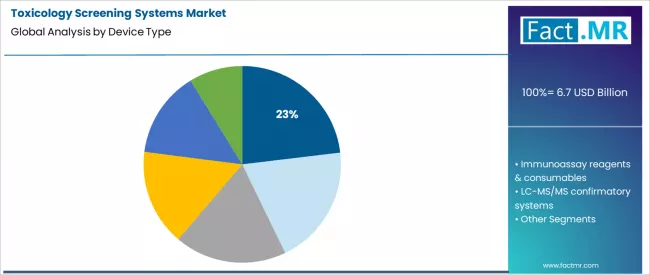
Immunoassayanalyzershold 23.1% of device type share in 2026,emergingas the leading segment.
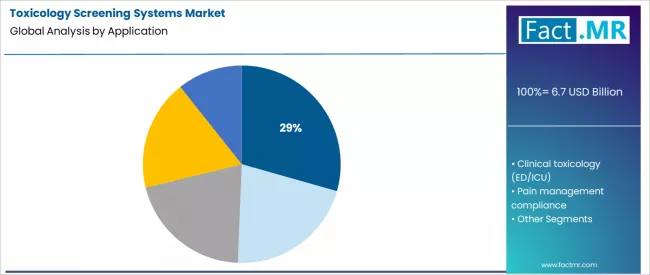
Workplace drug testing accounts for 29.4% of application share in 2026.
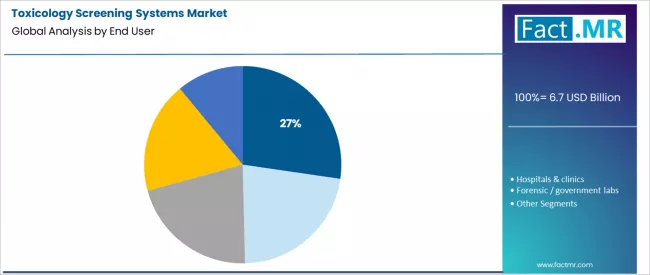
Reference laboratories hold 27.3% of end-user share in 2026, positioning them as the dominant segment.
Geography and Competitive Outlook
Growth is supported across North America, Europe, Asia Pacific.
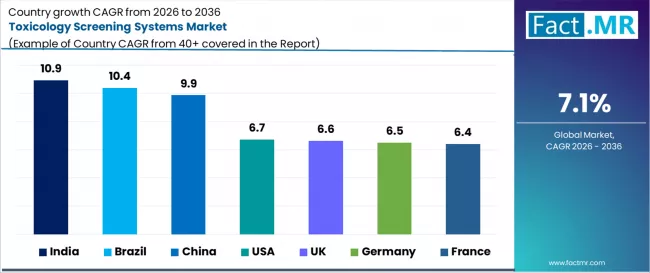
Key growth markets and CAGR: India 10.9%, Brazil 10.4%, China 9.9%, USA 6.7%, UK 6.6%, Germany 6.5%, France 6.4%
Market expansion is closely tied to:
Increasing workplace safety and compliance programs
Rising adoption of LC-MS/MS confirmatory toxicology systems
Growing automation and digital integration in diagnostic laboratories
Key companies active in this market include Abbott Laboratories, F. Hoffmann-La Roche Ltd, Siemens Healthineers,ThermoFisher Scientific Inc., and Beckman Coulter Inc.
Toxicology Screening Systems Market — At a Glance
Attribute
Details
Market Value 2026
USD 6.68 billion
Market Value 2036
USD 13.25 billion
Absolute Dollar Opportunity 2026–2036
USD 6.57 billion
Total Growth 2026–2036
98.4%
CAGR 2026–2036
7.1%
Growth Multiple
~2.0x
Key Demand Theme
Increasing adoption of automated toxicology and drug screening diagnostics
Leading Segment by Device Type (2026)
ImmunoassayAnalyzers
Segment Share (2026)
23.1%
Leading Segment by Application (2026)
Workplace Drug Testing
Segment Share (2026)
29.4%
Leading Segment by End User (2026)
Reference Laboratories
Segment Share (2026)
27.3%
Key Growth Regions
North America, Europe, Asia Pacific
Country CAGRs
India 10.9%, Brazil 10.4%, China 9.9%, USA 6.7%, UK 6.6%, Germany 6.5%, France 6.4%
Top Companies
Abbott Laboratories, F. Hoffmann-La Roche Ltd, Siemens Healthineers,ThermoFisher Scientific Inc., Beckman Coulter Inc.
North America, Latin America, Western Europe, Eastern Europe, East Asia, South Asia & Pacific, Middle East & Africa
Immunoassay analyzers form the foundational device segment, providing the high-throughput initial screening essential for large sample volumes. Workplace drug testing remains the primary application, sustained by corporate safety policies and regulatory mandates. Reference laboratories represent the leading end-user segment, centralizing complex confirmatory testing using advanced LC-MS/MS systems. Geographic growth is accelerated in regions with expanding healthcare access and increasing regulatory focus on substance abuse, with India, Brazil, and China demonstrating the highest growth rates. The market’s evolution is tied ttechnological advancements that improve sensitivity, specificity, and workflow automation.
North America, Latin America, Western Europe, Eastern Europe, East Asia, South Asia & Pacific, Middle East & Africa
What Key Healthcare and Social Trends are Influencing Toxicology Testing Volumes?
The ongoing opioid epidemic and rising polysubstance abuse globally have permanently elevated the clinical necessity for rapid toxicology screens in emergency departments, directly increasing instrument and consumable utilization. The legalization of cannabis in various jurisdictions is transforming workplace drug testing protocols, requiring panels that distinguish between recent impairment and historical use, thereby fueling demand for more sophisticated confirmatory testing.
The growing emphasis on medication adherence and monitoring within pain management clinics creates a stable, recurring patient population requiring regular compliance testing. Finally, technological convergence is pushing the market toward integrated solutions that combine automated sample preparation, multi-analyte screening, and sophisticated data management software to meet the demand for higher efficiency and lower error rates in high-volume laboratories.
Segmental Analysis
By Device Type, Which Systems Form the High-Volume Frontline of Screening?
Toxicology Screening Systems Market Analysis By Device Type | Source: Fact.MR
Immunoassay analyzers command a leading 23.1% share. This segment’s position is based on its role as the primary, rapid screening tool for high-volume environments like workplace testing programs and hospital emergency departments.
These systems offer the speed and throughput necessary to process large batches of urine or serum samples, providing a cost-effective initial result that guides the need for more expensive confirmatory testing. Their recurring use, driven by standardized testing panels and consistent reagent consumption, establishes a steady demand stream.
By Application, Which Sector Implements the Most Standardized and Routine Testing?
Toxicology Screening Systems Market Analysis By Application | Source: Fact.MR
Workplace drug testing constitutes the primary application segment at 29.4%. Mandated by safety regulations across transportation, manufacturing, and corporate sectors, this application generates consistent, high-volume sample flow. The standardization of testing panels and strict chain-of-custody protocols necessitate reliable, high-throughput immunoassay systems followed by definitive LC-MS/MS confirmation, creating a dual-market demand that is less susceptible to economic fluctuations than other segments.
By End User, Which Facility Type Centralizes Complex Confirmatory Analysis?
Toxicology Screening Systems Market Analysis By End User | Source: Fact.MR
Reference laboratories hold a leading 27.3% share. These labs serve as the central hub for definitive testing, utilizing advanced LC-MS/MS and GC-MS systems to confirm presumptive positive results from clinics, workplaces, and hospitals.
Their investment in high-cost, low-throughput confirmatory instrumentation and specialized expertise is essential for legally defensible results, particularly in forensic and employment-related testing, making them a critical and high-value end-user.
What Dynamics will Influence the Growth of the Toxicology Screening Systems Market?
Attribute
Impact
Driver
Rising global substance abuse rates and the expanding opioid crisis, which increase testing volumes in clinical, forensic, and employment settings.
Restraint
Stringent and variable reimbursement policies for clinical toxicology tests, alongside regulatory complexities in cross-jurisdictional workplace testing.
Opportunity
Integration of artificial intelligence and machine learning into laboratory software for automated result interpretation and identification of novel analogs.
Trend
Development and adoption of multi-analyte liquid chromatography-tandem mass spectrometry panels that screen for hundreds of substances in a single run.
Analysis of the Toxicology Screening Systems Market by Key Countries
Toxicology Screening Systems Market Cagr Analysis By Country | Source: Fact.MR
Country
CAGR 2026 to 2036
USA
6.7%
Germany
6.5%
China
9.9%
India
10.9%
Brazil
10.4%
France
6.4%
UK
6.6%
What underpins the USA's Extensive and Regulated Testing Infrastructure?
A 6.7% CAGR is supported by a mature framework of federally mandated workplace testing (DOT, SAMHSA), a high burden of opioid-related emergency department visits, and well-established reference laboratory networks. Market demand focuses on high-throughput immunoassay systems for screening and advanced LC-MS/MS for confirmation, with steady growth driven by panel expansions to include novel synthetic drugs.
How does Germany's Forensic and Clinical Precision Shape Its Market?
Germany's 6.5% CAGR reflects stringent requirements for forensic evidence quality and clinical diagnostics. The market is characterized by demand for highly accurate and legally defensible confirmatory systems in government and university forensic institutes. Clinical adoption in hospitals is guided by standardized treatment protocols for intoxication, supporting steady demand for reliable screening equipment.
Which Factors are Catalyzing China's Growing Domestic Testing Capacity?
China's 9.9% CAGR is propelled by increasing government focus on public safety and substance abuse, leading to investments in forensic and workplace testing infrastructure. The growth of domestic IVD manufacturers offering cost-competitive immunoassay systems is expanding access. Additionally, the modernization of hospital laboratories is increasing clinical toxicology testing volumes.
Why is India's Market Expansion Linked to Regulatory and Infrastructure Development?
India's leading 10.9% CAGR is driven by the formalization of workplace safety regulations in industrial and transportation sectors, creating new demand for standardized drug testing. The parallel expansion of private diagnostic chains and forensic capabilities further supports the adoption of both screening and confirmatory systems, addressing a previously underserved market.
How do Brazil's Public Health and Security Priorities Influence Demand?
Brazil's 10.4% CAGR is linked to public health initiatives targeting substance abuse and the needs of a large workforce in regulated industries. Market growth is concentrated in major urban centers where private laboratories and hospital networks are expanding their toxicology service offerings, requiring investments in both initial screening and confirmatory technologies.
What Distinguishes France's Approach to Clinical and Workplace Testing?
France's 6.4% CAGR operates within a system of strict workplace regulations and a well-developed hospital network. Testing protocols are highly standardized, favoring automated, high-efficiency systems. Growth is sustained by the clinical need for toxicology in emergency medicine and the ongoing requirements of workplace compliance programs in key industries.
How is the UK's Evolving Legal Landscape Affecting Testing Panels and Technology?
The UK’s 6.6% CAGR is influenced by evolving workplace policies related to cannabis and a high clinical focus on polydrug abuse. This drives demand for more comprehensive screening panels and confirmatory methods capable of detecting a wider range of substances. The market responds with advanced multiplexed assays and sophisticated data reporting software.
Competitive Landscape of the Toxicology Screening Systems Market
The competitive landscape is divided between large, diversified diagnostic corporations and specialized analytical instrument companies. Companies like Abbott, Roche, and Siemens dominate the high-volume immunoassay segment with integrated instrument and reagent systems. Firms like Thermo Fisher Scientific lead in the confirmatory LC-MS/MS segment, providing the gold-standard technology for definitive testing.
Competition centers on menu breadth, assay sensitivity, workflow automation, and the ability to provide end-to-end solutions from sample collection to data management. Success requires navigating complex regulatory landscapes for workplace testing and forming strong partnerships with large reference laboratory networks.
Key Players in the Toxicology Screening Systems Market
Abbott Laboratories
F. Hoffmann-La Roche Ltd
Siemens Healthineers
Thermo Fisher Scientific Inc.
Beckman Coulter Inc.
Others
References
American Association for Clinical Chemistry. (2025). Laboratory Guidelines for Clinical Toxicology Testing.
Journal of Analytical Toxicology. (2024). Emerging Trends in Mass Spectrometry for Forensic and Clinical Toxicology, 48(3).
Substance Abuse and Mental Health Services Administration. (2025). Mandatory Guidelines for Federal Workplace Drug Testing Programs.
United Nations Office on Drugs and Crime. (2024). World Drug Report.
U.S. Food and Drug Administration. (2024). Premarket Notification for Toxicology Testing Devices.
World Health Organization. (2024). International Standards for the Treatment of Drug Use Disorders.
Abbott Laboratories, F. Hoffmann-La Roche Ltd, Siemens Healthineers, Thermo Fisher Scientific Inc., Beckman Coulter Inc.
Additional Analysis
Comparative analysis of immunoassay versus mass spectrometry detection limits; impact of synthetic cannabinoid/opioid prevalence on assay development; review of chain-of-custody automation solutions; economic modeling of workplace testing program costs.
Market by Segments
Device Type :
Immunoassay Analyzers
Immunoassay Reagents & Consumables
LC-MS/MS Confirmatory Systems
Sample Prep & Automation Systems
POC Toxicology Devices
LIS / Analytics Software
Application :
Workplace Drug Testing
Clinical Toxicology (ED/ICU)
Pain Management Compliance
Forensic Toxicology
Rehab & Addiction Monitoring
End User :
Reference Laboratories
Hospitals & Clinics
Forensic / Government Labs
Workplace Testing Operators
Rehab & Specialty Clinics
Region :
North America
USA
Canada
Latin America
Brazil
Mexico
Argentina
Rest of Latin America
Western Europe
Germany
France
UK
Italy
Spain
BENELUX
Rest of Western Europe
Eastern Europe
Poland
Russia
Czech Republic
Rest of Eastern Europe
East Asia
China
Japan
South Korea
Rest of East Asia
South Asia & Pacific
India
ASEAN
Australia & New Zealand
Rest of South Asia & Pacific
MEA
GCC Countries
South Africa
Turkiye
Rest of MEA
Frequently Asked Questions
How big is the toxicology screening systems market in 2026?
The global toxicology screening systems market is estimated to be valued at USD 6.7 billion in 2026.
What will be the size of toxicology screening systems market in 2036?
The market size for the toxicology screening systems market is projected to reach USD 13.3 billion by 2036.
How much will be the toxicology screening systems market growth between 2026 and 2036?
The toxicology screening systems market is expected to grow at a 7.1% CAGR between 2026 and 2036.
What are the key product types in the toxicology screening systems market?
The key product types in toxicology screening systems market are immunoassay analyzers, immunoassay reagents & consumables, lc-ms/ms confirmatory systems, sample prep & automation systems, poc toxicology devices and lis / analytics software.
Which application segment to contribute significant share in the toxicology screening systems market in 2026?
In terms of application, workplace drug testing segment to command 29.4% share in the toxicology screening systems market in 2026.