- Market Value (2025): USD 0.98 Bn
- Estimated Value (2026): USD 1.02 Bn
- Forecast Value (2036): USD 1.56 Bn
- CAGR (2026-2036): 4.3%
What is the Triethylene Glycol Market forecast to be worth by 2036?
USD 1.02 billion in 2026 to USD 1.56 billion by 2036 at a 4.3% CAGR.
- As per the Fact.MR market analysis, the triethylene glycol market was valued at USD 0.98 billion in 2025.
- Demand is forecast to reach USD 1.56 billion by 2036, creating an absolute opportunity of USD 1.02billion.
- The forecast records a 4.3% CAGR from 2026 to 2036, supported by demand for triethylene glycol in natural gas dehydration and chemical manufacturing.
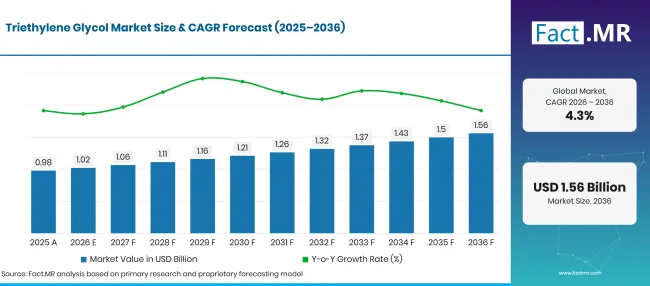
Triethylene Glycol Market Forecast Global | Source: Fact.MR
| Year | Basis | Market Value (USD billion) |
|---|---|---|
| 2025 | Actual | 0.98 |
| 2026 | Estimate | 1.02 |
| 2036 | Forecast | 1.56 |
| CAGR 2026 to 2036 | Forecast period | 4.3% |
Source: Fact.MR analysis. Updated Oct 27, 2026
What are the defining numbers behind Triethylene Glycol Market growth?
USD 0.6 billion in absolute opportunity between 2026 and 2036
- Demand Drivers in the Market
- Natural gas dehydration supports triethylene glycol (TEG) consumption because the chemical absorbs water vapour during gas processing. Removing moisture helps processors control hydrate formation, corrosion risks and operating problems in pipelines and downstream equipment. The U.S. Environmental Protection Agency explains that dehydration helps prevent water-related freezing and hydrate formation that can obstruct pipelines and equipment [1].
- Chemical manufacturing drives triethylene glycol (TEG) demand through its use as a solvent and processing aid in selected chemical applications. Triethylene glycol serves selected industrial chemical applications, including solvent and intermediate uses. Germany’s Federal Statistical Office reported that chemical industry production increased by 2.1% in April 2026 compared with March, seasonally and calendar adjusted. [2].
- Industrial demand and supply-chain requirements has driven the market growth. Manufacturers using TEG need consistent quality and reliable deliveries to maintain process performance. Brazil’s national industrial production rose 0.7% month over month in April 2026, although chemical products were among the activities recording declines that month. The mixed result underlines why broad industrial indicators should be interpreted as context rather than proof of TEG-specific growth [3].
- Key Segments Analyzed
- By Product Type: Regular Grade Triethylene Glycol is projected to account for 71.6% of the market in 2026. This share can be explained by regular-grade TEG’s use in established industrial applications, particularly natural gas dehydration and other process-fluid applications.
- By Application: Manufacture of Polyester leads with 28.4% share in 2026, supported qualitatively by TEG’s use as a chemical intermediate in polyester-related production.
- Analyst Opinion at Fact.MR
- Shambhu Nath Jha, Principal Consultant at Fact.MR, states, “Triethylene glycol demand is linked to industrial requirements for moisture removal and chemical processing. Buyers are likely to prioritize grade consistency, reliable supply and operating efficiency, while suppliers need to demonstrate that product specifications match the requirements of each application.”
- Strategic Implications
- Manufacturers need to maintain consistent purity and quality specifications across regular and high-purity grades.
- Natural gas processors can assess TEG circulation and regeneration efficiency to support dehydration performance and manage operating losses.
- Chemical buyers should verify grade suitability against process requirements rather than treating all TEG products as interchangeable.
- Distributors can strengthen customer retention through dependable supply, clear technical documentation and application-specific support.
Germany is set to record 4.0% CAGR through 2036, according to the estimates. Brazil is projected to grow at 4.8%, followed by the USA at 5.5%. The UK is estimated to advance at 5.2%, while Japan is forecast at 3.1%.
How does the Triethylene Glycol Market break down by segment?
Fact.MR's analysis identifies Regular Grade Triethylene Glycol as the leading product type at 71.6%. Manufacture of Polyester represents 28.4% of the market by application.
Which Product Type dominates?
Regular Grade Triethylene Glycol is set to hold 71.6% share in 2026.
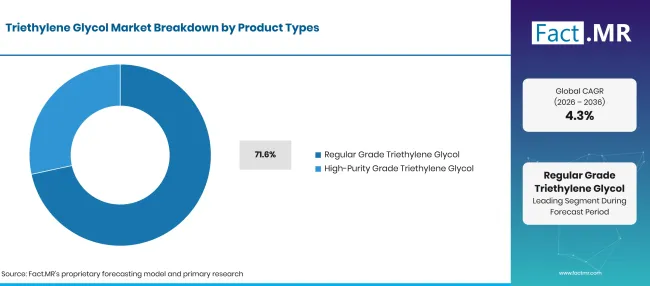
Triethylene Glycol Market Breakdown Product Types | Source: Fact.MR
| Product Type | Share (2026) |
|---|---|
| Regular Grade Triethylene Glycol (Leading segment) | 71.6% |
| High-Purity Grade Triethylene Glycol | 28.4%* |
| Total | 100.0% |
Source: Fact.MR analysis. Updated Oct 27, 2026
Regular-grade TEG serves industrial processes that require dependable moisture removal and chemical performance at the specified purity. High-purity grade is relevant where tighter impurity limits or more demanding product specifications apply. Buyers need to assess actual grade specifications and intended use rather than relying on grade labels alone.
How does Application shape demand?
Manufacture of Polyester accounts for 28.4% share in 2026.
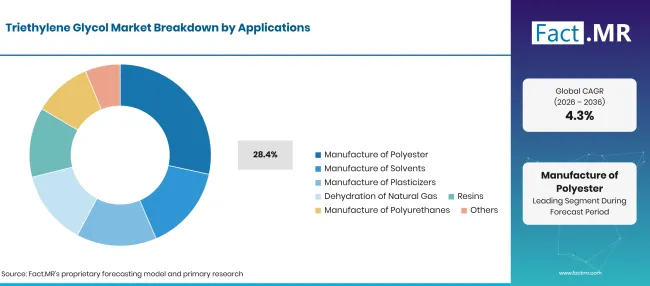
Triethylene Glycol Market Breakdown Applications | Source: Fact.MR
| Application | Share (2026) |
|---|---|
| Manufacture of Polyester | 28.4% |
| Other applications combined | 71.6%* |
| Total | 100.0% |
Source: Fact.MR analysis. Updated Oct 27, 2026
Manufacture of Polyester accounts for a significant share of the Triethylene Glycol Market because TEG serves as a solvent in polyester-related manufacturing and as a chemical intermediate in the production of certain polyester resins. Its compatibility with a range of organic compounds supports its use in industrial processing. Demand from this application is linked to polyester resin production and associated industrial activity.
What is accelerating Triethylene Glycol Market adoption, and what is holding it back?
Natural gas dehydration and chemical processing support demand, while operating costs, grade requirements and environmental management can constrain adoption.
Drivers Impact Analysis
| DRIVER | (~) % IMPACT ON CAGR | GEOGRAPHIC RELEVANCE | IMPACT TIMELINE |
|---|---|---|---|
| Natural gas dehydration requirements | +1.0% | USA, Brazil, global gas markets | Medium term (2–4 years) |
| Industrial chemical processing | +0.8% | Germany, USA, Japan | Medium term (2–4 years) |
| Polyester and intermediate manufacturing | +0.6% | Asia, Europe, Americas | Medium term (2–4 years) |
| Demand for reliable grade specifications | +0.4% | Global | Short term (≤ 2 years) |
| Industrial gas infrastructure investment | +0.5% | USA, Brazil, global | Long term (≥ 4 years) |
Source: Fact.MR analysis. Updated Oct 27, 2026
Opportunity Impact Analysis
| OPPORTUNITY | (~) % IMPACT ON CAGR | GEOGRAPHIC RELEVANCE | IMPACT TIMELINE |
|---|---|---|---|
| Efficient TEG dehydration systems | +0.7% | USA, Brazil, global | Medium term (2–4 years) |
| High-purity grade applications | +0.5% | Germany, Japan, USA | Medium term (2–4 years) |
| Reliable supply contracts for industrial buyers | +0.4% | Global | Short term (≤ 2 years) |
| Process optimisation and reduced glycol losses | +0.5% | Global | Medium term (2–4 years) |
| Expansion in chemical intermediates | +0.4% | Asia, Europe, Americas | Long term (≥ 4 years) |
Source: Fact.MR analysis. Updated Oct 27, 2026
Restraints Impact Analysis
| RESTRAINT | (~) % IMPACT ON CAGR | GEOGRAPHIC RELEVANCE | IMPACT TIMELINE |
|---|---|---|---|
| Feedstock and energy-cost volatility | -0.8% | Global | Short term (≤ 2 years) |
| Competition from alternative process solutions | -0.5% | Global | Medium term (2–4 years) |
| Grade purity and quality-control requirements | -0.4% | Global | Short term (≤ 2 years) |
| Emissions management in glycol regeneration | -0.6% | USA, global gas markets | Medium term (2–4 years) |
| Demand fluctuations across industrial sectors | -0.5% | Global | Medium term (2–4 years) |
Source: Fact.MR analysis. Updated Oct 27, 2026
Which countries are scaling the Triethylene Glycol Market through 2036?
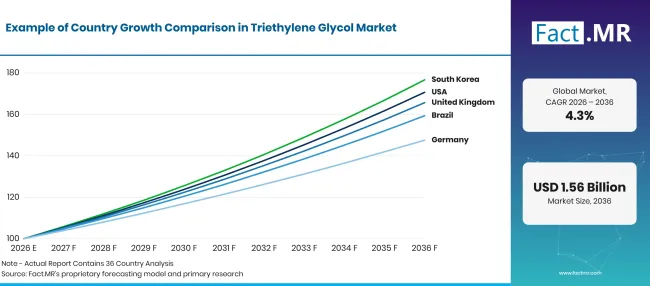
Triethylene Glycol Market Growth Index | Source: Fact.MR
| Country | CAGR (2026–2036) |
|---|---|
| Germany | 4.0% |
| Brazil | 4.8% |
| USA | 5.5% |
| UK | 5.2% |
| Japan | 3.1% |
Source: Fact.MR analysis. Updated Oct 27, 2026
What supports Germany adoption?
4.0% CAGR, supported by established chemical manufacturing and industrial processing activity.
Germany’s established chemical manufacturing base supports demand for industrial chemicals and process intermediates used across diverse manufacturing applications. Triethylene glycol suppliers can serve customers requiring reliable product quality, consistent grade specifications and dependable deliveries for chemical processing and industrial gas dehydration. Adoption will depend on application requirements, procurement costs and the ability to meet customer-specific technical standards.
How is Brazil developing Triethylene Glycol Market demand?
4.8% CAGR, shaped by chemical manufacturing activity and industrial gas-processing requirements.
Brazil’s industrial base creates demand opportunities for triethylene glycol (TEG) in chemical processing and industrial gas dehydration. Market development will depend on activity across relevant end-use industries, feedstock costs and the availability of imported supplies. Suppliers can target customers with recurring process requirements by offering consistent product quality, reliable deliveries and technical support tailored to application needs.
What supports United States adoption?
5.5% CAGR, driven by the natural gas processing sector.
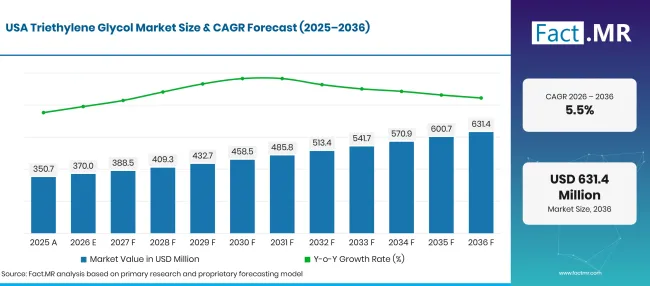
Triethylene Glycol Market Forecast Usa | Source: Fact.MR
The U.S. Energy Information Administration forecast marketed natural gas production to average 122.5 billion cubic feet per day in 2026 in its August 2026 outlook, exceeding the 2025 record [4]. Natural gas processing requires water removal in many applications, and TEG is widely used in glycol dehydrators. This provides relevant industry context for demand, although gas production alone does not determine TEG consumption because dehydration design, circulation rates, regeneration efficiency and operating practices also matter.
How is the United Kingdom building adoption?
5.2% CAGR, led by industrial chemical use and gas-processing requirements.
The UK market for triethylene glycol (TEG) is linked to its use in natural gas dehydration, chemical processing and industrial applications requiring moisture control. In gas-processing operations, TEG absorbs water vapour from natural gas to help meet pipeline moisture specifications and reduce the risk of hydrate formation and corrosion. Demand will depend on gas-processing activity, dehydration system operating rates, solvent purity requirements and the efficiency of TEG regeneration and reuse. Suppliers must also meet customer-specific technical specifications while maintaining reliable deliveries and competitive sourcing costs in a market exposed to imported supply.
What supports Japan adoption?
3.1% CAGR, backed by demand from chemical manufacturing and grade-specific industrial applications.
Japan's Ministry of Economy, Trade and Industry publishes a Current Survey of Production covering manufactured chemical products and other industrial categories. Its 2026 reporting provides an official framework for monitoring manufacturing trends, but the general production series does not independently establish the size or growth rate of the TEG market [5]. Product demand will depend on customer specifications, chemical plant operating rates and procurement requirements.
Who leads the Triethylene Glycol Market?
Fact.MR's competitive set for the Triethylene Glycol (TEG) Market includes SABIC, Shell plc (Shell Chemicals), Reliance Industries Limited, Servotech Pharma Impex Private Ltd. and Arham Petrochem Private Limited.
SABIC and Shell plc (Shell Chemicals) participate in the broader petrochemical and glycol industries, while Reliance Industries Limited has an established petrochemical manufacturing portfolio. Servotech Pharma Impex Private Ltd. and Arham Petrochem Private Limited are additional participants in the TEG supply landscape. Their competitive positions depend on product availability, manufacturing capabilities, regional reach and the ability to meet customer-specific requirements.
Competition in the TEG market depends on product purity, consistent quality, supply continuity, pricing and technical support. For natural gas dehydration, buyers may prioritize glycol performance, regeneration efficiency and reduced solvent losses. In chemical processing and polyester-related applications, product consistency and compatibility with downstream processes can influence supplier selection
Which companies are the key providers?
The Key Company Set Includes:
- SABIC
- Shell plc (Shell Chemicals)
- Reliance Industries Limited
- Servotech Pharma Impex Private Ltd.
- Arham Petrochem Private Limited
Bibliography
- [1] U.S. Environmental Protection Agency. (n.d.). Glycol dehydrators. EPA source
- [2] Statistisches Bundesamt (Destatis). (2026, June 9). Production in April 2026: +0.4% on the previous month. Destatis source
- [3] Instituto Brasileiro de Geografia e Estatística. (2026, June 3). Brazilian industrial production changed 0.7% in April. IBGE source
- [4] U.S. Energy Information Administration. (2026, August 12). United States on track for record natural gas production in 2026. EIA source
- [5] Ministry of Economy, Trade and Industry. (2026, June 30). Current Survey of Production. Government of Japan. METI source
This Report Answers
- The report examines triethylene glycol demand across the product grades and industrial applications.
- Segment analysis identifies Regular Grade Triethylene Glycol as the largest product category in 2026.
- Application analysis covers polyester manufacture, solvents, plasticizers, natural gas dehydration, resins and polyurethane manufacture.
- Country analysis compares Germany, Brazil, the USA, the UK and Japan using the market growth estimates and relevant official industrial indicators.
- The competitive overview lists companies for the analysis, subject to verification of current TEG product portfolios.
What does the Triethylene Glycol Market cover?
The market covers triethylene glycol products supplied for industrial and chemical applications. These include polyester-related manufacturing, solvent and plasticizer production, resin and polyurethane applications, and natural gas dehydration. The analysis distinguishes regular-grade and high-purity products because buyers may require different purity specifications and performance characteristics.
What is included in the scope?
Included products are triethylene glycol sold for the applications identified in the segmentation. The market boundary covers the product grades and their use in industrial manufacturing and gas dehydration. Product values, application shares and country forecasts are considered within the defined market scope, subject to validation against source data.
What is excluded from the scope?
The analysis excludes other glycol chemicals sold as separate products, including ethylene glycol and diethylene glycol, unless explicitly included within a separately defined commercial product boundary. Equipment used in gas dehydration, such as contactors, pumps and regeneration systems, is excluded from TEG product revenue. Revenue from unrelated chemical products and services is also excluded.
How Was the Analysis Built?
The analysis considers market forecasts, industry developments, company activities, technical requirements and relevant government statistics to assess market conditions and growth opportunities.
- Primary Research: Primary research includes discussions with manufacturers, service providers, technology developers, distributors, end users, and subject-matter experts. These conversations examine purchasing priorities, product adoption, operational challenges, approval requirements, competitive positioning, and the factors that influence wider market acceptance.
- Desk Research: Desk research covers government statistics, regulatory publications, company filings, trade data, technical studies, industry associations, standards, public policy, and other authoritative sources. Every source used in the analysis is documented in the bibliography.
- Market Sizing and Forecasting: Market estimates combine historical performance, demand indicators, pricing and volume trends, segment shares, company participation, country-level growth, adoption patterns, investment activity, and barriers to market expansion.
- Data Validation and Update Cycle: Findings are validated by comparing primary interviews with public data, company activity, regulatory changes, trade patterns, and industry developments. Regular updates review new product launches, capacity changes, partnerships, approvals, and shifts in commercial adoption.
Segmentation
What is the report’s scope and coverage?
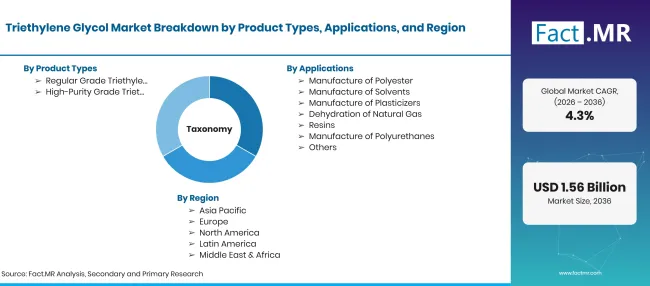
Triethylene Glycol Market Taxonomy | Source: Fact.MR
| Attribute | Details |
|---|---|
| Quantitative Units | USD billion: 2026 valuation, 2036 forecast and CAGR |
| Market Definition | Triethylene glycol used in industrial chemical processing, natural gas dehydration and related applications |
| Product Type | Regular Grade Triethylene Glycol; High-Purity Grade Triethylene Glycol |
| Applications | Manufacture of Polyester; Manufacture of Solvents; Manufacture of Plasticizers; Dehydration of Natural Gas; Resins; Manufacture of Polyurethanes; Others |
| Regions Covered | North America; Latin America; Western Europe; Eastern Europe; East Asia; South Asia & Pacific; Middle East & Africa |
| Countries Covered | Germany; Brazil; USA; UK; Japan |
| Companies Profiled | SABIC, Shell plc (Shell Chemicals), Reliance Industries Limited, Servotech Pharma Impex Private Ltd., Arham Petrochem Private Limited |
| Forecast Period | 2026 to 2036 |
| Approach | Market segmentation and scenario-based analysis supported by official industrial and natural gas statistics |
Source: Fact.MR analysis. Updated Oct 27, 2026
How is the market segmented?
-
By Product Type
- Regular Grade Triethylene Glycol
- High-Purity Grade Triethylene Glycol
-
By Application
- Manufacture of Polyester
- Manufacture of Solvents
- Manufacture of Plasticizers
- Dehydration of Natural Gas
- Resins
- Manufacture of Polyurethanes
- Others
-
By Region
- North America
- Latin America
- Western Europe
- Eastern Europe
- East Asia
- South Asia & Pacific
- Middle East & Africa
Frequently Asked Questions
How big is the Triethylene Glycol Market in 2026?
What is the CAGR from 2026 to 2036?
Which product type has the largest share?
Which application has a leading share?
Which country has the highest CAGR?
Which companies are covered?
Who worked on this report


Preview the report firsthand - request a free sample
Free SampleGet the brochure for pricing and purchase details
Download PDF