- Base Value(2025): 4.9 Bn
- Estimated Value(2026): 5.3 Bn
- Forecast Value (2036): 13.5 Bn
- CAGR (2026 - 2036): 9.8%
Two Wheeler Rental Market Forecast and Outlook 2026 to 2036)
In 2025, the two wheeler rental market was valued at USD 4.9 billion. It is expected to reach USD 5.3 billion in 2026 and grow to USD 13.5 billion by 2036, at a CAGR of 9.8%. This means the market could nearly triple over the next decade.
The two wheeler rental market is projected to generate an absolute dollar opportunity of USD 8.2 billion. Growth is driven by rising gig economy demands, urban congestion pushing short-term mobility, support from platforms like Uber Eats and delivery services, and stricter emission rules in Asia and Europe. However, limited charging infrastructure for EVs, high initial fleet costs, and reliance on ICE models may slow wider adoption.
Amit Gupta, Co-Founder & CEO of Yulu, "We’re the backbone of the quick commerce business in India... for anyone living in big cities right now, if you ask what their biggest problem is besides relationship issues, they’ll say traffic. Our business is about solving that complex problem with a simple solution."
Country growth varies by urban density, gig economy scale, delivery electrification, and tourism adoption. China leads at 14.2% CAGR, supported by vast urban networks and green transport mandates. India follows at 13.7%, driven by initiatives like FAME-II and new electric scooter deployments. Germany grows at 13.0% from tourism demand and emission zones. Brazil posts 12.4% with rising delivery fleets. The United States records 11.4% with consumer uptake. The United Kingdom reaches 10.3%.
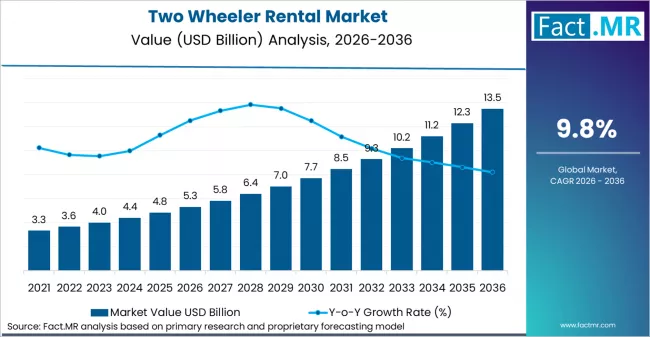
Two Wheeler Rental Market Market Value Analysis | Source: Fact.MR
| Metric | Value |
|---|---|
| Estimated Value in 2026 | USD 5.3 billion |
| Forecast Value in 2036 | USD 13.5 billion |
| Forecast CAGR (2026 to 2036) | 9.8% |
Source: Fact.MR analysis. Updated Mar 5, 2026
Market Definition
The two wheeler rental market includes vehicles like scooters and motorcycles rented for short or long terms, either self-driven or chauffeured, via desktop, mobile apps, or direct sales. It spans urban commuters, gig workers, tourists, and leisure users, with propulsion from ICE to electric systems serving delivery and personal mobility needs.
Market Inclusions
The report provides global and regional forecasts from 2026 to 2036. It covers types, channels, modes, and applications. Country analysis includes China, India, Germany, Brazil, United States, United Kingdom, and others. Pricing, technology trends, competition, and charging infrastructure development are included.
Market Exclusions
Ownership or sales of two wheelers are excluded unless rental integrated. Large cargo vehicles and four-wheelers are excluded. Conventional purchase without rental systems are excluded. Autonomous vessels, trailers, and standalone infrastructure are out of scope.
Research Methodology
- Primary Research: Interviews were conducted with rental operators, fleet suppliers, gig platforms, government agencies, dealers, and investors across key regions.
- Desk Research: Sources included OEM catalogues, investor reports, regulations, national mobility programmes, tenders, and product launch documentation.
- Market Sizing and Forecasting : A hybrid top down and bottom up model was applied. Top down inputs included delivery fleet budgets and tourism data. Bottom up inputs covered pricing, EV mix, replacement cycles, and order pipelines.
- Data Validation and Update Cycle : Findings were validated using fleet deliveries, procurement data, government budgets, and registration statistics. Forecasts are reviewed annually for policy, cost, and infrastructure changes.
Summary
- Market Definition
- Two wheeler rentals provide scooters and motorcycles in self-driven or chauffeured formats across gig, tourism, and commuter applications globally.
- Demand Drivers
- Mottu’s fleet expansion in Brazil demonstrates lower costs and accessibility advantages in gig delivery.
- Yamaha’s investment in Royal Brothers accelerates electric rental scale in India.
- TIER-Dott merger shows consolidation boosting premium electric offerings in Europe.
- Key Segments Analyzed
- By Two Wheeler Type: Scooter holds about 23% share in 2026, driven by urban demand.
- By Sales Channel: Desktop Based holds about 42% share in 2026 due to ease for long-term bookings.
- By Rental Mode: Self-Driven holds about 54% share in 2026 from gig worker preference.
- By Geography: Asia Pacific represents the largest volume market while China leads at 14.2% CAGR.
- Analyst Opinion at FACT.MR
- Shambhu Nath Jha, Principal Consultant at FACT.MR, opines, ‘CXOs reviewing this report will find that incremental value through 2036 is driven by two parallel dynamics: gig economy mandated electric fleet electrification creating predictable volume in China, India, and Brazil, and a premium tourism shift led by platform partnerships and EV innovation.
- Strategic Implications
- Gig operators should assess electric scooters for urban routes where cost savings improve economics.
- Manufacturers should partner with mobility platforms to gain scale and brand advantage.
- Rental firms should expand charging infrastructure to support rising EV deliveries.
- Methodology
- Market sizing used delivery fleet data, tourism budgets, and order pipelines.
- Segment shares validated through specifications and sales mix disclosures.
- Country forecasts built using policy budgets, emission regulations, expansion, and renewal schedules.
Segmental Analysis
Two Wheeler Rental Market Analysis by Two Wheeler Type
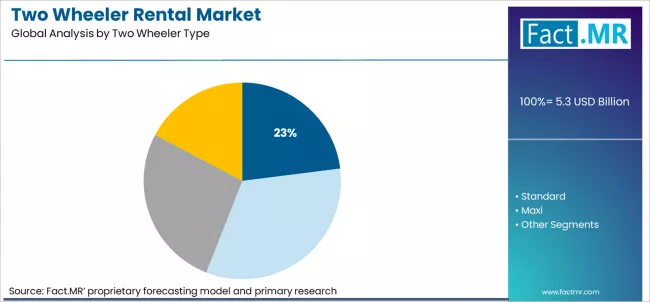
Two Wheeler Rental Market Analysis By Two Wheeler Type | Source: Fact.MR
Scooters hold about 23% share in 2026, supported by urban congestion, parking constraints, and short-distance commuting demand. Lightweight structure, better fuel efficiency, and rising electric scooter penetration make scooters highly suitable for intra-city rentals. Compared to motorcycles, scooters offer easier handling and lower operating costs, making them attractive for first-time renters and tourists in metro cities.
- Urban Mobility Shift: Increasing traffic congestion and low-emission zones in major cities are pushing demand for compact, fuel-efficient rental options, positioning scooters as the preferred urban mobility solution.
- Royal Brothers Investment February 2023: Yamaha’s investment in Royal Brothers strengthened EV scooter fleet expansion in India, supporting electrified urban rental adoption. [1]
Two Wheeler Rental Market Analysis by Sales Channel
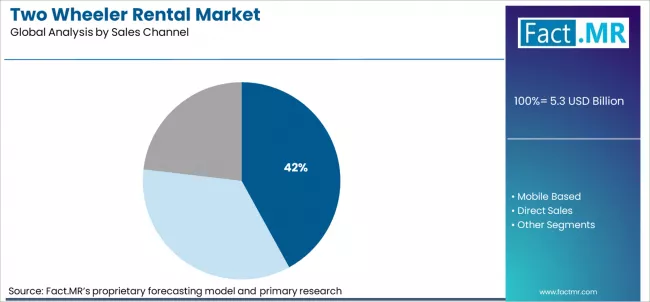
Two Wheeler Rental Market Analysis By Sales Channel | Source: Fact.MR
Desktop-based bookings hold about 42% share in 2026, as long-term rentals, tourism bookings, and corporate fleet contracts are frequently executed through structured web platforms. Desktop interfaces offer better comparison tools, documentation upload convenience, and payment flexibility for extended rental durations.
- Tourism and Fleet Contracts: Travel agencies and corporate clients often prefer desktop portals for bulk and long-duration bookings, sustaining channel dominance.
- Lime Fleet Investment April 2024: Lime’s $55 million fleet investment expanded operational scale, supporting integrated multi-channel booking infrastructure including desktop platforms. [2]
- TIER-Dott Merger January 2024 and Bird-Segway Alliance July 2025: Consolidation and partnerships enhanced platform integration and fleet deployment efficiency, improving booking reliability and backend management systems that support both desktop and app-based reservations. [3]
Drivers, Restraints, and Opportunities
FACT.MR analysts note two wheeler rentals long existed as a niche for tourism use. Market growth to USD 4.9 billion in 2025 reflects EV cost declines and improved range. Global emission targets and urban rules have shifted rentals into mainstream gig and commuter procurement.
The market splits between volume ICE low-cost rentals and a premium EV performance segment. Volume sales remain in delivery and short commutes. Premium models command high prices with strong range.
- Mottu 100,000 Unit Milestone and Latin America Expansion: Mottu reached 100,000 active rentals in April 2025, showing cost advantages in gig transport. Orders expanded to Mexico, supporting wider procurement.[4]
- EU Emission Rules and Urban Mobility Regulations: EU rules and UK zero emission mandates from 2025 drive electric rental procurement. Germany and Netherlands expanded zones. These create demand visibility. [5]
- China Urban Electrification Under Transport Plan: China’s plan targets scooter electrification in cities. Incentives and fleet renewals support domestic production. Government demand scales capacity. [6]
Regional Analysis
The two wheeler rental market is analysed across Asia Pacific, Europe, North America, Latin America, and Middle East and Africa, spanning over 40+ countries with distinct demand profiles shaped by urban density, gig economy scale, electrification mandates, tourism culture, and government zero-emission programme intensity. The full report offers market attractiveness analysis by region based on regulatory timelines, production concentration, and infrastructure development.
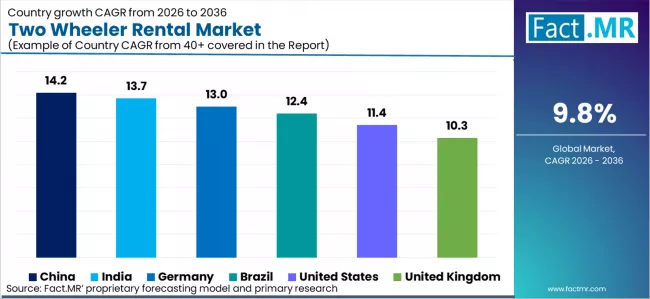
Two Wheeler Rental Market Cagr Analysis By Country | Source: Fact.MR
| Country | CAGR (2026-2036) |
|---|---|
| China | 14.2% |
| India | 13.7% |
| Germany | 13.0% |
| Brazil | 12.4% |
| United States | 11.4% |
| United Kingdom | 10.3% |
Source: Fact.MR analysis. Updated Mar 5, 2026
Asia Pacific Two Wheeler Rental Market Analysis
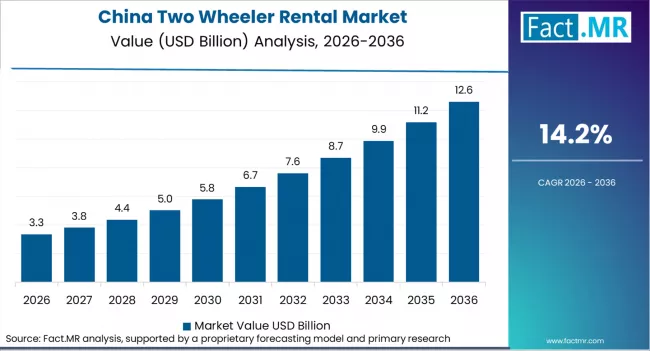
Two Wheeler Rental Market Country Value Analysis | Source: Fact.MR
Asia Pacific remains the structural growth engine for the two wheeler rental market, supported by dense urbanization, expanding gig-economy logistics networks, and strong policy backing for electric micro-mobility. The region combines high commuter intensity with rapid platform digitization, enabling scalable fleet deployment across both metro and emerging cities.
- China: China’s market is projected to expand at a robust 14.2% CAGR through 2036. Micro-mobility dominance across high-density urban clusters, reinforced by government-backed “Green Travel” mandates, sustains structural demand. Battery-swapping infrastructure maturity in Tier-1 cities significantly reduces fleet downtime, improving utilization economics. Premiumization is also accelerating, with strong uptake of high-performance electric scooters for lifestyle commuting. Advanced AI-based fleet management systems are increasingly deployed to predict hyper-local demand surges in commercial districts.
- India: India is forecast to grow at 13.7% CAGR through 2036. The gig economy surge, particularly within the $15B+ quick-commerce ecosystem, positions two wheeler rentals as essential logistics assets. Financing constraints for EV ownership are pushing consumers toward Rental-as-a-Service models. Tier-2 and Tier-3 city expansion presents untapped growth as public transit gaps persist. Dedicated B2B fleet partnerships with delivery platforms such as Zomato, Blinkit, and Swiggy further institutionalize rental demand.
FACT.MR's Asia Pacific analysis of the two wheeler rental market covers China, India, Japan, South Korea, ASEAN, Australia and New Zealand, and Rest of Asia Pacific. Readers can find country-level CAGR projections, EV penetration benchmarks, gig-economy fleet intensity, battery-swapping infrastructure maturity, and regulatory support trends.
Europe Two Wheeler Rental Market Analysis
Europe represents a regulation-integrated and ESG-driven expansion corridor, where mobility policy alignment and corporate sustainability mandates shape rental demand patterns.
- Germany: Germany is expected to post 13.0% CAGR through 2036. Regulatory integration of Bike Sharing Systems (BSS) into Deutsche Bahn’s digital mobility platforms enhances multimodal adoption. Corporate ESG mandates are accelerating “Company Bike” rental programs. Cargo-bike rentals are expanding rapidly for urban logistics, particularly as city-center van restrictions intensify. Smart infrastructure integration with Vision Zero safety grids further supports connected fleet growth.
- United Kingdom: The UK is projected to grow at 10.3% CAGR through 2036. Expansion of Ultra Low Emission Zones (ULEZ) is driving modal shift toward electric two wheelers. Strong net-zero alignment and micro mobility subsidies reinforce adoption. Tourist-heavy regions, particularly in South East England, are scaling seasonal rental hubs. Rent-to-own programs bundled with insurance and maintenance are improving safety and stability for gig delivery riders.
FACT.MR's European analysis of the two wheeler rental market covers Germany, France, the United Kingdom, Italy, Spain, the Nordics, BENELUX, and Rest of Europe. Readers can find ESG mandate impacts, congestion pricing influence, multimodal transport integration benchmarks, corporate fleet adoption rates, and country-level CAGR projections.
North America Two Wheeler Rental Market Analysis
North America combines leisure-oriented rentals with emerging urban electrification demand, creating a dual-structure growth model.
- United States: The U.S. market is projected to expand at 11.4% CAGR through 2036. Tourism and leisure segments dominate cruiser and adventure rentals, especially in seasonal destinations. In urban “transit deserts,” e-scooters are filling last-mile connectivity gaps. Subscription-based commuter passes are replacing pay-per-ride models to increase customer lifetime value. Electrification of touring fleets toward high-range electric motorcycles is gradually reshaping premium rental portfolios.
FACT.MR's North American analysis of the two wheeler rental market covers the United States and Canada. Readers can find tourism-driven rental demand benchmarks, subscription model adoption trends, electrification progress, urban last-mile deployment intensity, and state-level regulatory developments.
Latin America Two Wheeler Rental Market Analysis
Latin America’s growth trajectory is anchored in cost-efficiency dynamics and app-based commercial mobility expansion.
- Brazil: Brazil is forecast to grow at 12.4% CAGR through 2036. Elevated fuel prices and financing costs make ownership prohibitive, strengthening rental uptake among working-class commuters. Rapid growth of delivery platforms such as 99 and iFood drives commercial two wheeler demand. Flex-fuel and EV hybrid fleet opportunities are emerging alongside expanding charging infrastructure. Rising safety concerns in São Paulo and Rio are encouraging telemetry-enabled rentals to reduce accident exposure and insurance costs.
FACT.MR's Latin American analysis of the two wheeler rental market covers Brazil, Mexico, Chile, Colombia, and Rest of Latin America. Readers can find fuel-price sensitivity benchmarks, app-based delivery fleet expansion metrics, financing gap indicators, EV infrastructure rollout trends, and country-level CAGR projections.
Competitive Aligners for Market Players
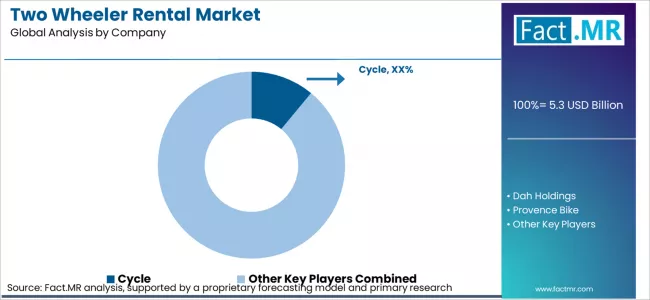
Two Wheeler Rental Market Analysis By Company | Source: Fact.MR
The two wheeler rental market is increasingly platform-driven, where competitive advantage is shaped less by fleet size alone and more by ecosystem integration. Leading players are differentiating through technology-enabled fleet optimization, subscription-based pricing models, and strong OEM partnerships that secure access to next-generation electric vehicles. In high-growth markets such as China and India, operators that integrate battery-swapping infrastructure and AI-driven demand forecasting are achieving higher fleet utilization and lower downtime, directly improving profitability.
Strategic alliances with delivery platforms and tourism operators are also becoming critical. B2B fleet partnerships provide predictable utilization rates, while seasonal leisure rentals enhance revenue diversification. In Europe and the United Kingdom, regulatory alignment and ESG compliance serve as competitive levers, favoring operators that offer low-emission fleets and transparent carbon reporting.
In North America, subscription commuter passes and long-term rental models are replacing transactional ride-based structures, improving customer lifetime value. Overall, success in this market depends on balancing asset-light scalability with operational discipline, digital booking efficiency, and localized regulatory adaptation rather than relying solely on aggressive fleet expansion.
Recent Development
- In October 2025, River Mobility announced plans to raise roughly $150 million to expand production capacity, launch new electric two-wheeler products annually starting FY27, and grow its distribution network, signaling industry investment momentum that will feed into larger rental and fleet deployments.
- In July 2025, Hero MotoCorp unveiled the Hero Vida VX2 electric scooter, featuring a pay-as-you-go battery subscription model designed to lower ownership costs and expand access to electric scooters in India, which supports rental fleet relevance.
Key Players
- Cycle
- Dah Holdings
- Provence Bike
- EagleRider
- Vegas Motorcycle Rentals
- Moab Tour
- Aloha Motorsports
- AdMo-Tours
- Dubbelju Motorcycle Rentals
- Auto Europe
- IMTBike
- GTA Exotics
This Report Addresses
- Strategic intelligence on micro-mobility dominance in China, gig-economy fleet expansion in India, regulatory integration of shared mobility in Germany, congestion-driven electrification in the United Kingdom, tourism-led rentals in the United States, and app-based delivery demand in Brazil.
- Market size and forecast: valued at USD 5.3 billion in 2026, projected to reach USD 13.5 billion by 2036 at a 9.8% CAGR, segmented by two wheeler type, propulsion type, sales channel, rental mode, and region.
- Growth opportunity mapping across electric scooter fleet expansion, subscription-based commuter models, battery-swapping infrastructure integration, Tier-2/3 city penetration, and B2B delivery fleet partnerships.
- Country CAGR outlook: China (14.2%), India (13.7%), Germany (13.0%), Brazil (12.4%), United States (11.4%), and United Kingdom (10.3%) with detailed segment splits by vehicle type and sales channel.
- Competitive analysis of Lime, TIER-Dott, Bird Global, Vogo, Royal Brothers, and regional operators covering fleet utilization efficiency, subscription innovation, OEM partnerships, and platform scalability.
- Product and technology tracking including battery-as-a-service models, AI-driven fleet management systems, telemetry-enabled safety monitoring, high-range electric motorcycles, and integrated multimodal booking platforms.
- Regulatory impact analysis covering ULEZ expansion in the UK, EV subsidy frameworks in India and China, ESG mandates in Europe, and urban micro mobility policy integration across major metropolitan regions.
- Report delivered in Excel datasets, PowerPoint summary, and detailed PDF supported by urban mobility statistics, regulatory documentation, operator disclosures, and primary research interviews with fleet managers and mobility platform executives.
Segmentation
Scope of Report
| Items | Values |
|---|---|
| Quantitative Units | USD 5.3 billion (2026) to USD 13.5 billion (2036), at a CAGR of 9.8% |
| Market Definition | Two wheeler rentals encompass scooters and motorcycles, including ICE and electric, across gig delivery, tourism, commuting, utilising desktop, mobile, direct sales, spanning short to long term and self-driven to chauffeured. |
| Two Wheeler Type | Scooter, Standard, Maxi, Enclosed, Three-Wheeled, Motorcycle, Cruiser, Sports Bikes, Others |
| Sales Channel | Desktop Based, Mobile Based, Direct Sales |
| Rental Mode | Self-Driven, Chauffeured |
| Application Coverage | Urban gig delivery, tourism routes, commuter services, leisure rentals, emission-free zone compliant craft, charter fleet deployment. |
| Regions Covered | Asia Pacific, Europe, North America, Latin America |
| Countries Covered | China, India, Germany, Brazil, United States, United Kingdom, Rest of Asia Pacific, Rest of Europe, Rest of North America, Rest of Latin America |
| Key Companies Profiled | Cycle, Dah Holdings, Provence Bike, EagleRider, Vegas Motorcycle Rentals, Moab Tour, Aloha Motorsports, AdMo-Tours, Dubbelju Motorcycle Rentals, Auto Europe, IMTBike, GTA Exotics |
| Forecast Period | 2026 to 2036 |
| Approach | A hybrid top-down and bottom-up model was applied. Top-down inputs included global tourism statistics, gig fleet budgets, government electrification budgets. Bottom-up inputs covered average prices by type, mode, replacement assumptions, order data from releases. |
Source: Fact.MR analysis. Updated Mar 5, 2026
Two Wheeler Rental Market by Segments
-
Two Wheeler Type:
- Scooter
- Standard
- Maxi
- Enclosed
- Three-Wheeled
- Motorcycle
- Cruiser
- Sports Bikes
- Others
-
Sales Channel:
- Desktop Based
- Mobile Based
- Direct Sales
-
Rental Mode:
- Self-Driven
- Chauffeured
-
Region:
- North America
- USA
- Canada
- Mexico
- Latin America
- Brazil
- Chile
- Rest of Latin America
- Western Europe
- Germany
- UK
- Italy
- Spain
- France
- Nordic
- BENELUX
- Rest of Western Europe
- Eastern Europe
- Russia
- Poland
- Hungary
- Balkan & Baltic
- Rest of Eastern Europe
- East Asia
- China
- Japan
- South Korea
- South Asia and Pacific
- India
- ASEAN
- Australia & New Zealand
- Rest of South Asia and Pacific
- Middle East & Africa
- Kingdom of Saudi Arabia
- Other GCC Countries
- Turkiye
- South Africa
- Other African Union
- Rest of Middle East & Africa
- North America
Frequently Asked Questions
What will the market size be in 2026?
What is the projected market size by 2036?
What is the expected CAGR for the forecast period 2026 to 2036?
Which two wheeler type segment holds the leading share?
Which sales channel segment commands the largest share?
Which country is projected to grow the fastest?
What is the expected growth rate for India?
What is the forecast CAGR for Germany's two wheeler rental market?
How is the two wheeler rental market in the United States expected to grow?
Which rental mode segment shows the fastest growth?
Who worked on this report


Preview the report firsthand - request a free sample
Free SampleGet the brochure for pricing and purchase details
Download PDF