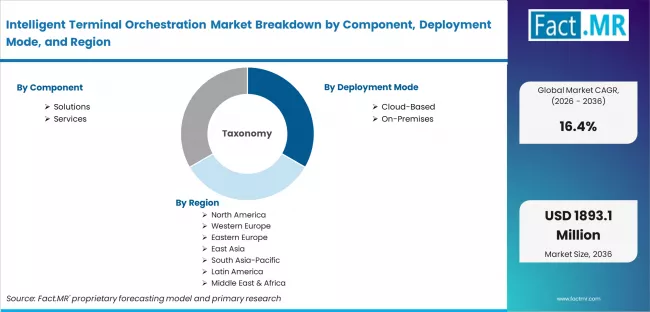
Intelligent Terminal Orchestration Market Size, Share, Growth and Forecast (2026 - 2036)

The Intelligent Terminal Orchestration Market is segmented by Component, Deployment Mode, Technology, Terminal Type, Enterprise Size, Application, End User and Region. Forecast for 2026 to 2036.

According to Fact.MR estimates, the intelligent terminal orchestration market stood at USD 356.2 million in 2025. The market is projected to reach USD 414.6 million in 2026 and climb to USD 1,893.1 million by 2036, progressing at a CAGR of 16.4%. Solution is anticipated to account for nearly 68% share of the component segment, while Cloud-Based is expected to remain the leading deployment mode with around 59% share, driven by rising investments in smart transportation and logistics infrastructure, increasing demand for AI-driven terminal automation and real-time operational orchestration.

Intelligent Terminal Orchestration Market Overview, Growth Outlook, and Forecast by Fact.MR

  • Global intelligent terminal orchestration market revenue was valued at USD 356.2 Mn in 2025 and is forecast to reach USD 1,893.1 Mn by 2036.
  • With a 16.4% CAGR from 2026 to 2036, this market is set to expand ~ 4.6X in value, adding USD 1,478 Mn in absolute opportunity.
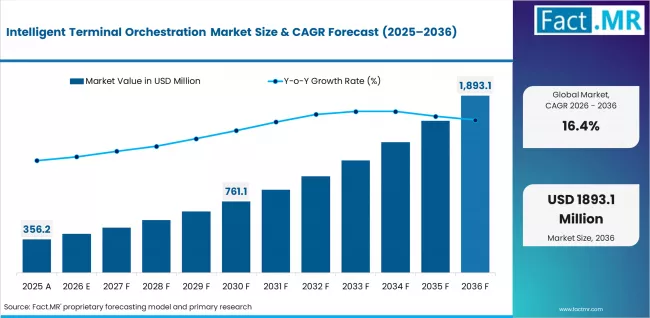
Intelligent Terminal Orchestration Market  Value Analysis

Summary of the Intelligent Terminal Orchestration Market

  • Demand and Growth Drivers
    • Increasing adoption of automation and smart infrastructure across logistics hubs and transportation terminals is driving demand for intelligent orchestration platforms.
    • Growing need for real-time operational visibility, predictive analytics, and workflow optimization is supporting adoption of AI-enabled orchestration solutions.
    • Expansion of IoT-connected devices and edge computing infrastructure is accelerating deployment of intelligent terminal management systems.
    • Rising focus on reducing operational costs, improving throughput, and minimizing downtime is increasing adoption across logistics and industrial facilities.
    • Increasing investments in smart ports, airports, and multimodal transportation infrastructure are supporting long-term market growth.
    • Advancements in AI, machine learning, and connectivity technologies are improving operational coordination and decision-making capabilities.
  • Product and Segment View
    • Solutions dominate component segment with 68% share, driven by increasing deployment of orchestration software platforms and integrated terminal management systems.
    • Services account for 32% share, supported by rising demand for consulting, integration, and managed support services.
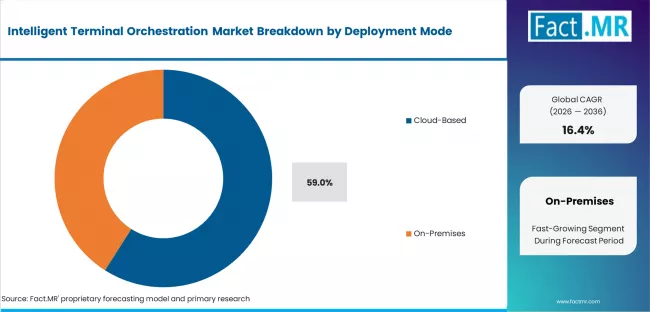
    • Cloud-based deployment holds 59% share, reflecting growing preference for scalable and remotely managed orchestration platforms.
    • On-premises deployment contributes 41% share, primarily used in high-security and mission-critical operations.
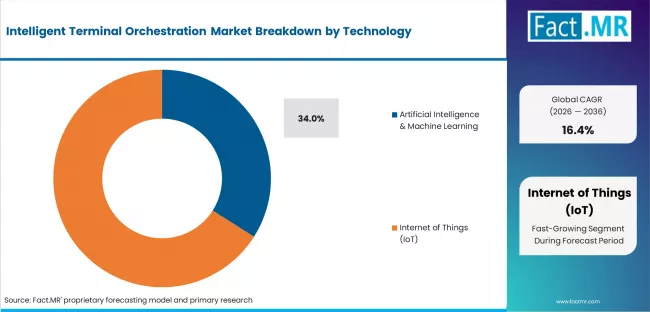
    • Artificial intelligence & machine learning lead technology segment with 34% share, driven by increasing demand for predictive and autonomous operational management.
    • Internet of Things (IoT) accounts for 27% share, followed by edge computing at 21% and connectivity technologies at 18%.
  • Geography and Competitive Outlook
    • North America and Europe represent key markets supported by advanced transportation infrastructure and digital transformation initiatives.
    • Asia Pacific is witnessing rapid growth driven by smart port development, industrial automation, and logistics infrastructure expansion.
    • China, India, and South Korea are emerging as high-growth markets due to increasing investments in intelligent transportation and supply chain modernization.
    • Market growth is influenced by advancements in AI-driven automation, edge intelligence, and cloud-native orchestration platforms.
    • Key companies active in this market include Siemens AG, IBM Corporation, Cisco Systems Inc., Huawei Technologies Co. Ltd., and ABB Ltd.
  • Analyst Opinion
    • Shambhu Nath Jha, Principal Consultant at Fact.MR, says, “The Intelligent Terminal Orchestration Market is no longer defined solely by conventional terminal management systems. Growth is increasingly driven by AI-powered operational orchestration, rising demand for autonomous and real-time terminal coordination, and the shift toward cloud-native, edge-enabled, and low-latency infrastructure that enhances efficiency, throughput, and operational resilience across airports, seaports, rail terminals, and logistics hubs

Intelligent Terminal Orchestration Market— At a Glance

Attribute Details
Market Value 2025 USD 356.2 Mn
Market Value 2036 USD 1,893.1 Mn
Absolute Dollar Opportunity USD 1,536.8 Mn
CAGR 16.4%
Growth Multiple 5.3x
Key Demand Theme Increasing demand for AI-enabled automation and real-time terminal management
Leading Component Solutions
Segment Share 68%
Leading Deployment Mode Cloud-Based
Segment Share 59%
Leading Technology Artificial Intelligence & Machine Learning
Segment Share 34%
Leading Terminal Type Seaport & Container Terminals
Segment Share 36%
Leading Enterprise Size Large Enterprises
Segment Share 72%
Leading Application Operational Optimization
Segment Share 33%
Leading End User Transportation & Logistics
Segment Share 61%
Key Growth Regions North America, Europe, Asia Pacific
Key Companies Siemens, IBM, Cisco, Huawei, ABB
Segmentation by Component Solutions, Services
Segmentation by Deployment Mode On-Premises, Cloud-Based
Segmentation by Technology Artificial Intelligence & Machine Learning, Internet of Things (IoT), Edge Computing, Connectivity Technologies
Segmentation by Terminal Type Airport Terminals, Seaport & Container Terminals, Rail & Intermodal Terminals, Logistics & Distribution Hubs
Segmentation by Enterprise Size Large Enterprises, Small & Medium Enterprises (SMEs)
Segmentation by Application Operational Optimization, Autonomous Operations, Safety & Security Management, Sustainability & Energy Optimization
Segmentation by End User Transportation & Logistics, Government & Defense, Industrial & Manufacturing
Segmentation by Region North America, Latin America, Europe, East Asia, South Asia & Pacific, Middle East & Africa

Key Growth Drivers, Constraints, and Opportunities
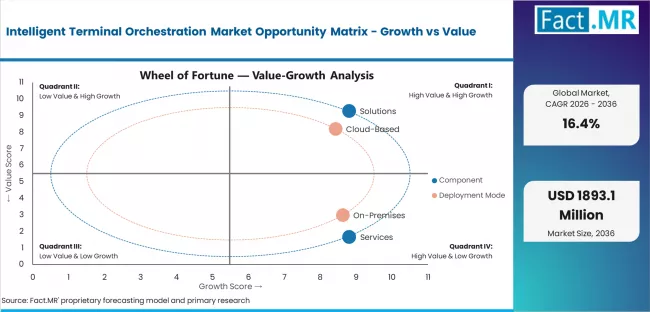
Intelligent Terminal Orchestration Market Opportunity Matrix Growth Vs Value

Key Factors Driving Growth

  • Smart transportation infrastructure modernization, along with the growing requirements of real-time efficient coordination among airports, seaports, railway stations, and logistics hub terminals, will fuel the adoption of intelligent terminal orchestration solutions.
  • The rising deployment of AI-based automation, autonomous machinery coordination, and operational predictive management technology will boost the adoption of intelligent terminal orchestration platforms.
  • The adoption of private 5G networks, edge computing, cloud-based orchestration platforms, digital twins, and industrial IoT technologies will fuel the adoption of intelligent terminal orchestration solutions worldwide.
Growth Driver Demand Impact Time Horizon Key Impact Area Fact.MR Insight
Rising investments in smart transportation infrastructure and terminal modernization High Short-Mid Term Airports, ports & logistics hubs Increasing focus on operational efficiency and real-time coordination is driving demand for intelligent terminal orchestration solutions
Growing demand for autonomous operations and real-time terminal visibility High Short-Mid Term AI-driven terminal management Operators are increasingly adopting AI-powered orchestration platforms to optimize throughput and reduce operational delays
Expansion of private 5G, edge computing, and cloud-based terminal ecosystems High Short-Mid Term Connected terminal infrastructure Rising deployment of low-latency and cloud-native infrastructure is accelerating adoption of intelligent orchestration technologies
Advancements in AI-driven automation, predictive analytics, and digital twins Medium-High Mid-Long Term Intelligent operational management AI-powered orchestration and predictive operational systems are improving terminal efficiency, resource utilization, and resilience
Growth in global cargo traffic, smart logistics, and intermodal transportation networks Medium Short-Mid Term Transportation & logistics expansion Increasing freight volumes and logistics digitization are boosting deployment of automated and coordinated terminal operations systems

Key Market Constraints

  • High costs related to infrastructure modernization, complexity of integration, and high cost of implementation will act as major barriers to the growth of the global intelligent terminal orchestration market.
  • Operational interoperability, cybersecurity issues, and difficulties with integration with existing terminals will limit market adoption.
  • Low digital infrastructure readiness, lack of skilled operators, and financial restrictions may limit market growth in developing countries and small terminal operators.

Key Opportunity Areas

  • Intelligent terminal orchestration solution providers will be witnessing substantial growth opportunities in the areas of AI-based orchestration solutions, autonomous terminal orchestration, predictive analysis, and intelligent terminal optimization through digital twins.
  • Growing adoption from airports, port operators, logistics hubs, rail infrastructure providers, and industrial terminals will provide ample market expansion opportunity.
  • Increased adoption of private 5G networks, edge AI, autonomous logistics systems, cloud-based terminal operations, and smart transportation ecosystems will enhance market potential.

Segment-wise Analysis of the Intelligent Terminal Orchestration Market

  • By the year 2026, Solutions account for a 68% market share of the component segment due to increasing deployment of AI-driven orchestration platforms, terminal operating systems, autonomous coordination software, and real-time operational management solutions across airports, seaports, rail terminals, and logistics hubs.
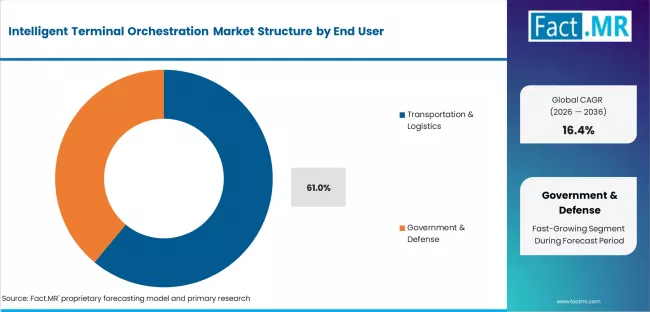
  • Transportation & Logistics represent a 61% market share of the end user segment by 2026, driven by rising investments in smart transportation infrastructure, growing cargo traffic volumes, increasing adoption of autonomous logistics systems, and expanding demand for real-time terminal coordination and operational optimization technologies.

The segmentation of the intelligent terminal orchestration market includes component, deployment mode, technology, terminal type, enterprise size, application, end user, and region.

Which Component Dominates the Intelligent Terminal Orchestration Market?
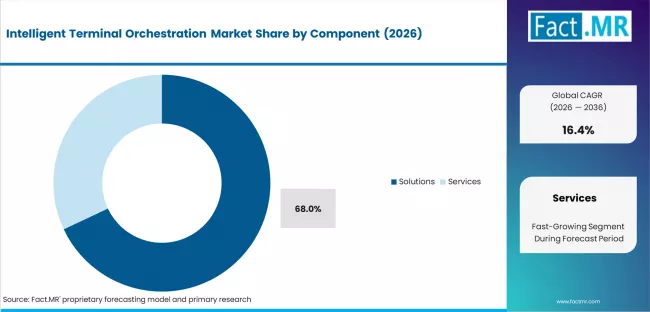
Intelligent Terminal Orchestration Market Analysis By Component

Solution drives growth in the AI-based terminal ecosystem market at 68%, due to increasing adoption of AI-driven orchestration platforms, terminal operating systems, and autonomous coordination software. Increasing demand for real-time operational visibility, predictive analytics, and automated workflow management across airports, seaports, rail terminals, and logistics hubs continues to drive growth. Services represent 32% of the market due to rising demand for system integration services, deployment services, infrastructure consulting services, cybersecurity management services, and optimization of intelligent terminal ecosystems.

Which Deployment Mode Dominates the Intelligent Terminal Orchestration Market?
Intelligent Terminal Orchestration Market Analysis By Deployment Mode

Cloud-Based deployment holds a 59% market share due to increasing adoption of scalable orchestration platforms, central terminal monitoring, and AI-based operational management systems deployed within the cloud environment. The rising demand for remote accessibility, multi-terminal coordination, and cost-effective solutions is increasing the adoption of cloud technologies. On-Premises deployment holds 41% due to rising demand for low-latency control and operational security along with integration with mission-critical terminal infrastructure such as airports, ports, and government-operated facilities.

Which Technology Dominates the Intelligent Terminal Orchestration Market?
Intelligent Terminal Orchestration Market Analysis By Technology

Artificial Intelligence & Machine Learning leads the technology segment accounting for 34% market share due to increasing deployment of predictive analytics, autonomous orchestration, digital twins, and AI-based operation optimization systems. Internet of Things (IoT) accounts for 27% of the market due to increased deployment of connected sensors, smart equipment monitoring, and real-time telemetry systems.

Which Application Dominates the Intelligent Terminal Orchestration Market?
Intelligent Terminal Orchestration Market Analysis By Application

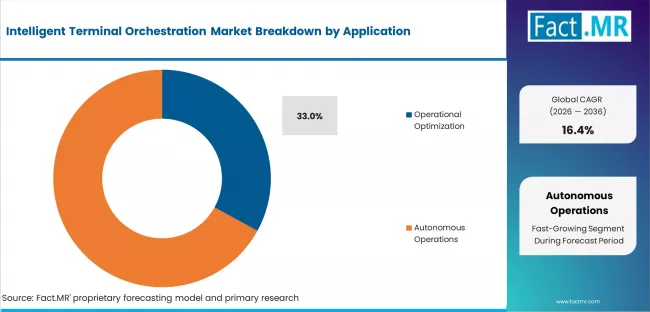
Operational Optimization drives the application segment at a 33% market share, due to rising adoption of terminal operation optimization techniques. Autonomous Operations holds 29% market share due to increasing deployment of robotics and autonomous vehicle technologies in addition to AI-based workflow coordination systems.

Which End User Dominates the Intelligent Terminal Orchestration Market?
Intelligent Terminal Orchestration Market Analysis By End User

Transportation & Logistics dominates the end-user segment with a 61% market share due to rising investments in smart ports, airports, freight corridors, and automated logistics. Industrial & Manufacturing represents 25% of the market due to increasing adoption of intelligent freight handling and warehouse coordination systems.

Regional Outlook Across Key Markets

The market analysis covers key global regions, including South Asia and Pacific, Middle East & Africa, North America, Latin America, Western Europe, and Eastern Europe. It is segmented geographically, with specific market dynamics for each region. The full report provides a detailed market attractiveness analysis.

Top Country Growth Comparison Intelligent Terminal Orchestration Market Cagr (2026 2036)

CAGR Table

Country CAGR (%)
Germany 14.8%
U.K. 15.2%
U.S. 15.8%
Japan 16.5%
South Korea 17.1%
China 18.4%
India 19.3%

Source: Fact.MR (FMR) analysis, based on proprietary forecasting model and primary research.
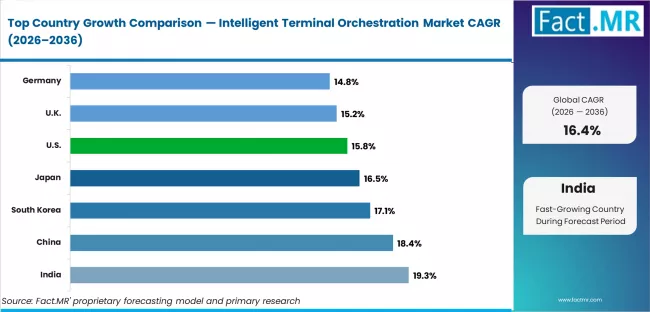
Intelligent Terminal Orchestration Market Cagr Analysis By Country

North America

North America represents the global innovation hub for AI-enabled terminal orchestration and autonomous logistics infrastructure. The region benefits from advanced digital transportation ecosystems, large-scale airport modernization projects, and high investments in cloud-native operational technologies. Major industry participants including Honeywell, Cisco Systems, and IBM maintain strong competitive positions through AI-powered operational analytics, smart infrastructure orchestration, and industrial automation solutions supporting airports, ports, rail terminals, and logistics hubs.

  • United States - Demand for intelligent terminal orchestration solutions in the United States is projected to rise at 15.8% CAGR through 2036. Growth is driven by large-scale smart infrastructure modernization, increasing deployment of AI-enabled logistics coordination systems, and rising investments in autonomous terminal operations. In October 2025, the U.S. Department of Transportation expanded funding support for digital freight and smart transportation initiatives under federal infrastructure modernization programs [1]. Additionally, in September 2025, Honeywell announced expanded deployment of AI-driven operational management platforms for airport and logistics infrastructure optimization [2].

Western Europe
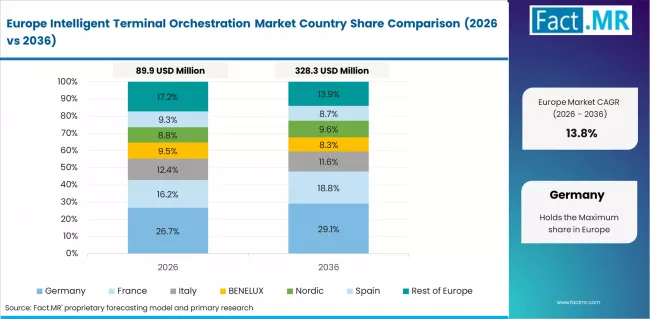
Intelligent Terminal Orchestration Market Europe Country Market Share Analysis, 2026 & 2036

Western Europe serves as the global regulatory and smart infrastructure transformation center for intelligent terminal orchestration technologies. The region is characterized by advanced port digitization initiatives, sustainability-driven transportation modernization, and strong adoption of AI-enabled logistics ecosystems. Leading companies including Siemens, ABB, and Konecranes maintain significant regional influence through smart port automation, digital twin technologies, and autonomous cargo handling solutions.

  • Germany - Demand for intelligent terminal orchestration solutions in Germany is projected to rise at 14.8% CAGR through 2036. Market growth is supported by Industry 4.0 adoption, smart port modernization, and increasing automation across freight and intermodal logistics networks. In July 2025, the Port of Hamburg expanded digital twin deployment programs focused on AI-enabled cargo traffic optimization and operational visibility enhancement [3].

East Asia
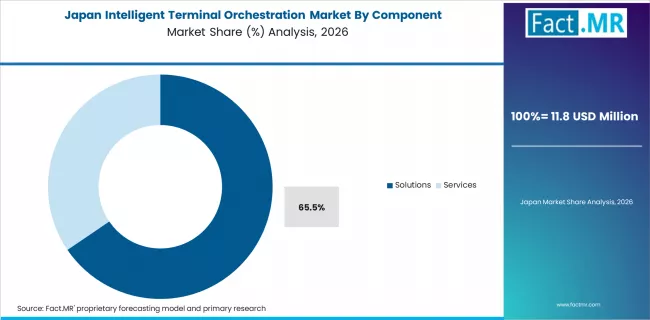
Intelligent Terminal Orchestration Market Japan Market Share Analysis By Component

East Asia represents the global production and deployment epicenter for autonomous terminal operations and smart port ecosystems. The region benefits from aggressive investments in AI, robotics, industrial IoT, and intelligent transportation infrastructure modernization. Major regional participants including Huawei, KONGSBERG Gruppen, and Kalmar are strengthening competitive positioning through AI-driven operational platforms, autonomous cargo handling technologies, and advanced smart terminal orchestration systems.

  • China - Demand for intelligent terminal orchestration solutions in China is projected to rise at 18.4% CAGR through 2036. Growth is fueled by aggressive smart port development, autonomous cargo terminal expansion, and government-backed transportation digitization programs. In June 2025, Chinese port authorities accelerated deployment of AI-powered container handling systems and automated logistics coordination infrastructure across major maritime hubs [4]. Additionally, Huawei expanded investments in private 5G-enabled smart port orchestration platforms during 2025 to support real-time terminal coordination and edge intelligence deployment [5].
  • Japan - Demand for intelligent terminal orchestration solutions in Japan is projected to rise at 16.5% CAGR through 2036. Market expansion is supported by advanced robotics integration, smart airport modernization, and increasing adoption of AI-powered logistics coordination systems. In May 2025, Japan’s Ministry of Land, Infrastructure, Transport and Tourism promoted smart port automation initiatives focused on autonomous cargo operations and digital infrastructure optimization [6].

South Asia & Pacific

South Asia & Pacific is emerging as the fastest-growing smart logistics and transportation infrastructure development region globally. Rapid freight corridor expansion, airport modernization, and smart port initiatives are driving strong adoption of intelligent orchestration technologies. Companies including Tata Consultancy Services, Wipro, and Nokia are expanding regional presence through AI-enabled logistics platforms, private 5G connectivity, and cloud-native transportation orchestration solutions.

  • India - Demand for intelligent terminal orchestration solutions in India is projected to rise at 19.3% CAGR through 2036. Market growth is driven by rapid logistics digitization, smart port modernization, and increasing investments in AI-enabled transportation infrastructure. In October 2025, the Government of India launched the “Digi Bandar” initiative to make ports AI-enabled, interconnected, and data-driven under Maritime India Vision programs [7]. Additionally, the Indian Ports Act, 2025 introduced a modernized regulatory framework supporting integrated digital port development and operational efficiency improvements [8].

Fact.MR’s analysis of the Intelligent Terminal Orchestration Market provides region-wise and country-wise assessment across North America, Western Europe, East Asia, South Asia & Pacific, Eastern Europe, Latin America, and Middle East & Africa. Readers can find insights on AI-driven terminal automation, smart transportation infrastructure investments, private 5G deployment, autonomous logistics ecosystems, cloud-native orchestration adoption, competitive benchmarking, and regional growth opportunities shaping intelligent terminal operations globally.

Competitive Benchmarking and Company Positioning

Leading Companies Shaping the Intelligent Terminal Orchestration Market
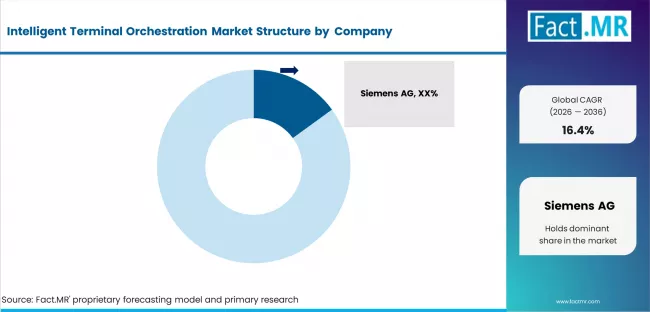
Intelligent Terminal Orchestration Market Analysis By Company

Intelligent Terminal Orchestration Market is moderately consolidated, with some of its leading market players being Siemens AG, ABB, Honeywell, Schneider Electric, Cisco Systems, IBM, Kaleris, Navis, Rockwell Automation, and Yokogawa Electric Corporation. Competitiveness in the market is fueled by the implementation of AI-driven automation and real-time operations intelligence, cloud-based orchestration services, and advanced security solutions. The large established vendors of industrial automation equipment enjoy competitive strengths through their strong installed infrastructure base, hardware-software ecosystem, and international presence; at the same time, the niche vendors such as Kaleris and Navis have competitive advantages in terminal operating systems and logistics orchestration.

Key Players of the Intelligent Terminal Orchestration Market

  • Siemens AG
  • ABB
  • Honeywell International Inc.
  • Schneider Electric
  • Cisco Systems
  • IBM
  • Kaleris
  • Navis
  • Rockwell Automation
  • Yokogawa Electric Corporation

Recent Industry Developments

  • Honeywell International Inc. introduced its cloud-based Warehouse Execution Software (WES) platform in March 2025 to improve AI-driven warehouse orchestration, operational visibility, and logistics automation capabilities across transportation and fulfillment environments. (Honeywell) [9]
  • Siemens AG expanded its industrial AI and automation ecosystem in March 2025 through new AI-driven automation, digital twin, and software-defined industrial technologies showcased at Hannover Messe 2025 to support intelligent infrastructure and autonomous operational orchestration. (Siemens) [10]
  • ABB strengthened its electrification and automation strategy during ABB Capital Markets Day 2025 in November 2025, highlighting expanded focus on smart infrastructure, industrial automation, and connected operational ecosystems supporting intelligent transportation and logistics environments. (ABB) [11]

Sources and Research References

  • [1] U.S. Department of Transportation, “Federal Investments Supporting Smart Freight and Digital Transportation Infrastructure,” October 2025
  • [2] Honeywell International Inc., “Honeywell Expands AI-Driven Operational Management Solutions for Logistics and Airport Infrastructure,” September 2025
  • [3] Port of Hamburg, “Port of Hamburg Expands Digital Twin and Smart Port Operations Program,” July 2025
  • [4] Ministry of Transport of the People’s Republic of China, “China Accelerates Smart Port and Automated Cargo Infrastructure Deployment,” June 2025
  • [5] Huawei Technologies Co., Ltd., “Huawei Advances 5G-Enabled Smart Port and Logistics Infrastructure Solutions,” 2025
  • [6] Ministry of Land, Infrastructure, Transport and Tourism (Japan), “Promotion of Smart Port Automation and Digital Infrastructure Optimization,” May 2025
  • [7] Press Information Bureau, Government of India, “Digi Bandar Initiative under Maritime India Vision,” October 2025
  • [8] Government of India, “Indian Ports Act, 2025,” 2025
  • [9] Honeywell International Inc., “Honeywell Introduces Warehouse Execution Software on the Cloud,” March 2025
  • [10] Siemens AG, “Siemens Accelerates Path Toward AI-Driven Industries Through Innovation and Partnerships,” March 2025
  • [11] ABB Ltd., “ABB Capital Markets Day 2025,” November 2025

Intelligent Terminal Orchestration Market Definition

Intelligent terminal orchestration market refers to software platforms, automation tools, AI-powered analytics and connectivity technologies that orchestrate and optimize operations in airports, seaports, rail terminals, and logistics centers. The applications include terminal workflow and cargo management, passenger flow optimization, equipment orchestration and management, and real-time monitoring and visibility. The core purpose of using such technologies lies in improving efficiency, preventing traffic congestion, building operational resilience and ensuring autonomy. Transportation & logistics operators, government bodies and industrial enterprises operating terminal facilities are considered key end users of this market.

Intelligent Terminal OrchestrationMarket Inclusions

The research evaluates current state and forecast of the global and regional market until 2026-2036 along with detailed analysis by component (software, hardware, services), deployment mode (cloud-based, on-premises), technology (automation, cloud computing, AI, edge computing), terminal type (rail, air cargo, airport, port), enterprise size (small, medium, large), application (cargo management, equipment orchestration, passenger management, terminal optimization), end-user (transportation & logistics operator, government, industrial enterprise) and geography.

Intelligent Terminal OrchestrationMarket Exclusions

Scope of the market does not include classic standalone terminal hardware without orchestration capabilities, basic warehouse management software and enterprise IT infrastructure unrelated to terminal orchestration. The report also does not cover consumer transportation software, passenger ticketing software and unrelated industrial automation equipment unless integrated with intelligent terminal orchestration platform, autonomous logistics orchestration system and AI-powered terminal operation management solution respectively.

Intelligent Terminal OrchestrationMarket Research Methodology

  • Primary Research
    • The team at Fact.MR interviewed terminal operators, airport and port authorities, logistics infrastructure operators, AI orchestration software providers, automation technology firms, and industry consultants. Insights from key opinion leaders, product managers, and operations professionals were leveraged to understand market dynamics, adoption patterns, and future areas of investment.
  • Desk Research
    • Sources of information for the report include published annual reports and presentations by firms, databases on transportation infrastructure, government programs related to logistics, smart ports and airports programs, industry journals, white papers, and regulations related to automation, AI, industrial Internet of Things, and terminal infrastructure upgrades.
  • Market-Sizing and Forecasting
    • Fact.MR adopted a composite approach to forecast market trends by employing both top-down and bottom-up approaches to analyze the global transport infrastructure industry and evaluate the revenues generated by major solution providers and infrastructure implementations, respectively. Adoption trends of AI orchestration, terminal automation, cloud infrastructure, 5G, and smart transportation solutions were leveraged to estimate market forecasts.
  • Data Validation and Update Cycle
    • All market numbers were cross-verified through triangulation with primary interviews, company financial performance, infrastructure investments, and technology adoption rates. Forecasting assumptions and calculation models for segments were revised continually based on new macroeconomic variables, transport volume metrics, and enterprise digital transformation.

Scope of Analysis

Intelligent Terminal Orchestration Market Breakdown By Component, Deployment Mode, And Region

Parameter Details
Quantitative Units USD 356.2 million in 2025 to USD 1,893.1 million in 2036, at a CAGR of 16.4%
Market Definition The Intelligent Terminal Orchestration Market comprises AI-driven software, automation platforms, and connectivity solutions that optimize terminal operations, cargo flow, resource coordination, and real-time decision-making across transportation and logistics infrastructure environments.
Regions Covered North America, Latin America, Europe, East Asia, South Asia and Pacific, MiddleEastand Africa
Countries Covered USA, Canada, UK, Germany, China, India, 30 plus countries
Key Companies Siemens AG, ABB, Honeywell International Inc., Schneider Electric, Cisco Systems, IBM, Kaleris, Navis, Rockwell Automation, Yokogawa Electric Corporation
Forecast Period 2026 to 2036
Approach Hybrid demand-side and top-downmethodologybuilt on country-level application demand, product benchmarking, pricing analysis, shipment validation, and primary interviews across manufacturers, distributors, retailers, and end users

Intelligent Terminal Orchestration Market by Segments

  • Intelligent Terminal Orchestration Market by Component

    • Solutions
      • Terminal Operating Systems (TOS)
      • Automation & Control Platforms
      • Analytics & Intelligence Platforms
      • Communication & Connectivity Solutions
      • Cybersecurity & Resilience Solutions
    • Services
      • Professional Services
      • Managed Services
      • Support & Maintenance
  • Intelligent Terminal Orchestration Market by Deployment Mode

    • On-Premises
      • Private Data Center Deployment
      • Edge-Based Deployment
    • Cloud-Based
      • Public Cloud
      • Private Cloud
      • Hybrid Cloud
  • Intelligent Terminal Orchestration Market by Technology

    • Artificial Intelligence & Machine Learning
      • Predictive AI
      • Generative & Agentic AI
      • Computer Vision
    • Internet of Things (IoT)
      • Sensor Networks
      • Connected Infrastructure
    • Edge Computing
      • Real-Time Processing
      • Distributed Intelligence
    • Connectivity Technologies
      • 5G & Private Networks
      • Cloud Networking
  • Intelligent Terminal Orchestration Market by Terminal Type

    • Airport Terminals
    • Seaport & Container Terminals
    • Rail & Intermodal Terminals
    • Logistics & Distribution Hubs
  • Intelligent Terminal Orchestration Market by Enterprise Size

    • Large Enterprises
    • Small & Medium Enterprises (SMEs)
  • Intelligent Terminal Orchestration Market by Application

    • Operational Optimization
      • Traffic Flow Management
      • Resource Scheduling
      • Asset Utilization Optimization
    • Autonomous Operations
      • Autonomous Vehicle Coordination
      • Robotics Orchestration
      • Remote Equipment Operations
    • Safety & Security Management
      • AI Surveillance
      • Threat Detection
      • Emergency Response Coordination
    • Sustainability & Energy Optimization
      • Energy Consumption Management
      • Emission Monitoring
      • Green Terminal Optimization
  • Intelligent Terminal Orchestration Market by End User

    • Transportation & Logistics
      • Port Authorities
      • Airport Operators
      • Rail Infrastructure Providers
    • Government & Defense
      • Military Logistics Bases
      • Customs & Border Operations
      • Critical Infrastructure Agencies
    • Industrial & Manufacturing
      • Industrial Freight Hubs
      • Smart Manufacturing Logistics
      • Heavy Equipment Terminals
  • Intelligent Terminal Orchestration Market by Region

    • North America
      • USA
      • Canada
      • Mexico
    • Latin America
      • Brazil
      • Chile
      • Rest of LATAM
    • East Asia
      • China
      • Japan
      • South Korea
    • Western Europe
      • Germany
      • Italy
      • France
      • U.K.
      • Spain
      • BENELUX
      • Nordic
      • Rest of W. Europe
    • Eastern Europe
      • Russia
      • Hungary
      • Poland
      • Balkan & Baltics
      • Rest of E. Europe
    • South Asia & Pacific
      • India
      • ASEAN
      • ANZ
      • Rest of SAP
    • Middle East and Africa
      • Kingdom of Saudi Arabia
      • United Arab Emirates
      • South Africa
      • Rest of Middle East and Africa

- Frequently Asked Questions -

How large is the demand for Intelligent Terminal Orchestration solutions in the global market in 2026?

Demand for Intelligent Terminal Orchestration solutions in the global market is estimated to be valued at USD 414.6 million in 2026.

What will be the market size of Intelligent Terminal Orchestration solutions in the global market by 2036?

The market size for Intelligent Terminal Orchestration solutions is projected to reach USD 1,893.1 million by 2036.

What is the expected demand growth for Intelligent Terminal Orchestration solutions in the global market between 2026 and 2036?

Demand for Intelligent Terminal Orchestration solutions in the global market is expected to grow at a CAGR of 16.4% between 2026 and 2036, driven by increasing automation of logistics terminals, smart ports, and industrial operations.

Which component is expected to dominate the market?

Solutions are expected to dominate the market, accounting for 68% of the market share in 2026, due to rising demand for integrated orchestration platforms, AI-enabled workflow automation, and terminal optimization software.

Which country is expected to show the highest growth rate for Intelligent Terminal Orchestration solutions?

India is projected to show the highest regional CAGR at 19.3%, supported by rapid digital infrastructure modernization and increasing investments in smart logistics ecosystems.

How significant is the growth outlook for China in this market?

China is expected to grow at a CAGR of 18.4%, reflecting strong adoption of intelligent automation technologies across ports, logistics hubs, and industrial facilities.

What is the growth outlook for the United States in the Intelligent Terminal Orchestration market?

The United States is expected to grow at a CAGR of 15.8%, influenced by growing investments in digital logistics infrastructure and intelligent industrial operations.

Which company is identified as a leading player in the Intelligent Terminal Orchestration market?

Siemens AG is recognized as a leading player in this market, offering advanced orchestration platforms and automation technologies for industrial and logistics environments.

Table of Content

  1. Market – Executive Summary
  2. Market Overview
    • Market Definition & Introduction
    • Market Taxonomy & Research Scope
  3. Global Market Demand (in Value or Size in US$ Mn) Analysis 2021-2025 and Forecast, 2026–2036
    • Historical Market Value (US$ Mn) Analysis, 2021-2025
    • Current and Future Market Value (US$ Mn) Projections, 2026–2036
      • Y-o-Y Growth Trend Analysis
      • Absolute $ Opportunity Analysis
  4. Market Background and Foundational Data Points
    • Smart port infrastructure investments
    • Airport modernization spending
    • Global container traffic growth
    • AI adoption in terminal operations
    • Terminal automation deployment rate
    • Autonomous equipment installations (AGVs, cranes, robots)
    • Private 5G deployment across terminals
    • Cloud-based terminal operating system (TOS) adoption
    • Industrial IoT device penetration
    • Logistics hub expansion projects
    • Transportation digital transformation investments
    • Labor shortages driving automation adoption
    • Start-up Ecosystem Analysis, 2021-2025
    • Market Opportunity Assessment
      • Total Available Market (US$ Mn)
      • Serviceable Addressable Market (US$ Mn)
      • Serviceable Obtainable Market (US$ Mn)
    • Porter’s Five Forces and PESTEL Analysis
    • Investment Feasibility Analysis
    • Macro-Economic Factors & Forecast Factors - Relevance & Impact
    • Market Dynamics
      • Drivers
      • Restraints
      • Opportunity Analysis
    • Key Regulations & Certifications
  5. Market Analysis 2021-2025 and Forecast 2026–2036, By Component
    • Introduction / Key Findings
    • Historical Market Size (US$ Mn) Trend Analysis By Component, 2021-2025
    • Current and Future Market Size (US$ Mn) Analysis and Forecast By Component, 2026-2036
      • Solutions
        • Terminal Operating Systems (TOS)
        • Automation & Control Platforms
        • Analytics & Intelligence Platforms
        • Communication & Connectivity Solutions
        • Cybersecurity & Resilience Solutions
      • Services
        • Professional Services
        • Managed Services
        • Support & Maintenance
    • Market Attractiveness Analysis By Component
  6. Market Analysis 2021-2025 and Forecast 2026–2036, By Deployment Mode
    • Introduction / Key Findings
    • Historical Market Size (US$ Mn) Trend Analysis By Deployment Mode, 2021-2025
    • Current and Future Market Size (US$ Mn) Analysis and Forecast By Deployment Mode, 2026-2036
      • On-Premises
        • Private Data Center Deployment
        • Edge-Based Deployment
      • Cloud-Based
        • Public Cloud
        • Private Cloud
        • Hybrid Cloud
    • Market Attractiveness Analysis By Deployment Mode
  7. Market Analysis 2021-2025 and Forecast 2026–2036, By Technology
    • Introduction / Key Findings
    • Historical Market Size (US$ Mn) Trend Analysis By Technology, 2021-2025
    • Current and Future Market Size (US$ Mn) Analysis and Forecast By Technology, 2026-2036
      • Artificial Intelligence & Machine Learning
        • Predictive AI
        • Generative & Agentic AI
        • Computer Vision
      • Internet of Things (IoT)
        • Sensor Networks
        • Connected Infrastructure
      • Edge Computing
        • Real-Time Processing
        • Distributed Intelligence
      • Connectivity Technologies
        • 5G & Private Networks
        • Cloud Networking
    • Market Attractiveness Analysis By Technology
  8. Market Analysis 2021-2025 and Forecast 2026–2036, By Terminal Type
    • Introduction / Key Findings
    • Historical Market Size (US$ Mn) Trend Analysis By Terminal Type, 2021-2025
    • Current and Future Market Size (US$ Mn) Analysis and Forecast By Terminal Type, 2026-2036
      • Airport Terminals
      • Seaport & Container Terminals
      • Rail & Intermodal Terminals
      • Logistics & Distribution Hubs
    • Market Attractiveness Analysis By Terminal Type
  9. Market Analysis 2021-2025 and Forecast 2026–2036, By Enterprise Size
    • Introduction / Key Findings
    • Historical Market Size (US$ Mn) Trend Analysis By Enterprise Size, 2021-2025
    • Current and Future Market Size (US$ Mn) Analysis and Forecast By Enterprise Size, 2026-2036
      • Large Enterprises
      • Small & Medium Enterprises (SMEs)
    • Market Attractiveness Analysis By Enterprise Size
  10. Market Analysis 2021-2025 and Forecast 2026–2036, By Application
    • Introduction / Key Findings
    • Historical Market Size (US$ Mn) Trend Analysis by Application, 2021-2025
    • Current and Future Market Size (US$ Mn) Analysis and Forecast by Application, 2026-2036
      • Operational Optimization
        • Traffic Flow Management
        • Resource Scheduling
        • Asset Utilization Optimization
      • Autonomous Operations
        • Autonomous Vehicle Coordination
        • Robotics Orchestration
        • Remote Equipment Operations
      • Safety & Security Management
        • AI Surveillance
        • Threat Detection
        • Emergency Response Coordination
      • Sustainability & Energy Optimization
        • Energy Consumption Management
        • Emission Monitoring
        • Green Terminal Optimization
    • Market Attractiveness Analysis by Application
  11. Market Analysis 2021-2025 and Forecast 2026–2036, By End-User
    • Introduction / Key Findings
    • Historical Market Size (US$ Mn) Trend Analysis by End-User, 2021-2025
    • Current and Future Market Size (US$ Mn) Analysis and Forecast by End-User, 2026-2036
      • Transportation & Logistics
        • Port Authorities
        • Airport Operators
        • Rail Infrastructure Providers
      • Government & Defense
        • Military Logistics Bases
        • Customs & Border Operations
        • Critical Infrastructure Agencies
      • Industrial & Manufacturing
        • Industrial Freight Hubs
        • Smart Manufacturing Logistics
        • Heavy Equipment Terminals
    • Market Attractiveness Analysis by End-User
  12. Global Market Analysis and Forecast, by Region
    • Introduction / Key Findings
    • Historical Market Size (US$ Mn) Trend Analysis by Region, 2021-2025
    • Current and Future Market Size (US$ Mn) Analysis and Forecast by Region, 2026-2036
      • North America
      • Latin America
      • Western Europe
      • Eastern Europe
      • East Asia
      • South Asia & Pacific
      • Middle East & Africa
    • Market Attractiveness Analysis by Region
  13. North America Market Analysis and Forecast
    • Introduction / Key Findings
    • Historical Market Size (US$ Mn) Trend Analysis by Market Taxonomy, 2021-2025
    • Current and Future Market Size (US$ Mn) Analysis & Forecast by Market Taxonomy, 2026-2036
    • By Country
      • United States
      • Canada
      • Mexico
    • By Taxonomy
    • Market Attractiveness Analysis By Country & Taxonomy
    • Market Trends
    • Key Market Participants – Intensity Mapping
    • Drivers and Restraints - Impact Analysis
  14. Latin America Market Analysis and Forecast
    • Introduction / Key Findings
    • Historical Market Size (US$ Mn) Trend Analysis by Market Taxonomy, 2021-2025
    • Current and Future Market Size (US$ Mn) Analysis & Forecast by Market Taxonomy, 2026-2036
    • By Country
      • Brazil
      • Chile
      • Rest of LATAM
    • By Taxonomy
    • Market Attractiveness Analysis By Country & Taxonomy
    • Market Trends
    • Key Market Participants – Intensity Mapping
    • Drivers and Restraints - Impact Analysis
  15. Western Europe Market Analysis and Forecast
    • Introduction / Key Findings
    • Historical Market Size (US$ Mn) Trend Analysis by Market Taxonomy, 2021-2025
    • Current and Future Market Size (US$ Mn) Analysis & Forecast by Market Taxonomy, 2026-2036
    • By Country
      • Germany
      • Italy
      • France
      • United Kingdom
      • Spain
      • BENELUX
      • Nordics
      • Rest of Western Europe
    • By Taxonomy
    • Market Attractiveness Analysis By Country & Taxonomy
    • Market Trends
    • Key Market Participants – Intensity Mapping
    • Drivers and Restraints - Impact Analysis
  16. Eastern Europe Market Analysis and Forecast
    • Introduction / Key Findings
    • Historical Market Size (US$ Mn) Trend Analysis by Market Taxonomy, 2021-2025
    • Current and Future Market Size (US$ Mn) Analysis & Forecast by Market Taxonomy, 2026-2036
    • By Country
      • Russia
      • Hungary
      • Poland
      • Balkan & Baltics
      • Rest of Eastern Europe
    • By Taxonomy
    • Market Attractiveness Analysis By Country & Taxonomy
    • Market Trends
    • Key Market Participants – Intensity Mapping
    • Drivers and Restraints - Impact Analysis
  17. East Asia Market Analysis and Forecast
    • Introduction / Key Findings
    • Historical Market Size (US$ Mn) Trend Analysis by Market Taxonomy, 2021-2025
    • Current and Future Market Size (US$ Mn) Analysis & Forecast by Market Taxonomy, 2026-2036
    • By Country
      • China
      • Japan
      • South Korea
    • By Taxonomy
    • Market Attractiveness Analysis By Country & Taxonomy
    • Market Trends
    • Key Market Participants – Intensity Mapping
    • Drivers and Restraints - Impact Analysis
  18. South Asia & Pacific Market Analysis and Forecast
    • Introduction / Key Findings
    • Historical Market Size (US$ Mn) Trend Analysis by Market Taxonomy, 2021-2025
    • Current and Future Market Size (US$ Mn) Analysis & Forecast by Market Taxonomy, 2026-2036
    • By Country
      • India
      • ASEAN
      • Australia & New Zealand
      • Rest of South Asia & Pacific
    • By Taxonomy
    • Market Attractiveness Analysis By Country & Taxonomy
    • Market Trends
    • Key Market Participants – Intensity Mapping
    • Drivers and Restraints - Impact Analysis
  19. Middle East & Africa Market Analysis and Forecast
    • Introduction / Key Findings
    • Historical Market Size (US$ Mn) Trend Analysis by Market Taxonomy, 2021-2025
    • Current and Future Market Size (US$ Mn) Analysis & Forecast by Market Taxonomy, 2026-2036
    • By Country
      • Kingdom of Saudi Arabia
      • Other GCC Countries
      • Turkiye
      • South Africa
      • Other African Union
    • By Taxonomy
    • Market Attractiveness Analysis By Country & Taxonomy
    • Market Trends
    • Key Market Participants – Intensity Mapping
    • Drivers and Restraints - Impact Analysis
  20. Country-level Market Analysis and Forecast
    • Introduction
    • Market Value Proportion Analysis, By Key Countries
    • Global Vs. Country Growth Comparison
      • United States Market Analysis
        • Market Size (US$ Mn) Analysis by Market Taxonomy, 2021–2036
        • By Component
        • By Deployment Mode
        • By Technology
        • By Terminal Type
        • By Enterprise Size
        • By Application
        • By End User
        • Canada Market Analysis
        • Mexico Market Analysis
        • Brazil Market Analysis
        • Chile Market Analysis
        • Germany Market Analysis
        • France Market Analysis
        • Italy Market Analysis
        • Spain Market Analysis
        • United Kingdom Market Analysis
        • BENELUX Market Analysis
        • Nordics Market Analysis
        • Poland Market Analysis
        • Russia Market Analysis
        • Hungary Market Analysis
        • Balkan & Baltics Market Analysis
        • China Market Analysis
        • Japan Market Analysis
        • South Korea Market Analysis
        • India Market Analysis
        • ASEAN Market Analysis
        • ANZ Market Analysis
        • KSA Market Analysis
        • Other GCC Countries Market Analysis
        • South Africa Market Analysis
        • Turkiye Market Analysis
    • Market Structure Analysis
      • Market Analysis by Tier of Companies
      • Market Concentration
      • Market Share Analysis of Top Players
      • Market Space for New Brands and Dollar Opportunity
      • Market Presence Analysis
        • Regional Footprint of Players
        • Product Footprint by Players
    • Mobile Optical Pluggable Competition Analysis
      • Competition Dashboard
      • Pricing Analysis by Competition
      • Competition Benchmarking
      • Competition Deep Dive
        • Siemens AG
          • Overview
          • Product Portfolio
          • Sales Footprint
          • Key Developments
          • SWOT Analysis
          • Strategy Overview
          • Key Financials
        • ABB
        • Honeywell International Inc.
        • Schneider Electric
        • Cisco Systems
        • IBM
        • Kaleris
        • Navis
        • Rockwell Automation
        • Yokogawa Electric Corporation
        • Other Prominent Players
    • Primary insights
    • Assumptions & Acronyms Used
    • Research Methodology & Data Sources

List Of Table

  • Table 1: Global Market Value (USD Mn) Forecast by Region, 2021 to 2036
  • Table 2: Global Market Value (USD Mn) Forecast by Component, 2021 to 2036
  • Table 3: Global Market Value (USD Mn) Forecast by Deployment Mode, 2021 to 2036
  • Table 4: Global Market Value (USD Mn) Forecast by Technology, 2021 to 2036
  • Table 5: Global Market Value (USD Mn) Forecast by Terminal Type, 2021 to 2036
  • Table 6: Global Market Value (USD Mn) Forecast by Enterprise Size, 2021 to 2036
  • Table 7: Global Market Value (USD Mn) Forecast by Application, 2021 to 2036
  • Table 8: Global Market Value (USD Mn) Forecast by End User, 2021 to 2036
  • Table 9: North America Market Value (USD Mn) Forecast by Country, 2021 to 2036
  • Table 10: North America Market Value (USD Mn) Forecast by Component, 2021 to 2036
  • Table 11: North America Market Value (USD Mn) Forecast by Deployment Mode, 2021 to 2036
  • Table 12: North America Market Value (USD Mn) Forecast by Technology, 2021 to 2036
  • Table 13: North America Market Value (USD Mn) Forecast by Terminal Type, 2021 to 2036
  • Table 14: North America Market Value (USD Mn) Forecast by Enterprise Size, 2021 to 2036
  • Table 15: North America Market Value (USD Mn) Forecast by Application, 2021 to 2036
  • Table 16: North America Market Value (USD Mn) Forecast by End User, 2021 to 2036
  • Table 17: Latin America Market Value (USD Mn) Forecast by Country, 2021 to 2036
  • Table 18: Latin America Market Value (USD Mn) Forecast by Component, 2021 to 2036
  • Table 19: Latin America Market Value (USD Mn) Forecast by Deployment Mode, 2021 to 2036
  • Table 20: Latin America Market Value (USD Mn) Forecast by Technology, 2021 to 2036
  • Table 21: Latin America Market Value (USD Mn) Forecast by Terminal Type, 2021 to 2036
  • Table 22: Latin America Market Value (USD Mn) Forecast by Enterprise Size, 2021 to 2036
  • Table 23: Latin America Market Value (USD Mn) Forecast by Application, 2021 to 2036
  • Table 24: Latin America Market Value (USD Mn) Forecast by End User, 2021 to 2036
  • Table 25: Western Europe Market Value (USD Mn) Forecast by Country, 2021 to 2036
  • Table 26: Western Europe Market Value (USD Mn) Forecast by Component, 2021 to 2036
  • Table 27: Western Europe Market Value (USD Mn) Forecast by Deployment Mode, 2021 to 2036
  • Table 28: Western Europe Market Value (USD Mn) Forecast by Technology, 2021 to 2036
  • Table 29: Western Europe Market Value (USD Mn) Forecast by Terminal Type, 2021 to 2036
  • Table 30: Western Europe Market Value (USD Mn) Forecast by Enterprise Size, 2021 to 2036
  • Table 31: Western Europe Market Value (USD Mn) Forecast by Application, 2021 to 2036
  • Table 32: Western Europe Market Value (USD Mn) Forecast by End User, 2021 to 2036
  • Table 33: Eastern Europe Market Value (USD Mn) Forecast by Country, 2021 to 2036
  • Table 34: Eastern Europe Market Value (USD Mn) Forecast by Component, 2021 to 2036
  • Table 35: Eastern Europe Market Value (USD Mn) Forecast by Deployment Mode, 2021 to 2036
  • Table 36: Eastern Europe Market Value (USD Mn) Forecast by Technology, 2021 to 2036
  • Table 37: Eastern Europe Market Value (USD Mn) Forecast by Terminal Type, 2021 to 2036
  • Table 38: Eastern Europe Market Value (USD Mn) Forecast by Enterprise Size, 2021 to 2036
  • Table 39: Eastern Europe Market Value (USD Mn) Forecast by Application, 2021 to 2036
  • Table 40: Eastern Europe Market Value (USD Mn) Forecast by End User, 2021 to 2036
  • Table 41: East Asia Market Value (USD Mn) Forecast by Country, 2021 to 2036
  • Table 42: East Asia Market Value (USD Mn) Forecast by Component, 2021 to 2036
  • Table 43: East Asia Market Value (USD Mn) Forecast by Deployment Mode, 2021 to 2036
  • Table 44: East Asia Market Value (USD Mn) Forecast by Technology, 2021 to 2036
  • Table 45: East Asia Market Value (USD Mn) Forecast by Terminal Type, 2021 to 2036
  • Table 46: East Asia Market Value (USD Mn) Forecast by Enterprise Size, 2021 to 2036
  • Table 47: East Asia Market Value (USD Mn) Forecast by Application, 2021 to 2036
  • Table 48: East Asia Market Value (USD Mn) Forecast by End User, 2021 to 2036
  • Table 49: South Asia and Pacific Market Value (USD Mn) Forecast by Country, 2021 to 2036
  • Table 50: South Asia and Pacific Market Value (USD Mn) Forecast by Component, 2021 to 2036
  • Table 51: South Asia and Pacific Market Value (USD Mn) Forecast by Deployment Mode, 2021 to 2036
  • Table 52: South Asia and Pacific Market Value (USD Mn) Forecast by Technology, 2021 to 2036
  • Table 53: South Asia and Pacific Market Value (USD Mn) Forecast by Terminal Type, 2021 to 2036
  • Table 54: South Asia and Pacific Market Value (USD Mn) Forecast by Enterprise Size, 2021 to 2036
  • Table 55: South Asia and Pacific Market Value (USD Mn) Forecast by Application, 2021 to 2036
  • Table 56: South Asia and Pacific Market Value (USD Mn) Forecast by End User, 2021 to 2036
  • Table 57: Middle East & Africa Market Value (USD Mn) Forecast by Country, 2021 to 2036
  • Table 58: Middle East & Africa Market Value (USD Mn) Forecast by Component, 2021 to 2036
  • Table 59: Middle East & Africa Market Value (USD Mn) Forecast by Deployment Mode, 2021 to 2036
  • Table 60: Middle East & Africa Market Value (USD Mn) Forecast by Technology, 2021 to 2036
  • Table 61: Middle East & Africa Market Value (USD Mn) Forecast by Terminal Type, 2021 to 2036
  • Table 62: Middle East & Africa Market Value (USD Mn) Forecast by Enterprise Size, 2021 to 2036
  • Table 63: Middle East & Africa Market Value (USD Mn) Forecast by Application, 2021 to 2036
  • Table 64: Middle East & Africa Market Value (USD Mn) Forecast by End User, 2021 to 2036

List Of Figures

  • Figure 1: Global Market Pricing Analysis
  • Figure 2: Global Market Value (USD Mn) Forecast 2021–2036
  • Figure 3: Global Market Value Share and BPS Analysis by Component, 2026 and 2036
  • Figure 4: Global Market Y-o-Y Growth Comparison by Component, 2026 to 2036
  • Figure 5: Global Market Attractiveness Analysis by Component
  • Figure 6: Global Market Value Share and BPS Analysis by Deployment Mode, 2026 and 2036
  • Figure 7: Global Market Y-o-Y Growth Comparison by Deployment Mode, 2026 to 2036
  • Figure 8: Global Market Attractiveness Analysis by Deployment Mode
  • Figure 9: Global Market Value Share and BPS Analysis by Technology, 2026 and 2036
  • Figure 10: Global Market Y-o-Y Growth Comparison by Technology, 2026 to 2036
  • Figure 11: Global Market Attractiveness Analysis by Technology
  • Figure 12: Global Market Value Share and BPS Analysis by Terminal Type, 2026 and 2036
  • Figure 13: Global Market Y-o-Y Growth Comparison by Terminal Type, 2026 to 2036
  • Figure 14: Global Market Attractiveness Analysis by Terminal Type
  • Figure 15: Global Market Value Share and BPS Analysis by Enterprise Size, 2026 and 2036
  • Figure 16: Global Market Y-o-Y Growth Comparison by Enterprise Size, 2026 to 2036
  • Figure 17: Global Market Attractiveness Analysis by Enterprise Size
  • Figure 18: Global Market Value Share and BPS Analysis by Application, 2026 and 2036
  • Figure 19: Global Market Y-o-Y Growth Comparison by Application, 2026 to 2036
  • Figure 20: Global Market Attractiveness Analysis by Application
  • Figure 21: Global Market Value Share and BPS Analysis by End User, 2026 and 2036
  • Figure 22: Global Market Y-o-Y Growth Comparison by End User, 2026 to 2036
  • Figure 23: Global Market Attractiveness Analysis by End User
  • Figure 24: Global Market Value (USD Mn) Share and BPS Analysis by Region, 2026 and 2036
  • Figure 25: Global Market Y-o-Y Growth Comparison by Region, 2026 to 2036
  • Figure 26: Global Market Attractiveness Analysis by Region
  • Figure 27: North America Market Incremental $ Opportunity, 2026 to 2036
  • Figure 28: Latin America Market Incremental $ Opportunity, 2026 to 2036
  • Figure 29: Western Europe Market Incremental $ Opportunity, 2026 to 2036
  • Figure 30: Eastern Europe Market Incremental $ Opportunity, 2026 to 2036
  • Figure 31: East Asia Market Incremental $ Opportunity, 2026 to 2036
  • Figure 32: South Asia and Pacific Market Incremental $ Opportunity, 2026 to 2036
  • Figure 33: Middle East & Africa Market Incremental $ Opportunity, 2026 to 2036
  • Figure 34: North America Market Value Share and BPS Analysis by Country, 2026 and 2036
  • Figure 35: North America Market Value Share and BPS Analysis by Component, 2026 and 2036
  • Figure 36: North America Market Y-o-Y Growth Comparison by Component, 2026 to 2036
  • Figure 37: North America Market Attractiveness Analysis by Component
  • Figure 38: North America Market Value Share and BPS Analysis by Deployment Mode, 2026 and 2036
  • Figure 39: North America Market Y-o-Y Growth Comparison by Deployment Mode, 2026 to 2036
  • Figure 40: North America Market Attractiveness Analysis by Deployment Mode
  • Figure 41: North America Market Value Share and BPS Analysis by Technology, 2026 and 2036
  • Figure 42: North America Market Y-o-Y Growth Comparison by Technology, 2026 to 2036
  • Figure 43: North America Market Attractiveness Analysis by Technology
  • Figure 44: North America Market Value Share and BPS Analysis by Terminal Type, 2026 and 2036
  • Figure 45: North America Market Y-o-Y Growth Comparison by Terminal Type, 2026 to 2036
  • Figure 46: North America Market Attractiveness Analysis by Terminal Type
  • Figure 47: North America Market Value Share and BPS Analysis by Enterprise Size, 2026 and 2036
  • Figure 48: North America Market Y-o-Y Growth Comparison by Enterprise Size, 2026 to 2036
  • Figure 49: North America Market Attractiveness Analysis by Enterprise Size
  • Figure 50: North America Market Value Share and BPS Analysis by Application, 2026 and 2036
  • Figure 51: North America Market Y-o-Y Growth Comparison by Application, 2026 to 2036
  • Figure 52: North America Market Attractiveness Analysis by Application
  • Figure 53: North America Market Value Share and BPS Analysis by End User, 2026 and 2036
  • Figure 54: North America Market Y-o-Y Growth Comparison by End User, 2026 to 2036
  • Figure 55: North America Market Attractiveness Analysis by End User
  • Figure 56: Latin America Market Value Share and BPS Analysis by Country, 2026 and 2036
  • Figure 57: Latin America Market Value Share and BPS Analysis by Component, 2026 and 2036
  • Figure 58: Latin America Market Y-o-Y Growth Comparison by Component, 2026 to 2036
  • Figure 59: Latin America Market Attractiveness Analysis by Component
  • Figure 60: Latin America Market Value Share and BPS Analysis by Deployment Mode, 2026 and 2036
  • Figure 61: Latin America Market Y-o-Y Growth Comparison by Deployment Mode, 2026 to 2036
  • Figure 62: Latin America Market Attractiveness Analysis by Deployment Mode
  • Figure 63: Latin America Market Value Share and BPS Analysis by Technology, 2026 and 2036
  • Figure 64: Latin America Market Y-o-Y Growth Comparison by Technology, 2026 to 2036
  • Figure 65: Latin America Market Attractiveness Analysis by Technology
  • Figure 66: Latin America Market Value Share and BPS Analysis by Terminal Type, 2026 and 2036
  • Figure 67: Latin America Market Y-o-Y Growth Comparison by Terminal Type, 2026 to 2036
  • Figure 68: Latin America Market Attractiveness Analysis by Terminal Type
  • Figure 69: Latin America Market Value Share and BPS Analysis by Enterprise Size, 2026 and 2036
  • Figure 70: Latin America Market Y-o-Y Growth Comparison by Enterprise Size, 2026 to 2036
  • Figure 71: Latin America Market Attractiveness Analysis by Enterprise Size
  • Figure 72: Latin America Market Value Share and BPS Analysis by Application, 2026 and 2036
  • Figure 73: Latin America Market Y-o-Y Growth Comparison by Application, 2026 to 2036
  • Figure 74: Latin America Market Attractiveness Analysis by Application
  • Figure 75: Latin America Market Value Share and BPS Analysis by End User, 2026 and 2036
  • Figure 76: Latin America Market Y-o-Y Growth Comparison by End User, 2026 to 2036
  • Figure 77: Latin America Market Attractiveness Analysis by End User
  • Figure 78: Western Europe Market Value Share and BPS Analysis by Country, 2026 and 2036
  • Figure 79: Western Europe Market Value Share and BPS Analysis by Component, 2026 and 2036
  • Figure 80: Western Europe Market Y-o-Y Growth Comparison by Component, 2026 to 2036
  • Figure 81: Western Europe Market Attractiveness Analysis by Component
  • Figure 82: Western Europe Market Value Share and BPS Analysis by Deployment Mode, 2026 and 2036
  • Figure 83: Western Europe Market Y-o-Y Growth Comparison by Deployment Mode, 2026 to 2036
  • Figure 84: Western Europe Market Attractiveness Analysis by Deployment Mode
  • Figure 85: Western Europe Market Value Share and BPS Analysis by Technology, 2026 and 2036
  • Figure 86: Western Europe Market Y-o-Y Growth Comparison by Technology, 2026 to 2036
  • Figure 87: Western Europe Market Attractiveness Analysis by Technology
  • Figure 88: Western Europe Market Value Share and BPS Analysis by Terminal Type, 2026 and 2036
  • Figure 89: Western Europe Market Y-o-Y Growth Comparison by Terminal Type, 2026 to 2036
  • Figure 90: Western Europe Market Attractiveness Analysis by Terminal Type
  • Figure 91: Western Europe Market Value Share and BPS Analysis by Enterprise Size, 2026 and 2036
  • Figure 92: Western Europe Market Y-o-Y Growth Comparison by Enterprise Size, 2026 to 2036
  • Figure 93: Western Europe Market Attractiveness Analysis by Enterprise Size
  • Figure 94: Western Europe Market Value Share and BPS Analysis by Application, 2026 and 2036
  • Figure 95: Western Europe Market Y-o-Y Growth Comparison by Application, 2026 to 2036
  • Figure 96: Western Europe Market Attractiveness Analysis by Application
  • Figure 97: Western Europe Market Value Share and BPS Analysis by End User, 2026 and 2036
  • Figure 98: Western Europe Market Y-o-Y Growth Comparison by End User, 2026 to 2036
  • Figure 99: Western Europe Market Attractiveness Analysis by End User
  • Figure 100: Eastern Europe Market Value Share and BPS Analysis by Country, 2026 and 2036
  • Figure 101: Eastern Europe Market Value Share and BPS Analysis by Component, 2026 and 2036
  • Figure 102: Eastern Europe Market Y-o-Y Growth Comparison by Component, 2026 to 2036
  • Figure 103: Eastern Europe Market Attractiveness Analysis by Component
  • Figure 104: Eastern Europe Market Value Share and BPS Analysis by Deployment Mode, 2026 and 2036
  • Figure 105: Eastern Europe Market Y-o-Y Growth Comparison by Deployment Mode, 2026 to 2036
  • Figure 106: Eastern Europe Market Attractiveness Analysis by Deployment Mode
  • Figure 107: Eastern Europe Market Value Share and BPS Analysis by Technology, 2026 and 2036
  • Figure 108: Eastern Europe Market Y-o-Y Growth Comparison by Technology, 2026 to 2036
  • Figure 109: Eastern Europe Market Attractiveness Analysis by Technology
  • Figure 110: Eastern Europe Market Value Share and BPS Analysis by Terminal Type, 2026 and 2036
  • Figure 111: Eastern Europe Market Y-o-Y Growth Comparison by Terminal Type, 2026 to 2036
  • Figure 112: Eastern Europe Market Attractiveness Analysis by Terminal Type
  • Figure 113: Eastern Europe Market Value Share and BPS Analysis by Enterprise Size, 2026 and 2036
  • Figure 114: Eastern Europe Market Y-o-Y Growth Comparison by Enterprise Size, 2026 to 2036
  • Figure 115: Eastern Europe Market Attractiveness Analysis by Enterprise Size
  • Figure 116: Eastern Europe Market Value Share and BPS Analysis by Application, 2026 and 2036
  • Figure 117: Eastern Europe Market Y-o-Y Growth Comparison by Application, 2026 to 2036
  • Figure 118: Eastern Europe Market Attractiveness Analysis by Application
  • Figure 119: Eastern Europe Market Value Share and BPS Analysis by End User, 2026 and 2036
  • Figure 120: Eastern Europe Market Y-o-Y Growth Comparison by End User, 2026 to 2036
  • Figure 121: Eastern Europe Market Attractiveness Analysis by End User
  • Figure 122: East Asia Market Value Share and BPS Analysis by Country, 2026 and 2036
  • Figure 123: East Asia Market Value Share and BPS Analysis by Component, 2026 and 2036
  • Figure 124: East Asia Market Y-o-Y Growth Comparison by Component, 2026 to 2036
  • Figure 125: East Asia Market Attractiveness Analysis by Component
  • Figure 126: East Asia Market Value Share and BPS Analysis by Deployment Mode, 2026 and 2036
  • Figure 127: East Asia Market Y-o-Y Growth Comparison by Deployment Mode, 2026 to 2036
  • Figure 128: East Asia Market Attractiveness Analysis by Deployment Mode
  • Figure 129: East Asia Market Value Share and BPS Analysis by Technology, 2026 and 2036
  • Figure 130: East Asia Market Y-o-Y Growth Comparison by Technology, 2026 to 2036
  • Figure 131: East Asia Market Attractiveness Analysis by Technology
  • Figure 132: East Asia Market Value Share and BPS Analysis by Terminal Type, 2026 and 2036
  • Figure 133: East Asia Market Y-o-Y Growth Comparison by Terminal Type, 2026 to 2036
  • Figure 134: East Asia Market Attractiveness Analysis by Terminal Type
  • Figure 135: East Asia Market Value Share and BPS Analysis by Enterprise Size, 2026 and 2036
  • Figure 136: East Asia Market Y-o-Y Growth Comparison by Enterprise Size, 2026 to 2036
  • Figure 137: East Asia Market Attractiveness Analysis by Enterprise Size
  • Figure 138: East Asia Market Value Share and BPS Analysis by Application, 2026 and 2036
  • Figure 139: East Asia Market Y-o-Y Growth Comparison by Application, 2026 to 2036
  • Figure 140: East Asia Market Attractiveness Analysis by Application
  • Figure 141: East Asia Market Value Share and BPS Analysis by End User, 2026 and 2036
  • Figure 142: East Asia Market Y-o-Y Growth Comparison by End User, 2026 to 2036
  • Figure 143: East Asia Market Attractiveness Analysis by End User
  • Figure 144: South Asia and Pacific Market Value Share and BPS Analysis by Country, 2026 and 2036
  • Figure 145: South Asia and Pacific Market Value Share and BPS Analysis by Component, 2026 and 2036
  • Figure 146: South Asia and Pacific Market Y-o-Y Growth Comparison by Component, 2026 to 2036
  • Figure 147: South Asia and Pacific Market Attractiveness Analysis by Component
  • Figure 148: South Asia and Pacific Market Value Share and BPS Analysis by Deployment Mode, 2026 and 2036
  • Figure 149: South Asia and Pacific Market Y-o-Y Growth Comparison by Deployment Mode, 2026 to 2036
  • Figure 150: South Asia and Pacific Market Attractiveness Analysis by Deployment Mode
  • Figure 151: South Asia and Pacific Market Value Share and BPS Analysis by Technology, 2026 and 2036
  • Figure 152: South Asia and Pacific Market Y-o-Y Growth Comparison by Technology, 2026 to 2036
  • Figure 153: South Asia and Pacific Market Attractiveness Analysis by Technology
  • Figure 154: South Asia and Pacific Market Value Share and BPS Analysis by Terminal Type, 2026 and 2036
  • Figure 155: South Asia and Pacific Market Y-o-Y Growth Comparison by Terminal Type, 2026 to 2036
  • Figure 156: South Asia and Pacific Market Attractiveness Analysis by Terminal Type
  • Figure 157: South Asia and Pacific Market Value Share and BPS Analysis by Enterprise Size, 2026 and 2036
  • Figure 158: South Asia and Pacific Market Y-o-Y Growth Comparison by Enterprise Size, 2026 to 2036
  • Figure 159: South Asia and Pacific Market Attractiveness Analysis by Enterprise Size
  • Figure 160: South Asia and Pacific Market Value Share and BPS Analysis by Application, 2026 and 2036
  • Figure 161: South Asia and Pacific Market Y-o-Y Growth Comparison by Application, 2026 to 2036
  • Figure 162: South Asia and Pacific Market Attractiveness Analysis by Application
  • Figure 163: South Asia and Pacific Market Value Share and BPS Analysis by End User, 2026 and 2036
  • Figure 164: South Asia and Pacific Market Y-o-Y Growth Comparison by End User, 2026 to 2036
  • Figure 165: South Asia and Pacific Market Attractiveness Analysis by End User
  • Figure 166: Middle East & Africa Market Value Share and BPS Analysis by Country, 2026 and 2036
  • Figure 167: Middle East & Africa Market Value Share and BPS Analysis by Component, 2026 and 2036
  • Figure 168: Middle East & Africa Market Y-o-Y Growth Comparison by Component, 2026 to 2036
  • Figure 169: Middle East & Africa Market Attractiveness Analysis by Component
  • Figure 170: Middle East & Africa Market Value Share and BPS Analysis by Deployment Mode, 2026 and 2036
  • Figure 171: Middle East & Africa Market Y-o-Y Growth Comparison by Deployment Mode, 2026 to 2036
  • Figure 172: Middle East & Africa Market Attractiveness Analysis by Deployment Mode
  • Figure 173: Middle East & Africa Market Value Share and BPS Analysis by Technology, 2026 and 2036
  • Figure 174: Middle East & Africa Market Y-o-Y Growth Comparison by Technology, 2026 to 2036
  • Figure 175: Middle East & Africa Market Attractiveness Analysis by Technology
  • Figure 176: Middle East & Africa Market Value Share and BPS Analysis by Terminal Type, 2026 and 2036
  • Figure 177: Middle East & Africa Market Y-o-Y Growth Comparison by Terminal Type, 2026 to 2036
  • Figure 178: Middle East & Africa Market Attractiveness Analysis by Terminal Type
  • Figure 179: Middle East & Africa Market Value Share and BPS Analysis by Enterprise Size, 2026 and 2036
  • Figure 180: Middle East & Africa Market Y-o-Y Growth Comparison by Enterprise Size, 2026 to 2036
  • Figure 181: Middle East & Africa Market Attractiveness Analysis by Enterprise Size
  • Figure 182: Middle East & Africa Market Value Share and BPS Analysis by Application, 2026 and 2036
  • Figure 183: Middle East & Africa Market Y-o-Y Growth Comparison by Application, 2026 to 2036
  • Figure 184: Middle East & Africa Market Attractiveness Analysis by Application
  • Figure 185: Middle East & Africa Market Value Share and BPS Analysis by End User, 2026 and 2036
  • Figure 186: Middle East & Africa Market Y-o-Y Growth Comparison by End User, 2026 to 2036
  • Figure 187: Middle East & Africa Market Attractiveness Analysis by End User
  • Figure 188: Global Market – Tier Structure Analysis
  • Figure 189: Global Market – Company Share Analysis

Intelligent Terminal Orchestration Market