EGR and Emissions Control Actuator Systems Market Size, Share, Growth and Forecast (2026 - 2036)

The EGR and Emissions Control Actuator Systems Market is segmented by Actuator Type, Vehicle Type, Emissions Function, and Region. Forecast for 2026 to 2036.

Fact.MR analysis indicates that the EGR and emissions control actuator systems market is experiencing a precision-versus-compliance shift. Actuators in this category are no longer judged only by whether they open or close a valve. They are increasingly judged by how accurately they meter exhaust gas, air, or reductant flow under tighter emissions limits and more complex engine calibration.

EGR and Emissions Control Actuator Systems Market Forecast and Outlook by Fact.MR

  • The EGR and emissions control actuator systems market was valued at USD 5.1 billion in 2025.
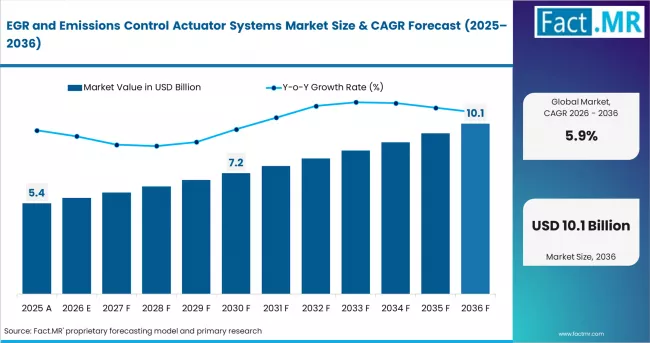
  • According to Fact.MR, demand is projected to reach USD 5.4 billion in 2026 and expand to USD 9.7 billion by 2036, reflecting a CAGR of 5.9% during the forecast period.
Egr And Emissions Control Actuator Systems Market  Value Analysis

Metric Value
Estimated Value in 2026 USD 5.4 billion
Forecast Value in 2036 USD 9.7 billion
Forecast CAGR (2026 to 2036) 5.9%

Summary of the EGR and Emissions Control Actuator Systems Market

  • Market Definition
    • The EGR and emissions control actuator systems market includes electrically controlled hardware that meters exhaust gas, air, or reductant flow to support emissions compliance.
  • Demand Drivers
    • OEMs need more exact recirculation and dosing control to meet tighter emissions limits.
    • Hybrid and combustion powertrains continue to rely on actuator-managed air and exhaust routing.
    • Integrated emissions systems are increasing the number of hardware points that require precise actuation.
  • Key Segments Analyzed
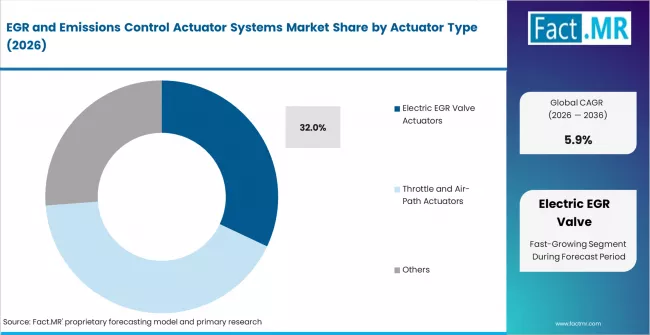
    • By Actuator Type: Electric EGR Valve Actuators are expected to account for 32.0% share in 2026, supported by their central role in exact recirculation control.
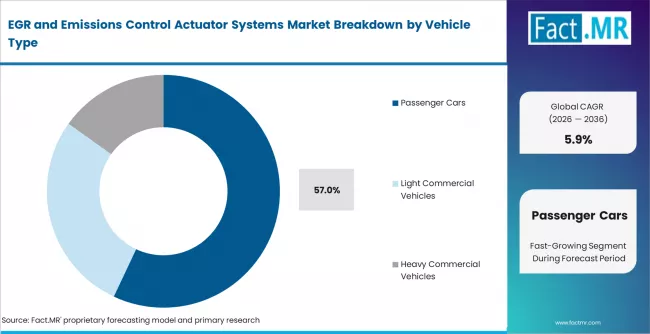
    • By Vehicle Type: Passenger Cars are projected to hold 57.0% share in 2026 because emissions-relevant actuator content is widespread in passenger combustion and hybrid vehicles.
    • By Emissions Function: Exhaust Gas Recirculation is expected to capture 35.0% share in 2026 as EGR remains one of the clearest actuator-defined emissions functions.
    • By Geography: China leads growth with a 6.5% CAGR through 2036.
  • Analyst Opinion at Fact.MR
    • Shambhu Nath Jha, Senior Analyst at Fact.MR, states, strongest shift in this market is that emissions compliance increasingly depends on actuator quality, not just catalyst chemistry. Once exact exhaust-gas recirculation, air-path control, and reductant dosing all become tightly calibrated, the actuator layer turns into a strategic emissions-control asset rather than a supporting part.”
  • Strategic Implications
    • Suppliers that combine precise motion control with thermal durability will be better placed in next-generation emissions systems.
    • OEMs need actuator vendors that support calibration and system integration rather than only valve hardware supply.
    • Aftermarket participants gain more from OE-quality replacement and fitment accuracy than from low-cost generic substitution.
  • Methodology
    • Market sizing used combustion and hybrid-vehicle production, EGR/SCR penetration, and emissions-actuator density as baseline anchors.
    • Analysis incorporated supplier positioning around electric EGR valves, intake actuators, and dosing systems.
    • Forecasts were checked against current product pages and public emissions-system materials from Bosch, Continental, and BorgWarner. [3]

The market is expected to create an absolute opportunity of USD 4.2 billion between 2026 and 2036, supported by tightening emissions standards and increasing system complexity. Growth remains steady because emissions compliance now depends on a larger number of actively controlled hardware points across the powertrain. Electrically actuated EGR valves, intake throttles, dosing modules, and other air-path and exhaust-flow actuators are being deployed to achieve more precise control over combustion and aftertreatment processes. Continental positions electrical EGR valves as enabling more accurate exhaust gas recirculation control, while Bosch highlights dosing and supply modules designed to meet current and upcoming nitrogen oxide regulations. [1]

Commercial demand is increasingly tied to control precision and system integration rather than standalone component performance. Automakers are prioritizing actuator systems that support compliance, improve efficiency, and integrate seamlessly with engine and aftertreatment control strategies, sustaining steady market expansion.

China is projected to remain the fastest-growing country, with a CAGR of 6.5% by 2036, followed by India at 6.1% and Mexico at 5.8%. Germany is expected to expand at 5.7%, the United States at 5.6%. Fact.MR views this spread as a reflection of differences in combustion and hybrid-vehicle output, emissions-regulation pressure, and the degree of local supplier capability in EGR, dosing, and actuator hardware. The continued official positioning of EGR systems, electric EGR valves, and Denoxtronic-style dosing systems by major suppliers supports this outlook.

Segmental Analysis

EGR and Emissions Control Actuator Systems Market Analysis by Actuator Type
Egr And Emissions Control Actuator Systems Market Analysis By Actuator Type

Electric EGR valve actuators are expected to hold 32.0% share in 2026, as EGR remains one of the most actuator-dependent emissions-control functions in combustion and hybrid powertrains. Continental states that electrically actuated exhaust recirculation valves enable more accurate control of exhaust-gas recirculation rates than traditional valves and help meet stricter standards. BorgWarner also positions EGR valves and modules as core exhaust-gas-management products. That makes electric EGR valve actuators the clearest commercial center of this market. This segment stays ahead because precise recirculation control directly affects combustion temperature and NOx formation. Electrically actuated EGR hardware gives OEMs more calibration freedom than simpler layouts and fits the broader direction toward system-level emissions management. [4]

  • Precision control: Electric actuation gives more exact recirculation metering than traditional valve approaches.
  • Compliance value: EGR actuators directly support tighter exhaust-emission compliance.
  • System relevance: EGR remains one of the most visible actuator-defined emissions functions in current supplier portfolios.

EGR and Emissions Control Actuator Systems Market Analysis by Vehicle Type
Egr And Emissions Control Actuator Systems Market Analysis By Vehicle Type

Passenger cars are projected to hold 57.0% share in 2026. The lead comes from high-volume use of emissions-managed combustion and hybrid powertrains in passenger vehicles. Electrically actuated EGR valves, intake actuators, and dosing-related components are all commercially relevant in this class. Continental’s engine-actuator catalog and Bosch’s air-management pages both reflect the breadth of passenger-vehicle applicability for these products. Passenger cars remain ahead because they combine large production volumes with ongoing emissions pressure and a broad transition into hybridized combustion systems rather than a complete overnight shift away from internal combustion. That keeps emissions-related actuation commercially important.

  • Volume leverage: Passenger vehicles create the largest installed base for emissions-relevant actuation.
  • Hybrid overlap: Many passenger hybrids still rely on EGR and air-path hardware for emissions control.
  • Calibration breadth: Passenger powertrains use multiple actuator-managed emissions functions at scale.

EGR and Emissions Control Actuator Systems Market Analysis by Emissions Function
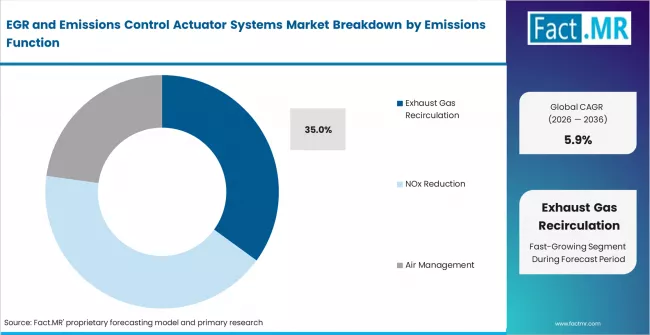
Egr And Emissions Control Actuator Systems Market Analysis By Emissions Function

Exhaust gas recirculation is expected to capture 35.0% share in 2026. This lead comes from the fact that EGR remains the clearest actuator-centered emissions strategy in current supplier materials. BorgWarner explicitly develops high- and low-pressure EGR systems, and Continental’s actuator catalog directly emphasizes electrically actuated EGR valves. Bosch’s differential-pressure-sensor page also shows that low-pressure EGR remains actively monitored and controlled in modern powertrains.

  • Direct actuator dependence: EGR performance depends heavily on accurate valve movement and flow control.
  • System maturity: EGR remains a well-established emissions strategy with continued electronic refinement.
  • Broad applicability: High- and low-pressure EGR architectures widen the addressable actuator base.

EGR and Emissions Control Actuator Systems Market Drivers, Restraints, and Opportunities
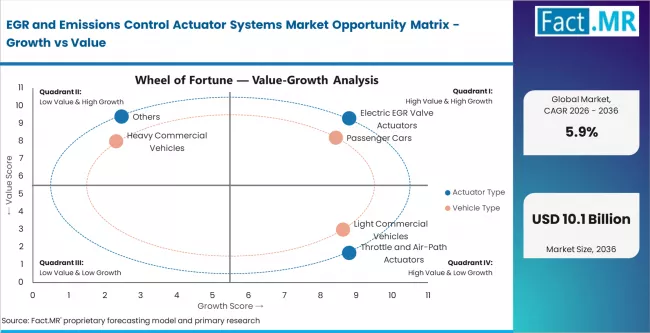
Egr And Emissions Control Actuator Systems Market Opportunity Matrix Growth Vs Value

The strongest market driver is the need for more accurate control of emissions-relevant flow paths. Continental explicitly says electrically actuated EGR valves enable more accurate recirculation control, and Bosch states that precise actuator control in the intake tract helps reduce fuel consumption, CO2, and other emissions. Bosch’s dosing-module and Denoxtronic pages show the same trend on the exhaust side, where more exact metering supports NOx reduction.

The main restraint is complexity and durability burden. These actuators must operate reliably in thermal, soot-laden, vibration-heavy environments while maintaining precision over time. Public supplier messaging around integrated systems and exact metering implies why actuator quality matters so much: once the calibration window tightens, mechanical drift or sticking becomes costlier.

Regional Analysis

Based on the regional analysis, the EGR and Emissions Control Actuator Systems Market is segmented into East Asia, Europe, North America, South Asia and Pacific, Latin America, and Middle East and Africa across 40 plus countries.

Top Country Growth Comparison Egr And Emissions Control Actuator Systems Market Cagr (2026 2036)

Country CAGR (2026 to 2036)
China 6.5%
India 6.1%
Mexico 5.8%
Germany 5.7%
United States 5.6%

Source: Fact.MR analysis, based on proprietary forecasting model and primary research
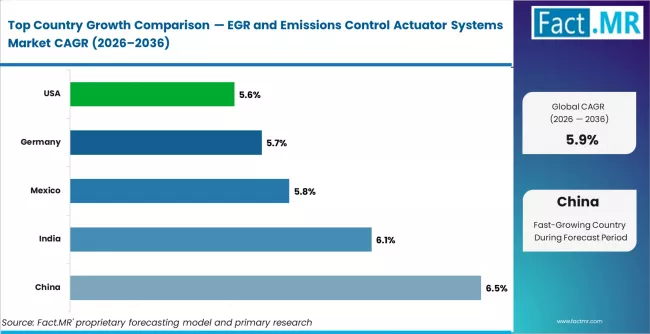
Egr And Emissions Control Actuator Systems Market Cagr Analysis By Country

East Asia EGR and Emissions Control Actuator Systems Market Analysis
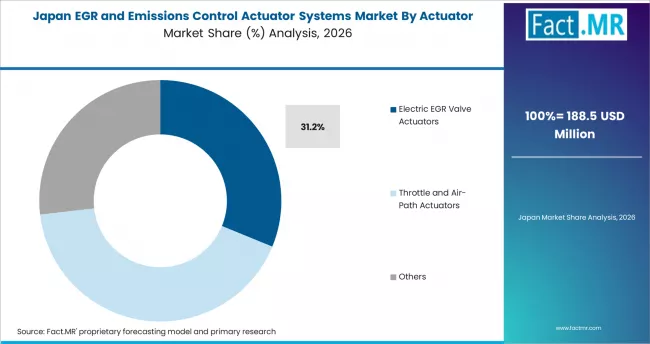
Egr And Emissions Control Actuator Systems Market Japan Market Share Analysis By Actuator Type

East Asia remains the strongest production and adoption base for this market. The region combines high combustion and hybrid-vehicle output with strong supplier depth in engine-management, EGR, and emissions components. BorgWarner’s integrated EGR-system positioning and Bosch’s and Continental’s actuator portfolios support the region’s importance as both a manufacturing and application center for emissions-control actuation.

  • China: EGR and emissions control actuator systems demand in China is projected to grow at a CAGR of 6.5% by 2036. The market benefits from large vehicle output and sustained use of emissions-managed combustion and hybrid powertrains.
  • Japan: Japanese demand is projected to expand at a CAGR of 5.2% over the forecast period. Growth is steadier because the market is more mature and places stronger emphasis on long-cycle component precision and reliability.
  • South Korea: South Korea is expected to grow at a CAGR of 5.0% through 2036. Its role is tied to modern combustion and hybrid programs that continue to rely on exact air-path and emissions actuation.
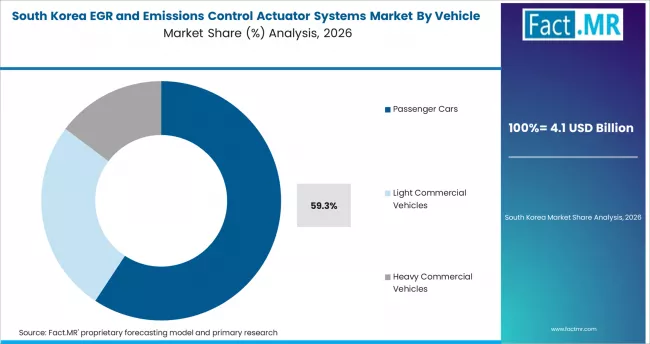
Egr And Emissions Control Actuator Systems Market South Korea Market Share Analysis By Vehicle Type

Fact.MR’s report also covers ASEAN, Australia and New Zealand, and other South Asia and Pacific markets. These countries matter where combustion and hybrid powertrain production remains commercially important.

North America EGR and Emissions Control Actuator Systems Market Analysis
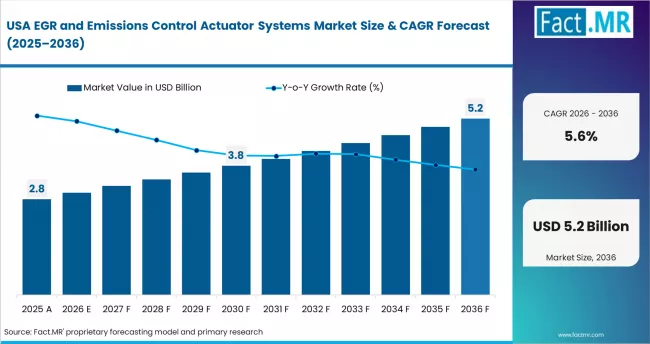
Egr And Emissions Control Actuator Systems Market Country Value Analysis

North America is shaped by a large installed base of emissions-managed combustion vehicles and a meaningful service market for engine-management components. EGR and related actuator systems matter in this region because exact recirculation, air management, and dosing control remain necessary in vehicles that continue using combustion or hybrid powertrains. Continental’s engine-actuator portfolio and Bosch’s dosing-system materials align with that market logic.

  • United States: EGR and emissions control actuator systems demand in the United States is projected to rise at a CAGR of 5.6% from 2026 to 2036. A large installed vehicle base and the continued relevance of combustion and hybrid powertrains support steady demand. Emissions compliance requirements, along with the need to maintain performance and efficiency, keep actuator systems central to powertrain control strategies. OEMs and suppliers focus on durability, calibration precision, and integration with broader engine and aftertreatment systems, ensuring reliable operation across diverse driving and regulatory conditions.

Fact.MR’s report also includes Canada and the broader North American powertrain ecosystem. Additional value comes from replacement demand and continued emissions-compliance hardware needs in the installed parc.

Europe EGR and Emissions Control Actuator Systems Market Analysis
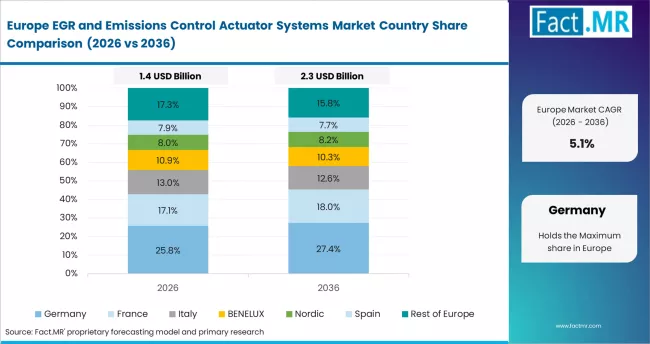
Egr And Emissions Control Actuator Systems Market Europe Country Market Share Analysis, 2026 & 2036

Europe remains a high-discipline market rather than the fastest-growing one. Vehicle makers and suppliers in the region place strong weight on exact emissions control, integrated exhaust-gas management, and hardware that supports tighter regulatory targets. Bosch’s emissions-system pages, Continental’s electric EGR-valve materials, and BorgWarner’s integrated EGR-system positioning all reinforce Europe’s role as a major engineering center for this category.

  • Germany: Germany is projected to expand at a CAGR of 5.7% by 2036. Strong engineering depth across air-path systems, exhaust gas recirculation (EGR), and aftertreatment control hardware underpins its importance in this market. Demand is supported by the need for precise emissions management, efficient combustion control, and integration of advanced actuator systems within both conventional and hybrid powertrains. OEMs and suppliers continue to prioritize reliability, calibration accuracy, and system-level optimization, reinforcing Germany’s role as a key center for powertrain control technologies.

Fact.MR’s report also covers France, Italy, the United Kingdom, Spain, and the rest of Europe. These markets add commercial depth through advanced combustion and hybrid powertrain engineering and ongoing emissions-compliance pressure.

Competitive Aligners for Market Players
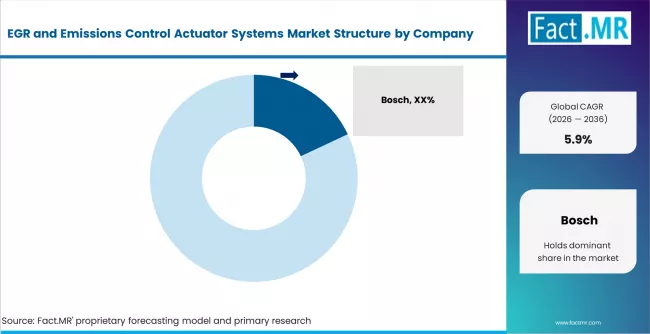
Egr And Emissions Control Actuator Systems Market Analysis By Company

The EGR and emissions control actuator systems market is moderately consolidated. Buyers do not choose suppliers only on nominal valve movement. They choose on metering precision, thermal durability, diagnostics compatibility, and the ability to fit into a larger emissions-control architecture. Bosch, Continental, and BorgWarner remain highly visible in current public materials because they position these products as integrated emissions-system hardware rather than isolated motion parts.

Established suppliers hold an advantage because emissions-control actuation is closely tied to full engine and aftertreatment calibration rather than a standalone component function. A new entrant may offer a functional actuator, but matching OEM confidence is more difficult when precise exhaust-gas recirculation or dosing behavior directly determines compliance margins. This dependence on system-level tuning and validation keeps the market more selective than a typical actuator category. Buyer leverage remains relevant, though moderated by fitment sensitivity and certification-related risk. OEMs aim to manage cost, but they also prioritize low risk in components that directly influence emissions performance, onboard diagnostics, and regulatory approval. Any variation in actuator behavior can affect compliance outcomes, increasing the importance of proven solutions.

Key Players in EGR and Emissions Control Actuator Systems Market

  • Bosch
  • Continental
  • BorgWarner
  • Denso
  • Hitachi Astemo
  • Marelli
  • Aisin-related emissions and powertrain suppliers
  • Cummins Components
  • Delphi-related engine-management suppliers
  • Hella-related electronics suppliers

Bibliography

  • [1] Continental Aftermarket. Engine Actuators. Official page stating that electrically actuated exhaust recirculation valves enable more accurate recirculation control and help meet stricter emissions standards.
  • [2] Bosch Mobility. General-purpose actuator. Official page stating that precise actuator control of flaps and valves helps reduce fuel consumption, CO2, and other emissions.
  • [3] Continental Aftermarket. Actuators Catalogue 2022. Official catalog page covering EGR valve actuators.
  • [4] BorgWarner. Intake and Exhaust Gas Management. Official page stating BorgWarner develops complete high- or low-pressure EGR systems.
  • [5] Bosch Mobility. Differential pressure sensor. Official page noting use in control of low-pressure exhaust-gas recirculation.

This Report Addresses

  • Strategic demand outlook for EGR and emissions control actuator systems across combustion and hybrid powertrains.
  • Market forecast from USD 5.4 billion in 2026 to USD 9.7 billion by 2036.
  • The growing role of electric EGR valves, air-path actuators, and dosing hardware in emissions compliance.
  • The effect of tighter emissions requirements and integrated emissions-system design on actuator demand.
  • OEM versus aftermarket demand patterns in a fitment- and calibration-sensitive emissions category.
  • Regional differences in combustion output, hybridization, and supplier capability.
  • Competitive positioning of suppliers active in EGR, dosing, and related emissions-control actuation.
  • Segment analysis by actuator type, vehicle type, emissions function, sales channel, and geography.

EGR and Emissions Control Actuator Systems Market Definition

The market covers actuator hardware that physically regulates emissions-related flow paths in the engine and exhaust system. This includes electric EGR valve actuators, intake and exhaust air-management actuators, reductant dosing actuators, and related control hardware that affects exhaust-gas recirculation, NOx reduction, and thermal management.

EGR and Emissions Control Actuator Systems Market Inclusions

The market includes electrically actuated exhaust-gas-recirculation valves, variable lift or throttle-type air-path actuators when used for emissions-relevant flow control, SCR/DEF dosing modules and supply modules, and related actuator-side hardware used in passenger, commercial, and hybrid vehicles.

EGR and Emissions Control Actuator Systems Market Exclusions

The market excludes passive catalytic substrates, diesel particulate filters, simple exhaust pipes, and full engine-control units where actuator value cannot be isolated. It also excludes non-automotive stationary-engine emissions systems.

EGR and Emissions Control Actuator Systems Market Research Methodology

  • Primary Research
    • Interviews with exhaust-gas-management engineers, air-path specialists, emissions calibration teams, powertrain controls engineers, and aftermarket engine-management distributors.
  • Desk Research
    • Review of official product pages and catalogs for electric EGR valves, air-path actuators, dosing modules, and integrated EGR systems from Bosch, Continental, and BorgWarner.
  • Market-Sizing and Forecasting
    • Fact.MR used a blended model based on combustion and hybrid-vehicle production, EGR and SCR penetration, actuator count per powertrain, and replacement demand in the installed vehicle parc.
  • Data Validation and Update Cycle
    • Forecasts were cross-checked through current supplier positioning around electric EGR valves, intake actuators, low-pressure EGR control, and Denoxtronic-style dosing systems. Bosch’s differential-pressure-sensor page also shows the continuing role of sensing in low-pressure EGR control, reinforcing the broader electronically managed nature of the category. [2]

Scope of the Report

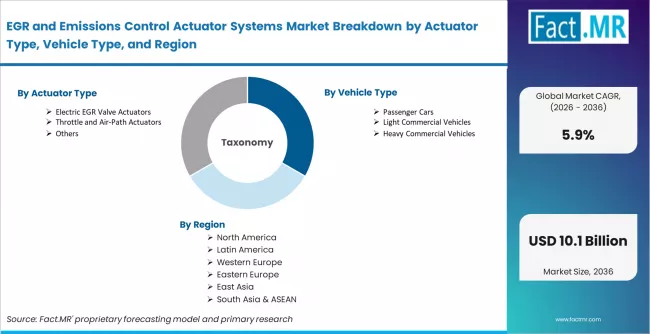
Egr And Emissions Control Actuator Systems Market Breakdown By Actuator Type, Vehicle Type, And Region

Attribute Details
Quantitative Units USD 5.4 billion in 2026 to USD 9.7 billion in 2036, at a CAGR of 5.9%
Market Definition EGR and emissions control actuator systems that electronically meter or position emissions-relevant valves, flaps, and dosing elements in automotive powertrains.
Actuator Type Segmentation Electric EGR Valve Actuators, Throttle and Air-Path Actuators, SCR Dosing Actuators, Exhaust Flap and Bypass Actuators, Others
Vehicle Type Segmentation Passenger Cars, Light Commercial Vehicles, Heavy Commercial Vehicles, Hybrid Vehicles
Emissions Function Segmentation Exhaust Gas Recirculation, NOx Reduction, Air Management, Thermal Management, Others
Regions Covered East Asia, Europe, North America, South Asia and Pacific, Latin America, Middle East and Africa
Countries Covered China, India, Mexico, Germany, United States, Japan, South Korea, and 40+ countries
Key Companies Profiled Bosch, Continental, BorgWarner, Schaeffler/Vitesco-related businesses, Denso, Hitachi Astemo, Marelli, Cummins and others
Forecast Period 2026 to 2036
Approach Fact.MR combined primary interviews with emissions and powertrain stakeholders, desk research across official supplier materials, and a forecast model anchored in combustion and hybrid powertrain output, EGR/SCR penetration, and actuator replacement demand.

EGR and Emissions Control Actuator Systems Market by Segments

  • By Actuator Type:

    • Electric EGR Valve Actuators
    • Throttle and Air-Path Actuators
    • SCR Dosing Actuators
    • Exhaust Flap and Bypass Actuators
    • Others
  • By Vehicle Type:

    • Passenger Cars
    • Light Commercial Vehicles
    • Heavy Commercial Vehicles
    • Hybrid Vehicles
  • By Emissions Function:

    • Exhaust Gas Recirculation
    • NOx Reduction
    • Air Management
    • Thermal Management
    • Others
  • By Region:

    • North America
      • United States
      • Canada
      • Mexico
    • Latin America
      • Brazil
      • Argentina
      • Rest of Latin America
    • Europe
      • Germany
      • France
      • United Kingdom
      • Italy
      • Spain
      • Rest of Europe
    • East Asia
      • China
      • Japan
      • South Korea
    • South Asia and Pacific
      • India
      • ASEAN
      • Australia and New Zealand
      • Rest of South Asia and Pacific
    • Middle East and Africa
      • GCC Countries
      • South Africa
      • Turkey
      • Rest of Middle East and Africa

- Frequently Asked Questions -

What is the estimated size of the EGR and emissions control actuator systems market in 2026?

The market is estimated at USD 5.4 billion in 2026.

How large is the market expected to become by 2036?

Fact.MR estimates the market will reach USD 9.7 billion by 2036.

What is the forecast CAGR for 2026 to 2036?

The market is projected to expand at a CAGR of 5.9% during the forecast period.

Which actuator type leads the market?

Electric EGR valve actuators lead the market with an expected 32.0% share in 2026. Continental’s current engine-actuator materials directly support the commercial importance of this category.

Which vehicle type dominates demand?

Passenger cars lead with a projected 57.0% share in 2026.

Why does the OEM channel dominate?

OEM dominates because actuator behavior is tied directly to emissions calibration, certification, and system integration.

Why are emissions-control actuators important here?

They make exact exhaust-gas recirculation, air-path control, and reductant dosing possible in modern powertrains.

What is the strongest demand driver?

The strongest driver is the need for more precise control of emissions-relevant flow paths under tighter regulatory requirements.

What is the key restraint?

The main restraint is the durability and precision burden created by hot, contaminated operating environments and tighter calibration windows.

Which country is growing fastest?

China is the fastest-growing country, with a projected CAGR of 6.5% through 2036.

Why is China ahead?

China combines high combustion and hybrid-vehicle output with strong supplier capability in emissions-control hardware.

How do hybrids affect this market?

Hybrids preserve demand for emissions actuators because many still rely on combustion engines that need EGR, air-path, and dosing control.

Is this a fragmented supplier market?

No. It is moderately consolidated because buyers value calibration support, metering precision, and systems integration, not just valve movement.

What do OEM buyers prioritize?

They prioritize metering precision, thermal durability, diagnostics compatibility, and fit with the larger emissions-control architecture.

Why does the aftermarket matter in this segment?

Because EGR valves and related actuator hardware are service and replacement items in the installed vehicle base, though exact fitment matters.

Which companies are most visible in this market?

Bosch, Continental, and BorgWarner are the clearest names in the official source material used here.

What is the broader outlook through 2036?

By 2036, the market is expected to become more precision-led, with greater value placed on exact electronic control of EGR, air-path, and dosing hardware inside integrated emissions systems.

Table of Content

  1. Executive Summary
    • Global Market Outlook
    • Demand to side Trends
    • Supply to side Trends
    • Technology Roadmap Analysis
    • Analysis and Recommendations
  2. Market Overview
    • Market Coverage / Taxonomy
    • Market Definition / Scope / Limitations
  3. Research Methodology
    • Chapter Orientation
    • Analytical Lens and Working Hypotheses
      • Market Structure, Signals, and Trend Drivers
      • Benchmarking and Cross-market Comparability
      • Market Sizing, Forecasting, and Opportunity Mapping
    • Research Design and Evidence Framework
      • Desk Research Programme (Secondary Evidence)
        • Company Annual and Sustainability Reports
        • Peer-reviewed Journals and Academic Literature
        • Corporate Websites, Product Literature, and Technical Notes
        • Earnings Decks and Investor Briefings
        • Statutory Filings and Regulatory Disclosures
        • Technical White Papers and Standards Notes
        • Trade Journals, Industry Magazines, and Analyst Briefs
        • Conference Proceedings, Webinars, and Seminar Materials
        • Government Statistics Portals and Public Data Releases
        • Sector Databases and Reference Repositories
        • Fact.MR Internal Proprietary Databases and Historical Market Datasets
        • Subscription Datasets and Paid Sources
        • Social Channels, Communities, and Digital Listening Inputs
        • Additional Desk Sources
      • Expert Input and Fieldwork (Primary Evidence)
        • Primary Modes
          • Qualitative Interviews and Expert Elicitation
          • Quantitative Surveys and Structured Data Capture
          • Blended Approach
        • Why Primary Evidence is Used
        • Field Techniques
          • Interviews
          • Surveys
          • Focus Groups
          • Observational and In-context Research
          • Social and Community Interactions
        • Stakeholder Universe Engaged
          • C-suite Leaders
          • Board Members
          • Presidents and Vice Presidents
          • R&D and Innovation Heads
          • Technical Specialists
          • Domain Subject-matter Experts
          • Scientists
          • Physicians and Other Healthcare Professionals
        • Governance, Ethics, and Data Stewardship
          • Research Ethics
          • Data Integrity and Handling
      • Tooling, Models, and Reference Databases
    • Data Engineering and Model Build
      • Data Acquisition and Ingestion
      • Cleaning, Normalisation, and Verification
      • Synthesis, Triangulation, and Analysis
    • Quality Assurance and Audit Trail
  4. Market Background
    • Market Dynamics
      • Drivers
      • Restraints
      • Opportunity
      • Trends
    • Scenario Forecast
      • Demand in Optimistic Scenario
      • Demand in Likely Scenario
      • Demand in Conservative Scenario
    • Opportunity Map Analysis
    • Product Life Cycle Analysis
    • Supply Chain Analysis
    • Investment Feasibility Matrix
    • Value Chain Analysis
    • PESTLE and Porter’s Analysis
    • Regulatory Landscape
    • Regional Parent Market Outlook
    • Production and Consumption Statistics
    • Import and Export Statistics
  5. Global Market Analysis 2021 to 2025 and Forecast, 2026 to 2036
    • Historical Market Size Value (USD Million) Analysis, 2021 to 2025
    • Current and Future Market Size Value (USD Million) Projections, 2026 to 2036
      • Y to o to Y Growth Trend Analysis
      • Absolute $ Opportunity Analysis
  6. Global Market Pricing Analysis 2021 to 2025 and Forecast 2026 to 2036
  7. Global Market Analysis 2021 to 2025 and Forecast 2026 to 2036, By Actuator Type
    • Introduction / Key Findings
    • Historical Market Size Value (USD Million) Analysis By Actuator Type , 2021 to 2025
    • Current and Future Market Size Value (USD Million) Analysis and Forecast By Actuator Type , 2026 to 2036
      • Electric EGR Valve Actuators
      • Throttle and Air-Path Actuators
      • Others
    • Y to o to Y Growth Trend Analysis By Actuator Type , 2021 to 2025
    • Absolute $ Opportunity Analysis By Actuator Type , 2026 to 2036
  8. Global Market Analysis 2021 to 2025 and Forecast 2026 to 2036, By Vehicle Type
    • Introduction / Key Findings
    • Historical Market Size Value (USD Million) Analysis By Vehicle Type, 2021 to 2025
    • Current and Future Market Size Value (USD Million) Analysis and Forecast By Vehicle Type, 2026 to 2036
      • Passenger Cars
      • Light Commercial Vehicles
      • Heavy Commercial Vehicles
    • Y to o to Y Growth Trend Analysis By Vehicle Type, 2021 to 2025
    • Absolute $ Opportunity Analysis By Vehicle Type, 2026 to 2036
  9. Global Market Analysis 2021 to 2025 and Forecast 2026 to 2036, By Emissions Function
    • Introduction / Key Findings
    • Historical Market Size Value (USD Million) Analysis By Emissions Function, 2021 to 2025
    • Current and Future Market Size Value (USD Million) Analysis and Forecast By Emissions Function, 2026 to 2036
      • Exhaust Gas Recirculation
      • NOx Reduction
      • Air Management
    • Y to o to Y Growth Trend Analysis By Emissions Function, 2021 to 2025
    • Absolute $ Opportunity Analysis By Emissions Function, 2026 to 2036
  10. Global Market Analysis 2021 to 2025 and Forecast 2026 to 2036, By Region
    • Introduction
    • Historical Market Size Value (USD Million) Analysis By Region, 2021 to 2025
    • Current Market Size Value (USD Million) Analysis and Forecast By Region, 2026 to 2036
      • North America
      • Latin America
      • Western Europe
      • Eastern Europe
      • East Asia
      • South Asia and Pacific
      • Middle East & Africa
    • Market Attractiveness Analysis By Region
  11. North America Market Analysis 2021 to 2025 and Forecast 2026 to 2036, By Country
    • Historical Market Size Value (USD Million) Trend Analysis By Market Taxonomy, 2021 to 2025
    • Market Size Value (USD Million) Forecast By Market Taxonomy, 2026 to 2036
      • By Country
        • USA
        • Canada
        • Mexico
      • By Actuator Type
      • By Vehicle Type
      • By Emissions Function
    • Market Attractiveness Analysis
      • By Country
      • By Actuator Type
      • By Vehicle Type
      • By Emissions Function
    • Key Takeaways
  12. Latin America Market Analysis 2021 to 2025 and Forecast 2026 to 2036, By Country
    • Historical Market Size Value (USD Million) Trend Analysis By Market Taxonomy, 2021 to 2025
    • Market Size Value (USD Million) Forecast By Market Taxonomy, 2026 to 2036
      • By Country
        • Brazil
        • Chile
        • Rest of Latin America
      • By Actuator Type
      • By Vehicle Type
      • By Emissions Function
    • Market Attractiveness Analysis
      • By Country
      • By Actuator Type
      • By Vehicle Type
      • By Emissions Function
    • Key Takeaways
  13. Western Europe Market Analysis 2021 to 2025 and Forecast 2026 to 2036, By Country
    • Historical Market Size Value (USD Million) Trend Analysis By Market Taxonomy, 2021 to 2025
    • Market Size Value (USD Million) Forecast By Market Taxonomy, 2026 to 2036
      • By Country
        • Germany
        • UK
        • Italy
        • Spain
        • France
        • Nordic
        • BENELUX
        • Rest of Western Europe
      • By Actuator Type
      • By Vehicle Type
      • By Emissions Function
    • Market Attractiveness Analysis
      • By Country
      • By Actuator Type
      • By Vehicle Type
      • By Emissions Function
    • Key Takeaways
  14. Eastern Europe Market Analysis 2021 to 2025 and Forecast 2026 to 2036, By Country
    • Historical Market Size Value (USD Million) Trend Analysis By Market Taxonomy, 2021 to 2025
    • Market Size Value (USD Million) Forecast By Market Taxonomy, 2026 to 2036
      • By Country
        • Russia
        • Poland
        • Hungary
        • Balkan & Baltic
        • Rest of Eastern Europe
      • By Actuator Type
      • By Vehicle Type
      • By Emissions Function
    • Market Attractiveness Analysis
      • By Country
      • By Actuator Type
      • By Vehicle Type
      • By Emissions Function
    • Key Takeaways
  15. East Asia Market Analysis 2021 to 2025 and Forecast 2026 to 2036, By Country
    • Historical Market Size Value (USD Million) Trend Analysis By Market Taxonomy, 2021 to 2025
    • Market Size Value (USD Million) Forecast By Market Taxonomy, 2026 to 2036
      • By Country
        • China
        • Japan
        • South Korea
      • By Actuator Type
      • By Vehicle Type
      • By Emissions Function
    • Market Attractiveness Analysis
      • By Country
      • By Actuator Type
      • By Vehicle Type
      • By Emissions Function
    • Key Takeaways
  16. South Asia and Pacific Market Analysis 2021 to 2025 and Forecast 2026 to 2036, By Country
    • Historical Market Size Value (USD Million) Trend Analysis By Market Taxonomy, 2021 to 2025
    • Market Size Value (USD Million) Forecast By Market Taxonomy, 2026 to 2036
      • By Country
        • India
        • ASEAN
        • Australia & New Zealand
        • Rest of South Asia and Pacific
      • By Actuator Type
      • By Vehicle Type
      • By Emissions Function
    • Market Attractiveness Analysis
      • By Country
      • By Actuator Type
      • By Vehicle Type
      • By Emissions Function
    • Key Takeaways
  17. Middle East & Africa Market Analysis 2021 to 2025 and Forecast 2026 to 2036, By Country
    • Historical Market Size Value (USD Million) Trend Analysis By Market Taxonomy, 2021 to 2025
    • Market Size Value (USD Million) Forecast By Market Taxonomy, 2026 to 2036
      • By Country
        • Kingdom of Saudi Arabia
        • Other GCC Countries
        • Turkiye
        • South Africa
        • Other African Union
        • Rest of Middle East & Africa
      • By Actuator Type
      • By Vehicle Type
      • By Emissions Function
    • Market Attractiveness Analysis
      • By Country
      • By Actuator Type
      • By Vehicle Type
      • By Emissions Function
    • Key Takeaways
  18. Key Countries Market Analysis
    • USA
      • Pricing Analysis
      • Market Share Analysis, 2025
        • By Actuator Type
        • By Vehicle Type
        • By Emissions Function
    • Canada
      • Pricing Analysis
      • Market Share Analysis, 2025
        • By Actuator Type
        • By Vehicle Type
        • By Emissions Function
    • Mexico
      • Pricing Analysis
      • Market Share Analysis, 2025
        • By Actuator Type
        • By Vehicle Type
        • By Emissions Function
    • Brazil
      • Pricing Analysis
      • Market Share Analysis, 2025
        • By Actuator Type
        • By Vehicle Type
        • By Emissions Function
    • Chile
      • Pricing Analysis
      • Market Share Analysis, 2025
        • By Actuator Type
        • By Vehicle Type
        • By Emissions Function
    • Germany
      • Pricing Analysis
      • Market Share Analysis, 2025
        • By Actuator Type
        • By Vehicle Type
        • By Emissions Function
    • UK
      • Pricing Analysis
      • Market Share Analysis, 2025
        • By Actuator Type
        • By Vehicle Type
        • By Emissions Function
    • Italy
      • Pricing Analysis
      • Market Share Analysis, 2025
        • By Actuator Type
        • By Vehicle Type
        • By Emissions Function
    • Spain
      • Pricing Analysis
      • Market Share Analysis, 2025
        • By Actuator Type
        • By Vehicle Type
        • By Emissions Function
    • France
      • Pricing Analysis
      • Market Share Analysis, 2025
        • By Actuator Type
        • By Vehicle Type
        • By Emissions Function
    • India
      • Pricing Analysis
      • Market Share Analysis, 2025
        • By Actuator Type
        • By Vehicle Type
        • By Emissions Function
    • ASEAN
      • Pricing Analysis
      • Market Share Analysis, 2025
        • By Actuator Type
        • By Vehicle Type
        • By Emissions Function
    • Australia & New Zealand
      • Pricing Analysis
      • Market Share Analysis, 2025
        • By Actuator Type
        • By Vehicle Type
        • By Emissions Function
    • China
      • Pricing Analysis
      • Market Share Analysis, 2025
        • By Actuator Type
        • By Vehicle Type
        • By Emissions Function
    • Japan
      • Pricing Analysis
      • Market Share Analysis, 2025
        • By Actuator Type
        • By Vehicle Type
        • By Emissions Function
    • South Korea
      • Pricing Analysis
      • Market Share Analysis, 2025
        • By Actuator Type
        • By Vehicle Type
        • By Emissions Function
    • Russia
      • Pricing Analysis
      • Market Share Analysis, 2025
        • By Actuator Type
        • By Vehicle Type
        • By Emissions Function
    • Poland
      • Pricing Analysis
      • Market Share Analysis, 2025
        • By Actuator Type
        • By Vehicle Type
        • By Emissions Function
    • Hungary
      • Pricing Analysis
      • Market Share Analysis, 2025
        • By Actuator Type
        • By Vehicle Type
        • By Emissions Function
    • Kingdom of Saudi Arabia
      • Pricing Analysis
      • Market Share Analysis, 2025
        • By Actuator Type
        • By Vehicle Type
        • By Emissions Function
    • Turkiye
      • Pricing Analysis
      • Market Share Analysis, 2025
        • By Actuator Type
        • By Vehicle Type
        • By Emissions Function
    • South Africa
      • Pricing Analysis
      • Market Share Analysis, 2025
        • By Actuator Type
        • By Vehicle Type
        • By Emissions Function
  19. Market Structure Analysis
    • Competition Dashboard
    • Competition Benchmarking
    • Market Share Analysis of Top Players
      • By Regional
      • By Actuator Type
      • By Vehicle Type
      • By Emissions Function
  20. Competition Analysis
    • Competition Deep Dive
      • Bosch
        • Overview
        • Product Portfolio
        • Profitability by Market Segments (Product/Age /Sales Channel/Region)
        • Sales Footprint
        • Strategy Overview
          • Marketing Strategy
          • Product Strategy
          • Channel Strategy
      • Continental
      • BorgWarner
      • Denso
      • Hitachi Astemo
      • Marelli
      • Aisin-related emissions and powertrain suppliers
      • Cummins Components
  21. Assumptions & Acronyms Used

List Of Table

  • Table 1: Global Market Value (USD Million) Forecast by Region, 2021 to 2036
  • Table 2: Global Market Value (USD Million) Forecast by Actuator Type , 2021 to 2036
  • Table 3: Global Market Value (USD Million) Forecast by Vehicle Type, 2021 to 2036
  • Table 4: Global Market Value (USD Million) Forecast by Emissions Function, 2021 to 2036
  • Table 5: North America Market Value (USD Million) Forecast by Country, 2021 to 2036
  • Table 6: North America Market Value (USD Million) Forecast by Actuator Type , 2021 to 2036
  • Table 7: North America Market Value (USD Million) Forecast by Vehicle Type, 2021 to 2036
  • Table 8: North America Market Value (USD Million) Forecast by Emissions Function, 2021 to 2036
  • Table 9: Latin America Market Value (USD Million) Forecast by Country, 2021 to 2036
  • Table 10: Latin America Market Value (USD Million) Forecast by Actuator Type , 2021 to 2036
  • Table 11: Latin America Market Value (USD Million) Forecast by Vehicle Type, 2021 to 2036
  • Table 12: Latin America Market Value (USD Million) Forecast by Emissions Function, 2021 to 2036
  • Table 13: Western Europe Market Value (USD Million) Forecast by Country, 2021 to 2036
  • Table 14: Western Europe Market Value (USD Million) Forecast by Actuator Type , 2021 to 2036
  • Table 15: Western Europe Market Value (USD Million) Forecast by Vehicle Type, 2021 to 2036
  • Table 16: Western Europe Market Value (USD Million) Forecast by Emissions Function, 2021 to 2036
  • Table 17: Eastern Europe Market Value (USD Million) Forecast by Country, 2021 to 2036
  • Table 18: Eastern Europe Market Value (USD Million) Forecast by Actuator Type , 2021 to 2036
  • Table 19: Eastern Europe Market Value (USD Million) Forecast by Vehicle Type, 2021 to 2036
  • Table 20: Eastern Europe Market Value (USD Million) Forecast by Emissions Function, 2021 to 2036
  • Table 21: East Asia Market Value (USD Million) Forecast by Country, 2021 to 2036
  • Table 22: East Asia Market Value (USD Million) Forecast by Actuator Type , 2021 to 2036
  • Table 23: East Asia Market Value (USD Million) Forecast by Vehicle Type, 2021 to 2036
  • Table 24: East Asia Market Value (USD Million) Forecast by Emissions Function, 2021 to 2036
  • Table 25: South Asia and Pacific Market Value (USD Million) Forecast by Country, 2021 to 2036
  • Table 26: South Asia and Pacific Market Value (USD Million) Forecast by Actuator Type , 2021 to 2036
  • Table 27: South Asia and Pacific Market Value (USD Million) Forecast by Vehicle Type, 2021 to 2036
  • Table 28: South Asia and Pacific Market Value (USD Million) Forecast by Emissions Function, 2021 to 2036
  • Table 29: Middle East & Africa Market Value (USD Million) Forecast by Country, 2021 to 2036
  • Table 30: Middle East & Africa Market Value (USD Million) Forecast by Actuator Type , 2021 to 2036
  • Table 31: Middle East & Africa Market Value (USD Million) Forecast by Vehicle Type, 2021 to 2036
  • Table 32: Middle East & Africa Market Value (USD Million) Forecast by Emissions Function, 2021 to 2036

List Of Figures

  • Figure 1: Global Market Pricing Analysis
  • Figure 2: Global Market Value (USD Million) Forecast 2021-2036
  • Figure 3: Global Market Value Share and BPS Analysis by Actuator Type, 2026 and 2036
  • Figure 4: Global Market Y-o-Y Growth Comparison by Actuator Type, 2026 to 2036
  • Figure 5: Global Market Attractiveness Analysis by Actuator Type
  • Figure 6: Global Market Value Share and BPS Analysis by Vehicle Type, 2026 and 2036
  • Figure 7: Global Market Y-o-Y Growth Comparison by Vehicle Type, 2026 to 2036
  • Figure 8: Global Market Attractiveness Analysis by Vehicle Type
  • Figure 9: Global Market Value Share and BPS Analysis by Emissions Function, 2026 and 2036
  • Figure 10: Global Market Y-o-Y Growth Comparison by Emissions Function, 2026 to 2036
  • Figure 11: Global Market Attractiveness Analysis by Emissions Function
  • Figure 12: Global Market Value (USD Million) Share and BPS Analysis by Region, 2026 and 2036
  • Figure 13: Global Market Y-o-Y Growth Comparison by Region, 2026 to 2036
  • Figure 14: Global Market Attractiveness Analysis by Region
  • Figure 15: North America Market Incremental Dollar Opportunity, 2026 to 2036
  • Figure 16: Latin America Market Incremental Dollar Opportunity, 2026 to 2036
  • Figure 17: Western Europe Market Incremental Dollar Opportunity, 2026 to 2036
  • Figure 18: Eastern Europe Market Incremental Dollar Opportunity, 2026 to 2036
  • Figure 19: East Asia Market Incremental Dollar Opportunity, 2026 to 2036
  • Figure 20: South Asia and Pacific Market Incremental Dollar Opportunity, 2026 to 2036
  • Figure 21: Middle East & Africa Market Incremental Dollar Opportunity, 2026 to 2036
  • Figure 22: North America Market Value Share and BPS Analysis by Country, 2026 and 2036
  • Figure 23: North America Market Value Share and BPS Analysis by Actuator Type, 2026 and 2036
  • Figure 24: North America Market Y-o-Y Growth Comparison by Actuator Type, 2026 to 2036
  • Figure 25: North America Market Attractiveness Analysis by Actuator Type
  • Figure 26: North America Market Value Share and BPS Analysis by Vehicle Type, 2026 and 2036
  • Figure 27: North America Market Y-o-Y Growth Comparison by Vehicle Type, 2026 to 2036
  • Figure 28: North America Market Attractiveness Analysis by Vehicle Type
  • Figure 29: North America Market Value Share and BPS Analysis by Emissions Function, 2026 and 2036
  • Figure 30: North America Market Y-o-Y Growth Comparison by Emissions Function, 2026 to 2036
  • Figure 31: North America Market Attractiveness Analysis by Emissions Function
  • Figure 32: Latin America Market Value Share and BPS Analysis by Country, 2026 and 2036
  • Figure 33: Latin America Market Value Share and BPS Analysis by Actuator Type, 2026 and 2036
  • Figure 34: Latin America Market Y-o-Y Growth Comparison by Actuator Type, 2026 to 2036
  • Figure 35: Latin America Market Attractiveness Analysis by Actuator Type
  • Figure 36: Latin America Market Value Share and BPS Analysis by Vehicle Type, 2026 and 2036
  • Figure 37: Latin America Market Y-o-Y Growth Comparison by Vehicle Type, 2026 to 2036
  • Figure 38: Latin America Market Attractiveness Analysis by Vehicle Type
  • Figure 39: Latin America Market Value Share and BPS Analysis by Emissions Function, 2026 and 2036
  • Figure 40: Latin America Market Y-o-Y Growth Comparison by Emissions Function, 2026 to 2036
  • Figure 41: Latin America Market Attractiveness Analysis by Emissions Function
  • Figure 42: Western Europe Market Value Share and BPS Analysis by Country, 2026 and 2036
  • Figure 43: Western Europe Market Value Share and BPS Analysis by Actuator Type, 2026 and 2036
  • Figure 44: Western Europe Market Y-o-Y Growth Comparison by Actuator Type, 2026 to 2036
  • Figure 45: Western Europe Market Attractiveness Analysis by Actuator Type
  • Figure 46: Western Europe Market Value Share and BPS Analysis by Vehicle Type, 2026 and 2036
  • Figure 47: Western Europe Market Y-o-Y Growth Comparison by Vehicle Type, 2026 to 2036
  • Figure 48: Western Europe Market Attractiveness Analysis by Vehicle Type
  • Figure 49: Western Europe Market Value Share and BPS Analysis by Emissions Function, 2026 and 2036
  • Figure 50: Western Europe Market Y-o-Y Growth Comparison by Emissions Function, 2026 to 2036
  • Figure 51: Western Europe Market Attractiveness Analysis by Emissions Function
  • Figure 52: Eastern Europe Market Value Share and BPS Analysis by Country, 2026 and 2036
  • Figure 53: Eastern Europe Market Value Share and BPS Analysis by Actuator Type, 2026 and 2036
  • Figure 54: Eastern Europe Market Y-o-Y Growth Comparison by Actuator Type, 2026 to 2036
  • Figure 55: Eastern Europe Market Attractiveness Analysis by Actuator Type
  • Figure 56: Eastern Europe Market Value Share and BPS Analysis by Vehicle Type, 2026 and 2036
  • Figure 57: Eastern Europe Market Y-o-Y Growth Comparison by Vehicle Type, 2026 to 2036
  • Figure 58: Eastern Europe Market Attractiveness Analysis by Vehicle Type
  • Figure 59: Eastern Europe Market Value Share and BPS Analysis by Emissions Function, 2026 and 2036
  • Figure 60: Eastern Europe Market Y-o-Y Growth Comparison by Emissions Function, 2026 to 2036
  • Figure 61: Eastern Europe Market Attractiveness Analysis by Emissions Function
  • Figure 62: East Asia Market Value Share and BPS Analysis by Country, 2026 and 2036
  • Figure 63: East Asia Market Value Share and BPS Analysis by Actuator Type, 2026 and 2036
  • Figure 64: East Asia Market Y-o-Y Growth Comparison by Actuator Type, 2026 to 2036
  • Figure 65: East Asia Market Attractiveness Analysis by Actuator Type
  • Figure 66: East Asia Market Value Share and BPS Analysis by Vehicle Type, 2026 and 2036
  • Figure 67: East Asia Market Y-o-Y Growth Comparison by Vehicle Type, 2026 to 2036
  • Figure 68: East Asia Market Attractiveness Analysis by Vehicle Type
  • Figure 69: East Asia Market Value Share and BPS Analysis by Emissions Function, 2026 and 2036
  • Figure 70: East Asia Market Y-o-Y Growth Comparison by Emissions Function, 2026 to 2036
  • Figure 71: East Asia Market Attractiveness Analysis by Emissions Function
  • Figure 72: South Asia and Pacific Market Value Share and BPS Analysis by Country, 2026 and 2036
  • Figure 73: South Asia and Pacific Market Value Share and BPS Analysis by Actuator Type, 2026 and 2036
  • Figure 74: South Asia and Pacific Market Y-o-Y Growth Comparison by Actuator Type, 2026 to 2036
  • Figure 75: South Asia and Pacific Market Attractiveness Analysis by Actuator Type
  • Figure 76: South Asia and Pacific Market Value Share and BPS Analysis by Vehicle Type, 2026 and 2036
  • Figure 77: South Asia and Pacific Market Y-o-Y Growth Comparison by Vehicle Type, 2026 to 2036
  • Figure 78: South Asia and Pacific Market Attractiveness Analysis by Vehicle Type
  • Figure 79: South Asia and Pacific Market Value Share and BPS Analysis by Emissions Function, 2026 and 2036
  • Figure 80: South Asia and Pacific Market Y-o-Y Growth Comparison by Emissions Function, 2026 to 2036
  • Figure 81: South Asia and Pacific Market Attractiveness Analysis by Emissions Function
  • Figure 82: Middle East & Africa Market Value Share and BPS Analysis by Country, 2026 and 2036
  • Figure 83: Middle East & Africa Market Value Share and BPS Analysis by Actuator Type, 2026 and 2036
  • Figure 84: Middle East & Africa Market Y-o-Y Growth Comparison by Actuator Type, 2026 to 2036
  • Figure 85: Middle East & Africa Market Attractiveness Analysis by Actuator Type
  • Figure 86: Middle East & Africa Market Value Share and BPS Analysis by Vehicle Type, 2026 and 2036
  • Figure 87: Middle East & Africa Market Y-o-Y Growth Comparison by Vehicle Type, 2026 to 2036
  • Figure 88: Middle East & Africa Market Attractiveness Analysis by Vehicle Type
  • Figure 89: Middle East & Africa Market Value Share and BPS Analysis by Emissions Function, 2026 and 2036
  • Figure 90: Middle East & Africa Market Y-o-Y Growth Comparison by Emissions Function, 2026 to 2036
  • Figure 91: Middle East & Africa Market Attractiveness Analysis by Emissions Function
  • Figure 92: Global Market - Tier Structure Analysis
  • Figure 93: Global Market - Company Share Analysis

EGR and Emissions Control Actuator Systems Market