- Market Value (2025): USD 772.8 Mn
- Estimated Value (2026): USD 840.0 Mn
- Forecast Value (2036): USD 1934.5 Mn
- CAGR (2026-2036): 8.7%
What is the Ultra-Matte Dispersing Agents Market forecast to be worth by 2036?
USD 840.0 million in 2026 to USD 1934.5 million by 2036 at an 8.7% CAGR.
- The Ultra-Matte Dispersing Agents Market crossed a valuation of USD 772.8 million in 2025.
- Demand is projected to increase from USD 840.0 million in 2026 to USD 1934.5 million by 2036.
- The market is forecast to record an 8.7% CAGR from 2026 to 2036 as wood finishers and industrial coaters tighten control over gloss drift.
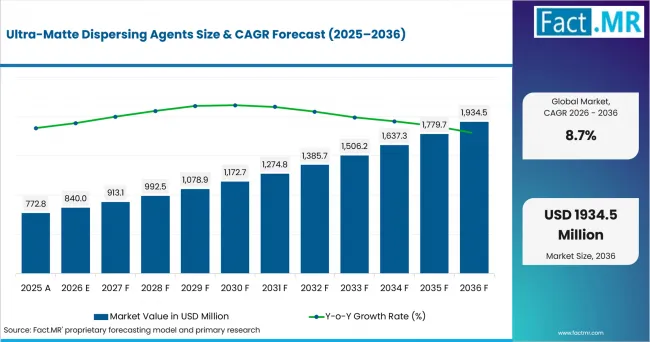
Ultra Matte Dispersing Agents Value Analysis | Source: Fact.MR
What are the defining numbers behind Ultra-Matte Dispersing Agents Market growth?
USD 1094.5 million absolute opportunity by 2036, led by polymeric dispersants, silica matting agents and wood coatings.
- Demand Drivers in the Market
- Wood coating formulators need particle stability because low-sheen furniture finishes show haze and gloss drift quickly on clear surfaces.
- Industrial metal coaters need lower glare on cabinets and panels, supported by dispersants that keep mill-base viscosity predictable.
- Ink and OPV formulators need clean particle separation so printed packs keep definition when brands ask for soft-touch matte surfaces.
- Key Segments Analyzed
- By Chemistry: Polymeric dispersants are expected to hold 38.0% share in 2026 because anchoring groups help stabilize silica and pigment surfaces.
- By Matting Agent: Silica is projected to account for 46.0% share in 2026, supported by its proven role in low-gloss coating design.
- By Coating System: Solventborne is anticipated to represent 29.0% share in 2026 owing to continued use in premium wood and industrial finishes.
- By End-use: Wood is estimated to capture 31.0% share in 2026, shaped by furniture and joinery lines that need tactile low sheen.
- Analyst Opinion at Fact.MR
- Shambhu Nath Jha, Principal Consultant at Fact.MR, states, “Ultra-matte dispersing agents are attracting closer review because low gloss now depends on stable particle behavior. The market is expected to reward suppliers that prove viscosity control at high matting loadings. Formulators need additives that connect wetting, storage stability and reproducible sheen across wood, metal and UV coating lines.”
- Strategic Implications
- Additive suppliers should document gloss, viscosity and storage stability in one trial package so formulators can compare total batch behavior.
- Coating manufacturers should qualify dispersants against the actual matting solid used in production because silica and polymer beads respond differently.
- Wood finishing brands should set tighter gloss-window targets before scale-up so additive selection matches real application equipment.
- Industrial coaters should test ultra-matte additives under curing and repair conditions because small dispersion shifts change the final surface.
The UK is expected to record 9.6% CAGR through 2036, supported by coatings output and low-VOC reformulation. Japan is projected to post 9.2%, led by precision finishing across electronics and automotive interiors. The USA is anticipated to advance at 8.9% because large paint and adhesive plants create a deep formulation base. Italy is forecast to register 8.6% as design-led wood finishes sustain specialty additive trials. Germany is estimated to reach 8.3%, shaped by industrial coatings capability and electric-vehicle finishing.
How does the Ultra-Matte Dispersing Agents Market break down by segment?
Polymeric dispersants lead Chemistry at 38.0%; Silica leads Matting Agent at 46.0%.
Which Chemistry dominates?
Polymeric dispersants hold 38.0% share in 2026.
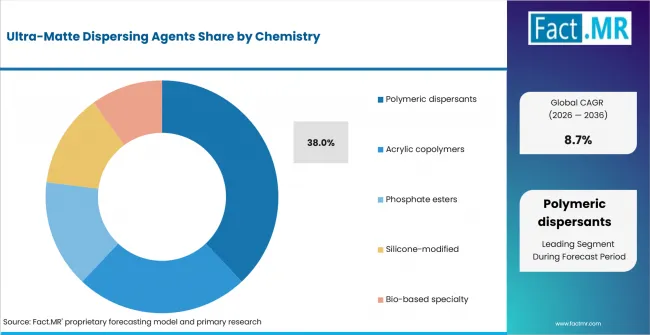
Ultra Matte Dispersing Agents Analysis By Chemistry | Source: Fact.MR
Polymeric dispersants lead the chemistry split because their molecular structure helps attach to more than one particle surface. That behavior is valuable in ultra-matte coatings where silica and pigments must remain separated during storage. BYK introduced DISPERBYK-2180 in July 2026 as a wetting and dispersing additive for inorganic pigments and fillers in aqueous systems.
Acrylic copolymers, phosphate esters and silicone-modified chemistries remain relevant where formulators balance wetting speed with compatibility. Bio-based specialty systems are gaining review in customer trials when lower-fossil-carbon claims have to be paired with repeatable appearance performance.
What leads the Matting Agent segment?
Silica accounts for 46.0% share in 2026.
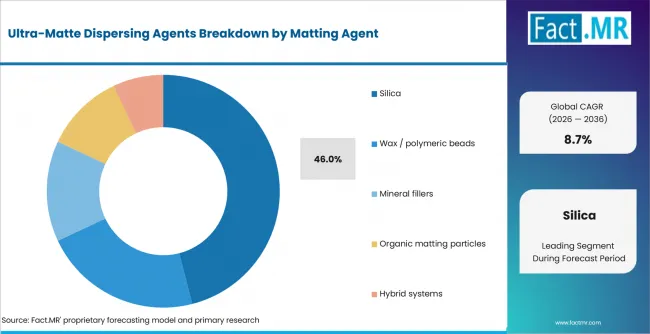
Ultra Matte Dispersing Agents Analysis By Matting Agent | Source: Fact.MR
Silica leads because it gives formulators a direct route to lower gloss across wood, industrial and UV coatings. The same high surface area can raise viscosity when dispersion is weak. Ultra-matte dispersing agents are therefore selected for their ability to stabilize treated and untreated silica without dulling film clarity.
Wax and polymeric beads serve applications that need softness or burnish control. Mineral fillers remain cost-relevant in selected industrial systems. Organic matting particles support design-led finishes where the formulator wants a softer feel with less mineral character.
How does Coating System shape demand?
Solventborne represents 29.0% share in 2026.
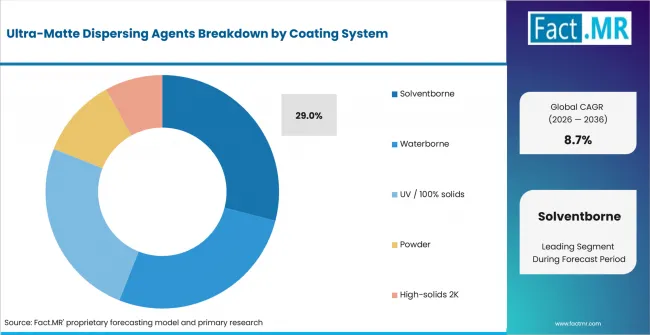
Ultra Matte Dispersing Agents Analysis By Coating System | Source: Fact.MR
Solventborne systems remain a meaningful share because many wood and industrial lines still value flow, open time and deep surface appearance. Ultra-matte dispersants used in these formulas must balance gloss control with storage stability. The same products also need to keep clear-film quality acceptable after sanding or recoating.
Waterborne and UV systems are expected to gain more trial activity as formulators lower solvent exposure. Powder and high-solids 2K systems need additive packages that survive curing and storage. Hybrid systems create the hardest stability work because more than one matting solid can compete for the same dispersant surface.
What supports Wood within End-use?
Wood holds 31.0% share in 2026.
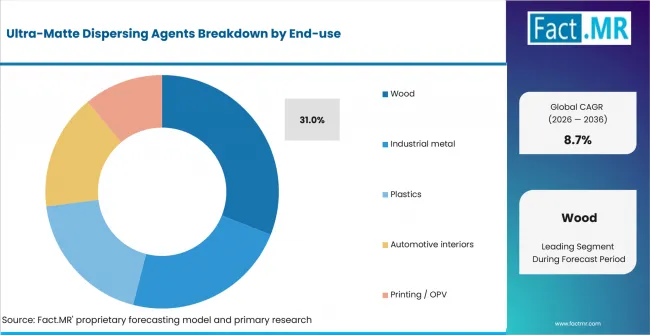
Ultra Matte Dispersing Agents Analysis By End Use | Source: Fact.MR
Wood leads end use because furniture, flooring and joinery surfaces make gloss variation easy to see. Finishers value ultra-matte dispersants that stabilize matting agents without changing spray behavior. These coatings also need surface feel, grain visibility and rub resistance to remain consistent across production batches.
Industrial metal, plastics and automotive interiors add further demand where low glare has a functional role. Printing and OPV applications are smaller but technically demanding because dot clarity and surface feel have to be managed together.
What is accelerating Ultra-Matte Dispersing Agents Market adoption, and what is holding it back?
Demand is expected to rise through low-gloss design requirements and high-solids reformulation. Growth is constrained by qualification time, solvent controls and input-cost pressure.
Drivers Impact Analysis
| DRIVER | (~) % IMPACT ON CAGR | GEOGRAPHIC RELEVANCE | IMPACT TIMELINE |
|---|---|---|---|
| Ultra-matte wood and furniture finishing | +1.2% | Europe, North America | Short term (<= 2 years) |
| High-silica UV and 100% solids systems | +1.1% | Europe, Japan, USA | Medium term (2-4 years) |
| Waterborne and low-VOC reformulation | +0.9% | Europe, North America | Medium term (2-4 years) |
| Matte printing and OPV surface control | +0.7% | Europe, East Asia | Long term (>= 4 years) |
Opportunity Impact Analysis
| OPPORTUNITY | (~) % IMPACT ON CAGR | GEOGRAPHIC RELEVANCE | IMPACT TIMELINE |
|---|---|---|---|
| Mass-balanced additive lines | +0.8% | Europe, Japan | Medium term (2-4 years) |
| Waterborne inkjet receptive coatings | +0.6% | Europe, East Asia | Short term (<= 2 years) |
| Hybrid matting packages for UV and powder coatings | +0.5% | Global | Long term (>= 4 years) |
Restraints Impact Analysis
| RESTRAINT | (~) % IMPACT ON CAGR | GEOGRAPHIC RELEVANCE | IMPACT TIMELINE |
|---|---|---|---|
| Long formulation qualification cycles | -0.6% | Global | Short term (<= 2 years) |
| Solvent exposure documentation | -0.5% | Europe, North America | Medium term (2-4 years) |
| Chemical input price pressure | -0.4% | Europe, USA | Medium term (2-4 years) |
Which countries are scaling the Ultra-Matte Dispersing Agents Market through 2036?
- The country comparison spans 1.3 percentage points and forms three practical growth bands across the forecast period.
- The UK remains 0.4 percentage point above Japan through low-VOC coating reformulation and high-value finishing work.
- Japan remains 0.3 percentage point above the USA through precision surface requirements in electronics and automotive interiors.
- The USA remains 0.3 percentage point above Italy because a large coating manufacturing base supports continued additive qualification.
- Italy remains 0.3 percentage point above Germany through design-led wood finishing and specialty industrial coatings.
- Germany closes the displayed range through mature coatings output and careful reformulation cycles.
Comparable CAGRs can create different entry conditions due to coating-system preference, gloss qualification, raw-material exposure and end-use mix. Full report coverage includes North America, Latin America, Western Europe, Eastern Europe, East Asia, South Asia & Pacific, Middle East & Africa.
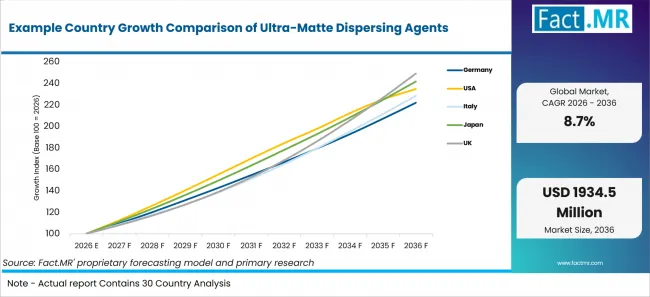
Example Country Growth Comparison Of Ultra Matte Dispersing Agents | Source: Fact.MR
| Country | CAGR (2026-2036) |
|---|---|
| United Kingdom | 9.6% |
| Japan | 9.2% |
| United States | 8.9% |
| Italy | 8.6% |
| Germany | 8.3% |
What supports United Kingdom adoption?
9.6% CAGR, supported by coating output and low-VOC reformulation.
UK formulators are expected to review ultra-matte dispersants as coating plants balance appearance control with solvent reduction. The Office for National Statistics recorded GBP 1,082.5 million in Q2 2026 total turnover for UK paint, varnish, printing ink and mastics manufacturing.
How is Japan developing demand?
9.2% CAGR, led by precision finishing in electronics, wood and automotive interiors.
Japan’s demand is anticipated to reflect precise surface standards in electronics housings, interior trims and specialty wood finishes. METI said on April 14, 2026 that a paint-thinner manufacturer and its wholesalers and retailers immediately halved April shipments after being told that May supplies had not yet been determined. The episode documents short-term supply uncertainty in the paint-thinner supply chain.
What supports United States adoption?
8.9% CAGR, supported by a large coating manufacturing base and premium finishing demand.
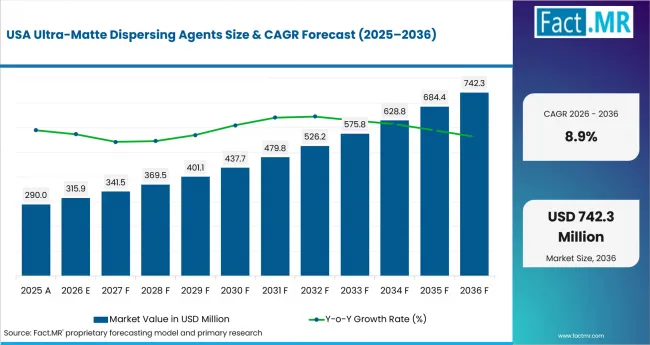
Ultra Matte Dispersing Agents Country Value Analysis | Source: Fact.MR
The USA is projected to remain a large qualification base for ultra-matte dispersing agents because coating plants serve wood, metal and plastic applications at scale. The U.S. Census Bureau’s M3 Benchmark Report recorded seasonally adjusted shipments of USD 4.209 billion for paints, coatings, and adhesives in January 2025.
How is Italy scaling demand?
8.6% CAGR, backed by design-led wood finishes and industrial coating reformulation.
Italy’s finishing market is expected to keep ultra-matte additives tied to furniture, interiors and specialty industrial coatings. Istat reported in February 2026 that the calendar-adjusted industrial production index increased 3.2% year over year in December 2025.
What is supporting Germany’s adoption?
8.3% CAGR, supported by specialty coatings capability and electric-vehicle finishing.
Germany’s adoption is estimated to be steadier because mature coating producers qualify additive changes carefully before plant use. VdL reported on February 11, 2026 that Germany’s paints, varnishes and printing-inks sector’s 2025 sales volume fell 2.8% to 1.4 million tonnes.
Who leads the Ultra-Matte Dispersing Agents Market?
Companies profiled in this report include BYK, Evonik, Lubrizol, BASF, and Elementis each with relevant wetting, dispersing or coating-additive portfolios.
BYK participates through wetting and dispersing additives for pigments and fillers across coating formulations. BASF offers Efka and Dispex dispersing agents for water-based, solvent-based and solvent-free formulations. Evonik supplies TEGO wetting and dispersing additives as well as AERODISP particle dispersions for coating and ink applications.
Lubrizol serves paint, coating and graphic-art formulators through Solsperse hyperdispersants, while Elementis provides NUOSPERSE wetting and dispersing agents for paints, coatings and inks. Competitive differentiation is likely to depend on application-specific performance, including viscosity control, particle stabilization, gloss and coating appearance.
Which companies are the key providers?
Companies profiled include BYK; Evonik; Lubrizol; BASF; Elementis.
- BYK
- Evonik
- Lubrizol
- BASF
- Elementis
Bibliography
- BASF. (2026, May 13). American Coatings Show 2026: BASF debuts Efka® PX 4720 to power ultra-matte UV coatings with CFRP technology.
- BYK. (2026, July 14). BYK portfolio extended by a more environmentally friendly, alkali-resistant wetting and dispersing additive for aqueous systems.
- Evonik. (2025a, March 12). Evonik Coating Additives launches first mass balanced products for coatings and inks.
- Evonik. (2025b, May 8). Evonik launches particle dispersion portfolio to enhance dot sharpness and resolution of inkjet ink receptive coatings.
- Istat. (2026, February 11). Industrial production – December 2025.
- Ministry of Economy, Trade and Industry. (2026, April 14). Press Conference by Minister Akazawa (Excerpt).
- Office for National Statistics. (2026, August 13). UKProdTO: 20.3 – Mfr paint varnish & similar, printing ink & mastics TOTAL (£m) [Data set].
- U.S. Census Bureau. (2025, May 16). Table 1. Value of manufacturers’ shipments for industry groups: January 2025–March 2025 [Data table].
- Verband der deutschen Lack- und Druckfarbenindustrie e.V. (2026, February 11). Der Markt für Lacke, Farben und Druckfarben in 2025.
This Report Addresses
- The report explains where ultra-matte dispersing agents are used across chemistry, matting-agent type, coating system and end use.
- Segment analysis identifies the leading subsegments and the formulation reasons buyers prioritize them.
- Country analysis examines the listed markets and the coating output, raw-material exposure and finishing mechanisms supporting demand.
- Competitive analysis reviews providers across wetting and dispersing additives, ultra-matte UV additives and waterborne coating systems.
- Application analysis assesses how gloss, viscosity and storage stability influence purchase decisions.
What does the Ultra-Matte Dispersing Agents Market cover?
The Ultra-Matte Dispersing Agents Market covers specialty additives used to wet, disperse and stabilize matting solids in coatings and inks. It includes additives used with silica, wax or polymeric beads, mineral fillers and organic matting particles.
The assessment covers solventborne, waterborne, UV or 100% solids, powder, high-solids 2K and hybrid systems. Related coverage includes coating additives, wetting and dispersing agents, pigment wetting additives, matting agents and formulation additives.
What is included in the scope?
The scope includes commercial dispersing agents sold for ultra-matte coating and ink formulations. It covers products used during grinding, let-down or final formulation when the additive stabilizes matting solids.
Included demand spans wood coatings, industrial metal coatings, plastics, automotive interiors and printing or overprint varnish uses. Adjacent coverage includes paint and coating systems, wood coating lines, powder coating systems, automotive OEM coatings and ultra-matte UV dispersants.
What is excluded from the scope?
The scope excludes standalone matting agents sold separately from a dispersing function. Raw silica, wax powders, mineral fillers and organic matting particles are outside the defined revenue boundary.
General coating additives are excluded when they act only as defoamers, rheology modifiers, adhesion promoters or slip agents. Finished paints, varnishes, inks and coating resins are outside the scope.
How Was the Analysis Built?
The analysis draws on 120+ sources, 35+ company portfolios, 25+ countries and more than 20 industry interviews.
- Primary Research: Primary research includes discussions with additive producers, coating formulators, wood finishers, industrial coaters, ink formulators and distributors. These conversations examine qualification priorities, dosage behavior, application issues and supplier selection.
- Desk Research: Desk research covers government statistics, regulatory publications, company releases, product literature, trade data, industry associations, standards and public policy. Every source used in the analysis is documented in the bibliography.
- Market Sizing and Forecasting: Market estimates combine historical performance, demand indicators, pricing trends, segment shares, company participation, country-level growth, adoption patterns and barriers.
- Data Validation and Update Cycle: Findings are validated by comparing interviews with public data, company activity, regulatory changes and trade patterns. Regular updates review launches, capacity changes and approvals.
What is the report’s scope and coverage?
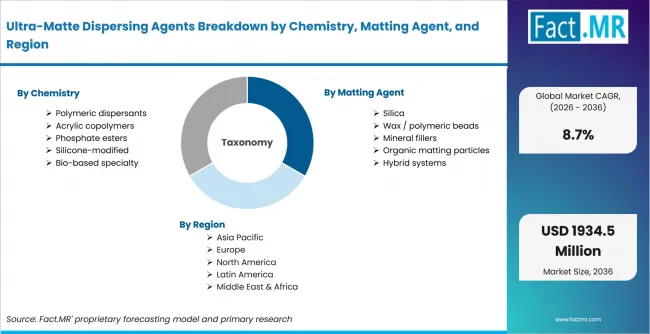
Ultra Matte Dispersing Agents Breakdown By Chemistry, Matting Agent, And Region | Source: Fact.MR
| Attribute | Details |
|---|---|
| Quantitative Units | USD million |
| Market Definition | Specialty dispersing agents used to wet, disperse and stabilize silica, wax, mineral and organic matting particles in coatings and inks where ultra-matte appearance is the target outcome. |
| Chemistry | Polymeric dispersants; Acrylic copolymers; Phosphate esters; Silicone-modified; Bio-based specialty |
| Matting Agent | Silica; Wax / polymeric beads; Mineral fillers; Organic matting particles |
| Coating System | Solventborne; Waterborne; UV / 100% solids; Powder; High-solids 2K; Hybrid systems |
| End-use | Wood; Industrial metal; Plastics; Automotive interiors; Printing / OPV |
| Regions Covered | North America; Latin America; Western Europe; Eastern Europe; East Asia; South Asia & Pacific; Middle East & Africa |
| Countries Covered | United Kingdom; Japan; United States; Italy; Germany |
| Key Companies Profiled | BYK; Evonik; Lubrizol; BASF; Elementis |
| Forecast Period | 2026 to 2036 |
| Approach | Hybrid top-down and bottom-up approach using coatings output, matting-system demand, dispersant chemistry use, coating-system mix, country adoption and provider portfolio review. |
How is the market segmented?
-
By Chemistry
- Polymeric dispersants
- Acrylic copolymers
- Phosphate esters
- Silicone-modified
- Bio-based specialty
-
By Matting Agent
- Silica
- Wax / polymeric beads
- Mineral fillers
- Organic matting particles
-
By Coating System
- Solventborne
- Waterborne
- UV / 100% solids
- Powder
- High-solids 2K
- Hybrid systems
-
By End-use
- Wood
- Industrial metal
- Plastics
- Automotive interiors
- Printing / OPV
-
By Region
- North America
- Latin America
- Western Europe
- Eastern Europe
- East Asia
- South Asia & Pacific
- Middle East & Africa