- Market Value (2025): USD 1.0 Bn
- Estimated Value (2026): USD 1.0 Bn
- Forecast Value (2036): USD 2.0 Bn
- CAGR (2026-2036): 6.7%
What is the Pigment Wetting Additives Market forecast to be worth by 2036?
USD 1.0 billion in 2026 to USD 2.0 billion by 2036, at 6.7% CAGR.
- The Pigment Wetting Additives Market crossed a valuation of USD 1.0 billion in 2025.
- Demand is projected to increase from USD 1.0 billion in 2026 to USD 2.0 billion by 2036.
- The market is forecast to record a 6.7% CAGR from 2026 to 2036 as formulators tighten control over pigment loading and milling time.
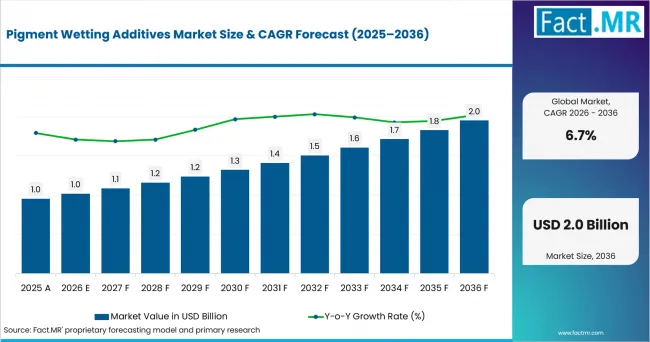
Pigment Wetting Additives Market Value Analysis | Source: Fact.MR
What are the defining numbers behind Pigment Wetting Additives Market growth?
USD 0.9 billion absolute opportunity by 2036, led by polymeric dispersants, titanium dioxide and waterborne coatings.
- Demand Drivers in the Market
- Coating formulators need lower mill-base viscosity in high-pigment architectural and industrial coatings. The Federal Reserve reported the U.S. paint, coating and adhesive production index at 103.4522 in July 2026.
- Colorant producers need dispersants that handle titanium dioxide, organic pigments and carbon black.
- Finish teams need gloss control and repeatable appearance across coating batches. The requirement is sharper in automotive refinish and industrial coating systems.
- Key Segments Analyzed
- By Wetting and Dispersant Chemistry: Polymeric dispersants are projected to hold 39.00% share in 2026 due to their broad compatibility with high-solids pigment concentrates.
- By Pigment Type: Titanium dioxide is anticipated to account for 31.00% share in 2026 as white and light-colour coatings require efficient pigment spacing.
- By Coating and Ink System: Waterborne coatings are estimated to capture 37.00% share in 2026, supported by lower-VOC reformulation and wider architectural use.
- By Performance Target: Color development is forecast to represent 29.00% share in 2026 owing to its direct effect on shade accuracy and tint strength.
- Analyst Opinion at Fact.MR
- Shambhu Nath Jha, Principal Consultant at Fact.MR, states, "Pigment wetting additives draw attention because colour strength, milling energy and storage stability meet in one formulation choice. Supplier selection is expected to rely on proof across titanium dioxide, organic pigments and carbon black. Well-positioned providers should combine polymer design, technical service and clear documentation that helps formulators reduce batch risk."
- Strategic Implications
- Additive producers should document grind-time reduction and viscosity control by pigment type.
- Paint manufacturers should link dispersant choice with titanium dioxide efficiency and color strength. The U.S. Bureau of Labor Statistics recorded sectoral output of USD 52,405.806 million in 2025 for paint, coating, and adhesive manufacturing.
- Ink formulators should test wetting additives across UV-curable and polyurethane systems.
- Distributors should maintain technical-service support near coating clusters. CBS recorded EUR 8.087 billion in total building costs for orders received by contractors in the Netherlands during Quarter 2 2026, based on provisional figures.
Germany is forecast to post 7.6% CAGR through 2036, led by industrial coating demand and EU formulation controls. The USA is projected to record 7.2% CAGR as domestic coating output supports local qualification. The UK is anticipated to advance at 6.8% CAGR. The Netherlands is estimated to hold 6.4% CAGR, while Japan is forecast to reach 6.0% CAGR.
How does the Pigment Wetting Additives Market break down by segment?
Polymeric dispersants lead at 39.00%; waterborne coatings lead at 37.00%.
Which Wetting and Dispersant Chemistry dominates?
Polymeric dispersants hold 39.0% share in 2026.
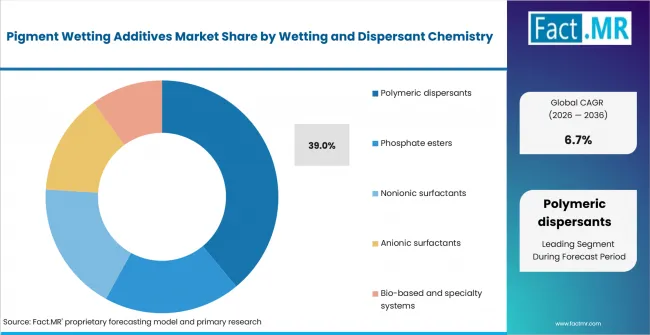
Pigment Wetting Additives Market Analysis By Wetting And Dispersant Chemistry | Source: Fact.MR
Polymeric dispersants are projected to lead chemistry because they anchor on several pigment surfaces. They keep particles apart during grinding and storage, helping formulators reach colour strength with fewer correction batches. BASF announced Efka PX 4720 in May 2026 for ultra-matte solvent-free UV coating formulations. The launch shows how polymer design remains central to solvent-free dispersant positioning.
What leads the Pigment Type segment?
Titanium dioxide holds 31.0% share in 2026.
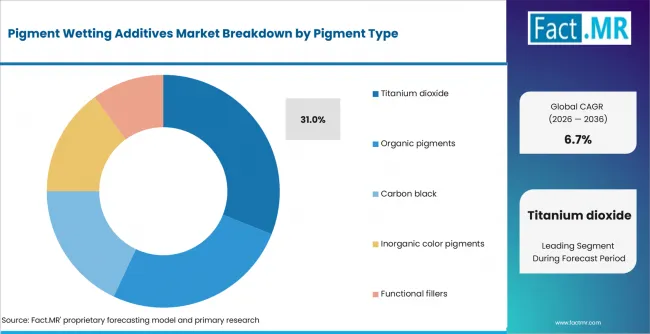
Pigment Wetting Additives Market Analysis By Pigment Type | Source: Fact.MR
Titanium dioxide is anticipated to lead pigment type because white coatings depend on stable particle spacing for opacity. Efficient wetting limits agglomeration and protects hiding power. BYK says DISPERBYK-2180 stabilizes titanium dioxide in aqueous systems and lowers mill-base viscosity. Organic pigments and carbon black need closer dispersant matching because surface chemistry changes colour strength and viscosity response.
How does Coating and Ink System shape demand?
Waterborne coatings hold 37.0% share in 2026.
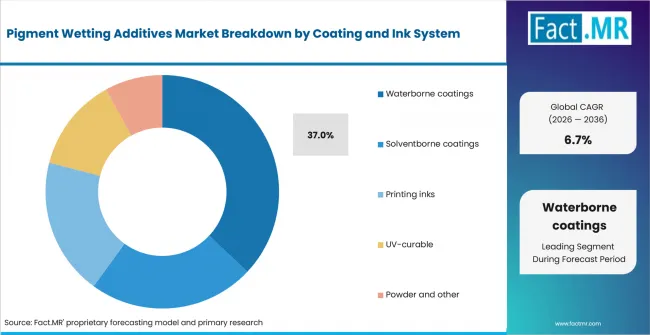
Pigment Wetting Additives Market Analysis By Coating And Ink System | Source: Fact.MR
Waterborne coatings are estimated to lead system demand, supported by architectural coatings and lower-emission reformulation. These formulas need additives that wet pigment quickly while preserving storage stability. Evonik launched TEGO Dispers 695 in January 2026 for radiation-curing inks and solventborne polyurethane inks. Solventborne and UV-curable systems continue to need specialty additives where gloss and colour density define approval.
What supports Color Development within Performance Target?
Color development holds 29.0% share in 2026.
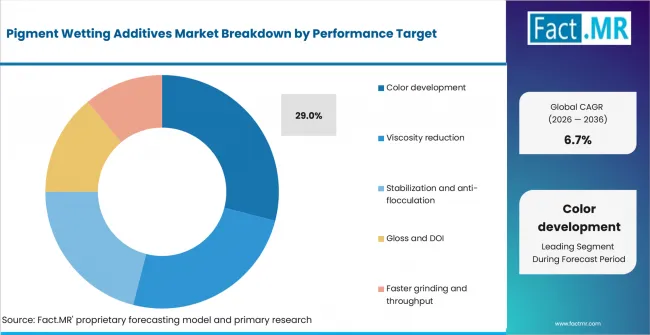
Pigment Wetting Additives Market Analysis By Performance Target | Source: Fact.MR
Color development is forecast to lead performance targets because tint strength and shade accuracy affect approval. Viscosity reduction follows as plants raise solids and keep mill bases pumpable. Clariant listed Dispersogen® PSL 100 in an August 2026 product update as a dispersing agent for waterborne pigment preparations, particularly for formulations with high pigment loads. Gloss and DOI needs stay linked to fine particle size and anti-flocculation control.
What is accelerating Pigment Wetting Additives Market adoption, and what is holding it back?
Waterborne reformulation drives it; raw-material volatility restrains it.
Drivers Impact Analysis
| DRIVER | (~) % IMPACT ON CAGR | GEOGRAPHIC RELEVANCE | IMPACT TIMELINE |
|---|---|---|---|
| Waterborne coating reformulation | +1.4% | North America, Europe, East Asia | <= 2 years |
| Titanium dioxide efficiency pressure | +1.1% | Global | <= 2 years |
| UV-curable and specialty ink growth | +0.9% | Europe, Japan, USA | 2-4 years |
| Automotive and industrial finish quality needs | +0.7% | Germany, Japan, USA | 2-4 years |
| Regulatory documentation and labelling discipline | +0.5% | Europe, UK | >= 4 years |
Source: Fact.MR analysis. Updated Sep 3, 2026
- Waterborne coating reformulation: Waterborne coating systems require wetting additives that disperse pigments efficiently and maintain titanium dioxide stability in lower-emission formulations. Architectural coating activity supports continuing demand for dispersants that improve pigment distribution, viscosity control, and finished-film consistency.
- UV-curable and specialty ink growth: Radiation-curing inks require fine pigment dispersion and strong color development, increasing the value of compatible hyperdispersants. Specialty ink producers provide a clear application route for additives that improve dispersion stability, processing behavior, and print performance.
- Automotive and industrial finish quality needs: Automotive and industrial coating manufacturers carefully qualify additives because dispersion failures can affect gloss, appearance, and surface uniformity. Advanced dispersants support controlled pigment distribution and help formulators achieve consistent finish quality across demanding coating systems.
- Regulatory documentation and labelling discipline: European and UK formulators evaluate additives for hazard classification and regulatory compliance before wider use. Suppliers with clear safety documentation, application guidance, and formulation data can help shorten qualification cycles and support smoother movement from laboratory trials to commercial formulations.
Opportunity Impact Analysis
| OPPORTUNITY | (~) % IMPACT ON CAGR | GEOGRAPHIC RELEVANCE | IMPACT TIMELINE |
|---|---|---|---|
| Low-label dispersant systems | +0.8% | Europe, USA | 2-4 years |
| High-solids pigment concentrates | +0.6% | Global | <= 2 years |
| Inkjet and receptive coating additives | +0.5% | Japan, Europe, USA | 2-4 years |
| Localized technical-service models | +0.4% | Germany, Netherlands, USA | >= 4 years |
Source: Fact.MR analysis. Updated Sep 3, 2026
- Low-label dispersant systems: Formulators increasingly favor low-VOC or solvent-free additives when cleaner formulation positioning must be combined with reliable pigment wetting. Products with clear composition data and dependable dispersion performance can gain stronger trial activity across waterborne and lower-emission coating systems.
- High-solids pigment concentrates: Advanced dispersants help concentrate producers increase pigment loading while keeping viscosity manageable. These additives can improve color development, tinting strength, processing efficiency, and mill output across high-solids pigment systems.
- Inkjet and receptive coating additives: Specialty printing applications create demand for additives that control particle behavior at fine scale. Effective dispersants and receptive-coating systems can improve dot sharpness, ink fixation, and print consistency across waterborne inkjet applications.
- Localized technical-service models: Regional laboratories help match additive chemistry with binder, pigment, and processing conditions before scale-up. Local technical support remains valuable where small formulation changes can affect color approval, viscosity, and finished-coating performance.
Restraints Impact Analysis
| RESTRAINT | (~) % IMPACT ON CAGR | GEOGRAPHIC RELEVANCE | IMPACT TIMELINE |
|---|---|---|---|
| Raw-material and intermediate price volatility | -0.6% | Europe, USA, Netherlands | <= 2 years |
| Long qualification cycles | -0.5% | Global | 2-4 years |
| Compatibility risk across pigments and binders | -0.4% | Global | <= 2 years |
| Regulatory screening burden | -0.3% | Europe, UK | >= 4 years |
Source: Fact.MR analysis. Updated Sep 3, 2026
- Raw-material and intermediate price volatility: Additive manufacturers face margin pressure when intermediate and chemical input costs rise faster than formulation pricing. Buyers therefore favor dispersants that can reduce pigment waste, shorten milling time, or improve overall processing efficiency.
- Long qualification cycles: Coating and ink manufacturers test color, viscosity, storage stability, and film quality before changing dispersants. Because additive changes can alter shade development and formulation behavior, supplier switching remains disciplined in high-value coating and printing systems.
- Compatibility risk across pigments and binders: Dispersant performance varies according to pigment surface chemistry and binder system. Formulation teams therefore rely on laboratory screening before plant trials, while additives with broad pigment affinity gain an advantage across titanium dioxide, organic pigments, and carbon black.
- Regulatory screening burden: European formulators require additive dossiers that align with current hazard classifications and permitted-use conditions. Suppliers that provide clear regulatory documentation and respond quickly to data requests can shorten approval work and strengthen repeat use in regulated coating systems.
Which countries are scaling Pigment Wetting Additives Market through 2036?
- The country comparison spans 1.54 percentage points and forms three practical growth bands across the forecast period.
- Germany remains 0.40 percentage point above the USA through coating output and EU formulation controls.
- The USA remains 0.40 percentage point above the UK as paint, coating and adhesive production supports additive qualification.
- The UK remains 0.40 percentage point above the Netherlands through repair activity and specialty manufacturing demand.
- The Netherlands remains 0.34 percentage point above Japan as chemical distribution and coating trade support adoption.
- Japan closes the displayed range through construction coating use and precision industrial finishes.
Comparable CAGRs create different entry conditions due to coating production, construction activity, chemical distribution and formulation rules. Full report coverage includes North America, Latin America, Western Europe, Eastern Europe, East Asia, South Asia & Pacific, and Middle East & Africa.
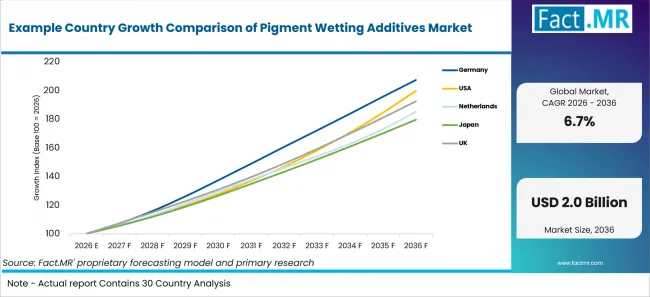
Example Country Growth Comparison Of Pigment Wetting Additives Market | Source: Fact.MR
| Country | CAGR (2026-2036) |
|---|---|
| Germany | 7.6% |
| United States | 7.2% |
| United Kingdom | 6.8% |
| Netherlands | 6.4% |
| Japan | 6.0% |
Source: Fact.MR analysis. Updated Sep 3, 2026
What supports Germany adoption?
7.6% CAGR, supported by coating output and EU formulation controls.
Germany anchors demand through coating producers that work close to automotive and industrial finish customers. The market is forecast to record 7.6% CAGR as VdL reported in February 2026 that German paint, coating and printing-ink sales reached EUR 5.8 billion in 2025. BYK and Evonik add local technical depth for polymeric dispersants used with titanium dioxide, organic pigments and carbon black.
How is the USA scaling demand?
7.2% CAGR, driven by domestic paint, coating and adhesive output.
The USA scales through a large paint, coating and adhesive manufacturing base. The market is projected to record 7.2% CAGR as the U.S. Census Bureau reported that seasonally adjusted paint, coating, and adhesive manufacturing shipments reached USD 4,273 million in June 2026. BASF and Lubrizol portfolios keep polymeric wetting and dispersing agents visible in waterborne coatings and pigment concentrates.
What supports the United Kingdom's growth?
6.8% CAGR, backed by repair activity and specialty manufacturing.
UK demand is tied to construction repair activity and specialty manufacturing that uses protective coatings and printing inks. The market is anticipated to advance at 6.8% CAGR as ONS estimated total construction output grew 0.3% in Quarter 2 2026. Technical distributors help formulators test additive stability before production scale-up.
How is the Netherlands developing demand?
6.4% CAGR, supported by chemical distribution and coating trade.
The Netherlands functions as a Western European channel hub for chemicals and coating materials. The market is estimated to hold 6.4% CAGR as CBS reported manufacturing output 4.6% higher year over year in June 2026.
How does Japan perform?
6.0% CAGR, led by construction coating use and precision finishes.
Japan demand is shaped by precision coatings used in automotive, electronics and building applications. The market is forecast to reach 6.0% CAGR. Japan’s Ministry of Land, Infrastructure, Transport and Tourism published its fiscal 2026 Construction Investment Outlook on August 31, 2026. Domestic paint makers favour additives that maintain fine particle size and stable colour in high-specification finishes.
Who leads the Pigment Wetting Additives Market?
BYK is an active provider through wetting and dispersing additives for aqueous coating systems. Its portfolio supports titanium dioxide stabilization, mill-base viscosity reduction, pigment wetting, and dispersion stability across waterborne formulations.
Evonik competes through specialty dispersants for coatings and inks, including products designed for radiation-curing and polyurethane ink systems. BASF strengthens its position through polymeric dispersant technologies used in solvent-free and specialty coating formulations where controlled pigment dispersion supports finish quality.
Clariant participates through dispersing agents for waterborne pigment preparations and high-pigment-load formulations. Lubrizol and Elementis also maintain relevant portfolios covering hyperdispersants, wetting agents, and dispersing additives used across coatings, inks, pigment concentrates, and colorant systems.
Competition centers on polymeric dispersant design, pigment compatibility, viscosity reduction, color development, and anti-flocculation performance. Technical-service depth and regulatory documentation also influence supplier selection because formulators need additives that perform consistently across titanium dioxide, organic pigments, carbon black, and different binder systems.
Which companies are the key providers?
Key companies include BYK; Evonik; Lubrizol; BASF; Clariant; and Elementis.
- BYK
- Evonik
- Lubrizol
- BASF
- Clariant
- Elementis
Bibliography
- BASF. (2026, May 13). American Coatings Show 2026: BASF debuts Efka® PX 4720 to power ultra-matte UV coatings with CFRP technology.
- Board of Governors of the Federal Reserve System. (2026, August 18). Industrial production and capacity utilization—G.17: Industrial production, industry subtotals and individual series.
- BYK. (2026, July 14). BYK portfolio extended by a more environmentally friendly, alkali-resistant wetting and dispersing additive for aqueous systems.
- Statistics Netherlands. (2026, August 10). Manufacturing output in June almost 5 percent higher, year on year.
- Statistics Netherlands. (2026, August 31). Construction; building costs, building phase, type of building.
- Clariant. (2026, August 13). Dispersogen PSL 100.
- Elementis. (2026). Adding future with coatings additive solutions.
- European Chemicals Agency. (2026, July 14). Substances restricted under REACH.
- Evonik Industries AG. (2025, March 12). Evonik Coating Additives launches first mass balanced products for coatings and inks.
- Evonik Industries AG. (2025, May 8). Evonik launches particle dispersion portfolio to enhance dot sharpness and resolution of inkjet ink receptive coatings.
- Evonik Industries AG. (2026, January 20). Take your inks to the next level of performance with TEGO® Dispers 695.
- The Lubrizol Corporation. (2025, February 4). Lubrizol introduces Solsperse™ W60 Hyperdispersant.
- Office for National Statistics. (2026, August 13). Construction output in Great Britain: June 2026, new orders and Construction Output Price Indices, April to June 2026.
- U.S. Bureau of Labor Statistics. (2026, June 24). Productivity and costs by industry: Manufacturing and mining industries—2025.
- U.S. Census Bureau. (2026, August 4). Monthly full report on manufacturers’ shipments, inventories, & orders.
- U.S. Census Bureau. (2026, August 18). Monthly new residential construction, July 2026.
- Verband der deutschen Lack- und Druckfarbenindustrie e.V. (2026, February 11). Der Markt für Lacke, Farben und Druckfarben in 2025.
This Report Answers
- The report explains pigment wetting additive use across dispersant chemistry, pigment type, coating systems and performance targets.
- Segment analysis identifies leading subsegments and the formulation reasons behind supplier selection.
- Country analysis examines five markets using official statistics tied to coating demand.
- Competitive analysis reviews active providers across polymeric dispersants, ink hyperdispersants and colorant additives.
- Application analysis assesses viscosity, colour strength and anti-flocculation needs.
What does the Pigment Wetting Additives Market cover?
The Pigment Wetting Additives Market covers additives used to wet pigment surfaces, lower viscosity and stabilize pigment particles. The scope connects coating additives with pigment dispersion, where additives affect milling, shade strength and storage stability.
The assessment covers wetting and dispersing agents, polymeric dispersants, phosphate esters and specialty additives used with titanium dioxide and other pigments. Demand is reviewed across waterborne coatings, solventborne coatings, printing inks and UV-curable systems.
What is included in the scope?
The scope includes formulated additives sold for pigment wetting, dispersion stabilization, viscosity reduction and colour development in coating pigments and colorant systems. It also covers formulation additives used during grinding and tinting.
It includes polymeric dispersants, hyperdispersants, phosphate ester wetting agents, nonionic surfactants and anionic surfactants used in paints and coatings. Adjacent pigments and dyes categories are considered when additive selection shapes dispersion.
What is excluded from the scope?
The scope excludes pigments sold without additive functionality, base resins, solvents, fillers and finished paints. General surfactants outside coating and ink formulation are also excluded.
General process aids are included only when they improve wetting, stability, viscosity or colour development. Raw titanium dioxide production and pigment equipment are outside scope.
How Was the Analysis Built?
The analysis draws on 120+ sources, 35+ company portfolios, 25+ countries, and more than 20 industry interviews.
- Primary Research: Primary research includes discussions with manufacturers, service providers, technology developers, distributors, end users, and subject-matter experts. These conversations examine purchasing priorities, product adoption, operational challenges, approval requirements, competitive positioning, and the factors that influence wider market acceptance.
- Desk Research: Desk research covers government statistics, regulatory publications, company filings, trade data, technical studies, industry associations, standards, public policy, and other authoritative sources. Every source used in the analysis is documented in the bibliography.
- Market Sizing and Forecasting: Market estimates combine historical performance, demand indicators, pricing and volume trends, segment shares, company participation, country-level growth, adoption patterns, investment activity, and barriers to market expansion.
- Data Validation and Update Cycle: Findings are validated by comparing primary interviews with public data, company activity, regulatory changes, trade patterns, and industry developments. Regular updates review new product launches, capacity changes, partnerships, approvals, and shifts in commercial adoption.
Segmentation
What is the report's scope and coverage?
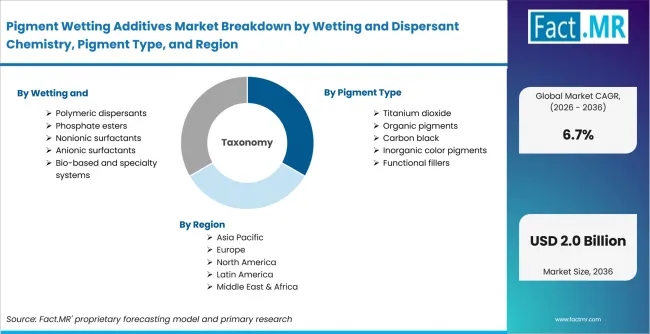
Pigment Wetting Additives Market Breakdown By Wetting And Dispersant Chemistry, Pigment Type, And Region | Source: Fact.MR
| Attribute | Details |
|---|---|
| Quantitative Units | USD billion in 2026 to USD billion by 2036 at a CAGR |
| Market Definition | Additives that improve pigment wetting, dispersion stability, viscosity control and colour development in coatings, inks, pigment concentrates and colorant systems. |
| Wetting and Dispersant Chemistry | Polymeric dispersants; Phosphate esters; Nonionic surfactants; Anionic surfactants; Bio-based and specialty systems |
| Pigment Type | Titanium dioxide; Organic pigments; Carbon black; Inorganic color pigments; Functional fillers |
| Coating and Ink System | Waterborne coatings; Solventborne coatings; Printing inks; UV-curable; Powder and other |
| Performance Target | Color development; Viscosity reduction; Stabilization and anti-flocculation; Gloss and DOI; Faster grinding and throughput |
| Regions Covered | North America; Latin America; Western Europe; Eastern Europe; East Asia; South Asia & Pacific; Middle East & Africa |
| Countries Covered | Germany; United States; United Kingdom; Netherlands; Japan |
| Key Companies Profiled | BYK; Evonik; Lubrizol; BASF; Clariant; Elementis |
| Forecast Period | 2026 to 2036 |
| Approach | Hybrid top-down and bottom-up approach using coating and ink production indicators, application demand, additive portfolio validation, country CAGR inputs and segment share review. |
Source: Fact.MR analysis. Updated Sep 3, 2026
How is the market segmented?
-
By Wetting and Dispersant Chemistry:
- Polymeric dispersants
- Phosphate esters
- Nonionic surfactants
- Anionic surfactants
- Bio-based and specialty systems
-
By Pigment Type:
- Titanium dioxide
- Organic pigments
- Carbon black
- Inorganic color pigments
- Functional fillers
-
By Coating and Ink System:
- Waterborne coatings
- Solventborne coatings
- Printing inks
- UV-curable
- Powder and other
-
By Performance Target:
- Color development
- Viscosity reduction
- Stabilization and anti-flocculation
- Gloss and DOI
- Faster grinding and throughput
-
By Region:
- North America
- Latin America
- Western Europe
- Eastern Europe
- East Asia
- South Asia & Pacific
- Middle East & Africa
Frequently Asked Questions
How big is the pigment wetting additives market in 2026?
What is the CAGR of the pigment wetting additives market from 2026 to 2036?
Which wetting and dispersant chemistry leads the pigment wetting additives market?
Which pigment type leads the pigment wetting additives market?
Who are the leading companies in the pigment wetting additives market?
Who worked on this report


Preview the report firsthand - request a free sample
Free SampleGet the brochure for pricing and purchase details
Download PDF