- Base Value(2025): 11.0 Bn
- Estimated Value(2026): 11.5 Bn
- Forecast Value (2036): 18.4 Bn
- CAGR (2026 - 2036): 4.8%
Ultrapure Water Treatment Systems Market Analysis and Forecast by Fact.MR
- The global market for ultrapure water treatment systems is estimated to be around US$ 11.5 billion in 2026 and has been forecast to expand at a CAGR of 4.8% to end up at US$ 18.4 billion by 2036.
- Ultrapure water treatment systems produce water with resistivity at or near 18.2 megohm-cm, removing ionic, organic, particulate, and microbial contaminants to levels required by semiconductor fabrication, pharmaceutical production, power generation, and laboratory applications.
- Technologies include reverse osmosis, electrodeionization, ion exchange, UV oxidation, and ultrafiltration.
- Growth reflects expanding chip fabrication capacity, tighter pharmacopeia water standards, and rising demand for point-of-use polishing systems in advanced manufacturing facilities worldwide.
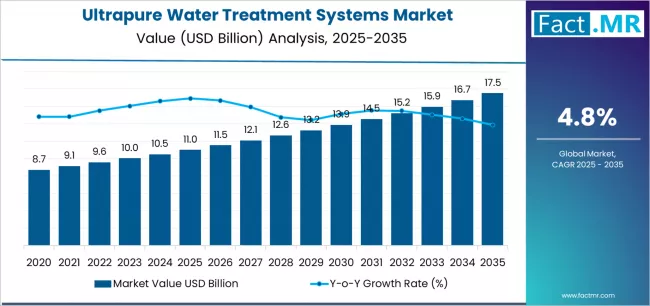
Ultrapure Water Treatment Systems Market Market Value Analysis | Source: Fact.MR
Summary of Ultrapure Water Treatment Systems Market
- Market Snapshot
- In 2025, the global Ultrapure Water Treatment Systems Market was valued at approximately USD 11.0 billion.
- The market is estimated to reach USD 11.5 billion in 2026 and is projected to attain USD 18.4 billion by 2036.
- The ultrapure water treatment systems market is likely to expand at a CAGR of 4.8% during the forecast period.
- The market is anticipated to create an absolute dollar opportunity of USD 6.9 billion between 2026 and 2036.
- Semiconductor Manufacturing accounts for 42% of application share in 2026.
- India (6.2%) and China (5.8%) are the key growth markets during the forecast period.
- Demand and Growth Drivers
- Expanding semiconductor fabrication capacity in East Asia, North America, and Europe is increasing demand for ultrapure water systems that meet sub-parts-per-trillion contamination requirements.
- Tightening pharmacopeia water quality standards for injectable drug manufacturing are pushing pharmaceutical producers to upgrade purification and polishing systems.
- Growth in advanced display, solar cell, and LED manufacturing is extending ultrapure water demand beyond traditional semiconductor applications.
- Rising adoption of electrodeionization and advanced oxidation technologies is enabling lower chemical consumption and higher water recovery rates in treatment trains.
- Expansion of point-of-use polishing systems in cleanroom environments is supporting incremental system sales alongside large-scale central plant installations.
- Product and Segment View
- Semiconductor Manufacturing accounts for 42% of application share in 2026, supported by consistent demand across primary end-use applications.
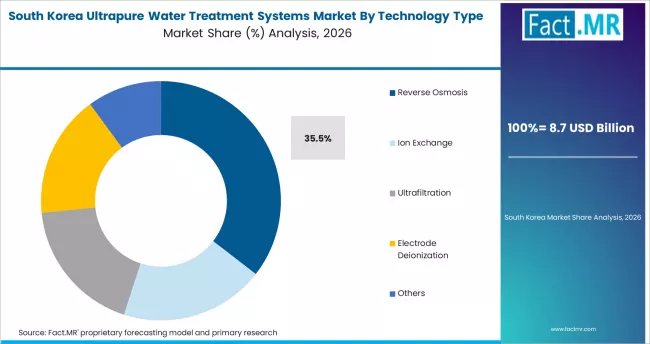
- Reverse Osmosis account for 36% of technology type share in 2026, supported by consistent demand across primary end-use applications.
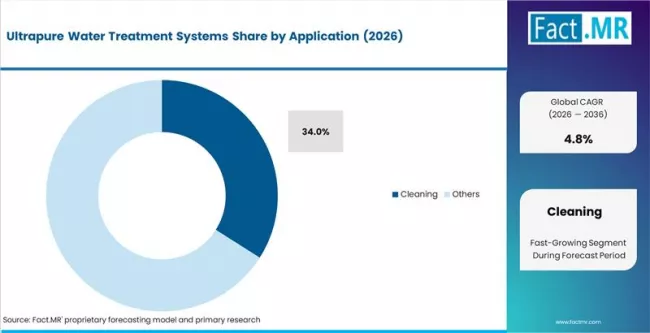
- Cleaning accounts for 34% of application share in 2026, supported by consistent demand across primary end-use applications.
- Key segmentation includes:
- Application: Semiconductor Manufacturing, Pharmaceutical Industry, Power Generation, Microelectronics And Electronics, Laboratories And Research
- Technology Type: Reverse Osmosis, Ion Exchange, Ultrafiltration, Electrode Deionization, Others
- Application: Cleaning, Etching, Ingredient, Others
- End Use: Semiconductor, Wafer Fabrication Plants, Chip Manufacturing Units, Pharmaceuticals, Drug Manufacturing Units, Biotech Facilities, Power Generation, Thermal Power Plants, Nuclear Power Plants, Food And Beverage, Food Processing Units, Beverage Production Plants, Healthcare, Hospitals, Diagnostic Centers, Others, Research Institutes, Industrial Applications
- These systems enable:
- Removal of ionic, organic, particulate, and microbial contaminants to resistivity levels at or near 18.2 megohm-cm
- Multi-stage treatment combining reverse osmosis, electrodeionization, UV oxidation, and ultrafiltration
- Real-time monitoring and automated control of water quality at point-of-use delivery
- Geography and Competitive Outlook
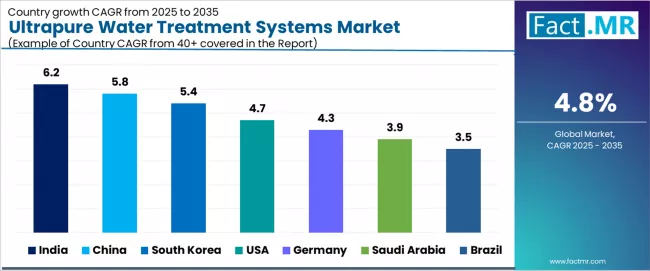
- Asia Pacific leads growth with India at 6.2%, China at 5.8%, South Korea at 5.4%, supported by expanding industrial capacity and infrastructure investment.
- North America shows steady demand with USA at 4.7%, Brazil at 3.5%, reflecting established end-use markets and replacement-led procurement.
- Europe maintains stable growth with Germany at 4.3%, supported by regulatory compliance requirements and technology upgrades.
- India (6.2%) and China (5.8%) are the key growth markets, reflecting strong investment activity and expanding addressable demand.
- Leading participants include Toray Industries, Danaher Corporation, Merck KGaA, Pentair, Eaton, Culligan Water.
- Analyst Opinion
- Shambhu Nath Jha, Principal Consultant at Fact.MR, says 'The ultrapure water treatment systems market is tightly linked to semiconductor expansion plans, which now span East Asia, North America, and parts of Europe. Each new fab requires a dedicated water treatment infrastructure that meets contamination thresholds measured in parts per trillion. That creates a large, concentrated demand channel. Beyond semiconductors, pharmaceutical manufacturers are upgrading systems to comply with tighter pharmacopeia standards. The competitive dynamic favors suppliers that can deliver integrated treatment trains, including reverse osmosis, electrodeionization, and UV oxidation, with strong aftermarket service and consumables support tied to long-term operating contracts.'
Key Growth Drivers, Constraints, and Opportunities
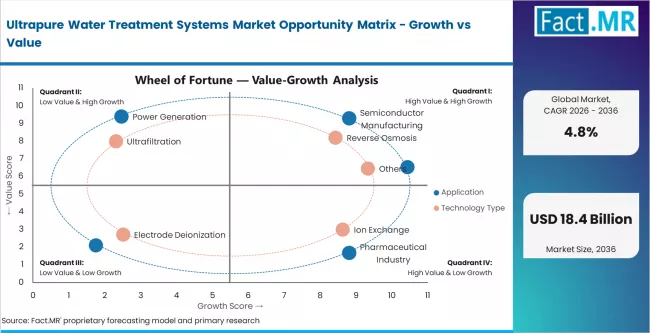
Ultrapure Water Treatment Systems Market Opportunity Matrix Growth Vs Value | Source: Fact.MR
Key Factors Driving Growth
- Expanding semiconductor fabrication capacity globally is increasing demand for water treatment systems meeting sub-parts-per-trillion contamination thresholds.
- Tighter pharmacopeia water standards for drug manufacturing are pushing system upgrades across pharmaceutical production facilities.
- Growth in advanced display and solar cell manufacturing is extending ultrapure water demand beyond traditional semiconductor applications.
Key Market Constraints
- High capital and operating costs of multi-stage ultrapure water treatment trains create procurement barriers for smaller manufacturing facilities.
- Water recovery rates in reverse osmosis and ion exchange stages generate reject streams that require additional treatment or disposal.
- Dependence on specialty consumables and membrane replacement creates ongoing cost commitments tied to vendor-specific supply chains.
Key Opportunity Areas
- New semiconductor fab construction in North America, Europe, and Southeast Asia is creating large-scale, concentrated procurement opportunities for integrated treatment systems.
- Adoption of water recycling and recovery technologies within ultrapure water trains offers efficiency gains and supports sustainability commitments by manufacturing facilities.
- Growth in point-of-use polishing and monitoring systems creates incremental equipment sales opportunities alongside central plant installations.
Segment-wise Analysis of the Ultrapure Water Treatment Systems Market
- Semiconductor Manufacturing holds 42% of the application segment in 2026, supported by established demand across primary end-use applications.
- Reverse Osmosis represent 36% of the technology type segment in 2026, with consistent adoption across core applications.
- Cleaning accounts for 34% of the application segment in 2026, reflecting concentrated demand in the leading vertical.
The ultrapure water treatment systems market is segmented by application, technology type, application, end use, and region. Semiconductor Manufacturing leads by value in the near term, while emerging categories are expected to drive the next phase of growth as end-use requirements evolve.
Which Application Segment Dominates the Ultrapure Water Treatment Systems Market?
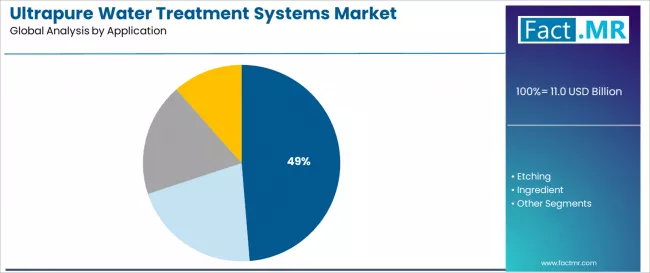
Ultrapure Water Treatment Systems Market Analysis By Application | Source: Fact.MR
Semiconductor Manufacturing is expected to account for 42% of the application segment in the global Ultrapure Water Treatment Systems Market by 2026. Demand is supported by consistent procurement across primary end-use applications, where established performance requirements and pricing accessibility sustain the installed base.
The segment is expected to maintain its position through the forecast period as replacement demand and capacity expansion in core verticals continue to generate steady procurement. Emerging alternatives are gaining share, but semiconductor manufacturing remains the primary volume category because of buyer familiarity and application suitability across mature and developing markets.
Which Technology Type Segment Dominates the Ultrapure Water Treatment Systems Market?
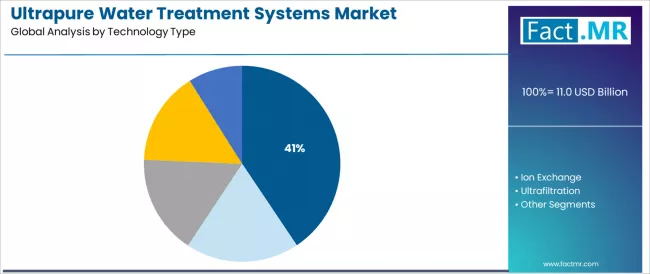
Ultrapure Water Treatment Systems Market Analysis By Technology Type | Source: Fact.MR
Reverse Osmosis is expected to account for 36% of the technology type segment in the global Ultrapure Water Treatment Systems Market by 2026. Demand is supported by consistent procurement across primary end-use applications, where established performance requirements and pricing accessibility sustain the installed base.
The segment is expected to maintain its position through the forecast period as replacement demand and capacity expansion in core verticals continue to generate steady procurement. Emerging alternatives are gaining share, but reverse osmosis remain the primary volume category because of buyer familiarity and application suitability across mature and developing markets.
Which Application Segment Dominates the Ultrapure Water Treatment Systems Market?
Ultrapure Water Treatment Systems Market | Source: Fact.MR
Cleaning is expected to account for 34% of the application segment in the global Ultrapure Water Treatment Systems Market by 2026. Demand is supported by consistent procurement across primary end-use applications, where established performance requirements and pricing accessibility sustain the installed base.
The segment is expected to maintain its position through the forecast period as replacement demand and capacity expansion in core verticals continue to generate steady procurement. Emerging alternatives are gaining share, but cleaning remains the primary volume category because of buyer familiarity and application suitability across mature and developing markets.
Which Product Trend is Shaping the Next Phase of Growth in the Ultrapure Water Treatment Systems Market?
Electrodeionization is gaining share as a continuous polishing technology that reduces chemical consumption and simplifies operations compared to conventional mixed-bed ion exchange. Its adoption is rising in both semiconductor and pharmaceutical applications where consistent water quality, lower chemical handling requirements, and reduced regeneration waste are valued by facility operators.
The shift toward electrodeionization reflects broader changes in how manufacturing facilities approach water treatment system design. Operators are increasingly selecting technologies that minimize chemical logistics and waste generation while maintaining the resistivity and TOC performance required for advanced manufacturing processes. Electrodeionization fits this profile and is becoming a standard component in new treatment train designs, particularly in facilities targeting higher environmental compliance and operational simplicity.
Regional Outlook Across Key Markets
.webp "Top Country Growth Comparison Ultrapure Water Treatment Systems Market Cagr (2026 2036)")
Top Country Growth Comparison Ultrapure Water Treatment Systems Market Cagr (2026 2036) | Source: Fact.MR
- India leads growth at 6.2%, supported by expanding domestic demand, industrial capacity investment, and broadening end-use adoption across commercial and institutional applications.
- The U.S. at 4.7% reflects a mature market where replacement demand and technology upgrades are the primary growth drivers.
- Germany at 4.3% reflects steady European demand supported by manufacturing investment and regulatory compliance requirements.
CAGR Table
| Country | CAGR (%) |
|---|---|
| India | 6.2% |
| China | 5.8% |
| South Korea | 5.4% |
| USA | 4.7% |
| Germany | 4.3% |
| Saudi Arabia | 3.9% |
| Brazil | 3.5% |
Source: Fact.MR analysis. Updated May 19, 2026
Source: Fact MR (FMR) analysis, based on proprietary forecasting model and primary research.
Ultrapure Water Treatment Systems Market Cagr Analysis By Country | Source: Fact.MR
Market Outlook for Ultrapure Water Treatment Systemss in India
The India ultrapure water treatment systems market is projected to grow at a CAGR of 6.2% through 2036. Demand is supported by expanding end-use activity and growing adoption of higher-specification products across key application segments.
- Expanding end-use demand supports procurement across primary applications.
- Infrastructure investment is broadening the installed equipment base.
- Growing performance requirements support mid-range and premium demand.
Demand Trends for Ultrapure Water Treatment Systemss in China
The China ultrapure water treatment systems market is projected to grow at a CAGR of 5.8% through 2036. Demand is supported by expanding end-use activity and growing adoption of higher-specification products across key application segments.
- Expanding end-use demand supports procurement across primary applications.
- Infrastructure investment is broadening the installed equipment base.
- Growing performance requirements support mid-range and premium demand.
Growth Assessment for Ultrapure Water Treatment Systemss in South Korea
Ultrapure Water Treatment Systems Market South Korea Market Share Analysis By Technology Type | Source: Fact.MR
The South Korea ultrapure water treatment systems market is projected to grow at a CAGR of 5.4% through 2036. Demand is supported by expanding end-use activity and growing adoption of higher-specification products across key application segments.
- Expanding end-use demand supports procurement across primary applications.
- Infrastructure investment is broadening the installed equipment base.
- Growing performance requirements support mid-range and premium demand.
Market Growth Outlook for Ultrapure Water Treatment Systemss in USA
Ultrapure Water Treatment Systems Market Country Value Analysis | Source: Fact.MR
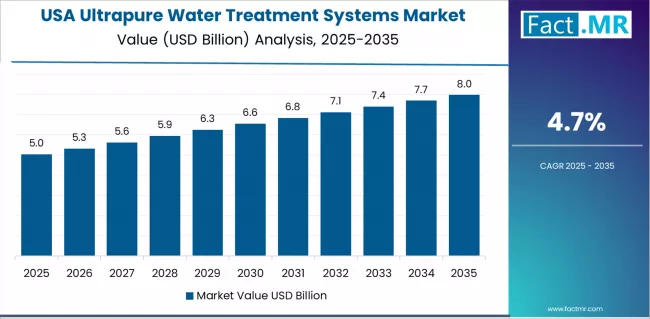
The USA ultrapure water treatment systems market is projected to grow at a CAGR of 4.7% through 2036. Demand is supported by expanding end-use activity and growing adoption of higher-specification products across key application segments.
- Expanding end-use demand supports procurement across primary applications.
- Infrastructure investment is broadening the installed equipment base.
- Growing performance requirements support mid-range and premium demand.
Market Opportunity Outlook for Ultrapure Water Treatment Systemss in Germany
The Germany ultrapure water treatment systems market is projected to grow at a CAGR of 4.3% through 2036. Demand is supported by expanding end-use activity and growing adoption of higher-specification products across key application segments.
- Expanding end-use demand supports procurement across primary applications.
- Infrastructure investment is broadening the installed equipment base.
- Growing performance requirements support mid-range and premium demand.
Demand Analysis for Ultrapure Water Treatment Systemss in Saudi Arabia
The Saudi Arabia ultrapure water treatment systems market is projected to grow at a CAGR of 3.9% through 2036. Demand is supported by expanding end-use activity and growing adoption of higher-specification products across key application segments.
- Expanding end-use demand supports procurement across primary applications.
- Infrastructure investment is broadening the installed equipment base.
- Growing performance requirements support mid-range and premium demand.
Growth Forecast for Ultrapure Water Treatment Systemss in Brazil
The Brazil ultrapure water treatment systems market is projected to grow at a CAGR of 3.5% through 2036. Demand is supported by expanding end-use activity and growing adoption of higher-specification products across key application segments.
- Expanding end-use demand supports procurement across primary applications.
- Infrastructure investment is broadening the installed equipment base.
- Growing performance requirements support mid-range and premium demand.
Competitive Benchmarking and Company Positioning
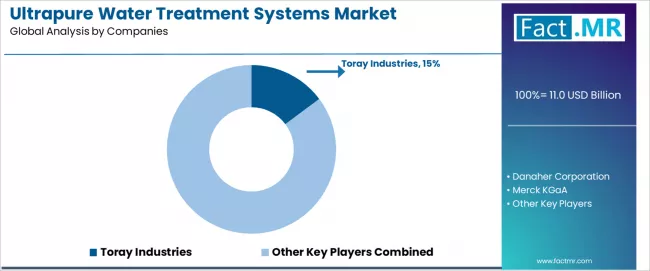
Ultrapure Water Treatment Systems Market Analysis By Company | Source: Fact.MR
Ultrapure Water Treatment Systems Market Analysis By Company
- Toray Industries, Danaher Corporation, Merck KGaA, Pentair hold strong positions in the global ultrapure water treatment systems market through broad product portfolios, established brand recognition, and growing capabilities across core end-use applications.
- Eaton, Culligan Water, OVIVO Inc., Applied Membranes Inc. participate meaningfully across specific price tiers, user segments, and regional channels, with competition shaped by product quality, application fit, and distribution access.
- Technology integration and aftermarket service capability create differentiation, particularly in higher-specification product categories where buyer retention depends on performance reliability and ongoing support.
The competitive landscape is moderately fragmented, with established industrial players, specialized manufacturers, and value-oriented producers. Toray Industries, Danaher Corporation, Merck KGaA, Pentair compete through product breadth, technical capability, and visibility across primary end-use applications.
Competition is shaped by differences between standard and premium product categories. Standard products attract price-sensitive buyers, while higher-specification systems create a premium layer of competition built around performance, durability, and service support.
Strategic priorities include expanding product portfolios, strengthening service networks, and widening reach across direct and e-commerce distribution channels. Companies combining reliable product performance with stronger technical support are positioned to improve retention and margin stability.
Key Companies in the Ultrapure Water Treatment Systems Market
- Toray Industries, Danaher Corporation, Merck KGaA, Pentair are among the leading players in the ultrapure water treatment systems market globally, supported by strong product portfolios, established market presence, and growing positions across primary end-use applications.
- Eaton, Culligan Water, OVIVO Inc., Applied Membranes Inc. hold established positions across specific application segments and regional markets, supported by durable products, distribution penetration, and category familiarity among end users.
- Evoqua Water Technologies, Kurita Water Industries Ltd, ECOLAB, Dupont and other specialist participants continue to compete through focused product offerings, price-point coverage, and niche application strength, reinforcing their relevance in a fragmented market.
Recent Industry Developments
- Toray Industries – Product Portfolio Expansion (2025)
- Toray Industries expanded its product portfolio with new models targeting higher-specification applications. The expansion strengthens the company's position in the growing premium segment.
- Danaher Corporation – Technology Upgrade Launch (2026)
- Danaher Corporation introduced upgraded technology capabilities across core product lines, improving operational efficiency and application versatility for end users.
- Merck KGaA – Geographic Expansion (2025)
- Merck KGaA expanded its distribution and service network into high-growth markets in Asia Pacific and Latin America, strengthening access to institutional procurement channels.
Leading Companies Shaping the Ultrapure Water Treatment Systems Market
- Toray Industries
- Danaher Corporation
- Merck KGaA
- Pentair
- Eaton
- Culligan Water
- OVIVO Inc.
- Applied Membranes Inc.
- Evoqua Water Technologies
- Kurita Water Industries Ltd
Sources and Research References
- Toray Industries. Product portfolio updates and corporate announcements.
- Danaher Corporation. Product portfolio updates and corporate announcements.
- Merck KGaA. Product portfolio updates and corporate announcements.
- Industry association publications, government regulatory databases, trade statistics, customs databases, and company product catalogs.
- Primary interviews with manufacturers, distributors, system integrators, end users, and industry consultants.
This bibliography is provided for reader reference and is not exhaustive. The full report contains the complete reference list and detailed citations.
Key Questions This Report Addresses
- What is the current and future size of the Ultrapure Water Treatment Systems Market?
- How fast is the Ultrapure Water Treatment Systems Market expected to grow between 2026 and 2036?
- Which application is likely to lead the market by 2026?
- Which technology type segment is expected to account for the highest demand by 2026?
- What factors are driving demand globally?
- How is technology evolution influencing market growth?
- Which countries are projected to show the fastest growth through 2036?
- What is driving market expansion in India and China?
- Who are the key companies active in the Ultrapure Water Treatment Systems Market?
- How does Fact.MR estimate and validate the market forecast?
Ultrapure Water Treatment Systems Market Definition
The ultrapure water treatment systems market covers multi-stage purification systems that produce water meeting resistivity levels at or near 18.2 megohm-cm. It includes reverse osmosis, electrodeionization, ion exchange, UV oxidation, and ultrafiltration technologies used in semiconductor manufacturing, pharmaceutical production, power generation, laboratory, and advanced electronics manufacturing applications.
Ultrapure Water Treatment Systems Market Inclusions
- The scope covers global and regional market size and forecasts for 2026 to 2036 across application, technology type, application, end use, and region.
- It includes regional demand analysis across major geographies, based on factors such as end-use activity levels, regulatory requirements, infrastructure investment, and technology adoption.
- The report includes pricing and cost analysis across entry-level, mid-range, and premium product categories, including hardware, consumables, and service components.
- It covers technology trends, market drivers and constraints, and the competitive landscape, including product portfolios, pricing strategy, geographic reach, and distribution positioning of leading players.
Ultrapure Water Treatment Systems Market Exclusions
- The scope excludes general-purpose water treatment systems used for potable water, process water, and cooling water applications that do not meet ultrapure water resistivity standards.
- It excludes wastewater treatment and water recycling systems not directly part of ultrapure water production trains.
- The report excludes laboratory water purification units sold as standalone benchtop systems without integration into facility-scale treatment infrastructure.
- It also excludes water quality testing instruments, consumable replacement parts sold independently, and software-only monitoring platforms not bundled with treatment systems.
Ultrapure Water Treatment Systems Market Research Methodology
- The methodology combines secondary research, primary interviews, and forecast modelling.
- It draws on 120+ secondary sources and benchmarks 65+ company product portfolios.
- Market sizing covers 30+ countries through a demand-side model, supported by top-down validation.
- Key inputs include end-use activity levels, regulatory requirements, procurement patterns, and technology adoption rates.
- The model cross-checks demand with shipments, pricing trends, channel mix, and product launches.
- Primary validation includes 25+ interviews across manufacturers, distributors, system integrators, and end users.
- Final estimates go through trade-flow checks, sales-pattern review, and sensitivity testing.
Segmentation
Scope of Analysis
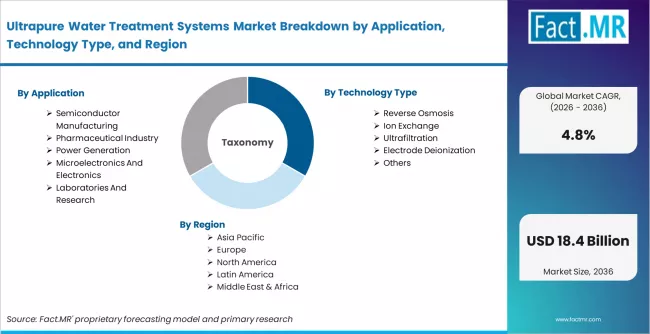
Ultrapure Water Treatment Systems Market Breakdown By Application, Technology Type, And Region | Source: Fact.MR
| Parameter | Details |
|---|---|
| Quantitative Units | USD 11.5 billion to USD 18.4 billion, at a CAGR of 4.8% |
| Market Definition | Multi-stage purification systems producing water at or near 18.2 megohm-cm resistivity for semiconductor, pharmaceutical, and advanced manufacturing applications. |
| Regions Covered | North America, Latin America, Europe, East Asia, South Asia and Pacific, Middle East and Africa |
| Countries Covered | India, China, South Korea, USA, Germany, Saudi Arabia, Brazil, 30 plus countries |
| Key Companies | Toray Industries, Danaher Corporation, Merck KGaA, Pentair, Eaton, Culligan Water, OVIVO Inc., Applied Membranes Inc., Evoqua Water Technologies, Kurita Water Industries Ltd |
| Forecast Period | 2026 to 2036 |
| Approach | Hybrid demand-side and top-down methodology built on country-level application demand, product benchmarking, pricing analysis, shipment validation, and primary interviews across manufacturers, distributors, and end users |
Source: Fact.MR analysis. Updated May 19, 2026
Ultrapure Water Treatment Systems Market Segmentation
-
Ultrapure Water Treatment Systems marketSegmented by Application:
- Semiconductor Manufacturing
- Wafer Fabrication
- Chip Cleaning Processes
- Lithography Operations
- Display Panel Manufacturing
- LCD And OLED Production
- Microelectronics Processing
- Wafer Fabrication
- Pharmaceutical Industry
- Injection Grade Water Production
- Drug Formulation Support
- Sterile Manufacturing Processes
- Biopharmaceutical Production
- Vaccine Manufacturing
- Laboratory Research Applications
- Injection Grade Water Production
- Power Generation
- Boiler Feed Water Treatment
- Steam Cycle Optimization
- Turbine Protection Systems
- Nuclear Power Plants
- Cooling And Reactor Systems
- High Purity Water Circuits
- Boiler Feed Water Treatment
- Microelectronics And Electronics
- PCB Manufacturing
- Precision Cleaning Processes
- Component Fabrication
- Sensor And Device Production
- High Precision Assembly
- Contamination Control Systems
- PCB Manufacturing
- Laboratories And Research
- Analytical Laboratories
- Chemical Testing Processes
- Research And Development Labs
- Biotechnology Labs
- Genomics And Cell Research
- Experimental Systems
- Analytical Laboratories
- Semiconductor Manufacturing
-
Ultrapure Water Treatment Systems marketSegmented by Technology Type:
- Reverse Osmosis
- Single Stage RO Systems
- Pre Treatment Filtration
- Bulk Water Purification
- Multi Stage RO Systems
- High Purity Water Production
- Semiconductor Grade Processing
- Single Stage RO Systems
- Ion Exchange
- Cation Exchange Systems
- Hardness Removal Processes
- Pre Treatment Applications
- Anion Exchange Systems
- Silica And Contaminant Removal
- Polishing Treatment Stages
- Cation Exchange Systems
- Ultrafiltration
- Hollow Fiber Membranes
- Suspended Solids Removal
- Pre RO Filtration
- Pressure Driven Filtration
- Microbial Reduction
- Surface Water Treatment
- Hollow Fiber Membranes
- Electrode Deionization
- Continuous EDI Systems
- High Purity Water Production
- Semiconductor And Pharma Use
- Integrated RO EDI Systems
- Polishing Applications
- Ultra Low Conductivity Water
- Continuous EDI Systems
- Others
- Activated Carbon Filtration
- Organic Contaminant Removal
- Chlorine Reduction
- UV And Ozone Treatment
- Microbial Control Systems
- Final Disinfection Stage
- Activated Carbon Filtration
- Reverse Osmosis
-
Ultrapure Water Treatment Systems marketSegmented by Application:
- Cleaning
- Component Cleaning
- Semiconductor Wafer Cleaning
- Medical Equipment Cleaning
- Surface Preparation
- Industrial Cleaning Systems
- Precision Cleaning Applications
- Component Cleaning
- Etching
- Semiconductor Etching Processes
- Microchip Fabrication
- Circuit Pattern Formation
- Chemical Etching Systems
- Surface Structuring
- Material Removal Processes
- Semiconductor Etching Processes
- Ingredient
- Process Water Ingredient
- Food And Beverage Production
- Pharmaceutical Formulation
- Chemical Processing Input
- High Purity Reactant Water
- Laboratory Reagents
- Process Water Ingredient
- Others
- Cooling And Rinsing
- Power Plant Cooling Systems
- Industrial Rinse Applications
- Laboratory And Research Use
- Analytical Processes
- Testing Applications
- Cooling And Rinsing
- Cleaning
-
Ultrapure Water Treatment Systems marketSegmented by End Use:
- Semiconductor
- Wafer Fabrication Plants
- Cleanroom Water Systems
- Ultra Pure Water Supply
- Contamination Free Processing
- Cleanroom Water Systems
- Chip Manufacturing Units
- Precision Manufacturing Systems
- High Purity Water Circuits
- Microelectronics Production
- Precision Manufacturing Systems
- Pharmaceuticals
- Drug Manufacturing Units
- Formulation And Processing
- Sterile Water Systems
- Injection Grade Water
- Formulation And Processing
- Biotech Facilities
- Biopharma Production
- Research And Development
- Controlled Environment Systems
- Biopharma Production
- Power Generation
- Thermal Power Plants
- Boiler Feed Water Systems
- Steam Cycle Purification
- Scaling Prevention
- Boiler Feed Water Systems
- Nuclear Power Plants
- Reactor Cooling Systems
- Ultra Pure Water Circuits
- Safety Critical Operations
- Reactor Cooling Systems
- Food And Beverage
- Food Processing Units
- Ingredient Water Supply
- Quality Assurance Systems
- Contamination Control
- Ingredient Water Supply
- Beverage Production Plants
- Packaged Drink Production
- Purified Water Systems
- Taste And Quality Control
- Packaged Drink Production
- Healthcare
- Hospitals
- Sterile Water Systems
- Dialysis Applications
- Surgical Equipment Cleaning
- Sterile Water Systems
- Diagnostic Centers
- Laboratory Testing Systems
- High Purity Water Supply
- Sample Preparation
- Laboratory Testing Systems
- Others
- Research Institutes
- Laboratory Water Systems
- Analytical Applications
- Experimental Use
- Laboratory Water Systems
- Industrial Applications
- Process Water Systems
- General Industrial Use
- Equipment Maintenance
- Process Water Systems
-
Ultrapure Water Treatment Systems marketSegmented by System Type:
- Centralized Ultrapure Water Systems
- Large Scale Treatment Plants
- Bulk Water Purification Systems
- Facility Wide Water Supply
- Continuous Operation Systems
- Bulk Water Purification Systems
- Integrated Distribution Networks
- Piping And Loop Systems
- Closed Loop Circulation
- Contamination Control Systems
- Piping And Loop Systems
- Point Of Use Systems
- Localized Treatment Units
- On Site Water Purification
- Immediate Use Applications
- Reduced Distribution Loss
- On Site Water Purification
- Compact Systems
- Modular Units
- Lab Scale Installations
- Small Batch Processing
- Modular Units
- Mobile And Containerized Systems
- Skid Mounted Systems
- Portable Water Treatment Units
- Temporary Facility Use
- Emergency Deployment
- Portable Water Treatment Units
- Containerized Plants
- Turnkey Solutions
- Remote Site Installations
- Rapid Deployment Systems
- Turnkey Solutions
-
Ultrapure Water Treatment Systems marketby Region:
- North America
- USA
- Canada
- Mexico
- Latin America
- Brazil
- Chile
- Rest of Latin America
- Western Europe
- Germany
- UK
- Italy
- Spain
- France
- Nordic
- BENELUX
- Rest of Western Europe
- Eastern Europe
- Russia
- Poland
- Hungary
- Balkan & Baltic
- Rest of Eastern Europe
- East Asia
- China
- Japan
- South Korea
- South Asia and Pacific
- India
- ASEAN
- Australia & New Zealand
- Rest of South Asia and Pacific
- Middle East & Africa
- Kingdom of Saudi Arabia
- Other GCC Countries
- Turkiye
- South Africa
- Other African Union
- Rest of Middle East & Africa
- North America
Frequently Asked Questions
How big is the ultrapure water treatment systems market in 2025?
What will be the size of the ultrapure water treatment systems market in 2036?
How much will the ultrapure water treatment systems market grow between 2026 and 2036?
What are the key applications in the ultrapure water treatment systems market?
Which segment will contribute the most share in the ultrapure water treatment systems market in 2026?
Which countries are growing fastest in the Ultrapure Water Treatment Systems Market?
Who are the key companies in the ultrapure water treatment systems market?
Who worked on this report


Preview the report firsthand - request a free sample
Free SampleGet the brochure for pricing and purchase details
Download PDF