The Underwater Drones Rental Market is analyzed by product, including ROV rental, inspection ROV, autonomous and sonar based drones, along with application, end use, and region, forecast 2026 to 2036.
By Fact.MR Industrial Goods DeskLead analyst:
Shubham PatidarPublished :
Updated :
18 min read
Fact-checked under the Fact.MR editorial process
Underwater Drones Rental Market Analysis and Forecast by Fact.MR
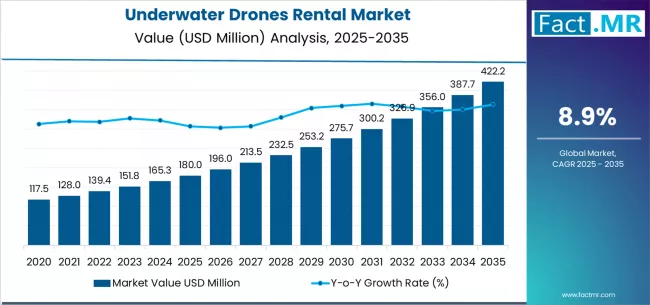
The global market for underwater drones rental is estimated to be around US$ 196 million in 2026 and has been forecast to expand at a CAGR of 8.9% to end up at US$ 500.7 million by 2036.
The underwater drones rental market covers the provision of remotely operated vehicles, professional inspection ROVs, and autonomous underwater vehicles on short-term and project-based rental contracts.
Underwater Drones Rental Market Value Analysis | Source: Fact.MR
Summary of Underwater Drones Rental Market
Market Snapshot
In 2025, the global Underwater Drones Rental Market was valued at approximately USD 196.0 Million.
The market is estimated to reach USD 196 Million in 2026 and is projected to attain USD 500.7 Million by 2036.
The underwater drones rental market is likely to expand at a CAGR of 8.9% during the forecast period.
The market is anticipated to create an absolute dollar opportunity of USD 287.3 Million between 2026 and 2036.
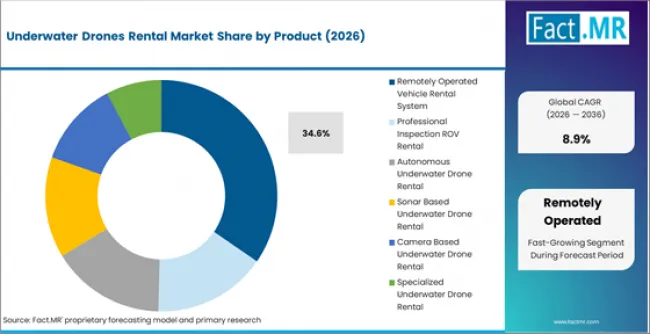
Remotely operated vehicle rental systems account for 34.6% of product segment share in 2026.
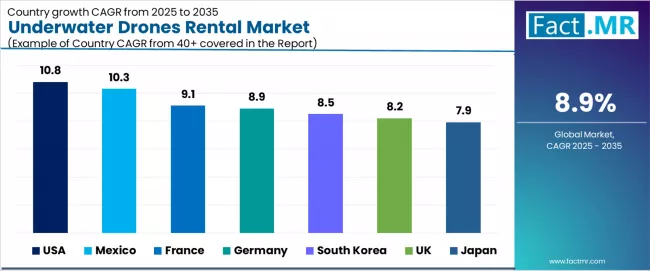
USA (10.8%) and Mexico (10.3%) are the key growth markets during the forecast period.
Demand and Growth Drivers
Offshore oil and gas operators require regular subseainspection of pipelines, wellheads, risers, and mooring systems, generating recurring demand for ROV rental across planned and unplanned maintenance windows.
Offshore wind farm construction and operational maintenance create growing demand for ROV and AUV rental services for cable route survey, foundation inspection, and scour monitoring.
Marine research institutions and government agencies are increasingly renting underwater drones for biodiversity surveys, seabed mapping, and environmental monitoring projects with fixed-term funding.
Port and harbor security applications are expanding the rental market as authorities deploy inspection ROVs for hull surveys, underwater infrastructure checks, and threat detection operations.
The rental model itself is a growth driver, enabling smaller operators, researchers, and one-time project teams to access subsea technology without the capital and maintenance burden of vehicle ownership.
Product and Segment View
Remotely operated vehicle rental systems account for 34.6% of the product segment in 2026, supported by their established track record in offshore energy inspection and their availability across a broad range of depth ratings and manipulation capabilities.
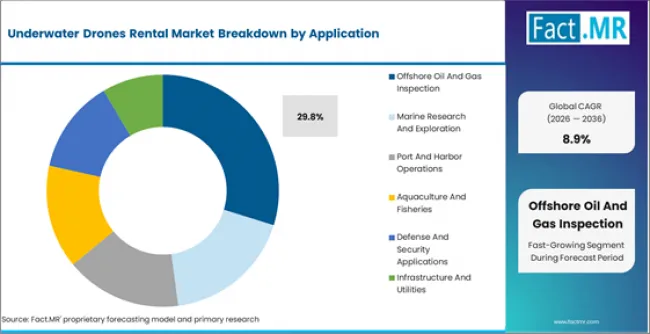
Offshore oil and gas inspection represents 29.8% of the application segment in 2026, driven by regulatory compliance requirements for subsea asset integrity monitoring and recurring inspection cycles.
Shallow water ROV systems hold 34.1% of the depth capability segment, reflecting the concentration of rental demand in coastal, port, and continental shelf applications where depth requirements are below 300 meters.
Application: Offshore Oil And Gas Inspection, Marine Research And Exploration, Port And Harbor Operations, Offshore Wind Farm Maintenance, Underwater Infrastructure Inspection
End Use: Oil And Gas Companies, Marine Service Providers, Government And Defense Agencies
These systems enable:
Subsea visual and sonar inspection of pipelines, wellheads, cables, and marine structures without permanent vehicle procurement
Project-based access to survey-grade AUV and ROV platforms for marine research, seabed mapping, and environmental monitoring
Flexible fleet scaling for inspection campaigns, construction support, and decommissioning projects with variable scope and duration
Geography and Competitive Outlook
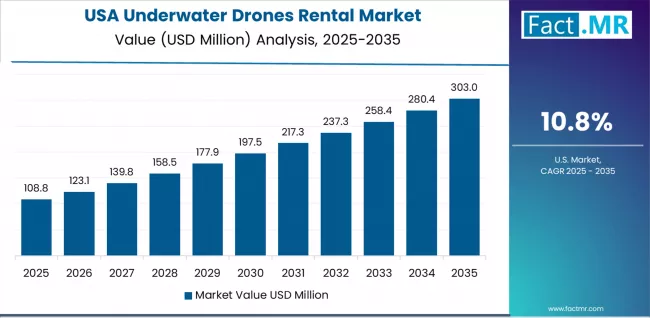
North America leads demand, with USA at 10.8% CAGR reflecting Gulf of Mexico offshore inspection cycles, East Coast offshore wind development, and defense agency underwater surveillance requirements.
Europe shows strong growth, with France at 9.1% supported by North Sea oil and gas inspection, offshore wind maintenance, and Mediterranean marine research activity.
Asia Pacific is an emerging market, with Australia and Southeast Asia generating rental demand from offshore energy operations, port infrastructure inspection, and marine environmental monitoring.
Key companies include Ocean Infinity Rentals, Fugro Rentals, Saab Seaeye, Oceaneering, Bluefin, ECA Group, Hydroid, Subsea 7 Rentals, SeaRaptor, and NOC.
Analyst Opinion
Shambhu Nath Jha, Principal Consultant at Fact.MR, says 'The underwater drones rental market is transitioning from a niche service supporting offshore oil and gas inspection into a broader subsea access platform. Offshore wind maintenance, marine research, port security, and infrastructure decommissioning are all creating new rental demand channels. The commercial leverage is shifting toward rental providers that can offer integrated service packages combining vehicle deployment, trained operators, data processing, and inspection reporting. Companies that build diversified rental fleets spanning shallow and deep water capability, with AI-enabled data analytics included in the service contract, will capture disproportionate share as the market broadens.'
The rental model is gaining traction as operators seek to access subsea inspection, survey, and monitoring capability without capital commitment to vehicle ownership. Growth is supported by offshore energy inspection cycles, marine research budgets, port and harbor security requirements, and expanding offshore wind farm maintenance demand.
Key Growth Drivers, Constraints, and Opportunities
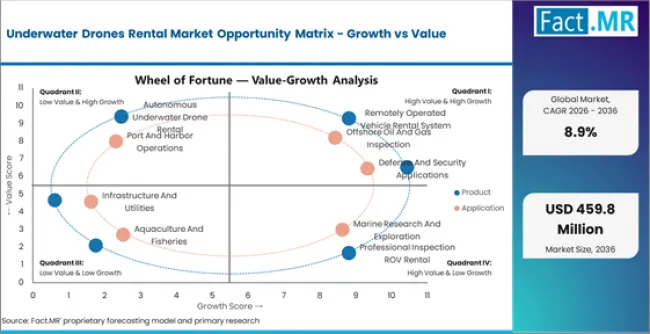
Underwater Drones Rental Market Opportunity Matrix Growth Vs Value | Source: Fact.MR
Key Factors Driving Growth
Recurring subsea inspection requirements for offshore oil and gas infrastructure, governed by regulatory compliance cycles, create predictable and sustained rental demand across major producing basins.
Offshore wind farm construction and operational maintenance are generating a new rental demand channel, particularly in the North Sea, Baltic, and US East Coast where cable and foundation inspection needs are growing.
The rental model reduces capital and maintenance burden for operators with intermittent subsea access needs, making underwater drone capability accessible to a broader range of organizations including research institutions, port authorities, and environmental agencies.
Key Market Constraints
Vessel and mobilization costs associated with deploying rental ROVs to remote offshore locations add significant expense beyond the vehicle day rate, limiting cost-effectiveness for short-duration projects.
Skilled ROV pilot and technician availability constrains the number of rental deployments that can be supported concurrently during peak offshore activity seasons.
Saltwater corrosion, pressure cycling, and subsea operating conditions create high maintenance requirements that increase fleet operating costs and limit the achievable utilization rate per vehicle.
Key Opportunity Areas
Autonomous underwater vehicles with pre-programmed survey routes are enabling rental providers to offer survey-grade data collection services without the cost of dedicated surface support vessels.
AI-enabled inspection data analytics bundled with rental contracts are creating higher-value service packages that differentiate rental providers beyond vehicle availability alone.
Decommissioning activity across aging offshore oil and gas fields in the North Sea, Gulf of Mexico, and Asia Pacific is generating new demand for ROV rental to support cutting, lifting, and environmental remediation operations.
Segment-wise Analysis of the Underwater Drones Rental Market
Remotely operated vehicle rental systems hold 34.6% of the product segment in 2026, anchored by their established role in offshore energy inspection and broad availability across depth and manipulation capability tiers.
Offshore oil and gas inspection represents 29.8% of the application segment, driven by regulatory inspection mandates and subsea infrastructure maintenance cycles.
Oil and gas companies account for 32.4% of the end-use segment, reflecting their position as the largest single source of recurring rental demand.
The market is segmented by product type, application, end use, technology, and depth capability. ROV rental leads by value due to its established offshore energy inspection role. Autonomous underwater drone rental is the fastest-growing category as AUV technology matures and operators seek more cost-effective survey and monitoring solutions.
Which Product Type Segment Dominates the Underwater Drones Rental Market?
Underwater Drones Rental Market Analysis By Product | Source: Fact.MR
Remotely operated vehicle rental systems account for 34.6% of the product segment in 2026. Their leadership reflects the established track record of ROVs in offshore energy inspection, construction support, and subsea maintenance operations. Work-class ROVs with manipulation capability are the highest-value rental tier, while observation-class systems serve inspection and survey applications at lower day rates.
The ROV rental segment benefits from the large installed base of offshore energy infrastructure requiring regular inspection and the regulatory frameworks that mandate subsea integrity verification at defined intervals. Rental providers with diverse ROV fleets spanning shallow and deep water ratings can capture demand across a broader range of projects and clients.
Which Application Segment Dominates the Underwater Drones Rental Market?
Underwater Drones Rental Market Analysis By Application | Source: Fact.MR
Offshore oil and gas inspection accounts for 29.8% of the application segment in 2026. Demand is driven by regulatory requirements for pipeline integrity verification, wellhead inspection, riser monitoring, and mooring system assessment at producing offshore fields. These inspection campaigns are typically project-based with defined scope and duration, making the rental model a natural fit for operators that do not maintain permanent ROV fleets.
The application is also supported by growing decommissioning activity at end-of-life offshore fields, where ROV rental demand increases for cutting, lifting support, environmental survey, and debris clearance operations. As mature basins in the North Sea, Gulf of Mexico, and Asia Pacific enter decommissioning phases, the associated ROV rental volumes are expected to grow.
Which Product Trend is Shaping the Next Phase of Growth in the Underwater Drones Rental Market?
Autonomous underwater vehicle rental is emerging as the fastest-growing product category, driven by advancing navigation and survey sensor technology that enables AUVs to conduct pre-programmed inspection and mapping missions without continuous human piloting or dedicated surface support vessels. This autonomy reduces mobilization costs and operational complexity, making AUV rental accessible to a wider range of clients including marine research institutions, environmental agencies, and port authorities.
The trend is supported by AI-enabled data processing that converts raw AUV sensor data into inspection reports, bathymetric maps, and environmental assessments as part of the rental service package. Rental providers that bundle AUV deployment with automated data analytics are creating higher-value service offerings that differentiate beyond vehicle availability. As AUV battery endurance and sensor resolution improve, the range of rental-viable applications is expected to expand significantly.
Regional Outlook Across Key Markets
USA at 10.8% CAGR reflects Gulf of Mexico inspection cycles, East Coast offshore wind development, and defense agency underwater surveillance requirements driving rental demand.
Mexico at 10.3% growth is supported by PEMEX-linked offshore production inspection, deepwater exploration support, and port security infrastructure investment.
France at 9.1% reflects North Sea and Mediterranean offshore energy inspection, naval defense underwater drone programs, and marine research activity.
Top Country Growth Comparison Underwater Drones Rental Market Cagr (2026 2036) | Source: Fact.MR
CAGR Table
Country
CAGR (%)
USA
10.8%
Mexico
10.3%
France
9.1%
Source: Fact.MR analysis. Updated Jun 4, 2026
Source: Fact MR (FMR) analysis, based on proprietary forecasting model and primary research.
Underwater Drones Rental Market Cagr Analysis By Country | Source: Fact.MR
Underwater Drones Rental Deployment Trends in the United States
Underwater Drones Rental Market Country Value Analysis | Source: Fact.MR
The scale of Gulf of Mexico offshore production infrastructure, combined with accelerating East Coast offshore wind construction, creates broad-based rental demand across work-class ROVs, observation systems, and survey-grade AUVs. Defense agency underwater surveillance programs, including the Department of Defense Freedom platform initiative with Oceaneering, are expanding the government rental and contract service channel. Port security ROV deployment for hull survey and infrastructure inspection adds a distinct non-energy rental vertical.
Gulf of Mexico offshore inspection cycles provide recurring, predictable ROV rental demand tied to regulatory compliance schedules.
East Coast offshore wind farm construction creates incremental rental demand for cable route survey, foundation inspection, and environmental monitoring.
PEMEX offshore production operations and deepwater exploration activity in the Gulf of Mexico generate multi-year ROV rental demand for pipeline inspection, wellhead integrity monitoring, and FPSO support services. Port modernization investment across Veracruz, Lazaro Cardenas, and Altamira is creating demand for inspection ROV rental in harbor infrastructure assessment and security operations. Private offshore operators entering Mexican waters under energy reform provisions are also contributing to rental demand growth.
PEMEX-linked offshore production inspection creates recurring work-class ROV rental demand across the Gulf of Mexico producing basin.
Port infrastructure investment generates rental demand for shallow water inspection ROVs used in harbor security and structural assessment.
France Underwater Drones Rental Growth Assessment
Government investment in naval defense programs, combined with sustained North Sea and Mediterranean offshore energy inspection activity, supports a diversified rental demand base. The French Navy and Direction Generale de l'Armement are active in autonomous underwater vehicle procurement and rental for mine countermeasure and surveillance operations. Marine research institutions funded through IFREMER and EU Horizon programs generate project-based AUV and ROV rental demand for deep sea exploration and environmental survey campaigns.
Naval defense programs sustain AUV and ROV rental demand for mine countermeasure, harbor surveillance, and underwater threat assessment operations.
IFREMER and EU-funded marine research projects generate campaign-based rental demand for survey-grade AUV and deep water ROV systems.
Competitive Benchmarking and Company Positioning
Underwater Drones Rental Market Analysis By Company | Source: Fact.MR
Underwater Drones Rental Market Analysis By Company
Oceaneering, Fugro, and Subsea 7 hold strong positions through large work-class ROV fleets, global offshore energy service contracts, and integrated inspection and survey service capability.
Ocean Infinity, Saab Seaeye, and ECA Group compete through technology-differentiated fleets, autonomous vehicle capability, and growing positions in defense and marine research rental channels.
Competition is shaped by fleet depth rating range, geographic service coverage, operator crew availability, and the ability to bundle vehicle rental with data processing and inspection reporting services.
The competitive landscape spans large offshore energy service companies with established ROV fleets and specialized rental providers focused on specific technologies or application verticals. Oceaneering maintains the largest global ROV fleet with 250 systems and contracts extending to 2031. Fugro leads in geotechnical and survey AUV services. Subsea 7 provides integrated subsea construction and ROV support.
Smaller specialists like Ocean Infinity, SeaRaptor, and Bluefin are gaining share through advanced autonomous vehicle technology and differentiated service models that target marine research, defense, and environmental monitoring segments outside the traditional offshore energy channel.
Key Companies in the Underwater Drones Rental Market
Oceaneering, Fugro, and Subsea 7 are the leading global players, supported by large ROV fleets, established offshore energy service contracts, and integrated subsea operation capabilities.
Ocean Infinity, Saab Seaeye, ECA Group, Hydroid, Bluefin, SeaRaptor, and NOC hold positions across specific technology tiers, application verticals, and regional rental markets.
Recent Industry Developments
Oceaneering, Contract Award, Petrobras Subsea Robotics (August 2025): Oceaneering secured USD 180 million in subsea robotics contracts with Petrobras for work-class ROV services, specialized tooling, and survey operations across multiple vessels offshore Brazil, with four-year contract terms commencing in late 2025 and early 2026.
Oceaneering, Technology Development, Freedom Autonomous Platform (2025): Oceaneering continued development of its Freedom autonomous ROV/AUV platform under a U.S. Department of Defense contract, expanding the company portfolio from tethered ROV systems into resident autonomous underwater vehicle technology.
Oceaneering, Financial Performance, Subsea Robotics Growth (Q1 2026): Oceaneering reported Subsea Robotics revenue of USD 214 million in Q1 2026, with ROV revenue per day utilized rising to USD 12,401, supported by improved pricing and over USD 300 million in new SSR contract awards during the quarter.
Fugro, Service Expansion, Autonomous Survey Capability (2025): Fugro expanded its autonomous underwater survey capability, deploying next-generation AUV platforms for geotechnical and environmental survey campaigns across offshore energy and infrastructure markets globally.
Leading Companies Shaping the Underwater Drones Rental Market
Ocean Infinity Rentals
Fugro Rentals
Saab Seaeye
Oceaneering
Bluefin
ECA Group
Hydroid
Subsea 7 Rentals
SeaRaptor
NOC
Sources and Research References
Oceaneering International. Subsea robotics contract awards, fleet data, and Freedom platform development updates.
Fugro N.V. Autonomous survey capability expansion and marine service portfolio updates.
International Marine Contractors Association (IMCA). ROV operations guidelines and industry standards.
Offshore energy industry publications, naval defense procurement databases, and company fleet catalogs.
Primary interviews with rental providers, offshore operators, marine researchers, port authorities, and defense procurement agencies.
This bibliography is provided for reader reference and is not exhaustive. The full report contains the complete reference list and detailed citations.
Key Questions This Report Addresses
What is the current and future size of the Underwater Drones Rental Market?
How fast is the Underwater Drones Rental Market expected to grow between 2026 and 2036?
Which product type is likely to lead the rental market by 2026?
Which application segment is expected to account for the highest demand by 2026?
What factors are driving demand for underwater drone rental services globally?
How is AUV technology influencing rental market growth?
Why is the USA emerging as the fastest-growing market?
How are offshore wind and decommissioning supporting demand?
Which countries are projected to show the fastest growth through 2036?
Who are the key companies active in the Underwater Drones Rental Market?
How does Fact.MR estimate and validate the market forecast?
Underwater Drones Rental Market Definition
The underwater drones rental market covers the provision of remotely operated vehicles, professional inspection ROVs, and autonomous underwater vehicles on short-term, project-based, and campaign rental contracts for subsea inspection, survey, monitoring, and maintenance support applications.
Underwater Drones Rental Market Inclusions
The scope covers global and regional market size and forecasts for 2026 to 2036 across product type, application, end use, technology, depth capability, and region.
It includes demand analysis based on offshore energy inspection cycles, wind farm maintenance requirements, marine research budgets, and port security investment.
The report covers pricing and cost analysis across rental duration types, including day rate, project rate, and long-term charter models.
Underwater Drones Rental Market Exclusions
The scope excludes direct sale of underwater drones and ROVs where no rental or service contract is involved.
It excludes consumer-grade recreational underwater drones, underwater cameras without navigation capability, and non-commercial hobby devices.
The report excludes military-classified autonomous underwater vehicle programs with restricted procurement channels.
Underwater Drones Rental Market Research Methodology
The methodology combines secondary research, primary interviews, and forecast modelling.
It draws on 100+ secondary sources and benchmarks 45+ company rental fleet profiles.
Market sizing covers 25+ countries through a demand-side model, supported by top-down validation.
Key inputs include offshore energy inspection schedules, wind farm installation pipelines, marine research funding, and port security budgets.
Primary validation includes 20+ interviews across rental providers, offshore operators, marine researchers, and port authorities.
Market Breakdown
Segmentation
Scope of Analysis
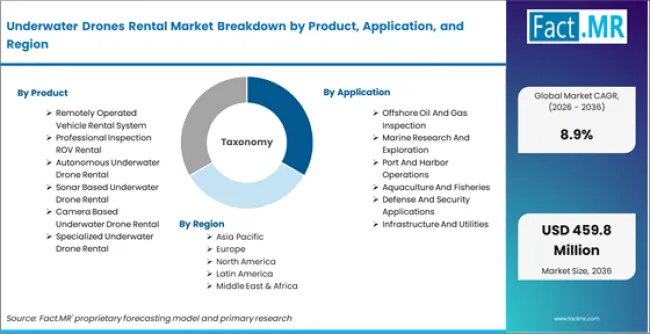
Underwater Drones Rental Market Breakdown By Product, Application, And Region | Source: Fact.MR
Parameter
Details
Quantitative Units
USD 213.5 Million to USD 500.7 Million, at a CAGR of 8.9%
Market Definition
The Underwater Drones Rental Market covers the provision of ROVs, professional inspection ROVs, and AUVs on rental contracts for subsea inspection, survey, monitoring, and maintenance applications.
Regions Covered
North America, Latin America, Europe, East Asia, South Asia and Pacific, Middle East and Africa
Countries Covered
USA, Mexico, France, UK, Australia, 25 plus countries
Hybrid demand-side and top-down methodology built on offshore inspection schedules, wind farm pipelines, marine research budgets, port security investment, and primary interviews
Source: Fact.MR analysis. Updated Jun 4, 2026
Underwater Drones Rental Market Segmentation
Underwater Drones Rental Market Segmented by Product:
Remotely Operated Vehicle Rental System
Micro Inspection ROV Rental
Ship Hull Inspection Operations
Port Infrastructure Survey Tasks
Mini Observation ROV Rental
Underwater Visual Inspection
Shallow Water Survey Operations
Professional Inspection ROV Rental
Work Class ROV Rental System
Offshore Oil And Gas Inspection
Subsea Pipeline Monitoring
Heavy Duty ROV Rental System
Deep Sea Infrastructure Inspection
Industrial Marine Maintenance
Autonomous Underwater Drone Rental
Semi Autonomous Underwater Drone
Bathymetric Survey Operations
Marine Mapping Projects
Fully Autonomous Underwater Drone
Environmental Monitoring Missions
Oceanographic Data Collection
Sonar Based Underwater Drone Rental
Multibeam Sonar Drone System
Seafloor Mapping Operations
Harbor Depth Analysis
Side Scan Sonar Drone System
Wreck Detection Surveys
Subsea Object Identification
Camera Based Underwater Drone Rental
HD Imaging Underwater Drone
Marine Research Observation
Aquaculture Inspection Tasks
4K Underwater Drone System
Coral Reef Monitoring
Scientific Exploration Missions
Specialized Underwater Drone Rental
Industrial Cleaning ROV Rental
Marine Structure Cleaning
Biofouling Inspection Tasks
Explosive Or Hazard Detection ROV
Defense And Security Operations
Critical Infrastructure Inspection
Underwater Drones Rental Market Segmented by Application:
Offshore Oil And Gas Inspection
Subsea Pipeline Inspection
Leak Detection Operations
Structural Integrity Checks
Offshore Platform Inspection
Drilling Rig Maintenance Support
Equipment Monitoring Tasks
Marine Research And Exploration
Oceanographic Research Missions
Deep Sea Data Collection
Marine Ecosystem Studies
Coral Reef Monitoring
Environmental Impact Assessment
Biodiversity Mapping
Port And Harbor Operations
Ship Hull Inspection Services
Dock Infrastructure Monitoring
Underwater Damage Assessment
Port Security Inspection
Berth Condition Evaluation
Navigation Channel Survey
Aquaculture And Fisheries
Fish Farm Inspection Operations
Cage Integrity Monitoring
Water Quality Observation
Aquatic Environment Monitoring
Stock Health Assessment
Farm Infrastructure Maintenance
Defense And Security Applications
Underwater Surveillance Operations
Naval Security Inspection
Harbor Protection Missions
Mine Detection Support Systems
Coastal Security Monitoring
Strategic Infrastructure Protection
Infrastructure And Utilities
Dam And Reservoir Inspection
Hydropower Facility Monitoring
Water Intake Structure Inspection
Subsea Cable Inspection
Pipeline Route Monitoring
Utility Infrastructure Maintenance
Underwater Drones Rental Market Segmented by End Use:
Oil And Gas Companies
Offshore Exploration Firms
Subsea Asset Inspection
Pipeline Maintenance Operations
Production Platform Operators
Drilling And Extraction Support
Asset Integrity Management
Marine Service Providers
Dive Inspection Companies
Underwater Survey Contractors
ROV Service Operators
Marine Engineering Firms
Ship Repair And Maintenance
Subsea Construction Services
Government And Defense Agencies
Naval Forces
Underwater Surveillance Operations
Defense Inspection Missions
Marine Safety Authorities
Port Security Operations
Coastal Monitoring Programs
Research Institutions
Oceanographic Research Centers
Marine Biology Studies
Deep Sea Exploration Labs
Environmental Agencies
Water Quality Research
Ecosystem Monitoring Programs
Infrastructure Operators
Port Authorities
Harbor Maintenance Operations
Underwater Structural Inspection
Power And Utility Companies
Hydropower And Dam Inspection
Subsea Asset Monitoring
Underwater Drones Rental Market Segmented by Technology:
Navigation Technology
Acoustic Positioning Systems
Underwater GPS Alternatives
Subsea Localization Systems
Sonar Navigation Systems
Obstacle Detection And Mapping
Autonomous Path Planning
Imaging Technology
HD Underwater Camera Systems
Low Light Imaging Systems
Marine Visual Inspection
3D Imaging Systems
Photogrammetry Based Mapping
Structural Analysis Imaging
Control Technology
Remote ROV Control Systems
Surface Based Operation Consoles
Real Time Joystick Control
Semi Autonomous Control Systems
Pre Programmed Missions
Adaptive Navigation Control
Communication Technology
Acoustic Communication Systems
Underwater Signal Transmission
Low Bandwidth Data Transfer
Tethered Communication Systems
Fiber Optic Control Links
High Speed Data Streaming
Power Technology
Battery Powered Underwater Drones
Extended Mission Energy Systems
Rechargeable Subsea Batteries
Tethered Power Supply Systems
Continuous Operation Support
High Depth Exploration Systems
Underwater Drones Rental Market Segmented by Depth Capability:
Shallow Water ROV Systems
Coastal Inspection Drones
Harbor And Port Operations
Near Shore Survey Tasks
Medium Depth ROV Systems
Offshore Platform Inspection
Pipeline Monitoring Tasks
Deep Water ROV Systems
Deep Sea Exploration Drones
Subsea Infrastructure Inspection
Oil And Gas Deep Operations
High Pressure Rated Systems
Ultra Deep Ocean Missions
Scientific Exploration Projects
Underwater Drones Rental Market by Region:
North America
USA
Canada
Mexico
Latin America
Brazil
Chile
Rest of Latin America
Western Europe
Germany
UK
Italy
Spain
France
Nordic
BENELUX
Rest of Western Europe
Eastern Europe
Russia
Poland
Hungary
Balkan & Baltic
Rest of Eastern Europe
East Asia
China
Japan
South Korea
South Asia and Pacific
India
ASEAN
Australia & New Zealand
Rest of South Asia and Pacific
Middle East & Africa
Kingdom of Saudi Arabia
Other GCC Countries
Turkiye
South Africa
Other African Union
Rest of Middle East & Africa
Questions Answered
Frequently Asked Questions
How big is the underwater drones rental market in 2026?
The global underwater drones rental market is estimated to be valued at USD 196.0 million in 2026.
What will be the size of underwater drones rental market in 2036?
The market size for the underwater drones rental market is projected to reach USD 459.8 million by 2036.
How much will be the underwater drones rental market growth between 2026 and 2036?
The underwater drones rental market is expected to grow at a 8.9% CAGR between 2026 and 2036.
What are the key product types in the underwater drones rental market?
The key product types in underwater drones rental market are remotely operated vehicle rental system, professional inspection rov rental, autonomous underwater drone rental, sonar based underwater drone rental, camera based underwater drone rental, and specialized underwater drone rental.
Which application segment is expected to contribute significant share in the underwater drones rental market in 2026?
In terms of application, offshore oil and gas inspection segment is expected to command 29.8% share in the underwater drones rental market in 2026.
.webp "Top Country Growth Comparison Underwater Drones Rental Market Cagr (2026 2036)")