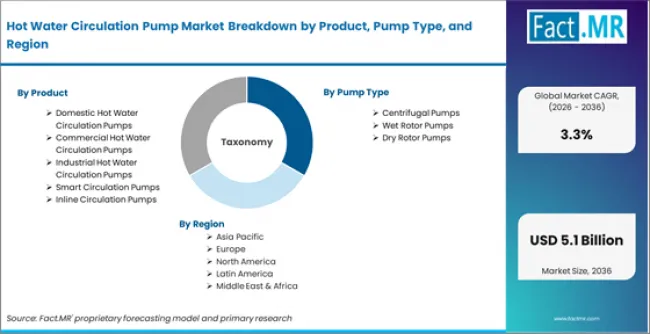
Hot Water Circulation Pump Market Size, Share, Growth and Forecast (2026 - 2036)
Hot Water Circulation Pump Market is segmented by Product (Domestic Hot Water Circulation Pumps, Commercial Hot Water Circulation Pumps, Industrial Hot Water Circulation Pumps, Smart Circulation Pumps, Inline Circulation Pumps), Pump Type (Centrifugal Pumps, Wet Rotor Pumps, Dry Rotor Pumps), Power Source (Electric Powered Pumps, Solar Powered Pumps), and Region, with forecasts covering the period from 2026 to 2036.
Hot Water Circulation Pump Market Analysis and Forecast by Fact.MR
- The global hot water circulation pump market is estimated at USD 3.719 billion in 2026 and is forecast to expand at a CAGR of 3.3% to reach USD 5.145 billion by 2036.
- Hot water circulation pumps maintain continuous or on-demand hot water flow through plumbing systems, eliminating wait times and reducing water waste. Product types include domestic on-demand units, comfort system pumps, and commercial centralized systems.
- Centrifugal and wet rotor configurations dominate, with electric-powered units representing the vast majority.
- EU ErP energy efficiency regulations are accelerating replacement of fixed-speed pumps with variable-speed, electronically controlled alternatives that reduce electricity consumption by 50 to 70 percent.
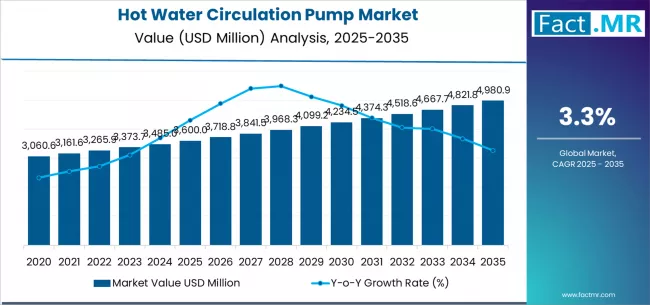
Summary of the Hot Water Circulation Pump Market
- Market Snapshot
- In 2025, the global Hot Water Circulation Pump Market was valued at approximately USD 3.6 billion.
- The market is estimated to reach USD 3.719 billion in 2026 and is projected to attain USD 5.145 billion by 2036.
- The hot water circulation pump market is likely to expand at a CAGR of 3.3% during the forecast period.
- The market is anticipated to create an absolute dollar opportunity of USD 1.426 billion between 2026 and 2036.
- Centrifugal Pumps accounts for 42.6% of the pump type segment share in 2026.
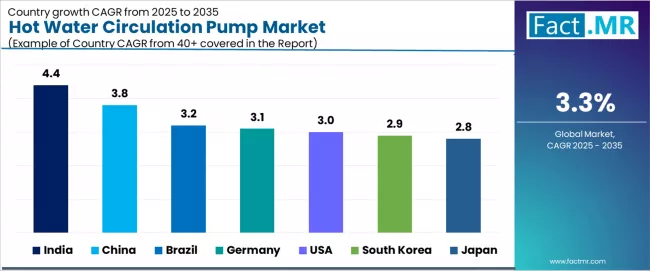
- India (4.4%) and China (3.8%) are the key growth markets during the forecast period.
- Demand and Growth Drivers
- Residential new construction across Asia Pacific, North America, and the Middle East is creating installation demand for recirculation systems designed into plumbing blueprints from the outset.
- Water conservation regulations and green building certifications are mandating or incentivizing pump installation to reduce cold water wasted while waiting for hot water at fixtures.
- EU ErP Directive requirements for glandless circulators are driving replacement of fixed-speed pumps with variable-speed ECM models that cut electricity consumption by 50 to 70 percent.
- Growing homeowner expectations for instant hot water, reinforced by smart home integration and app-based scheduling, are increasing willingness to invest in recirculation systems.
- Commercial building standards for hotels, hospitals, and multi-family housing require optimized hot water distribution that minimizes energy loss and ensures consistent supply.
- Product and Segment View
- Domestic pumps account for 38.2% of the product segment in 2026, supported by residential construction demand and growing retrofit adoption for instant hot water convenience.
- Centrifugal pumps represent 42.6% of the pump type segment, reflecting their established position across residential and commercial recirculation applications.
- Electric-powered pumps hold 61.4% of the power source segment, with AC-powered models dominating residential installations.
- Key segmentation includes:
- Product: Domestic Circulation Pumps, On Demand Pumps, Comfort System Pumps, Commercial Pumps
- Pump Type: Centrifugal Pumps, Wet Rotor Pumps, Integrated Motor Pumps
- Power Source: Electric Powered, Solar Powered
- Installation: New Installation, Retrofit
- Application: Residential, Commercial, Industrial
- These systems enable:
- Instant hot water delivery by maintaining circulation through plumbing, eliminating cold water wait times at fixtures
- Water conservation through elimination of 1 to 3 gallons wasted per fixture use while waiting for heated water
- Variable-speed operation adjusting output to real-time demand, reducing electricity consumption versus fixed-speed units
- Geography and Competitive Outlook
- North America holds significant value, with the U.S. at USD 1.387 billion in 2026, supported by residential construction, water conservation mandates in drought-prone states, and retrofit demand.
- Asia Pacific leads by growth, with India (4.4%) and China (3.8%) supported by urban construction volumes, plumbing modernization, and rising middle-class housing standards.
- Europe shows steady growth, with Germany (3.1%) driven by EU ErP mandates replacing fixed-speed circulators with variable-speed ECM models.
- Key companies include Grundfos, Wilo, Xylem, KSB, Armstrong Fluid.
- Analyst Opinion
- Shambhu Nath Jha, Principal Consultant at Fact.MR, says 'The hot water circulation pump market is being reshaped by the convergence of energy efficiency regulation, water conservation requirements, and homeowner comfort expectations. EU ErP mandates have forced a technology upgrade cycle in Europe, and similar replacement demand is emerging in North America and Asia. Manufacturers combining energy-efficient hardware with smart controls, app-based scheduling, and heat pump water heater compatibility are positioned to capture share as the market transitions from commodity plumbing component to intelligent building system element.'
Key Growth Drivers, Constraints, and Opportunities
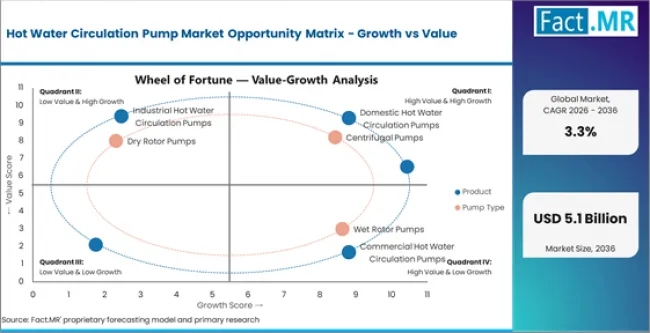
Key Factors Driving Growth
- Residential construction expansion across Asia Pacific and North America is creating new-build installation demand, with builders increasingly specifying circulation pumps as standard plumbing in mid-range and premium housing.
- EU ErP Directive Lot 11 energy efficiency requirements mandate minimum efficiency indices that require variable-speed ECM technology, driving replacement from legacy fixed-speed pumps across European markets.
- Water conservation regulations in drought-prone U.S. states and Australian regions create code-level requirements for recirculation pumps that reduce cold-water waste, expanding the mandatory installation base.
Key Market Constraints
- Low consumer awareness of recirculation pump benefits limits retrofit adoption, as homeowners who have never experienced instant hot water may not recognize the waste and convenience issues pumps address.
- Retrofit installation complexity in existing homes with distant water heaters may require dedicated return lines, adding plumbing labor costs that deter price-sensitive buyers.
- Price sensitivity in the commodity pump segment limits margins, as basic domestic pumps face pressure from low-cost imports and private-label products.
Key Opportunity Areas
- Heat pump water heater adoption creates a complementary opportunity, as these systems often require recirculation pumps for adequate delivery speed to distant fixtures due to lower recovery rates.
- Smart home integration through Wi-Fi pumps with app scheduling and demand sensing creates a premium tier improving margins and brand differentiation.
- Retrofit demand in aging housing stock across Europe and Japan is expanding as homeowners modernize plumbing during broader renovation projects.
Segment-wise Analysis of the Hot Water Circulation Pump Market
- Domestic pumps hold 38.2% of the product segment in 2026, reflecting broad applicability across residential new construction and retrofit.
- Residential applications represent 47.3% of the application segment, with single-family and multi-family housing accounting for the majority of installations.
- New installations account for 55.7% of the installation type segment, reflecting strong construction-driven demand.
The hot water circulation pump market is segmented by product type, pump type, power source, installation type, application, and region. Domestic pumps lead by volume on the large residential base, while commercial pumps command higher unit values for centralized recirculation in hotels, hospitals, and multi-family buildings.
Which Product Segment Dominates the Hot Water Circulation Pump Market?
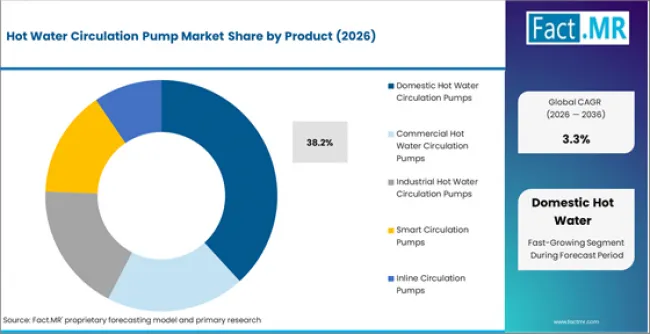
Domestic hot water circulation pumps account for 38.2% of the product segment in 2026. Leadership reflects the large residential installation base. Instant and on-demand models are growing fastest as homeowners expect immediate hot water without continuous pump operation.
Commercial pumps hold the second-largest share, serving centralized systems in hotels, hospitals, and multi-family buildings requiring higher flow rates, durability, and legionella prevention compliance.
Which Application Segment Dominates the Hot Water Circulation Pump Market?
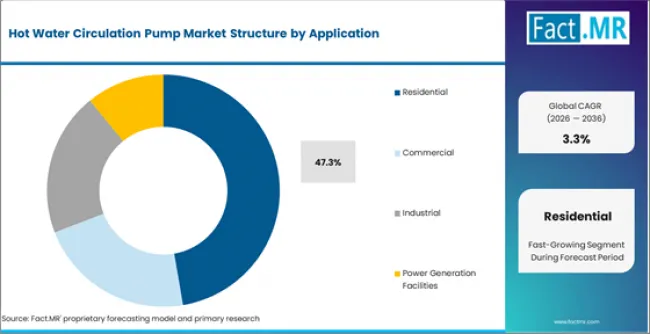
Residential leads with a 47.3% share in 2026, distributed across new construction, multi-family housing, and retrofit. Growing awareness of water waste reduction and instant convenience drives adoption beyond premium housing.
Commercial applications rank second, with hotels, hospitals, and healthcare facilities requiring reliable circulation for guest comfort and health code compliance. Industrial applications contribute smaller but stable demand.
Which Product Trend is Shaping the Next Phase of Growth in the Hot Water Circulation Pump Market?
Variable-speed ECM circulation pumps are the technology transition reshaping this market. These pumps adjust output using built-in sensors, reducing electricity consumption 50 to 70 percent versus fixed-speed units. EU ErP compliance has made ECM mandatory in Europe, with similar standards emerging in North America and Asia Pacific.
Beyond efficiency, ECM pumps enable smart features: Wi-Fi connectivity, app scheduling, demand sensing, and energy management integration. This transforms the pump from a passive plumbing component into an active element of whole-home energy optimization, creating premium pricing and software service revenue opportunities beyond commodity economics.
Regional Outlook Across Key Markets
.webp)
- India leads at 4.4%, supported by urban residential construction, rising middle-class housing standards, and plumbing infrastructure investment in new multi-family developments.
- China (3.8%) reflects high-volume construction, urban plumbing modernization, and domestic manufacturing scale supporting cost-competitive system adoption.
- The U.S. (3.0%) shows steady growth from new construction, California Title 24 water conservation compliance, and retrofit demand for instant hot water convenience.
CAGR Table
| Country | CAGR (%) |
|---|---|
| India | 4.4% |
| China | 3.8% |
| Brazil | 3.2% |
| Germany | 3.1% |
| USA | 3.0% |
| South Korea | 2.9% |
| Japan | 2.8% |
Source: Fact MR (FMR) analysis, based on proprietary forecasting model and primary research.
Hot Water Circulation Pump Demand Trends in India
Expanding urban residential construction and rising housing standards among middle-income buyers are primary drivers at 4.4% CAGR. National housing targets and organized real estate in tier-2 and tier-3 cities create installation volumes for domestic pumps in new apartments.
- Organized real estate is incorporating hot water circulation as standard plumbing in mid-range and premium housing.
- Growing middle-class expectations for domestic water comfort expand retrofit demand in existing urban housing.
China Hot Water Circulation Pump Growth Assessment
Domestic manufacturing capacity and high-volume residential construction sustain China at 3.8% CAGR. Updated building energy codes specifying improved hot water delivery performance create structured demand across the residential sector.
- Domestic manufacturers with integrated production deliver cost-competitive systems scaled to national construction volume.
- Updated building codes establish performance requirements supporting variable-speed pump adoption in new construction.
Market Outlook for Hot Water Circulation Pumps in the United States
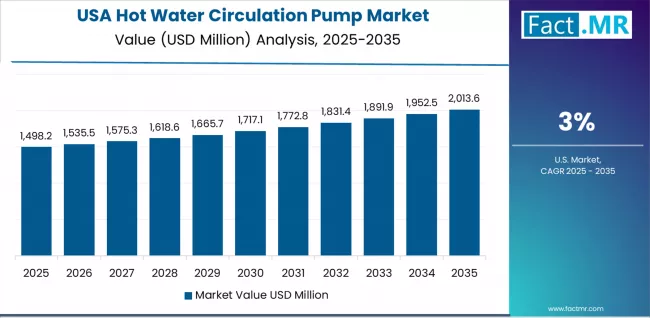
Residential construction and water conservation mandates in drought-prone western states are primary catalysts at 3.0% CAGR. California Title 24 building codes require hot water distribution efficiency, creating code-driven installation demand.
- California Title 24 mandates recirculation pump installation in new residential construction for hot water efficiency.
- Retrofit adoption grows as homeowners add on-demand pumps for instant hot water, supported by plumber recommendation and smart home integration.
Germany Hot Water Circulation Pump Demand Analysis
EU ErP energy efficiency mandates and high electricity prices drive technology replacement at 3.1% CAGR. Fixed-speed legacy circulators are being replaced with variable-speed ECM models meeting minimum Energy Efficiency Index requirements.
- ErP Lot 11 compliance has mandated variable-speed ECM technology for new installations, driving replacement of legacy pumps.
- High electricity prices strengthen the economic case, with variable-speed models delivering 50 to 70 percent electricity savings.
Brazil Hot Water Circulation Pump Opportunity Outlook
Residential construction expansion and urbanization are primary drivers at 3.2% CAGR. National housing programs and expanding middle-class residential development create installation opportunities in newly built apartment complexes.
- Federal housing investment generates construction volumes including domestic hot water systems with circulation pumps.
- Metropolitan apartment development increases demand for centralized recirculation in multi-family buildings.
Competitive Benchmarking and Company Positioning
Hot Water Circulation Pump Market Analysis By Company
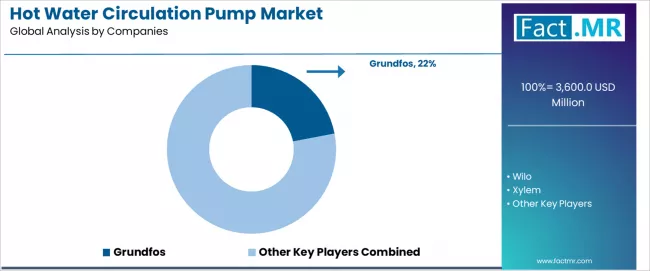
- Grundfos holds the strongest position with approximately 22.0% share, supported by the broadest circulator range, global distribution, ECM technology leadership, and strong brand recognition among plumbing professionals.
- Wilo and Xylem compete through energy-efficient portfolios, European depth, and digital connectivity, with Wilo particularly strong in the EU replacement circulator segment.
- KSB, Armstrong Fluid Technology, and Taco Comfort Solutions maintain positions in commercial and institutional systems where higher flow requirements and code compliance expertise shape selection.
The landscape is moderately concentrated, with Grundfos, Wilo, and Xylem commanding significant share through comprehensive circulator portfolios, installer relationships, and variable-speed ECM technology leadership.
In the domestic segment, Grundfos, Wilo, and Taco compete for installer specification through reliability, installation ease, and wholesale channel availability. Calpeda, Dab Pumps, and Ebara serve regional markets.
Strategic priorities include expanding smart connectivity, advancing ECM adoption in markets without ErP mandates, strengthening installer relationships, and developing compatibility with heat pump water heaters and energy management platforms.
Key Companies in the Hot Water Circulation Pump Market
- Grundfos, Wilo, Xylem, KSB are among the leading players in the hot water circulation pump market globally, supported by strong brand visibility, broad service portfolios, and growing positions in managed energy solutions.
- Armstrong Fluid, Taco Comfort, Calpeda, Ebara hold established positions across specific service segments, end-use categories, and regional markets, supported by specialized capabilities and established commercial relationships.
- Dab Pumps, Flowserve, Pedrollo, Bell & Gossett continue to compete through focused offerings, technology partnerships, and regional service networks.
Recent Industry Developments
- Grundfos, Product Enhancement, COMFORT and ALPHA Series (2025)
- Grundfos continued enhancement of its COMFORT domestic recirculation pump series and ALPHA circulator platform with improved efficiency and smart connectivity, reinforcing its position in the variable-speed domestic segment.
- Wilo, Market Expansion, Smart Pump Platform (2025)
- Wilo expanded its smart pump platform with connectivity and energy monitoring across European residential and commercial building applications, supporting demand for digitally connected circulation pumps.
- Xylem, Technology Integration, Connected Water Solutions (2025)
- Xylem advanced integration of connected water technology with circulation pump products, targeting commercial operators seeking data-driven water system management and predictive maintenance.
Leading Companies Shaping the Hot Water Circulation Pump Market
- Grundfos
- Wilo
- Xylem
- KSB
- Armstrong Fluid
- Taco Comfort
- Calpeda
- Ebara
- Dab Pumps
- Flowserve
Sources and Research References
- Grundfos. COMFORT and ALPHA circulator product updates.
- Wilo. Smart pump platform and residential circulator developments.
- Xylem. Connected water solutions and pump technology.
- European Commission. ErP Directive Lot 11 regulations.
- U.S. DOE. Water heater and plumbing efficiency standards.
- Primary interviews across manufacturers, distributors, contractors, and facility managers.
- This bibliography is provided for reader reference and is not exhaustive.
Key Questions This Report Addresses
- What is the current and future size of the Hot Water Circulation Pump Market?
- How fast is the Hot Water Circulation Pump Market expected to grow between 2026 and 2036?
- Which pump type leads the market by 2026?
- Which application accounts for the highest demand?
- What drives demand for hot water circulation pumps?
- How is variable-speed ECM technology influencing the market?
- Why is India the fastest-growing market?
- How are water conservation regulations supporting adoption?
- Which countries show the fastest growth through 2036?
- Who are the key companies in the Hot Water Circulation Pump Market?
- How does Fact.MR validate the forecast?
Hot Water Circulation Pump Market Definition
The hot water circulation pump market covers pumps for circulating heated water through residential, commercial, and industrial plumbing systems, including domestic recirculation, commercial centralized, and industrial circulation equipment.
Hot Water Circulation Pump Market Inclusions
- The scope covers global and regional market size and forecasts for 2026 to 2036 across product, pump type, power source, installation type, application, and region.
- It includes regional demand analysis based on construction activity, building codes, water conservation regulations, and energy efficiency mandates.
- The report includes pricing analysis across domestic and commercial categories, including variable-speed premium pricing and lifecycle cost comparisons.
- It covers technology trends, competitive landscape, product portfolios, and distribution networks of leading manufacturers.
Hot Water Circulation Pump Market Exclusions
- The scope excludes general-purpose water supply pumps, sewage pumps, industrial process pumps not designed for hot water circulation, and boiler feed pumps.
- It excludes water heaters, solar thermal collectors, and hydronic heating components sold separately from pump units.
- The report excludes pump accessories sold independently and industrial heat exchangers without dedicated circulation systems.
Hot Water Circulation Pump Market Research Methodology
- The methodology combines secondary research, primary interviews, and forecast modelling.
- It draws on 90+ secondary sources and benchmarks 40+ company product portfolios.
- Market sizing covers 30+ countries through a demand-side model supported by top-down validation.
- Key inputs include construction permits, commercial building activity, water heater installations, energy code updates, and pump replacement cycles.
- The model cross-checks with manufacturer shipments, distributor data, and plumbing permit activity.
- Primary validation includes 20+ interviews across pump manufacturers, distributors, HVAC contractors, and facility managers.
- Final estimates go through shipment reconciliation and sensitivity testing.
Scope of Analysis

| Parameter | Details |
|---|---|
| Quantitative Units | USD 3.719 billion to USD 5.145 billion, at a CAGR of 3.3% |
| Market Definition | The hot water circulation pump market covers pumps for circulating heated water through residential, commercial, and industrial plumbing systems. |
| Regions Covered | North America, Latin America, Europe, East Asia, South Asia and Pacific, Middle East and Africa |
| Countries Covered | India, China, Brazil, Germany, USA, South Korea, Japan, 30 plus countries |
| Key Companies | Grundfos, Wilo, Xylem, KSB, Armstrong Fluid, Taco Comfort, Calpeda, Ebara, Dab Pumps, Flowserve |
| Forecast Period | 2026 to 2036 |
| Approach | Hybrid demand-side and top-down methodology built on construction data, building codes, pump replacement cycles, manufacturer shipments, and primary interviews across manufacturers, distributors, contractors, and facility managers |
Hot Water Circulation Pump Market Segmentation
-
Hot Water Circulation Pump Market Segmented by Product:
- Domestic Hot Water Circulation Pumps
- Instant Hot Water Circulation Pumps
- On Demand Recirculation Pumps
- Comfort System Circulation Pumps
- Commercial Hot Water Circulation Pumps
- Centralized Recirculation Pumps
- High Capacity Circulation Pumps
- Continuous Duty Pumps
- Industrial Hot Water Circulation Pumps
- Process Water Circulation Pumps
- Boiler Feed Circulation Pumps
- High Temperature Circulation Pumps
- Smart Circulation Pumps
- Self Regulating Pumps
- Sensor Based Circulation Pumps
- Programmable Timer Pumps
- Inline Circulation Pumps
- Compact Inline Pumps
- Integrated Valve Pumps
- Domestic Hot Water Circulation Pumps
-
Hot Water Circulation Pump Market Segmented by Pump Type:
- Centrifugal Pumps
- Single Stage Centrifugal Pumps
- Multistage Centrifugal Pumps
- Wet Rotor Pumps
- Integrated Motor Pumps
- Sealless Wet Rotor Systems
- Dry Rotor Pumps
- External Motor Pumps
- High Efficiency Dry Rotor Systems
- Centrifugal Pumps
-
Hot Water Circulation Pump Market Segmented by Power Source:
- Electric Powered Pumps
- AC Powered Pumps
- DC Powered Pumps
- Solar Powered Pumps
- Standalone Solar Pumps
- Hybrid Solar Electric Pumps
- Electric Powered Pumps
-
Hot Water Circulation Pump Market Segmented by Installation Type:
- New Installation
- Residential New Construction
- Commercial Building Installation
- Industrial System Integration
- Retrofit Installation
- Residential Retrofit Systems
- Commercial Retrofit Projects
- New Installation
-
Hot Water Circulation Pump Market Segmented by Application:
- Residential
- Single Family Homes
- Multi Family Housing
- Commercial
- Hotels and Resorts
- Hospitals and Healthcare Facilities
- Office Buildings
- Industrial
- Manufacturing Plants
- Food Processing Facilities
- Power Generation Facilities
- Residential
-
Hot Water Circulation Pump Market by Region:
- North America
- USA
- Canada
- Mexico
- Latin America
- Brazil
- Chile
- Rest of Latin America
- Western Europe
- Germany
- UK
- Italy
- Spain
- France
- Nordic
- BENELUX
- Rest of Western Europe
- Eastern Europe
- Russia
- Poland
- Hungary
- Balkan & Baltic
- Rest of Eastern Europe
- East Asia
- China
- Japan
- South Korea
- South Asia and Pacific
- India
- ASEAN
- Australia & New Zealand
- Rest of South Asia and Pacific
- Middle East & Africa
- Kingdom of Saudi Arabia
- Other GCC Countries
- Turkiye
- South Africa
- Other African Union
- Rest of Middle East & Africa
- North America
- Frequently Asked Questions -
How big is the hot water circulation pump market in 2026?
The global hot water circulation pump market is estimated to be valued at USD 3.7 billion in 2026.
What will be the size of hot water circulation pump market in 2036?
The market size for the hot water circulation pump market is projected to reach USD 5.1 billion by 2036.
How much will be the hot water circulation pump market growth between 2026 and 2036?
The hot water circulation pump market is expected to grow at a 3.3% CAGR between 2026 and 2036.
What are the key product types in the hot water circulation pump market?
The key product types in hot water circulation pump market are domestic hot water circulation pumps, _instant hot water circulation pumps, _on demand recirculation pumps, _comfort system circulation pumps, commercial hot water circulation pumps, _centralized recirculation pumps, _high capacity circulation pumps, _continuous duty pumps, industrial hot water circulation pumps, _process water circulation pumps, _boiler feed circulation pumps, _high temperature circulation pumps, smart circulation pumps, _self regulating pumps, _sensor based circulation pumps, _programmable timer pumps, inline circulation pumps, _compact inline pumps and _integrated valve pumps.
Which pump type segment is expected to contribute significant share in the hot water circulation pump market in 2026?
In terms of pump type, centrifugal pumps segment is expected to command 42.6% share in the hot water circulation pump market in 2026.
Table of Content
- Executive Summary
- Global Market Outlook
- Demand to side Trends
- Supply to side Trends
- Technology Roadmap Analysis
- Analysis and Recommendations
- Market Overview
- Market Coverage / Taxonomy
- Market Definition / Scope / Limitations
- Research Methodology
- Chapter Orientation
- Analytical Lens and Working Hypotheses
- Market Structure, Signals, and Trend Drivers
- Benchmarking and Cross-market Comparability
- Market Sizing, Forecasting, and Opportunity Mapping
- Research Design and Evidence Framework
- Desk Research Programme (Secondary Evidence)
- Company Annual and Sustainability Reports
- Peer-reviewed Journals and Academic Literature
- Corporate Websites, Product Literature, and Technical Notes
- Earnings Decks and Investor Briefings
- Statutory Filings and Regulatory Disclosures
- Technical White Papers and Standards Notes
- Trade Journals, Industry Magazines, and Analyst Briefs
- Conference Proceedings, Webinars, and Seminar Materials
- Government Statistics Portals and Public Data Releases
- Press Releases and Reputable Media Coverage
- Specialist Newsletters and Curated Briefings
- Sector Databases and Reference Repositories
- Fact.MR Internal Proprietary Databases and Historical Market Datasets
- Subscription Datasets and Paid Sources
- Social Channels, Communities, and Digital Listening Inputs
- Additional Desk Sources
- Expert Input and Fieldwork (Primary Evidence)
- Primary Modes
- Qualitative Interviews and Expert Elicitation
- Quantitative Surveys and Structured Data Capture
- Blended Approach
- Why Primary Evidence is Used
- Field Techniques
- Interviews
- Surveys
- Focus Groups
- Observational and In-context Research
- Social and Community Interactions
- Stakeholder Universe Engaged
- C-suite Leaders
- Board Members
- Presidents and Vice Presidents
- R&D and Innovation Heads
- Technical Specialists
- Domain Subject-matter Experts
- Scientists
- Physicians and Other Healthcare Professionals
- Governance, Ethics, and Data Stewardship
- Research Ethics
- Data Integrity and Handling
- Primary Modes
- Tooling, Models, and Reference Databases
- Desk Research Programme (Secondary Evidence)
- Data Engineering and Model Build
- Data Acquisition and Ingestion
- Cleaning, Normalisation, and Verification
- Synthesis, Triangulation, and Analysis
- Quality Assurance and Audit Trail
- Market Background
- Market Dynamics
- Drivers
- Restraints
- Opportunity
- Trends
- Scenario Forecast
- Demand in Optimistic Scenario
- Demand in Likely Scenario
- Demand in Conservative Scenario
- Opportunity Map Analysis
- Product Life Cycle Analysis
- Supply Chain Analysis
- Investment Feasibility Matrix
- Value Chain Analysis
- PESTLE and Porter’s Analysis
- Regulatory Landscape
- Regional Parent Market Outlook
- Production and Consumption Statistics
- Import and Export Statistics
- Market Dynamics
- Global Market Analysis 2021 to 2025 and Forecast, 2026 to 2036
- Historical Market Size Value (USD Million) Analysis, 2021 to 2025
- Current and Future Market Size Value (USD Million) Projections, 2026 to 2036
- Y to o to Y Growth Trend Analysis
- Absolute $ Opportunity Analysis
- Global Market Pricing Analysis 2021 to 2025 and Forecast 2026 to 2036
- Global Market Analysis 2021 to 2025 and Forecast 2026 to 2036, By Product
- Introduction / Key Findings
- Historical Market Size Value (USD Million) Analysis By Product, 2021 to 2025
- Current and Future Market Size Value (USD Million) Analysis and Forecast By Product, 2026 to 2036
- Domestic Hot Water Circulation Pumps
- Instant Hot Water Circulation Pumps
- On Demand Recirculation Pumps
- Comfort System Circulation Pumps
- Commercial Hot Water Circulation Pumps
- Centralized Recirculation Pumps
- High Capacity Circulation Pumps
- Continuous Duty Pumps
- Industrial Hot Water Circulation Pumps
- Process Water Circulation Pumps
- Boiler Feed Circulation Pumps
- High Temperature Circulation Pumps
- Smart Circulation Pumps
- Self Regulating Pumps
- Sensor Based Circulation Pumps
- Programmable Timer Pumps
- Inline Circulation Pumps
- Compact Inline Pumps
- Integrated Valve Pumps
- Domestic Hot Water Circulation Pumps
- Y to o to Y Growth Trend Analysis By Product, 2021 to 2025
- Absolute $ Opportunity Analysis By Product, 2026 to 2036
- Global Market Analysis 2021 to 2025 and Forecast 2026 to 2036, By Pump Type
- Introduction / Key Findings
- Historical Market Size Value (USD Million) Analysis By Pump Type, 2021 to 2025
- Current and Future Market Size Value (USD Million) Analysis and Forecast By Pump Type, 2026 to 2036
- Centrifugal Pumps
- Single Stage Centrifugal Pumps
- Multistage Centrifugal Pumps
- Wet Rotor Pumps
- Integrated Motor Pumps
- Sealless Wet Rotor Systems
- Dry Rotor Pumps
- External Motor Pumps
- High Efficiency Dry Rotor Systems
- Centrifugal Pumps
- Y to o to Y Growth Trend Analysis By Pump Type, 2021 to 2025
- Absolute $ Opportunity Analysis By Pump Type, 2026 to 2036
- Global Market Analysis 2021 to 2025 and Forecast 2026 to 2036, By Power Source
- Introduction / Key Findings
- Historical Market Size Value (USD Million) Analysis By Power Source, 2021 to 2025
- Current and Future Market Size Value (USD Million) Analysis and Forecast By Power Source, 2026 to 2036
- Electric Powered Pumps
- AC Powered Pumps
- DC Powered Pumps
- Solar Powered Pumps
- Standalone Solar Pumps
- Hybrid Solar Electric Pumps
- Electric Powered Pumps
- Y to o to Y Growth Trend Analysis By Power Source, 2021 to 2025
- Absolute $ Opportunity Analysis By Power Source, 2026 to 2036
- Global Market Analysis 2021 to 2025 and Forecast 2026 to 2036, By Installation Type
- Introduction / Key Findings
- Historical Market Size Value (USD Million) Analysis By Installation Type, 2021 to 2025
- Current and Future Market Size Value (USD Million) Analysis and Forecast By Installation Type, 2026 to 2036
- New Installation
- Residential New Construction
- Commercial Building Installation
- Industrial System Integration
- Retrofit Installation
- Residential Retrofit Systems
- Commercial Retrofit Projects
- New Installation
- Y to o to Y Growth Trend Analysis By Installation Type, 2021 to 2025
- Absolute $ Opportunity Analysis By Installation Type, 2026 to 2036
- Global Market Analysis 2021 to 2025 and Forecast 2026 to 2036, By Application
- Introduction / Key Findings
- Historical Market Size Value (USD Million) Analysis By Application, 2021 to 2025
- Current and Future Market Size Value (USD Million) Analysis and Forecast By Application, 2026 to 2036
- Residential
- Single Family Homes
- Multi Family Housing
- Commercial
- Hotels and Resorts
- Hospitals and Healthcare Facilities
- Office Buildings
- Industrial
- Manufacturing Plants
- Food Processing Facilities
- Power Generation Facilities
- Residential
- Y to o to Y Growth Trend Analysis By Application, 2021 to 2025
- Absolute $ Opportunity Analysis By Application, 2026 to 2036
- Global Market Analysis 2021 to 2025 and Forecast 2026 to 2036, By Region
- Introduction
- Historical Market Size Value (USD Million) Analysis By Region, 2021 to 2025
- Current Market Size Value (USD Million) Analysis and Forecast By Region, 2026 to 2036
- North America
- Latin America
- Western Europe
- Eastern Europe
- East Asia
- South Asia and Pacific
- Middle East & Africa
- Market Attractiveness Analysis By Region
- North America Market Analysis 2021 to 2025 and Forecast 2026 to 2036, By Country
- Historical Market Size Value (USD Million) Trend Analysis By Market Taxonomy, 2021 to 2025
- Market Size Value (USD Million) Forecast By Market Taxonomy, 2026 to 2036
- By Country
- USA
- Canada
- Mexico
- By Product
- By Pump Type
- By Power Source
- By Installation Type
- By Application
- By Country
- Market Attractiveness Analysis
- By Country
- By Product
- By Pump Type
- By Power Source
- By Installation Type
- By Application
- Key Takeaways
- Latin America Market Analysis 2021 to 2025 and Forecast 2026 to 2036, By Country
- Historical Market Size Value (USD Million) Trend Analysis By Market Taxonomy, 2021 to 2025
- Market Size Value (USD Million) Forecast By Market Taxonomy, 2026 to 2036
- By Country
- Brazil
- Chile
- Rest of Latin America
- By Product
- By Pump Type
- By Power Source
- By Installation Type
- By Application
- By Country
- Market Attractiveness Analysis
- By Country
- By Product
- By Pump Type
- By Power Source
- By Installation Type
- By Application
- Key Takeaways
- Western Europe Market Analysis 2021 to 2025 and Forecast 2026 to 2036, By Country
- Historical Market Size Value (USD Million) Trend Analysis By Market Taxonomy, 2021 to 2025
- Market Size Value (USD Million) Forecast By Market Taxonomy, 2026 to 2036
- By Country
- Germany
- UK
- Italy
- Spain
- France
- Nordic
- BENELUX
- Rest of Western Europe
- By Product
- By Pump Type
- By Power Source
- By Installation Type
- By Application
- By Country
- Market Attractiveness Analysis
- By Country
- By Product
- By Pump Type
- By Power Source
- By Installation Type
- By Application
- Key Takeaways
- Eastern Europe Market Analysis 2021 to 2025 and Forecast 2026 to 2036, By Country
- Historical Market Size Value (USD Million) Trend Analysis By Market Taxonomy, 2021 to 2025
- Market Size Value (USD Million) Forecast By Market Taxonomy, 2026 to 2036
- By Country
- Russia
- Poland
- Hungary
- Balkan & Baltic
- Rest of Eastern Europe
- By Product
- By Pump Type
- By Power Source
- By Installation Type
- By Application
- By Country
- Market Attractiveness Analysis
- By Country
- By Product
- By Pump Type
- By Power Source
- By Installation Type
- By Application
- Key Takeaways
- East Asia Market Analysis 2021 to 2025 and Forecast 2026 to 2036, By Country
- Historical Market Size Value (USD Million) Trend Analysis By Market Taxonomy, 2021 to 2025
- Market Size Value (USD Million) Forecast By Market Taxonomy, 2026 to 2036
- By Country
- China
- Japan
- South Korea
- By Product
- By Pump Type
- By Power Source
- By Installation Type
- By Application
- By Country
- Market Attractiveness Analysis
- By Country
- By Product
- By Pump Type
- By Power Source
- By Installation Type
- By Application
- Key Takeaways
- South Asia and Pacific Market Analysis 2021 to 2025 and Forecast 2026 to 2036, By Country
- Historical Market Size Value (USD Million) Trend Analysis By Market Taxonomy, 2021 to 2025
- Market Size Value (USD Million) Forecast By Market Taxonomy, 2026 to 2036
- By Country
- India
- ASEAN
- Australia & New Zealand
- Rest of South Asia and Pacific
- By Product
- By Pump Type
- By Power Source
- By Installation Type
- By Application
- By Country
- Market Attractiveness Analysis
- By Country
- By Product
- By Pump Type
- By Power Source
- By Installation Type
- By Application
- Key Takeaways
- Middle East & Africa Market Analysis 2021 to 2025 and Forecast 2026 to 2036, By Country
- Historical Market Size Value (USD Million) Trend Analysis By Market Taxonomy, 2021 to 2025
- Market Size Value (USD Million) Forecast By Market Taxonomy, 2026 to 2036
- By Country
- Kingdom of Saudi Arabia
- Other GCC Countries
- Turkiye
- South Africa
- Other African Union
- Rest of Middle East & Africa
- By Product
- By Pump Type
- By Power Source
- By Installation Type
- By Application
- By Country
- Market Attractiveness Analysis
- By Country
- By Product
- By Pump Type
- By Power Source
- By Installation Type
- By Application
- Key Takeaways
- Key Countries Market Analysis
- USA
- Pricing Analysis
- Market Share Analysis, 2025
- By Product
- By Pump Type
- By Power Source
- By Installation Type
- By Application
- Canada
- Pricing Analysis
- Market Share Analysis, 2025
- By Product
- By Pump Type
- By Power Source
- By Installation Type
- By Application
- Mexico
- Pricing Analysis
- Market Share Analysis, 2025
- By Product
- By Pump Type
- By Power Source
- By Installation Type
- By Application
- Brazil
- Pricing Analysis
- Market Share Analysis, 2025
- By Product
- By Pump Type
- By Power Source
- By Installation Type
- By Application
- Chile
- Pricing Analysis
- Market Share Analysis, 2025
- By Product
- By Pump Type
- By Power Source
- By Installation Type
- By Application
- Germany
- Pricing Analysis
- Market Share Analysis, 2025
- By Product
- By Pump Type
- By Power Source
- By Installation Type
- By Application
- UK
- Pricing Analysis
- Market Share Analysis, 2025
- By Product
- By Pump Type
- By Power Source
- By Installation Type
- By Application
- Italy
- Pricing Analysis
- Market Share Analysis, 2025
- By Product
- By Pump Type
- By Power Source
- By Installation Type
- By Application
- Spain
- Pricing Analysis
- Market Share Analysis, 2025
- By Product
- By Pump Type
- By Power Source
- By Installation Type
- By Application
- France
- Pricing Analysis
- Market Share Analysis, 2025
- By Product
- By Pump Type
- By Power Source
- By Installation Type
- By Application
- India
- Pricing Analysis
- Market Share Analysis, 2025
- By Product
- By Pump Type
- By Power Source
- By Installation Type
- By Application
- ASEAN
- Pricing Analysis
- Market Share Analysis, 2025
- By Product
- By Pump Type
- By Power Source
- By Installation Type
- By Application
- Australia & New Zealand
- Pricing Analysis
- Market Share Analysis, 2025
- By Product
- By Pump Type
- By Power Source
- By Installation Type
- By Application
- China
- Pricing Analysis
- Market Share Analysis, 2025
- By Product
- By Pump Type
- By Power Source
- By Installation Type
- By Application
- Japan
- Pricing Analysis
- Market Share Analysis, 2025
- By Product
- By Pump Type
- By Power Source
- By Installation Type
- By Application
- South Korea
- Pricing Analysis
- Market Share Analysis, 2025
- By Product
- By Pump Type
- By Power Source
- By Installation Type
- By Application
- Russia
- Pricing Analysis
- Market Share Analysis, 2025
- By Product
- By Pump Type
- By Power Source
- By Installation Type
- By Application
- Poland
- Pricing Analysis
- Market Share Analysis, 2025
- By Product
- By Pump Type
- By Power Source
- By Installation Type
- By Application
- Hungary
- Pricing Analysis
- Market Share Analysis, 2025
- By Product
- By Pump Type
- By Power Source
- By Installation Type
- By Application
- Kingdom of Saudi Arabia
- Pricing Analysis
- Market Share Analysis, 2025
- By Product
- By Pump Type
- By Power Source
- By Installation Type
- By Application
- Turkiye
- Pricing Analysis
- Market Share Analysis, 2025
- By Product
- By Pump Type
- By Power Source
- By Installation Type
- By Application
- South Africa
- Pricing Analysis
- Market Share Analysis, 2025
- By Product
- By Pump Type
- By Power Source
- By Installation Type
- By Application
- USA
- Market Structure Analysis
- Competition Dashboard
- Competition Benchmarking
- Market Share Analysis of Top Players
- By Regional
- By Product
- By Pump Type
- By Power Source
- By Installation Type
- By Application
- Competition Analysis
- Competition Deep Dive
- Grundfos
- Overview
- Product Portfolio
- Profitability by Market Segments (Product/Age /Sales Channel/Region)
- Sales Footprint
- Strategy Overview
- Marketing Strategy
- Product Strategy
- Channel Strategy
- Wilo
- Xylem
- KSB
- Armstrong Fluid
- Taco Comfort
- Calpeda
- Ebara
- Dab Pumps
- Flowserve
- Pedrollo
- Bell & Gossett
- Lowara
- Pentair
- Kirloskar Brothers
- Grundfos
- Competition Deep Dive
- Assumptions & Acronyms Used
List Of Table
- Table 1: Global Market Value (USD Million) Forecast by Region, 2021 to 2036
- Table 2: Global Market Value (USD Million) Forecast by Product, 2021 to 2036
- Table 3: Global Market Value (USD Million) Forecast by Pump Type, 2021 to 2036
- Table 4: Global Market Value (USD Million) Forecast by Power Source, 2021 to 2036
- Table 5: Global Market Value (USD Million) Forecast by Installation Type, 2021 to 2036
- Table 6: Global Market Value (USD Million) Forecast by Application, 2021 to 2036
- Table 7: North America Market Value (USD Million) Forecast by Country, 2021 to 2036
- Table 8: North America Market Value (USD Million) Forecast by Product, 2021 to 2036
- Table 9: North America Market Value (USD Million) Forecast by Pump Type, 2021 to 2036
- Table 10: North America Market Value (USD Million) Forecast by Power Source, 2021 to 2036
- Table 11: North America Market Value (USD Million) Forecast by Installation Type, 2021 to 2036
- Table 12: North America Market Value (USD Million) Forecast by Application, 2021 to 2036
- Table 13: Latin America Market Value (USD Million) Forecast by Country, 2021 to 2036
- Table 14: Latin America Market Value (USD Million) Forecast by Product, 2021 to 2036
- Table 15: Latin America Market Value (USD Million) Forecast by Pump Type, 2021 to 2036
- Table 16: Latin America Market Value (USD Million) Forecast by Power Source, 2021 to 2036
- Table 17: Latin America Market Value (USD Million) Forecast by Installation Type, 2021 to 2036
- Table 18: Latin America Market Value (USD Million) Forecast by Application, 2021 to 2036
- Table 19: Western Europe Market Value (USD Million) Forecast by Country, 2021 to 2036
- Table 20: Western Europe Market Value (USD Million) Forecast by Product, 2021 to 2036
- Table 21: Western Europe Market Value (USD Million) Forecast by Pump Type, 2021 to 2036
- Table 22: Western Europe Market Value (USD Million) Forecast by Power Source, 2021 to 2036
- Table 23: Western Europe Market Value (USD Million) Forecast by Installation Type, 2021 to 2036
- Table 24: Western Europe Market Value (USD Million) Forecast by Application, 2021 to 2036
- Table 25: Eastern Europe Market Value (USD Million) Forecast by Country, 2021 to 2036
- Table 26: Eastern Europe Market Value (USD Million) Forecast by Product, 2021 to 2036
- Table 27: Eastern Europe Market Value (USD Million) Forecast by Pump Type, 2021 to 2036
- Table 28: Eastern Europe Market Value (USD Million) Forecast by Power Source, 2021 to 2036
- Table 29: Eastern Europe Market Value (USD Million) Forecast by Installation Type, 2021 to 2036
- Table 30: Eastern Europe Market Value (USD Million) Forecast by Application, 2021 to 2036
- Table 31: East Asia Market Value (USD Million) Forecast by Country, 2021 to 2036
- Table 32: East Asia Market Value (USD Million) Forecast by Product, 2021 to 2036
- Table 33: East Asia Market Value (USD Million) Forecast by Pump Type, 2021 to 2036
- Table 34: East Asia Market Value (USD Million) Forecast by Power Source, 2021 to 2036
- Table 35: East Asia Market Value (USD Million) Forecast by Installation Type, 2021 to 2036
- Table 36: East Asia Market Value (USD Million) Forecast by Application, 2021 to 2036
- Table 37: South Asia and Pacific Market Value (USD Million) Forecast by Country, 2021 to 2036
- Table 38: South Asia and Pacific Market Value (USD Million) Forecast by Product, 2021 to 2036
- Table 39: South Asia and Pacific Market Value (USD Million) Forecast by Pump Type, 2021 to 2036
- Table 40: South Asia and Pacific Market Value (USD Million) Forecast by Power Source, 2021 to 2036
- Table 41: South Asia and Pacific Market Value (USD Million) Forecast by Installation Type, 2021 to 2036
- Table 42: South Asia and Pacific Market Value (USD Million) Forecast by Application, 2021 to 2036
- Table 43: Middle East & Africa Market Value (USD Million) Forecast by Country, 2021 to 2036
- Table 44: Middle East & Africa Market Value (USD Million) Forecast by Product, 2021 to 2036
- Table 45: Middle East & Africa Market Value (USD Million) Forecast by Pump Type, 2021 to 2036
- Table 46: Middle East & Africa Market Value (USD Million) Forecast by Power Source, 2021 to 2036
- Table 47: Middle East & Africa Market Value (USD Million) Forecast by Installation Type, 2021 to 2036
- Table 48: Middle East & Africa Market Value (USD Million) Forecast by Application, 2021 to 2036
List Of Figures
- Figure 1: Global Market Pricing Analysis
- Figure 2: Global Market Value (USD Million) Forecast 2021 to 2036
- Figure 3: Global Market Value Share and BPS Analysis by Product, 2026 and 2036
- Figure 4: Global Market Y-o-Y Growth Comparison by Product, 2026 to 2036
- Figure 5: Global Market Attractiveness Analysis by Product
- Figure 6: Global Market Value Share and BPS Analysis by Pump Type, 2026 and 2036
- Figure 7: Global Market Y-o-Y Growth Comparison by Pump Type, 2026 to 2036
- Figure 8: Global Market Attractiveness Analysis by Pump Type
- Figure 9: Global Market Value Share and BPS Analysis by Power Source, 2026 and 2036
- Figure 10: Global Market Y-o-Y Growth Comparison by Power Source, 2026 to 2036
- Figure 11: Global Market Attractiveness Analysis by Power Source
- Figure 12: Global Market Value Share and BPS Analysis by Installation Type, 2026 and 2036
- Figure 13: Global Market Y-o-Y Growth Comparison by Installation Type, 2026 to 2036
- Figure 14: Global Market Attractiveness Analysis by Installation Type
- Figure 15: Global Market Value Share and BPS Analysis by Application, 2026 and 2036
- Figure 16: Global Market Y-o-Y Growth Comparison by Application, 2026 to 2036
- Figure 17: Global Market Attractiveness Analysis by Application
- Figure 18: Global Market Value (USD Million) Share and BPS Analysis by Region, 2026 and 2036
- Figure 19: Global Market Y-o-Y Growth Comparison by Region, 2026 to 2036
- Figure 20: Global Market Attractiveness Analysis by Region
- Figure 21: North America Market Incremental Dollar Opportunity, 2026 to 2036
- Figure 22: Latin America Market Incremental Dollar Opportunity, 2026 to 2036
- Figure 23: Western Europe Market Incremental Dollar Opportunity, 2026 to 2036
- Figure 24: Eastern Europe Market Incremental Dollar Opportunity, 2026 to 2036
- Figure 25: East Asia Market Incremental Dollar Opportunity, 2026 to 2036
- Figure 26: South Asia and Pacific Market Incremental Dollar Opportunity, 2026 to 2036
- Figure 27: Middle East & Africa Market Incremental Dollar Opportunity, 2026 to 2036
- Figure 28: North America Market Value Share and BPS Analysis by Country, 2026 and 2036
- Figure 29: North America Market Value Share and BPS Analysis by Product, 2026 and 2036
- Figure 30: North America Market Y-o-Y Growth Comparison by Product, 2026 to 2036
- Figure 31: North America Market Attractiveness Analysis by Product
- Figure 32: North America Market Value Share and BPS Analysis by Pump Type, 2026 and 2036
- Figure 33: North America Market Y-o-Y Growth Comparison by Pump Type, 2026 to 2036
- Figure 34: North America Market Attractiveness Analysis by Pump Type
- Figure 35: North America Market Value Share and BPS Analysis by Power Source, 2026 and 2036
- Figure 36: North America Market Y-o-Y Growth Comparison by Power Source, 2026 to 2036
- Figure 37: North America Market Attractiveness Analysis by Power Source
- Figure 38: North America Market Value Share and BPS Analysis by Installation Type, 2026 and 2036
- Figure 39: North America Market Y-o-Y Growth Comparison by Installation Type, 2026 to 2036
- Figure 40: North America Market Attractiveness Analysis by Installation Type
- Figure 41: North America Market Value Share and BPS Analysis by Application, 2026 and 2036
- Figure 42: North America Market Y-o-Y Growth Comparison by Application, 2026 to 2036
- Figure 43: North America Market Attractiveness Analysis by Application
- Figure 44: Latin America Market Value Share and BPS Analysis by Country, 2026 and 2036
- Figure 45: Latin America Market Value Share and BPS Analysis by Product, 2026 and 2036
- Figure 46: Latin America Market Y-o-Y Growth Comparison by Product, 2026 to 2036
- Figure 47: Latin America Market Attractiveness Analysis by Product
- Figure 48: Latin America Market Value Share and BPS Analysis by Pump Type, 2026 and 2036
- Figure 49: Latin America Market Y-o-Y Growth Comparison by Pump Type, 2026 to 2036
- Figure 50: Latin America Market Attractiveness Analysis by Pump Type
- Figure 51: Latin America Market Value Share and BPS Analysis by Power Source, 2026 and 2036
- Figure 52: Latin America Market Y-o-Y Growth Comparison by Power Source, 2026 to 2036
- Figure 53: Latin America Market Attractiveness Analysis by Power Source
- Figure 54: Latin America Market Value Share and BPS Analysis by Installation Type, 2026 and 2036
- Figure 55: Latin America Market Y-o-Y Growth Comparison by Installation Type, 2026 to 2036
- Figure 56: Latin America Market Attractiveness Analysis by Installation Type
- Figure 57: Latin America Market Value Share and BPS Analysis by Application, 2026 and 2036
- Figure 58: Latin America Market Y-o-Y Growth Comparison by Application, 2026 to 2036
- Figure 59: Latin America Market Attractiveness Analysis by Application
- Figure 60: Western Europe Market Value Share and BPS Analysis by Country, 2026 and 2036
- Figure 61: Western Europe Market Value Share and BPS Analysis by Product, 2026 and 2036
- Figure 62: Western Europe Market Y-o-Y Growth Comparison by Product, 2026 to 2036
- Figure 63: Western Europe Market Attractiveness Analysis by Product
- Figure 64: Western Europe Market Value Share and BPS Analysis by Pump Type, 2026 and 2036
- Figure 65: Western Europe Market Y-o-Y Growth Comparison by Pump Type, 2026 to 2036
- Figure 66: Western Europe Market Attractiveness Analysis by Pump Type
- Figure 67: Western Europe Market Value Share and BPS Analysis by Power Source, 2026 and 2036
- Figure 68: Western Europe Market Y-o-Y Growth Comparison by Power Source, 2026 to 2036
- Figure 69: Western Europe Market Attractiveness Analysis by Power Source
- Figure 70: Western Europe Market Value Share and BPS Analysis by Installation Type, 2026 and 2036
- Figure 71: Western Europe Market Y-o-Y Growth Comparison by Installation Type, 2026 to 2036
- Figure 72: Western Europe Market Attractiveness Analysis by Installation Type
- Figure 73: Western Europe Market Value Share and BPS Analysis by Application, 2026 and 2036
- Figure 74: Western Europe Market Y-o-Y Growth Comparison by Application, 2026 to 2036
- Figure 75: Western Europe Market Attractiveness Analysis by Application
- Figure 76: Eastern Europe Market Value Share and BPS Analysis by Country, 2026 and 2036
- Figure 77: Eastern Europe Market Value Share and BPS Analysis by Product, 2026 and 2036
- Figure 78: Eastern Europe Market Y-o-Y Growth Comparison by Product, 2026 to 2036
- Figure 79: Eastern Europe Market Attractiveness Analysis by Product
- Figure 80: Eastern Europe Market Value Share and BPS Analysis by Pump Type, 2026 and 2036
- Figure 81: Eastern Europe Market Y-o-Y Growth Comparison by Pump Type, 2026 to 2036
- Figure 82: Eastern Europe Market Attractiveness Analysis by Pump Type
- Figure 83: Eastern Europe Market Value Share and BPS Analysis by Power Source, 2026 and 2036
- Figure 84: Eastern Europe Market Y-o-Y Growth Comparison by Power Source, 2026 to 2036
- Figure 85: Eastern Europe Market Attractiveness Analysis by Power Source
- Figure 86: Eastern Europe Market Value Share and BPS Analysis by Installation Type, 2026 and 2036
- Figure 87: Eastern Europe Market Y-o-Y Growth Comparison by Installation Type, 2026 to 2036
- Figure 88: Eastern Europe Market Attractiveness Analysis by Installation Type
- Figure 89: Eastern Europe Market Value Share and BPS Analysis by Application, 2026 and 2036
- Figure 90: Eastern Europe Market Y-o-Y Growth Comparison by Application, 2026 to 2036
- Figure 91: Eastern Europe Market Attractiveness Analysis by Application
- Figure 92: East Asia Market Value Share and BPS Analysis by Country, 2026 and 2036
- Figure 93: East Asia Market Value Share and BPS Analysis by Product, 2026 and 2036
- Figure 94: East Asia Market Y-o-Y Growth Comparison by Product, 2026 to 2036
- Figure 95: East Asia Market Attractiveness Analysis by Product
- Figure 96: East Asia Market Value Share and BPS Analysis by Pump Type, 2026 and 2036
- Figure 97: East Asia Market Y-o-Y Growth Comparison by Pump Type, 2026 to 2036
- Figure 98: East Asia Market Attractiveness Analysis by Pump Type
- Figure 99: East Asia Market Value Share and BPS Analysis by Power Source, 2026 and 2036
- Figure 100: East Asia Market Y-o-Y Growth Comparison by Power Source, 2026 to 2036
- Figure 101: East Asia Market Attractiveness Analysis by Power Source
- Figure 102: East Asia Market Value Share and BPS Analysis by Installation Type, 2026 and 2036
- Figure 103: East Asia Market Y-o-Y Growth Comparison by Installation Type, 2026 to 2036
- Figure 104: East Asia Market Attractiveness Analysis by Installation Type
- Figure 105: East Asia Market Value Share and BPS Analysis by Application, 2026 and 2036
- Figure 106: East Asia Market Y-o-Y Growth Comparison by Application, 2026 to 2036
- Figure 107: East Asia Market Attractiveness Analysis by Application
- Figure 108: South Asia and Pacific Market Value Share and BPS Analysis by Country, 2026 and 2036
- Figure 109: South Asia and Pacific Market Value Share and BPS Analysis by Product, 2026 and 2036
- Figure 110: South Asia and Pacific Market Y-o-Y Growth Comparison by Product, 2026 to 2036
- Figure 111: South Asia and Pacific Market Attractiveness Analysis by Product
- Figure 112: South Asia and Pacific Market Value Share and BPS Analysis by Pump Type, 2026 and 2036
- Figure 113: South Asia and Pacific Market Y-o-Y Growth Comparison by Pump Type, 2026 to 2036
- Figure 114: South Asia and Pacific Market Attractiveness Analysis by Pump Type
- Figure 115: South Asia and Pacific Market Value Share and BPS Analysis by Power Source, 2026 and 2036
- Figure 116: South Asia and Pacific Market Y-o-Y Growth Comparison by Power Source, 2026 to 2036
- Figure 117: South Asia and Pacific Market Attractiveness Analysis by Power Source
- Figure 118: South Asia and Pacific Market Value Share and BPS Analysis by Installation Type, 2026 and 2036
- Figure 119: South Asia and Pacific Market Y-o-Y Growth Comparison by Installation Type, 2026 to 2036
- Figure 120: South Asia and Pacific Market Attractiveness Analysis by Installation Type
- Figure 121: South Asia and Pacific Market Value Share and BPS Analysis by Application, 2026 and 2036
- Figure 122: South Asia and Pacific Market Y-o-Y Growth Comparison by Application, 2026 to 2036
- Figure 123: South Asia and Pacific Market Attractiveness Analysis by Application
- Figure 124: Middle East & Africa Market Value Share and BPS Analysis by Country, 2026 and 2036
- Figure 125: Middle East & Africa Market Value Share and BPS Analysis by Product, 2026 and 2036
- Figure 126: Middle East & Africa Market Y-o-Y Growth Comparison by Product, 2026 to 2036
- Figure 127: Middle East & Africa Market Attractiveness Analysis by Product
- Figure 128: Middle East & Africa Market Value Share and BPS Analysis by Pump Type, 2026 and 2036
- Figure 129: Middle East & Africa Market Y-o-Y Growth Comparison by Pump Type, 2026 to 2036
- Figure 130: Middle East & Africa Market Attractiveness Analysis by Pump Type
- Figure 131: Middle East & Africa Market Value Share and BPS Analysis by Power Source, 2026 and 2036
- Figure 132: Middle East & Africa Market Y-o-Y Growth Comparison by Power Source, 2026 to 2036
- Figure 133: Middle East & Africa Market Attractiveness Analysis by Power Source
- Figure 134: Middle East & Africa Market Value Share and BPS Analysis by Installation Type, 2026 and 2036
- Figure 135: Middle East & Africa Market Y-o-Y Growth Comparison by Installation Type, 2026 to 2036
- Figure 136: Middle East & Africa Market Attractiveness Analysis by Installation Type
- Figure 137: Middle East & Africa Market Value Share and BPS Analysis by Application, 2026 and 2036
- Figure 138: Middle East & Africa Market Y-o-Y Growth Comparison by Application, 2026 to 2036
- Figure 139: Middle East & Africa Market Attractiveness Analysis by Application
- Figure 140: Global Market - Tier Structure Analysis
- Figure 141: Global Market - Company Share Analysis