- Base Value(2025): 28.2 Bn
- Estimated Value(2025): 28.2 Bn
- Forecast Value (2035): 77.5 Bn
- CAGR (2025 - 2035): 10.7%
Demand for Controlled Release Drug Delivery in USA 2025 to 2035
Demand for controlled release drug delivery in the USA is projected to grow from USD 28.16 billion in 2025 to approximately USD 77.48 billion by 2035, recording an absolute increase of USD 49.32 billion over the forecast period. This translates into a total growth of 175.1%, with demand forecast to expand at a compound annual growth rate (CAGR) of 10.7% between 2025 and 2035.
Quick Stats for USA Controlled Release Drug Delivery Industry
- USA Controlled Release Drug Delivery Sales Value (2025): USD 28.16 billion
- USA Controlled Release Drug Delivery Forecast Value (2035): USD 77.48 billion
- USA Controlled Release Drug Delivery Forecast CAGR: 10.7%
- Leading Technology in USA Controlled Release Drug Delivery Industry: Targeted Delivery (26.3%)
- Key Growth Regions in USA Controlled Release Drug Delivery Industry: West, Northeast, South, Midwest
- Regional Leadership: West holds the leading position in demand
- Key Players in USA Controlled Release Drug Delivery Industry: Johnson & Johnson, Pfizer Inc., Merck & Co. Inc., AbbVie Inc., Novartis AG, Bayer AG, AstraZeneca plc, Corium International Inc., Alkermes plc, Amneal Pharmaceuticals
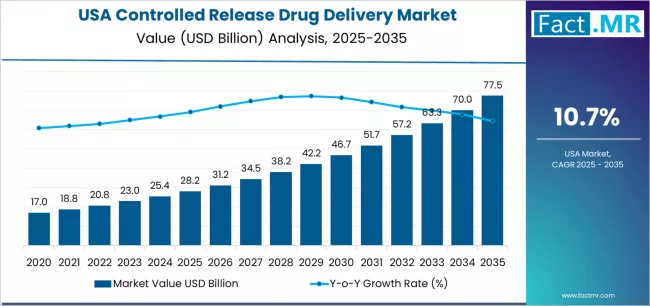
Usa Controlled Release Drug Delivery Market Market Value Analysis | Source: Fact.MR
The scope for controlled drug release drug delivery in USA is expected to grow by nearly 2.8 times during the same period, supported by increasing chronic disease prevalence, growing emphasis on patient adherence and therapeutic outcomes, rising investment in biopharmaceutical development, and expanding precision medicine applications throughout the USA.
The targeted delivery segment is projected to account for 26.3% of controlled release drug delivery demand in 2025. Targeted delivery applications are widely used in the USA for oncology treatments, cardiovascular therapies, and neurological applications where superior therapeutic precision, established bioavailability profiles, and proven clinical efficacy remain essential for patient care optimization and treatment implementations.
The oral controlled drug delivery segment is expected to represent 34.8% of controlled release drug delivery demand in 2025. Oral controlled applications are fundamental to the industry because they provide the patient convenience benefits, established dosing profiles, and formulation flexibility required for large-scale chronic disease management and pharmaceutical applications.
Between 2020 and 2025, controlled release drug delivery demand in the USA experienced steady expansion, driven by increasing awareness of adherence challenges and growing recognition of advanced therapeutic delivery benefits for patient outcomes and treatment optimization.
The sector developed as pharmaceutical manufacturers and healthcare providers, especially in major metropolitan centers, recognized the need for reliable dosing solutions and effective therapeutic systems to achieve clinical objectives while meeting regulatory standards and performance requirements. Drug companies and healthcare facilities began emphasizing formulation optimization and patient acceptance to maintain competitive advantages and clinical viability.
Between 2025 and 2030, demand for controlled release drug delivery in the USA is projected to expand from USD 28.16 billion to USD 43.98 billion, resulting in a value increase of USD 15.82 billion, which represents 32.1% of the total forecast growth for the decade. This phase of growth will be shaped by accelerating biopharmaceutical development campaigns, rising precision medicine investment, and growing therapeutic requirements for advanced formulations across key regions, particularly in areas where advanced healthcare infrastructure and pharmaceutical advancement initiatives are accelerating controlled release adoption. Increasing integration of automated technology in drug manufacturing and growing adoption of digital health platforms continue to drive demand.
Healthcare providers and pharmaceutical companies are expanding their development capabilities to address the growing complexity of modern therapeutic requirements and patient care standards, with USA operations leading investments in conventional manufacturing enhancement methods and efficient formulation optimization systems.
From 2030 to 2035, demand is forecast to grow from USD 43.98 billion to USD 77.48 billion, adding another USD 33.50 billion, which constitutes 67.9% of the overall ten-year expansion. This period is expected to be characterized by expansion of specialized therapeutic applications, development of enhanced bioavailability capabilities, and implementation of comprehensive controlled release technology education programs across different healthcare and pharmaceutical sectors.
The growing adoption of advanced delivery systems and enhanced therapeutic optimization platforms, particularly in major healthcare centers and pharmaceutical operations, will drive demand for more sophisticated drug delivery solutions and validated therapeutic systems.
USA Controlled Release Drug Delivery Industry Key Takeaways
| Metric | Value |
|---|---|
| USA Controlled Release Drug Delivery Sales Value (2025) | USD 28.16 billion |
| USA Controlled Release Drug Delivery Forecast Value (2035) | USD 77.48 billion |
| USA Controlled Release Drug Delivery Forecast CAGR (2025-2035) | 10.7% |
Source: Fact.MR analysis. Updated Dec 13, 2025
Why is the USA Controlled Release Drug Delivery Industry Growing?
The USA controlled release drug delivery industry is experiencing robust growth, primarily fueled by a parallel expansion in the broader healthcare infrastructure sector. A significant surge in demand for both chronic disease management and advanced therapeutic delivery systems has created a larger base of pharmaceutical companies, healthcare providers, and medical professionals requiring reliable controlled release products.
Changing patient demographics and aging population mandate the use of efficient dosing systems for optimal therapeutic performance and treatment optimization. This healthcare-driven demand establishes a consistent, clinical-based foundation. As new operators enter the biopharmaceutical infrastructure segment and existing healthcare practices are modernized, the need for standard-issue and specialized controlled release products forms a stable foundation for the industry's growth, ensuring a continuous stream of customers driven by clinical necessity and therapeutic compliance.
Technological innovation serves as a powerful secondary engine for this growth. Modern controlled release systems are no longer just basic dosing mechanisms; they are advanced therapeutic products. The rapid adoption of specialized polymer technologies has become a major selling point, significantly reducing dosing complexity and enhancing patient satisfaction.
Beyond traditional options, manufacturers are integrating advanced formulations for seamless incorporation with digitally conscious healthcare approaches, and compatibility with various therapeutic requirements. These features, coupled with improvements in bioavailability, system convenience, and product quality, are compelling both healthcare and pharmaceutical operators to upgrade from basic dosing systems, driving a cycle of replacement and premiumization within the industry.
The industry is benefiting from evolving patient dynamics and a heightened focus on therapeutic experience. An increasing emphasis on treatment efficiency, particularly exploration of advanced delivery technologies, is pushing demand for higher-quality, more diverse controlled release varieties. The segment has also expanded beyond traditional pharmaceutical channels, with growing interest from the biotechnology sector, personalized medicine applications, and even medical device units.
This diversification, combined with the rise of specialized platforms that improve accessibility for all patients, ensures that manufacturers can reach a wider audience than ever before. This confluence of efficiency, innovation, and accessibility creates a fertile ground for continued industry expansion.
The US Pharmacopeia National Formulary USP NF monograph 35 and FDA Drug Approval requirements provide definitive identity, purity, and testing requirements for controlled release formulations and sustained delivery ingredients, i.e., the material specifications demanded by finished pharmaceutical products and medical devices.
Independent clinical research, as published in the Journal of Pharmaceutical Sciences 2022, validates the bioavailability and therapeutic efficacy of specific controlled release formulations, demonstrating the clinical and pharmacokinetic benefits required for effective patient care. Technical reviews in peer reviewed journals further explain why advanced polymer systems and microsphere technologies improve efficacy versus conventional immediate release, citing superior plasma concentration profiles and targeted drug release kinetics, reinforcing their role as a scientifically backed therapeutic ingredient.
Segmental Analysis
The industry is segmented by technology, application, release mechanism, and region. By technology, the industry is divided into targeted delivery, micro-encapsulation, transdermal & implants, wurster & coacervation techniques, and other technologies.
In terms of application, the industry is segmented into oral controlled drug delivery, injectable long-acting formulations, metered dose inhalers, transdermal & ocular patches, and drug-eluting stents & infusion pumps, with targeted delivery representing a key growth and innovation hub for therapeutic technologies.
By release mechanism, the industry is categorized into feedback-regulated systems and activated modulated delivery systems. Regionally, the industry is divided into West, Northeast, South, and Midwest.
Which is the Most Preferred Controlled Release Drug Delivery Technology in USA?
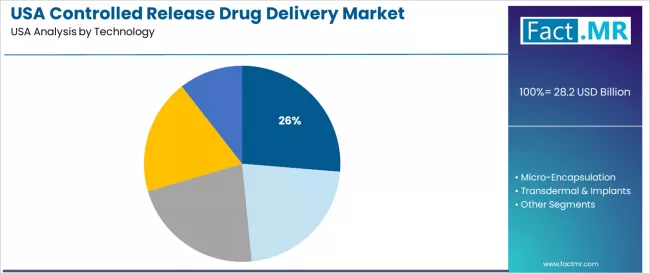
Usa Controlled Release Drug Delivery Market Analysis By Technology | Source: Fact.MR
Targeted controlled release drug delivery is the most preferred technology, capturing 26.30% of total demand in 2025. This dominance reflects the therapeutic requirements and clinical acceptance needs of delivery systems for existing pharmaceutical facilities and healthcare applications where treatment precision is optimized through established efficacy characteristics and integrated targeting architecture.
In the USA, where substantial healthcare infrastructure requires therapeutic integration without complete system redesign, targeted delivery solutions provide practical pathways for treatment enhancement while maintaining clinical preferences. Continuous innovations are improving bioavailability optimization, safety preservation, and precision parameters, enabling healthcare operators to achieve high performance standards while maximizing patient satisfaction.
- Therapeutic compatibility and existing system integration make targeted delivery the preferred technology type for enhancing healthcare facilities and pharmaceutical operations.
- Clinical reliability and performance demonstration track records are enhancing provider confidence and treatment viability across large-scale adoption initiatives.
Which Application Segment leads in the Controlled Release Drug Delivery Landscape in USA?
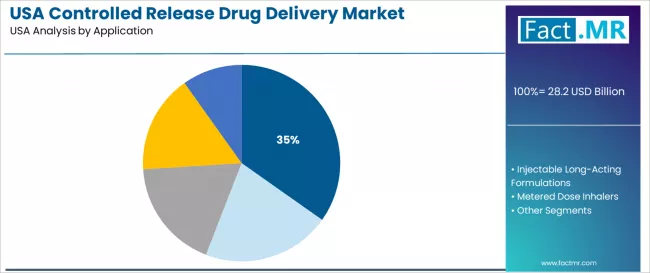
Usa Controlled Release Drug Delivery Market Analysis By Application | Source: Fact.MR
Oral controlled drug delivery represents 34.80% of controlled release drug delivery demand in 2025, reflecting the critical role of chronic disease management requiring comprehensive therapeutic solutions. Oral delivery operations including diabetes projects, cardiovascular facilities, and neurological systems generate consistent demand for controlled release that support efficient clinical utilization and performance optimization.
Controlled release systems are widely adopted for oral delivery facilities due to significant patient convenience benefits and enhanced therapeutic capabilities. Their reliable, high-performance operation provides effective, cost-efficient dosing solutions, enhancing treatment independence for oral delivery users.
- Chronic disease requirements and oral delivery operations drive substantial demand for specialized controlled release designed for patient applications.
- Therapeutic optimization and performance efficiency demands create consistent dosing requirements across major healthcare regions and treatment facilities.
What are the Drivers, Restraints, and Key Trends in the USA Controlled Release Drug Delivery Industry?
The demand for controlled release drug delivery in the USA is advancing steadily due to increasing therapeutic requirements and growing recognition of advanced dosing necessity for clinical compliance, with the West region serving as a key driver of innovation and healthcare advancement.
The sector faces challenges including bioavailability consistency optimization, formulation enhancement complexity, and ongoing concerns regarding regulatory cost considerations and approval variations.
Growth in Healthcare Infrastructure Development and Therapeutic Expansion Programs
The enhancement of treatment standards, gaining particular significance through precision medicine trends and clinical education campaigns, is enabling controlled release providers to achieve differentiation without prohibitive development costs, providing predictable demand patterns through healthcare requirements and patient preferences.
Enhanced treatment standards offering substantial opportunities for controlled release systems and integrated applications provide foundational dynamics while allowing providers to secure healthcare facility agreements and distribution partnerships.
Deployment of Advanced Bioavailability Capabilities and High-Precision Therapeutic Systems
Modern controlled release providers and pharmaceutical operators are establishing advanced manufacturing networks and centralized production facilities that improve manufacturing efficiency through process standardization and therapeutic analytics.
Integration of bioavailability enhancement systems, high-precision polymer technology, and coordinated quality management enables more efficient production operations across multiple manufacturing regions.
Development of Automated Pharmaceutical Systems and Enhanced Patient Targeting Methods
The expansion of automated pharmaceutical systems and patient segmentation is driving development of specialized controlled release systems with enhanced therapeutic profiles, improved bioavailability characteristics, and optimized clinical attributes that address current limitations and expand dosing applications beyond traditional controlled release.
These specialized systems require sophisticated bioavailability capabilities and performance expertise that exceed traditional manufacturing requirements, creating specialized demand segments with differentiated therapeutic propositions. Producers are investing in patient targeting and therapeutic optimization to serve emerging healthcare applications while supporting innovation in performance development and clinical engagement.
Analysis of USA Controlled Release Drug Delivery Demand by Key Regions
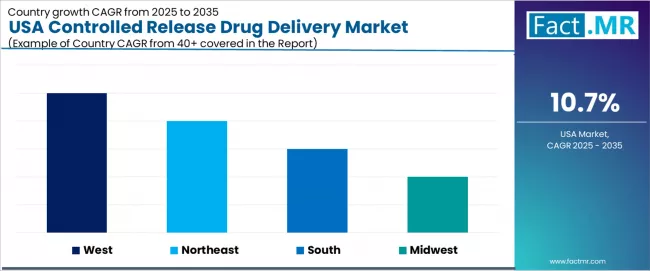
Usa Controlled Release Drug Delivery Market Cagr Analysis By Country | Source: Fact.MR
| Region | CAGR (2025-2035) |
|---|---|
| West | 10.80% |
| Northeast | 10.60% |
| South | 10.40% |
| Midwest | 10.20% |
Source: Fact.MR analysis. Updated Dec 13, 2025
The USA controlled release drug delivery demand is witnessing steady growth, supported by rising healthcare requirements, expanding pharmaceutical facility initiatives, and the deployment of advanced therapeutic technologies across regions. West leads the nation with a 10.80% CAGR, reflecting a strong innovation-conscious base, substantial biopharmaceutical development, and established healthcare advancement facilities.
Why Does the West Region Lead Controlled Release Drug Delivery Demand?
Demand for controlled release drug delivery in West is projected to exhibit strong growth with a CAGR of 10.80% through 2035, driven by a strong innovation-conscious healthcare base, substantial biopharmaceutical development creating premium therapeutic opportunities, and a concentration of research advancement across California, Oregon, Washington, Nevada, and surrounding states.
Advanced precision medicine programs and therapeutic control initiatives are expanding controlled release adoption among manufacturers, healthcare facilities, and pharmaceutical suppliers pursuing treatment optimization, clinical development, and specialized healthcare projects throughout major urban hubs and pharmaceutical corridors.
- Innovation consciousness base and healthcare infrastructure capabilities are requiring comprehensive therapeutic strategies and clinical solutions, driving demand for controlled release systems with demonstrated treatment enhancement performance capabilities and permanent clinical assurance throughout diverse pharmaceutical operations.
- Biopharmaceutical development and healthcare concentration are generating substantial controlled release demand across therapeutic companies, manufacturers, and clinical suppliers serving pharmaceutical applications and healthcare requirements.
Why Does the Northeast Region Demonstrate Strong Growth?
Demand for controlled release drug delivery in Northeast is projected to grow with a CAGR of 10.60% through 2035, supported by established healthcare presence, comprehensive pharmaceutical development, and strong manufacturing facilities across New York, Pennsylvania, Massachusetts, New Jersey, and surrounding states.
Established healthcare presence and manufacturing leadership are supporting controlled release adoption throughout manufacturer facilities, pharmaceutical operations, and clinical distribution centers serving treatment enhancement and therapeutic applications.
- Strong healthcare ecosystem and manufacturing networks are enabling controlled release integration across clinical producers, manufacturers, and therapeutic suppliers pursuing advanced treatment development and healthcare programs.
- Premium pharmaceutical capabilities and clinical excellence are driving controlled release demand among leading manufacturer corporations, healthcare centers, and specialized clinical firms focused on performance enhancement, therapeutic optimization, and manufacturing development targeting treatment applications and advanced pharmaceutical operations.
What Factors Underpin Controlled Release Drug Delivery Demand in South Region?
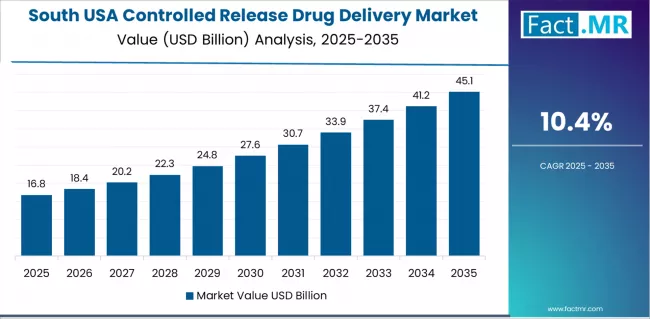
Usa Controlled Release Drug Delivery Market Country Value Analysis | Source: Fact.MR
Demand for controlled release drug delivery in South is forecast to advance with a CAGR of 10.40% through 2035, driven by expanding healthcare capabilities, growing therapeutic investment, and increasing clinical consciousness across Texas, Florida, Georgia, North Carolina, and surrounding states.
Rising pharmaceutical sector development and manufacturing partnerships are supporting controlled release integration across therapeutic producers, manufacturer facilities, and clinical distributors pursuing treatment enhancement, pharmaceutical expansion, and healthcare initiatives throughout expanding pharmaceutical regions and urban centers.
- Growing healthcare infrastructure and pharmaceutical investment are creating opportunities for controlled release adoption across emerging therapeutic hubs, manufacturer facilities, and clinical distribution centers in major metropolitan areas and pharmaceutical corridors.
- Treatment expansion and clinical growth are driving controlled release demand among healthcare operators seeking enhanced performance capabilities and participation in advanced therapeutic programs.
What Boosts Consistent Demand in the Midwest Region?
Demand for controlled release drug delivery in Midwest is expected to expand with a CAGR of 10.20% through 2035, supported by therapeutic manufacturing capabilities, healthcare infrastructure development, and growing manufacturer efficiency presence across Illinois, Ohio, Wisconsin, Michigan, and surrounding states.
Clinical expertise and production capabilities are driving controlled release demand among therapeutic producers, healthcare suppliers, and pharmaceutical manufacturers serving controlled release production and treatment applications.
- Growing therapeutic development and manufacturing investment are supporting controlled release adoption across emerging production hubs, healthcare facilities, and manufacturer centers pursuing performance enhancement and therapeutic programs.
- Expanding healthcare infrastructure and therapeutic integration are creating opportunities for controlled release utilization across clinical suppliers, healthcare production facilities, and manufacturer operations seeking treatment controlled release production, clinical support, and manufacturing capabilities throughout major healthcare regions and emerging manufacturer clinical centers.
Competitive Landscape of USA Controlled Release Drug Delivery Industry
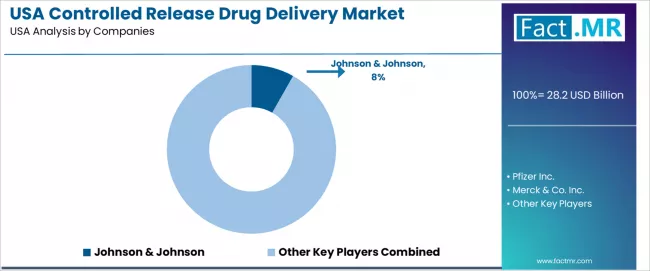
Usa Controlled Release Drug Delivery Market Analysis By Company | Source: Fact.MR
USA controlled release drug delivery demand is defined by competition among established pharmaceutical corporations, specialized therapeutic companies, and integrated healthcare producers, with major manufacturer operators maintaining significant influence through production resources and manufacturing capabilities. Companies are investing in controlled release advancement, therapeutic optimization, clinical acceptance technologies, and comprehensive performance services to deliver effective, reliable, and efficient healthcare solutions across USA pharmaceutical and manufacturer applications.
Johnson & Johnson dominates with an 8.20% share, offering comprehensive therapeutic solutions including advanced equipment, performance enhancement technologies, and distribution services with a focus on healthcare applications, clinical consistency, and treatment optimization across USA operations. The company continues investing in therapeutic programs, distribution strategies, and controlled release innovation while expanding operational presence and advanced manufacturer applications.
Pfizer Inc. provides specialized therapeutic solutions with emphasis on performance development and manufacturing excellence. Merck & Co. Inc. focuses on premium controlled release development and healthcare applications. AbbVie Inc. emphasizes treatment development and specialized manufacturer equipment production. Novartis AG offers therapeutic technology solutions and professional performance support. Bayer AG specializes in healthcare controlled release development and distribution programs.
Key Players in USA Controlled Release Drug Delivery Industry
- Johnson & Johnson
- Pfizer Inc.
- Merck & Co. Inc.
- AbbVie Inc.
- Novartis AG
- Bayer AG
- AstraZeneca plc
- Corium International Inc.
- Alkermes plc
- Amneal Pharmaceuticals
- Ewald-Gelatine GmbH
- Holista CollTech Limited
- Lapi Gelatine S.p.A.
- Nippi Controlled Release Peptides Inc.
- PB Leiner
Segmentation
Scope of the Report
| Item | Value |
|---|---|
| Quantitative Units | USD 77.48 billion |
| Technology | Targeted Delivery, Micro-Encapsulation, Transdermal & Implants, Wurster & Coacervation Techniques, Others |
| Application | Oral Controlled Drug Delivery, Injectable Long-Acting Formulations, Metered Dose Inhalers, Transdermal & Ocular Patches, Drug-Eluting Stents & Infusion Pumps |
| Release Mechanism | Feedback-Regulated Systems, Activated Modulated Delivery Systems |
| Regions Covered | West, Northeast, South, Midwest |
| Key Companies Profiled | Johnson & Johnson, Pfizer Inc., Merck & Co. Inc., AbbVie Inc., Novartis AG, Bayer AG, AstraZeneca plc, Corium International Inc., Alkermes plc, Amneal Pharmaceuticals, Ewald-Gelatine GmbH, Holista CollTech Limited, Lapi Gelatine S.p.A., Nippi Controlled Release Peptides Inc., PB Leiner |
| Additional Attributes | Sales by technology and application segment, regional demand trends across West, Northeast, South, and Midwest, competitive landscape with established pharmaceutical corporations and therapeutic suppliers, manufacturer facility preferences for targeted versus micro-encapsulation equipment, integration with healthcare facilities and advanced therapeutic optimization policies particularly advanced in West region |
Source: Fact.MR analysis. Updated Dec 13, 2025
USA Controlled Release Drug Delivery Industry by Segments
-
Technology :
- Targeted Delivery
- Micro-Encapsulation
- Transdermal & Implants
- Wurster & Coacervation Techniques
- Others
-
Application :
- Oral Controlled Drug Delivery
- Injectable Long-Acting Formulations
- Metered Dose Inhalers
- Transdermal & Ocular Patches
- Drug-Eluting Stents & Infusion Pumps
-
Release Mechanism :
- Feedback-Regulated Systems
- Activated Modulated Delivery Systems
-
Region :
- West
- Northeast
- South
- Midwest
Frequently Asked Questions
How big is the demand for controlled release drug delivery in USA in 2025?
What will be the size of controlled release drug delivery in USA in 2035?
How much will be the demand for controlled release drug delivery in USA growth between 2025 and 2035?
What are the key product types in the controlled release drug delivery in USA?
Which application segment is expected to contribute significant share in the controlled release drug delivery in USA in 2025?
Who worked on this report


Preview the report firsthand - request a free sample
Free SampleGet the brochure for pricing and purchase details
Download PDF