- Base Value(2025): 8.4 Bn
- Estimated Value(2025): 8.4 Bn
- Forecast Value (2035): 12.9 Bn
- CAGR (2025 - 2035): 4.4%
Demand for Liquid Dietary Supplements in US 2025 to 2035
The liquid dietary supplements industry in the United States is projected to grow from USD 8.4 billion in 2025 to approximately USD 12.9 billion by 2035, expanding at a compound annual growth rate (CAGR) of 4.4% between 2025 and 2035. Growth is propelled by an accelerating consumer shift towards convenient, bioavailable nutrition and a deepening focus on personalized, preventive health management. The market is further energized by advanced delivery format innovation and the expansion of direct to consumer digital brands that cater to specific wellness niches.
Despite a mature supplements landscape, the liquid segment is capturing disproportionate growth by addressing key consumer demands for rapid absorption, dosage flexibility, and ease of ingestion for children and older adults. Brands are investing in clinical substantiation, clean label formulations, and sophisticated flavor technology to enhance palatability without compromising on ingredient purity, with digitally native brands in the West and North leading market innovation. <
Quick Stats for US Liquid Dietary Supplements Industry
- US Liquid Dietary Supplements Sales Value (2025): USD 8.4 billion
- US Liquid Dietary Supplements Forecast Value (2035): USD 12.9 billion
- US Liquid Dietary Supplements Forecast CAGR: 4.4%
- Leading Product Type: Vitamins & Minerals (42.3%)
- Leading Distribution Channel: Online Retail (46.8%)
- Key Growth Regions: West, Southwest, North, Midwest
- Regional Leadership: The West holds a leading position in value demand
- Key Players in US Liquid Dietary Supplements Industry: Nestlé Health Science, Procter & Gamble (New Chapter, Metamucil), The Bountiful Company (Nature's Bounty, Puritan's Pride), Unilever (Olly, SmartyPants Vitamins), Bayer (One A Day, Flintstones), NOW Foods, Garden of Life, Herbalife Nutrition, Liquid Health, Inc., Vital Proteins.
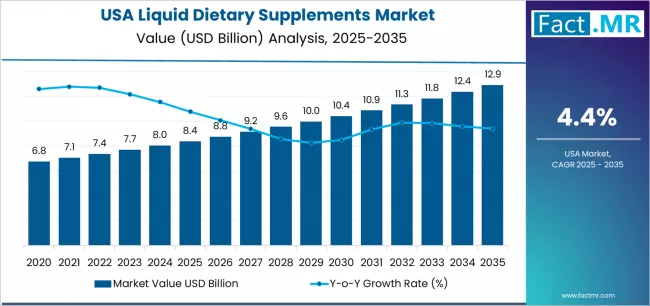
Usa Liquid Dietary Supplements Market Market Value Analysis | Source: Fact.MR
The vitamins & minerals segment is projected to account for 42.3% of market demand by value in 2025. This foundational category remains dominant due to widespread consumer familiarity, persistent nutrient gaps identified in national health surveys, and the versatility of liquid multivitamins for family use. Its position is reinforced by consistent recommendation from healthcare professionals and its role as an entry point for new supplement users seeking bioavailability benefits.
The online retail channel is expected to hold 46.8% of market demand in 2025. Demand is driven by the channel's strength in facilitating detailed product education, enabling subscription models for consistent replenishment, and providing access to a vast array of niche and innovative brands. This segment's growth is accelerated by brands that leverage content marketing and community building to establish trust and authority directly with consumers.
From 2030 to 2035, demand is forecast to grow from USD 10.5 billion to USD 12.9 billion, adding USD 2.4 billion. This latter period will be characterized by the integration of liquid supplements with digital health platforms, enabling dose personalization based on biometric feedback. The mainstreaming of nootropic and adaptogen blends for cognitive and stress support will gain significant traction. Sustainability will become a core purchase driver, influencing everything from ingredient sourcing to the development of reusable and refillable packaging systems, particularly among environmentally conscious consumers in the West and North.
The US liquid dietary supplements industry is experiencing dynamic, consumer led growth primarily due to the convergence of scientific interest in nutrient delivery and the demand for holistic, integrated wellness solutions. The market's emphasis on efficacy, transparency, and ethical sourcing necessitates ongoing investment in advanced formulation science and sustainable supply chain practices to meet the sophisticated expectations of the American consumer.
US Liquid Dietary Supplements Industry Key Takeaways
| Metric | Value |
|---|---|
| US Liquid Dietary Supplements Sales Value (2025) | USD 8.4 billion |
| US Liquid Dietary Supplements Forecast Value (2035) | USD 12.9 billion |
| US Liquid Dietary Supplements Forecast CAGR (2025-2035) | 4.40% |
Source: Fact.MR analysis. Updated Dec 3, 2025
Why is the US Liquid Dietary Supplements Industry Growing?
American consumers and healthcare providers are increasingly prioritizing liquid dietary supplements for their perceived superior bioavailability, dosing precision, and ease of integration into daily routines. Evolving wellness paradigms demand solutions that are both highly effective and highly convenient, driving innovation in targeted formulations for sleep, energy, immune function, and gut health that go beyond basic nutrition.
Brands and manufacturers are emphasizing pharmaceutical grade sourcing, third party testing for potency and purity, and compelling brand narratives rooted in science to build credibility. The regulatory environment, governed by the FDA under the Dietary Supplement Health and Education Act (DSHEA), requires careful navigation of structure/function claims and New Dietary Ingredient (NDI) notifications. Leading brands are differentiating through robust self-regulation, investing in clinical research to substantiate benefits and ensure alignment with FDA guidance, thereby building deeper trust in a market sensitive to quality concerns.
Segmental Analysis
The US liquid dietary supplements market is segmented by product type, distribution channel, and consumer demographic to provide a granular understanding of its diverse demand drivers and competitive dynamics. This segmentation is essential for analyzing the divergent growth trajectories between mass-market foundational nutrition and specialized, condition-specific wellness solutions. The shift towards personalized health and proactive wellness management disproportionately benefits the herbal/botanical and specialty nutrient segments, while persistent nutrient gaps and demographic needs sustain the high-volume vitamins & minerals category.
The distribution channel split reveals the evolving path-to-purchase, where online retail facilitates discovery and subscription for innovative brands, while brick-and-mortar channels retain trust and immediacy for staple products. Understanding these segments is crucial for brands to allocate R&D resources, tailor marketing messages, and optimize their omnichannel presence effectively.
Why do Vitamins & Minerals Maintain a Foundational Market Share?
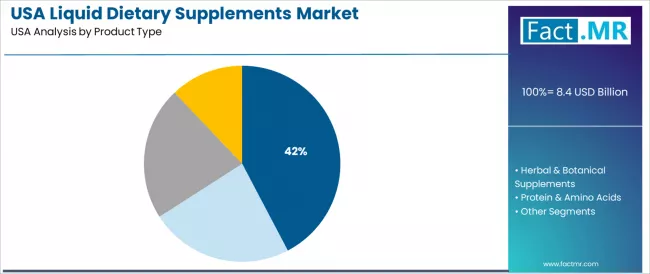
Usa Liquid Dietary Supplements Market Analysis By Product Type | Source: Fact.MR
The vitamins & minerals segment commands a 42.3% share, serving as the essential cornerstone of the industry. Its dominance is underpinned by universal recognition, alignment with public health guidelines (e.g., Vitamin D, prenatal nutrients), and the format's suitability for all age groups.
Continuous innovation focuses on enhancing mineral chelation for better absorption, creating tailored blends for life stages (e.g., senior multivitamins), and eliminating unnecessary additives to meet clean label demands. The segment's stability provides the volume base that supports retail shelf presence and fuels cross selling into more specialized product categories.
Why is the Online Channel the Engine for Growth and Innovation?
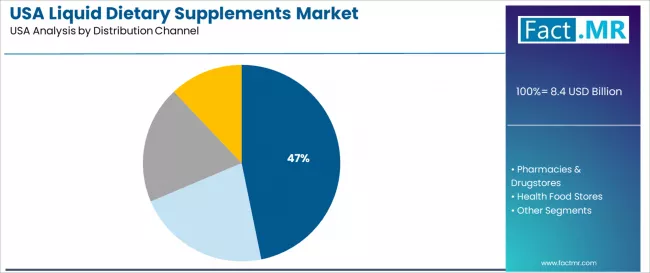
Usa Liquid Dietary Supplements Market Analysis By Distribution Channel | Source: Fact.MR
The online retail channel's 46.8% share highlights its role as the primary growth vector. It excels by offering an unlimited aisle for product discovery, detailed educational content, and authentic user reviews that are critical for high consideration purchases.
This channel is the launchpad for digitally native vertical brands (DNVBs) that use data driven marketing, subscription models, and direct consumer relationships to rapidly scale. It also caters to consumers seeking specific dietary protocols (e.g., keto friendly, allergen free) or professional grade brands not widely available in physical stores, making it indispensable for both mass market and niche growth.
What are the Drivers, Restraints, and Key Trends in the Liquid Dietary Supplements Industry in US?
The Personalized Nutrition Revolution
The movement towards hyper personalized health, fueled by at home testing kits, wearable device data, and genetic insights, is a powerful driver for liquid supplements. The liquid format's dose flexibility makes it ideal for tailored regimens.
Companies are developing algorithms and services that recommend specific liquid formulas based on individual biomarker profiles, transforming supplements from a generic product into a customized wellness solution and creating strong customer loyalty.
Aging Demographic and Focus on Healthy Longevity
The large and growing population of aging Baby Boomers and Gen Xers is proactively seeking products to support mobility, cognitive function, and overall vitality. Liquid formats are preferred for their ease of swallowing and rapid absorption. This demographic driver fuels demand for targeted solutions in joint health (glucosamine/MSM blends), cardiovascular support (omega 3s, CoQ10), and cognitive function, supporting premium pricing and subscription model adherence.
Regulatory Ambiguity and Consumer Skepticism
Operating under DSHEA creates a landscape where the FDA primarily acts post market. This has historically led to issues with product quality and exaggerated claims, fostering lingering consumer skepticism.
The burden of proof for safety and labeling compliance lies heavily with manufacturers, and navigating NDI notifications or defending structure/function claims requires significant legal and scientific resources, posing a high barrier for smaller, innovative companies.
Supply Chain Complexity and Ingredient Integrity
Sourcing high quality, bioavailable forms of nutrients (e.g., methylated B vitamins, specific mineral chelates) and stabilizing them in a liquid matrix without preservatives is technically challenging and costly.
Ensuring ingredient integrity from source to shelf requires rigorous supply chain controls and advanced manufacturing processes. Fluctuations in the cost and availability of raw materials can squeeze margins and disrupt production, especially for brands competing on transparency and purity.
The Functional Beverage and Shot Convergence
The boundary between liquid supplements and functional beverages is dissolving. The market is seeing rapid growth in ready to drink wellness shots (e.g., for immunity, energy, sleep) and enhanced waters that deliver supplemental doses of vitamins, adaptogens, or nootropics.
This trend leverages the convenience and sensory appeal of beverages to drive daily adherence, positioning supplementation as a lifestyle habit rather than a clinical routine and opening new channels like coffee shops and gyms.
Analysis of US Liquid Dietary Supplements Industry by Key Regions
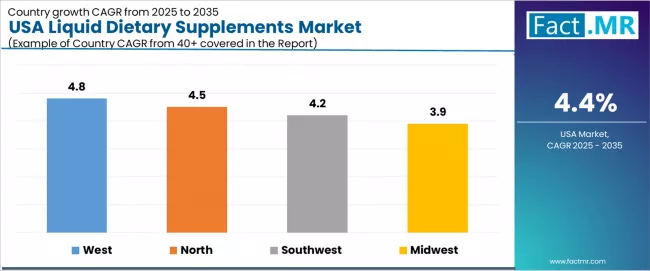
Usa Liquid Dietary Supplements Market Cagr Analysis By Country | Source: Fact.MR
| Region | CAGR (2025 to 2035) |
|---|---|
| West | 4.80% |
| North | 4.50% |
| Southwest | 4.20% |
| Midwest | 3.90% |
Source: Fact.MR analysis. Updated Dec 3, 2025
The US liquid dietary supplements market exhibits pronounced regional variations in growth rates, consumer preferences, and primary sales channels, shaped by disparate demographic profiles, cultural attitudes toward health, and economic factors. A regional analysis reveals that growth is not uniform but is instead catalyzed by specific, locally relevant drivers. The West leads as a trendsetter, characterized by early adoption and high value on innovation and sustainability.
The North follows closely, driven by a blend of high disposable income, professional healthcare engagement, and urban lifestyle demands. The Southwest shows robust growth fueled by demographic vitality and an active culture, while the Midwest represents a stable, value-oriented bastion of foundational supplement use. Understanding these geographic nuances is critical for manufacturers to tailor product development, marketing campaigns, and distribution strategies for maximum impact and penetration.
What Strategic Advantages Position the West as the Leading Growth Region?
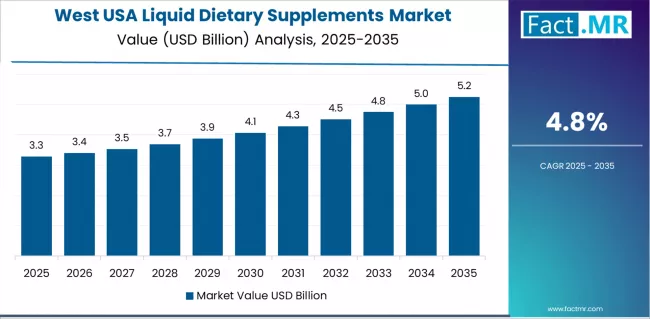
Usa Liquid Dietary Supplements Market Country Value Analysis | Source: Fact.MR
The West, with a leading CAGR of 4.8%, acts as the nation's primary trendsetter for wellness. High health consciousness, environmental values, and a concentration of tech-savvy consumers drive early adoption of innovative, clean-label, and sustainably packaged liquid supplements. The presence of Silicon Valley fosters the growth of tech-enabled personalized nutrition startups. This region demands transparency, scientific backing, and brand missions aligned with holistic and alternative health philosophies, setting standards that influence national brand strategies.
Consumer behavior in the West is heavily influenced by integrative health practitioners and a strong yoga/wellness community, which often recommend specific herbal tinctures and high-potency nutrient blends. The preference for liquid formats is high due to an appreciation for their perceived purity and rapid systemic integration. Brands successful in the West often lead with their sourcing story highlighting organic, wild-crafted, or regeneratively farmed ingredients and invest in packaging that is both functional and environmentally benign, such as glass bottles with minimal labels or refill systems.
How does the North's Affluent and Fast-Paced Culture Fuel its Market?
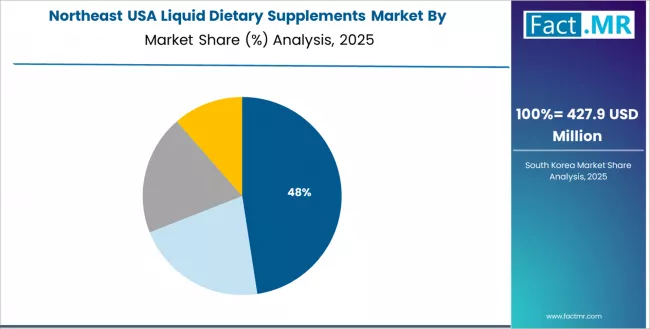
Usa Liquid Dietary Supplements Market Northeast Market Share Analysis By Distribution Channel | Source: Fact.MR
The North, with a CAGR of 4.5%, is characterized by high disposable income, a fast-paced urban lifestyle, and a strong culture of professional healthcare engagement. This drives demand for premium, clinically substantiated products and convenient formats like daily wellness shots that integrate seamlessly into busy routines. Consumers here are highly educated on health trends and respond to brands that leverage cutting-edge nutritional science, such as liposomal delivery systems or patented botanical extracts.
Major metropolitan hubs like New York and Boston are centers for functional medicine, creating a B2B channel where premium liquid supplements are recommended by practitioners. The retail landscape is sophisticated, with a mix of high-end health food stores, premium grocery aisles, and thriving online subscription services. Demand skews towards performance-oriented products nootropics for cognitive focus, advanced protein blends for fitness recovery, and adaptogens for stress resilience reflecting the region’s achievement-oriented culture.
How do Demographic and Lifestyle Trends Propel the Southwest?
The Southwest is forecast to grow at 4.2%, influenced by its large and growing Hispanic population, a climate conducive to outdoor activity, and a cultural emphasis on family wellness. This region fuels demand for immune support formulas (like elderberry and zinc), energy-enhancing products for active lifestyles, and supplements that incorporate traditional herbal knowledge (e.g., moringa, prickly pear) in palatable, modern liquid formats. Family-sized liquid multivitamins and children's supplements see particularly strong sales.
The retail environment is diverse, with strong penetration from mass merchandisers serving large families, alongside growing specialty and online channels. Marketing that resonates in the Southwest often features vibrant, family-centric messaging and emphasizes natural, "abuelita-approved" ingredients. Furthermore, the region's significant senior population, particularly in areas like Arizona, sustains steady demand for liquid joint health formulas, digestive enzymes, and comprehensive senior multivitamins, making it a key market for age-specific solutions.
What Factors Underpin Steady Demand in the Midwest?
The Midwest demonstrates steady growth at a CAGR of 3.9%, anchored in a practical, value-oriented consumer base with strong trust in established retail brands and healthcare professional recommendations. Demand is robust for foundational family vitamins, trusted herbal remedies in liquid form (e.g., elderberry, echinacea), and products purchased through mainstream brick-and-mortar retailers like mass merchandisers and club stores. Growth is driven by a focus on efficacy and value, with slower but steady adoption of newer functional trends compared to coastal regions.
Consumer loyalty in the Midwest is high for brands that have a long-standing reputation for quality and are readily available at local pharmacies or Walmart. Marketing that emphasizes "doctor-recommended" or "pharmacist-formulated" carries significant weight. While online sales are growing, in-person shopping at trusted retailers remains a primary purchasing method. The demand profile is less about trendy superfoods and more about reliable products that address common, well-understood health concerns like seasonal immune support, digestive health, and basic nutritional gaps, supporting consistent, recession-resilient volume.
Competitive Landscape and Recommendations for Market Players
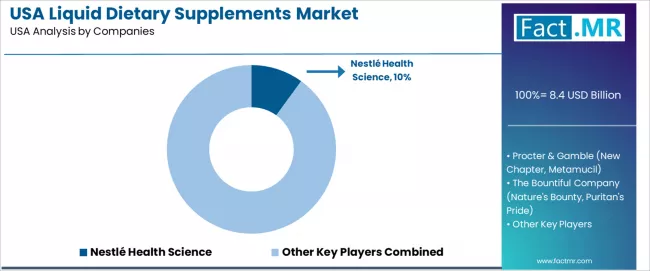
Usa Liquid Dietary Supplements Market Analysis By Company | Source: Fact.MR
The USA liquid dietary supplements landscape is fiercely competitive and fragmented, defined by the scale and resources of global CPG and pharmaceutical giants, the agility and digital mastery of direct-to-consumer (DTC) native brands, and the increasing quality and market share of retailer private labels. Competition centers on several core battlegrounds: scientific credibility and claim substantiation, ownership of specific health benefit platforms (e.g., sleep, gut health), supply chain integrity and transparency, and mastery of the omnichannel consumer journey. The market is undergoing a significant shift where brand loyalty is increasingly earned through authentic storytelling, demonstrable efficacy, and shared values around sustainability, rather than through traditional mass-media advertising alone.
Large incumbents like Nestlé Health Science and Procter & Gamble compete through vast R&D resources, extensive clinical trial capabilities, and dominant shelf space in mass retail and pharmacy channels. Their strategy often involves portfolio diversification maintaining mass-market brands while acquiring innovative smaller players (e.g., Nestlé's acquisition of Pure Encapsulations, P&G's purchase of New Chapter) to capture growing premium and practitioner segments. Conversely, agile DTC brands like those under Unilever's Olly or independent players like Liquid Health compete by building deep, direct relationships with consumers. They leverage social media and content marketing to educate and engage, use subscription models to ensure loyalty, and rapidly iterate products based on real-time customer feedback.
A critical and growing competitive force is the retailer private label, offered by chains like Costco (Kirkland Signature), Amazon (Solimo), and CVS Health. These lines compete aggressively on price, mimic popular innovations quickly, and benefit from inherent consumer trust in the retailer itself. Their improving quality and strategic placement force branded manufacturers to continuously prove their added value.
The competitive landscape is being reshaped by convergence from adjacent categories. Beverage companies are launching functional shots; food brands are introducing supplement lines. This blurring of lines creates new competitive sets and forces traditional supplement players to defend their turf by enhancing the experiential and sensory aspects of their liquid products.
Recommendations for Market Players
- Invest in Proprietary Research and High Velocity Clinical Validation: To transcend marketing noise and build defensible brand equity, companies must invest directly in clinical trials or partnerships with accredited research institutions. Focus on studies that demonstrate the superior bioavailability of liquid formats or the specific efficacy of proprietary blends. Publishing findings in peer reviewed journals and communicating results transparently to consumers will create a significant competitive moat and justify premium positioning, especially in skeptical or highly educated market segments.
- Develop an Agile, Omnichannel Commercial Strategy with DTC at the Core: A winning strategy requires a channel specific approach. Use the direct to consumer (DTC) channel not just for sales, but as a primary source of consumer insight, a testing ground for innovation, and a platform for community building. Simultaneously, tailor product formats, pack sizes, and marketing messaging for brick and mortar partners, from mass retailers to specialty health stores. Leverage DTC data to de risk product launches and prove demand before scaling into physical retail.
- Pioneer Sustainable and User Centric Packaging Innovation: Environmental impact is a growing purchase determinant. Lead the market by investing in packaging solutions that reduce plastic use, such as recyclable aluminum bottles, glass with recycled content, or reusable container systems with refill pouches. Simultaneously, enhance user experience with features like precision droppers, single dose sealed shots, and tamper evident designs. Solving the sustainability and convenience equation will become a major brand differentiator.
- Forge Strategic Partnerships with Healthcare Practitioners and Platforms: Build credibility and drive adoption by establishing legitimate partnerships with integrative doctors, dietitians, chiropractors, and telehealth platforms. Develop professional grade lines with accompanying educational materials for practitioners. Furthermore, integrate with digital health and wellness platforms (e.g., fitness apps, wearables) to become the recommended supplement solution within a larger ecosystem, capturing customers at the point of health decision making.
- Implement Vertical Integration and Blockchain for Supply Chain Transparency: Given intense scrutiny on ingredient purity and sourcing, forward integrate into key raw material production or form exclusive, long term partnerships with certified suppliers. Implement blockchain or other traceability technologies to provide consumers with a verifiable journey from source to bottle. This level of transparency mitigates risk, ensures consistent quality, and provides a powerful marketing story that addresses core consumer trust issues in the dietary supplement category.
Key Players in US Liquid Dietary Supplements Industry
- Nestlé Health Science
- Procter & Gamble (New Chapter, Metamucil)
- The Bountiful Company (Nature's Bounty, Puritan's Pride)
- Unilever (Olly, SmartyPants Vitamins)
- Bayer (One A Day, Flintstones)
- NOW Foods
- Garden of Life
- Herbalife Nutrition
- Liquid Health, Inc.
- Vital Proteins
- Standard Process
- Gaia Herbs
- Trace Minerals Research
Segmentation
Scope of the Report
| Item | Value / Coverage |
|---|---|
| Quantitative Units | Revenue in USD Billion |
| Market Valuation (2025) | USD 8.4 Billion |
| Market Valuation (2035) | USD 12.9 Billion |
| Forecast Period | 2025 - 2035 |
| Product Type Segmentation | Vitamins & Minerals, Herbal & Botanical, Protein & Amino Acids, Specialty Nutrients |
| Distribution Channel Segmentation | Online Retail, Pharmacies & Drugstores, Health Food Stores, Mass Merchandisers |
| Regions Covered | West, Southwest, North, Midwest |
| Key Companies Profiled | Nestlé Health Science, P&G, Bountiful Co., Unilever, Bayer, NOW Foods, Garden of Life |
| Additional Attributes | Analysis by product type and distribution channel; regional growth dynamics; competitive landscape; impact of personalization and digital health trends; regulatory (DSHEA) environment analysis. |
Source: Fact.MR analysis. Updated Dec 3, 2025
US Liquid Dietary Supplements Industry by Segments
-
Product Type :
- Vitamins & Minerals
- Herbal & Botanical Supplements
- Protein & Amino Acids
- Specialty Nutrient Formulas
-
Distribution Channel :
- Online Retail
- Pharmacies & Drugstores
- Health Food Stores
- Mass Merchandisers
-
Region :
- West
- Southwest
- North
- Midwest
Frequently Asked Questions
How big is the Demand for Liquid Dietary Supplements in US in 2025?
What will be the size of liquid dietary supplements in USA in 2035?
How much will be the Demand for Liquid Dietary Supplements in US growth between 2025 and 2035?
What are the key product types in the liquid dietary supplements in USA?
Which distribution channel segment is expected to contribute significant share in the liquid dietary supplements in USA in 2025?
Who worked on this report


Preview the report firsthand - request a free sample
Free SampleGet the brochure for pricing and purchase details
Download PDF